• 검색 결과가 없습니다.

Purchase Intention Towards Japanese Convenience Goods: A Cross-Sectional Study in Vietnam

N/A
N/A
Protected

Academic year: 2021

Share "Purchase Intention Towards Japanese Convenience Goods: A Cross-Sectional Study in Vietnam"

Copied!
12
0
0

로드 중.... (전체 텍스트 보기)

전체 글

(1)

Print ISSN: 2288-4637 / Online ISSN 2288-4645 doi:10.13106/jafeb.2021.vol8.no10.0165

Purchase Intention Towards Japanese Convenience Goods:

A Cross-Sectional Study in Vietnam

Nga Thi Quynh NGUYEN

1

, Duong Tuan NGUYEN

2

, Quynh Thi Phuc NGUYEN

3

Received: June 15, 2021 Revised: August 29, 2021 Accepted: September 06, 2021

Abstract

The primary purpose of this study is to identify determinants influencing Vietnamese consumers’ purchase intention towards Japanese convenience goods. The research model consisting of six factors affecting the dependent variable is proposed based on the Theory of Consumption Values and Theory of Perceived Value of purchase. This study employs a survey method in a convenient sampling method to collect data of target respondents. Data consisting of 180 samples was collected and analyzed using the SMARPLS3 software.

The measurement model is assessed to confirm the validity and reliability of the construct, then hypotheses testing is performed with Bootstrapping analysis. The results demonstrated that five factors affect Vietnamese consumers’ purchase intention towards Japanese convenience goods, including the price of the product, quality of the product, functional value, emotional value, and conditional value.

Major findings of this study suggest that the functional value that consumer perceives about Japanese convenience goods has the most significant relationship with their purchase intention, followed by the quality of the product and the price of the product. Besides, emotional value and conditional value have a moderate influence on consumers’ purchase intention. Whereas the influence of the epistemic value of the product on consumers’ purchase intention is insignificant in this presented study.

Keywords: Convenience Goods, Japan, Perceived Value, Purchase Intention, Vietnam JEL Classification Code: C38, M30, M31, M37

and territories investing in Vietnam in 2018, accounting for 24.2 percent of total investment capital (Ministry of Planning and Investment, 2019). Besides, the bilateral ties between Vietnam and Japan have been enforced, so a new wave of Japanese investment is expected to hit the country across numerous sectors. Vietnam has been a promising prospect for the investment community with its geographical position near global supply chains, coupled with a fast-growing consumer market. Moreover, the Vietnamese thriving consumer goods sector is an attractive investment destination for traders, as no matter how the economy evolves, the demand for using these products is always indispensable, especially for convenience goods.

Additionally, Vietnam is a highly dynamic market with a relatively young population structure of more than 95 million people. The working-age population constitutes a substantial proportion in which Vietnam’s strong consumer confidence and rising household income levels have contributed to an overall increase in consumer spending (Pham et al., 2019).

Despite not entering the market in large numbers, Japanese firms and consumer goods may nonetheless be competitive in comparison to powerful corporations. More than ever,

1

First Author. Lecturer, Foreign Trade University, Ho Chi Minh City Campus, Vietnam. Email: [email protected]

2

Corresponding Author. [1] Ph.D. Candidate, College of Management, National Sun Yat-sen University, Taiwan [2] Lecturer, Foreign Trade University, Ho Chi Minh City Campus, Vietnam [Postal Address:

No.15, D5 Street, Ward 25, Binh Thanh District, Ho Chi Minh City, 710000, Vietnam] Email: [email protected]

3

Foreign Trade University, Ho Chi Minh City Campus, Vietnam.

Email: [email protected]

© Copyright: The Author(s)

This is an Open Access article distributed under the terms of the Creative Commons Attribution Non-Commercial License (https://creativecommons.org/licenses/by-nc/4.0/) which permits unrestricted non-commercial use, distribution, and reproduction in any medium, provided the original work is properly cited.
1. Introduction

Vietnam has proven to be a desirable investment

destination in the ASEAN region. According to the data

of the Vietnamese Ministry of Planning and Investment,

Japan always ranked among countries having the largest

total investment in Vietnam. With total investment capital

of 8.59 billion USD, Japan ranked first among 112 nations

(2)

Vietnamese consumers are looking for the “Made in Japan”

label when purchasing consumer goods and are willing to pay a premium for these commodities. Japanese products see enormous potential market in Vietnam.

Although the topic of consumer purchase intention has been explored by many researchers, most of the previous works focused on a particular subject in a specific research context such as the influence of brand preference, brand trust on purchase intention (Chae et al., 2020), or purchase intention towards green products (Nguyen et al., 2021; Nguyen et al., 2020), organic products (Nguyen et al., 2019; Pham et al., 2019), and rarely giving an overall picture of convenience goods, in particular. Especially there is scant research on this topic pertaining directly to Vietnamese markets (Pai et al., 2017). In the case of convenience goods, research has previously been conducted on the impact of brand image, promotion activities, and perceived value on consumers’

purchase intentions in convenience stores in general (Pai et al., 2017) or the relationship between brand credibility and purchase intention for convenience goods (Alex & Thomas, 2014). There is a lack of investigation on consumers’ purchase intention toward convenience goods of a specific country.

Therefore, this study investigates consumers’ purchase intention towards Japanese convenience goods with the expectation to provide an empirical study related to the topic. Furthermore, value-oriented approaches to consumer intention and behavior are gradually gaining traction in current marketing definitions (Sánchez-Fernández & Iniesta- Bonillo, 2007; Sánchez et al., 2006). However, the marketing literature that explains value from the consumer perspective is still insufficient (Tanrikulu, 2021). The primary objective of this study is to identify critical factors influencing consumers’

purchase intention towards Japanese convenience goods in Vietnam based on the Theory of Consumption Values and Theory of Perceived Value of purchase.

2. Literature Review

2.1. Purchase Intention Towards Japanese Convenience Goods

Convenience goods are those that the customer purchases frequently, immediately, and with minimum effort.

Convenience goods are those that are frequently consumed and widely distributed at the most convenient and accessible places (Kotler & Armstrong, 2016). These goods are also relatively inexpensive and which the buyer desires to purchase with the minimum of effort, including items such as milk and tobacco products, medicines, laundry detergents, fast food, sugar, gasoline, and magazines. Convenience goods can be further segmented into staple convenience goods (satisfying basic customer needs) and impulse convenience goods (non-priority goods) (Kotler & Armstrong, 2016; Thomas, 2014).

Purchase intention is widely researched in the marketing field and is defined as “the antecedents that stimulate and drive consumers’ purchases of products and services”

(Mothersbaugh et al., 2020). In other words, purchase intention is the possibility that a person performs a specific behavior. Studying consumer purchase intention is considered as one of the most common approaches undertaken by marketers in gaining a deeper understanding of consumers’ actual behavior (Ghalandari & Norouzi, 2012;

Sánchez et al., 2006). Meanwhile, according to Shah et al.

(2012), purchase intention is “a kind of decision-making that studies the reason as to why a consumer might want to buy a particular brand.” Buying is a complicated process and purchase intention is an effective tool to forecast this process (Ajzen, 1991). According to Kotler and Armstrong (2016), an individual’s perceptions and perspectives may influence purchase intention and lead to his/her tentative purchasing behaviors. Besides, Crosno, et al. (2009) indicated the relationship between purchase intention and purchasing behavior towards a specific product category and a certain brand. A number of researchers agreed that the best way to understand consumers’ real behavior is to look into their intentions in different sub-domains and product categories (Ghalandari & Norouzi, 2012; Putra & Harijanto, 2015;

Wu & Chang, 2016). In this study, purchase intention towards Japanese convenience goods is investigated from the perspective of consumers.

2.2. Perceived Value and Purchase Intention

According to Kotler and Armstrong (2016), perceived value is a customer’s own perception of a product or service’s merit or desirability to them, especially in comparison to a competitor’s product. They also indicated that consumers would tend to buy products that bring the highest perceived value to them. Among marketing theories that focused on this aspect, the theory of consumption value (TCV) developed by Sheth et al. (1991) that study the motivation for consumers consumption behavior through their perceived consumption values, remains as an up-to-date theory in the consumer behavior literature that can explain the consumer intention and behavior in buying a specific product (Tanrikulu, 2021).

Besides, Sheth et al. (1991) contend that TCV can be used to investigate consumer intention and behavior towards a wide variety of products including durable and non-durable goods and services. By following this approach, the relationship between consumers’ perceived values and purchase intention has been demonstrated in a number of studies (Andrews et al., 2007; Boonsiritomachai & Sud-On, 2020; Sweeney

& Soutar, 2001). From a different approach, Sánchez

et al. (2006) focused on the aspect of consumer perceived

value and presented a measurement scale of perceived

value (GLOVAL model) consisting of 6 factors including

(3)

Functional value establishment, Functional value personnel, Functional value product, Functional value price, Emotional value, and Social value. According to Sánchez et al.

(2006), this model is both useful and intriguing because it divides value according to consumer needs, but it is also challenging. Subsequently, the functional value (including quality and price value) is considered a key factor influencing consumer choice; emotional value is similarly considered as a guiding element of consumer behavior towards products.

External elements relating to customers’ psychology, as well as components derived from the intrinsic value of the items, are supplemented by the two models indicated above to identify factors impacting consumer intention to purchase (Choe & Kim, 2018; Lee et al., 2011; Sánchez et al., 2006;

Tanrikulu, 2021).

In the present study, a research model is proposed to investigate the determinants affecting the consumers’

purchase intention towards Japanese convenience goods in Vietnam. In this proposed model, two constructs were removed, including distribution channel value (functional establishment value) and social value. The reason for this is because convenience goods, in comparison to durable goods, innovative products, limited goods, or high-end services, cannot reasonably and permanently reflect societal value - which is generally decided according to

“work, education, and income status” (Calvo-Porral &

Lévy-Mangin, 2017; Chae et al., 2020; Kotler & Armstrong, 2016). Furthermore, the epistemic value in the Sheth et al.

(1991) model was included in the proposed model despite the fact that this factor was not mentioned in the Sánchez et al. (2006) model because the epistemic value leads to the experience of novelty towards convenience goods, particularly Japanese products. As previously stated, purchasing products from Japan can provide consumers with new and useful information, and, understandably, Japanese goods have earned a worldwide reputation. Drawing on the above arguments, 6 factors may affect consumers’ purchase intention towards Japanese convenient goods including (1) Price of the product represents perceptions of the consumers in terms of the value of the product in response to the price of Japanese convenient goods. This factor is one of the main competitive factors of the enterprises in the retail industry, contributing significantly to the decision of customers to purchase the goods (Mothersbaugh et al., 2020); (2) Quality of the product reflect consumers perception of the quality of convenient goods in terms of the main criterion, the inspection process, safety and hygiene standards, and durability; (3) Functional value of the product relates to the functional usability of product attributes (mainly physical) and their benefits through performing practical tasks that can fulfill consumers’ utilitarian needs (Sheth et al., 1991); (4) Emotional value of the product is the mental state of consumers when it comes to purchasing decision.

This element can respond to profound human needs such as the need to give and receive sympathy, support, and encouragement (Sánchez et al., 2006; Wu & Chang, 2016);

(5) Conditional value of the product is conveyed through products or services whose value and utility are strongly linked into a specific context; and (6) Epistemic value of the product is characterized as curiosity, novelty, and gaining more knowledge from buying products.

Consequently, it is hypothesized that the six mentioned factors positively influencing the purchase intention of consumers towards Japanese convenience products. In other words, we posit 06 hypotheses as below:

H1: Price of the product positively influences consumers’

purchase intention towards Japanese convenience goods.

H2: Quality of the product positively influences consumers’ purchase intention towards Japanese convenience goods.

H3: Functional value of the product positively influences consumers’ purchase intention towards Japanese convenience goods.

H4: Emotional value of the product positively influences consumers’ purchase intention towards Japanese convenience goods.

H5: Conditional value of the product positively influences consumers’ purchase intention towards Japanese convenience goods.

H6: Epistemic value of the product positively influences consumers’ purchase intention towards Japanese convenience goods.

The proposed research model is presented in Figure 1.

3. Methodology

3.1. Procedure and Sample

To achieve the research objectives, this research employed

a quantitative approach. The preliminary research phase is

conducted with research objectives, theoretical background,

previous relevant studies; then the research model was

proposed, scales of measurement and questionnaire were

designed. The draft questionnaires were prepared in English

and then translated into Vietnamese and pretested. Then, a

pilot study was conducted on consumers who were shopping

at convenience stores. Besides, the author interviewed some

Japanese businesswomen working in Vietnam to explore

their experience in the current situation of the Vietnamese

retail market and consulted their feedbacks to gain more

insights for the survey. These surveys were rewritten

with certain changes to ensure that there was no room

for misinterpretation or unclear phrasing. Upon revising

questionnaires, the formal survey of consumers at several

(4)

shopping malls, convenience stores, and computer-based questionnaires was conducted. A data of 180 samples was collected, including 51 hardcopy questionnaires collected from the direct survey and 129 responses obtained from online survey.

The demographic characteristics of respondents were aggregated in Table 1. In which female respondents accounted for 69.4% and male is only 30.6% of the total samples. This result indicates that female consumers seem to prefer purchasing convenience products to male ones. This gender asymmetry is because women are the ones who often conduct the activities of purchasing necessary commodities for their families. The respondents in the age group of 18–35 years old constitute a large proportion, especially people in the age group of 25–35 years ranked first with 37.8%, followed by 27.8% consumers aged between 18–24 years. Middle-aged consumers constitute nearly 20% and consumers over 65 constitute just 1.7%. Most of the respondents are office employees, composing 28.9%

of the total sample. Undergraduate students ranked second with 26.7%. As analyzed above, office workers at a stable age with family responsibilities are the primary target of Japanese convenience stores; they come to buy what meets their needs on a regular basis. The proportion of consumers whose income is over 15 million VND accounts for 40% and

consumers with average income from 10 to 15 million VND form nearly 35% of samples.

3.2. Measurement

The measurement items of variables were measured by a 5-point Likert scale, a type of psychometric response scale in which responders specify their level of agreement to a statement typically in five points: (1) Strongly disagree;

(2) Disagree; (3) Neither agree nor disagree; (4) Agree;

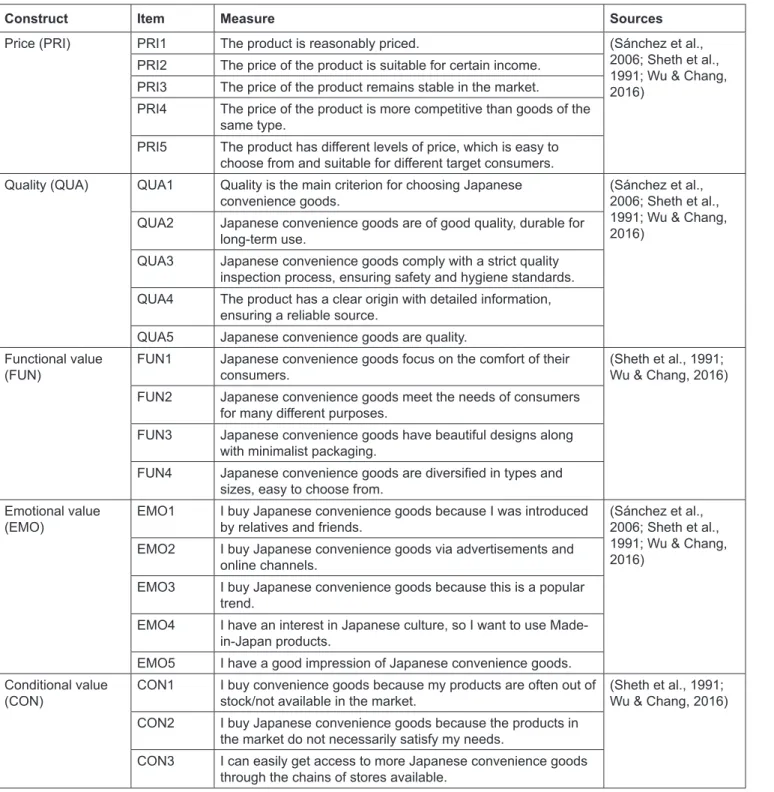
(5) Strongly agree. There are six factors including Price (5 items), Quality (5 items), Functional value (4 items), Emotional value (5 items), Conditional value (3 items), Epistemic value (4 items), and four measurement items for the dependent variable purchase intention. All measurement items in this study are listed in Table 2 below.

3.3. Data Analysis Strategy

Data was inputted and analyzed by using Partial lease

square (SMARPLS 3.0) for assessing both measurement

model and hypothesis testing. This technique has become a

key multivariate analysis technique in business, especially

in the marketing research domain (Hair et al., 2012). This

method is a prediction-oriented approach to SEM that

Figure 1: The Proposed Research Model

(5)

reduces the covariance-based SEM’s demands on data and relationship specification. In particular, is particularly useful for data with a small number of samples and non-normal distributions, which are common challenges in empirical studies in social science that rely on surveys to acquire field data. Besides, PLS-SME can analyze many latent variables with few observed variables (indicators). So, this method is suitable with and increasingly applied in exploratory research in different disciplines (Hair et al., 2012). In the first stage, the measurement model is evaluated using confirmatory factor analysis and the composite reliability score (CR), average variance extracted (EVA) value, and Cronbach’s alpha to ensure the construct’s convergent and discriminant validity. Then the common method bias is also demonstrated by evaluating the VIF values. In the second stage, the hypotheses testing will be performed with the Bootstrapping technique.

4. Results

4.1. The Measurement Model Assessment

The factor loading of all item values and the average variance extracted (AVE) to determine convergent validity are used to assess the measurement’s validity and reliability.

In particular, the factor loading and AVE should be larger than 0.50 (Hair et al., 2017). Three items having factor

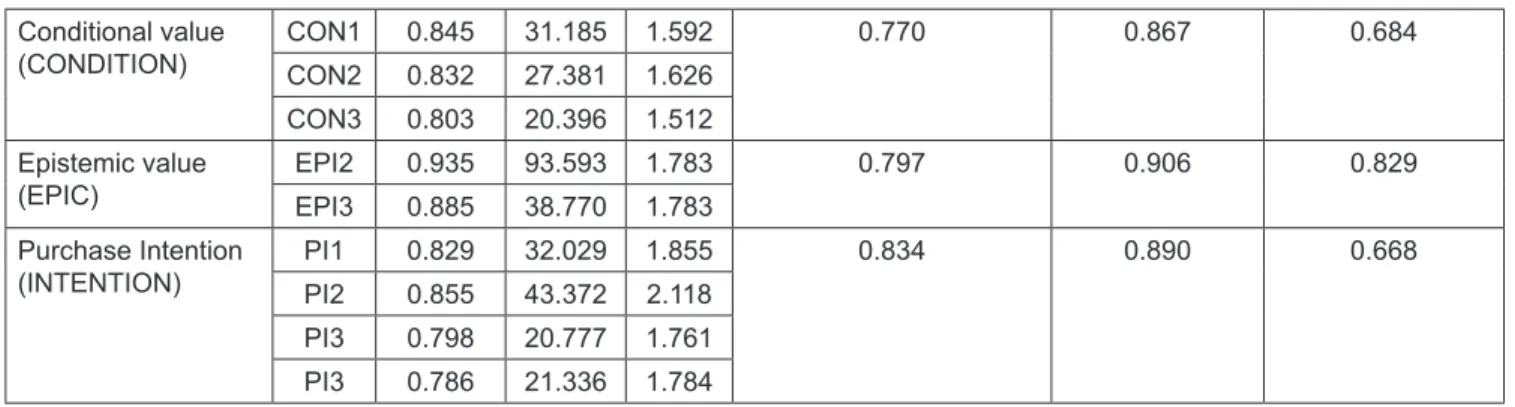
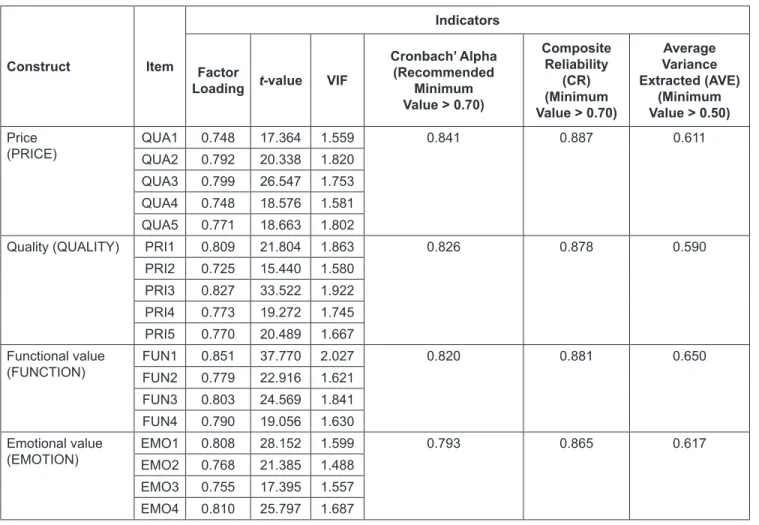
loading values smaller than 0.50 (EMO5, EPI1, and EPI4) were eliminated. Consequently, the value of the criteria of measurement model assessment was improved. The factor loading values of all items were larger than 0.70, and the AVE values were over 0.8 ranging from 0.865 (Emotional value) to 0.906 (Epistemic value). To assess the reliability of the measurement, the Cronbach’s alpha and composite reliability (CR) of the research constructs were performed.

All Cronbach’s alpha values exceeded 0.70 and all CR values exceeded 0.5. Therefore, the convergent validity of the research constructs was satisfied. The result of those indicators is presented in Table 3.

Besides, the discriminant validity of constructs was assessed through the Fornell-Larcker criterion (Fornell &

Larcker, 1981). The square root of the AVE values of each construct is larger than its correlation with other constructs (Hair et al., 2017). In Table 4, the adequate discriminant validity of all constructs is demonstrated.

4.2. Common Method Bias Testing

One of the most common challenges of cross-sectional research is the common method bias. To assess the common method bias of this study, a full collinearity assessment approach was applied, and the VIF values of all factors are lower than 3.3 (Table 3). Besides, Harman’s one-factor test and EFA analysis were performed, and the EFA result showed Table 1: Respondents’ Profile and Characteristics

Variable Categories Frequency Percentage

Age Under 18 27 15.0%

From 18–24 50 27.8%

From 25–35 68 37.8%

From 36–65 32 17.8%

Over 65 3 1.7%

Gender Male 55 30.6%

Female 125 69.4%

Occupation High School Student 27 15.0%

Undergraduate 48 26.7%

Office worker 52 28.9%

Manager 35 19.4%

Housewife 18 10.0%

Monthly income (million VND)

01 USD = 23,000 VND

Under 5 13 7.2%

From 5–10 38 21.1%

From 10–15 87 48.3%

Over 15 42 23.3%

(6)

Table 2: Measurement Items

Construct Item Measure Sources

Price (PRI) PRI1 The product is reasonably priced. (Sánchez et al.,

2006; Sheth et al., 1991; Wu & Chang, 2016)

PRI2 The price of the product is suitable for certain income.

PRI3 The price of the product remains stable in the market.

PRI4 The price of the product is more competitive than goods of the same type.

PRI5 The product has different levels of price, which is easy to choose from and suitable for different target consumers.

Quality (QUA) QUA1 Quality is the main criterion for choosing Japanese

convenience goods. (Sánchez et al.,

2006; Sheth et al., 1991; Wu & Chang, 2016)

QUA2 Japanese convenience goods are of good quality, durable for long-term use.

QUA3 Japanese convenience goods comply with a strict quality inspection process, ensuring safety and hygiene standards.

QUA4 The product has a clear origin with detailed information, ensuring a reliable source.

QUA5 Japanese convenience goods are quality.

Functional value

(FUN) FUN1 Japanese convenience goods focus on the comfort of their

consumers. (Sheth et al., 1991;

Wu & Chang, 2016) FUN2 Japanese convenience goods meet the needs of consumers

for many different purposes.

FUN3 Japanese convenience goods have beautiful designs along with minimalist packaging.

FUN4 Japanese convenience goods are diversified in types and sizes, easy to choose from.

Emotional value

(EMO) EMO1 I buy Japanese convenience goods because I was introduced

by relatives and friends. (Sánchez et al.,

2006; Sheth et al., 1991; Wu & Chang, 2016)

EMO2 I buy Japanese convenience goods via advertisements and online channels.

EMO3 I buy Japanese convenience goods because this is a popular trend.

EMO4 I have an interest in Japanese culture, so I want to use Made- in-Japan products.

EMO5 I have a good impression of Japanese convenience goods.

Conditional value

(CON) CON1 I buy convenience goods because my products are often out of

stock/not available in the market. (Sheth et al., 1991;

Wu & Chang, 2016) CON2 I buy Japanese convenience goods because the products in

the market do not necessarily satisfy my needs.

CON3 I can easily get access to more Japanese convenience goods

through the chains of stores available.

(7)

Table 2: (Continued) Epistemic value

(EPI) EPI1 Japanese convenience goods are novel, which creates special attraction from design, packaging, functions... arousing consumers’ desire for exploration.

(Sheth et al., 1991;

Wu & Chang, 2016)

EPI2 I know Japanese culture through Japanese convenience goods.

EPI3 I know Japanese convenience goods have a prestigious reputation around the world.

EPI4 I recognize that Japanese convenience goods are becoming more and more popular in my country.

Purchase intention

(PI) PI1 If I need to purchase convenience goods, I will definitely

purchase Japanese convenience goods first. (Sheth et al., 1991;

Wu & Chang, 2016) PI2 I prefer to purchase Japanese convenience goods rather than

those of other countries.

PI3 There is a high possibility that I will purchase Japanese convenience goods regularly in the near future.

PI4 I am ready to introduce Japanese convenience goods to friends and relatives for the values they bring to us.

Table 3: Measurement Items of the Construct’s Analysis Result

Construct Item

Indicators

Factor

Loading t-value VIF

Cronbach’ Alpha (Recommended

Minimum Value > 0.70)

Composite Reliability

(CR) (Minimum Value > 0.70)

Average Variance Extracted (AVE)

(Minimum Value > 0.50) Price

(PRICE) QUA1 0.748 17.364 1.559 0.841 0.887 0.611

QUA2 0.792 20.338 1.820 QUA3 0.799 26.547 1.753 QUA4 0.748 18.576 1.581 QUA5 0.771 18.663 1.802

Quality (QUALITY) PRI1 0.809 21.804 1.863 0.826 0.878 0.590

PRI2 0.725 15.440 1.580 PRI3 0.827 33.522 1.922 PRI4 0.773 19.272 1.745 PRI5 0.770 20.489 1.667 Functional value

(FUNCTION) FUN1 0.851 37.770 2.027 0.820 0.881 0.650

FUN2 0.779 22.916 1.621 FUN3 0.803 24.569 1.841 FUN4 0.790 19.056 1.630 Emotional value

(EMOTION) EMO1 0.808 28.152 1.599 0.793 0.865 0.617

EMO2 0.768 21.385 1.488

EMO3 0.755 17.395 1.557

EMO4 0.810 25.797 1.687

(8)

Table 4: Inter-Construct Correlation

Price Quality Functional

Value Emotional

Value Conditional

Value Epistemic

Value Purchase Intention

Price 0.782

Quality 0.462 0.768

Functional value 0.395 0.441 0.806

Emotional value 0.464 0.361 0.456 0.785

Conditional value 0.390 0.397 0.354 0.325 0.827

Epistemic value 0.484 0.571 0.420 0.493 0.510 0.910

Purchase Intention 0.683 0.647 0.658 0.573 0.508 0.570 0.818

Table 3: (Continued) Conditional value

(CONDITION) CON1 0.845 31.185 1.592 0.770 0.867 0.684

CON2 0.832 27.381 1.626 CON3 0.803 20.396 1.512 Epistemic value

(EPIC) EPI2 0.935 93.593 1.783 0.797 0.906 0.829

EPI3 0.885 38.770 1.783 Purchase Intention

(INTENTION) PI1 0.829 32.029 1.855 0.834 0.890 0.668

PI2 0.855 43.372 2.118 PI3 0.798 20.777 1.761 PI3 0.786 21.336 1.784

that the eigenvalues of six factors were 1.35 (larger than 1.0), the cumulative variances of six factors was 62.23%, and more than one factor was identified with no single factor explaining the majority of the variance. Therefore, we have evidence to conclude that the potential common method bias was not a serious threat to this study (Kock, 2015).

4.3. Hypotheses Testing Result

The Chi-square value for the model fit was 734.508 at the 0.05 significant level, while the standardized root mean square residual (SRMR) = 0.056, which is less than 0.08.

Hence, this model meets the criteria for model fit (Hair et al., 2017). Table 5 presents the result of hypotheses testing with Bootstrapping analysis with 5000 re-sampling.

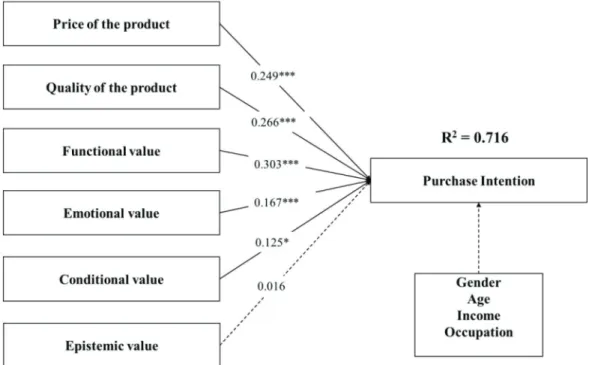
The hypotheses H1, H2, H3, H4, and H5 were supported at a significant level of 95%. On the contrary, hypothesis 6 is not supported. Besides, all control variables did not significantly relate to purchase intention.

The result of R

2

(explained variance) is 0.716, which means independent variables explain 71.6%

of the variance of the dependent variable (purchase intention) (Figure 2). This indicator, the coefficient of determination, assesses the extent of the overall effect of

the structural model (David Garson, 2016). The R

2

value is larger than 0.50 and smaller than 0.75 indicating a moderate value. Besides, the f

2

(effect size) enables evaluating the independent variable’s contribution to the dependent variable. In particular, f

2

= 0.02 is small, 0.15 is medium, and 0.35 is high (Bagozzi & Yi, 1988).

In this study, f

2

effect size for the influence of Functional

value → Purchase intention is medium at 0.204 and for

Emotional value → Purchase intention the f

2

is relatively

small at 0.143, for Quality → Purchase intention, the f

2

is 0.138 for the influence of Price → Purchase intention,

the f

2

is 0.062 for Emotional value → Purchase Intention,

and the f

2

is 0.038 for Conditional value → Purchase

intention. Finally, the model’s predictive power will

be assessed by means of the Q

2

value (also called

blindfolding). The smaller the difference between the

predicted and the original values, the greater the Q

2

value

and, thus, the model’s predictive accuracy. In other words,

the Q

2

measure can only be partly considered a measure

of an out-of-sample prediction (Chin, 1998; Hair et al.,

2012). The Q

2

value of purchase intention in this study is

0.458 larger than zero. Based on the above values, it can be

concluded that the model can be used further for predicting

the endogenous latent variable - purchase intention.

(9)

Table 5: Hypothesis Testing Results

Hypothesis Original

Sample (O) Sample Mean (M)

Standard Deviation

(STDEV) t-value P-values f-square Result

H1: Price → Purchase intention 0.249 0.248 0.047 5.282 0.000 0.138 Supported

H2: Quality → Purchase intention 0.266 0.267 0.052 5.135 0.000 0.143 Supported H3: Functional value → Purchase

intention 0.303 0.304 0.051 5.972 0.000 0.204 Supported

H4: Emotional value → Purchase

intention 0.167 0.168 0.055 3.010 0.003 0.062 Supported

H5: Conditional value → Purchase

intention 0.125 0.125 0.052 2.401 0.016 0.038 Supported

H6: Epistemic value → Purchase

intention 0.016 0.013 0.057 0.272 0.786 0.000 Not supported

Gender → Purchase intention -0.018 -0.018 0.046 0.396 0.692 0.001 Not supported

Age (18–24) → Purchase intention -0.021 -0.023 0.059 0.358 0.721 0.001 Not supported Age (25–35) → Purchase intention 0.004 0.003 0.057 0.075 0.940 0.000 Not supported Income (above 15) → Purchase

intention 0.025 0.024 0.042 0.606 0.544 0.002 Not supported

Officer → Purchase intention -0.001 -0.003 0.047 0.030 0.976 0.000 Not supported Student → Purchase intention -0.049 -0.050 0.044 1.119 0.263 0.005 Not supported

Figure 1: Results of Research Model (N = 180)

***p < 0.001, **p < 0.01 *p < 0.5.

(10)

5. Discussion and Conclusion

The present study investigates factors influencing the purchase intention of Vietnamese consumers towards Japanese convenience goods from the perceived value perspective. This research basically achieved the mentioned objectives. The research findings indicated 05 factors affecting consumers’ purchase intention towards Japanese convenience goods, in which functional value ranked the first place (β = 0.303, p = 0.000). This implies that this factor has the most significant impact on the purchase intention of Vietnamese consumers. In order words, the more multi- functional the products are, the higher the chance that middle-income consumers will purchase. The next factor that affects consumers’ purchase intention towards Japanese convenience goods is the quality of product (β = 0.266, p = 0.000) and the price of products (β = 0.249, p = 0.000).

The results are consistent with the research by Sheth et al.

(1991) and Pai et al. (2017) related to convenience goods, Vu et al. (2015) related to foods products, Wang (2010) related to natural functional food, and Yang et al. (2018) related to luxury products.

The findings also show that even when purchasing products from convenience stores, Vietnamese consumers focus on product function and quality. Furthermore, the influence of five factors is of average/fair magnitude, implying that improving the perceived value of these factors can increase customer purchase intention.

Moreover, R

2

equals 0.716, which means 71.6% of the dependent variable is explained by independent variables.

The remaining is due to measurement errors and is also explained by other factors not part of this study. However, the study fails to demonstrate the effect of the perceived epistemic value of the product on purchase intention towards Japanese convenient products. It suggests that consumers are unlikely to be influenced by curiosity, novelty, or knowledge gained through purchasing products in this category. This can be explained by the characteristics of convenience goods that can be bought to satisfy basic needs (Alex & Thomas, 2014)

It is inevitable that this study does have some limitations. First, the research model which emphasizes five main factors, only explains 71.6% of the total variation in purchase intention towards Japanese convenience goods.

The remaining is due to disturbance and other variables that are not part of the research model. It implies that there are still other factors that may influence consumer purchase intention, such as country-of-origin (Ghalandari & Norouzi, 2012), business strategy, and marketing strategy (Pai et al., 2017). Second, the research is only conducted on a small sample scale in a cross-sectional design, so it somehow fails to reflect an overall picture in generalizing the research findings. Consequently, it will limit the generalizability of the research findings. Third, the theoretical models employed

in this study were derived from relevant research on various product and service categories, and they did not specifically point out aspects influencing purchase intention, instead of focusing on consumer choice behavior. In an attempt to gain a stable background for the study, this study speculates that intention is the factor that motivates consumers and in turn has an impact on their behavior. These restrictions also pave the way for future research into the effect of other factors on consumer purchase intent, by including them in the model, such as country of origin, reputation, distribution capacity, customer service, and so on. Besides, broadening the scope of research as well as the sample size in longitudinal research is considered as an ideal way to achieve statistical significance and ensure better representativeness for the population. Finally, more advanced statistical analysis techniques should be used to attain more comprehensive findings when exploring the relationship between factors in the model.

References

Ajzen, I. (1991). The theory of planned behavior. Organizational Behavior and Human Decision Processes, 50(2), 179–211.

https://doi.org/10.1016/0749-5978(91)90020-T

Alex, J., & Thomas, J. (2014). Brand credibility and purchase intention among users of shopping and convenience goods:

The moderating role of brand involvement. Indian Journal of Marketing, 44, 17–24. https://doi.org/10.17010/ijom/2014/v44/

i4/80386

Andrews, L., Kiel, G., Drennan, J., Boyle, M. V., &

Weerawardena, J. (2007). Gendered perceptions of experi- ential value in using web‐based retail channels. European Journal of Marketing, 41(5/6), 640–658. https://doi.org/

10.1108/03090560710737660

Bagozzi, R. P., & Yi, Y. (1988). On the evaluation of structural equation models. Journal of the Academy of Marketing Science, 16(1), 74–94. https://doi.org/10.1007/BF02723327

Boonsiritomachai, W., & Sud-On, P. (2020). Increasing purchase intention and word-of-mouth through hotel brand awareness.

Tourism and Hospitality Management, 26, 265–289. https://

doi.org/10.20867/thm.26.2.1

Calvo-Porral, C., & Lévy-Mangin, J. P. (2017). Store brands’

purchase intention: Examining the role of perceived quality.

European Research on Management and Business Economics, 23(2), 90–95. https://doi.org/10.1016/j.iedeen.2016.10.001 Chae, H., Kim, S., Lee, J., & Park, K. (2020). Impact of product

characteristics of limited edition shoes on perceived value, brand trust, and purchase intention; focused on the scarcity message frequency. Journal of Business Research, 120, 398–406.

https://doi.org/10.1016/j.jbusres.2019.11.040

Chin, W. W. (1998). The partial least squares approach for structural

equation modeling. In G. A. Marcoulides (Ed.), Modern

methods for business research (pp. 295–336). Mahwah,

NJ: Lawrence Erlbaum Associates Publishers.

(11)

Choe, J. Y. J., & Kim, S. S. (2018). Effects of tourists’ local food consumption value on attitude, food destination image, and behavioral intention. International Journal of Hospitality Management, 71, 1–10. https://doi.org/10.1016/

j.ijhm.2017.11.007

Crosno, J. L., Freling, T. H., & Skinner, S. J. (2009). Does brand social power mean market might? Exploring the influence of brand social power on brand evaluations. Psychology &

Marketing, 26(2), 91–121. https://doi.org/10.1002/mar.20263 David Garson, G. (2016). Partial least squares: Regression &

structural equation models. Raleigh, NC: Statistical Publishing Associates.

Fornell, C., & Larcker, D. F. (1981). Evaluating structural equation models with unobservable variables and measurement error.

Journal of Marketing Research, 18(1), 39–50. https://doi.org/

10.2307/3151312

Ghalandari, K., & Norouzi, A. (2012). The effect of country of origin on purchase intention: The role of product knowledge.

Research Journal of Applied Sciences, Engineering Technology, 4(9), 1166–1171. https://maxwellsci.com/print/rjaset/v4-1166- 1171.pdf

Hair, J. F., Sarstedt, M., Ringle, C. M., & Mena, J. A. (2012).

An assessment of the use of partial least squares structural equation modeling in marketing research. Journal of the Academy of Marketing Science, 40(3), 414–433. https://

doi.org/10.1007/s11747-011-0261-6

Hair, J. F., Matthews, L. M., Matthews, R. L., & Sarstedt, M.

(2017). PLS-SEM or CB-SEM: updated guidelines on which method to use. International Journal of Multivariate Data Analysis, 1(2), 107–123. https://doi.org/10.1504/

IJMDA.2017.087624

Kock, N. (2015). Common method bias in PLS-SEM: A full collinearity assessment approach. International Journal of e-Collaboration, 11(4), 1–10. https://doi.org/10.4018/

ijec.2015100101

Kotler, P., & Armstrong, G. (2016). Principles of marketing ( 16th ed.). Harlow, United Kingdom: Pearson education.

Lee, J. S., Lee, C.K., & Choi, Y. (2011). Examining the role of emotional and functional values in festival evaluation.

Journal of Travel Research, 50(6), 685–696. https://doi.org/

10.1177/0047287510385465

Ministry of Planning and Investment. (2019). Brief on foreign direct investment of 2018. Retrieved from http://www.mpi.gov.

vn/en/Pages/tinbai.aspx?idTin=41941&idcm=122

Mothersbaugh, D. L., Hawkins, D. I., Kleiser, S. B., Mothersbaugh, L. L., & Watson, C. F. (2020). Consumer behavior: Building marketing strategy: McGraw-Hill Education.

Nguyen, N. T., Nguyen, L. H. A., & Tran, T. T. (2021). Purchase behavior of young consumers toward green packaged products in Vietnam. The Journal of Asian Finance, Economics, and Business, 8(1), 985–996. https://doi.org/10.13106/jafeb.2021.

vol8.no1.985

Nguyen, P. N. D., Nguyen, V. T., & Vo, N. N. T. (2019). Key determi- nants of repurchase intention toward organic cosmetics.

The Journal of Asian Finance, Economics, Business, 6(3), 205–214. https://doi.org/10.13106/jafeb.2019.vol6.no3.205 Nguyen, T. K. C., Nguyen, D. M., Trinh, V. T., Tran, T. P. D., &

Cao, T. P. (2020). Factors affecting intention to purchase green products in Vietnam. The Journal of Asian Finance, Economics, and Business, 7(4), 205–211. https://doi.org/10.13106/jafeb.

2020.vol7.no4.205

Pai, F. Y., Chen, C. P., Yeh, T. M., & Metghalchi, M. (2017).

The effects of promotion activities on consumers’ purchase intention in chain convenience stores. International Journal of Business Excellence, 12(4), 413–432. https://www.

inderscience.com/info/inarticle.php?artid=85005

Pham, T. H., Nguyen, T. N., Phan, T. T. H., & Nguyen, N. T.

(2019). Evaluating the purchase behavior of organic food by young consumers in an emerging market economy. Journal of Strategic Marketing, 27(6), 540–556. https://doi.org/10.1080/

0965254X.2018.1447984

Putra, G. K., & Harijanto, R. (2015). The impact of customer value proposition towards purchase intention of Chesa Cup.

iBuss Management, 3(2), 241–251. https://media.neliti.com/

media/publications/183342-EN-the-impact-of-customer-value- proposition.pdf

Sánchez-Fernández, R., & Iniesta-Bonillo, M. Á. (2007). The concept of perceived value: a systematic review of the research. Journal of Public policy, 7(4), 427–451. https://doi.

org/10.1177/1470593107083165

Sánchez, J., Callarisa, L., Rodríguez, R. M., & Moliner, M. A.

(2006). Perceived value of the purchase of a tourism product.

Tourism Management, 27(3), 394–409. https://doi.org/10.1016/

j.tourman.2004.11.007

Shah, S. S. H., Aziz, J., Jaffari, A. R., Waris, S., Ejaz, W., Fatima, M., & Sherazi, S. K. (2012). The impact of brands on consumer purchase intentions. Asian Journal of Business Management, 4(2), 105–110.

Sheth, J. N., Newman, B. I., & Gross, B. L. (1991). Why we buy what we buy: A theory of consumption values.

Journal of Business Research, 22(2), 159–170. https://doi.

org/10.1016/0148-2963(91)90050-8

Sweeney, J. C., & Soutar, G. N. (2001). Consumer perceived value: The development of a multiple-item scale. Journal of Retailing, 77(2), 203–220. https://doi.org/10.1016/S0022-4359 (01)00041-0

Tanrikulu, C. (2021). Theory of consumption values in consumer behavior research: A review and future research agenda.

International Journal of Consumer Studies, 51(4), 31–56.

https://doi.org/10.1111/ijcs.12687

Thomas, J. J. I. (2014). Brand credibility and purchase intention among users of shopping and convenience goods: The moderating role of brand involvement. 44(4), 17–24. https://

doi.org/10.17010/ijom/2014/v44/i4/80386

Vu, P. A., Phan, T. T. H., & Cao, T. K. (2015). An exploratory investigation into customer perceived value of food products in Vietnam. International Business Research, 8(12), 1. https://

doi.org/10.5539/ibr.v8n12p1

(12)

Wang, E. S. T. (2010). Impact of multiple perceived value on consumers’ brand preference and purchase intention:

A case of snack foods. Journal of Food Products Marketing, 16(4), 386–397. https://doi.org/10.1080/10454446.

2010.509242

Wu, S. I., & Chang, H. L. (2016). The model of the relationship between the perceived values and the purchase behaviors

toward innovative products. Journal of Management Strategy, 7(2), 31–45.

Yang, J., Ma, J., Arnold, M., & Nuttavuthisit, K. (2018). Global

identity, perceptions of luxury value and consumer purchase

intention: a cross-cultural examination. Journal of Consumer

Marketing, 35(5), 533–542. https://doi.org/10.1108/JCM-02-

2017-2081

수치

Table 2:  Measurement Items
Table 3:  Measurement Items of the Construct’s Analysis Result
Table 4:  Inter-Construct Correlation
Figure 1:  Results of Research Model (N = 180)          ***p &lt; 0.001, **p &lt; 0.01 *p &lt; 0.5.

참조

관련 문서

In conclusion, this study confirmed that the factors influencing nurses' intention to report medication administration errors comprised patient safety culture and

__________ and Jongchul Park(2004), “The Role of Situational Factors in the Relationship between Customer Satisfaction and Word-of-Mouth Intention: Tie Strength and Solicitation

To answer the first question, we built the integration model, in which purchase and loyalty are influenced by not only business factors of product assortment, price, and

This much has emerged after analysing the resale values of Korean versus Japanese cars, reports True Price.. Darryl Jacobson, managing director of True Price, explains that

웹 표준을 지원하는 플랫폼에서 큰 수정없이 실행 가능함 패키징을 통해 다양한 기기를 위한 앱을 작성할 수 있음 네이티브 앱과

The index is calculated with the latest 5-year auction data of 400 selected Classic, Modern, and Contemporary Chinese painting artists from major auction houses..

1 John Owen, Justification by Faith Alone, in The Works of John Owen, ed. John Bolt, trans. Scott Clark, &#34;Do This and Live: Christ's Active Obedience as the

The purpose of this study is to investigate the effect of online shopping mall characteristics on direct purchasing satisfaction of foreign consumers and purchase