• 검색 결과가 없습니다.

Application of Complex Korean Medicine Therapy and M&L Psychotherapy to Patient with Panic Disorder: A Case Report

N/A
N/A
Protected

Academic year: 2021

Share "Application of Complex Korean Medicine Therapy and M&L Psychotherapy to Patient with Panic Disorder: A Case Report"

Copied!
10
0
0

로드 중.... (전체 텍스트 보기)

전체 글

(1)

공황장애 환자에 대한 복합한의진료 및 M&L 심리치료 적용 경과: 증례보고

김종환, 조희근*,신현권

청연한방병원 한방신경정신과, 청연의학연구소*

Application of Complex Korean Medicine Therapy and M&L Psychotherapy to Patient with Panic Disorder: A Case Report

Jong Hwan Kim, Hee Geun Jo*, Hyun Kwon Shin

Department of Oriental Neuropsychiatry, Chung-Yeon Korean Medicine Hospital, *Chung-Yeon Medical Institute

Received: November 26, 2018 Revised: December 15, 2018 Accepted: December 21, 2018

Objectives: The objective of this study was to report the clinical effectiveness of the complex Korean medicine therapy and M&L (Mindfulness & Loving presence) psychotherapy on the patient with panic disorder.

Methods: The subject for this study was the patient diagnosed with panic disorder who complained about intermittent panic attack and accompanying insomnia. During the treatment period, the patient received complex Korean therapy and M&L psychotherapy. The clinical effects were evaluated through Beck Depression Inventory (BDI), Hamilton Depression Rating Scale (HDRS), State-Trait Anxiety Inventory (STAI), Panic Disorder Severity Scale (PDSS), and Pittsburgh Sleep Quality Index (PSQI).

Results: After the complex Korean medicine therapy and M&L psychotherapy, the overall symptoms of depression, anxiety, panic disorder and insomnia of the patient were lessened in a relatively short period. No specificities or adverse effects were reported during the treatment period.

Conclusions: This study established that the complex Korean medicine therapy and M&L psychother- apy was effective in treating patients with panic disorder.

Key Words: Panic disorder, Traditional Korean Medicine, Psychotherapy, Mindfulness, Ondam-tang.

Correspondence to Hee Geun Jo

Chung-Yeon Medical Institute, 1236, Chipyeong-dong, Seo-gu, Gwangju, Korea.

Tel: +82-62-371-1075 Fax: +82-62-371-1074 E-mail: [email protected] Acknowledgement This work was supported by Chung-Yeon Medical Institute Research Program.

Copyright © 2018 by The Korean Society of Oriental Neuropsychiatry. All rights reserved.

CC
This is an open access article distributed under the terms of the Creative Commons Attribution Non-Commercial License (http://creativecommons.org/licenses/by-nc/4.0) which

permits unrestricted non-commercial use, distribution, and reproduction in any medium, provided the original work is properly cited.

(2)

I. INTRODUCTION

Panic disorder is a type of anxiety disorder is char- acterized by recurrent and unexpected panic attacks, which are sudden surges of severe fear or discomfort that heighten within minutes. The individual experi- ences recurrent unexpected panic attacks with follow- ing symptoms: palpitations, abnormal sweating, trem- bling, chest pain or discomfort, nausea, paresthesia, etc

1)

. Cross-national epidemiology study of 2016 re- ported that the cross-national lifetime prevalence of panic disorder is 1.7%, and 80% of these patients have accompanying psychiatric disorders

2)

. In addition, pre- vious studies reported that panic disorder has a sig- nificant correlation with the health-related quality of life of patients

3)

. Considering these characteristics, An active approach to investigate an effective treatment for panic disorder through a psychiatric perspective can be viewed as an important research topic.

Chemical medication and other psychotherapy for panic disorder have been suggested, but studies have continued to develop interventions that are safer and more effective than conventional treatments. In this regard, many studies reported that traditional oriental medicine, such as herbal medicine and acupuncture, exhibited positive results for improving patients’

symptoms of anxiety, and in addition, according to the progress in the research of the oriental neuro- psychiatry, the use of meditation and psychological techniques in the psychotherapy is also being at- tempted

4-7)

.

With this background, the authors report a combi- nation of complex Korean medicine therapy, including herbal medicine and acupuncture, and M&L (Mindful- ness&Loving presence) psychotherapy to alleviate the overall symptoms of the patient diagnosed with panic disorder. We report the following case study and rec- ommend further investigations in the study of interest.

II. CASE

1. Case presentation

A 48-year-old man, who was originally engaged in commerce, visited our hospital. He resigned his job and visited various medical institutions for treatments due to the worsening panic attacks and adverse drug effects.

The main symptoms were intermittent panic attacks and accompanying insomnia, which kept him awake between 6 a.m. and 7 a.m. and couldn’t sleep more than 3∼4 hours. According to the patient’s statement, the time of symptom onset was six months ago. After receiving family-induced stress, symptoms such as pal- pitation and shortness of breath suddenly became more severe. He was diagnosed with panic disorder at the neuropsychiatry clinic and was prescribed psycho- tropic medication. Even after starting the medication, symptoms such as visual and auditory hallucinations continued. As a result, he was further prescribed med- ication at the neuropsychiatry department of the uni- versity hospital. After taking the new medication, he felt his body was badly sinking and had a hard time to remember previously familiar streets. At this point he decided to seek medical assistance from our hospi- tal, because of his memory is gradually worsening. At the time of admission, he treated with Trazodone HCl 25 mg 1T QD, Lorazepam 1 mg 1T QD, Alprazolam 250 μg 2T BID, and Escitalopram 5 mg 1T QD daily.

The patient was a 182 cm/50 kg skinny type and

complained of a decrease in appetite, cold feeling of

both hands, intermittent vomiting, persistent thirst, re-

peated symptoms of constipation, diarrhea, sweating,

severe fatigue, and headache at the temples. There

was no other relevant medical history. He was sepa-

rated from his wife and had frequent conflicts with his

mother. He did not sleep well, so he drank 1∼2 bot-

tles of soju or 1∼2 cans of beer at night and did not

eat properly. A month before admission, his symptoms

(3)

became aggravated. He complained of chest dis- comfort, nausea, vomiting associated with a decreased appetite more frequently. In the case of visual and au- ditory hallucination, occurrence repeated during nighttime, and recently, it happened three weeks be- fore admission. We obtained written consent to study the patient.

2. Assessment

The following tools were used for the diagnosis and progress assessment of the patients. First, we per- formed history taking according to the DSM-5 criteria for diagnosis. In addition, the following tools were used to evaluate the patient’s symptoms.

The Korean version of the Beck Depression Inventory (BDI) and the Hamilton Depression Rating Scale (HDRS) were used to measure depression symptoms

8,9)

. The total score of BDI ranges from 0∼63 with the higher score indicating greater depression. In the male group, the cutoff score is 24, and each of the scores of 16∼19, 20∼23, over 24 indicates ‘subclinical’,

‘manifest’, and ‘severe depression’

8)

. HDRS is classified as ‘mild depression’ in 8∼16, ‘moderate depression’

in 17∼23, and ‘severe depression’ in more than 24 ac- cording to the score

10)

.

Anxiety symptoms were evaluated using the State-Trait Anxiety Inventory (STAI). STAI is divided in- to STAI-X-1, evaluating current state of anxiety, and STAI-X-2, evaluating aspects of anxiety proneness.

The total score of each subtest is 20∼80 with the higher score indicating greater anxiety. To detect clin- ically significant symptoms for STAI-X-1, the cutoff point of 39∼40 has been suggested

11)

.

Symptoms of panic disorder were assessed using the Panic Disorder Severity Scale (PDSS). The total score of PDSS ranges from 0∼28 with the higher score in- dicating more severe symptoms

12)

. PDSS score is in- terpreted that 1 is ‘normal’, 2∼5 is ‘borderline’, 6∼9 is ‘slightly ill’, 10∼13 is ‘moderately ill’, and over 14

is ‘markedly ill’. The scores that decrease by 75∼100%

means ‘very much improved’

13)

.

Insomnia symptoms were evaluated using the Pittsburgh Sleep Quality Index (PSQI), which is widely used at home and abroad. The total score of PSQI ranges from 0∼21. The higher score means low qual- ity of sleep. The score of 5 is the cutoff point that dis- tinguishes good and poor sleepers

14)

. However, in the Korean version, The score of 8.5 is presented as the cutoff value

15)

.

Tools used to evaluate the patient’s symptoms were selected to have a previous study on the reliability and validity of the Korean version.

3. Treatment (Fig. 1)

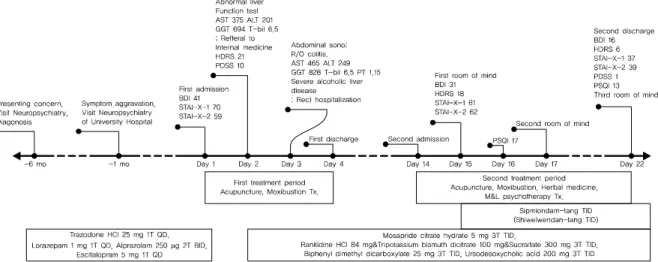
The first treatment period was performed in our hospital from Day 1 to Day 4. During this period, acu- puncture and moxibustion were administered. Acu- puncture was performed twice a day. The first session was performed on PC6 (內關), GB34 (陽陵泉), SP9 (陰陵 泉), ST36 (足三里), CV12 (中脘). The second session was performed on GB20 (風池), GV14 (大椎), GB21 (肩井), and Ashi points on the neck region. Moxibustion was performed twice a day on GV14 (大椎) and ST36 (足三 里). During the treatment period, Patient discontinued psychotropic medication only taken when the symp- toms were severe.

On Day 2, a blood test conducted by our hospital showed TG 337, AST 375, ALT 201, GGT 694, and T-bil 6.5, and urinalysis revealed bilirubin 1+. Therefore, we referred examination to the internal medicine de- partment of another hospital for liver function abnormality. Mosapride Citrate Hydrate 5 mg 3 T TID, Ranitidine HCl 84 mg, Tripotassium Bismuth Dicitrate 100 mg, Sucralfate 300 mg 3T TID, Biphenyl Dimethyl Dicarboxylate 25 mg 3T TID, and Ursodesoxycholic Acid 200 mg 3T TID was prescribed, and the patient was advised to stop taking psychotropic medication.

At another hospital, on Day 3, he underwent several

(4)

Fig. 1. Timeline of treatment course.

BDI: Beck Depression Inventory, STAI: State-Trait Anxiety Inventory, HDRS: Hamilton Depression Rating Scale, PDSS: Panic Disorder Severity Scale, PSQI: Pittsburgh Sleep Quality Index, M&L: Mindfulness&Loving presence.

examinations. The abdominal ultrasonography showed:

mild hepatomegaly, no detectable mass in liver no cir- rhosis, mild diffuse wall thickening of GB, some sludge in GB, and mild diffuse wall thickening of the colonic loop is noted. The blood test showed : AST 465, ALT 249, GGT 828, T-bil 6.5, and PT 1.16. He was diag- nosed with colitis and severe alcoholic liver disease through examinations. As a result, he was advised to be hospitalized. Therefore, on Day 4, he was dis- charged from our hospital in order to be hospitalized.

From Day 4 to Day 14, he underwent colonic polyps removal operation and medication treatment at anoth- er hospital.

After discharged from another hospital, he started the second treatment period in our hospital from Day 14 to Day 22. During this period, acupuncture, mox- ibustion, herbal medicine, and M&L psychotherapy were performed. Acupuncture was performed twice a day. The first session was performed on PC6 (內關), GB34 (陽陵泉), SP9 (陰陵泉), ST36 (足三里), CV12 (中脘).

The second session was performed on GB20 (風池), GV14 (大椎), GB21 (肩井), and ashi point on the neck region. Moxibustion was performed twice a day on GV14 (大椎) and ST36 (足三里).

Herbal medicine was administered three times a day after meals to improve panic disorder symptoms and insomnia. We chose Sipmiondam–tang (Shiweiwendan- tang, 十味溫膽湯) based on the previous study

16)

. The prescription was slightly modified according to the pa- tient’s symptoms by reducing Poria Sclerotium (茯苓) and Pinelliae Tuber (半夏). Composition of the pre- scription is Zizyphi Semen (酸棗仁), Rehmanniae Radix Preparata (熟地黃), Citri Unshius Pericarpium (陳皮) 16 g, Schisandrae Fructus (五味子), Ponciri Fructus Immaturus (枳實), Glycyrrhizae Radix et Rhizoma (甘草) 12 g, Poria Sclerotium (茯苓), Polygalae Radix (遠志) 10 g, Ginseng- 6yujn Radix (人蔘), Pinelliae Tuber (半夏), Zingiberis Rhizoma Crudus (生薑), and Zizyphi Fructus (大棗) 6 g per day. To improve insomnia, we added Longanae Arillus (龍眼肉) 16 g, and Thujae Semen (柏子仁) 12 g per day to this prescription.

M&L psychotherapy was performed seven sessions during the second treatment period. Each session took approximately 15 minutes at a time. It was composed of drawing ‘the room of mind’, ‘Resource Mindfulness’,

‘Mul Mindfulness’, ‘Access’, ‘Probe’ and ‘Finger mind-

fulness’, etc.

(5)

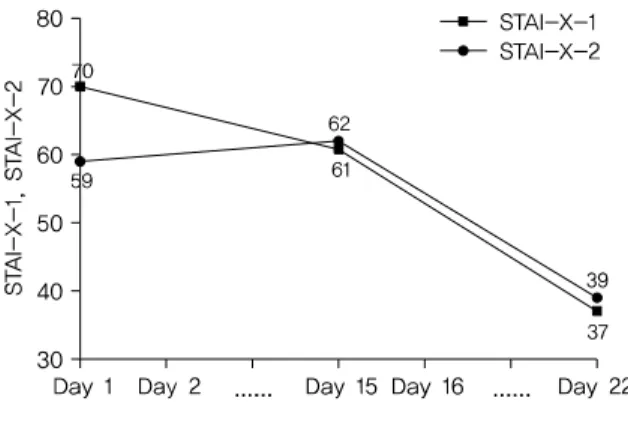
Fig. 2. Change of BDI, HDRS, STAI-X-1, STAI-X-2, PDSS, PSQI.

BDI: Beck Depression Inventory, HDRS: Hamilton Depression Rating Scale, STAI: State-Trait Anxiety Inventory, PDSS: Panic Disorder Severity Scale, PSQI:

Pittsburgh Sleep Quality Index.

4. Outcome and follow-up

BDI, HDRS, STAI-X-1, and STAI-X-2, PDSS ques- tionnaires were used for the evaluation of depression, anxiety, and panic disorder symptoms from the first admission. PSQI was used for the evaluation of in- somnia symptoms from the second admission. HDRS was interviewed with reference to SIGH-D, the struc- tured interview guide

17)

.

Depression and Anxiety Scale were measured on Day 1, 2, 15, 22. BDI and HDRS decreased in scores during each measurement, from 41 to 31 to 16 points in BDI and from 21 to 18 to 6 points in HDRS. STAI-X-1 and STAI-X-2 scores were also measured from 70 to 61 to 37 points in STAI-X-1 and from 59 to 62 to 39 points in STAI-X-2. PDSS was measured on Day 2 and 22, reducing to 1 point from 10. PSQI was measured on Day 16 and 22. Although PSQI is a questionnaire based on the symptoms of the last 1 month, measure-

ment of Day 22 was based on symptoms during the second treatment period. It decreased from 17 to 13 points (Fig. 2).

The progression of sleep symptoms was recorded during the second treatment period. Before the second admission, he would lay down in bed at 11 p.m., but it takes him 3∼4 hours to sleep. He woke up several times while sleeping, and the actual sleeping time was about 2∼4 hours.

He slept at 2:00 and woke every 30 to 40 minutes on Day 15. On Day 16 and 17, he slept for 5 hours and did not wake up. On Day 18, he slept for 5 hours and woke up twice during sleep. On Day 19, he slept for 5 hours and did not wake up. On Day 20, he slept 4 and a half hours and woke up twice during sleep.

On Day 21, he slept for 5 hours and woke up twice

during sleep. We observed sleep symptoms improve

during the second treatment period compared to

symptoms before admission.

(6)

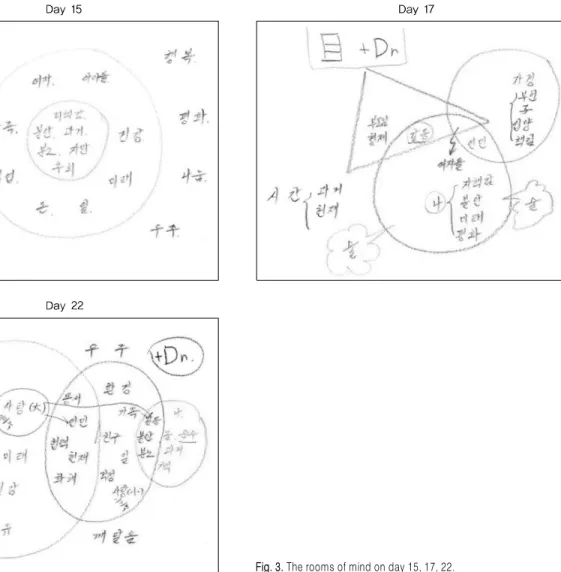
Fig. 3. The rooms of mind on day 15, 17, 22.

M&L psychotherapy was performed during the sec- ond treatment period. All sessions began after the process of inducing Mindfulness. In the first session, drawing ‘the room of mind’ was carried out. We had the process of recognizing and expressing the present state of mind. The innermost part of the patient’s room was composed of ‘guilt’, ‘anxiety’, ‘past’, ‘anger’,

‘pride’, and ‘regret’, which expressed feeling for the middle part of the room. The middle part of the pa- tient’s room was composed of ’women’, ‘child’, ‘family’, etc. The outermost background was ‘transcendence’,

‘happiness’, ‘present’, ‘peace’, ‘self-esteem’, ‘share’,

‘courage’, and ‘universe’ that were things patient

desired. In the second session, we conducted

‘Resource Mindfulness’. His resources were pleasure when he first saw his first child which were located on his right forearm the area that supports the child when he hugs his child. In the third session, ‘Mul Mindfulness’ and drawing ‘the room of mind’ were conducted. In ‘Mul Mindfulness’, he struggled to come up with the image of the lake. The rooms of mind were divided into ‘I’, ‘Parents’, and ‘Home’ room. ‘I’

room were composed of ‘remorse’, ‘anxiety’, and

‘peace’. ‘Conflict’ was placed between ‘I’ and ‘Parents’

room, and ‘compassion’ was placed between ‘I’ and

‘Home’ room. ‘Women’ was placed in the middle of

(7)

three room as the source of the problem. In the fourth session, ‘Access’ and ‘Probe’ were conducted. In

‘Probe’, his title was ‘OO’s father’, and we messaged him “OO’s father, you are enough to be loved.” and observed changes in his mind. In the fifth session, we focused on the senses of each finger through ‘Finger Mindfulness’. In the sixth session, we performed

‘Probe’. In the last session, We took the time to ob- jectify the inside of mind by drawing ‘the rooms of the mind’ again. He showed the awareness of ‘love[big (大)]’ that exists in the largest room. We had time to look at things like ‘forgiveness’, ‘reconciliation’, ‘conflict’, etc. through the view of love (Fig. 3).

III. DISCUSSION

This case report is meaningful in that the patient with panic disorder and insomnia have improved anxi- ety symptoms, sleep quality, and other additional symptoms due to applying complex Korean medicine therapy and M&L psychotherapy in the treatment.

Also, in the situation of suspected drug side effects, the treatment based on complex Korean medicine and psychotherapy alleviate the clinical symptoms which were persistent despite oral administration of psycho- tropic medications for 6 months. So, it is thought that the results can be helpful in forming a hypothesis re- lated to further research. In addition, because there are few studies that apply complex Korean medicine therapy and M&L psychotherapy to patients with pan- ic disorder, the results are valuable in that this study describes the treatment using psychotherapy in detail and patient’s subjective symptoms were measured through various objective evaluation tools.

Before visiting our hospital, the patient was already diagnosed with panic disorder at the neuropsychiatry clinic and the neuropsychiatry department of the uni- versity hospital. On Day 1, we interviewed through the structured interview about the DSM-5 disorders

18)

.

Although the patient took psychotropic medication, he suffered sudden heartbeat, feeling of suffocation, nau- sea and dizziness, trembling and numbness, and stated that symptoms did not occur in a specific situation, and the anticipatory anxiety was not severe. However, he avoided tense or unfamiliar situations due to fear of symptoms. The interview with the patient showed more than 4 out of 13 physical and cognitive symp- toms of DSM-5 criteria. Although the level of antici- patory anxiety about panic attacks was not severe, he showed avoidance behaviors in situations where panic attacks occurred.

To achieve a specific diagnosis of panic disorder, cardiovascular diseases such as arrhythmia, pulmonary diseases, endocrine diseases such as hyperthyroidism, neurological diseases such as temporal lobe epilepsy and ingestion of excessive quantities of caffeine, drug intoxication (eg, cocaine), drug withdrawal (eg, benzo- diazepines, alcohol) should be ruled out. For this, standard laboratory testing (thyroid function, complete blood cell count (CBC), and chemistry panel), urine toxicology screen, electrocardiogram, chest radiog- raphy, electrocardiogram (ECG), cardiac enzyme test, CT, etc. may be needed

19,20)

. In this case, no abnormal- ities were found in ECG and chest X-ray at the time of admission, so we ruled out arrhythmia and car- diopulmonary abnormalities that can be identified through the examination. Although there was a state- ment related to persistent alcohol consumption, there were no findings relating to alcohol dependence, so we thought that the relationship between alcohol con- sumption and psychiatric findings would be insufficient.

There were no abnormalities found in CBC. Chemistry

panel showed abnormality of liver function due to

continuous ingestion of alcohol (TG 337, AST 375, ALT

201, GGT 694, and T-bil 6.5) and a decrease in protein

and albumin due to insufficient food intake. As a result

of referral to the internal medicine department of an-

other hospital, the patient was diagnosed with colitis

(8)

and severe alcoholic liver disease based on the examinations. However, the symptoms of severe alco- holic liver disease and colitis were not correlated with that of panic disorder. Therefore, according to current diagnosis of panic disorder at the neuropsychiatry de- partment of the university hospital and the fact that the patient’s symptoms meet the diagnosis criteria of DSM-5, the patient was diagnosed with panic disorder.

In the progression of this case, BDI showed 41 and 31 points in the first and second measurements, in- dicating ‘severe depression’. However, the last meas- urement recorded 16 points which could be in- terpreted as ‘subclinical depression’

8)

. In HDRS, 21 and 18 points were recorded in the first and second meas- urements, respectively, which corresponded to the cri- teria for ‘moderate depression’, but 6 points were re- corded at the last measurement, which could be in- terpreted as ‘no depression’

10)

. In STAI-X-1, 70 and 61 points were recorded in the first and second measurements. However, in the last measurement, the score was 37, which is under the cutoff value

11)

. In STAI-X-2, 59 And 62 points in the first and second measurements decreased to 39 points at the last meas- urement, indicating an objective improvement of anxi- ety symptoms. PDSS showed ‘moderately ill’ at 10 points in the first measurement, but 3 weeks later, in the second measurement, it was ‘normal’ at 1 point, and the rate of change was also -90%, indicating that overall severity of panic disorder symptoms was also

‘very much improved’

13)

. Though, in PSQI, 17 and 13 points higher than cutoff value were recorded in the first and second measurements

15)

. PSQI score improved and symptoms of insomnia lessened. The results showed that the combined application of complex Korean medicine therapy and M&L psychotherapy im- prove overall symptoms of depression, anxiety, panic disorder and insomnia of patient in a relatively short period.

Sipmiondam-tang used in this case was based on

the prior studies that showed a significant effect on patients with insomnia and generalized anxiety dis- order

21,22)

. In a previous study that reviewed the classi- cal literature published between AD 206 and 1949 re- ported that ondam-tang was the most widely used for insomnia

23)

. Ondam-tang improves negative emotions in the sleep-deprived environment by regulating orex- in-A and leptin

24)

. Zizyphi Semen (酸棗仁) acts on the GABAergic system to relieve anxiety and has hypnotic effect by acting on the serotonergic system

25,26)

. Acupuncture treatment is also applied to relieve symp- toms in this case. The previous study revealed that acupuncture can be effective in anxiety symptoms by adjusting neurotransmitters such as platelet 5-HT and plasma ACTH

27)

. ‘The room of mind’, a part of the M&L psychotherapy, is a useful tool to observe pa- tient’s mind more objectively through visualizing, dia- gramming, and specifying. It can observe the pro- gression and evaluate changes of mind before and after treatments, and it enables the internal reflection to be done in the process of summarizing

28)

.

This case report has the following limitations. First,

it can’t be generalized to all panic disorder patients

because it is the only case report. Also, we applied

complex Korean medicine therapy and M&L psycho-

therapy, so we can’t find which intervention induce

specific effects because of that clinical limitation. In

addition, despite the frequent recurrence problem of

panic disorder, we didn’t perform a further evaluation

after admission treatment, so we can’t evaluate wheth-

er the treatment effect was maintained or not. It is

thought to be worth that evaluating the efficacy and

safety of the application of complex Korean medicine

therapy and M&L psychotherapy to patients with pan-

ic disorder through further clinical research that sup-

plemented the limits of this case report.

(9)

REFERENCES

1. American Psychiatric Association. Diagnostic and Statistical Manual of Mental Disorders. 5th ed. Washington, DC: American Psychiatric Association. 2013:208-14.

2. de Jonge P, Roest AM, Lim CC, Florescu SE, Bromet EJ, Stein DJ, Harris M, Nakov V, Caldas-de-Almeida JM, Levinson D, Al-Hamzawi AO, Haro JM, Viana MC, Borges G, O’Neill S, de Girolamo G, Demyttenaere K, Gureje O, Iwata N, Lee S, Hu C, Karam A, Moskalewicz J, Kovess-Masfety V, Navarro-Mateu F, Browne MO, Piazza M, Posada-Villa J, Torres Y, Ten Have ML, Kessler RC, Scott KM. Cross-national epidemiology of panic disorder and panic attacks in the world mental health surveys.

Depress Anxiety. 2016 Dec;33(12):1155-77.

3. Kang EH, Kim B, Choe AY, Lee JY, Choi TK, Lee SH. Panic disorder and health-related quality of life: the predictive roles of anxiety sensitivity and trait anxiety. Psychiatry Res. 2015 Jan 30;225(1-2):157-63.

4. Liu L, Liu C, Wang Y, Wang P, Li Y, Li B. Herbal Medicine for Anxiety, Depression and Insomnia. Curr Neuropharmacol.

2015;13(4):481-93.

5. Amorim D, Amado J, Brito I, Fiuza SM, Amorim N, Costeira C, Machado J. Acupuncture and electro- acupuncture for anxiety disorders: A systematic review of the clinical research. Complement Ther Clin Pract. 2018 May;31:31-7.

6. Lee SW, Lee YJ, Yoo SW, Lee RD, Park SJ. Case series of panic disorder patients treated by oriental medical treat- ments and EFT. J of Oriental Neuropsychiatry. 2014;

25(1):13-28.

7. Lee SY, Lyu SJ, Choi SY, Lyu YS, Kang HW. A Study on the clinical effects of group therapy for panic disorder pa- tients based on Mindfulness&Li-Gyeung-Byun-Qi therapy.

J of Oriental Neuropsychiatry. 2014;25(4):319-32.

8. Lee MK, Lee YH, Park SH, Son CH, Jeong YJ, Hong SG, Lee BK, Jang PR, Yoon AR. Reliability and Factor Analysis – A Standardization Study of Beck Depression Inventory 1-Korean Version (K-BDI). Kor J Psychopathol. 1995;4(1):

77-95.

9. Yi JS, Bae SO, Ahn YM, Park DB, Noh KS, Shin HK, Woo HW, Lee HS, Han SI, Kim YS. Validity and Reliability of the Korean Version of the Hamilton Depression Rating Scale(K-HDRS). J Korean Neuropsychiatr Assoc. 2005 Jul;44(4):456-65.

10. Zimmerman M, Martinez JH, Young D, Chelminski I, Dalrymple K. Severity classification on the Hamilton Depression Rating Scale. J Affect Disord. 2013 Sep 5;

150(2):384-8.

11. Julian LJ. Measures of anxiety: State-Trait Anxiety Inventory (STAI), Beck Anxiety Inventory (BAI), and Hospital Anxiety and Depression Scale-Anxiety (HADS-A).

Arthritis Care Res (Hoboken). 2011 Nov;63 Suppl 11:

S467-72.

12. Kim JB. Development of the Korean Version of the Panic Disorder Severity Scale. Kor J Psychopathol. 2001;10(2):

140-51.

13. Furukawa TA, Katherine Shear M, Barlow DH, Gorman JM, Woods SW, Money R, Etschel E, Engel RR, Leucht S.

Evidence-based guidelines for interpretation of the Panic Disorder Severity Scale. Depress Anxiety. 2009;26(10):

922-9.

14. Buysse DJ, Reynolds CF 3rd, Monk TH, Berman SR, Kupfer DJ. The Pittsburgh Sleep Quality Index: a new in- strument for psychiatric practice and research. Psychiatry Res. 1989 May;28(2):193-213.

15. Sohn SI, Kim DH, Lee MY, Cho YW. The reliability and val- idity of the Korean version of the Pittsburgh Sleep Quality Index. Sleep Breath. 2012 Sep;16(3):803-12.

16. Chen JL, Wang SF. 42 cases of Shiwei Wendan Decoction for Premature beat. Liaoning J of Traditional Chinese Medicine. 1996;23(10):461.

17. Williams JB. A structured interview guide for the Hamilton Depression Rating Scale. Arch Gen Psychiatry. 1988 Aug;45(8):742-7.

18. Michael B. First, Janet B.W. Williams, Rhonda S. Karg, Robert L. Spitzer. Structured Clinical Interview for Dsm-5 disorders Clinician Version. Trans. Oh MY, Park YC, Oh SW. Hakjisa, 2017:63-6.

19. Locke AB, Kirst N, Shultz CG. Diagnosis and manage- ment of generalized anxiety disorder and panic disorder in adults. Am Fam Physician. 2015 May 1;91(9):617-24.

20. Berko EH, Feier G. Behavioral Health Consult: Ensuring prompt recognition and treatment of panic disorder. J Fam Pract. 2017 Dec;66(12):750-3.

21. Zhu YX, Feng FJ . 30 cases of Shiwei Wendan Decoction for Insomnia of Heart, Gallbladder and Qi Deficiency and Phlegm Disturbance Type. Hubei J of Traditional Chinese medicine. 2011;33(9):48.

22. Zhang CL, Wen X, Li YP. 40 Cases of Generalized Anxiety Disorder Treated with Shiwei Wendan Decoction. Henan Traditional Chinese medicine. 2014;34(7):1343.

23. Ni X, Shergis JL, Zhang AL, Guo X, Lu C, Li Y, Xue CC.

Traditional Use of Chinese Herbal Medicine for Insomnia and Priorities Setting of Future Clinical Research. J Altern Complement Med. 2018 Oct 30. doi: 10.1089/acm.2018.

0249.

24. Wu F, Song Y, Li F, He X, Ma J, Feng T, Guan B, Wang L, Li S, Liu X, Liu Y, Mao M, Liu J, Bai S, Song C. Wen-dan de- coction improves negative emotions in sleep-deprived rats by regulating orexin-a and leptin expression. Evid Based Complement Alternat Med. 2014;2014:872547.

25. Han H, Ma Y, Eun JS, Li R, Hong JT, Lee MK, Oh KW.

Anxiolytic-like effects of sanjoinine A isolated from Zizyphi Spinosi Semen: possible involvement of GABAergic transmission. Pharmacol Biochem Behav. 2009 Apr;92(2):

206-13.

(10)

26. Cao JX, Zhang QY, Cui SY, Cui XY, Zhang J, Zhang YH, Bai YJ, Zhao YY. Hypnotic effect of jujubosides from Semen Ziziphi Spinosae. J Ethnopharmacol. 2010 Jul 6;130(1):

163-6.

27. Yuan Q, Li JN, Liu B, Wu ZF, Jin R. Effect of Jin-3-needling therapy on plasma corticosteroid, adrenocorticotrophic

hormone and platelet 5-HT levels in patients with general- ized anxiety disorder. Chin J Integr Med. 2007 Dec;13(4):

264-8

28. Yu SY, Kang HW. The Study on Quantitative and

Qualitative Analysis of Mentalizing the Rooms of Mind. J

of Oriental Neuropsychiatry 2017;28(3):275-86.

수치

Fig. 1. Timeline of treatment course.
Fig. 2. Change of BDI, HDRS, STAI-X-1, STAI-X-2, PDSS, PSQI.
Fig. 3. The rooms of mind on day 15, 17, 22.

참조

관련 문서

The purpose of this study is to examine whether internet addiction is related with ADHD (Attention Deficit Hyperactivity Disorder) that is characterized

Conclusion: These results suggest that old patient who expressed typically intoxicated symptoms, lower GCS and blood pressure, shown acidosis in gas analysis,

The Mann-whitney U test was used to compare and analyze the salivary cortisol concentration according to the duration of symptoms in the temporomandibular disorder patient group

Thirdly, it appeared that social support had meaningful effect on self-efficacy and the quality of life, and in the case of the difference analysis by

Behavioral symptom differences between depressed and non-depressed groups of adolescents diagnosed with CD(Conduct Disorder) and ODD(Oppositional Defiant

Korean Aspects to Scenario 4, LG HC with decelerating TPER This case requires Korean government to maintain nuclear energy and pursue alternative

quality of life and improved standard of living, and as reflected in this popular desire, kiosks provide various forms of food-related information and have

Objective : The study aim was to estimate the prevalence of sleep disturbance and depressive symptoms as well as to examine the moderating effect of