86
and Safety
Available online at http://www.foodhygiene.or.kr
https://doi.org/10.13103/JFHS.2021.36.1. 86
갈색거저리(Tenebrio molitor) 유충의 산화방지 성분 및 활성
진경남 · 정은정 · 김용석* 전북대학교 식품공학과
Antioxidant Components and Antioxidant Activities of Mealworm (Tenebrio molitor Larvae)
Kyoung Nam Jin, Eun-Jeong Jeong, Yong-Suk Kim*
Department of Food Science and Technology, Jeonbuk National University, Jeonju, Korea
(Received February 4, 2021/Revised February 8, 2021/Accepted February 10, 2021)
ABSTRACT - In order to utilize edible insect larvae as a functional material, the antioxidant components and activities of Tenebrio molitor larvae extracts were evaluated. The total phenolic content of the extract by ethanol con- centration (95%, 70%, 50%, water) of T. molitor larvae powder was the highest in the 50% ethanol extract at 459.23
± 1.05 mg%, and the total flavonoid content was the highest in the water extract at 19.86 ± 0.69 mg%. The DPPH radical scavenging activity of T. molitor larvae powder extract was the highest in 70% ethanol extract at 82.60 ± 0.00%, followed by water, 50% ethanol, and 95% ethanol extract. The ABTS radical scavenging activity in 50% eth- anol and water extract was highest at 97.57 ± 0.16% and 95.33 ± 0.41%, respectively, with no significant difference.
Significantly, the reducing power was the highest in water extracts, followed by 50%, 70%, and 95% ethanol extract.
The results confirmed the antioxidant components and antioxidant activities of T. molitor larvae have been identified, indicating that it is worth using as a functional material.
Key words : Tenebrio molitor larvae, Antioxidant activity, Phenolic, Flavonoid, DPPH
식용곤충은 단백질과 지방이 풍부하게 함유되어 쇠고 기, 돼지고기, 닭고기 등 동물성 단백질의 대체 자원으로 이용될 수 있다. 또한, 돼지, 닭 등의 단백질 급원식품의 사육효율에 비해 사육에 필요한 공간과 시설요구도가 낮 으며, 사육 시 방출되는 암모니아 가스와 온실가스가 훨 씬 적은 양을 방출한다. 따라서 가파른 인구 증가로 인한 식량자원이 부족한 시대에 환경오염을 줄일 수 있는 단백 질 급원 식품원료이다 1) .
갈색거저리(Tenebrio molitor)는 딱정벌레목(Coleoptera) 에 속하며, 그 유충은 mealworm이라고도 불린다 2) . 갈색거 저리 유충은 2016년 식품공전에 등록되었으며, 현재 등재
된 5종의 식용곤충 중 하나이다 3) . 갈색거저리 유충에는 glutamic acid 가 다량 함유되어 있고, 혈중 high density lipoprotein (HDL) 의 함량을 높이고 low density lipoprotein (LDL) 의 함량을 낮춰주는 oleic acid가 다량 존재하여 영 양적 가치도 우수하다 4) .
지금까지 갈색거저리 유충에 대한 연구는 영양성분 4-6) , 항균효과 7) , 항산화 효과 8,9) , β-secretase 저해 효과 10) , hexane fraction 의 항치매 효과 11,12) 등이 보고되었다. 또한 식품소재 로 이용한 연구는 갈색거저리 유충 분말을 첨가한 식빵 13) , 머핀 14) , 양갱 15) , 선식 16) , 쌀 팽화 스낵 17) , 발효유 18) 등이 있 다. 그러나 갈색거저리 유충의 산화방지 성분과 활성에 대 한 연구는 부분적으로 이루어져 있으나 종합적인 연구는 많이 수행되지 않았다.
따라서 본 연구에서는 식용곤충인 갈색거저리 유충 추 출물의 total phenolics와 total flavonoid 등 산화방지 성분 의 함량을 측정하고 여러 방법에 의한 산화방지 활성을 확인하여 갈색거저리 유충을 건강기능식품 소재로 활용하 기 위한 가능성을 확인하고자 하였다.
*Correspondence to: Yong-Suk Kim, Department of Food Science and Technology, Jeonbuk National University, Jeonju 54896, Korea
Tel: +82-63-270-2567, Fax: +82-63-270-2572 E-mail: [email protected]
Copyright © The Korean Society of Food Hygiene and Safety. All rights reserved. The Journal of Food Hygiene and Safety is an Open-Access journal distributed under the terms of the Creative Commons Attribution Non-Commercial License(http://creativecommons.org/licenses/by-nc/3.0) which permits unrestricted non-commercial use, distribution,and reproduction in any medium, provided the original work is properly cited.
Materials and Methods
재료 및 시약
2019 년에 MG네츄럴(Damyang, Korea)에서 갈색거저리 유충(약 3.5-4.0 cm 크기)을 구입하여 정제수로 세척하고, -80 o C 에서 24시간 동안 두어 희생하였으며 -45 o C 에서 동 결 건조 후 분쇄하여 -80 o C 에서 보관하면서 시료로 사용 하였다. 시험에 사용한 ethanol, Folin-Denis’s phenol 용액, sodium carbonate, gallic acid, aluminium nitrate, potassium acetate, quercetin, 1,1-diphenyl-2-picrylhydrazyl, 2,6-di- tert-butyl-4-methylphenol, potassium persulfate, phosphate buffer, 2,2'-azino-bis (3-ethylbenzothiazoline-6-sulphonic acid) diammonium salt, potassium ferricyanide, trichloroacetic acid 등은 Sigma-Aldrich Co. (St. Louis, MO, USA)로부터 구입하여 사용하였다.
갈색거저리 유충의 추출물 제조
갈색거저리 유충의 기능성 성분을 추출하기 위해 식품 에서 특정한 성분을 추출하는데 사용할 수 있는 물과 ethanol 3) 을 농도별(95%, 70%, 50%, 0%)로 사용하였다. 즉, 동결건조한 갈색거저리 유충 분말 5 g에 100 mL의 용매를 각각 가한 후 25 o C 에서 24시간 교반(150 rpm)하여 기능 성 성분을 추출하였다. 추출 후 여과지(Whatman No.2, Whatman International Ltd., Maidstone, England) 로 감압여 과한 후 각각의 용매를 가하여 100 mL로 정용한 것을 추 출물로 하여 -40 o C 에서 보관하면서 실험에 사용하였다.
일반성분 및 이화학적 특성
수분함량은 AOAC법 19) 에 준하여 105 o C 상압 가열건조 법으로 측정하였고, 조단백질은 semi-Kjeldahl법, 조회분은 550 o C 회화법, 조지방은 soxhlet 추출법으로 분석하였다 3) .
총 phenolic compounds 함량
총 phenolic compounds는 Folin-Denis’s phenol 방법으로 측정하였다 20) . 즉, 추출물 0.2 mL를 시험관에 가하고 1 M Folin-Denis’s phenol 용액 0.2 mL를 시험관에 더하여 혼합 하였다. 여기에 물 1.8 mL를 가하고 잘 혼합하여 3분 동 안 반응시킨 다음 10% Na 2 CO 3 0.4 mL 를 첨가하고 증류 수를 가하여 총 용량을 4 mL로 하였다. 1시간 동안 실온 에 방치한 후 상층액을 취하여 UV-vis spectrophotometer (UV-1650PC, Shimadzu Co., Kyoto, Japan) 를 이용하여 725 nm 에서 흡광도를 측정하였으며 표준물질로는 gallic acid 를 이용하였다.
총 flavonoid 함량
총 flavonoid 함량은 질산알루미늄 검사법으로 측정하였 다 21) . 즉, 추출물 0.5 mL, 80% ethanol 1.5 mL, 10%
aluminum nitrate 0.1 mL 및 1 M potassium acetate 0.1 mL 를 시험관에 가하고 잘 혼합하였다. 증류수를 가하여 총 용량이 4 mL가 되게 하고, 실온에 30분간 방치한 후 UV- vis spectrophotometer (UV-1650PC, Shimadzu Co., Kyoto, Japan) 로 415 nm에서 흡광도를 측정하였으며, 표준물질로 는 quercetin을 이용하였다.
1,1-Diphenyl-2-picrylhydrazyl (DPPH) radical 소거 활성 DPPH 라디칼 소거능은 Braca 등 22) 의 방법을 변형하여 측정하였다. 즉, 시험관에 추출물 1 mL와 0.15 mM DPPH 용액 3 mL를 가하고 혼합하였다. 실온 암소에서 30분 동안 방치하고 UV-vis spectrophotometer (UV-1650PC, Shimadzu Co., Kyoto, Japan) 를 이용하여 517 nm에서 흡광도를 측정 하였으며, 대조구로는 2,6-di-tert-butyl-4-methylphenol (BHT) 를 사용하였다 20) .
ABTS radical 소거 활성
2,2'-Azino-bis (3-ethylbenzothiazoline-6-sulphonic acid) (ABTS) radical 소거 활성은 Kim 등 23) 의 방법을 응용하여 측정하였다. 즉, 7.4 mM의 ABTS diammonium salt 250 mL 와 2.6 mM potassium persulfate 250 mL (1:1 반 응)를 혼합한 후 실온, 암소에서 24시간 반응시켰다. 그 반응물을 물에 희석하여 734 nm에서 흡광도 값 1.10(±0.2) 으로 조정하여 준비한다. ABTS 용액 2.85 mL와 추출물 0.15 mL 를 혼합하고 실온 암소에 30분간 반응시킨 후 UV- vis spectrophotometer (UV-1650PC, Shimadzu Co., Kyoto, Japan) 를 이용하여 734 nm에서 흡광도를 측정하였으며, 대 조구로는 BHT를 사용하였다.
환원력 측정
환원력 측정은 추출물 1 mL에 200 mM phosphate buffer (pH 6.6) 1 mL 와 1% potassium ferricyanide 1 mL를 첨가한 후 50 o C 항온수조에서 20분간 반응시켰다. 여기에 10%
trichloroacetic acid 1 mL 를 첨가하여 혼합한 후 원심분리기 (HA-1000-3, Hanil, Daejeon, Korea) 로 13,500 × g에서 15분 간 원심분리하였다. 상층액 1 mL와 증류수 1 mL, ferric acid 1 mL 를 넣고 혼합한 후 UV-vis spectrophotometer (UV- 1650PC, Shimadzu Co., Kyoto, Japan) 를 이용하여 700 nm에 서 흡광도를 측정하였고 24) , 대조구로는 BHT를 사용하였다.
통계분석
모든 실험은 3회 반복 측정하였으며, 결과는 SAS (Statistical analysis system ver. 6, SAS Institute, Cary, NC, Scavenging activity % ( ) = ⎝ ⎛ 1 Absorbance of sample – Absorbance of control --- ⎠ ⎞ 100 ×
Scavenging activity % ( ) = ⎝ ⎛ 1 Absorbance of sample – Absorbance of control --- ⎠ ⎞ 100 ×
USA) 통계 package 25) 를 이용하여 평균 및 표준편차를 구했 으며, ANOVA 분석 및 Duncan’s multiple rage test로 유의 성을 검정하였다.
Results and Discussion
일반성분
갈색거저리 유충의 건조 수율은 건조 전 3,050 g에서 동 결건조 후 1,060 g으로 35.33%이었다(data not shown).
동결건조한 갈색거저리 유충의 일반성분(Table 1)은 수 분함량 0.80 ± 0.06%, 조회분 3.29 ± 0.03%, 조단백질 54.07 ± 0.24%, 조지방 36.78 ± 0.66%로 분석되었다. Yoo 등 4) 의 연구에서는 국산 갈색거저리 유충의 일반성분이 수 분 2.90 ± 0.04%, 조회분 3.73 ± 0.3%, 조단백질 50.32 ± 0.21%, 조지방 33.7 ± 0.13%로 보고하였다. Baek 등 8) 은 동결건조한 갈색거저리 유충의 일반성분이 수분 3.36 ± 0.031%, 조회분 3.68 ± 0.003%, 조단백질 53.38 ± 0.152%, 조지방 30.71 ± 0.051%로 보고하였다. 이들 결과는 본 연 구의 결과와 약간 차이가 있었으며, 이는 유충의 생육정 도와 건조조건의 차이에 의한 것으로 추정된다.
총 phenolic compounds 함량
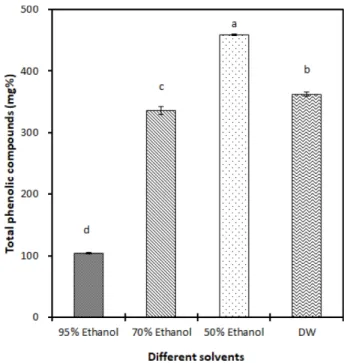
페놀성 화합물은 식물체에 다량 분포된 2차 대사산물의 하나로 phenolic hydroxyl기(-OH)를 포함하며, 단백질 및 거대 분자와 쉽게 결합하는 성질을 갖고 있다. 페놀성 화 합물은 항산화 효과 등 다양한 기능을 갖는 것으로 알려 져 있으며, 함량이 증가할수록 항산화 활성 또한 증가하 는 경향을 나타낸다 26,27) . 갈색거저리 유충의 ethanol 농도 별 추출물을 이용하여 총 phenolic compounds 함량을 측 정하였다(Fig. 1). Ethanol (50%) 추출물의 총 phenolic compounds 함량은 459.23 ± 1.05 mg%으로 추출물 중 유 의적으로 가장 높게 나타났으며, 물 추출물 362.62 ± 3.62 mg%, 70% ethanol 추출물 335.75 ± 6.96 mg%, 95%
ethanol 추출물 103.82 ± 0.84 mg% 순이었다.
Baek 등 28) 은 갈색거저리 유충(약 3 cm 크기)을 동결건 조하여 얻은 70% ethanol 추출물의 총 phenolic compounds 함량이 다른 건조 방법에 비해 가장 높은 9.23 ± 0.09 mg GAE/g 이라고 보고하여 본 연구결과보다 높게 나타났으며, 이는 유충의 사육환경 및 생육정도 차이에 의한 것으로 생각된다. Jang 등 29) 은 발효한 갈색거저리 물추출물의 phenolic compounds 함량은 10.97 ± 0.84 mg%로서 95%
ethanol 추출물의 3.59 ± 0.36 mg%보다 높다고 보고하였 으며, 이는 본 연구결과와 비슷한 경향을 나타냈다. 한편 Kim 등 30) 은 70% ethanol로 추출한 동결건조한 벼메뚜기 의 phenolic compounds 함량이 17.61 mg/100 g으로 보고 하여 갈색거저리유충의 총 phenolic compound의 함량이 벼메뚜기에 비해 훨씬 높은 것으로 나타났다.
총 flavonoids 함량
플라보노이드는 페놀성 화합물 중에서 자연적으로 많이 생성되는 화합물 중 하나이다 31) . 이들은 단백질 및 거대 분 자들과 결합하는 성질이 있고 reducing agent, singlet oxygen quencher, hydrogen donor 로 작용함으로써 항산화 효과를 나
타낸다 32,33) . 동결건조한 갈색거저리 유충의 ethanol 농도별
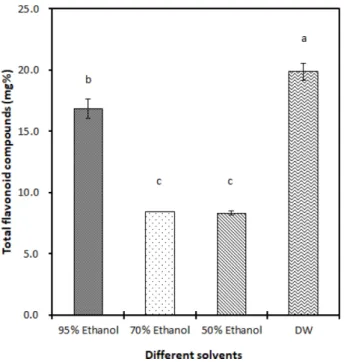
추출물을 이용하여 총 flavonoid 함량을 측정한 결과는 Fig.
2 와 같다. 물 추출물의 총 flavonoids 함량이 19.86 ± 0.69 mg% 으로 가장 높았고, 95% ethanol 추출물 16.85 ± 0.79 mg%, 70% ethanol 추출물 8.44 ± 0.00, 50% ethanol 추출물 8.33 ± 0.15 mg% 순으로 나타났다. Jang 등 29) 은 발효한 갈 색거저리 물추출물의 총 flavonoid 함량이 2.13 ± 0.22 mg%, 95% 에탄올 추출물에서 3.23 ± 0.51 mg%라고 보고하여 본 연구결과보다 낮게 검출되었으며, 물추출물의 함량이 높게 나타난 본 연구결과와 다른 경향을 보였는데, 이는 시료의 차이와 발효의 적용에 따른 것으로 추정된다.
DPPH radical 소거 활성
DPPH radical 소거 활성은 안정한 free radical로서 항산
Table 1. Proximate composition of freeze-dried Tenebrio molitor larvae (unit : dry basis %)
Moisture Crude ash Crude protein Crude fat 0.80 ± 0.06
1)3.29 ± 0.03 54.07 ± 0.24 36.78 ± 0.66
1)
Values are mean±standard deviation (n=3).
Fig. 1. Total phenolic compounds content of Tenebrio molitor larvae
extracts by different solvents ( P<0.05) (n=3). DW: Distilled water.
화 활성을 갖는 물질로부터 전자나 수소를 제공 받으면 DPPH-H 로 환원되면서 보라색이 노란색으로 탈색되는 비 색법을 이용한 항산화 활성 측정 방법이다 34) . 동결건조한 갈색거저리 유충 분말의 ethanol 추출물에 의한 DPPH
radical 소거 활성을 측정한 결과는 Fig. 3과 같다. Ethanol (70%) 추출물의 DPPH radical 소거 활성은 82.60 ± 0.00%
로써 대조구인 BHT (0.3 mg/mL) 처리구의 77.95 ± 0.78%
보다 높게 나타났으며, 물 및 50% ethanol 추출물은 각각 74.15 ± 1.54%, 65.00 ± 0.17% 를 나타내었다. Ethanol (95%) 추출물은 16.36 ± 3.1%를 나타내 가장 낮은 소거 활성을 나타냈다. Baek 등 8) 은 10 mg/mL 농도(70% ethanol 추출물)에서 81.17%의 DPPH radical 소거 활성을 나타내 어 같은 농도의 블루베리 추출물과 유사한 활성을 나타냈 다고 보고하여 본 연구결과와 비슷한 활성을 나타내었다.
Kim 등 30) 은 벼메뚜기의 DPPH에 의한 항산화 효과를 실 험한 결과 70% ethanol, 50% ethanol, 물, 100% ethanol 추출물 순으로 높은 것을 확인 하였으며 이는 본 실험결 과와 유사한 경향을 나타내었다.
ABTS radical 소거 활성
ABTS radical 소거 활성 시험은 페놀성 화합물이 없을 경우에는 ABTS + 가 비교적 안정하지만 페놀성 화합물과 같 은 수소공여제와는 강열하게 반응하여 무색의 ABTS로 색 이 변하는 비색법을 이용한 항산화 활성 측정 방법이다 35) . 동결건조한 갈색거저리 유충의 ethanol 농도별 추출물의 ABTS radical 소거 활성을 측정한 결과는 Fig. 4와 같다.
Ethanol (50%) 추출물과 물 추출물의 ABTS radical 소거 활성은 각각 97.57 ± 0.16%와 95.33 ± 0.41%를 나타내 유의적 차이는 없었으며, 그 다음 70% ethanol 추출물이 Fig. 2. Total flavonoid compounds content of Tenebrio molitor
larvae extracts by different solvents ( P<0.05) (n=3). DW: Dis- tilled water.
Fig. 3. The DPPH radical scavenging activity of Tenebrio molitor larvae extracts by different solvents ( P<0.05) (n=3). BHT: 2,6-Di- tert-butyl-4-methylphenol (0.3 mg/mL), DW: Distilled water.
Fig. 4. The ABTS radical scavenging activity of Tenebrio molitor
larvae extracts by different solvents ( P<0.05) (n=3). BHT: 2,6-Di-
tert-butyl-4-methylphenol (0.15 mg/mL), DW: Distilled water.
66.39 ± 3.37%, 95% ethanol 추출물이 50.41 ± 3.51%로 써 ethanol 농도가 높아질수록 소거 활성이 감소하였다. 대 조구인 BHT (0.15 mg/mL)는 73.64 ± 3.21%의 소거 활성 을 나타냈다. 이 결과는 총 phenolic compounds의 함량 결 과와 같은 비슷한 경향을 나타내었다. Baek 등 28) 은 갈색 거저리 유충의 ABTS radical 소거 활성이 농도 의존적으 로 증가하였고, 2,000 μg/mL의 농도에서 25% 정도의 소 거 활성을 나타냈으며, 동결건조한 것이 다른 건조 방법 에 의한 것보다 활성이 높았다고 보고하였다.
환원력 측정
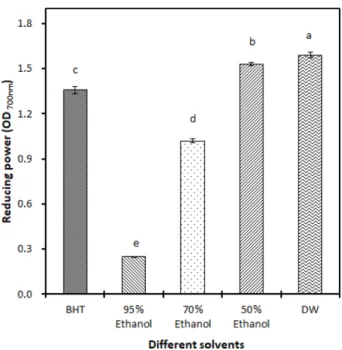
환원력 측정 실험은 700 nm에서 ferric-ferricyanide (Fe 3+ ) 혼합물이 수소를 공여하여 유리라디칼을 안정화시켜 ferrous (Fe 2+ ) 로 전환하는 환원력을 흡광도 값으로 나타낸 방법이 다 24) . 동결건조된 갈색거저리 유충을 ethanol 농도별로 추 출한 추출물의 환원력을 측정한 결과는 Fig. 5와 같다. 물 추출물의 흡광도(OD 700 nm ) 는 1.589 ± 0.02로 유의적으로 가장 높은 환원력을 나타내었고, 50% ethanol, 70% ethanol, 95% ethanol 추출물의 흡광도는 각각 1.529 ± 0.01, 1.020
± 0.02, 0.248 ± 0.00 으로 나타나 ethanol 농도가 높을수록 환원력이 감소하여 ABTS radical 소거 활성 시험의 결과 와 비슷한 경향을 나타내었다. 물 추출물과 50% ethanol 추출물의 환원력은 대조구(BHT 0.3 mg/mL, 1.357 ± 0.02) 보다 높은 활성을 보였다. Jang 등 29) 은 갈색거저리의 95%
ethanol 추출물의 Cu 환원력이 0.46 ± 0.03으로서 물 추출 물(0.32 ± 0.02)보다 높았다고 보고하여 본 연구 결과와
다른 경향을 나타냈으나 본 연구와는 다른 측정 방법을 사용하였다. Dlamini 등 36) 과 Pasko 등 37) 은 총 phenolic compounds 의 함량이 많을수록 환원력 등 항산화 활성이 높게 나타난다고 보고하였는데, 본 연구에서도 비슷한 경 향을 나타내었다.
본 연구결과 갈색거저리 유충은 총 phenolic compounds 와 총 flavonoids 등 산화방지 성분을 많이 함유하고 있었 으며, 다양한 방법에 의해 측정한 산화방지 활성이 우수 함을 확인하였다.
국문요약
식용곤충인 갈색거저리 유충을 기능성 소재로 활용하기 위하여 갈색거저리 유충 추출물의 산화방지 성분 및 활성 을 확인하였다. 동결건조한 갈색거저리 유충 분말의 일반 성분은 수분함량 0.80 ± 0.06%, 조회분 3.29 ± 0.03%, 조 단백질 54.07 ± 0.24%, 조지방 36.78 ± 0.66%이었다. 갈색 거저리 유충 분말의 ethanol 농도별(95%, 70%, 50%, 물) 추 출물의 총 phenolic compounds 함량은 50% ethanol 추출물 에서 459.23 ± 1.05 mg/100 g으로 가장 높았으며, 총 flavonoid compounds 함량은 물 추출물에서 19.86 ± 0.69 mg/100 g으 로 가장 높았다. 갈색거저리 유충 분말 추출물의 DPPH radical 소거 활성은 70% ethanol 추출물에서 82.60 ± 0.00% 로 가장 높았으며, 물, 50% ethanol, 95% ethanol 추 출물 순으로 높았다. ABTS radical 소거 활성은 50%
ethanol 및 물 추출물에서 각각 97.57 ± 0.16%와 95.33 ± 0.41% 로 높게 나타났으며, 유의적 차이는 없었다. 환원력 의 경우 물 추출물에서 유의적으로 가장 높았으며, 50%
ethanol, 70% ethanol, 95% ethanol 추출물 순이었다. 본 연구결과 갈색거저리 유충의 산화방지 성분의 함량이 많 고 산화방지 활성을 우수함을 확인하였으며, 기능성 소재 로서 활용할 가치가 있는 것으로 나타났다.
Conflict of interests
The authors declare no potential conflict of interest.
ORCID
References