<論 文 >
갈색거저리의 발육특성
김선영†·박종빈†·이영보·윤형주·이경용·김남정
*
국립농업과학원 농업생물부 곤충산업과
Growth characteristics of mealworm Tenebrio molitor
Sun Young Kim†, Jong Bin Park†, Young Bo Lee, Hyung Joo Yoon, Kyeong Yong Lee, and Nam Jung Kim*
Applied Entomology Division, National Academy of Agricultural Science, RDA, Wanju-gun, Jeollabuk-do, 565-851, Korea
(Received March 30, 2015, Revised April 27, 2015, Accepted April 29, 2015)
ABSTRACT
As increasing utilization of Tenebrio molitor for industry, establishing effective conditions of indoor mass-rearing sys- tem become more important. For this reason, the aim of this study was to identify the physiological characteristics of Tenebrio molitor in different range of temperatures, photoperiods and rearing densities for mass breeding. As a result, their egg had above 70% hatching rate at 17.5 ~ 27.5
oC and the egg period was shown 5 ~ 7 days in 25 ~ 35
oC. Con- sequently, in the consideration of the hatching rates and egg periods, the optimal indoor temperature for rearing was 25 ~ 27.5
oC. Furthermore, development period of larvae in mass breeding system was shorter than individual breeding system under all the conditions of temperature. Also, the pupal weight was higher in mass breeding system except for 20
oC and 25
oC. Considering elasticity of demand and weight of production, the effective condition was mass-breeding system at 25
oC. In photoperiodic condition, the shortest of larval period was 157.35 day in 14L : 10D.
Key words : Tenebrio molitor, Temperature, Photoperiodic condition, Rearing density
서 론
갈색거저리(Tenebrio molitor)는 딱정벌레목 거저리과에 속하며(Lemos et al. 2011), 비교적 건조한 토양, 바위 밑, 나무 속, 동물들의 은신처, 곡물더미 등에 서식한다고 알 려져 있다(Jung 2012). 이는 일반적으로 곡물에 사는 해 충으로 인식되어 있지만(Koo et al. 2013, Kim et al. 2014), 최근에는 이를 효율적인 동물사료로 이용하기 위해 각종 영양분석이 진행되고 있다. 갈색거저리는 단백질과 지방 이 풍부하며, 여러 종류의 아미노산, 불포화지방산, 무기 질을 포함하고 있다(Ye et al. 1997, Huang et al. 2006, Huang et al. 2007, Huang et al. 2011, Yoo et al. 2013, Kim et al. 2014). 더불어, 지구 온난화 지수와 토지 이용 도는 우유, 닭, 돼지, 소고기 단백질원을 생산할 때보다 갈색거저리를 사육할 때의 발생률이 훨씬 낮아 미래 대 체단백질 공급원으로서 기대됨과 동시에(Oonincx 2012),
인류를 위한 대체식량으로도 각광받고 있다(Megido et al.
2013). 또한 이용도가 낮은 밀짚과 오래된 배추 잎, 버섯 폐배지 등의 농업부산물을 갈색거저리 사육을 위한 먹이 원으로 사용할 수 있어 친환경적(Li et al. 2012, Kim et al. 2014) 이다. 따라서 이를 활용하여 충질을 강화시키고, 생산단가를 낮출 수 있는 양질의 대체먹이를 개발하기 위 한 연구가 진행 중에 있다(Kim et al. 2014).
일반적으로, 갈색거저리의 사육 시 적정 온도와 습도는 25
oC/75% RH 이며(Punzo and Mutchmor 1980), 암컷이 페 로몬(4-methyl-1-nonanol)을 분비하여 수컷을 유인한다 (Tanaka et al. 1986, Bryning et al. 2005). 또한 여러 번 수 컷과 교미한 암컷이 교미를 적게 한 암컷보다 산란율이 높은 특징을 가진다(Drnevich et al. 2001). 25
oC 에서 총 령수는 평균적으로 15 ~ 17령을 가지며(Park et al. 2014), 적정온도보다 높은 30
oC 조건에서는 15 ~ 23령을 가지는 특징이 있다(Fiore 1960). 하지만 적정 온도보다 낮은 19
oC,
†These authors contributed equally.
*Corresponding author. E-mail:
[email protected]
21
oC, 23
oC 조건에서 사육할 경우, 온도가 높아질수록 움 직임이 느려지며(Silva 2012), 또한 초령 유충은 춥고 건 조한 조건에서 생존율이 낮아지지만(Punzo and Mutchmor 1980), 만약 4
oC 조건에서 유충에게 selenium을 먹이면, 먹이지 않는 대조군보다 생존율이 높아지는 것을 관찰할 수 있다고 보고되었다(Audas et al. 1995).
이와 같이 곤충은 온도에 민감하게 반응하기 때문에 (Abdullah 1961) 갈색거저리 대량생산에 있어 온도는 중 요한 요인임을 추정할 수 있다. 만약 특정 온도에서 갈색 거저리의 부화율, 용화율, 우화율 등에 문제가 나타난다 면 대량생산에 큰 차질이 생길 가능성이 크다. 따라서 본 연구는 갈색거저리 실내 대량사육 기술 개발을 위해 다 양한 온도 및 광주기 조건에 따른 발육특성을 조사하였다.
재료 및 방법
1. 갈색거저리 사육
갈색거저리 성충은 국립농업과학원 곤충산업과 사육실 (25
±3
oC, 50 ~ 70% RH, 14L : 10D) 에서 5세대 이상 계대사 육한 개체를 사용하였다. 갈색거저리 성충(약 1,000마리)을 아크릴 박스(가로 48
×세로 49
×높이 33 cm)에서 사육했 으며, 주먹이원인 밀기울을 약 0.8 cm 높이로 밑바닥에 깔 아주었다. 수분 공급을 위해 각종 신선한 채소(배추, 무, 당근 등)를 주 2회 공급하였고, 사육온도는 온도조절기로 25
oC 를 유지해 주었다. 광주기 조건은 현재 사육실에서 가장 높은 성충화율을 보이는 14L : 10D로 설정하였다.
2. 온도별 부화율 및 부화 전 기간 측정
알을 한 곳에 수집하기 위해 교미하고 있는 신성충 30쌍 을 밀기울이(7 g) 깔린 페트리디쉬(지름 10 cm, 높이 1 cm) 에 옮겨주었고, 성충이 나가지 못하도록 플라스틱 박스 ( 가로 36
×세로 27
×높이 8 cm)에 넣어 주었다. 알의 존 재 유무는 페트리디쉬에 있는 밀기울을 걷어내어, 만약 바닥에 붙어 있는 알이 약 100개 정도 발견되면 다시 새 로운 밀기울(7 g)을 덮어 인큐베이터에 옮겨 주었다(페트 리디쉬 바닥 외에, 밀기울 표면에도 알이 붙어 있을 가능 성이 있기 때문에 정확한 부화율 측정을 위해 밀기울을 새로 교체하였다). 인큐베이터 온도는 각각 12.5
oC, 15
oC, 17.5
oC, 20
oC, 22.5
oC, 25
oC, 27.5
oC, 30
oC, 32.5
oC, 35
oC 로 설정했으며, 부화한 유충의 수와 날짜를 기록해 온도에 따른 부화율 및 부화 전 기간을 측정하였으며, 3회 반복 실험하였다.
3. 개별사육과 집단사육 간 생리적 차이
한 개의 개별사육 실험군은 갓 부화한 유충을 밀기울
(4 g) 이 깔린 페트리디쉬(지름 6 cm, 높이 1.5 cm) 33개에 각각 1마리씩 넣어 주었고, 실험군마다 수분 공급을 배추 (3 g) 로 해주었다. 반면에 한 개의 집단사육 실험군은 밀 기울(15 g)이 깔린 페트리디쉬(지름 10 cm, 높이 4 cm) 10 개마다 갓 부화한 유충 10마리를 넣어 주었고, 마찬가 지로 실험군마다 배추(7 g)로 주 2회 수분공급을 해주었 다. 준비된 실험군을 각각 17.5
oC, 20
oC, 22.5
oC, 25
oC, 27.5
oC, 30
oC 조건으로 설정된 인큐베이터에 넣어준 후, 유충기간, 번데기 기간, 번데기 무게, 성충무게, 성충의 체장을 비교 관찰하였다.
4. 광주기에 따른 생리적 차이
갓 부화한 유충 각각 1마리를 밀기울(4 g)이 깔린 페트 리디쉬(지름 6 cm, 높이 1.5 cm)에 넣어주었고, 배추(3 g) 로 주 2회 수분 공급을 해주었다. 이들을 25
oC 인큐베이 터에 넣어 광주기를 각각 10L : 14D, 12L : 12D, 14L : 10D 로 설정한 후, 유충기간, 번데기 기간, 번데기 무게, 성충 무게, 성충의 체장, 성충화율을 비교관찰하였다.
5. 통계분석
개체사육 및 대량사육에 따른 다양한 온도 조건에서 유 충 및 번데기 발육기간, 번데기 및 성충의 무게, 성충 체 장과 광주기별 유충과 번데기 발육 기간, 번데기와 성충 의 무게, 성충 체장에 대한 통계분석은 One-way ANOVA 를 사용하였고, ANOVA test를 거친 모든 데이터는 Tukey HSD method 로 사후분석하였다.
결과 및 고찰
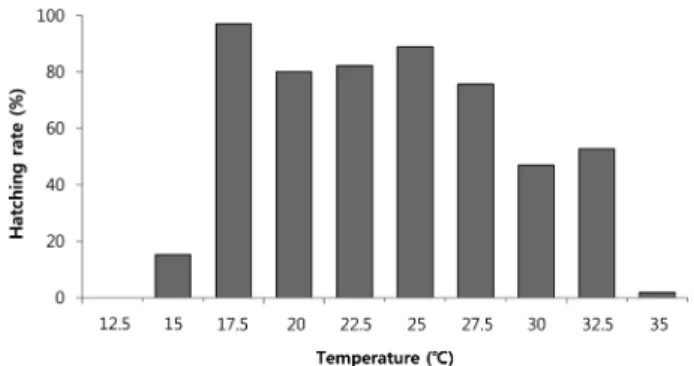
온도별 부화율은 17.5 ~ 27.5
oC 조건에서 70% 이상의 높 은 수치를 나타냈다. 이 온도 범위에서 벗어난 조건에서 는 60% 이하의 낮은 부화율을 보였다. 그리고, 15
oC 조 건에서 알에서 유충으로 부화하지 않았던 결과(Koo et al.
Fig. 1. Hatching rate of T. molitor eggs under different temperatures.
2013) 와는 달리, 이 실험에서는 비록 작은 수치이지만 약 17% 의 부화율을 보였다(그림 1). 이 결과는 갈색거저리가 다양한 온도 범위 안에서 부화가 가능하다는 것을 보여
주었다. 더 나아가, 15
oC 와 35
oC 에서 부화한 유충의 여러 생리적인 특징들을 밝히는 실험을 하여 생존한계 온도를 구명하는 것 또한 중요한 연구가 될 것이라고 생각되었다.
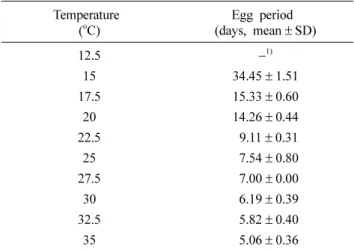
부화 전 기간은 온도가 15
oC 에서 35
oC 로 올라가면서 짧 아지는 것을 알 수 있었고, 반면에 온도가 내려갈수록 기 간이 길어지는 것을 관찰할 수 있었다. 특히 15
oC 조건에 서는 다른 조건에 비해 부화 전 기간(34.45
±1.51 일)이 상 당한 차이가 있었다 (표 1). 대량사육 후, 유통하는 시간 의 신속성을 생각한다면 5 ~ 7일 정도의 부화 기간을 가 진 25 ~ 35
oC 조건이 가장 알맞았다. 더불어, 부화율과 산 란 전 기간을 같이 고려했을 때, 가장 적절한 온도는 25 ~ 27.5
oC 였다. 이는 예전의 갈색거저리 사육 최적온도 의 결과와도 일치하였다(Punzo and Mutchmor 1980).
온도별 유충의 개별사육과 집단사육에 따른 생리적 특 성을 밝히는 실험에서는(표 2 ~ 3) 모든 온도 조건에서 집 단사육을 한 실험군의 유충 발육기간이 개별사육한 실험 군보다 짧았으며, 17.5
oC 조건에서 개별사육할 경우 유충 은 생존할 수 없었다. 그리고, 집단사육조건에서 17.5
oC 에
Table 1. Egg period of T. molitor under different temperaturesTemperature (oC)
Egg period (days, mean± SD)
12.5 −1)
15 34.45± 1.51
17.5 15.33± 0.60
20 14.26± 0.44
22.5
09.11
± 0.3125
07.54
± 0.8027.5
07.00
± 0.0030
06.19
± 0.3932.5
05.82
± 0.4035
05.06
± 0.361)Not survived.
Table 2. Developmental periods of larvae and pupae, body weights of pupae and adults, and body sizes of adults under different temperatures by individual rearing
Temperature (oC)
Larval period (days)
Pupal period (days)
Pupal weight
(mg)
Adult weight
(mg)
Adult body size
(mm) 30 165.06± 15.90b1)
06.00
± 1.18c 140.00± 0.04b 120.00± 0.03b 14.80± 0.18a 27.5 158.30± 11.06b06.33
± 2.11c 160.00± 0.05b 130.00± 0.04b 15.10± 0.16a 25 157.35± 7.85b 10.20± 1.66b 210.00± 0.03a 180.00± 0.03a 16.30± 0.09a 22.5 199.00± 8.72a 13.20± 1.10a 160.00± 0.03b 120.00± 0.03b 14.60± 0.09a 20 204.14± 15.35a 14.00± 2.10a 190.00± 0.03ab 160.00± 0.03ab 15.30± 0.15a17.5 −2) −2) −2) −2) −2)
The values are indicated as mean± SD.
1)Means within each column followed by the same letter are not significantly different at P< 0.05 by Tukey HSD method.
2)Not survived.
Table 3. Developmental periods of larvae and pupae, body weights of pupae and adults, and body sizes of adults under different temperatures by mass rearing
Temperature (oC)
Larval period (days)
Pupal period (days)
Pupal weight
(mg)
Adult weight
(mg)
Adult body size
(mm) 30
0129.01
± 24.93c1)06.76
± 3.19d 180.00± 0.03b 140.00± 0.03b 15.60± 0.12b 27.5 126.56± 18.80d06.51
± 1.19d 170.00± 0.03b 150.00± 0.03b 15.60± 0.12b 25 135.89± 14.73c08.48
± 1.58c 200.00± 0.04a 160.00± 0.03a 16.20± 0.14a 22.5 158.64± 13.91b 13.88±2.75b 170.00± 0.02b 140.00± 0.02b 15.60± 0.10b 20 168.59± 14.12b 15.50± 3.79b 180.00± 0.03b 150.00± 0.03b 015.80± 0.09ab 17.5 215.88± 16.55a 20.24± 3.31a 180.00± 0.03b 160.00± 0.08a 15.50± 0.11b The values are indicated as mean ± SD.1)Means within each column followed by the same letter are not significantly different at P< 0.05 by Tukey HSD method.
서 25
oC 로 온도가 올라갈수록 유충 발육기간이 짧아짐을 관찰할 수 있었으며, 반면에, 30
oC 조건에서는 오히려 27.5
oC(126.56 일) 조건보다 긴 129.01일의 발육기간을 가 졌다. 개별사육한 실험군에서는 25
oC 조건에서 유충 발육 기간이 126.56일로 가장 짧았다. 이 결과는 유충 15마리 에게 여러 온도 조건 중, 30
oC 조건에서 유충 발육기간이 110.8 일로 가장 짧았던 결과와 다소 차이가 있었다(Koo et al. 2013). 이러한 차이는 위 실험에서, 사육 시 개별사 육과 집단사육이 여러 생리적 차이를 보인 것처럼, 10마 리와 15마리 사이에서도 밀도 변화에 따른 생리적 차이 를 나타낼 가능성이 크다고 생각되었다. 따라서 향후 다 양한 밀도로 여러 생리적 특징을 구명하는 연구가 필요 하다고 판단되었다.
번데기 기간은 집단사육 시, 27.5
oC 조건에서 6.51일로 가장 짧았고, 개별사육 시에는 30
oC 조건에서 6일로 가장 짧았다. 번데기 무게는 집단사육과 개별사육 모두 25
oC 조건에서 각각 200 mg, 210 mg으로 가장 높았으며, 성충 무게도 25
oC 조건에서 가장 높았고(집단사육: 160 mg, 개 별사육: 180 mg) 체장 역시, 25
oC 조건에서 집단 및 개별 사육 모두 각각 16.20 mm, 16.30 mm로 가장 길었다.
성충화율은 집단사육한 실험군에서 개별사육보다 높은 수치를 보였다(그림 2). 특히, 집단사육 시 22.5
oC 조건에 서 89%로 가장 높았으며, 20
oC 와 25
oC 조건에서도 각각
83%, 77% 로 높은 우화율을 보였다. 개별사육에서는 27.5
oC 에서 55%로 가장 높았으며, 나머지 조건에서도 대체적으 로 낮은 성충화율을 나타냈다. 갈색거저리의 수요 탄력성 을 고려한다면, 유충과 번데기 기간이 짧아야 함과 동시 에 우화율도 높아야 하며, 번데기와 성충의 무게 그리고 성충 역시 영양상태에 문제가 없어야 할 것이다. 이를 모 두 만족시키는 조건은 25
oC 에서 집단사육한 실험군이었다.
광주기별 생리적 특성을 밝히는 실험에서는 광주기가 14L : 10D 조건일 때 유충기간(157.35일)이 짧았으며, 번데 기 기간은 12L : 12D 조건에서 8.65일로 가장 짧았다. 번 데기 무게는 12L : 12D와 10L : 14D조건에서 220 mg으로 가장 크게 증가되었지만, 우화 후 성충무게는 모든 조건 에서 180 mg으로 동일하였다. 12L : 12D 조건에서 성충의 체장은 가장 길었고, 성충화율도 가장 높았다. 이 결과를 종합해 볼 때, 비록 14L : 10D 조건에서의 성충화율이 12L : 12D 조건보다 조금 낮았지만, 유충기간이 한 달 정 도 빠르게 진행됨을 알 수 있었다. 따라서, 수요의 탄력 성을 고려한다면 14L : 10D조건이 가장 적합함을 알 수 있었다. 하지만 대체적으로 낮은 성충화율을 나타냈기 때 문에, 향후 적합한 광주기를 찾아 생산성을 효율적으로 증대시키는 연구가 필요할 것이다. 더불어, 표 2 ~ 3과 그 림 2에서 집단사육과 개별사육의 결과가 다르게 나온 것 처럼, 이 실험 역시 다른 광주기 조건에 따른 집단사육과 개별사육의 생리적 특성의 차이를 보일 것이라 생각되었다.
적 요
갈색거저리의 산업 활용도가 높아짐에 따라, 효율적인 실내 대량사육 시스템의 확립이 더욱 중요하게 인식되고 있다. 본 연구는 대량사육을 위해 다양한 범위의 온도, 광 주기, 사육밀도에서 갈색거저리의 생리적 특성을 알아보 고자 수행되었다. 갈색거저리 알은 17.5 ~ 27.5
oC 에서 70%
이상의 부화율을 나타냈고, 부화기간은 25 ~ 35
oC 에서 5 ~ 7 일로 조사되었다. 결과적으로, 부화율과 산란 전 기간(egg periods) 을 고려했을 때, 대량사육을 위해 적절한 실내온
Table 4. Developmental periods of larvae and pupae, body weights of pupae and adults, body sizes of adults, and eclosion rate under various photoperiod conditions at 25oCPhotoperiod
Larval period (days)
Pupal period (days)
Pupal weight
(mg)
Adult weight
(mg)
Adult body size
(mm)
Eclosion rate (%) 14L : 10D 157.35±7.85b1) 10.20±1.66b 210.00±0.03a 180.00±0.03a 16.30±0.09a 45.50 12L : 12D 184.89± 16.76a 08.65±2.40a 220.00±0.02a 180.00±0.03a 16.90±0.09a 51.50 10L : 14D 179.56± 30.22a 09.75±1.75a 220.00±0.06a 180.00±0.04a 16.40±0.14a 24.20 The values are indicated as mean ± SD.
1)Means within each column followed by the same letter are not significantly different at P< 0.05 by Tukey HSD method.
Fig. 2. Eclosion rate of T. molitor under different temperatures and rearing types.
도는 25 ~ 27.5
oC 였다. 다양한 온도 조건하에서 대량사육 시스템에서 유충의 발육기간은 개별사육 시스템에서 보다 더 짧았다. 번데기 무게는 20
oC 와 25
oC 를 제외한 대량사 육 시스템에서 좀 더 높게 관찰되었다. 수요 탄력성과 생 산중량을 고려했을 때, 가장 효과적인 조건은 25
oC 에서 대량사육한 실험군이었다. 14L : 10D의 광주기 조건에서 157.35 일로 가장 짧은 유충기간을 나타냈다.
감사의 글
본 연구는 농림축산식품부 생명산업기술개발사업(과제 번호: 312026-3, 세부과제명: 사료용 곤충 대량 생산 기술 개발)의 지원을 받아 이루어진 것입니다.
References
Abdullah M (1961) Behavioural effects of temperature on insects.
Ohio J Sci 61(4), 212~219.
Audas A, Hogan GR, Razniak H (1995) Incubation temperature as a modifying factor on survival of Tenebrio molitor reared in selenium-containing media. J Toxicol Environ Health 44(1), 115~122.
Bryning GP, Chambers J, Wakefield ME (2005) Identification of a sex pheromone from male yellow mealworm beetles, Tene- brio molitor. J Chem Ecol 31(11), 2721~2730.
Drnevich JM, Papke RS, Rauser CL, Rutowski RL (2001) Mate- rial benefits from multiple mating in female mealworm beetles (Tenebrio molitor L.). J Insect Behav 14(2), 215~230.
Fiore C (1960) Effects of temperature and parental age on the life cycle of the dark mealworm, Tenebrio obscurus Fabricius. J N Y Entomol Soc 68(1), 27~35.
Huang Q, Zhou ZJ, Zhou DG, Hu J, Yang W, Yang CP (2006) Analysis of nutritional component of Tenebrio molitor L.
pupa. Sichuan J Zool 25(4), 809~813.
Huang Q, Zhou ZJ, Zhou DG, Hu J, Yang W, Yang CP (2007) Analysis of nutritional components of seven species of insects.
Acta Nutr Sin 29(1), 94~96.
Huang Q, Hu J, Zhou DG, Sun L, Ruan HB, Wang XN, Chen G, Zhu TH, Yang CP, Yang W (2011) Comparison of growth, development, survivorship and food utilization of two color varieties of Tenebrio molitor (Coleoptera: Tenebrionidae).
Acta Entomol Sin 54(3), 286~292.
Jung BH (2012) Insect fauna of Korea. vol.12, no.5, Darkling Bee- tles Arthropoda: Insecta: Coleoptera: Tenebrionidae: Tene-
brionae / national institute of biological resources, flora and fauna of Korea, national institute of biological resources press, Korea.
Kim SY, Chung TH, Kim SH, Song SH, Kim NJ (2014) Recycling agricultural wastes as feed for mealworm (Tenebrio molitor).
Korean J Appl Entomol 53(4), 365~371.
Koo HY, KIM SG, Oh HK, Kim JE, Choi DS, Kim DI, Kim IS (2013) Temperature-dependent development model of larvae of mealworm beetle, Tenebrio molitor L. (Coleoptera: Tene- brionidae). Korean J Appl Entomol 52(4), 387~394.
Lemos WP, Ribeiro RC, Ramalho FS, Serrao JE, Zanuncio JC (2011) The reproductive tract of the males of the zoophy- tophagous predator Brontocoris tabidus (Signoret) (Het- eroptera: Pentatomidae) with different diets and ages. Am J Agr Sci 6(1), 12~18.
Li LY, Zhaob Z, Liua H (2012) Feasibility of feeding yellow meal- worm (Tenebrio molitor L.) in bioregenerative life support systems as a source of animal protein for humans. Act Ast- rona, 92(1), 103~109.
Megido RC, Sablon L, Geuens M, Brostaux Y, Alabi T, Blecker C, Drugmand D, Haubruge E, Francis F (2013) Edible insects acceptance by Belgian consumers: promising attitude for ento- mophagy development. J Sensory Stud 29(1), 14~20.
Oonincx DGAB (2012) Environmental impact of the production of mealworms as a protein source for humans-a life cycle assessment. PLoS ONE 7(12), e51145.
Park JB, Choi WH, Kim SH, Jin HJ, Han YS, Lee YS, Kim NJ (2014) Developmental characteristics of Tenebrio molitor lar- vae (Coleoptera: Tenebrionidae) in different instars. Int J Indust Entomol 28(1), 5~9.
Punzo F, Mutchmor JA (1980) Effects of temperature, relative humidity and period of exposure on the survival capacity of Tenebrio molitor (Coleoptera: Tenebrionidae). J Kansas Ento- mol Soc 53(2), 260~270.
Silva O (2012) A study of the effect of a compromised immune system on Tenebrio molitor exposed to environmental bacteria and fungi at increasing temperatures. STEM research project mass academy of math and science, pp. 1~28.
Tanaka Y, Honda H, Ohsawa K, Yamamoto I (1986) A sex attrac- tant of the yellow mealworm, Tenebrio molitor, and its role in mating behavior. J Pest Sci 11, 49~55.
Ye XQ, Su P, Hu C (1997) Chemical analysis and evaluation of protein and fat for yellow mealworm (Tenebrio molitor L.). J Zhejiang Agric Univ 23(S), 35~38.
Yoo JM, Hwang JS, Goo TW, Yun EY (2013) Comparative anal- ysis of nutritional and harmful components in Korean and Chi- nese mealworms (Tenebrio molitor). J Korean Soc Food Sci Nutr 42(2), 249~254.