www.earticle.net
고온기 온 ․ 습도에 따른 산란계의 생산성 분석
천시내1,2․이준엽2․전중환2*
경상대학교 대학원 응용생명과학부1,2, 농촌진흥청 국립축산과학원 축산환경과2
Analysis on Laying Hens’ Performance under High Ambient Temperature
Si-Nae Cheon1,2, Jun-Yeob Lee2 and Jung-Hwan Jeon2*
1Division of Applied Life Science, Gyeongsang National University, Korea
2National Institute of Animal Science, R.D.A., Korea
ABSTRACT1)
There is no doubt that global warming and climate change affect animal production and sustainability of livestock systems. High ambient temperature and humidity have detrimental effects on the performance of laying hens. The aim of this study was to evaluate the influence of cyclic temperatures on the performance and egg quality of laying hens during the summer in Korea. A total of 1028 Hy-Line Brown layers were reared in the open floor house and exposed to a 24 hr linear temperature cycle ranging from 21.7 to 33.0℃.
Feed intake significantly decreased and cracked eggs increased under high ambient temperature or high THI (Temperature Humidity Index). Egg production was decreased gradually from 21 to 29℃ or from 21 to 26 THI. On the other hens, it was increased above 30℃ or 27 THI rather than decreased. High ambient temperature has no important impact on dirty eggs and mortality in this study. We believe that present data contribute to predict the effect of thermal conditions on the performance of laying hens by using ambient temperature or THI.
(Key words: Heat stress, Ambient temperature, Humidity, Production performance, Laying hens)
Ⅰ. 서론
지구온난화(global warming)와 기후 변화(climate change)는 세계적으로 가장 큰 이슈가 되고 있는 지구환경 문제로, 미국 항공우주국(National Aeronautics and Space Administration: NASA)과 국립해양대기청(National Oceanic and Atmospheric Administration: NOAA)은 지난 2014년 지구표면의 온도가 1880년 보다 평균 0.8℃ 가 더 상승한 역사상 가장 더운 해였다고 발표한 바 있다. 최근 우리나라 도 여름이 길어지고 기온이 상승하는 등 이상기후 현상에
의해 농업, 축산업, 수산업 분야 등에서 피해가 속출하고 있다. 특히 축산 분야에서 환경온도는 가축의 생산성과 직 접적으로 연관이 있으므로 매우 중요하다. 여름철 고온으 로 인한 지나친 열 스트레스는 가축의 생산성 저하뿐만 아 니라 심각할 경우 폐사로 이어져 농가에 막대한 경제적 손 실을 야기한다(Cavestany 등, 1985; Huber 등, 1994;
Oguntunji와 Alabi, 2010; Tůmova와 Gous, 2012; Vercese 등, 2012; Xin과 DeShazer, 1992). 기후 과학자들이 지구의 기온상승 속도가 점점 더 빨라질 것이라 예측하고 있는 가 운데, 우리나라도 온대기후에서 아열대기후로 변하게 될
* Corresponding author: Jung-Hwan Jeon, Animal environment division, National Institute of Animal Science, R.D.A., Wanju 565-851, Korea. Tel: +82-63-238-7407, E-mail: [email protected]
This is an Open Access journal distributed under the teams of the Creative Commons Attribution Non-Commercial License (http://creativecommons.org/licenses(by-nc/3.0) which permits unrestricted non-commercial use, and reproduction in any medium, provided the original work is properly cited.
[Provider:earticle] Download by IP 118.70.52.165 at Monday, December 20, 2021 7:57 PM
www.earticle.net
것을 감안하여 가축의 고온대비를 위한 방안을 마련해야 할 것이다.
모든 항온동물은 건강하게 생활하고 높은 생산성을 발 휘할 수 있는 열적중성역(thermoneutral zone)이라는 주변 환경온도의 범위가 있는데, 열적중성역에서 최저점의 온도 를 저온임계온도(lower critical temperature)라고 하며, 최고 점의 온도를 고온임계온도(upper critical temperature)라고 한다. 즉, 가축의 고온 스트레스는 고온임계온도와 관련 있 으며, 고온임계온도는 열에 의한 스트레스가 동물에 영향 을 미치기 시작하는 지점이라 할 수 있다(Yoon, 2013). 닭 은 40.6-41.7℃ 의 체온을 갖는 온혈동물로 주변온도로부터 스스로 체온조절이 가능하다. 그러나 몸 전체가 깃털로 쌓 여있을 뿐만 아니라 땀샘이 발달되어 있지 않아 고온에 있 어 매우 취약하다. 고온에 노출되면 특히 사료섭취량이 감 소하게 되는데, 사료섭취량의 감소는 체내의 영양 및 호르 몬 등의 균형 파괴와 증체량 감소, 면역력 저하 등의 부정 적인 결과를 초래한다(Lin 등, 2006; Tao 와 Xin, 2003). 최 근 이상 고온현상의 지속적인 발생으로 가금 산업에서는 고온스트레스로 인한 육계의 증체량 감소와 산란계의 산 란율 및 계란품질 저하에 대한 문제가 급속히 부각되고 있 으며, 고온 스트레스와 관련하여 많은 연구가 수행되고 있 다(Altan 등, 2003; Lin 등, 2006; Mashaly 등, 2004;
Sandercock 등, 2001; Sterling 등, 2003; Zhang 등, 2012).
가축의 열 스트레스에 영향을 주는 요인으로는 온도 이 외에도 습도, 풍속, 태양복사열 등이 있다. 미국의 기후학 자 Thom(1959)은 온도와 습도를 이용하여 처음 THI (Temperature Humidity Index: 온 습도지수)를 보고한 바 있으며, 최근에는 온 ․ 습도뿐만 아니라 풍속까지 고려한 THVI(Temperature Humidity Velocity Index) 계산식이 연구된 바 있다(Tao 와 Xin, 2003). THI 또는 THVI 는 가축 의 고온스트레스를 측정하는데 가장 보편적으로 사용되고 있는 방법으로, 학자들마다 계산 공식에 있어 차이가 있으 며, 가축의 종에 따라 달라지기도 한다(Brown-Brandl 등, 1997; Kabuga, 1992; Tao 와 Xin, 2003; Xin 등, 1992).
따라서 본 연구는 우리나라 여름철 온·습도에 따른 산란 계의 생산성을 규명하기 위하여 실시하였다. 또한 THI 수 식을 이용하여 생산성을 분석해봄으로써 향후 국내 사육 여건을 고려한 THI 지표 설정 및 여름철 산란계 사양관리 시스템을 구축하는데 기초자료로써 활용 가능할 것으로 기대된다.
Ⅱ. 재료 및 방법
1. 공시동물 및 사육시설
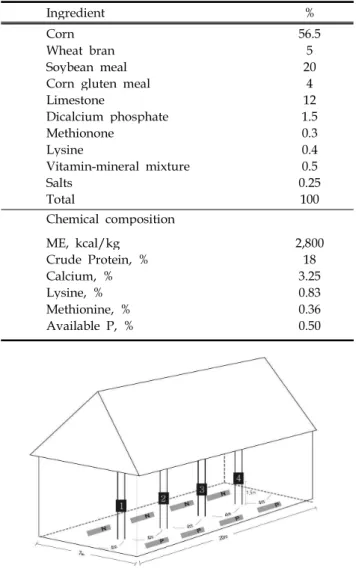
Hy-Line Brown 계열의 80 일령 산란계 1,028 수를 평사 에 공시하였으며 산란계사는 윈치커튼을 이용한 개방형 축사로 바닥 면적은 7x20m 이었다. 국내 산란계 동물복지 인증기준에 부합되도록 횃대(15cm/수)와 산란상(12 수/㎡) 등을 제공하였으며, 바닥에는 왕겨를 3cm 두께로 깔아주 었다. 축사 내 열 환경을 측정하기 위해서 총 4 개의 센서 를 축사바닥으로부터 1.5m 위치한 곳에 설치하였다(Fig.
1). 사료는 오전(05:30)과 오후(16:30), 하루 2 회 급여하였으 며(Table 1), 물은 자유 급이 하였다. 실험은 2014 년 7 월부
Table 1. Composition of experimental diets for laying hens
Ingredient %
Corn Wheat bran Soybean meal Corn gluten meal Limestone
Dicalcium phosphate Methionone
Lysine
Vitamin-mineral mixture Salts
Total
56.5 205 124 1.50.3 0.4 0.250.5 100 Chemical composition
ME, kcal/kg Crude Protein, % Calcium, % Lysine, % Methionine, % Available P, %
2,800 18 3.250.83 0.36 0.50
Fig. 1. Schematic of the open floor house reared laying hens in this experiment.
(1~4: Thermo-hygrometer, N: Nest boxes, P: Perches)
[Provider:earticle] Download by IP 118.70.52.165 at Monday, December 20, 2021 7:57 PM
www.earticle.net
터 8 월까지 수행되었으며, 실험기간 동안 자연조명(명기 14 시간, 암기 10 시간) 이외에 인공조명은 사용하지 않았다.
2. 조사항목 및 조사방법
1) 온 ․ 습도
축사내부의 건구온도와 상대습도를 1시간 간격으로 측 정하여 일일 평균으로 데이터를 분석하였으며, 또한 Psychrometric chart를 이용하여 습구온도의 값을 계산하 였다. 산란계의 THI는 다음의 식을 이용하여 산출하였다 (Zulovich와 DeShazer, 1990).
THI layer = 0.6 Tdb + 0.4 Twb THI = Temperature Humidity Index Tab = dry-bulb temperature (℃) Twb = wet-bulb temperature (℃)
2) 생산성
실험기간 동안 매일 산란수, 파란수, 오란수, 폐사수 및 사료섭취량을 조사하였으며, 축사내부의 열 환경에 따른 산란계의 생산성을 분석하기 위해 온도와 THI 의 값을 기 준으로 범위를 분류하여 비교하였다. 축사내부 온도를 기 준으로 3구간(21-23℃, 24-26℃, 27-29℃, 30℃ 이상)으로 분 류(Vercese 등, 2012), THI 값을 기준으로 2구간(21-25, 26-30)으로 분류(Kilic과 Simsek, 2013) 그리고 THI 값을 기 준으로 3구간(21-24, 25-27, 28-30)으로 분류하여 각각의 데 이터를 분석하였다.
3) 계란품질
난질분석은 30주령에 산란된 계란 20개를 대상으로 난 각 두께, 난각 강도, 난중, 난각색, 난황색, 난백 높이, HU (Haugh Unit)를 측정 조사하였다. 난각 두께는 micrometer (NSK, Japan), 난각 강도는 FHK(Fujihara, Japan)를 이용 하여 측정하였다. 그리고 난중, 난각색, 난황색, 난백 높이 및 HU는 QCM+(Instrument Rage Operating Instruction, TSS, England)를 이용하여 측정하였다.
3. 통계분석
본 시험에서 얻어진 모든 결과는 SAS(Statistical Analysis Systems Institute Inc., 2000)의 ANOVA를 이용하여 분석 하였으며, 처리구간의 유의성은 Duncan’s multiple range test(Duncan, 1955)를 이용하여 검사하였다.
Ⅲ. 결과 및 고찰
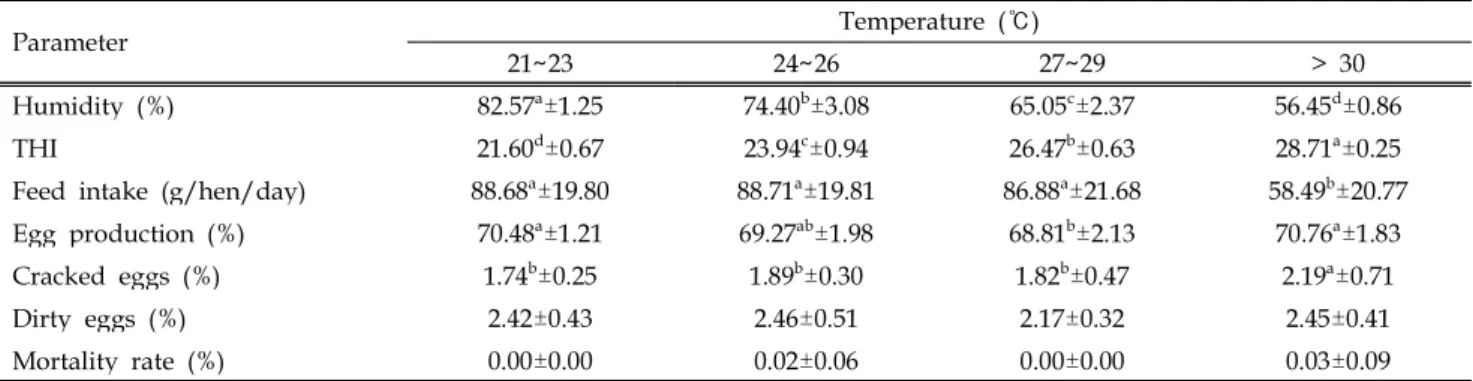
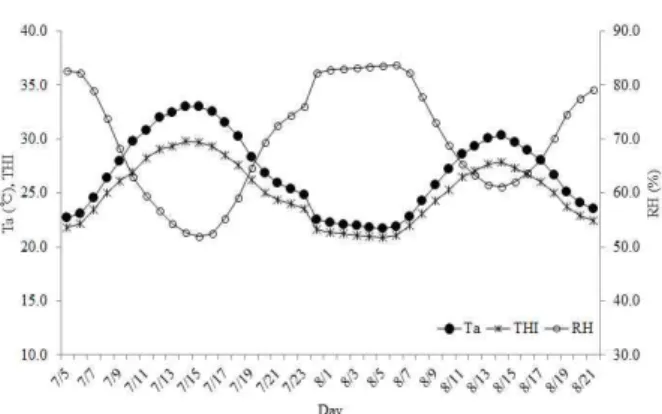
본 실험기간 동안 계사 내 온도와 습도를 측정한 결과, 각각 평균 26.84℃(21.74-33.04℃), 70.16%(51.86-83.66%)이 었으며, THI 는 평균 25.03(21.09-29.79)으로 조사되었다 (Table 2). 산란계의 생산성은 온·습도에 영향을 받는 것으 로 나타났다. 27℃ 이상의 온도에서는 산란계의 사료섭취 량이 감소하기 시작하였으며(p<0.05), 산란율은 온도가 올 라갈수록 감소하다가 30℃ 이상의 온도에서 다시 증가하 였다(p<0.05). THI 28-30 에서는 사료섭취량 감소와 산란율 및 파란율의 증가를 나타냈다(p<0.05). 그리고 계란품질의 결과는 Table 3 에 표기하였다.
계란을 생산하는 산란계는 육계보다 고온 스트레스에 있어 더욱 민감하다(Clark 와 Sarakoon, 1967). 최근 산란 계의 적정 사육온도를 18-24℃, 그리고 생산성에 있어 가장 이상적인 온도를 21℃라고 한 바 있다(Holik, 2009). 25℃
이상의 온도에서는 고온 스트레스의 영향으로 산란계의 건강과 생산성에 부정적인 영향을 미치게 된다(Mashaly, 2004; Muiruri 와 Harrison, 1991; Peguri 와 Coon, 1991;
Seven, 2008; Vercese 등, 2012). Vercese 등(2012)은 21℃를 기준으로 환경온도가 3℃씩 상승함에 따라 산란계의 생산 성 및 계란품질에 미치는 영향에 대하여 연구를 수행하였 으며 그 결과, 27℃에서 사료섭취량과 난중, 난각 두께가 모두 감소하기 시작하였다. 따라서 계사 내부 온도가 27℃
이상일 때 산란계가 고온 스트레스를 받기 시작한다고 하 였으며, Peguri 와 Coon(1991)도 비슷한 결과를 보고한 바 있다. 본 실험에서도 27℃에서 사료섭취량이 감소하기 시 작하였다(Table 4). 고온으로 인한 열 스트레스가 산란계의
Table 2. Environmental conditions measured during the experiment period
Parameters July August Total Range
Temperature (℃) 28.49±3.66 25.40±3.16 26.84±3.63 21.74-33.04
Humidity (%) 65.69±10.92 74.03±8.66 70.16±10.35 51.86-83.66
THI 26.83±2.79 24.03±2.53 25.03±2.83 21.09-29.79
[Provider:earticle] Download by IP 118.70.52.165 at Monday, December 20, 2021 7:57 PM
www.earticle.net
Table 3. Descriptive statistics of egg quality parameters
Parameters Means±SD
Egg weight (g) Eggshell color
Eggshell thickness (mm) Eggshell weight (g) Eggshell strength (kg/㎠) Yolk color
Albumen height (mm) Haugh Unit (HU)
54.93±6.00 27.99±3.95 0.35±0.02 7.24±0.66 4.82±1.06 8.17±0.90 6.81±1.55 83.19±11.03
Table 4. The effects of exposing laying hens at different ambient temperature on production performance
Parameter Temperature (℃)
21~23 24~26 27~29 > 30
Humidity (%) 82.57a±1.25 74.40b±3.08 65.05c±2.37 56.45d±0.86
THI 21.60d±0.67 23.94c±0.94 26.47b±0.63 28.71a±0.25
Feed intake (g/hen/day) 88.68a±19.80 88.71a±19.81 86.88a±21.68 58.49b±20.77 Egg production (%) 70.48a±1.21 69.27ab±1.98 68.81b±2.13 70.76a±1.83
Cracked eggs (%) 1.74b±0.25 1.89b±0.30 1.82b±0.47 2.19a±0.71
Dirty eggs (%) 2.42±0.43 2.46±0.51 2.17±0.32 2.45±0.41
Mortality rate (%) 0.00±0.00 0.02±0.06 0.00±0.00 0.03±0.09
a~d Means with different superscripts in the same row were significantly different (p<0.05).
사료섭취량을 감소시키는 이유는 대개 사료섭취로 인해 추가적으로 발생되는 열에너지를 줄이기 위함으로(De Andrade 등, 1977; Kirunda 등, 2001; Muiruri 와 Harrison, 1991), Hurwitz 등(1980)은 고온에 대한 산란계의 첫 스트 레스 반응을 식욕감퇴라고 한 바 있다. 또한 Mashaly (2004)에 의하면, 산란계가 23.9-35℃의 자연 환경에 노출 되면 적온(24℃) 환경에서 보다 사료섭취량이 감소하지만, 35℃의 고온 환경에서는 사료섭취량 뿐만 아니라 산란율, 난중, 난각 무게 및 두께가 모두 감소하였다. 또한 Lin 등 (2004)은 20℃에서 32℃로 환경온도가 상승할 때, 난각 두 께가 346.5 ㎛에서 326.6 ㎛로 감소하고 파란율이 8.7%에서 33.3%로 급격히 증가한다고 보고한 바 있다. 본 연구에서 도 30℃ 이상의 온도에서 파란율이 급격히 증가한 것으로 보아 고온 스트레스가 난각 품질에 영향을 미쳤을 것으로 판단된다.
고온 환경이 산란계의 산란율에 있어 크게 영향을 미치 지 않는다는 몇몇 연구결과(Roland 등, 1996; Yahav 등, 2000; Yoshida 등, 2011)와 달리, Vercese 등 (2012) 은 36℃
에서, Ugurlu 와 Topak (2002)은 27℃에서 산란율이 감소 하기 시작한다고 주장하였다. 본 시험에서는 21℃에서 2 9℃까지 산란율이 점점 감소하다가 30℃ 이상에서 다시 원 래 수준으로 유지되었으며, 이는 환경온도의 급격한 상승
이 산란계의 급성 스트레스를 유발하여 산란율이 순간적 으로 감소하였다가 이후 점점 회복되었기 때문으로 판단 된다. 또한 일평균기온이 30℃ 이상인 경우가 대부분 실험 초반에만 일시적으로 나타났기 때문에 고온에 대한 산란 계의 만성 스트레스가 없었던 것으로 판단된다. Mashaly 등(2004)는 자연 환경(23.9-35.0℃, 15-50%), 적온 환경(23.
9℃, 50%), 고온 환경(35℃, 50%)에서의 산란계의 생산성을 비교분석하였으며 그 결과, 자연 환경에서는 사료섭취량과 난중만이 감소하였으나 고온 환경에서는 산란율이 추가적 으로 감소하였다. 그리고 2-3 주 이후 산란율이 점차 회복 되는 경향을 보이다가 4-5 주부터 다시 감소하게 되는데, 이를 고온 환경에 대한 급성 및 만성 스트레스 때문이라고 하였다. Muinuri 와 Harriso (1991)은 산란계를 25℃에서 2 주간, 그리고 35℃에서 3 주간 노출시킨 다음 다시 25℃에 서 2 주간 회복기간을 제공하였더니 회복기간 동안 사료섭 취량은 점차 증가하지만, 산란율의 경우 오히려 13.5% 더 감소되었다고 보고한 바 있다. 따라서 주어진 환경온도에 대한 산란계의 적응 수준에 따라 생산성 및 계란품질에 미 치는 영향에 차이가 있을 것으로 생각된다. 환경의 변화에 대한 민감도는 개체 또는 품종에 따라 다르며, 최근 고온 에 대한 적응력이 높은 품종개량이 요구되고 있다. 이외 오란율과 폐사율에 있어서는 유의적인 차이가 없었다.
[Provider:earticle] Download by IP 118.70.52.165 at Monday, December 20, 2021 7:57 PM
www.earticle.net
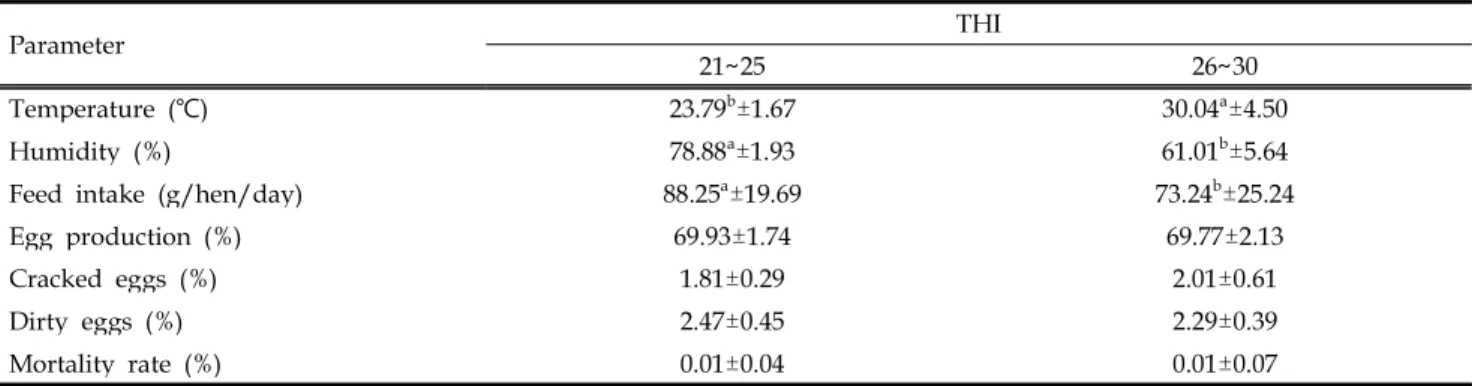
환경온도뿐만 아니라 가축의 고온 스트레스를 가중시키 는데 습도 또한 매우 중요하다. 같은 온도에서도 습도에 따라 체감 온도가 다르기 때문이다. 따라서 보다 효과적인 고온 스트레스 감소를 위해서는 축사내부 온도뿐만 아니 라 습도를 감안해야만 한다. 본 시험에서는 산란계의 체감 온도를 수치화하기 위하여 Zulovich 와 DeShzer(1990)의 THI 수식을 이용하였다. 이들의 THI 수식은 습도보다 온 도에 더 영향을 받는다고 할 수 있다. 따라서 온도의 범위 가 높을수록 THI 값이 높아지는데, Fig. 2 에서도 확인되어 진다. 본 실험에서는 THI 범위를 Kilic 과 Smisek(2013)를 따라 2 단계(21-25 와 26-30)로 나누어 생산성을 분석하였다 (Table 5). 그 결과, Kilic 과 Smisek(2013)은 THI-29 에서 THI-25 보다 사료섭취량과 산란율이 25% 감소하고 폐사율 이 5% 증가하였지만, 본 시험에서는 사료섭취량 이외 다 른 파라미터에서는 유의적인 차이가 없는 것으로 나타났 다. Kilic 과 Smisek(2013)는 평균 온도가 31.2℃로 본 실험 보다 약 4.4℃가 더 높고, 평균 습도는 44.7%로 약 25.5%가 더 낮았기 때문에 이러한 차이가 나타난 것으로 판단된다. Emery 등(1984)에 의하면, 사육시설 내부 평균온도가 26.
7℃인 자연 환경과 24℃로 유지된 환경에서 산란계의 생산 성 및 계란품질 비교하였을 때 어떠한 차이도 없었다. 그 러나 평균온도가 29.4℃로 증가하자 사료섭취량, 산란율, 난각 두께의 감소가 나타났다. 따라서 본 연구에서는 THI 범위를 다시 3 단계로 세분화하여 데이터를 분석하였다 (Table 6). 그 결과, THI 21-24 와 THI 25-27 에서는 유의적 인 차이가 없었지만, THI 28-30 에서 사료섭취량이 감소하 고 산란율과 파란율이 증가하였다. 예상과 달리, THI 값이 가장 높은 구간임에도 불구하고 산란율이 오히려 증가한 이유에 대해서는 정확한 원인을 알 수가 없었으나, 실험기 간 동안 다양한 온 ․ 습도에 노출되면서 고온 스트레스로부 터 빠르게 회복되었을 것이라 생각된다. 한편, 본 실험기간 동안 사료섭취량과 산란율이 전체적으로 낮게 조사되었는 데, 때 이른 무더위의 기승으로 산란계의 고온 스트레스가 이미 누적된 상태였을 것으로 판단된다. 그러나 명확한 원 인규명을 위해서는 질병에 의한 것인지에 대한 혈청 검사 등 추가적인 조사가 필요하다. 일부 연구에서는 산란계의 생산성이 사육환경보다 오히려 유전적 환경에 더 영향을 받는다고 보고된 바 있다(Franco-Jimenez 등, 2007; Sterling 등, 2003).
열 환경과 산란계의 생산성 및 계란품질에 대한 연구는 대부분 인위적으로 환경온도를 제어하기 위하여 케이지
사육을 통해서 수행되고 있다. Franco-Jimenze 등(2007)과 Lin 등(2004)는 본 실험과 동일한 품종의 산란계를 케이지 에 공시하여 고온 환경에 노출시켰으며 그 결과, 사료섭취 량과 산란율이 본 실험의 결과 보다 현저히 낮게 조사되었 다. 그러나 두 실험 모두 30℃ 이상의 고온 환경에 지속적 으로 산란계를 노출시켰기 때문에 열에 대한 스트레스가 더욱 심각한 수준이었을 것이다. Barbosa 등(2005)는 Hy-Line W36 과 Hy-Line Brwon 을 고온 환경에 노출시켰 을 때, 두 품종에서 모두 난중, 난각 두께, HU 의 감소가 나타났다고 보고하였다. 또한 Hy-Line Brown 에서는 사육형태에 따라 난각 품질의 차이가 있었으며, 동일한 온 도조건에서 케이지에서 생산된 계란이 평사 보다 난각 두 께가 더 얇은 것으로 조사되었다. 따라서 사육밀도 또는 사육형태가 산란계의 열 스트레스를 가중시키는 역할을 하는 것으로 생각된다.
본 실험은 인위적으로 온도를 조절하여 고온 스트레스 를 가한 것이 아니며, 자연 상태에서의 환경온도에서 산란 계의 생산성 및 계란품질을 분석한 것으로 온도가 항상 일 정하게 유지된 것이 아니기 때문에 산란계의 생산성과 계 란품질에 있어 큰 차이가 없었던 것으로 판단된다. 또한 사육환경의 개선을 통해 열 스트레스로 인한 피해를 어느 정도 극복할 수 있을 것으로 기대된다. 따라서 향후에는 자연 상태가 아닌 제한된 환경에서의 산란계의 생산성 분 석이 수행되어야 할 것이며, 케이지와 대체사육시설 등 다양한 사육형태에서 조사될 필요가 있다. 또한 국내 사육 여건에 맞는 산란계의 온습도지수 지표 마련을 위해 더욱 더 많은 연구가 수행되어야 할 것이다.
Fig. 2. Temperature, relative humidity and THI in the open floor house during July and August.
[Provider:earticle] Download by IP 118.70.52.165 at Monday, December 20, 2021 7:57 PM
www.earticle.net
Table 5. The effects of exposing laying hens at two different THI on production performance
Parameter THI
21~25 26~30
Temperature (℃) 23.79b±1.67 30.04a±4.50
Humidity (%) 78.88a±1.93 61.01b±5.64
Feed intake (g/hen/day) 88.25a±19.69 73.24b±25.24
Egg production (%) 69.93±1.74 69.77±2.13
Cracked eggs (%) 1.81±0.29 2.01±0.61
Dirty eggs (%) 2.47±0.45 2.29±0.39
Mortality rate (%) 0.01±0.04 0.01±0.07
a,b Means with different superscripts in the same row were significantly different (p<0.05).
Table 6. The effects of exposing laying hens at three different THI on production performance
Parameter THI
21~24 25~27 28~30
Temperature (℃) 23.79c±1.67 28.88b±3.16 32.19a±0.81
Humidity (%) 78.88a±4.50 64.41b±3.16 54.69c±2.74
Feed intake (g/hen/day) 88.25a±19.69 86.49a±20.73 48.64b±0.00
Egg production (%) 69.93b±1.74 68.77b±1.85 71.64a±0.83
Cracked eggs (%) 1.81b±0.29 1.78b±0.38 2.44a±0.72
Dirty eggs (%) 2.47±0.45 2.19±0.36 2.48±0.37
Mortality rate (%) 0.00±0.04 0.02±0.08 0.00±0.00
a~c Means with different superscripts in the same row were significantly different (p<0.05).
Ⅳ. 요약
여름철 고온으로 인한 지나친 고온 스트레스는 가축의 생산성 저하뿐만 아니라 심각할 경우 폐사로 이어져 농가 에 막대한 경제적 손실을 초래한다. 기후 과학자들이 지구 의 기온상승 속도가 점점 더 빨라질 것이라 예측하고 있는 가운데, 우리나라도 아열대기후로 변하게 될 것을 감안하 여 가축의 고온대비를 위한 방안을 마련이 필요하다. 그러 나 아직 국내에서는 이와 관련된 연구 및 자료가 매우 부 족한 실정이다. 따라서 본 연구는 우리나라 여름철 온 ․ 습 도에 따른 산란계의 생산성을 분석하기 위하여 실시하였 다. 80 일령의 Hy-Line Brown 계열 산란계 1,028 수를 평 사에 공시하여 매일 산란수, 파란수, 오란수, 폐사수 및 사 료섭취량을 기록하였으며, 또한 축사 내 열 환경을 측정하 기 위해서 총 4 개의 센서를 이용하여 건구온도와 습도를 1 시간 간격으로 측정하였다. 또한 습구온도는 Psychrometric chart 를 이용하여 계산하였으며, 건구온도와 습구온도를 이용하여 산란계의 THI(Temperature Humidity Index)를 산출하였다(Zulovich 와 DeShazer, 1990). 모든 데이터는
일일 평균값으로 수집하여 분석하였다. 산란계의 생산성은 온도와 THI 의 값을 기준으로 범위를 분류하여 비교하였 으며 그 결과, 온도와 THI 값이 증가할수록 사료섭취량이 감소하고 파란율이 증가하였으며(p<0.05), 계란품질이 저 하되는 경향을 보였다. 27℃의 온도에서 산란계의 사료섭 취량이 감소되기 시작한 것으로 보아 27℃에서부터 고온 스트레스의 영향을 받기 시작한 것으로 판단된다. 그러나 산란율은 환경온도가 상승함에 따라 일시적으로 감소하다 가 이내 원래 수준으로 유지되었다. 이외 오란율과 폐사율 에 있어서는 유의적인 차이가 없었다. 본 실험은 인위적으 로 온도를 조절하여 고온 스트레스를 가한 것이 아니라 자 연 상태에서의 환경온도 및 생산성을 조사한 것으로 온도 가 항상 일정하게 유지된 것이 아니기 때문에 산란계의 생 산성에 큰 영향을 미치지 않은 것으로 판단된다. 또한 자 연 상태의 다양한 온 ․ 습도에 의해 고온 스트레스로부터 회복이 빨랐을 것이라 생각된다. 따라서 향후에는 자연 상 태가 아닌 제한된 환경온도에서의 산란계의 생산성 분석 이 수행되어야 할 것이다. 또한 산란계의 고온 스트레스 지표로써 THI 를 유용하게 활용하기 위해서는 현재 사용 되고 있는 산란계의 THI 지표가 국내 사육여건에서도 적
[Provider:earticle] Download by IP 118.70.52.165 at Monday, December 20, 2021 7:57 PM
www.earticle.net
합한지에 대한 추가적인 검토 및 연구가 필요할 것으로 생 각된다.
사사
본 논문은 농촌진흥청 공동연구사업(세부과제명: 축사 열 환경 기준설정에 관한 연구, 세부과제번호: PJ008442062015)의 지원에 의해 이루어진 것임
Ⅴ. REFERENCES
1. Altan, Ö., Pabuçcuoğlu, A., Altan, A., Konyalioğlu, S.
and Bayraktar, H. 2003. Effect of heat stress on oxidative stress, lipid peroxidation and some stress parameters in broilers. Bri. Poult. Sci. 44(4):545-550.
2. Barbosa Filho, J. A. D., Silva, M. A. N., Silva, I. J. O.
and Coelho, A. A. D. 2006. Egg quality in layers housed in different production systems and submitted to two environmental conditions. Revista Brasileira de Ciência Avícola. 8(1):23-28.
3. Brown-Brandl, T. M., Beck, M. M., Schulte, D. D., Parkhurst, A. M. and DeShazer, J. A. 1997. Physiological responses of tom turkeys to temperature and humidity change with age. J. Therm. Bio. 22(1):43-52.
4. Cavestany, D., El-Wishy, A. B. and Foote, R. H. 1985.
Effect of season and high environmental temperature on fertility of Holstein cattle. J. Dairy Sci. 68(6):1471-1478.
5. Ciftci, M., Ertas, O. N. and Guler, T. 2005. Effects of vitamin E and vitamin C dietary supplementation on egg production and egg quality of laying hens exposed to a chronic heat stress. Revue. Med. Vet.
156(2):107-111.
6. Clark, C. E. and Sarakoon, K. 1967. Influence of ambient temperature on reproductive traits of male and female chickens. Poult. Sci. 46(5):1093-1098.
7. De Andrade, A. N., Rogler, J. C., Featherston, W. R.
and Alliston, C. W. 1977. Interrelationships between diet and elevated temperatures (cyclic and constant) on egg production and shell quality. Poult. Sci.
56(4):1178-1188.
8. Duncan, D. B. 1955. Multiple range and multiple F
tests. Biometric. 11(1):1-42.
9. Emery, D. A., Vohra, P., Ernst, R. A. and Morrison, S.
R. 1984. The effect of cyclic and constant ambient temperatures on feed consumption, egg production, egg weight, and shell thickness of hens. Poult. Sci.
63(10):2027-2035.
10. Franco-Jimenez, D. J., Scheideler, S. E., Kittok, R. J., Brown-Brandl, T. M., Robeson, L. R., Taira, H. and Beck, M. M. 2007. Differential effects of heat stress in three strains of laying hens. J. Appl. Poultry Res.
16(4):628-634.
11. Holik, V. 2009. Management of laying hens to minimize heat stress. Lohmann Information. 44(1):16-29.
12. Huber, J. T., Higginbotham, G., Gomez-Alarcon, R.
A., Taylor, R. B., Chen, K. H., Chan, S. C. and Wu, Z.
1994. Heat stress interactions with protein supplemental Fat, and fungal cultures. J. Dairy Sci.
77(7):2080-2090.
13. Hurwitz, S., Weiselberg, M., Eisner, U., Bartov, I., Riesenfeld, G., Sharvit, M. and Bornstein, S. 1980. The energy requirements and performance of growing chickens and turkeys as affected by environmental temperature. Poult. Sci. 59(10):2290-2299.
14. Kabuga, J. D. 1992. The influence of thermal conditions on rectal temperature, respiration rate and pulse rate of lactating Holstein-Friesian cows in the humid tropics. Int. J. Biometeorol. 36(3):146-150.
15. Kilic, I. and Simsek, E. 2013. The Effects of heat stress on egg production and quality of laying hens. J. Ani.
Vet. Adv. 12(1):42-47.
16. Kirunda, D. F., Scheideler, S. E. and McKee, S. R.
2001. The efficacy of vitamin E (DL-α-tocopheryl acetate) supplementation in hen diets to alleviate egg quality deterioration associated with high temperature exposure. Poult. Sci. 80(9):1378-1383.
17. Lin, H., Jiao, H. C., Buyse, J. and Decuypere, E. 2006.
Strategies for preventing heat stress in poultry.
World's Poult. Sci. 62(1):71-86.
18. Lin, H., Mertens, K., Kemps, B., Govaerts, T., De Ketelaere, B., De Baerdemaeker, J. and Buyse, J. 2004.
New approach of testing the effect of heat stress on eggshell quality: mechanical and material properties of eggshell and membrane. Br. Poult. Sci. 45(4):476-482.
[Provider:earticle] Download by IP 118.70.52.165 at Monday, December 20, 2021 7:57 PM
www.earticle.net
19. Mashaly, M. M., Hendricks, G. L., Kalama, M. A., Gehad, A. E., Abbas, A. O. and Patterson, P. H.
2004. Effect of heat stress on production parameters and immune responses of commercial laying hens.
Poult. Sci. 83(6):889-894.
20. Mitchell, M. A. 1985. Effects of air velocity on convective and radiant heat transfer from domestic fowls at environmental temperatures of 20 and 30 C.
Br. Poult. Sci. 26(3):413-423.
21. Muiruri, H. K. and Harrison, P. C. 1991. Effect of roost temperature on performance of chickens in hot ambient environments. Poult. Sci. 70(11):2253-2258.
22. Oguntunji, A. O. and Alabi, O. M. 2010. Influence of high environmental temperature on egg production and shell quality: A review. World's Poult. Sci.
66(04):739-750.
23. Peguri, A. and Coon, C. 1991. Effect of temperature and dietary energy on layer performance. Poult. Sci.
70(1):126-138.
24. Roberts, J. R. 2004. Factors affecting egg internal quality and egg shell quality in laying hens. Poult.
Sci. 41(3):161-177.
25. Roland, D. A., Bryant, M. M., Rabon, H. W. and Self, J. 1996. Influence of calcium and environmental temperature on performance of first-cycle (Phase 1) commercial Leghorns. Poult. Sci. 75(1):62-68.
26. Sandercock, D. A., Hunter, R. R., Nute, G. R., Mitchell, M. A. and Hocking, P. M. 2001. Acute heat stress-induced alterations in blood acid-base status and skeletal muscle membrane integrity in broiler chickens at two ages: Implications for meat quality.
Poult. Sci. 80(4):418-425.
27. Seven, P. T. 2008. The effects of dietary Turkish propolis and vitamin C on performance, digestibility, egg production and egg quality in laying hens under different environmental temperatures. Asian Australas. J. Anim. Sci. 21(8):1164-1170.
28. Simmons, J. D., Lott, B. D. and Miles, D. M. 2003.
The effects of high-air velocity on broiler performance. Poult. Sci. 82(2):232-234.
29. Sterling, K. G., Bell, D. D., Pesti, G. M. and Aggrey, S. E. 2003. Relationships among strain, performance, and environmental temperature in commercial laying
hens. The J. Appl. Poultry Res. 12(1):85-91.
30. Tao, X. and Xin, H. 2003. Temperature-Humidity-V elocity Index for market-size broilers.
31. Thom E. C. 1959. The discomfort index. Weatherwise 12:57-60.
32. Ugurlu, N., Acar, B. and Topak, R. 2002. Production performance of caged layers under different environmental temperatures. Archiv für Geflügelkunde.
66(1):43-46.
33. Vercese, F., Garcia, E. A., Sartori, J. R., Silva, A. D.
P., Faitarone, A. B. G., Berto, D. A. and Pelícia, K.
2012. Performance and egg quality of Japanese quails submitted to cyclic heat stress. Revista Brasileira de Ciência Avícola. 14(1):37-41.
34. Xin, H., DeShazer, J. A. and Beck, M. M. 1992.
Responses of pre-fasted growing turkeys to acute heat exposure. Trans. ASAE, 35(1):315-318.
35. Yahav, S., Shinder, D., Razpakovski, V., Rusal, M.
and Bar, A. 2000. Lack of response of laying hens to relative humidity at high ambient temperature. Bri.
Poult. Sci. 41(5):660-663.
36. Yanagi, Jr. T., Xin, H. and Gates, R. S. 2002.
Optimization of partial surface wetting to cool caged laying hens. Transactions of the ASAE, 45(4):1091.
37. Yoshida, N., Fujita, M., Nakahara, M., Kuwahara, T., Kawakami, S. I. and Bungo, T. 2011. Effect of high environmental temperature on egg production, serum lipoproteins and follicle steroid hormones in laying hens. Poult. Sci. 48(3):207-211.
38. Yoon, C. 2012. Animal industry environmentology.
Yuhansa. Seoul.
39. Zhang, Z. Y., Jia, G. Q., Zuo, J. J., Zhang, Y., Lei, J., Ren, L. and Feng, D. Y. 2012. Effects of constant and cyclic heat stress on muscle metabolism and meat quality of broiler breast fillet and thigh meat. Poult.
Sci. 91(11):2931-2937.
40. Zulovich, J. M. and DeShazer, J. A. 1990. Estimating egg production declines at high environmental temperatures and humidities. Paper/ASAE, (90-4021).
(Received 13 February 2015, Revised 17 June 2015, Accepted 18 June 2015)
[Provider:earticle] Download by IP 118.70.52.165 at Monday, December 20, 2021 7:57 PM