Vol. 30, No. 9 (2020)
447
Removal of Heavy Metals from Wastewater using α-Fe
2O
3Nanocrystals
Bulgan Tsedenbal
1, Ji Eun Lee
1, Seok Hwan Huh
2, Bon Heun Koo
1and Chan Gyu Lee
1†1School of Materials Science and Engineering, Changwon National University, Changwon, Gyeongnam 51140, Republic of Korea
2School of Mechatronics Convergence Engineerings, Changwon National University, Changwon, Gyeongnam 51140, Republic of Korea
(Received June 26, 2020 : Revised July 29, 2020 : Accepted August 21, 2020)
Abstract
In this work, α-Fe2O3 nanocrystals are synthesized by co-precipitation method and used as adsorbent to remove Cr6+, Cd2+, and Pb2+ from wastewater at room temperature. The prepared sample is evaluated by XRD, BET surface area, and FESEM for structural and morphological characteristics. XRD patterns confirm the formation of a pure hematite structure of average particle size of ~ 40 nm, which is further supported by the FESEM images of the nanocrystals. The nanocrystals are found to have BET specific surface area of ~ 39.18 m2 g−1. Adsorption experiments are carried out for the different values of pH of the solutions, contact time, and initial concentration of metal ions. High efficiency Cr6+, Cd2+, and Pb2+ removal occur at pH 3, 7, and 5.5, respectively. Equilibrium study reveals that the heavy metal ion adsorption of the α-Fe2O3 nanocrystals followed Langmuir and Freundlich isotherm models. The Cr6+, Cd2+, and Pb2+ adsorption equilibrium data are best fitted to the Langmuir model. The maximum adsorption capacities of α-Fe2O3 nanocrystals related to Cr6+, Cd2+, and Pb2+ are found to be 15.15, 11.63, and 20 mg g−1, respectively. These results clearly suggest that the synthesized α-Fe2O3 nanocrystals can be considered as potential nano-adsorbents for future environmental and health related applications.Key words
α-Fe2O3 nanocrystals, heavy metal, adsorption, isotherm model.1. Introduction
The environmental and health issues related to water pollution have a deep connection to the increasing population and industrialization. The wastewater has a real hazard for our environment because of the various contaminants such as heavy metals into soil and water resources.
1)Lead, chromium and cadmium are considered to be among the 11 most hazardous pollutants.
2)Main sources of lead include wastewater from battery manufac- turing, steel industries, painting pigment, fuels, photographic materials, automobile, and coating industries.
3)Chromium mainly exists in aqueous systems in the forms of anions of chromate and dichromate and is generally extricate from several industrial procedures such as metallurgy and leather tanning.
4)Cadmium is a heavy and toxic metal and it is extensively used in Ni-Cd batteries and paint pigments. Cadmium has been reported to be an effective carcinogen and hemopoietic.
5)Many organic pollutants
and heavy metals are not removed or reduced from wastewater through typical usual environmental and biological processes. The common methods for the elimination of heavy metal ions from waste water contain reverse osmosis, chemical precipitation, ion exchange, electrochemical treatment and adsorption.
6-8)Among these, methods adsorption is an inexpensive and widely used technique.
9)The typical adsorbents used in this method are silica gel, activated alumina, molecular sieve zeolites, activated carbon and polymeric adsorbents.
However, these sorbents have many disadvantages such as high cost and low adsorption capacities.
10)Among inorganic minerals present in the environment, iron oxide nanoparticles with large surface area have the most reactive surface sites and organic contaminants including both cations and anions
5). The small size of iron oxide was benign for the scattering of metal ions from solution onto the active sites of the adsorbents surface
11). We considered α-Fe
2O
3(hematite), is the most
†Corresponding author
E-Mail : [email protected] (C. G. Lee, Changwon Nat'l Univ.)
©Materials Research Society of Korea, All rights reserved.
This is an Open-Access article distributed under the terms of the Creative Commons Attribution Non-Commercial License (http://creative- commons.org/licenses/by-nc/3.0) which permits unrestricted non-commercial use, distribution, and reproduction in any medium, provided the original work is properly cited.
have attracted extensive attention in the area of materials science due to its well-known applications in pigments, rechargeable lithium ion batteries, catalyst, photocatalysis and waste water treatment
12).
Many iron oxide (Fe
3O
4, γ-Fe
2O
3and α-Fe
2O
3) nano- structures have been synthesized to remove heavy metals due to their high surface area, magnetic properties, chemical stability and low toxicity.
10, 13,14, 15-17)In this work, we synthesized the α-Fe
2O
3(hematite) using co-precipitation method. The synthesized sample was characterized by physical and chemical properties.
The α-Fe
2O
3nanocrystals were used as nano-adsorbents for the removal of heavy metal ions Cr
6+, Cd
2+and Pb
2+from water. The optimum pH, adsorption capacity and equilibrium parameters were investigated. The results obtained in the present work clearly suggest that the hematite nanocrystals can be used convenient and low costing material for the recovery of heavy metal ions from waste water.
2. Experimental
2.1 Synthesis of adsorbent and characterization The sample was prepared using the method reported in our previous work.
18)FeCl
3was added into a 2M HCl to form a solution with the concentration of 1M for FeCl
3. Then pH of the solution was adjusted to 10 by using 2M NH
4OH. The preparing precipitate was centrifuged and washed with ethanol and deionized water 3 times and dried in air at 70
oC for 12 h. Finally, the precursors were calcined at 400
oC temperatures for 2 h in air. X-ray diffraction (XRD) pattern of α-Fe
2O
3nanocrystals was obtained using a BRUKER D8 Advance diffractometer with Cu K α radiation of wavelength 1.5406 Å. The morphology of the α-Fe
2O
3nanocrystals was studied by field emission scanning electron microscopy (FESEM, MERLIN-ZEISS). Surface area was analyzed by Brunauer- Emmet-Teller (BET) methods using an Autosorb iQ Station 1 gas sorption analyzer (Quantachrome Instrument Corp., USA). Nitrogen adsorption data were taken at five relative pressures and at a temperature of 77 K to calculate the surface area using BET theory. The sample was degassed at 150
oC for 5 h under vacuum prior to analysis.
2.2 Adsorption analysis
Metal ions Cd
2+and Pb
2+solutions were prepared respectively from their nitrates, chlorides while Cr
6+solution was prepared by using K
2Cr
2O
7and DI water.
The adsorption study was conducted by making the stock solutions (with initial concentration of 1000 mg L
-1) and diluted heavy metal ions solution. For the adsorption,
of the heavy metal ions solution with the initial pH value 5.5 ± 0.1. After 10 min, the adsorbent was separated by filtering the solution. Initial and final metal ions concentrations were analyzed by an inductively coupled plasma-optical emission spectrometer (ICP-OES, Optima 8300, PERKIN ELMER USA). The adsorption efficiency (AE) was calculated by analyzing initial and residual heavy metal ions concentrations in solution before and after contact with adsorbent through the following equation:
(1) where C
0and C
e(mg L
−1) are the initial and final residual concentrations of heavy metal ions in aqueous solutions. The equilibrium adsorption capacity of heavy metal ions was calculated using the following equation:
(2) where C
0and C
e(mg L
−1) are initial concentration and equilibrium concentration of heavy metal ions, respectively;
V (L) is the sample volume and m (g) is the mass of iron oxide nanocrystals.
11)Effect of adsorbent dosage study was conducted at laboratory temperature and at optimum pH with varying mass of adsorbent dose. The different masses of adsorbent introduced into the heavy metal ions solutions (10 mg L
−1) were 0.05, 0.10, 0.15 and 0.25 g at pH value 5.5 for 10 min. Heavy metals of Cr
6+, Cd
2+and Pb
2+for the same initial concentration and adsorption equilibrium time were determined as a function of pH.
The pH values were adjusted to 3, 5.5, 7 and 9 using 0.1N HCl or NaOH solution. Afterwards, the mixtures were separated and residual metal ions concentrations were measured. The effect of sorption time on each metal ion adsorption was determined in time intervals ranging from 2 to 20 min. After completing the adsorption process, adsorbents were separated followed by the determination of remaining metal ions concentration.
Adsorption isotherms were obtained by adsorbent with metal ion solutions of varied initial concentrations 20 to 160 mg L
−1for 10 min. After adsorption, the equilibrium concentrations of metal ions in the solutions were analyzed.
3. Results and discussion
3.1 Properties of prepared α-Fe
2O
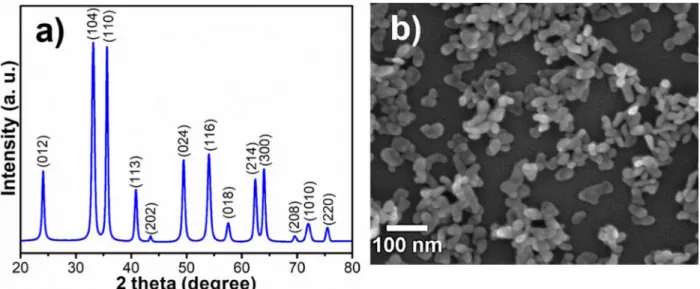
3nanocrystals Fig. 1(a) and (b) shows the XRD and FESEM image of the synthesized sample respectively. The XRD analysis showed the formation of the hematite structure well indexed according to the JCPDS No. 89-2810. In the
AE% (C0–Ce) C0
--- 100×
=
qe (C0–Ce)V ---m
=
XRD pattern of the synthesized sample indicating no impurity peak was observed the complete reaction between the raw materials. The most intense (104) peak was selected to calculate the crystallite size. The average crystallite size of α-Fe
2O
3nanocrystals as calculated from the Scherrer equation was found to be 17 nm. The FESEM image shows the morphology and the particle sizes of the sample which are very similar with those reported in Ref.
18). Furthermore, the specific BET surface areas of the nanocrystal α-Fe
2O
3was found to be 39.18 m
2g
−1by calculating the results of N
2adsorption. The large BET surface area is significant for adsorption process.
5)3.2 Adsorption study
The effect of adsorbent amount, on heavy metals adsorption by α-Fe
2O
3nanoparticles was studied in the
30 ml solution was mixed with different doses of while keeping other parameters constant. Initial concentration of heavy metals was kept at 10 mg L
−1with the contact time of 10 min. It can be seen from Fig. 2(a) that the removal efficiency of metal ions generally increased with an increase in the dosage of α-Fe
2O
3nanoparticles. An increase in the adsorbent dosage from 0.05 to 0.15 g led to an increase in the removal efficiency of Cr
6+, Cd
2+and Pb
2+from 32.6 to 74.3, 59.7 to 92.2, and 38.3 to 100 %, respectively. Adsorbent mass increased with the increase in removal efficiency. This can be attributed to the increasing number of binding sites with the increased amount of absorbent.
14,19)The maximum adsorption of heavy metals with adsorbent was obtained to be 0.15 g which indicated the optimum dosage.
The pH is an important parameter in the adsorption experiments. 0.1N HCl and NaOH solutions were used to
Fig. 1. (a) The powder XRD pattern, (b) FESEM image of α-Fe2O3 nanocrystalsFig. 2. (a) Effect of mass, (b) Effect of pH on adsorption efficiency for heavy metal ions by of α-Fe2O3 nanocrystals
solution pH in the range 3 to 9 on the removal of Cr , Cd
2+and Pb
2+ions from aqueous solutions by hematite nanoparticles. When nanocrystal adsorbent was used for adsorption of Cr
6+, maximum removal of 99.6 % occurred at pH value 3 and gradually decreased as pH approached from 5.5 to 9. The positive surface charge of the adsorbent attracted more Cr
6+which was present in the form of negative charged CrO
42−at pH value 3. Similar results were noted earlier.
10)Surface sites of adsorbent occupied by negatively charged ligands, however replaced the negatively charged Cr
6+species. Thus, the adsorption efficiency of Cr
6+decreased with increasing pH values
13). For Cd
2+and Pb
2+ions, the adsorption efficiency first increased for pH 3 to 5 and then reached the equilibrium state for pH 5 to 7. However, the removal rate slightly dropped at pH 9. At pH lower than 5.5, low adsorption of the heavy metal ions was observed. Higher pH was favorable for the deprotonation of sorbent surface. The increase with deprotonation resulted in the increase of the negatively charged sites, which enhanced electrostatic forces between the sorbent surface and heavy metals Cd
2+and Pb
2+ions. This resulted in an increase in the adsorption efficiency. However, further increase in pH led to the decrease in the adsorption efficiency; hence the higher pH values Cd
2+and Pb
2+ions got precipitated in their hydroxide form
14). The pH values chosen for the further study of the adsorption of heavy metal ions of Cr
6+, Cd
2+and Pb
2+were 3, 7 and 5.5 respectively.
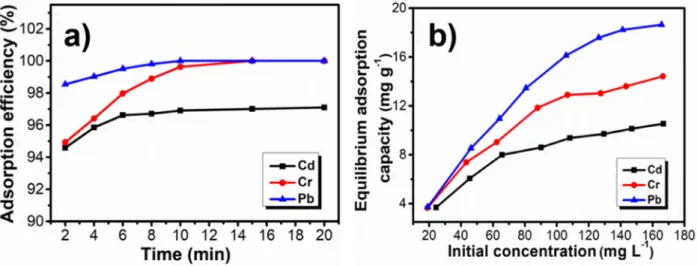
Time is the also major factor in defining the removal efficiency of adsorption system. In order to investigate the effect of contacting time on heavy metal ions, further experiments were carried out using 0.15 g of α-Fe
2O
3nanocrystals at room temperature. Fig. 3(a) shows the effect of contacting time on the adsorption efficiency of
the heavy metals solution concentration was reduced by above 90 % within the first 2 minutes of contact and remained constant up to 20 minutes. It is clear that adsorption rates of heavy metal ions were time independent.
However, a slight increase in the all heavy metal ions adsorption rates observed at the 10 minutes in adsorption time.
In this study, the wastewater with initial heavy metal ions concentration of 20 to 160 mg L
−1was taken and adsorption time was settled at 10 min. As shown in Fig.
3(b) adsorption capacity depended on the initial metal ions concentration. It was found that the adsorption capacities increased with increase in initial concentrations of heavy metal ions. This can be attributed to the fact that more heavy metal ions could bind to the adsorption sites on the surface of the hematite nanocrystals. At the higher concentrations of heavy metal ions, the rate of increase adsorption capacity became gradually slow.
These results are in good agreement with the already reported works.
11,15)Both Langmuir and Freundlich isotherm models were used to evaluated the obtained data. Langmuir isotherm equation is derived from the adsorbent surface with a fixed number of binding sites, and the monolayer adsorption occurs on the surface of adsorbent isotherm
20). The linearized Langmuir isotherm is given as:
(3) Where C
eis equilibrium concentration of the metal ions (mg l
−1) and q
eis the quantity of the heavy metal adsorbed at equilibrium of α-Fe
2O
3nanocrystal (mg g
−1), b Langmuir constant connected to the bond energy of adsorption (l g
−1) and q
mis maximum adsorption capacity
Ce qe --- 1
qmb --- Ce
qm --- +
=
Fig. 3. (a) Effect of adsorption time, (b) Effect of initial concentration of heavy metal ions on adsorption capacity by α-Fe2O3 nanocrystals
(mg g
−1).The constants b and q
mcan be determined from the intercept and slope of the linear plot C
e/ q
eversus C
e.
21)Freundlich isotherm can be applied for heterogenous surfaces and multilayer adsorption can occurred. It is represented as:
(4) where K is the constant the relative adsorption capacity of the adsorbent (mg
1-1/nL
1/ng
−1) and n represents the adsorption intensity. The constants n and K can be determined from the slope and intercept of the linear plot log q
eversus log C
e.
10)The quantitative relationship between initial Cr
6+, Cd
2+and Pb
2+ions concentration and the adsorption capacity analyzed with two different isotherm models are illustrated in Fig. 4(a, b). The calculated correlation coefficients ( b, q
m, n and K) and linear regression coefficient ( R
2) values for each
Langmuir and Freundlich model are outlined in Table 1.
The calculated linear regression coefficient ( R
2) values for the plots in Fig. 4(a) are well greater than 0.99 suggesting a strong linear relationship between C
eand C
e/ q
e. It is indicating that the Langmuir model was more applicable than Freundlich model.
In particular, metal ions of Pb
2+have more affinity to iron oxide nanocrystal and are more favorable for adsorption than Cr
6+and Cd
2+ions. This may be attributed to the comparatively higher electronegativity value of lead.
22)The more electronegative metals should form the strongest covalent bond with oxygen atoms on nanoparticles surfaces.
19)A comparison of the maximum adsorption capacities of Cr
6+, Cd
2+and Pb
2+ions onto different morphologies of α-Fe
2O
3are given in Table 2.
The adsorption capacity of heavy metals ions on α-Fe
2O
3nanocrystals was significantly higher than that of other adsorbents. This may be due to the morphology, surface
logqs logK 1n---logCe +
=
Fig. 4. (a) Langmuir isotherm model, (b) Freundlich isotherm model
Table 1. The Langmuir and Freundlich isotherm models parameters for the adsorption of Cd2+, Cr6+ and Pb2+ ions onto α-Fe2O3 nanocrystals
Metal ions Langmuir Freundlich
qm (mg g-1) b (L mg−1) R2 K n R2
Cd 11.63 0.071 0.997 2.31 2.99 0.929
Cr 15.15 0.143 0.992 4.17 3.57 0.982
Pb 20.00 0.192 0.995 5.13 3.03 0.971
Table 2. The adsorption capacities of different morphologies of α-Fe2O3 adsorbents
Adsorbents Surface area, m2 g-1 Cd Cr Pb References
Sphere like α-Fe2O3 35.73 7.00 12
3D Ordered Macroporous (3DOM) α-Fe2O3 24.15 12.50 7.00 23
Hollow spindles α-Fe2O3 16.55 6.14 5.30 24
Microspheres α-Fe2O3 13.07 5.05 3.65 24
Nanocrystal α-Fe2O3 39.18 11.63 15.15 20.00 This work
which are quite different from those reported in literatures.
12,23,24)4. Conclusions
In summary, α-Fe
2O
3nanocrystals were well synthesized by a simple co-precipitation method. The fabricated sample was tested for the removal of heavy metals from wastewater. Heavy metal ions adsorption activities of α-Fe
2O
3nanocrystals were examined with different experimental conditions. The pH was played important role in heavy metal ion adsorption. Maximum removal of Cd
2+, Cr
6+and Pb
2+ions occurred at pH 3, 7 and 5.5, respectively. The adsorption is a physico-chemical process which affecting significant electrostatic attractions between α-Fe
2O
3nanocrystals and heavy metal ions. The results show that the capacity of heavy metal ions increased as the contact time and initial metal ions concentration increased. The Langmuir adsorption isotherm model provided the better fit as revealed by the higher linear regression coefficient values compared to the Freundlich model which confirmed the monolayer adsorption of the studied metal ions onto α-Fe
2O
3nanocrystals surface.
Langmuir adsorption capacities of 11.63, 15.15, and 20 mg g
−1were obtained for Cd
2+, Cr
6+and Pb
2+ions respectively. The findings of the present work showed that α-Fe
2O
3nanocrystals can be used as good adsorbents for the removal of heavy metal ions from waste water.
Acknowledgement
This research was supported by Changwon National University, 2019-2020.
References
1. K. M. S. Surchi, Int. J. Chem., 3, 103 (2011).
2. F. Rozada, M. Otero, A. Moran and A. I. Garsia, Bioresour. Technol., 99, 6332 (2008).
3. Y. Bagbi, A. Sarswat, D. Mohan, A. Pandey and P. R.
Solanki, Sci. Rep., 7, 1 (2017).
4. P. Yuan, D. Liu, M. Fan, D. Yang, R. Zhu, F. Ge, J. Zhu and H. He, J. Hazard. Mater., 173, 614 (2010).
5. M. A. Ahmed, S. M. Ali, S. I. El-Dek and A. Galal, Mater. Sci. Eng., B, 178, 744 (2013).
6. V. M. Boddu, K. Abburi, J. L. Talbott and E. D. Smith, Environ. Sci. Technol. Lett., 37, 4449 (2003).
7. J. T. Mayo, C. Yavuz, S. Yean, L. Cong, H. Shiple, W.
Yu, J. Falkner, A. Kan, M. Tomson and V. L. Colvin, Sci.
Technol. Adv. Mater., 8, 71 (2007).
and A. Montiel, J. Hazard. Mater., 156, 412 (2008).
9. G. Vijayakumar, R. Tamilarasan and M. Dharmendirakumar, J. Mater. Environ. Sci., 3, 157 (2012).
10. W. Jiang, M. Pelaez, D. D. Dionysiou, M. H. Entezari, D. Tsoutsou and K. O’Shea, Chem. Eng. J., 222, 527 (2013).
11. H. Karami, Chem. Eng. J., 219, 209 (2013).
12. X. L. Fang, C. Chen, M. S. Jin, Q. Kuang, Z. X. Xie, S.
Y. Xie, R.B. Huang and L. S. Zheng, J. Mater. Chem., 19, 6154 (2009).
13. S. Rajput, C. U. Pittman Jr and D. Mohan, J. Colloid Interface Sci., 468, 334 (2016).
14. Y. F. Shen, J. Tang, Z. H. Nie, Y. D. Wang, Y. Ren and L. Zuo, Sep. Purif. Technol., 68, 312 (2009).
15. A. Roy, J. Bhattacharya, Chem. Eng. J., 211-212, 493 (2012).
16. X. L. Cheng, J. S. Jiang, C. Y. Jin, C. C. Lin, Y. Zeng and Q. H. Zhang, Chem. Eng. J., 236, 139 (2014).
17. H. Liang, B. Xu and Z. Wang, Mater. Chem. Phys., 141, 727 (2013).
18. B. Tsedenbal, M. S. Anwar, I. Hussain and B. H. Koo, J. Nanosci. Nanotechnol., 17, 7682 (2017).
19. S. Mahdavi, M. Jalali and A. Afkhami, J. Nanopart. Res.
14, 846 (2012).
20. B. E. Reed, M. R. Matsumoto, Sep. Sci. Technol., 28, 2179 (1993).
21. L. Giraldo, A. Erto and J. C. Moreno-Pirajan, Adsorption, 19, 465 (2013).
22. D. Fialova, M. Kremplova, L. Melichar, P. Kopel, D.
Hynek, V. Adam and R. Kizek, Materials, 7, 2242 (2014).
23. D. He, Y. Xiao, D. Liang, H. Zhou, L. Du and L. Liu, Mater. Sci. Appl., 2, 215 (2011).
24. S. Zeng, K. Tang, T. Li, Z. Liang, D. Wang, Y. Wang and W. Zhou, J. Phys. Chem. C, 111, 10217 (2007).
Author Information Bulgan Tsedenbal
Changwon National University, Changwon Researcher of Post-Doctoral
Ji Eun Lee
Changwon National University Researcher of Master
Seok Hwan Huh
Changwon National University Professor
Bon Heun Koo
Changwon National University Professor
Chan Gyu Lee
Changwon National University Professor