한수지 54(1), 107-110, 2021
107
Copyright © 2021 The Korean Society of Fisheries and Aquatic Science pISSN:0374-8111, eISSN:2287-8815
Korean J Fish Aquat Sci 54(1),107-110,2021
Note
서 론
다시마
(Saccharina japonica)
는 식용 갈조류로써 식이섬유,
단백질,
카로티노이드,
비타민,
필수지방산및미네랄과같은 건강증진물질의좋은공급원으로알려져있으며,
항종양및 항응고제,
항증식제및항산화활성과같은다양한생물학적및기능성식품특성을가지고있는것으로알려져있다
(Haroun-
Bouhedja et al., 2000; Yuan and Walsh, 2006; Wang et al.,
2008).
다시마는또한주요신경억제전달물질로작용하는비단백질아미노산인
γ-aminobutyric acid (GABA)
를함유하고있으며저혈압
,
이뇨및진정작용과같은유익한생리적특성을 갖는것으로알려져있다(Lee et al., 2010). Lee et al. (2010)
는 다시마를probiotic bacteria
인Lactobacillus brevis BJ20
으로 발효시켰을때다시마의GABA
함량이약100
배증가했다고 보고하였다.
그러나발효다시마분말은수분흡습성이강해가 공,
취급및보관시안정성이낮아기능성식품개발에서의이 용성이크게제한적이다(Yu et al., 2019).
미역귀
(Unidaria pinnatifida)
후코이단은미역귀에서추출한 황화다당류로서,
다양한생리활성기능을가지는것으로알려 져 있다.
헤파린(heparin)
과유사한구조를가진물질로알려발효 다시마(Saccharina japonica) 분말, 미역귀 후코이단 분말 및 이들 혼합분말의 수분 흡습 특성
이창헌 1 ·심진하 1 ·김진현 1 ·유대웅 1,2 *
1창원대학교 시니어 휴먼 에콜로지 협동과정(식품영양학전공), 2창원대학교 식품영양학과
Moisture Sorption Characteristics of Lactobacillus brevis-fermented Sea Tangle Saccharina japonica, Mekabu Fucoidan, and These Mixture Pow- ders
Changheon Lee
1
, Jin Ha Sim1
, Jin Hyeon Kim1
and Daeung Yu1,2
*1Department of Senior Human Ecology Cooperative Course (Food and Nutrition), Changwon National University, Changwon 51140, Korea
2Department of Food and Nutrition, Changwon National University, Changwon 51140, Korea
The goal of this study was to investigate moisture sorption characteristics of Lactobacillus brevis -fermented sea tan- gle Saccharina japonica , Mekabu fucoidan, and these mixture powders. Moisture sorption isotherms of powders were determined at 37°C using the static gravimetric technique in a water activity ( a w ) range of 0.11-0.93. Equilibrium moisture content ( X eq ) values of the fermented sea tangle powder were almost 3 times when a w <0.7 and increased upto almost 4 times when a w <0.9 higher than mekabu fucoidan powder. In these reason, to improve strong hygro- scopic nature of the fermented sea tangle powder, fermented sea tangle and mekabu fucoidan powders were dissolved as ratios of 7:3, 5:5, and 3:7 (w/w) in a distilled water and then freeze dried. X eq values of mixture powders were around average value of sum of both powders at all a w ranges. All moisture sorption isotherms of powders exhibited typical J-shaped type III. X eq of mixture powders increased with increasing a w and decreased as increasing propor- tion of mekabu fucoidan powder. The Peleg model was found to accurately describe moisture sorption isotherms of powders. The results can be used to understand hygroscopic nature of powders, improve shelf life, and retain quality across postharvest processing.
Keyword: Lactobacillus brevis , Fermented sea tangle, Mekambu fucoidan, Moisture sorption isotherm, Modeling
*Corresponding author: Tel: +82. 55. 213. 3513 Fax: +82. 55. 213. 7480 E-mail address: [email protected]
This is an Open Access article distributed under the terms of the Creative Commons Attribution Non-Commercial Licens (http://creativecommons.org/licenses/by-nc/3.0/) which permits unrestricted non-commercial use, distribution, and reproduction in any medium, provided the original work is properly cited.
Received 14 December 2020; Revised 13 January 2021; Accepted 15 January 2021 저자 직위: 이창헌(대학원생), 심진하(대학원생), 김진현(대학원생), 유대웅 (교수)
https://doi.org/10.5657/KFAS.2021.0107
Korean J Fish Aquat Sci 54(1), 107-110, February 2021
이창헌
ㆍ
심진하ㆍ
김진현ㆍ
유대웅108
져있으며
,
혈행개선,
항암,
면역조절작용및항바이러스등의 생리활성기능이보고되었다(Itoh et al., 1993; Chevolot et al., 1999; Cooper et al., 2002; Berteau and Mulloy, 2003).
선행연 구에서미역귀후코이단분말의수분흡습성은상대적으로발 효다시마분말보다낮음을확인하였다.
따라서,
발효다시마 분말의높은수분흡습력으로인한낮은가공및유통안정성 을수분흡습력이낮은미역귀후코이단분말과의화학적결합 을통해보완하며,
이에따른기능성향상을도모하고자한다.
본연구의목적은저장온도
(37°C)
및a
w(0.11-0.96)
에서L.
brevis
발효다시마분말,
미역귀후코이단분말및이들혼합분 말의수분흡습력을분석하고, a
w에따른Equilibrium moisture content (X
eq)
예측모델을도출하여분말들의수분흡습특성을 조사하고자한다.
재료 및 방법
재료
건다시마
(S. japonica)
의경우Food & Food Co., Ltd. (Busan, Korea)
에서제공받았다.
다시마분말발효에사용되는L. bre- vis BJ20
는Marine Bioprocess Co., Ltd. (Busan, Korea)
에 서 제공받았다. Lithium chloride (LiCl), Potassium acetate (CH
3COOK), Magnesium chloride (MgCl
2), Potassium car- bonate (K
2CO
3), Magnesium nitrate (Mg(NO
3)
2), Potassium iodide (KI), Ammonium sulfate ((NH
4)
2SO
4), Potassium ni- trate (KNO
3)
및Thymol (C
10H
14O)
는삼전순약(Samchun Pure Chemical Co. Ltd., Seoul, Korea)
에서구매하였다.
발효 다시마 분말 제조
발효다시마분말은
Kang et al. (2012)
의방법에따라제조하 였다.
건다시마를깨끗한물로헹군후건다시마양의2
배증 류수에1
시간동안담궈탈염처리후,
건조오븐(60°C, 24
시 간)
에서건조시킨후분쇄기로분쇄하였다.
다시마분말에쌀가 루3% (w/w)
를혼합하고15
배의증류수(w/v)
를첨가하여고압 증기멸균기에서(121°C, 30
분)
증숙및살균을진행하였다. De Man-Rogosa-Sharpe (MRS) Broth
에L. brevis BJ20 (KCTC 11377BP)
을37°C
진탕 배양기(DS 301-FL, Dasol science, Hwasung, Korea)
에서24
시간배양후다시마용액에2%
접 종후, 37°C
진탕배양기(DS 301-FL, Dasol science, Hwasung, Korea)
에서24
시간발효하였다.
발효된다시마용액을면포를 이용하여여과후-20°C
에서48
시간동안동결건조(FD-550;
Tokyo Rikakikai Co., Ltd., Tokyo, Japan)
하였다. 미역귀 후코이단 분말 제조
사용된 미역귀 후코이단 분말의 제조 공정은 건 미역귀에
0.1N HCl
을1:100 (w/v)
비율로산분해(45°C, 12
시간)
시킨후여과액에
95%
발효주정을동량추가하여12
시간동안 침지시킨후
14,901 g
에서연속원심분리(J-1050A, Hanil Sci-med Co., Ltd., Deajeon, Korea)
하여동결건조된분말을세진바이 오텍(Sejin biotech, Seoul, Korea)
으로부터제공받았다. 발효 다시마 및 미역귀 후코이단 혼합 분말 제조
상온에서증류수
500 mL
에발효다시마분말과미역귀후코 이단분말을
7:3, 5:5
및3:7 (w/w)
비율로50 g
을넣어완전용 해시킨후-20°C
에서48
시간동안동결건조(FD-550; Tokyo Rikakikai Co., Ltd., Tokyo, Japan)
하여제조하였다.
수분 흡습 등온곡선 (MSI) 분석
분말들의
MSI (moisture sorption isotherms)
는37°C
에서중 량측정법으로측정하였다. 9
개의유리데시케이터바닥에약300 g
의염을각각넣고증류수에용해하여포화된염용액을만든 후
, 37°C
배양기(AS-B105; A-sung Tester., Busan, Ko- rea)
에서최소24
시간동안a
w평형을만들어0.11-0.96
범위 의a
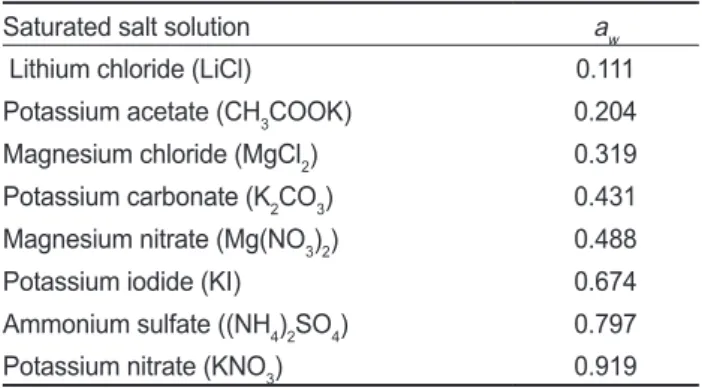
w를가지는포화염데시케이터를얻는다(Table 1).
각분 말(2±0.001 g)
을계량된알루미늄접시에최대한평평하게준 비하여포화염데시케이터에넣은후, a
w>0.67
인데시케이터 에는30 g
의Thymol
을넣어미생물성장을억제했다.
분말이 포함된데시케이터를37°C
의배양기에 넣고,
시료의무게변 화가±0.001 g
미만이될때까지정밀저울(ARG224; Ohaus, Parsippany, NJ, USA)
을사용하여무게변화를측정하였다. 수분 흡습 등온곡선 모델링
MSI
의모델링은앞선연구인Yu et al. (2019)
에규명한최적 모델식인Peleg model
을적용하여분석하였다.
모델식의매개 변수는SPSS
소프트웨어(ver. 20.0; SPSS Inc., Chicago, IL, USA)
를사용하여비선형회귀분석을통해도출하였다.
결과 및 고찰
수분 흡습 등온곡선 (MSI)
37°C
에서발효다시마분말과미역귀후코이단분말의수분Table 1. Water activities of saturated salt solutions at 37°C (Yu et al., 2019)
Saturated salt solution aw
Lithium chloride (LiCl) 0.111
Potassium acetate (CH3COOK) 0.204
Magnesium chloride (MgCl2) 0.319
Potassium carbonate (K2CO3) 0.431 Magnesium nitrate (Mg(NO3)2) 0.488
Potassium iodide (KI) 0.674
Ammonium sulfate ((NH4)2SO4) 0.797
Potassium nitrate (KNO3) 0.919
해조류 분말의 수분 흡습 특성
109
흡습등온곡선은
Fig. 1
과같았다.
발효다시마의37°C
에서의 수분흡습등온곡선은Yu et al. (2019)
으로부터채택하여사 용하였다.
두분말의X
eq는a
w가0
에서0.7
까지증가함에따라 선형적으로증가한다음a
w>0.7
에서급격히증가하였다.
이러 한형상은푸쿠스(Fucus vesiculosus),
카파피쿠스알바레지아 이(Kappaphycus alvarezii),
꼬시래기(Gracilaria spp.)
및우뭇 가사리(Gelidium sesquipedale)
와같이해조류에대해서연구 된전형적인type III (J
형)
의수분흡수특성이였다(Mohamed et al., 2005; Lemus et al., 2008; Senthil et al., 2011; Moreira et al., 2016).
발효다시마분말의
X
eq는선형증가영역(a
w<0.7)
에서약0.4 g water/g dry matter
미만이였지만a
w가0.9
이상으로증가함 에따라1.13 g water/g dry matter
으로약2.8
배증가하였다.
다 른해조류의X
eq는일반적으로a
w<0.7
에서약0.1-0.2 g water/g dry matter
이였고, a
w가0.9
이상으로증가함에따라약0.6-1. 4 g water/g dry matter
으로약5.2
에서6.5
까지증가하였다(Le- mus et al., 2008; Senthil et al., 2011; Moreira et al., 2016).
발 효다시마분말의수분흡수력은다른해조류보다높은것으로 관찰되었다.
미역귀후코이단분말의
X
eq는a
w<0.7
에서약0.1 g water/g dry matter
미만이였으며, a
w가0.9
이상일때0.4 g water/g dry matter
으로약4
배증가하였다.
두분말의비교시발효다시마 분말의X
eq값이미역귀후코이단분말보다약4
배높은수분흡 습력을나타내었다.
혼합분말들의수분흡습등온곡선은
Fig. 2
와같다.
혼합분말 에서의X
eq 또한a
w가0.7
까지증가함에따라선형적으로증가 한후a
w가0.9
이상일때급격히증가하였고type III (J
형)
의 수분흡습특성을보여주었다.
혼합분말의 수분흡습은미역 귀후코이단분말의비율이증가할수록X
eq값이감소하는경향을보여주었으며
, a
w가0.9
이상일때약1.04 (7:3), 0.982 (5:5)
및0.716 (3:7) g water/g dry matter
까지감소하는경향을보여 주었다.
혼합분말의Xeq
값은모든aw
범위에서약두분말의Xeq
합의평균값으로관찰되었다.
위결과와같이상대적으로높은수분흡습력을보여주는발 효다시마분말과낮은수분흡습력을보여주는미역귀후코이 단분말의혼합을통하여수분흡습력조절가능성을확인하였 으며
,
이는해조류유래기능성분말의가공및유통안정성측 면에서유용하게활용될수있을것으로사료된다.
수분 흡습 등온곡선 모델링
모든분말들의
a
w에따른X
eq예측모델인Peleg model
의매Table 2. Parameters of sorption isotherm models, coefficient of de- termination (R2), standard error (SE), and mean relative percentage deviation modulus (Mr) estimated for moisture sorption isotherms of fermented sea tangle, mekabu fucoidan and these mixture pow- ders
Model Parameters Samples
FSP1 7:32 5:5 3:7 MFP3
Peleg
K1 0.568 1.302 1.349 0.873 0.230 K2 1.320 0.324 0.167 0.281 1.805 n1 1.731 6.427 5.678 7.194 1.689 n2 8.519 1.596 1.486 1.877 33.225 R2 0.998 0.999 0.999 0.999 0.999 SE 0.021 0.006 0.003 0.004 0.005 Mr (%) 11.920 6.466 3.479 10.878 4.798
1FSP, Fermented sea tangle powder. 2Mixture ration of FSP and MFP. 3MFP, Mekabu fucoidan powder.
Fig. 1. Moisture sorption isotherms comparison of fermented sea tangle Saccharina japonica (FSP, ◆) and mekabu fucoidan (MFP,
◇) powders, Symbols represent experimental data and solid lines are simulated results obtained from the Peleg model.
0.0 0.2 0.4 0.6 0.8 1.0 1.2 1.4
0.0 0.1 0.2 0.3 0.4 0.5 0.6 0.7 0.8 0.9 1.0 X
eq( g wateer/ g dry powder)
a
wa
wFSP
MFP Model
0.0 0.2 0.4 0.6 0.8 1.0 1.2 1.4
0.0 0.1 0.2 0.3 0.4 0.5 0.6 0.7 0.8 0.9 1.0 X
eq( g wateer/ g dry powder)
7:3 5:5 3:7 Model
Fig. 2. Moisture sorption isotherms comparison of fermented sea tangle Saccharina japonica (FSP) and mekabu fucoidan (MFP) was mixed as ratios of 7:3 (●), 5:5 (■), and 3:7 (▲), Symbols represent experimental data and solid lines are simulated results obtained from the Peleg model.
0.0 0.2 0.4 0.6 0.8 1.0 1.2 1.4
0.0 0.1 0.2 0.3 0.4 0.5 0.6 0.7 0.8 0.9 1.0 X
eq( g wateer/ g dry powder)
a
wa
wFSP
MFP Model
0.0 0.2 0.4 0.6 0.8 1.0 1.2 1.4
0.0 0.1 0.2 0.3 0.4 0.5 0.6 0.7 0.8 0.9 1.0 X
eq( g wateer/ g dry powder)
7:3 5:5
3:7 Model
이창헌
ㆍ
심진하ㆍ
김진현ㆍ
유대웅110
개변수들은
Table 2
에명시되었다.
매개변수인K
1과K
2는초기 의수분흡수속도와총수분흡수량을나타낸다. K
1이낮을수록 분말의초기수분흡수속도는증가하고, K
2가낮을수록총수 분흡수량은증가한다(Turhan et al., 2002).
발효다시마분말 과미역귀후코이단분말의K
1과K
2를비교하였을때발효다 시마분말의K
1(0.568)
이미역귀후코이단분말의K
1(0.230)
보다높아발효다시마분말의초기수분흡습속도가후코이 단분말보다낮았으나,
발효다시마분말의K
2(1.320)
가미역 귀후코이단분말K
2(1.805)
보다낮아발효다시마분말의총 수분흡습량은미역귀후코이단분말보다높음을확인하였다(Fig. 1).
혼합분말의K
1및K
2값은두분말의화학및물리적결 합에의해실제혼합분말의수분흡습특성과는큰연관이없는 것으로관찰되었다.
사 사
이논문은
2019-2020
년도창원대학교자율연구과제연구비지원으로수행된연구결과임
.
References
Berteau O and Mulloy B. 2003. Sulfated fucans, fresh perspec- tives: structures, functions, and biological properties of sul- fated fucans and an overview of enzymes active toward this class of polysaccharide. Glycobiology 13, 29R-40R. https://
doi.org/10.1093/glycob/cwg058.
Chevolot L, Foucault A, Chaubet F, Kervarec N, Sinquin C, Fisher AM and Boisson-Vidal C. 1999. Further data on the structure of brown seaweed fucans: relationships with anti- coagulant activity. Carbohydr Res 319, 154-165. https://doi.
org/10.1016/S0008-6215(99)00127-5.
Cooper R, Dragar C, Elliot K, Fitton JH, Godwin J and Thomp- son K. 2002. GFS, a preparation of Tasmanian Undaria pin-
natifida is associated with healing and inhibition of reactiva-
tion of Herpes. BMC Complement Altern Med 2, 11. https://doi.org/10.1186/1472-6882-2-11.
Haroun-Bouhedja F, Ellouali M, Sinquin C and Boisson-Vidal C. 2000. Relationship between sulfate groups and biological activities of fucans. Thromb Res 100, 453-459. https://doi.
org/10.1016/S0049-3848(00)00338-8.
Itoh H, Noda H, Amano H, Zhuaug C, Mizuno T and Ito H.
1993. Antitumor activity and immunological properties of marine algal polysaccharides, especially fucoidan, prepared from Sargassum thunbergii of Phaeophyceae. Anticancer Res 13, 2045-2052.
Kang YM, Lee BJ, Kim JI, Nam BH, Cha JY, Kim YM, Ahn CB, Choi JS, Choi IS and Je JY. 2012. Antioxidant effects of fermented sea tangle Laminaria japonica by Lactoba-
cillus brevis BJ20 in individuals with high level of γ-GT:
a randomized, double-blind, and placebo-controlled clini-
cal study. Food Chem Toxicol 50, 1166-1169. https://doi.
org/10.1016/j.fct.2011.11.026.
Lee BJ, Kim JS, Kang YM, Lim JH, Kim YM, Lee MS, Jeong MH, Ahn CB and Je JY. 2010. Antioxidant activity and γ-aminobutyric acid (GABA) content in sea tangle ferment- ed by Lactobacillus brevis BJ20 isolated from traditional fermented foods. Food Chem 122, 271-276. https://doi.
org/10.1016/j.foodchem.2010.02.071.
Lemus RA, Pérez M, Andrés A, Roco T, Tello CM and Vega A. 2008. Kinetic study of dehydration and desorption iso- therms of red alga Gracilaria. LWT 41, 1592-1599. https://
doi.org/10.1016/j.lwt.2007.10.011.
Mohamed LA, Kouhila M, Lahsasni S, Jamali A, Idlimam A, Rhazi M, Aghfir M and Mahrouz M. 2005. Equilib- rium moisture content and heat of sorption of Gelidium
sesquipedale. J Stored Prod Res 41, 199-209. https://doi.
org/10.1016/j.jspr.2004.03.001.
Moreira R, Chenlo F, Sineiro J, Arufe S and Sexto S. 2016. Dry- ing temperature effect on powder physical properties and aqueous extract characteristics of Fucus vesiculosus. J Appl Phycol 28, 2485-2494. https://doi.org/10.1007/s10811-015- 0744-9.
Senthil A, Mamatha BS, Vishwanath P, Bhat KK and Ravishan- kar GA. 2011. Studies on development and storage stabil- ity of instant spice adjunct mix from seaweed Eucheuma.
J Food Sci Technol 48, 712-717.https://doi.org/10.1007/
s13197-010-0165-3.
Turhan M, Sayar S and Gunasekaran S. 2002. Application of Peleg model to study water absorption in chickpea during soaking. J Food Eng 53, 153-159. https://doi.org/10.1016/
S0260-8774(01)00152-2.
Yu D, Kwon G, Kim M, Kim YM, Choi SI, Kim GH and Chung D. 2019. Moisture sorption characteristics of probiotic-fer- mented sea tangle powder and its thermodynamic properties.
J Food Process Preserv 43, e13991. https://doi.org/10.1111/
jfpp.13991.
Yuan YV and Walsh NA. 2006. Antioxidant and antiproliferative activities of extracts from a variety of edible seaweeds. Food Chem Toxicol 44, 1144-1150. https://doi.org/10.1016/j.
fct.2006.02.002.
Wang J, Zhang Q, Zhang Z and Li Z. 2008. Antioxidant activity of sulfated polysaccharide fractions extracted from Lami-
naria japonica. Int J Biol Macromol 42, 127-132. https://
doi.org/10.1016/j.ijbiomac.2007.10.003.