• 검색 결과가 없습니다.

The Assessment of Water Supply Issues in Metro Manila

N/A
N/A
Protected

Academic year: 2021

Share "The Assessment of Water Supply Issues in Metro Manila"

Copied!
9
0
0

로드 중.... (전체 텍스트 보기)

전체 글

(1)

1. Introduction

Philippines' focal point of population growth, where most of the business centers are located, is in Metro Manila. It was first founded in 1571 and is situated on an isthmus bounded by Manila Bay to the west and Laguna de Bay to the south-east and divided by Pasig River that links the two bodies of water. The city lies on a wide flood plain that is one of the biggest in the country. The area is bounded by Bulacan to the north, Rizal to the east, Laguna to the south and Cavite to the south west, as shown in Fig. 1.

Under the Kӧppen climate classification system, Metro Manila has a tropical monsoon climate. Its proximity to the equator means that

the temperature range is very small, rarely ever going lower than 20℃ and going higher than 3 8℃. However, humidity levels are usually very high which makes it feel much warmer. It has a distinct dry season from November to May, and a wet season from June to October.

As proclaimed by Presidential Decree No.940, Metro Manila (Kalakhang Maynila, Kamaynilaan) or the National Capital Region (NCR) as a whole is the Philippines seat of government although only the City of Manila is the capital.

It has a residential population of 11,553,427 as of August 1, 2007 census (National Statistics Office, 2007), an area of 636 ㎢ and a population density of 18,166 per ㎢.

It is the political, economic, social, and cultural

마닐라 광역시 물공급 이슈(Issues) 진단

Rubio, Christabel Jane * / 김 이 형 ** / 정 상 만 ***

+

The Assessment of Water Supply Issues in Metro Manila

Rubio, Christabel Jane / Kim, Lee Hyung / Jeong, Sang Man***

+

Abstract : The Philippine government enacted the National Water Crisis Act in 1995, as a response to the burgeoning situation of water supply systems in the country. This act led to the privatization of Metropolitan Waterworks and Sewerage System (MWSS), sector having jurisdiction and control over all waterworks and sewerage systems in a service area including Metro Manila. Nowadays, the region's supply of water is still facing a lot of difficulties, both in quality and quantity. The unabated migration of people to the metro which increases its population, tapping from the aged pipelines, lack of water facilities and infrastructure, excessive groundwater withdrawal, environmental degradation, and surface and groundwater pollution are some of the issues that Metro Manila have to deal with. These situations lead to two primary water supply issues suffered by Metro Manila: water shortage and flooding. The purpose of this paper was to present water supply in Metro Manila with respect to the problems in its distribution, environmental implications and quality. In this paper, several technical reports, published literature, and news articles were consulted and became the major basis for identifying gaps and suggesting remedial measures.

Keywords : Water Shortage, Flooding, Metro Manila

+ Corresponding author : [email protected]

* Graduate Student, Department of Civil and Environmental Engineering, Kongju National University

** Member, Assistant Professor. Department of Civil and Environmental Engineering, Kongju National University

*** Member, Corresponding Author, Professor, Department of Civil and Environmental Engineering, Kongju National University

(2)

center of Philippines and is one of the more modern metropolises in Southeast Asia. The metropolitan area is the smallest of the country's administrative regions. It is also the only region without any provinces, instead being subdivided into 17 local government areas, with 16 cities and one municipality given by Table 1.

2. Metro Manila Water Service Providers

The Manila Waterworks Authority was founded in 1878 to take charge of the water supply of Metro Manila. In order to improve the service quality. The sector has been repeatedly subject of extensive reforms which created numerous institutions and responsibilities(World Bank, 2005).

On 1919, the sector was transformed into Metropolitan Water District. Then in 1955, the National Waterworks and Sewerage Authority (NAWASA) was created to take over water supply and sewerage services for the whole country.

In June 1971, Republic Act No. 6234 dissolved

NAWASA and created the present MWSS which since this date has had jurisdiction and control

Fig. 1. Map of the Philippines and its National Capital Region (Metro Manila)

Local Government

Unit Population Area

(km

2

)

Population Density (per km

2

)

Annual Population

Growth Rate Cityhood

Caloocan 1,177,604 53.33 22,081 0.97 1962

Las Piñas 528,011 41.54 12,710 1.04 1997

Makati 444,867 27.36 16,260 -0.12 1995

Malabon 338,855 15.76 21,501 1.13 2001

Mandaluyong 278,474 11.26 24,731 -0.09 1994

Manila 1,581,082 38.55 41,014 -0.06 1574

Marikina 391,170 33.97 11,515 0.98 1996

Muntinlupa 379,310 46.70 8,122 1.14 1995

Navotas 230,403 10.77 21,393 1.23 2007

Parañaque 449,811 47.69 9,432 0.99 1998

Pasay 354,908 19.00 18,679 1.43 1947

Pasig 505,058 31.00 16,292 1.32 1995

Pateros 57,407 2.10 27,337 1.46 Not a City

Quezon City 2,173,831 161.12 13,492 0.78 1939

San Juan 117,680 5.94 19,811 0.78 2007

Taguig 467,375 47.88 9,7611 .09 2004

Valenzuela 485,433 44.58 10,889 1.23 1998

Table 1. Seventeen Local Government Units Metro Manila

(3)

over all waterworks and sewerage systems in a service area including the NCR, the entire province of Rizal and part of Cavite Province, a territory of more than 200,000 hectares.

The expanding population of Metro Manila, unregistered connections tapped to the cities’

aging main line (oldest in Asia), leaks everywhere, and looming environmental problems has placed a need on the Philippines to develop alternatives to the current system. This situation prompted the Philippine government to enact Republic Act No. 8041 or “The National Water Crisis Act of 1995”, attempting to address the burgeoning population's need for improved water services. This provided the government with one-year period emergency power to address the issues related to supply distribution, finance privatization, lay the groundwork for the reorganization of MWSS and strengthening the government's anti-water pilferage efforts.

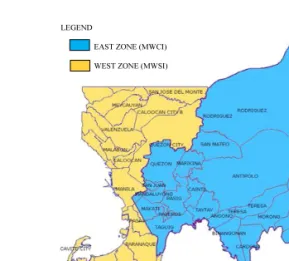
After almost three years of preparation, on February 21, 1997, the concession contract in which the concessionaires were given the task to operate and manage the facilities, whereas MWSS preserved the ownership of infrastructure, was implemented. In order to facilitate benchmark comparisons, the service area was divided into two zones. Fig. 2 shows the division and coverage area of each zone. In 1997, the Maynilad Water Services, Inc. (MWSI), a joint venture by the French Suez and the Filipino Benpres Holdings was awarded the concession contract for the West Zone, whereas Manila Water Company, Inc. (MWCI), consisting of the Filipino Ayala Corporation as well as the British Utilities and the US Company Bechtel was awarded the East Zone. The concession contract were expected to last for 25 years and included targets concerning coverage, service quality and economic efficiency. The concessionaires took over the operations on August 1, 1997. (Wu and Malaluan, 2008).

The Angat-Ipo-La Mesa Dam Raw Water System is currently the major source of water for

Metro Manila. Two private concessionaires treat and deliver water and also provide needed sewerage services.

LEGEND

EAST ZONE (MWCI) WEST ZONE (MWSI) LEGEND

EAST ZONE (MWCI) WEST ZONE (MWSI)

Fig. 2. The division and coverage area of the two private concessionaires

2.1 Maynilad Water Services, Incorporated (MWSI)

MWSI was at first a partnership between Benpres Holdings Corporation and Ondeo Water Services, Inc. Towards its tenth year, Maynilad went through a change of ownership with the consortium of D.M. Consuji, Inc. and Metro Pacific Investments Corp. acquiring 83.97% of stakes previously held by the Metropolitan Waterworks and Sewerage System due to a debt – capital conversion. Lyonnaise Asia Water Limited (LAWL) got the 16% share.

Presently, Maynilad has a total of 677,985 billed water services equivalent to a population of around 6.2 million. The West Zone concession area covers a total of 540.43 ㎢ which covers nine cities and two municipalities in Metro Manila and one city and five towns in the Cavite province.

In order to make the distribution services in

such a large service area more manageable, the

West Zone was divided into two areas of service

management. These are the following: North

(4)

Business Region services the Roosevelt and Novaliches districts in Quezon City, municipalities of Malabon, Navotas, and the cities of Valenzuela and Caloocan; South Business Region serves Manila, except some parts of Sta. Ana and San Andres, the cities of Pasay, Parañaque, Las Piñas, Cavite, part of Makati and municipalities of Rosario, Imus, Noveleta, Bacoor and Kawit in Cavite province.

Of the estimated 12.8 million inhabitants in MWSS concession area as of June 2007, 8.1 million or 60% reside in the West Zone of which 5.9 million are Maynilad's customers. There are 696,805 water service connections including private meters, 67,420 sewerage connections and a workforce of 2,350.

Maynilad receives 98% of its water from the Angat Dam. The remaining two percent is sourced from deep wells. From the Angat Dam, water flows to the La Mesa Treatment Plants in Novaliches, Quezon City, which at present, treats a combines 2,400 ml/d of water.

The reprivatized Maynilad charges its customers in the West Zone an average of P32.99/ cu. m ($0.72/ ㎥), as of January 1, 2007 (figure converted into price at that time). Maynilad's rate consists of the basic charge (P22.47, including inflation adjustment of P1.35); currency adjustment (P1.00); foreign currency differential adjustment (P14.00); special transitory mechanism for debt payments (P3.31); environmental charge (P2.69), and value added tax (12 percent of bill).

Under the debt and capital restricting agreement with creditors, Maynilad is allowed to increase its rates by P3.45 to P4.15 per cubic meter to enable it to service its debt of $200 million (Gaylican, 2006).

2.2 Manila Water Company, Incorporated (MWCI)

East Zone covers 23 municipalities including Makati and parts of Manila. It also covers all new business centers in the Metro Manila and is focal point of population growth.

Manila Water spans approximately 1,400 ㎢ and is home to some 5.3 million people. It has eight business areas which include the cities of Antipolo, Makati, Pasig, Mandaluyong, Marikina, Balara and Cubao of Quezon City, and the municipality of Taguig.

Manila Water provides water services to more than 985,000 households in the East Concession area through more than 550,000 water service connections and 45,000 sewer service connections.

More significantly, of more than two million people connected to the water network, 900,000 people or about 150,000 households belong to the low-income communities.

Manila Water charges its customers an all-in average tariff rate of P20.68 / ㎥ ($0.45 / ㎥), as of January 1, 2007 (figure converted into real price at that time). Manila Water’s rate is broken down into the basic charge (P15.90, including the inflation adjustment of P0.96); currency adjust- ment (P1.00); foreign currency differential adjustment (P0.12), environmental and sewerage charge (P1.68), and value added tax (12 percent of bill) (Gaylican, 2006).

3. Water Supply Issues in Metro Manila The widespread problem of water in Metro Manila area has become a central policy issue.

These problems are aggravating with time. Most of these problems are due to the metropolitans’

inconsiderate treatment of the water supply, illegal connections, excessive groundwater withdrawal, pollution of water bodies, deforestation and absence of sewerage and drainage systems. In general the metro experiences two major water supply problems : (1) water shortage due to non-revenue water, excessive groundwater extraction and pollution of water bodies; and (2) flooding as a result of inefficient drainage systems, denuded watershed and land subsidence 3.1 Water Shortage

This problem is not on the shortage of water

(5)

per se but is due to supply-demand mismatches caused by inadequate infrastructure to capture and store abundant run-off in the rainy season for consumption in the dry season. The problem is compounded by weakness in water supply management and inefficient water use and facilities.

3.1.1 Illegal connections and leaks (non–

revenue water)

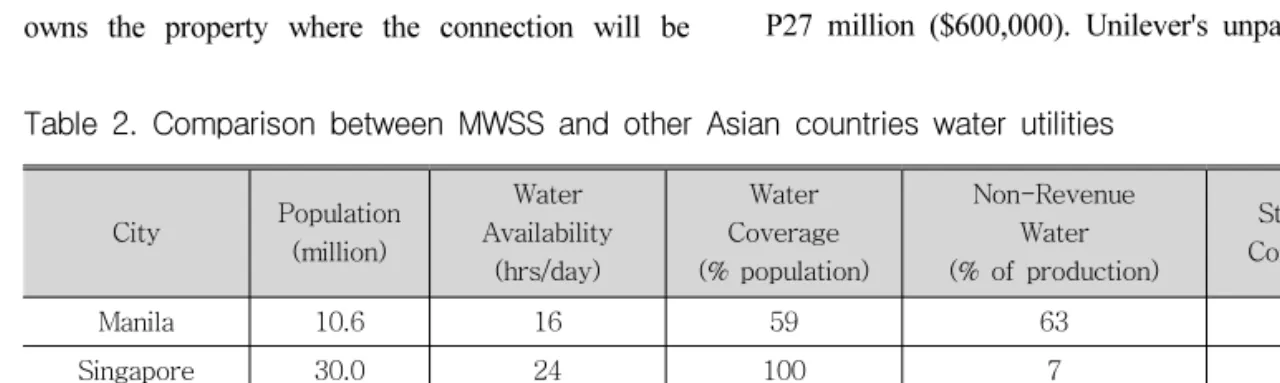
In 1997, non-revenue water due to losses in distribution network ascribed to illegal connections and leaks in aged main pipelines (oldest in Asia), thefts and faulty metering reached 63%. Table 2 shows the comparison between MWSS and other Asian countries water utilities. The squatters living in crowded slum communities were the ones blamed for this loss.

Philippine Center for Investigative Journalism mentioned that before the MWSS privatization, it is admitted that the bureaucratic requirements for water service connections left many potential water customers with no other recourse but illegal connections. Apart from the excavation permit, which is a necessity in any digging - whether for water service connections, detection of illegal connections or leak repair - applicant must shoulder a fee as much as P4,000 ($97.76, converted into real price as of March 7, 2000) and must also present a proof that he or she owns the property where the connection will be

made .

Before the MWSS privatization, impoverished families who squatted on other people’s properties were automatically disqualified from MWSS service. As a result, the most number of illegal connections is found in squatter community.

On the contrary, the biggest water pilferers, as stated by the same report, are the large commercial, industrial and residential users that consume huge volumes of water daily, among them are some big corporations, malls, hotels, motels, condominium owners, and real estate developers. True the number of illegal connections in squatter areas is high, but the volume of water they steal is low. It is among the big entities - those that illegally siphon off huge volumes of water from both concessionaires - which are actually causing enormous losses.

Among the big corporations where Maynilad has found illegal water connections are Coca-Cola Bottling Company, Unilever Philippines, and Merville Park Subdivision in Parañaque. Manila Water's records yields such names as Loyola Grand Villas and the San Juan Slaughterhouse.

Maynilad and Manila Water, and before them the MWSS, have been losing billions of pesos each year to these big water pilferers. Coca-Cola's arrears arising from a discovered illegal connection believed to have been installed in its Pandacan bottling facility in 1984 amounted to P27 million ($600,000). Unilever's unpaid accounts

City Population (million)

Water Availability

(hrs/day)

Water Coverage (% population)

Non-Revenue Water (% of production)

Staff/1000 Connections

Manila 10.6 16 59 63 9.80

Singapore 30.0 24 100 7 2.00

Hong Kong 6.3 24 100 36 2.80

Seoul 10.6 24 100 35 2.30

Kuala Lumpur 1.4 24 100 36 1.40

Bangkok 7.3 24 82 38 4.60

Table 2. Comparison between MWSS and other Asian countries water utilities

(6)

were assessed at P19 million ($410,000), Merville Park at P18 million ($390,000) (figures converted as of that time).

Manila Water has so far filed cases against four customers for violation of Republic Act 8041 - which penalizes water pilferage - one of them the San Juan Slaughterhouse whose arrears are estimated at P3 million ($65,000). Documents also show a dispute between the concessionaire and V.

V. Soliven, developer of Loyola Grand Villas, which failed to pay debts of over P600,000 ($13,000 as of that time) arising from illegal connection (Philippine Center for Investigative Journalism, 2000).

Moreover, tapping of pipe lines leads to contamination of the water supply. As a result, remain a severe public health concern. About 4,200 people die each year due to contaminated drinking water (World Bank, 2005).

3.1.2 Excessive groundwater withdrawal According to a newspaper, the National Water Regulatory Board (NWRB) is issuing a regulation prohibiting extraction of water from deep wells as groundwater condition in Metro Manila has become extremely critical. The NWRB order will amend Resolution 904 issued way back in 2004 which covered the same prohibition but only in certain Metro Manila towns and cities. The ban on water extraction from deep wells has become essential considering contaminated groundwater's critical effect on human health and the environment (Aguiba, 2008).

The unabated migration to the cities, which brought the country's urban population to nearly 30 million, stressed out the cities' water supply.

Inefficient resource use could lead to the eventual decline in the groundwater level, salt water intrusion, land subsidence, groundwater pollution and other similar negative externalities.

Over-extraction of groundwater systems is now a pressing problem in Metro Manila especially in the coastal areas where heavy pumpage have been

going on for some decades. These have been demonstrated by the lowering of piezometric heads throughout the regions (Munasinghe, 1992).

In Metro Manila, the water tables are being drawn at the rate of 6 to 12 meters a year causing saline water intrusion along the coastal areas (Tacio, 2004). According to Philippine Institute for Development Studies, there are a number of reasons that can cause an aquifer to become saline and render it unsuitable for irrigation or drinking purposes. The reuse of agricultural drainage water, deforestation coupled with high evaporative demand and over pumping can lead to build-up of salts in aquifers (Clemente et al., 2001).

Aside from salt intrusion, the metro's groundwater supply is also contaminated by other pollutants from sewage and seepage from inefficient sanitary facilities, industrial discharges and urban effluents and agrochemical residue (fertilizers and pesticides). Land subsidence are also evident in some regions were groundwater is over-extracted

3.1.3 Pollution of water bodies

River pollution has added to the country's water problem. It intensifies the shortage for a clean source of water. The Philippine Urban Sewerage and Sanitation classifies 37 out of 418 rivers in the country as polluted while the rest were seriously polluted. Eleven rivers were considered "biologically dead." Fifty-two percent of the country's water pollution load is attributable to domestic wastes, while industry accounts for forty-eight percent (Tacio, 2004).

Biochemical Oxygen Demand (BOD) of Metro Manila alone contributes over 150,000 Metric tons per year (World Bank Water and Sanitation Program – East Asia Pacific, 2003).

Only 7% of the Metro Manila population is

connected to a piped sewerage network. The vast

majority uses flush toilets connected to septic

tanks. Since sludge treatment and disposal

(7)

facilities are rare, most effluents are discharged without treatment (World Bank, 2005). Although soils are considered as natural purifiers, there can be some risks of direct migration of pathogens to underlying aquifer. According to the Asian Development Bank, the Pasig River is one of the world's most polluted rivers (Asian Development Bank, 2007). Aside from damage to human health, lead-filled water also destroys equipment, causing rusty and corroded pipes. Since untreated groundwater extracted through deep wells contain metal and other mineral deposits, this can destroy storage tanks, pipes, and other facilities.

A major source of water pollution is domestic wastewater, accounting for 48% of the total pollution sources. One-fifth of the pollution is generated by Metro Manila alone, making it the largest contributor among the Philippines' 16 regions. In terms of BOD loading in Metro Manila, 58% comes from domestic waste and 42% from industrial waste(World Bank, 2003).

3.2 Flooding

On the average, 19 tropical cyclones enter the Philippine Area of Responsibility (PAR) annually, with about 8 or 9 of them crossing the Philippines. At least one tropical cyclone per year may not make its landfall but still inflict damage and casualties in the country, as a consequence the metro experiences frequent flooding. The primary reasons for experiencing flood in the metro ranges from the illegal dumping of solid wastes which blocks its inefficient drainage system, denudation of watersheds and land subsidence due to urbanization.

3.2.1 Absence of sewerage and drainage system

A more serious and probably unsolvable cause of flash floods and massive flooding is the very absence of sewage and drainage pipelines. There are no such pipelines and no culverts. There are no waterways to take the flood waters to the

smaller rivers that feed the Pasig River, and on to the sea. Instead, the floods stay on our streets instead of being able to flow to the sea. Most houses and roads have been built over waterways and creeks therefore covering them.

Solid wastes are dumped everywhere and dumping sites are not properly managed allowing leachate and other toxic wastes to contaminate the groundwater. Moreover, most of the existing drainage culverts and pipelines are blocked by solid wastes and other refuse which are either thrown or are not collected. Maintenance of the existing drainage facilities are also not given high priorities therefore making it non-functional which allows flood events to occur more frequently.

3.2.2 Denuded Watersheds

Most of the watersheds in the Philippines are in critical condition as manifested from recent and recurring calamities such as flashfloods in Southern Leyte and Northern Mindanao and greater frequency of El Niño in Luzon that reduces the water levels in dams. The chronic shortage of water supply in Metro Manila and the countryside has placed in the forefront the increased recognition of the adverse effects of man's activities in the watersheds which has caused erosion and siltation problems in the country's rivers, lakes and reservoirs. One particular concern is deforestation leading to siltation of dams and waters stores in land lakes such as the Laguna Lake near Metro Manila and the Ambuklao reservoir in the north (Barbara, 2005).

Former head of Department of Environment

and Natural Resources, Elisea Guzon, cited in a

newspaper report that from a high of 15 million

hectares decades ago, the country has only about

5.4 million hectares of forestland left. About 90

percent of the 99 watershed areas in the country

were “hydro logically critical”(Tacio, 2004).

(8)

3.2.3 Land Subsidence

Flooding has been a feature of daily life in Manila since at least the nineteenth century, but the first recorded instance of serious flooding dates to 1942. The extent of flooding has also been considerably aggravated in recent decades by land subsidence. Sediments that underlie river deltas have a high water content that is

‘squeezed’ by the weight of succeeding deposits, a process that is greatly accelerated when groundwater is extracted faster than it can be replenished by natural recharge from rain seeping back into the ground. Records taken at Manila's South Harbour show that mean sea levels rose about 2 millimeters a year between 1902 and 1960, but that the subsequent rate was about ten times faster. Such an increase cannot be explained as solely a consequence of global warming and bears a marked correlation to the rise in groundwater extraction. As the land around Manila Bay sinks and the level of the sea rises, flooding has become more prevalent not only in the city but also in the surrounding provinces (Bankoff, 2003).

Philippine Center for Investigative Journalism reported that this phenomenon was also observed in Muntinlupa City, where there is a heavy concentration of industries and subdivisions. A study early in 2000 by the Philippine Institute of Volcanology and Seismology (Philvolcs) found

“vertical movements with displacement ranging from 12 cm to 116 cm, and an average displacement of 50 cm” (Philippine Center for Investigative Journalism, 2000). Land subsidence, in time, could also lead to fissures and enhancement of fault lines. These effects accompanied by increase in high tides in some areas due to drastic climate change would enhance the effect and frequency of flooding.

4. Conclusion

This paper aimed to present the water supply

in Metro Manila, the capital city of the Philippines, with respect to the problems in its distribution, quality and environmental implications. In this paper, several technical reports, published literature, and news articles were consulted and became the major basis for identifying water related issues and suggesting remedial measures.

The water supply issues stated in this paper emphasizes that Metro Manila is in fact facing an intensifying problem in water supply. This is very evident in the daily life suffered by most of the metropolitan. Water shortage and flooding are the two critical water management issues which challenges Metro Manila's water supply.

Development of new water infrastructures and improved facilities efficiency should be given high priority. This would help in water loss reduction and improvement of service delivery efficiency and water quality. Also, Metro Manila, as an urbanizing area must have sufficient and functioning drainage system that would hinder the frequent occurrences of floods.

Water utilities and regulatory agencies must be strengthened. Water management group should strictly impose the fundamental water laws protecting and regulating water consumption.

Water conservation should also be implemented with the initiative of the government and private sectors.

In parallel to these, public information of the hazards brought about by ignoring these problems should be done. The government, as well as the public should be aware of the irreversible consequences of their harmful way of using water, a limited and non-renewable resource.

References

Aguiba, M.M. (2008). NWRB prohibits deep well extraction in Metro Manila. Manila Bulletin, 9 April 2008.

Asian Development Bank (2007). Country Paper

Philippines : Asian Water Development

(9)

Outlook 2007.

Bankoff, G. (2003). Vulnerability and Flooding in Metro Manila.

Barbara, P.F. (2005). The Challenges in Water Management in the Philippines.

Clemente, R.S., Tabios, G.Q., Abracosa, R.P., David, C.C., Inocencio, A.B. (2001).

Groundwater Supply in Metro Manila : Distribution, Environmental and Economic Assessment. Philippine Institute for Development Studies. No. 2001-06.

Gaylican, C.A. (2006). Water rates up starting January 1 : Inflation, big debts cited for increases. Philippine Daily Inquirer, 19 December 2006, p. A1.

Munasinghe, M. (1992). Water Supply and Environmental Management. Westview Press.

National Statistics Office. (2007). 2007 Census of Population.

The Growing Thirst, Philippine Center for Investigative Journalism, 2000.

Tacio, H.D. (2004). Water Crisis looms in RP.

Sun.Star Davao, 13 December, 2004.

World Bank. (2003). Philippine Environmental Monitor 2003 – Water Quality.

World Bank. (2003). Third Manila Sewerage Project. Project Information Document. Report No. AB380.

World Bank. (2005). Philippines : Meeting Infrastructure Challenges.

World Bank Water and Sanitation Program – East Asia and the Pacific. (2003). Urban Sewerage and Sanitation: Lessons learned from case studies in the Philippines.

Wu, X. and Malaluan, N.A. (2008). A Tale of

Two Concessionaires : A Natural Experiment

of Water Privatization in Metro Manila.

수치

Fig.  1.  Map  of  the  Philippines  and  its  National  Capital Region (Metro Manila)
Fig.  2.  The  division  and  coverage  area  of  the  two private concessionaires
Table 2. Comparison between MWSS and other Asian countries water utilities

참조

관련 문서

A Study on the Development of Ship’s Ballast Water A Study on the Development of Ship’s Ballast Water A Study on the Development of Ship’s Ballast Water A Study on the

In addition, using the properties of water shown in diverse shapes, Ki Hyung-do's recognition on the reality and future consciousness from regression of

Protecting the aquatic ecosystem in the water body Recover water and resources from wastewater and. produce renewable energy using wastewater constituents.. • So, the goal

In nuclear power plants, the water level is maintained by controlling the water supply when the steam generator's water level deviation occurs. During

• Oxygen dissolved in water (DO) is important for many forms of aquatic life. • From Henry’s Law, the DO concentration in air-saturated water is 8 to 15 mg/L depending

The inlet temperatures of each stages and return water, evaporation rates of each stages and total fresh water generating rates were predicted. By varying

9.12 Unsteady flow and water hammer in pipelines 9.13 Rigid water column theory..

This Study was conducted on privatizing the Water Supply Industry in Korea. Water supply service has been operated by local autonomous and public entities. But in