1. INTRODUCTION
Organic substances in cultural properties can be broadly classified into plant materials, such as paper, wood, and textile; and animal materi- als, such as fur, leather, and silk. They lose material characteristics due to damage as a habitation or food source of insects and fungi.
Fumigation using chemical fumigants is the
most frequent method of controlling biological damage of organic materials. Being active in gaseous a state at room temperature, a fumi- gant, a type of agricultural pesticide, is widely applied to movable cultural properties and wooden architecture as a biocide.
In Korea, the first fumigation treatment of cultural properties was conducted using a mix- ture (product name: Ekibon) of 86% methyl
Original Article
Evaluation on Biological Sensitivity of Three Fumigants Used for Conservation of Wooden Cultural Property
1Si Hyun Kim
2,3⋅Dae Woon Kim
4⋅Hyun Ju Lee
3⋅ Byung Ho Lee
5⋅Bong Su Kim
5⋅Yong Jae Chung
3,†ABSTRACT
Fumigants are used worldwide for control of biological agents that damage wooden cultural property. To es- tablish a policy for fumigant use, biological evaluation of insects and microorganisms considering many factors is required. This study was performed to evaluate biological sensitivity and wood penetration of three fumigants applied for control of biological agents that damage wooden cultural properties in Korea. Among these, methyl bromide and ethylene oxide can control insects and fungi when exposed directly. However, they were unable to completely control biological agents within deeper parts of wood. Ethanedinitrile, which was developed as an alternative fumigant, exhibited outstanding wood penetration and biocidal efficacy. Further research involving various environmental conditions is warranted.
Keywords : fumigant, wooden cultural property, biological sensitivity, methyl bromide, ethylene oxide, ethanedi- nitrile
1Date Received March 10, 2016, Date Accepted June 19, 2016
2Research Division of Architectural Heritage, National Research Institute of Cultural Heritage, Dae-jeon, 34122, Republic of Korea
3Department of Heritage Conservation & Restoration, Graduate School of Convergence Cultural Heritage, Korea National University of Cultural Heritage, Bu-yeo, 33115, Republic of Korea
4Department of Biology, College of Natural Science, Kongju National University, Gong-ju, 32588, Republic of Korea 5Dongbu ARI, Dongbu Farm Hannong Co., Ltd., Non-san, 33006, Republic of Korea
† Corresponding author: Yong Jae Chung (e-mail: [email protected])
bromide (MB) and 14% ethylene oxide (EO) of Gongsunyeongeung monument (Historical Site No. 205) in 1982 (Cultural Heritage Administration, 2009). Since then, 159,446 mov- able cultural properties in large storage facilities were fumigated up to March 2015 (Cultural Heritage Administration, 2015).
Pursuant to the Montreal Protocol, the use of MB, an ozone layer-depleting substance, was prohibited in 2015. Since then, various alter- native fumigants and eco-friendly methods have been evaluated, such as heat treatment, irradi- ation, and modified atmosphere treatment (Gilberg, 1989; Elert and Maekawa, 1997;
Ackery et al., 2004; Sonoda and Hidaka, 2008;
Gilman et al., 2015). Though fumigants are toxic to human health, they are effective for control of biological agents. Recent studies of fumigants have focused on evaluation of the stability of various materials (Lee et al., 2002;
Chae et al., 2004; Sophie, 2004; Kang, 2009b;
Kang, 2009c; Rika et al., 2011; Kim et al., 2015; Robbiola et al., 2015). However, no re- search on the biological sensitivity of species damaging to wooden cultural properties has been conducted.
The efficiency of fumigants varies dependent upon environmental conditions, such as temper- ature and humidity, and the concentration and treatment duration (Nayak and Colins, 2008).
Furthermore, sensitivity is subject to the growth stage of insect (Winks and Waterford, 1986).
Thus, application of fumigants should involve the optimum exposure condition, stage of growth, and other environmental conditions such
as temperature and humidity (Schortemeyer et al., 2011).
Accordingly, this research evaluated the de- gree of sensitivity to biology of three fumi- gants, two of which have been used previously for fumigation in conservation science.
Ethanedinitrile (EDN), which was developed as an alternative to MB, was also evaluated. Our findings will facilitate development of a standard fumigation treatment for cultural properties.
2. MATERIALS and METHODS 2.1. Fumigants
The fumigants used were MB 14% + EO 86%, used for fumigation for cultural properties from 1982 until recently; EO 15% + HFC 134a 85%, which is currently used for fumigation of cultural properties in Japan and Korea as an al- ternative to MB, and EDN, which has recently been used for quarantine and as an alternative to MB. The chemical compositions of fumi- gants are shown in Table 1.
2.2. Insects and fungi
Three test insect species were used to eval-
uate biological sensitivity to fumigants: termites
(Reticulitermes speratus kyushuensis), which
damage wooden historical buildings, cigarette
beetles (Lasioderma serricorne), which damage
all types of organic substance, and rice weevil
(Sitophilus oryzae). Termites were collected
from a hill near Korea National University of
Cultural Heritage in Buyeo-gun city (E 126.92°, N 36.31°) and cultivated in a darkroom at 22 ± 3 ℃ with a relative humidity of 50 ± 10%.
Only adult termites including 5% soldiers were separated and used. Only active adult cigarette beetles were used. Egg, larva, and adult rice weevils were used to evaluate sensitivity to fu- migants according to growth stage. After put- ting 100 adult rice weevils per 100 g rice into an insect breeding bottle and mating them for 3 days, cultivation was conducted in a darkroom at 22 ± 2 ℃. Rice cultivated for 2 and 4 weeks were used to evaluate eggs and larvae, re- spectively (Lee et al., 2004).
Three molds and two wood rot fungi were used. The molds were Trichoderma koningii (KACC No. 40779), Penisillium chrysogenum
(Provided from Institute of Preventive Conservation for Cultural Heritage in Korea National University of Cultural Heritage), and Aspergillus niger (KACC No. 43547), which are standard species for fumigation. The wood rot fungi used were Trametes versicolor (IPCCH), which is a white rot fungus, and Fomitopsis palustris (IPCCH), which is a brown rot fungus.
2.3. Direct exposure evaluation
To evaluate the sensitivity to fumigants of test insects and fungi, direct exposure was conducted. Fifty adults of test insects, 50 g of rice containing eggs and larvae of rice weevil and the edge of fungus colonies stripped off
type species feature
Insect
Termite (Isoptera)
termite
(Reticulitermes speratus kyushuensis) adult (worker 95%, soildier 5%)
Beetle (Coleoptera)
cigarette beetle
(Lasioderma serricorne) adult
rice weevil (Sitophilus oryzae)
egg, larva, adult
standard test insect in fumigation of cultural heritage
Fungi
Mold
Aspergillus niger standard test fungi in fumigation of cultural heritage Penisillium chrysogenum
Trichoderma koningii
Wood rot fungi Trametes versicolor white-rot fungi
Fomitopsis palustris brown-rot fungi
Table 2. List of test insect and fungi
Fumigant Chemical composition
Methyl Bromide + Ethylene Oxide Methyl bromide 86% + Ethylene Oxide 14% CH3Br + C2H4O Ethylene Oxide Ethylene Oxide 15% + HFC 134a 85% C2H4O + CH2FCF3
Ethanedinitrile Ethanedinitrile C2N2
Table 1. Chemical composition of three fumigants
using a cork borer were placed in a glass desic- cator with a capacity of 7.8
ℓ. The desiccator was sealed with grease (Dow Corning high vac- uum grease, USA), and fumigants were injected using a syringe (100 m
ℓ, Hamilton, USA). The treatment concentrations of MB+EO were 50, 100, and 200 g/m
3, and those of EO+HFC were 100, 200, and 400 g/m
3which based on that recommended by the manufacturer. The treat- ment times were 3, 6, 12, and 24 h. EDN was treated for 3, 6, 12, and 24 h at 2.5, 5, 10, and 20 g/m
3. The temperature within the treatment space was maintained at 22 ± 3 ℃ and its rela- tive humidity was maintained at 60 ± 10%. A small fan inside the desiccator distributed the agents homogenously (Fig. 1).
The biocidal effectiveness against test adult insects was evaluated by determining the mor- tality rate after being exposed to air for 3 days after treatment. Eggs and larvae of rice weevil were evaluated by determining their emergence rate compared to the non-treated control after 6 and 4 weeks, respectively. Fungicidal efficacy was evaluated as - (no growth), + (slow growth
rate), and ++ (normal growth rate) after culture for 5 days at 27 ℃ in Potato Dextrose Agar medium after treatment.
2.4. In-direct exposure evaluation
An indirect exposure evaluation was con- ducted to mimic the habitation of wood-damag- ing biological agents in the deeper parts of wood (Choi, 2014). The wooden test apparatus (10 cm diameter and 6.5 cm height) used in the wood penetration test was produced from a pine tree (Pinus densiflora S. et Z.). It has a cylin- drical space (3 cm diameter and 0.5 cm height) in which test insects and fungi are placed, and a loop was hung on both sides. After pro- duction, it was dried for 3 weeks within air-circulating chamber. The test insects and fungi were placed in the empty space, the wooden test apparatus was fixed with loops, and the cross-section where the two test appara- tus met was sealed using fabric tape.
Adults of rice weevil and A. niger were used in the evaluation. Fifty adult test insects were selected and treated under the same conditions as the direct exposure test by placing them in an empty space inside the wooden test appara- tus along with ∼20 grains of rice. The edge of a fungus colony stripped off using a cork borer was placed in the space within the wooden test ports and treated using the same method as for direct exposure (Fig. 2). The temperature and relative humidity within the treatment space was maintained at 22 ± 3 ℃ and 60 ± 10%. A small fan inside the desiccator distributed the
Fig. 1. Direct-exposure method (left: front side,right: upper side).
agents homogenously. Biocidal efficacy was evaluated by determining the mortality rate and growth status.
3. RESULTS and DISCUSSION 3.1. MB+EO
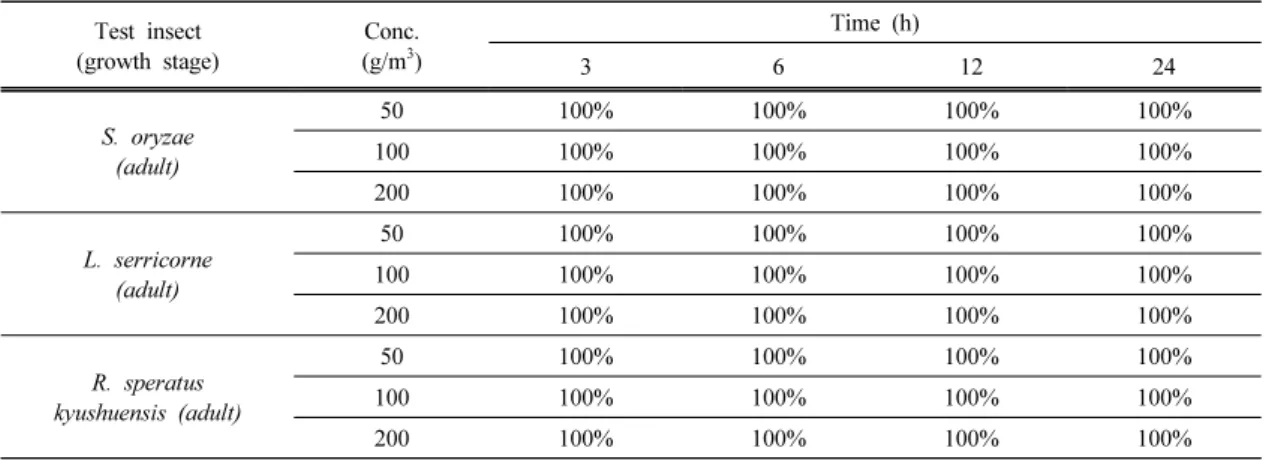
Direct exposure to MB+EO for 3 h at 50 g/m
3resulted in death of all test insects.
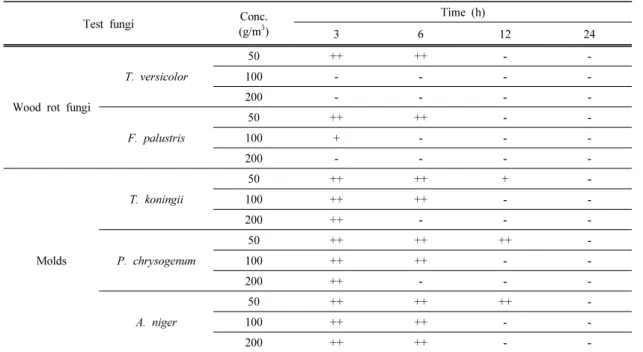
However, 5% of eggs emerged to adults, so sensitivity differed according to growth stage (Tables 3, 4). The two species of wood rot fungi
Fig. 2. Indirect-exposure method.Test insect (growth stage)
Conc.
(g/m3)
Time (h)
3 6 12 24
S. oryzae (adult)
50 100% 100% 100% 100%
100 100% 100% 100% 100%
200 100% 100% 100% 100%
L. serricorne (adult)
50 100% 100% 100% 100%
100 100% 100% 100% 100%
200 100% 100% 100% 100%
R. speratus kyushuensis (adult)
50 100% 100% 100% 100%
100 100% 100% 100% 100%
200 100% 100% 100% 100%
Table 3. Insecticidal Activity of MB+EO Following Direct Exposure (Death Rate: %)
Test insect (growth stage)
Conc.
(g/m3)
Time (h)
3 6 12 24
S. oryzae (egg)
50 3.2 (5.2%)* 0 0 0
100 0 0 0 0
200 0 0 0 0
S. oryzae (larva)
50 0 0 0 0
100 0 0 0 0
200 0 0 0 0
* Emergence ratio between the test insect and control
Table 4. Insecticidal Activity of MB+EO Following Direct Exposure (Number of Emergences)
were removed following direct exposure for 3 h to 200 g/m
3or 6 h to 100 g/m
3; however, the three species of molds were removed following direct exposure for > 12 h at 100 g/m
3(Table 5).
Indirect exposure for 12 h to 200 g/m
3or 24 h to 100 g/m
3resulted in the death of all test insects. Indirect exposure for 24 h to 200 g/m
3, which were the maximum time and concen- tration applied in this research, some of the
insects and fungi grew. Thus, the insecticidal and fungicidal effects were incomplete (Table 6). Therefore, fumigation may not always con- trol insects or fungi in wood due to the high enclosure ratio within the treatment space. In outdoor environments, these problems occur more frequently due to leakage of fumigant through soil.
Test fungi Conc.
(g/m3)
Time (h)
3 6 12 24
Wood rot fungi
T. versicolor
50 ++ ++ - -
100 - - - -
200 - - - -
F. palustris
50 ++ ++ - -
100 + - - -
200 - - - -
Molds
T. koningii
50 ++ ++ + -
100 ++ ++ - -
200 ++ - - -
P. chrysogenum
50 ++ ++ ++ -
100 ++ ++ - -
200 ++ - - -
A. niger
50 ++ ++ ++ -
100 ++ ++ - -
200 ++ ++ - -
* Activity evaluation: no growth (-), slow growth rate (+), normal growth rate (++)
Table 5. Fungicidal Activity of MB+EO Following Direct Exposure
Conc. (g/m3) Hour (h)
Insecticidal activity* Fungicidal activity**
50 100 200 50 100 200
12 90% 94% 100% ++ ++ ++
24 92% 100% 100% ++ ++ +
* Death rate (%)
** Activity evaluation: no growth (-), slow growth rate (+), normal growth rate (++)
Table 6. Biocidal Activity of MB+EO Following Non-direct Exposure
3.2. EO+HFC
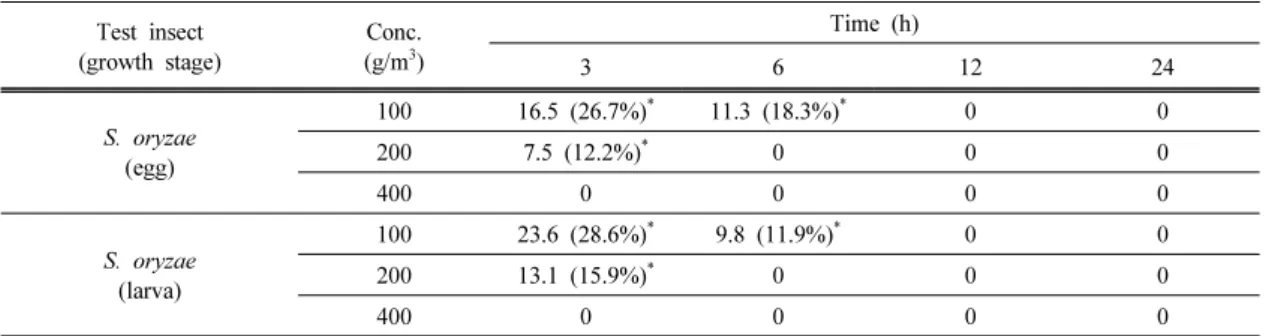
Direct exposure to EO+HFC for 6 h at 100 g/m
3, resulted in the death of all adult test insects. The frequency of egg and larva emer- gence was 18.3% and 11.9%, respectively, com- pared to the non-treated control group (Tables 7, 8). The two species of wood rot fungi were removed by treatment for 12 h at 100 g/m
3. However, the three species of molds were removed by treatment for 24 h at 200 g/m
3(Table 9).
Indirect exposure for 12 h at 400 g/m
3re- sulted in the death of all test insects. After
treatment for 48 h at 400 g/m
3, the maximum time and concentration, fungi exhibited active growth (Table 10). Similar to MB+EO, fungi actively grew inside the wood in the presence of a concentration twofold that recommended by the manufacturer. Thus, penetration deep in- side the wood under outdoor conditions may be problematic.
3.3. EDN
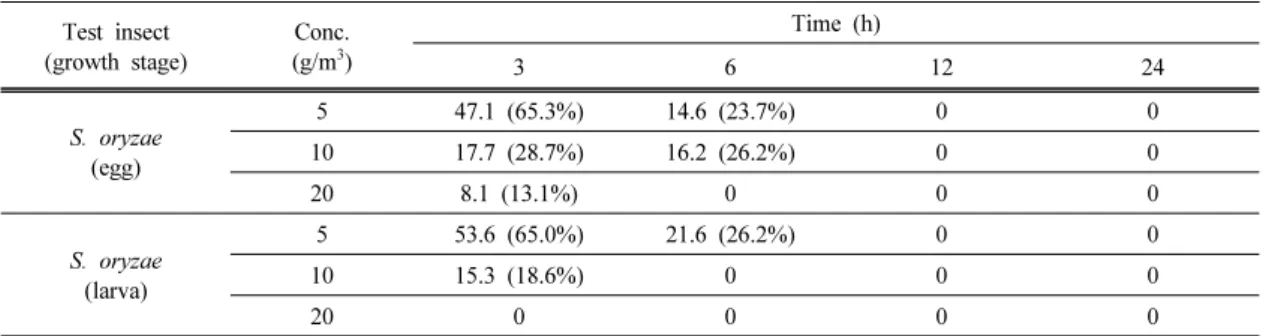
Direct exposure to EDN for 3 h at 10 g/m
3or 6 h at 5 g/m
3resulted in the death of adult test insects. Treatment for 6 h and 3 h at 20
Test insect (growth stage)
Conc.
(g/m3)
Time (h)
3 6 12 24
S. oryzae (adult)
100 83% 100% 100% 100%
200 92% 100% 100% 100%
400 100% 100% 100% 100%
L. serricorne (adult)
100 83% 100% 100% 100%
200 85% 100% 100% 100%
400 100% 100% 100% 100%
R. speratus kyushuensis (adult)
100 100% 100% 100% 100%
200 100% 100% 100% 100%
400 100% 100% 100% 100%
Table 7. Insecticidal Activity of EO+HFC Following Direct Exposure (Death Rate: %)
Test insect (growth stage)
Conc.
(g/m3)
Time (h)
3 6 12 24
S. oryzae (egg)
100 16.5 (26.7%)* 11.3 (18.3%)* 0 0
200 7.5 (12.2%)* 0 0 0
400 0 0 0 0
S. oryzae (larva)
100 23.6 (28.6%)* 9.8 (11.9%)* 0 0
200 13.1 (15.9%)* 0 0 0
400 0 0 0 0
* Emergence ratio between the test insect and control
Table 8. Insecticidal Activity of EO+HFC Following Direct Exposure (Number of Emergences)
g/m
3resulted in the death of all eggs and lar- vae, respectively (Tables 11, 12). This indicates a greater difference in sensitivity according to growth stage than the other two fumigants. The two species of wood rot fungi were removed by treatment for 3 h at 5 g/m
3and the three spe- cies of molds were removed by treatment for 3 h at 10 g/m
3or 6 h at 5 g/m
3, similar to the
other two fumigants (Table 13).
Indirect exposure for 12 h at 5 g/m
3resulted in the death of all test insects, and the fungi were removed by treatment for 24 h at 20 g/m
3(Table 14). As EDN has not been applied as a fumigant for cultural property to date, the optimum concentration and treatment duration are unclear. Thus, treatment at 20 g/m
3for 24
Test fungi Conc.
(g/m3)
Time (h)
3 6 12 24
wood rot fungi
T. versicolor
100 ++ ++ - -
200 ++ - - -
400 + - - -
F. palustris
100 ++ ++ - -
200 ++ + - -
400 ++ - - -
Molds
T. koningii
100 ++ ++ ++ +
200 ++ ++ + -
400 ++ ++ ++ -
P. chrysogenum
100 ++ ++ - -
200 ++ ++ - -
400 ++ - - -
A. niger
100 ++ ++ + +
200 ++ ++ + -
400 ++ ++ - -
*Activity evaluation: no growth (-), slow growth rate (+), normal growth rate (++)
Table 9. Fungicidal Activity of EO+HFC Following Direct Exposure
Conc. (g/m3) Hour (h)
Insecticidal activity* Fungicidal activity**
100 200 400 100 200 400
12 41%
(20.5/50)
82%
(41/50)
100%
(50/50) ++ ++ ++
24 69%
(34.5/50)
95%
(47.5/50)
100%
(50/50) ++ ++ ++
*Insect: death rate (%)
**Fungi: activity evaluation: no growth (-), slow growth rate (+), normal growth rate (++)
Table 10. Biocidal Activity of EO+HFC Following Non-direct Exposure
h can be used to establish such a standard. It have to consider the characteristics of the material, diverse field conditions, such as temperature, enclosure ratio, and treatment capacity.
3.4. Discussion
The biocidal effects of fumigants are in pro- portion to the concentration time product (CT Product), which is the product of the treatment concentration and duration (Su et al., 1989).
The CT Product for control of adult rice weevil by direct exposure to MB+EO was ≤ 150 g
⋅h/m
3at 22 ℃ with 60% relative humidity, compared to 1200-2400 g ⋅h/m
3for indirect exposure. This indicates that the amount of agents penetrating wood decreased rapidly.
MB does not penetrate and spread in the deeper parts of wood (United Nations Environment Programme, 2006), and the pine (Pseudotsuga menziesii) wood penetration of MB was significantly lower than that of SF, PH
3and EDN. Moreover, the equilibrium con- centration was not achieved after 50 h at 5, 10, and 15 cm depths within the wood (Ren et al., 2011).
Test insect (growth stage)
Conc.
(g/m3)
Time (h)
3 6 12 24
S. oryzae (adult)
5 59% 100% 100% 100%
10 100% 100% 100% 100%
20 100% 100% 100% 100%
L. serricorne (adult)
5 100% 100% 100% 100%
10 100% 100% 100% 100%
20 100% 100% 100% 100%
R. speratus kyushuensis (adult)
5 100% 100% 100% 100%
10 100% 100% 100% 100%
20 100% 100% 100% 100%
Table 11. Insecticidal Activity of EDN Following Direct Exposure (Death Rate: %)
Test insect (growth stage)
Conc.
(g/m3)
Time (h)
3 6 12 24
S. oryzae (egg)
5 47.1 (65.3%) 14.6 (23.7%) 0 0
10 17.7 (28.7%) 16.2 (26.2%) 0 0
20 8.1 (13.1%) 0 0 0
S. oryzae (larva)
5 53.6 (65.0%) 21.6 (26.2%) 0 0
10 15.3 (18.6%) 0 0 0
20 0 0 0 0
*Emergence ratio between test insect and control
Table 12. Insecticidal Activity of EDN Following Direct Exposure (Number of Emergences)
EO+HFC was first used in Japan to replace MB+EO, and is less effective on various mate- rials (Kang, 2009b; Kang, 2009c; Jeong et al., 2015). The CT Product required for control of adult rice weevils was 600-1,200 g ⋅h/m
3. However, the corresponding value for indirect exposure was ∼4800 g⋅h/m
3. Thus, the quan- tity of agent penetrating the wood decreased significantly.
EO remains for a long period when adsorbed to rubber or plastic (Abbey Publication, 1982).
If the fumigant does not affect the material im- mediately after treatment, deterioration of the material may occur due to the effect of the re- sidual gas (Kang, 2009a). Since EO mutagenic and carcinogenic (National Institute for Occupational Safety and Health, 1981), long-term ventilation after treatment would be
Test fungi Conc.
(g/m3)
Time (h)
3 6 12 24
Wood rot fungi
T. versicolor
5 - - - -
10 - - - -
20 - - - -
F. palustris
5 - - - -
10 - - - -
20 - - - -
Molds
T. koningii
5 ++ - - -
10 - - - -
20 - - - -
P. chrysogenum
5 - - - -
10 - - - -
20 - - - -
A. niger
5 + - - -
10 - - - -
20 - - - -
*Activity evaluation: no growth (-), slow growth rate (+), normal growth rate (++)
Table 13. Fungicidal Activity of EDN Following Direct Exposure
Conc. (g/m3) Hour (h)
Insecticidal activity* Fungicidal activity**
5 10 20 5 10 20
12 100%
(50/50)
100%
(50/50)
100%
(50/50) ++ ++ ++
24 100%
(50/50)
100%
(50/50)
100%
(50/50) ++ + -
*Insect: death rate (%)
**Fungi: activity evaluation: no growth (-), slow growth rate (+), normal growth rate (++)
Table 14. Biocidal Activity of EDN Following Non-direct Exposure
required.
EDN could be applied at a low dosage and exhibited an excellent fungicidal effect. It can likely control insects and fungi inside wood fol- lowing treatment for 24 h at 20 g/m
3at 22 ℃, as it shows outstanding wood penetration.
Therefore, it has various advantages as a fumigant. However, discoloration of metal and paper can occur (National Research Institute of Cultural Heritage, 2008; Robbiola et al., 2015);
thus, this agent should be applied to cultural properties with caution.
4. CONCLUSION
We evaluated the sensitivity of biological agents and wood penetration of fumigants used to control insects and fungi damaging to wood- en cultural properties. MB+EO and EO+HFC did not completely control insects and fungi in the deeper parts of wood. The biocidal effect of fumigants is in proportion o the accumulated quantity of fumigant through breathing (Liu, 2008), and the environmental condition sig- nificantly affects the spread of fumigant and the breathing of biological agents. Thus, the treat- ment conditions must take into consideration these factors. Fumigants applied to wooden buildings located outdoors can leak through soil. Thus, a biocidal effect may require addi- tional agent during the treatment period.
Numerous studies on eco-biocidal treatments, such as heat treatment and low oxygen treat- ment, have been conducted (Oh et al., 2012;
Jang et al., 2014; Oh and Choi, 2014; Oh et
al., 2014), and these methods are applied to management of museum collections. These methods cannot be applied to outdoor wooden architecture. However, fumigants can be used outdoors, in closed rooms, and in large spaces.
Thus, fumigants can complement eco-friendly methods for controlling organisms, which will require additional research and product development.
ACKNOWLEDGEMENTS
This study was supported by the National Research Institute of Cultural Heritage (Project No.
NRICH-1307-B15F).
REFERENCES
Abbey publication, 1982, EtO Reevaluated, The Abbey Newsletter 6(3): 1∼2.
Ackery, P.R., Testa, J.M., Ready, P.D., Doyle, A.M., Pinniger, D.B. 2004. Effects of High Temperature Pest Eradication on DNA in Entomological Collections, Studies in Conservation 49(1): 35∼40.
Chae, O.J., Park, S.S., Ahn, C.S. 2004. A Study on the Effects of Fumigation on Excavated Costumes, Journal of the Korea Society of Clothing and Textiles 28(5): 668∼677.
Choi, K.S. 2014. Fumigant toxicity of phosphine against a termite, Reticulitermes speratus (Isoptera: Rhinotermitidae), Master of science thesis, Chungbuk National University.
Cultural Heritage Administration. 2009. 50 Years History of Cultural Heritage Administration, Daejeon, 35208.
Cultural Heritage Administration. 2015. Statistics of Cultural Heritage Administration, Daejeon,
35208.
Elert, K., Maekawa, S. 1997. Rentokil Bubble in Nitrogen Anoxia Treatment of Museum Pests, Studies in Conservation 42(4): 247∼252.
Gilberg, M. 1989. Inert Atmosphere Fumigation of Museum Objects, Studies in Conservation 34(2):
80∼84.
Gilman, J., Jacxsens, L., Meulenaer, B. D., Devieghere, F. 2015. Modified Atmosphere Packaging and Irradiation to Preserve Contemporary Food-based art: An Experimental Study, Journal of Cultural Heritage 16(3): 391∼ 397.
Jeong, S.Y., Kim, Y.H., Lee, J.M. 2015. Stability Assessment on Materials of Cultural Property by Fumigants Containing Ethylene Oxide, Korean Journal of Cultural Heritage Studies 48(3): 46∼ 59.
Jang, H.G., Baek, N.Y., Kang, D.I. 2014. Material Stability Assessment of Low Oxygen and Heating Treatment, Journal of Conservation Science 30(2): 149∼156.
Kang, D.I. 2009a. The Secular Variation Influence of Fumigation Gas on Cultural Property Materials, The Journal of Conservation of Cultural Properties 6: 74∼86.
Kang, D.I. 2009b. The Stability Appraisement of Cultural Property Material with the Replacing Fumigation Gas of Methyl Bromide, Journal of Conservation Science 25(3): 283∼291.
Kang, D.I. 2009c. The 2nd Stability Appraisement on Cultural Property Material with the Replacing Fumigation Gas of Methyl Bromide Ⅱ, Journal of Conservation Science 25(4): 465∼471.
Kigawa, R., Strang, T., Hayakawa, N., Yoshida, N., Kimura, H., Young, G. 2011. Investigation of Effects of Fumigants on Proteinaceous Components of Museum Objects (Muscle, Animal Glue and Silk) in Comparison with
Other Non-chemical Pest Eradicating Measures, Studies in Conservation 56(3): 191∼215.
Kim, Y.H., Jo, C.W., Kim, S.J., Lee, J.M., Choi, K.H. 2015. Effects of as asarum sieboldii Miquel Extracts on the Properties of Korean Traditional Paper (Han-ji).
Lee, K.S., Park, B.B., Choi, K.Y. 2002. Influence of Ethylene Oxide Fume upon Chromaticity of Cultural Material, Korean Journal of Environmental Health 28(5): 4∼12.
Liu, Y.B. 2008. Low Temperature Phosphine Fumigation for Postharvest Control of Western Flower Thrips (thysanoptera: thripidae) on Lettuce, Broccoli, Asparagus, and Strawberry, Journal of Economic Entomology 101: 1786∼ 1791.
Lee, B.H., Annis, P.C., Tumaalii, F., Lee, S.E. 2004.
Fumigant Toxicity of Eucalyptus blakelyi and Melaleuca Fulgens Essential oils and 1,8-Cineole against Different Development Stages of the Rice Weevil Sitophilus oryzae, Phytoparasitica 32(5): 498∼506.
National Research Institute of Cultural Heritage.
2008. Development of New Fumigants and Less Toxic Control Methods for Pests, R&D project report.
Nayak, M.K., Colins, P.J. 2008. Influence of Concentration, Temperature and Humidity on the Toxicity of Phosphine to the Strongly Phosphine Resistant psocid Liposcelis bostrychophila Badonnel (Psocoptera: Liposcelididae), Pest Management Science 64: 971∼976.
Oh, J.S., Choi, J.E., Lee, J.M. 2012. Trial Manufacture and Disinfection Evaluation of Anoxic Chamber System for Museum Insects, Journal of Conservation Science 28(4): 377∼ 385.
Oh, J.S., Choi, J.E., Noh, S.J., Eum, S.W. 2014. The Effects of Anoxic Treatments on Color and
Mechanical Property in Fabrics, Natural Dyed Fabrics, Papers, Natural Dyed Papers and Paints, Journal of Conservation Science 30(2): 219∼ 234.
Oh, J.S., Choi, J.E. 2014. The Evaluation of Disinfection and Operation of Large Scale Anoxic Chamber System for Museum Insects, Journal of Conservation Science 30(2): 137∼ 148.
Ren, Y.L., Lee, B.H., Benjamin, P. 2011. Penetration of Methyl Bromide, Sulfuryl Fluoride, Ethanedinitrile and Phosphine into Timber Blocks and the Sorption Rate of the Fumigants, Journal of Stored Products Research 47: 63∼68.
Robbiola, L., Queixalos, I., Zwick, A., Baslé, K., Daniel, F., Drieux-Daguerre, M., Ducom, P., Fritsch, J. 2015. Disinfestation of historical buildings - corrosion evaluation of four fumi- gants on standard metals, Journal of Cultural Heritage 16(1): 15∼25.
Roew, S. 2004. The Effect of Insect Fumigation by Anoxia on Textiles Dyed with Prussian Blue, Studies in Conservation 49(4): 259∼270.
Schortemeyer, M., Thomas, K., Haack, R.A., Uzunovic, A., Hoover, K., Simpson, J.A., Grgurinnovic, C.A. 2011. Appropriateness of Probit-9 in the Development of Quarantine
Treatments for Timber and Timber Commodities, Journal of Economic Entomology 104: 717∼ 731.
Sonoda, N., Hidaka, S. 2008. Between Conservation and Access: Implementation of Integrated Pest Management at the National Museum of Ethnology, Osaka, Japan, Studies in Conservation 53(1): 88∼92.
Su, N.Y., Weste, L.A., Scheffrahn, R.H. 1989.
Concentration-Time Relationship for Fumigant Efficacy of Sulfuryl Fluoride Against the Formosan Subterranean Termite (Isoptera:
Rhinotermitidae), Journal of Economical Entomology 82(1): 156∼158.
The National Institute for Occupational Safety and Health (NIOSH). 1981. Ethylene Oxide (EtO):
Evidence of Carcinogenicity, DHHS publication number 81∼130.
United Nations Environment Programme. 2006.
Handbook for the Montreal Protocol on Substances that Deplete the Ozone Layer, 7th edition, 482.
Winks, R.G., Waterford, C.J. 1986. The Relationship between Concentration and Time in the Toxicity of Phosphine to Adults of a Resistant Strain the Tribolium Castaneum, Journal of Stored Products Research 22: 85∼92.