Journal of the Ergonomics Society of Korea
Vol. 30, No. 1 pp.221-227, February 2011 DOI:10.5143/JESK.2011.30.1.221
감성이 시각적 이미지의 색감기억에 미치는 영향
장 필 식 대불대학교 컴퓨터교육과
Effects of Emotion on Color Vividness of Visual Memory
Phil Sik Jang
Department of Computer Education, Daebul University, Yeongam, 526‐702
ABSTRACT
Objective: The aim of this study is to investigate the quantitative effects of various emotions and retention periods on the color vividness of visual memory. Background: Although numerous studies have focused on the effects of emotions on memory such as visual detail and vividness of emotional events compared to neutral events, the relationship between emotion and visual memory is ambiguous yet. Furthermore, there were few studies on the effect of emotion on vividness of visual memory. Method: A total of 68 subjects were participated in serial experiments proceed on online and the experiments had two phases: recognition phase and reproduction phase. The 15 photographs were used as visual stimuli and all experiments were conducted over the internet(experiment website) and the results were collected on the web database. Results: The retention period, sleep-arousal emotion and subjective saturation of visual stimuli had a significant effect on the color vividness of visual memory. Conclusion: The results suggested that the color of visual stimulus might be more vividly remembered when it is arousing, the subjective saturation is higher and the retention period is longer. Application: The findings of this study may help clarify the relationship between human emotions and visual memory.
Keywords: Human emotions, Color vividness, Retention period, Visual Memory
1. Introduction
인간은 이성적인 동시에 감정적인 동물이다. 감정·감성은 어떤 사건(일)에 대한 주관적 해석에 의해 유발되며, 유발된 감정·감성은 그 사건·일에 대한 기억에 영향을 미칠 수 있다. 사람들은 일반적으로, 부정적인 감성·감정이 유발된 사건을 다른 사건들에 비해 더 생생하고 선명하게(vividly) 기억한다고 주장한다(Kensinger et al., 2006; Kensinger et al., 2007). 교통사고와 같은 극도의 공포를 체험하는 경우에
는 사고순간의 사물들이 영화의 슬로우모션(slow motion) 처럼 느리게 움직이고 이에 따라 모든 사물을 상세하게 기 억하게 된다는 사람도 있다. 실험결과, 눈과 뇌가 실제로 사 물들을 슬로모션으로 인식(perception)하지는 못한 것으로 밝혀졌지만, 감정과 관련된 기억은 일반적인 기억보다 더 강 렬하기 때문에 카메라 플래쉬를 터트려 사진을 찍은 것처럼 (섬광기억) 상세하고 명료하게 기억되는 것으로 알려져 있 다(Stetson et al., 2007).
Block & Keller(1997)에 의하면 특정 정보가 생생하게 회상 가능할 수록, 의사소통 시 설득력 있는 정보전달이 가
Corresponding Author: Phil Sik Jang. Department of Computer Education, Daebul University, Yeongam, 526-702.
Mobile: E-mail: [email protected]
Copyright@2011 by Ergonomics Society of Korea(pISSN:1229-1684 eISSN:2093-8462). All right reserved.
***-****-****
능하다고 하며, 기억의 생생한 정도는 인간의 메시지 처리 (message processing)에 유의한 영향을 준다는 연구결과 도 있다(Smith & Shaffer, 2000). 심리학에서는 어느 정도 생생하게 회상하는가가 개개인의 상황인식에 큰 영향을 준 다는 현저성 효과(vividness effect)가 널리 알려져 있으며, 이를 마케팅 및 의사결정과정과 연관 짓는 연구들도 발표되 고 있다(Keller & Block, 1997).
실험실 내에서의 다양한 연구들에서도 피실험자들은 감정 과 연관된 사물을 그렇지 않은 사물들 보다 생생하고 세밀하 게 기억한다고 일관되게 주장해 왔다(Dewhurst & Parry, 2000; Kensinger & Corkin, 2003; Ochsner, 2000). 실제 로, 피실험자들은 자극적이며 각성을 일으키는(arousing) 내용이 담긴 문장(text)의 위치와 글꼴, 화면 색상 등을 좀 더 정확하게 기억할 가능성이 높다고 한다(D'Argembeau &
Van der Linden, 2004; Doerksen & Shimamura, 2001;
Kensinger & Corkin, 2003).
하지만 이러한 주장과는 달리, 피실험자들 기억의 정확도 와 감정, 감성의 개재 여부는 실제적으로 상관관계가 낮다 는 연구결과들도 발표되고 있다(Loftus & Burns, 1982;
Neisser & Harsch, 1992; Schmolck, Buffalo, & Squire, 2000; Talarico & Rubin, 2003). 또한 재인(recognition) 실험결과 유의한 차이가 없는데도 불구하고 피실험자들은 감정이 개재된 사물을 그렇지 않은 사물보다 생생하게 기억 한다고 주장하는 것으로 나타났다(Ochsner, 2000; Sharot, Delgado, & Phelps, 2004). 이에 따라 피실험자의 자기보고 (self-report)에 대한 객관성에 의문이 제기되고 있다.
위에서 언급한 연구들에서는 특정 단어의 맥락, 텍스트 색상, 위치 등에 대한 시각적 기억의 정확성과 시각적 이미 지를 어느 정도까지 세부적으로 기억하는가 등이 주된 연구 대상이었다. 하지만 우리가 일상적으로 이야기하는 '기억이 생생하다' 또는 '기억이 퇴색되었다'라는 표현에는 시각적으 로 어느 정도 세밀하게 기억하는 가뿐만 아니라 시각적 이 미지가 어느 정도 선명하게 기억되었는가가 포함된다. 이것 은 시각적 기억에 있어 내용과 색상 기억의 정확성뿐만 아 니라, 색감, 특히 전체적인 채도 기억이 연관됨을 나타낸다.
심미적 관점에서 색이 바래 채도가 낮아진 사진은 그만큼 내포하는 의미가 감소된 것으로 봐야 한다는 주장도 있다 (Vemallis, 1999).
본 연구에서는 일련의 실험을 통해 감성과 색감(채도) 기 억에 대한 관계를 살펴보고자 한다. 특히, 시각적 이미지에 의해 유발된 감성과 파지기간(retention period)에 따라 색 감 기억에 차이가 있는지를 검증하고자 한다.
2. Method
본 연구에서 실험은 일반 정서모형에서 주로 이용되는 감 성들을 유발할 수 있는 이미지들을 자극으로 제시하고, 재인 (recognition), 재생(reproduction) 실험을 통해 피실험자 들의 반응을 측정하였다. 실험은 컴퓨터를 이용해 웹(web) 상에서 이루어지도록 하였으며, 이를 통계적으로 분석하여 결론을 도출하였다.
2.1 Subjects
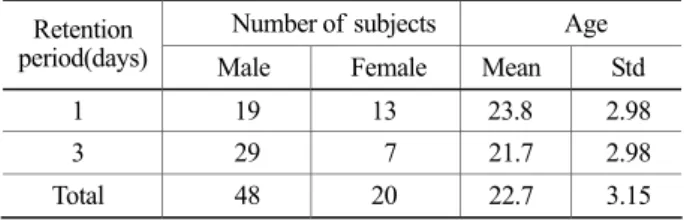
본 연구에는 색맹이나 색약을 가지고 있지 않은 68명의 학부과정 대학생이 참여하였으며, 자극 제시 후 실험까지 파 지기간에 따른 각 실험 별 피실험자들의 인원 수 및 나이는 Table 1과 같다. 이들은 대학 학부과정의 컴퓨터 관련 과목 (개론 포함)을 1개 과목 이상 수강한 학생들로써 실험진행 에 필요한 기초적인 컴퓨터 및 인터넷 활용능력을 갖추고 있다고 가정하였다.
2.2 Apparatus
실험은 피실험자로 하여금 인터넷에 접속하도록 하여 웹 상에서 진행하였으며, 실험에는 Intel Pentium 4 Micro- processor를 기반으로 하는 PC와 1024*768 해상도 32 bit color, refresh rate 85Hz로 설정된 17인치 모니터가 이용되었다. 실험장소는 대학교 컴퓨터 관련 학과 실습실로 써 암막커튼을 이용하여 실험 시 동일한 채광상태를 유지하 도록 하였다. 실험 용 웹페이지는 Macromdeia Flash 8.0에 의해 작성되었으며, 피실험자의 평가치 및 입력값은 Web Database에 취합되었다. 결과분석을 위한 통계분석에는 SPSS 15.0 for Windows®를 이용하였다.
2.3 Stimuli
42명의 학부과정 대학생으로 하여금 인터넷 등을 이용 하여 쾌, 불쾌, 이완, 각성 등의 감성을 유발할 수 있는 이
Table 1. Subjects participated in experiments Number of subjects Age Retention
period(days) Male Female Mean Std
1 19 13 23.8 2.98
3 29 7 21.7 2.98
Total 48 20 22.7 3.15
미지 220여 개를 취합하도록 하였다. 이 이미지들은 일반 정서모형(Mehrabian & Russell, 1974)에서 사용되는 쾌 (pleasure), 불쾌(displeasure), 이완(sleep), 각성(arousal), 중립(neutral)의 다섯 개 감성유형으로 분류되었으며, 각 감성분류 당 3개, 총 15개의 이미지가 최종 실험자극으로 선정되었다. 실험에 이용된 이미지들의 예를 보이면 Figure 1과 같다. 15개의 이미지들은 일반적으로 많이 사용되는 이 미지 리터칭 소프트웨어인 Adobe Photoshop 7.0의 히스토 그램 평활화(histogram stretching) 기법을 이용하여 명도 와 대비, 색상을 보정하였다.
실험자극으로 제시된 15개 이미지의 너비는 최소 394 픽셀, 최대 750 픽셀이며, 이것은 모니터와 눈과의 거리를 45Cm라고 할 때, 시야각 15.3∼28.7°에 해당한다. 이미지 들의 높이는 384픽셀(시야각 14.9°)∼563픽셀(21.7°)였 다. 이미지들의 평균 크기는 640×511 픽셀이며, 24.6×
19.7°의 시야각을 가진다.
2.4 Procedure
실험절차는 자극제시 단계와 재인(recognition), 재생 (reproduction)실험의 단계로 이루어졌다. 자극제시 단계에 서는 각 피실험자들에게 15개 이미지들을 임의의 순서대로 제시하고 이미지에서 느껴지는 감성과 주관적 채도(이미지 색상이 선명한지)를 평가하도록 하였다. 감성은 쾌-불쾌, 이완-각성 두 개의 축으로 나누어 각각 7점 리커트 척도 (Likert scale)로 측정하였으며, 이미지의 주관적 채도 또한 7점 리커트 척도로 측정하였다. 재생과 재인실험은 파지기간 (retention time)에 따라 피실험자를 두 개의 그룹으로 나 누어, 첫 번째 그룹은 1일 후, 두 번째 그룹은 3일 후 실시 하였다.
기억재인실험에서는 자극제시 단계에 제시한 15개 이미지 를 임의의 순서로 피실험자들에게 다시 제시하고, 기억하고
있는 이미지와 채도가 동일한지를 판단하도록 하였다. 피실 험자의 평가는 5점 리커트 스케일(+2 ~ -2)로 측정하였는 데, 채도가 동일한 경우에는 0점, 훨씬 채도가 높고 선명하 면 +2점, 훨씬 채도가 낮고 흑백사진에 가까우면 -2점이 배정되도록 하였다.
기억재생실험에서는 각 피실험자에게 첫 단계에 제시한 15개 이미지의 채도를 임의로 변화시켜 제시한 후, 키보드 와 마우스를 이용하여 기억하고 있는 이미지의 채도와 같게 조정하도록 하였다. 이미지 전체가 무채색일 때(gray scale) 를 0이라 하고 원본 이미지의 채도를 100라고 할 때, 0∼
250 범위까지 조정할 수 있도록 하였다.
실험화면은 Figure 2와 같으며, 재생실험과 재인실험의 피실험자 응답치는 웹 데이터베이스에 전송, 취합되어 통계 분석에 이용되었다.
3. Results
3.1 Recognition experiment
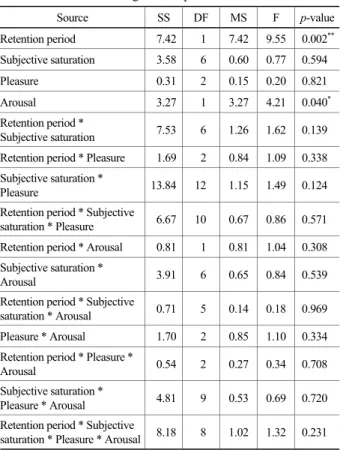
피실험자가 평가한 채도 동일성(-2∼2점)을 종속변수로 하고 파지기간과 주관적 채도, 불쾌-쾌, 이완-각성 정도에 따라 평균차이가 있는지를 판별하기 위해 분산분석을 실시 한 결과는 Table 2와 같다. 파지기간에 따라 동일성 평가치 는 유의한 차이가 있는 것으로 나타났으며(p<0.01), 이완 -각성 정도에 따라 0.01 수준에서 유의한 차이를 보였다.
하지만 주관적 채도와 불쾌-쾌 차원에 의해서는 유의한 평 Figure 1. Visual stimuli used in the experiment
Figure 2. The screenshots of recognition(left) and reproduction experiment (right)
균 차가 없는 것으로 나타났으며(p>0.05), 2인자 이상 교호 작용은 유의수준 0.05에서 영향을 미치지 않는 것으로 나타 났다.
Figure 3은 파지기간에 따라 피실험자가 평가한 채도 동 일성 평균과 95% 신뢰구간을 나타낸 것이다. 그리고 Table 3은 피실험자들이 각 수준(1일, 3일)에서 평가한 값이 0인
지, 즉 자극제시 단계의 이미지와 동일하다고 평가하였는지 아닌지를 판단하기 위해서 단일표본 t 검정(one-sample t-test)을 실시한 결과이다. 실험결과, 파지기간 각 수준에 서 동일성 평가치 평균을 0이라고 할 수 없는 것으로 나타 났다.
(p<0.01). 이것은 파지기간이 1일인 경우보다 3일인 경 우, 피실험자들은 원 이미지보다 다시 제시된 이미지의 채도 가 낮은 것으로 평가하였음을 나타낸다.
Figure 4는 이완-각성의 정도에 따른 동일성평점의 평균 과 95% 신뢰구간을 나타낸 것이며, Table 4는 이완, 각성 각 수준의 동일성 평균평점이 0인지를 검정한 결과이다. 단 일표본 T검정 결과, 이완, 각성 두 개 수준 모두 유의수준 0.05에서 평균값이 0이라는 가설이 채택되었다. 즉, 분산분 석에서 이완과 각성 수준간에 유의한 차이가 있는 것으로 나타났지만, T검정 결과 피실험자들은 각 차원에서 처음 제 시된 이미지와 추후 다시 제시된 이미지의 채도가 동일한 것으로 판단한 것으로 사료된다.
Table 2. ANOVA results for comparison of means by recognition experiment
Source SS DF MS F p-value
Retention period 7.42 1 7.42 9.55 0.002**
Subjective saturation 3.58 6 0.60 0.77 0.594
Pleasure 0.31 2 0.15 0.20 0.821
Arousal 3.27 1 3.27 4.21 0.040*
Retention period *
Subjective saturation 7.53 6 1.26 1.62 0.139 Retention period * Pleasure 1.69 2 0.84 1.09 0.338 Subjective saturation *
Pleasure 13.84 12 1.15 1.49 0.124
Retention period * Subjective
saturation * Pleasure 6.67 10 0.67 0.86 0.571 Retention period * Arousal 0.81 1 0.81 1.04 0.308 Subjective saturation *
Arousal 3.91 6 0.65 0.84 0.539
Retention period * Subjective
saturation * Arousal 0.71 5 0.14 0.18 0.969 Pleasure * Arousal 1.70 2 0.85 1.10 0.334 Retention period * Pleasure *
Arousal 0.54 2 0.27 0.34 0.708
Subjective saturation *
Pleasure * Arousal 4.81 9 0.53 0.69 0.720
Retention period * Subjective
saturation * Pleasure * Arousal 8.18 8 1.02 1.32 0.231 SS(sum of square), DF(degree of freedom), MS(mean square)
(*: significant at the 0.05 level) (**: significant at the 0.01 level)
Table 3. One-sample t-test and confidence interval for identity scores as a function of retention period
95% CID Retention
Period(day) t DF Sig.
(2-tailed) MD
Lower Upper 1 4.15 479 0.000** 0.17 0.09 0.24 3 -4.03 524 0.000** -0.16 -0.23 -0.08 MD(mean difference), CID(confidence interval of the difference) (**:significant at the 0.01 level)
Table 4. One-sample t-test and confidence interval for identity scores as a function of sleep-arousal axis
95% CID Axis t DF Sig.
(2-tailed) MD
Lower Upper Sleep 1.04 580 0.298 0.04 -0.03 0.11 Arousal -1.33 423 0.185 -0.06 -0.15 0.03
0.08
-0.10
-1.0 -0.5 0.0 0.5 1.0
Sleep Arousal
Identity score
0.14
-0.17
-1.0 -0.5 0.0 0.5 1.0
1 3
Identity Score
Retention Period(day)
Figure 3. Mean identity scores and 95% confidence intervals as a function of retention period in recognition experiment
Figure 4. Mean identity scores and 95% confidence intervals as a function of sleep-arousal axis in recognition experiment
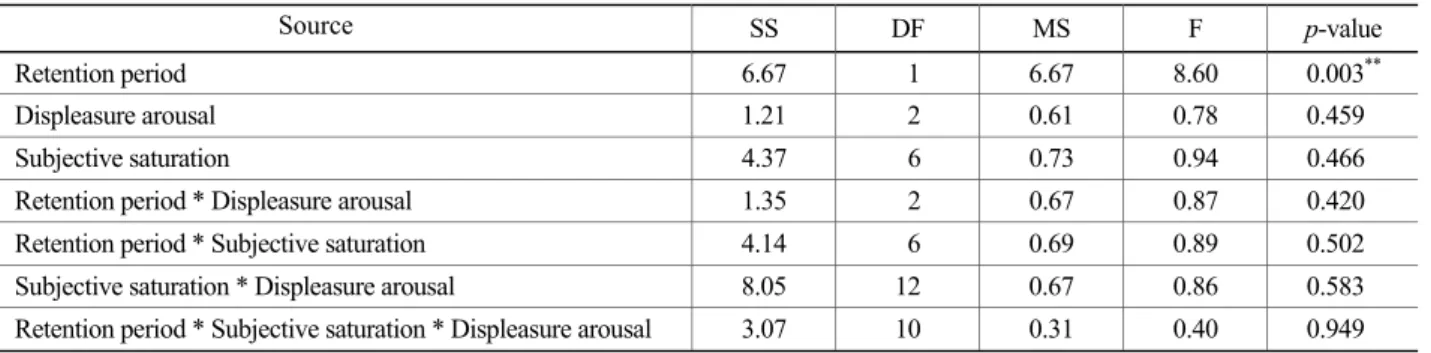
Kensinger et al.(2006)은 불쾌한 감성과 각성 정도가 높을 경우, 즉 불쾌-각성 시 세부적인 이미지 기억이 향상 된다고 주장하였다. Table 5는 Table 2에 제시한 분산분석 에서 감성관련 독립변수인 불쾌-쾌, 이완-각성 대신, 불쾌 각성을 독립변수로 하여 실시한 분산분석 결과이다. Table 2 와 마찬가지로 파지기간에 따라 유의한 차이(p<0.01)가 있는 것으로 나타났으나, 불쾌각성 정도에 따라서 동일성 평 점은 유의한 차이가 없는 것으로 나타났다(p>0.05). 즉, 불 쾌-각성을 일으키는 이미지에 대한 선명한 정도의 기억은 다른 이미지에 비교하여 유의한 차이가 없는 것으로 판단 된다.
3.2 Reproduction experiment
Table 6은 피실험자가 조정한 채도재생 값을 종속변수로 하고 파지기간, 주관적 채도, 불쾌-쾌, 이완-각성을 독립변 수로 분산분석을 실시한 결과이다. 파지기간에 따라 유의수 준 0.01에서 차이가 있는 것으로 나타났으며, 주관적 채도와 이완-각성 정도에 따라 유의수준 0.05에서 차이를 보였다.
불쾌-쾌 차원에서는 0.05 수준에서 유의한 차이가 없었으 며 2인자 이상 교호작용은 존재하지 않는 것으로 나타났다.
Figure 5는 파지기간에 따른 채도재생 평균과 95% 신뢰구 간을 표시한 것이다. 파지기간 1일인 경우보다 3일인 경우, 피실험자들은 채도를 더 높게 조정하였다. 즉, 1일째 보다 3일이 지난 후에 기억에 존재하는 이미지의 채도는 더 높은 것으로 판단되며, 이것은 재인실험의 결과와 일치한다.
Table 5. ANOVA results for comparison of means by recognition experiment
Source SS DF MS F p-value
Retention period 6.67 1 6.67 8.60 0.003**
Displeasure arousal 1.21 2 0.61 0.78 0.459
Subjective saturation 4.37 6 0.73 0.94 0.466 Retention period * Displeasure arousal 1.35 2 0.67 0.87 0.420
Retention period * Subjective saturation 4.14 6 0.69 0.89 0.502 Subjective saturation * Displeasure arousal 8.05 12 0.67 0.86 0.583
Retention period * Subjective saturation * Displeasure arousal 3.07 10 0.31 0.40 0.949 (**: significant at the 0.01 level)
Table 6. ANOVA results for comparison of means by reproduction experiment
Source SS DF MS F p-value
Retention period 57421.8 1 57421.8 21.54 0.000**
Subjective saturation 42940.8 6 7156.8 2.68 0.014*
Pleasure 1581.1 2 790.5 0.30 0.743
Arousal 14902.6 1 14902.6 5.59 0.018*
Retention period * Subjective saturation 13286.2 6 2214.4 0.83 0.546 Retention period * Pleasure 2533.0 2 1266.5 0.48 0.622 Subjective saturation * Pleasure 23196.0 12 1933.0 0.73 0.728 Retention period * Subjective saturation * Pleasure 19154.9 10 1915.5 0.72 0.708 Retention period * Arousal 81.3 1 81.3 0.03 0.861 Subjective saturation * Arousal 15557.6 6 2592.9 0.97 0.443 Retention period * Subjective saturation * Arousal 4233.6 5 846.7 0.32 0.903
Pleasure * Arousal 8203.0 2 4101.5 1.54 0.215
Retention period * Pleasure * Arousal 3859.7 2 1929.9 0.72 0.485 Subjective saturation * Pleasure * Arousal 14600.9 9 1622.3 0.61 0.791 Retention period * Subjective saturation * Pleasure * Arousal 3970.2 8 496.3 0.19 0.993
(*: significant at the 0.05 level) (**: significant at the 0.01 level)
Figure 6은 이미지 제시 단계에서 피실험자가 평가한 이 미지의 주관적 채도와 이에 따른 채도재생 평균과 평균의 95% 신뢰구간을 나타낸 것이다. 도표 내의 A~C는 Scheffe 사후검정결과(post-hoc test) 그룹을 표시한 것으로써, 같 은 알파벳은 유의수준 0.05에서 통계적으로 동일함을 나타 낸다. 실험결과는 피실험자가 주관적으로 채도가 높다고 느 낀 이미지를 일정기간 후 재생하게 되면 실제 이미지보다 더 채도를 높게 재생함을 보이고 있다. 재인실험에서는 재생 실험결과와는 달리 주관적 채도가 재인 평가치에 유의한 영 향을 미치지 않은 것으로 나타났다. 이렇게 다른 결과가 나 타난 이유는 본 연구의 재인실험에 자극제시 단계에 이용되 었던 이미지들만을 다시 제시하였기 때문이라 사료된다. 즉, 실험의 변별력을 높일 수 있도록 채도를 다르게 조정한 자극 들을 다양하게 제시하였다면 재생실험과 비슷한 결과를 얻 었을 것으로 추측된다.
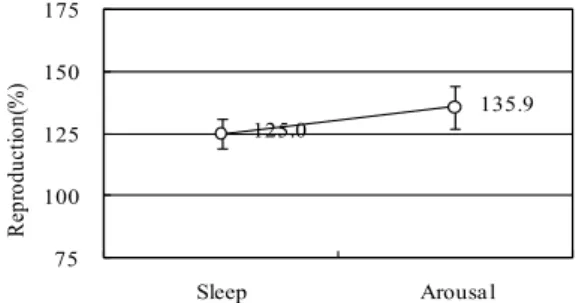
Figure 7은 이완-각성 정도에 따라 피실험자가 조정한 채도재생 평균값과 95% 신뢰구간을 나타낸 것이다. 이완되 는 느낌을 주는 이미지들보다 각성의 느낌을 주는 이미지들 을 기억재생할 때 채도를 더 높여 표현한 것으로 나타났다.
즉 각성의 느낌을 일으키는 이미지는 이완을 유발하는 이미
지들에 비해 기억 시 채도가 높아지는 것으로 사료된다.
4. Conclusion
본 연구의 결과를 요약하면 다음과 같다.
첫째, 재인실험과 재생실험결과, 최초 사진(시각적 자극) 제시 후 기억유지 시간인 파지기간이 피실험자의 채도 기억 에 유의한 영향을 주는 것으로 나타났다. 즉, 파지기간 1일 보다 3일이 이 지난 후에 기억에 존재하는 이미지의 주관적 채도는 실제 이미지에 대한 주관적 채도보다 더 높은 것으로 나타났다. 물론 명확한 결론을 도출하기에는 실험에 이용된 파지기간의 수가 충분하지 않지만, 시간이 지나 기억이 희미 해 지면서, 피실험자들은 이미지 내의 정확한 색채보다는 그 색상들에 해당하는 대표적인 색채인 순색(純色)들로 기억하 기 때문인 것으로 추측된다.
둘째, 재인실험과 재생실험결과, 실험에 이용된 감성 축 중, 이완-각성 정도에 따라 유의한 차이가 관찰되었다. 이완 되는 느낌을 주는 이미지보다 각성을 유발하는 이미지를 기 억할 때, 더 높은 채도로 기억되는 것으로 판단되며, 이것은 각성을 유발하는 시각적 이미지가 좀 더 생생하게 기억될 수 있음을 나타낸다.
셋째, 재생실험결과, 피실험자가 시각적 이미지 자극의 채 도가 높다고 느낄 수록(주관적 채도), 1~3일 후 피실험자로 하여금 재생하도록 하였을 때, 더 채도를 더 높게 재생하는 것으로 나타났다. 즉, 이것은 초기 시각적 자극이 생생하다 고 느낄수록 더 생생한 색채로 기억될 수 있음을 의미한다.
재인실험에서는 이러한 경향이 관찰되지 않았는데, 재인실험 의 시각적 자극이 세분화되지 않았기 때문으로 추측되며 이 에 대한 추후연구가 필요할 것으로 판단된다.
결론적으로, 기억의 파지기간 및 이완-각성과 같은 특정 한 감성과 시각적 자극에 대한 주관적 채도 등이 시각적 이 미지 기억의 채도(생생함)에 영향을 미치는 것으로 판단된
118.5
142.6
75 100 125 150 175
1 3
Reproducttion(%)
Retention period(day)
Figure 5. Mean saturation reproduction and 95% confidence intervals as a function of retention period
A 119.9 A
110.0 A B 123.9
B C 131.2
B C 135.2
C 141.2
C 143.5
75 100 125 150 175
-3 -2 -1 0 1 2 3
Reproduction(%)
Subjective saturation
Figure 6. Mean saturation reproduction and 95% confidence intervals as a function of subjective saturation and
Scheffe post-hoc test(α=0.05)
125.0
135.9
75 100 125 150 175
Sleep Arousal
Reproduction(%)
Figure 7. Mean saturation reproduction and 95% confidence intervals as a function of sleep-arousal axis
다. 이러한 결과는 현저성 효과(vividness effect)가 시각적 감성변화에 따라 유의한 영향을 받을 수 있음을 암시한다.
특히 기억의 파지기간 및 감성자극을 조절함으로써 의사소 통의 설득력을 좀 더 높일 수 있으며, 인간의 메시지 처리과 정에도 영향을 주는 등 마케팅 및 의사결정 분야에도 본 연 구결과가 활용 가능할 것으로 예측된다. 추후, 다양한 연구 가 진행되어야 하겠지만, 이러한 연구결과는 감성과 기억의 연관관계를 밝히고 더 나아가 이를 인간중심의 제품설계에 반영할 수 있는 기초 연구자료로 활용 가능할 것으로 기대 된다.
Acknowledgements
This paper was supported by the Daebul University Research Fund in 2010.
References
Block, L.G. and P. Anand Keller, Effects of Self-Efficacy and Vividness on the Persuasiveness of Health Communications, Journal of Consumer Psychology, 6(1), 31-54, 1997.
D'Argembeau, A. and Van der Linden, M., Influence of affective meaning on memory for contextual information, Emotion, 4(2), 173-188, 2004.
Dewhurst, S. A. and Parry, L. A., Emotionality, distinctiveness, and recollective experience, European Journal of Cognitive Psychology, 12(4), 541-551, 2000.
Keller P. A. and Block L. G., Vividness effects: a resource-matching perspective. Journal of Consumer Research, 24, 295-304, 1997.
Kensinger, E. A. and Corkin, S., Effect of divided attention on the memory benefit for negative as compared to neutral words. Brain and Cognition, 51, 223-225, 2003.
Kensinger E. A., Garoff-Eaton R. J. and Schacter D. L., Memory for specific visual details can be enhanced by negative arousing content.
Journal of Memory and Language, 54, 99-112, 2006.
Kensinger E. A., Garoff-Eaton R. J. and Schacter D. L., Remembering the specific visual details of presented objects: Neuroimaging evidence for effects of emotion. Neuropsychologia, 45, 2951-2962, 2007.
Loftus, E. F. and Burns, T. E., Mental shock can produce retrograde amnesia. Memory & Cognition, 10(4), 318-323, 1982.
Mehrabian, A. and Russell, J. A., An approach to environmental psychology, Cambridge, MA: M.I.T. Press, 1974.
Plutchik, R., Emotions and life: Perspectives from psychology, biology, and evolution, Washington, DC: American Psychological Association, 2003.
Neisser, U. and Harsch, N., "Phantom flashbulbs: False recollections of hearing the news about Challenger." In E. Winograd & U. Neisser (Eds.), Affect and accuracy in recall: Studies of flashbulb memories.
New York: Cambridge University Press, 1972.
Ochsner, K. N., Are affective events richly "remembered" or simply familiar. The experience and process of recognizing feelings past.
Journal of Experimental Psychology: General, 129, 242-261, 2000.
Schmolck, H., Buffalo, E. A. and Squire, L. R., Memory distortions develop over time: Recollections of the O.J. Simpson trial verdict after 15 and 32 months. Psychological Science, 11(1), 39-45, 2000.
Sharot, T., Delgado, M. R. and Phelps, E. A., How emotion enhances the feeling of remembering. Nature Neuroscience, 7(12), 1376-1380, 2004.
Smith, S. M. and Shaffer, D. R., Vividness can undermine or enhance message processing: the moderating role of vividness congruency.
Pers. Soc. Psychol. Bull. 26: 769-779, 2000.
Stetson, C., Fiesta, M. P., Eagleman, D. M. and Burr, D., Does Time Really Slow Down during a Frightening Event?. PLoS ONE, 2(12), e1295.
DOI: 10.1371/journal.pone.0001295, 2007.
Talarico, J. M. and Rubin, D. C., Confidence, not consistency, characterizes flashbulb memories. Psychological Science, 14(5), 455-461, 2003.
Vemallis, K., The loss of meaning in faded color photographs. Journal of the American Institute for Conservation, 38(3), 459-476, 1999.
Author listings
Phil Sik Jang: [email protected]
Highest degree: PhD, Department of Industrial Engineering, KAIST
Position title: Professor, Department of Computer Education, Daebul University Areas of interest: Human Computer Interaction, Affective Computing, Algorithmic Trading
Date Received : 2010-11-28 Date Revised : 2011-02-11 Date Accepted : 2011-02-11