≫ 總 說 ≪
水溶液에서 코발트와 니켈 分離
·
木浦大學校 工科大學 新素材工學科
Separation of Cobalt and Nickel from Aqueous Solution
Yang Liu and Manseung Lee
Department of Advanced Material Science and Engineering, Mokpo National University, Chonnam, 534-729, Korea
요 약
코발트와 니켈에 대한 수요가 증가함에 따라 다양한 자원으로부터 순도가 높은 상태로 이 금속들을 회수하는 것은 중요하다. 고 순도 코발트와 니켈을 얻기 위해서는 다른 금속이온과의 분리가 필요하다. 본 총설에서는 순수한 코발트와 니켈용액을 얻을 수 있 는 용매추출, 이온교환 및 침전법을 소개하고 비교하였다. 특히 용매추출에 대해서는 기존 공정의 장단점과 함께 공정조건을 조사 하였다.
주제어 : 코발트, 니켈, 용매추출, 침전, 이온교환
Abstract
Recovery of pure cobalt and nickel from diverse resources is important due to the increased demand for these metals. In order to get cobalt and nickel with high purity, separation of them from other metal ions is necessary. In this review, several methods to obtain pure cobalt or nickel solution, such as solvent extraction, ion exchange, precipitation were introduced and compared.
For solvent extraction, the advantage and disadvantage of the separation process together with detailed process conditions were investigated.
Key Word : cobalt, nickel, separation, solvent extraction, precipitation, ion exchange
1. Introduction
The rapid increase in the consumption of cobalt and nickel has made it important to recover these two metals from ores and various secondary resources.
1)The main nickel ores include sulfide(pentlandite, nickel-pyrrhotite, carrollite and linnaeite, etc) and oxide (laterite). Around 1/3 of the nickel consumed is
produced from laterite ores, which occupy 2/3 of the world’s nickel resources.
2)They also are an important source of cobalt. In secondary resources containing cobalt and nickel are waste batteries, spend electrodes, sludges, and spend catalysts. Hydrometallurgy methods for handling these cobalt-nickel resources include atmospheric acid pressure leaching, high pressure acid leaching, biological leaching and microwave heating.
3)* Received : August 27, 2012 ·Revised : October 4, 2012·Accepted : October 22, 2012 Corresponding Author : Man-Seung Lee (E-mail: [email protected])
Department of Advanced Materials Science & Engineering, Mokpo National University, 61 Dorim-ri, Chungkye-myun, Muan- gun, Chonnam, 534-729, Korea
Tel : +82-62-450-2492 / Fax : +82-62-450-2498
ⓒThe Korean Institute of Resources Recycling. All rights reserved. This is an open-access article distributed under the terms
of the Creative Commons Attribution Non-Commercial License (http://creativecommons.org/licenses/by-nc/3.0/), which permits
unrestricted non-commercial use, distribution and reproduction in any medium, provided the original work is properly cited.
In hydrometallurgical treatment of laterite ore with little Mg content, high-pressure acid leaching (HPAL) has been widely employed due to the in-situ removal of iron by precipitation as hematite from acid solution at high temperature. The leaching of ores and secondary resources can be done in chloride, sulfate and chloride-sulfate systems and led to mixed solution containing cobalt and nickel together with other metal ions. In order to recover cobalt and nickel from these materials, the leaching step is followed by various purification steps.
In treating laterite ore or secondary sources, mixed solutions containing various metal ions, such as manganese, magnesium, aluminum, and iron are obtained. In order to recover cobalt and nickel with high purity from these solutions, separation of them from other metal ions is necessary. It is difficult to obtain pure cobalt and nickel compounds from these leach liquors because of the difficulties in separating cobalt from nickel.
Methods of separating nickel and cobalt from solution can be classified as solvent extraction, ion exchange and precipitation (hydroxide or sulfide). In comparing these methods, the cost of reagents, the efficiency of the processes, and the quality of the products are important.
4)In this review, the current technology employed in the separation of nickel and cobalt from solution is discussed. For this purpose, various extractants and ion exchange resins used in the separation of the two metals are introduced and their advantage and disadvantage is discussed.
2. Precipitation
2.1. Hydroxide precipitation
Hydroxide precipitation is by far the most widely used process to remove heavy metals from solutions.
The reaction of metal hydroxide precipitation can be described as:
M
n++ nOH
−= M(OH)
n(1)
The equilibrium constant can be expressed by K = 1/([M
n+][OH
−]
n) = 1/K
SP(2)
where K
SPis defined as the solubility product.
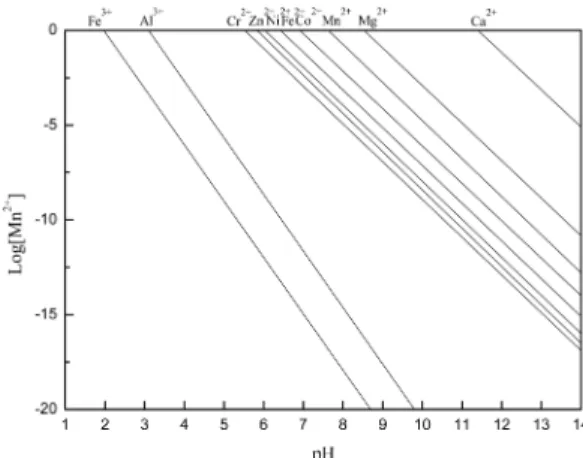
The difference in the solubility product of metal hydroxide offers the possibility to separate them by adjusting the pH. The solubility-pH diagram is shown in Fig. 1.
5)It is predicted that Fe
3+, Al
3+and Ca
2+can be separated from Co
2+and Ni
2+, while separation of Co
2+from Ni
2+is difficult by using hydroxide pre- cipitation method. After removing some impurities by neutralization at low pH, nickel and cobalt refining could be carried out in a high pH range of about 5-7 with ammonia or sodium hydroxide as neutralization reagents.
6)Precise control of pH in neutralization is essential because higher pH results in the loss of cobalt and nickel to the precipitate owing to adsorption, while lower pH leads to insufficient precipitation of the metal ions.
7)Zhu
7)found cobalt and nickel were present in the precipitate even at a low pH of 4, which was much lower than their precipitation pH of 7.0. That was ascribed to two chemical forms, one as sulphate resulting from chemical adsorption (below pH 5.7);
and also as the hydroxide which resulted from co- precipitation (above pH 5.7).
However, metal hydroxides are of amphoteric nature and the pH value corresponding to the minimum solubility varies for each heavy metal. Thus, it may be difficult to adjust to optimum pH for the treatment of solutions containing a mixture of several heavy metals.
Further, the metal hydroxides tend to redissolve when the optimum pH value is changed, which could result in the dissolution of heavy metals into the environment.
8)Fig. 1. Solubility diagram for metal hydroxides at 25
oC
2.2. Sulfide precipitation
Other treatment methods such as sulfidation treatment have been tried. The reactions involved in the sulfide precipitation are:
X
2S = 2X
−+ S
2−, (3)
M
n++ n/2S
2−= MS
n/2,K
sp= [M
n+][S
2−]
n/2(4) where X
2S represents sulfidation agents, and K
SPis the solubility product of metal sulfide.
In the sulfidation treatment, the sulfidation agents can be classified as solid (FeS, CaS), aqueous (Na
2S, NaHS, (NH
4)
2S) or gaseous sulfide sources (H
2S).
Precise pH control is of great importance if high precipitation selectivity is to be achieved. The main advantages of sulfide precipitation are lower solubility of metal sulfide precipitates, potential for selective removal of metal, fast reaction rates, better settling properties, reuse of sulfide precipitates by smelting and finally higher dewaterability of metal sulfide sludges compared to metal hydroxide sludges.
9)Fukuta
10)reported the possibility of separation of Cu, Zn and Ni by precipitation with Na
2S at different pH.
They reported as high as 94.5% for Cu (pH 1.5), 75.9%
for Zn (pH 2.5) and 65.9% for Ni (pH 5.5 - 6.0) was achieved. Kondo
11)studied the precipitation of Cu, Zn and Ni from mixed plating wastewater with H
2S and reported that higher precipitation selectivity can be achieved with H
2S compared to Na
2S. The precipitation selectivity was 95.5% for Cu (pH 1.5), 87.4% for Zn (pH 4.5) and 94.7% for Ni (pH 6.7 ± 0.2).
Because the toxicity, corrosiveness of excess sulfide and the difficulty in controlling the dosage of the sulfide, sulfide precipitation is not widely used.
12)Precipitation provides a useful means to separate cobalt and nickel from other metals. In general, precipitation in separation of cobalt and nickel is used together with other methods like solvent extraction.
3. Solvent extraction
Leaching of either laterite or secondary sources usually results in a mixed solution of cobalt and nickel with some impurities such as iron, manganese, copper and zinc. The recovery of cobalt and nickel from the
leach solution through solvent extraction is one of the versatile methods. A lot of work has been performed to develop extractants which are selective for one of the metal ions.
Although there are some kinds of extractants which have been used to separate cobalt and nickel from various aqueous solutions, in most cases cobalt is extracted while nickel remains in the raffinate. In this review, cationic exchange reagents, amine reagents and synergistic extractants system are introduced.
3.1. Cationic exchange reagents
Cationic exchange reagents include phosphorus acid, carboxylic acid and thiophosphinic acid extractants.
Their chemical structures and some main properties are represented in Table 1. They usually exist as dimer state (H
2A
2) in non-polar organic solvent. The extraction reaction of bivalent metals with organophosphorous acid extractants can be represented.
13)M
2++nH
2A
2org=MA
2(n-1)H
2A
2org+2H
+(5) When the extractant is in excess, the value of n for Co
2+and Ni
2+is 2 and 3, respectively.
13)The extracted species of cobalt includes tetrahedral and octahedral structures while nickel only includes octahedral structure.
The moisture content of tetrahedral extraction complexes is lower than that in octahedral structure. Therefore, the solubility of octahedral structure complex in organic is higher than that of tetrahedral structure. The fact that cobalt is selectively extracted by organophosphorus extractants can be ascribed to the difference in the chemical structure of extracted species and in the solubility. The ratio of tetrahedral to octahedral is the determining factor for the separation factor between cobalt and nickel. In the same extraction condition, the structures and properties of extractants can influence the separation factor significantly.
It has been found that the separation factor between
cobalt and nickel increased in the following order,
phosphinic > phosphonic > phosphoric
14, 15)because of
the increase in the stability of tetrahedral coordination
compound of cobalt with the extractant in the organic
phase
16)and the basicity of the extractants increases
with the decrease in the distance of the alkyl chain
from the central phosphorous atom.
17)Although the
separation factor of cobalt and nickel by using phosphinic acid is highest among the three extractants, other conditions such as solution pH, ratio of Co-Ni concentration and economics should be considered, in choosing a suitable extractant for application.
During solvent extraction process, acid liberated from acidic extractants affects the metal extraction.
18)The use of saponification with NaOH or NH
4OH was tried to overcome this problem.
19)The saponification reaction can be described13,
20)Na
aq++ HA
org= NaA
org+ H
aq+(6) and
NH
4OH+ HA
org= NH
4A
org+ H
2O (7)
Saponified acidic extractant was prepared by adding a stoichiometric amount of a concentrated base solution to the extractant to form a single phase. The fact that a single phase is formed during the saponification means that water is moved to organic phase and saponified extractants contain water. The consumption of base reagent is a main operation cost of solvent extraction.
3.1.1. D2EHPA
D2EHPA(di-2-ethylhexyl phosphoric acid) was first used to separate cobalt from nickel by Ritcey and Ashbrook.
21)In sulfate medium, Cheng
1)investigated the potential of D2EHPA in kerosene for separation of impurities like manganese from cobalt and nickel in laterite leach solution. The synthetic leach solution contained Co, Ni, Mg, Mn, Zn and Cu. The extraction order and pH
50for the metals was found to be Zn(1.70)
~ Ca(1.71) > Mn(2.72) ~ Cu(2.80) > Co(3.68) ~ Ni(3.86) > Mg(4.28). It is easy to separate cobalt and nickel from zinc and calcium and possible to separate them from copper and manganese. But it is difficult to separate cobalt from nickel by using D2EHPA.
3.1.2. PC88A
PC88A(2-ethylhexyl phosphinic acid) gives a much higher Co/Ni separation factor than that of D2EHPA.
In sulfate medium, the extraction order and pH
50were found to be Zn(2.2) > Cu(3.8) > Co(4.2) > Ca(4.65) >
Mg(5.0) > Ni(5.7).
22)These data show that use of PC88A leads to the separation of zinc from other metals. It is possible to separate cobalt and nickel in sulfate solution by using PC88A. In separation of cobalt and nickel from a sulfate solution containing Table 1. Chemical structures and properties of acid exchange reagents
Extractant Structure R pKa Density
/gcm
−3Viscosity (25
oC )
/mPas
Solubility in water/m
−3