• 검색 결과가 없습니다.

Evaluation of GSICS Correction for COMS/MI Visible Channel Using S-NPP/VIIRS

N/A
N/A
Protected

Academic year: 2021

Share "Evaluation of GSICS Correction for COMS/MI Visible Channel Using S-NPP/VIIRS"

Copied!
8
0
0

로드 중.... (전체 텍스트 보기)

전체 글

(1)

Evaluation of GSICS Correction

for COMS/MI Visible Channel Using S-NPP/VIIRS

Donghyun Jin

1)

·Soobong Lee

2)

·Seonyoung Lee

3)

·Daeseong Jung

4)

· Suyoung Sim

4)

·Morang Huh

5)

·Kyung-soo Han

6)†

Abstract: The Global Space-based Inter-Calibration System (GSICS) is an international partnership sponsored by World Meteorological Organization (WMO) to continue and improve climate monitoring and to ensure consistent accuracy between observation data from meteorological satellites operating around the world. The objective for GSICS is to inter-calibration from pairs of satellites observations, which includes direct comparison of collocated Geostationary Earth Orbit (GEO)-Low Earth Orbit (LEO) observations. One of the GSICS inter- calibration methods, the Ray-matching technique, is a surrogate approach that uses matched, co-angled and co- located pixels to transfer the calibration from a well calibrated satellite sensor to another sensor. In Korea, the first GEO satellite, Communication Ocean and Meteorological Satellite (COMS), is used to participate in the GSICS program. The National Meteorological Satellite Center (NMSC), which operated COMS/MI, calculated the Radiative Transfer Model (RTM)-based GSICS coefficient coefficients. The L1P reproduced through GSICS correction coefficient showed lower RMSE and Bias than L1B without GSICS correction coefficient applied.

The calculation cycles of the GSICS correction coefficients for COMS/MI visible channel are provided annual and diurnal (2, 5, 10, 14-day), but long-term evaluation according to these cycles was not performed. The purpose of this paper is to perform evaluation depending on the annual/diurnal cycles of COMS/MI GSICS correction coefficients based on the ray-matching technique using Suomi-NPP/Visible Infrared Imaging Radiometer Suite (VIIRS) data as reference data. As a result of evaluation, the diurnal cycle had a higher coincidence rate with the reference data than the annual cycle, and the 14-day diurnal cycle was the most suitable for use as the GSICS correction coefficient.

Key Words: GSICS correction, Inter-calibration, Ray-matching technique, COMS/MI, S-NPP/VIIRS, SBAF

https://doi.org/10.7780/kjrs.2021.37.1.14 ISSN 2287-9307 (Online)

Letter

Received February 5, 2021; Revised February 16, 2021; Accepted February 18, 2021; Published online February 23, 2021

1)

PhD Candidate, Department of Spatial Information Engineering, Pukyong National University

2)

Researcher, Satellite Analysis Division, National Meteorological Satellite Center, Korea Meteorological Administration

3)

Senior Researcher, Satellite Analysis Division, National Meteorological Satellite Center, Korea Meteorological Administration

4)

Master Student, Department of Spatial Information Engineering, Pukyong National University

5)

Director, Research Center, Nano C&W Ltd. co.

6)

Professor, Department of Spatial Information Engineering, Pukyong National University

Corresponding Author: Kyung-Soo Han ([email protected])

This is an Open-Access article distributed under the terms of the Creative Commons Attribution Non-Commercial License

(http://creativecommons.org/licenses/by-nc/3.0) which permits unrestricted non-commercial use, distribution, and reproduction in

any medium, provided the original work is properly cited.

(2)

1. Introduction

The Global Space-based Inter-Calibration System (GSICS) is an international partnership sponsored by World Meteorological Organization (WMO) to continue and improve climate monitoring and to ensure consistent accuracy between observation data from meteorological satellites operating around the world (Goldberg et al., 2011). This is achieved through monitoring instrument performances, operational inter- calibration of satellite instrument, and contains direct comparison collocated observations between satellite instruments, and observations are consistently used to compare, reference, and correct the tendencies of monitored observation instruments (Hewison et al., 2013). The objective for GSICS is to inter-calibration from pairs of satellites observations, which includes direct comparison of collocated Geostationary Earth Orbit (GEO)-Low Earth Orbit (LEO) observations. For GSICS in the visible wavelength range, Aqua/Moderate Resolution Imaging Spectroradiometer (MODIS) was used as the calibration reference data and an inter- calibration algorithm was performed. However, due to the long operating period of Aqua/MODIS over 14 years, the need for sensors with similar calibration functions and stable performance to MODIS has increased. The Suomi-NPP/Visible Infrared Imaging Radiometer Suite (VIIRS) is a sensor with spectroscopic characteristics similar to MODIS. In other words, VIIRS is an ideal instrument to replace MODIS as a GSICS reference sensor after MODIS (Xiong et al., 2016). Doelling Dave (2018) also recommended S-NPP/VIIRS as a GSICS reference sensor in the visible wavelength range instead of MODIS. The GSICS inter-calibration has diverse methods with the same principle. One of the GSICS inter-calibration methods, the Ray-matching technique, is a surrogate approach that uses matched, co-angled and co-located pixels to transfer the calibration from a well calibrated satellite sensor to another sensor (Doelling et al., 2011).

The National Aeronautics and Space Administration (NASA) Langley Research Center calibrated the GEO satellite using this technique as a reference for the Aqua/Moderate Resolution Imaging Spectroradiometer (MODIS) data, which is LEO for the visible channels. In Korea, the first GEO satellite, Communication Ocean and Meteorological Satellite (COMS), is used to participate in the GSICS program. COMS/Meteorological Imager (MI) is a meteorological satellite, which monitors and calculates meteorological phenomena and the environment in East Asia and the Western Pacific (Han et al., 2015; Lee et al., 2017). The MI onboard COMS had 5 channels: 1 visible and 4 infrared channels. The COMS/MI was operated by National Meteorological Satellite Center (NSMC), Korea Meteorological Administration (KMA). The NMSC provided the Radiative Transfer Model (RTM)-based GSICS coefficient coefficients for COMS/MI. The calculation cycles of the GSICS correction coefficients for COMS/MI visible channel are provided annual and diurnal (02, 05, 10, 14-day), but long-term evaluation according to these cycles was not performed.

Accordingly, the purpose of this paper is to perform evaluation depending on the annual/diurnal cycles of COMS/MI GSICS correction coefficients based on the ray-matching technique using S-NPP/VIIRS data as reference data.

2. Measurements

1) COMS/MI

The COMS/MI was located at a longitude of

128.2°E and launched on June 27, 2010, and official

operation began in April 2011. The visible channel of

COMS/MI Level-1B (L1B) has one band, and its center

wavelength was 0.68 µm. The spatial resolution of

its channel was 1 km. The MI instrument had 2 scan

modes. One mode or continuous Full Disk (FD)

mode, the MI produced a FD image every 3 hours.

(3)

Another mode was Extended Northern Hemisphere (ENH) image every 15 minutes. In this study, evaluation was carried out by comparing COMS/MI L1B directly with S-NPP/VIIRS L1B. Accordingly, COMS/MI L1B with dense observation time intervals are required, and ENH images are used. Also, the Top of Atmosphere (TOA) reflectance of COMS/MI L1B was used. The GSICS correction coefficients according to annual/

diurnal cycles and the calibration procedure for converting Digital Number (DN) to TOA reflectance of COMS/MI L1B was provided by NMSC. In addition, for performing a quality assessment of GSICS correction coefficients, we used COMS/MI L1B from January 2015 to October 2019.

2) S-NPP/VIIRS

The S-NPP/VIIRS was launched on October 28, 2011 as a LEO satellite. The VIIRS L1B instrument consists of 22 spectral bands (14 visible and Near Infrared, 7 Infrared, and one Day-Night Band), and the scan angle range for observing the Earth is from -56.28° to 56.28°. It has a wide-swath of 3000 km. It has two types of bands: 5 Imaging (I) bands with spatial resolution 375 m and 16 Moderate (M) bands with spatial resolution 750 m. In this study, channel data having a center wavelength of 0.64 µm, which has a wavelength band most similar to that of COMS/MI L1B visible channel data among S-NPP/VIIRS L1B I bands, was used. The data of L1B I bands produced by S-NPP/VIIRS are provided as a swath product, and the observation time interval of each scene is 6 minutes.

The L1B Swath product refers to data that has not been subjected to geographic correction. It was also converted to TOA reflectance and used as reference data and utilized data of overlapping period with COMS/MI L1B.

3. Inter-Calibration Algorithm

For evaluation of GSICS correction coefficients on the COMS/MI, this study was performed to the construction of the collocation dataset between COMS/MI L1B and S-NPP/VIIRS L1B. The ray-matching technique was used to construct the collocation dataset. Following the collocation datasets constructed, COMS/MI L1B was reproduced as L1P by applying the COMS/MI GSICS correction coefficient according to the annual/diurnal cycles, and evaluation was performed through 1:1 comparison with reference data. The evaluation method was described after the description of the ray-matching technique.

1) Ray-matching Method

The Ray-matching technique is a surrogate test approach that calibrates another satellite sensor with a satellite sensor calibrated based on the pixel of the matched position and the same angle. It utilizes a mutual calibration algorithm according to a step-by- step approach to ensure maximum consistency and traceability of the two data (Doelling et al., 2011). In other words, it is a technique that considers an area where the observation conditions of two data are the same as possible. The algorithm is largely defined in four steps, each of which is as follows.

(1) Gridding and Sub-setting data

The COMS/MI on the GEO sensor has a probability

of causing distortion of the channel data as the

observation angle increases based on the center latitude

and longitude, so a certain area (Sub-Satellite Point,

SSP) was set to compensate for this part. SSP was set

to a sea area of ±15.0° for latitude and ±20.0° for

longitude based on the central latitude (0°N) and central

longitude (128.2°E) of COMS/MI, and the conditions

used in Doelling et al. (2011) value was used. The

ocean is less likely to cause distortion of the observed

value due to the surrounding environment compared to

(4)

the land, so only the ocean was used. In addition, a gridding operation to perform re-projection of the two data in the bin-resolution area, which is a virtual area, is also included. The bin-resolution area was set at 0.5°

intervals for latitude and longitude. In this study, not only the sub-setting data, but also the condition values used in Algorithm Theoretical Basis Document (ATBD) (Doelling et al., 2011) were used for the other three steps.

(2) Collocating dataset

Collocating GEO and reference data aims to set the observation environment of COMS/MI which was GEO sensor and S-NPP/VIIRS which was reference data as much as possible, and the difference between the observation time, Solar Zenith Angle (SZA), Viewing Zenith Angle (VZA) and Azimuth Angle between the two satellites was utilized. The following steps were performed for the region where the observation time difference between the two satellites was within 5 minutes, the SZA difference was less than 5°, the VZA difference was 10°, and the azimuth angle difference was less than 15°. In addition, to exclude the area where channel data was distorted by the sun-glint of the two satellites, the area where the sun-glint was less than 15° was excluded from the collocation dataset.

(3) Spectral Transformation of data

Spectral transformation of data is the step of using Spectral Band Adjustment Factor (SBAF) to correct the difference in response function for each wavelength between satellites. The SBAF is a coefficient that corrects the difference in response function for each wavelength between different satellite sensors based on Environmental Satellite (Envisat)’s Scanning Imaging Absorption Spectraometer for Atmospheric Cartography (SCIAMACHY) data (Scarino et al., 2016). In this study, for evaluation of the COMS/MI GSICS correction coefficient depending on the annual/diurnal cycles, the

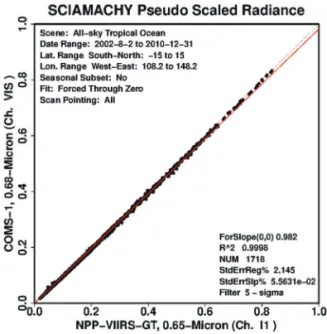
reference data, S-NPP/VIIRS, were used to convert the S-NPP/VIIRS Pseudo data considering the COMS/MI Spectral Response Function (SRF). The SBAF calculation area was designated as COMS/MI SSP condition and All-sky Tropical Ocean, and the regression model was set as Force Fit. In this study, to calculate the S-NPP/VIIRS Pseudo data, the For Slope in Fig. 1, which is the SBAF result calculated according to the conditions, was used. Among the subsets for calculating SBAF, the date range was set as the entire period of SCIAMACHY data.

(4) Filtering data

Filtering data is a process of removing outliers from observation data of satellites by checking spatial inhomogeneity. COMS/MI calculated the spatial standard deviation of pixels within 9-by-9 of a specific pixel and use it to check the spatial uniformity of the reflectance of a specific pixel and surrounding pixels, and if the value is 3 times larger than the spatial standard deviation of a specific pixel, the pixel was excluded.

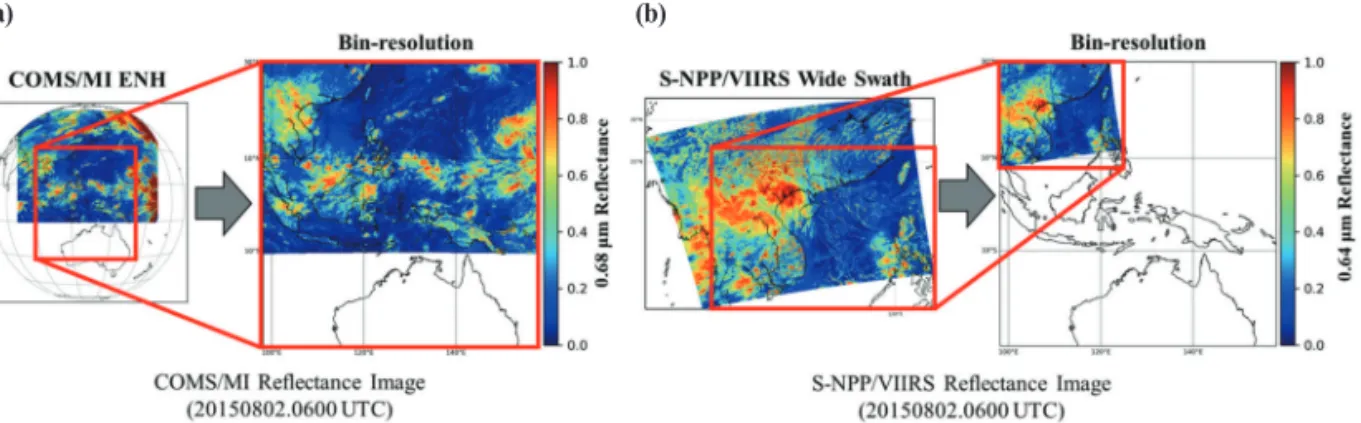
Fig. 2 is an image of reconstructing the collocation

dataset from COMS/MI L1B and S-NPP/VIIRS L1B

Fig. 1. The SBAF regressions of SCIAMACHY-based pseudo

scaled radiance for COMS/MI and S-NPP/VIIRS over

the COMS/MI SSP.

(5)

data with SSP bin-resolution.

Table 1 is the conditional elements of the ray- matching technique used to build the collocation dataset in this study.

2) Comparison Analysis

R-squared (R

2

), Root Mean Square Error (RMSE) and Bias were used as the indices for evaluation of COMS/MI L1P reproduced depending on the annual/

diurnal cycles. In addition, a time series analysis was performed to monitor the period in which trends and outliers appear during the analysis period of the evaluation index, and the GSICS correction coefficient depending on the annual/diurnal cycles of the visible channel was evaluated.

4. Results

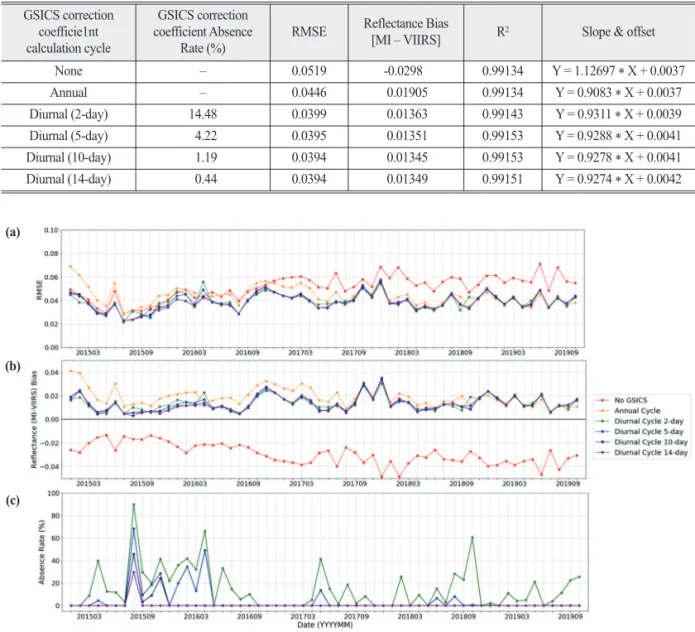
Table 2 is the result of evaluation with S-NPP/VIIRS pseudo reflectance data depending on the annual/diurnal cycles. Both COMS/MI L1B without GSICS correction coefficients and COMS/MI L1P with R

2

showed high agreement rates of 0.99 or higher. However, in RMSE and Bias, the difference between COMS/MI L1P with GSICS correction coefficients applied depending on diurnal cycles and reference data was smaller than COMS/MI without GSICS correction coefficient applied and annual cycle. This is consistent with the results of the high accuracy of the GSICS corrected SST output (Park et al., 2015). As a result of comparing the absence rate of the GSICS correction coefficients, the 2-day diurnal cycle showed 14.48% of the absence rate of the GSICS correction coefficients during the long-term period analysis, which was higher than that Fig. 2. COMS/MI and S-NPP/VIIRS L1B images and constructed Collocation dataset (Bin-resolution) images: (a)

COMS/MI, (b) S-NPP/VIIRS.

(a) (b)

Table 1. Conditions of ray-matching factor between COMS/MI and S-NPP/VIIRS

Collocation Condition Index Condition Value

COMS/MI vs. S-NPP/VIIRS Parameter Ray-Match threshold

Latitude Domain 15°N to 15°S ocean only

Longitude Domain ±20° of GEO sub-satellite

Bin resolution 0.5° by 0.5° lat/lon

Time match difference < 15 minutes

Solar Zenith Angle difference < 5°

View Angle difference < 10°

Azimuth Angle difference < 15°

Sun Glint Angle > 15°

(6)

of other diurnal cycles.

Fig. 3 is a time-series analysis of the monthly evaluation results with COMS/MI visible channel and S-NPP/VIIRS pseudo data. The analysis results on the time series of the COMS/MI GSICS correction evaluation showed that the difference between the reference data and the COMS/MI L1P applied diurnal cycles during study period was small. In the case of the bias shown in Fig. 3(b)), for COMS/MI L1B to which the GSICS correction coefficient was not applied, it was confirmed that the reflectance bias value decreased

over time. This can be estimated that the degradation of COMS/MI L1B was progressing over time. In the diurnal cycles, time series analysis results can be seen that the difference in evaluation results was very slight.

Fig. 3(c)) is an image showing the days in which the GSICS correction coefficients were absent in terms of monthly percentages for diurnal cycles. In the case of the bias shown in Fig. 3(c)), the 2-day diurnal cycle showed a high absence rate of up to 70%, which means that when calculating L1P, there may be restrictions on continuous calculation. In the calculation cycle, 5-day Table 2. 0.64 μm COMS/MI and S-NPP/VIIRS pseudo quality assessment results depending on the annual/diurnal cycles

GSICS correction coefficie1nt calculation cycle

GSICS correction coefficient Absence

Rate (%) RMSE Reflectance Bias

[MI – VIIRS] R

2

Slope & offset

None – 0.0519 -0.0298 0.99134 Y = 1.12697 * X + 0.0037

Annual – 0.0446 0.01905 0.99134 Y = 0.9083 * X + 0.0037

Diurnal (2-day) 14.48 0.0399 0.01363 0.99143 Y = 0.9311 * X + 0.0039

Diurnal (5-day) 4.22 0.0395 0.01351 0.99153 Y = 0.9288 * X + 0.0041

Diurnal (10-day) 1.19 0.0394 0.01345 0.99153 Y = 0.9278 * X + 0.0041

Diurnal (14-day) 0.44 0.0394 0.01349 0.99151 Y = 0.9274 * X + 0.0042

Fig. 3. The time series of monthly evaluation for COMS/MI data; (a) RMSE, (b) Bias (COMS/MI-S-NPP/VIIRS), (c) Absence rate for GSICS correction coefficient.

(a)

(b)

(c)

(7)

diurnal cycle also represented a maximum absence ratio of 60%, and when considering the absence ratio, it can be seen that the diurnal 14-day represented the lowest absence ratio in the GSICS correction coefficient. Given that the evaluation result with S- NPP/VIIRS pseudo data and the absence rate of GSICS correction coefficient, the diurnal 14-day is the most suitable for applying the GSICS correction coefficient.

5. Conclusions

GSICS has an important objective to ensure the comparability of satellite measurements provided at different times, different instruments, and GEO-LEO inter-calibration is an important process for completing that objective (Wu et al., 2009). The NMSC provided GSICS correction coefficients depending on annual and diurnal (2, 5, 10, 14-day) cycles for COSM/MI, but long-term evaluation of correction coefficients was not performed. Therefore, this study performed evaluation on the GSICS correction coefficients of COMS/MI visible channels from January 2015 to October 2019.

The S-NPP/VIIRS L1B data were used as reference data, and the collocation dataset of two satellites was constructed based on the ray-matching technique for inter-calibration. The results showed that diurnal cycles were more similar to S-NPP/VIIRS than annual cycles.

The difference in diurnal cycles of 2, 5, 10, and 14-days was very small when compared with S-NPP/VIIRS.

Although the difference was very small, when additionally considering the presence or absence of the daily GSICS correction coefficient, it was determined that 14-days is more suitable GSICS correction coefficient than other coefficients for the COMS/MI. This analysis can be helpful when using the appropriate GSICS correction coefficient for COMS/MI.

Acknowledgements

This research was supported by “The Technical Development on Weather Forecast Support and Fusion Service using Meteorological Satellites” of the NMSC/

KMA.

References

Cao, C., F. De Luccia, X. Xiong, R. Wolfe, and F.

Weng, 2014. Early on-orbit performance of the Visible Infrared Imaging Radiometer Suite (VIIRS) onboard the Suomi National Polar- orbiting Partnership (S-NPP) satellite, IEEE Transactions on Geoscience and Remote Sensing, 52(2): 1142-1156.

Doelling, D.R., R. Bhatt, D. Morstad, and B. Scarino, 2011. Algorithm Theoretical Basis Document (ATBD) for ray-matching technique of calibrating GEO sensors with Aqua-MODIS for GSICS, NASA-Langley SSAI, 2011: 1-10.

Doelling, D., 2018. GSICS recommends SNPP-VIIRS as the VIS/NIR calibration reference, GSICS Quarterly Newsletter-Summer Vol. 12 Number 2, GSICS Coordination Center, University Research Court College Park, MD, USA, pp.

1-2.

Goldberg, M., G. Ohring, J. Butler, C. Cao, R. Datla, D. Doelling, V. Gaertner, T. Hewison, B.

Iacovazzi, D. Kim, T. Kunino, J. Lafeuille, P.

Minnis, D. Renaut, J. Schmetz, D. Tobin, L.

Wang, F. Weng, X. Wu, F. Yu, P. Zhang, and T. Zhu, 2011. The global space-based inter- calibration system, Bulletin of the American Meteorological Society, 92(4): 467-475.

Han, K.S., J.M. Yeom, C.S. Lee, I.C. Shin, and D. Kim,

2015. Improved estimation of insolation by

using calibrated COMS MI images over South

Korea, Remote Sensing Letters, 6(3): 175-182.

(8)

Hewison, T.J., X. Wu, F. Yu, Y. Tahara, X. Hu, D. Kim, and M. Koenig, 2013. GSICS inter-calibration of infrared channels of geostationary imagers using Metop/IASI, IEEE Transactions on Geoscience and Remote Sensing, 51(3): 1160- 1170.

Lee, C.S., K.S. Han, J.M. Yeom, K.S. Lee, M. Seo, J. Hong, J.W. Hong, K. Lee, J. Shin, I.C. Shin, J. Chun, and J.L. Roujean, 2018. Surface albedo from the geostationary Communication, Ocean and Meteorological Satellite (COMS)/

Meteorological Imager (MI) observation system, GIScience & Remote Sensing, 55(1): 38-62.

Park, E.B., K.S. Han, J.M. Yeom, C.S. Lee, J.H. Ryu, H. Kim, and D.H. Kim, 2015. Effects of GSICS correction on estimation of sea surface temperature using COMS data, International Journal of Remote Sensing, 36(4): 1026-1037.

Scarino, B.R., D.R. Doelling, P. Minnis, A. Gopalan, T. Chee, R. Bhatt, C. Lukashin, and C. Haney, 2016. A web-based tool for calculating spectral band difference adjustment factors derived from SCIAMACHY hyperspectral data, IEEE

Transactions on Geoscience and Remote Sensing, 54(5): 2529-2542.

Wu, X., T. Hewison, Y. Tahara, 2009. GSICS GEO- LEO intercalibration: Baseline algorithm and early results, In Atmospheric and Environmental Remote Sensing Data Processing and Utilization V: Readiness for GEOSS III, 7456: 745604.

Xiong, X., J. Sun, J. Espositio, B. Guenther, and W.

Barnes, 2002. MODIS reflective solar bands calibration algorithm and on-orbit performance, Proc. of 2002 Earth Observing Missions and Sensors: Development, Implementation, and Characterization IV, Hangzhou, CHN, Oct.

23-27, Vol. 9881, p. 98811D.

Xiong, X., A. Angal, J. Butler, C. Cao, D. Doelling, A. Wu, and X. Wu, 2016. Global space-based inter-calibration system reflective solar calibration reference: From Aqua MODIS to S-NPP VIIRS, Proc. of 2016 Earth Observing Missions and Sensors: Development, Implementation, and Characterization IV, New Delhi, IND, Apr.

4-7, Vol. 9881, p. 98811D.

수치

Fig. 2 is an image of reconstructing the collocation dataset from COMS/MI L1B and S-NPP/VIIRS L1BFig
Table  1  is  the  conditional  elements  of  the  ray- ray-matching technique used to build the collocation dataset in this study.
Fig.  3  is  a  time-series  analysis  of  the  monthly evaluation  results  with  COMS/MI  visible  channel  and S-NPP/VIIRS pseudo data

참조

관련 문서

_____ culture appears to be attractive (도시의) to the

The “Asset Allocation” portfolio assumes the following weights: 25% in the S&amp;P 500, 10% in the Russell 2000, 15% in the MSCI EAFE, 5% in the MSCI EME, 25% in the

1 John Owen, Justification by Faith Alone, in The Works of John Owen, ed. John Bolt, trans. Scott Clark, &#34;Do This and Live: Christ's Active Obedience as the

Abstract: This study was aimed to investigate the adhesion control standards of pain relieving patch (PRP) drugs and to survey it′s adverse effects on the skin of patients

Objects ofthi s research are uni ts rel ated to the anti -bi as educati on i n the 7th mi ddl e schoolKorean Language educati on curri cul um,and 211 mi ddl e school

M.(2011), “Evaluation of reliquefaction resistance using shaking table tests”, Soil Dynamics and Earthquake Engineering, (31), pp. Iai, S.(1989), “Similitude For Shaking Table

Ti ssue engi neeri ng i s appl i ed to overcome l i mi ted ti ssueregenerati on usi ng the factors that woul d sti mul ate the regenerati on of al veol oar bone

Therefore, cTnT is a recommended biomarker for use in the detection of myocardial infarction (MI) and in acute coronary syndromes.[8] Indeed, several authors