• 검색 결과가 없습니다.

Ingestion size of food microalgae of the Pacific oyster Crassostrea gigas larvae

N/A
N/A
Protected

Academic year: 2021

Share "Ingestion size of food microalgae of the Pacific oyster Crassostrea gigas larvae"

Copied!
9
0
0

로드 중.... (전체 텍스트 보기)

전체 글

(1)

Received: October 18, 2011 ; Accepted: December 17, 2011

Corresponding author: Young-baek Hur

Tel: +82 (55) 640-4754 e-mail: [email protected] 1225-3480/24407

굴,

Crassostrea gigas

유생의 먹이생물 섭취 크기

허영백, 전창영, 조기채, 허성범

1

국립수산과학원 남동해수산연구소,

1

부경대학교 해양바이오신소재학과

Ingestion size of food microalgae of the Pacific oyster Crassostrea gigas larvae

Young-Baek Hur, Chang-Young Jeon, Kee-Chae Cho and Sung-Bum Hur

1

Southeast Sea Fisheries Research Institute, NFRDI, Tongyeong 650-943, Korea

1

Department of Marine Bio-materials and Aquaculture, Pukyong National University, Busan 608-737, Korea

ABSTRACT

Digestibility index of 12 phytoplankton species were invested during the larval development sizes. Ingestible size of phytoplankton varied depending on larval sizes: Isochrysis galbana, I. aff. galbana, Pavlova lutheri, Chlorella ellipsoidea, Nannochloris oculata was ingested 94.2-99.7% all larval sizes. Cheatoceros calcitrans, C. gracilis and C. simplex could ingest over 90.0% after umbo stage (mean shell length 189.3 ± 13.8 μm). Phaeodactylum triconutum, Dunaliella tertiolecta and Tetraselmis tetrathele could not ingested D-shaped larvae (shell length 65.0-100.0 μm) but ingested 97.3-99.7%, 43.3-99.3%, 48.5-99.3% after then larval stages, respectively. But Thalassiosira weissflogii was ingested 1.0-1.7% only at full grown stage. Over 50.0% ingestion cell size was D-shape stage larvae with smaller than mean 102.3 μm in shell length could ingest phytoplankton with 4.6 μm in both major and minor axis and up to 9.3 μm in minor axis basis for larger than mean 158.3 μm in shell length, respectively. At all larval stages, phytoplankton with larger than 10.0 μm in both major and minor axis could not be ingested.

Keywords: Ingestion size, Epifluorescence microscopy, oyster, Crassostrea gigas, microalgae, larval development

서 론

미세조류는 1940년대에서 지금까지 이매패류의 인공종묘생 산 과정에서 유생 및 치패사육 그리고 어미관리에 먹이생물로 널리 이용되어지고 있다 (Bruce et al., 1940). 먹이생물로 미 세조류가 이용되기 위해서는 공급 대상생물에 대한 적당한 크 기 , 영양적으로 우수한 질 그리고 대량배양성 등의 조건을 갖 추어야 한다 . 이러한 조건을 갖춘 70여종을 선택하여 다년간 이용가능성을 조사하였지만 , 단지 몇몇 종만이 현재 이매패류 등의 인공종묘생산에 이용되어지고 있다 (Chrétiennot- Dinet et al., 1991).

우리나라 굴, Crassostrea gigas 인공종묘생산은 천연종묘

생산의 문제점을 해결하기 위하여 1990년 초부터 개발되기

시작하여 1999년 완전 산업화되었다 (Min et al., 1999). 현

재 국내 굴 인공종묘는 연간 150-200만연이 생산되어 국내

수하식 양식에 필요한 종묘의 약 15%를 충당하고 있고, 양성

시 성장이 빠르고, 알굴 생산효율이 좋아 매년 그 수요가 증대

되고 있다. 그러나 인공종묘는 생산단가가 천연종묘에 비해 매

우 높다. 인공종묘의 생산비용을 유발하는 요인을 다양하겠지

만, 대부분 먹이로 이용되는 미세조류의 배양관리에 많은 비용

이 유발되는데, 배양방법 및 배양규모 등에 따라 전체 인공종

묘생산 비용의 15-85%에 육박하고 있다 (Urban and

Langdon, 1984; Myers and Boisvert, 1990; Coutteau

and Sorgeloos, 1992). 이러한 문제점을 해결하기 위해 신선

한 살아있는 식물성 플랑크톤을 대신할 수 있는 최적의 대체

먹이를 찾기 위해 많은 실험적 연구가 수행 되어졌고,

(Coutteau and Sorgeloos, 1992; Robert and

Trintignac, 1997; Albentosa et al., 1999; Ponis et al.,

(2)

2003; Enes and Borges, 2003; Espinosa and Allam, 2006; Badillo-Salas et al., 2009), 그 결과 효모, 박테리아, microencapsulateds, 건조미세조류, 저온냉동농축 미세조류 등 최근 10년 사이 효과적인 일부 대체먹이가 개발되어졌지 만 , 먹이원으로서 그 효과가 떨어져 완전히 생먹이를 대체하지 는 못하고 여전히 대부분의 이매패류 인공종묘생산에 미세조 류가 대량배양되고 있다 . 특히 국내 굴 인공종묘생산 과정에서 는 먹이생물로써 전량 미세조류에 의존하고 있다 . 따라서 인공 종묘의 단가를 낮추기 위해서는 고가의 미세조류를 효율적으 로 이용 관리하는 것은 매우 중요한데 , 지금까지 국내 굴 인공 종묘생산과 미세조류의 이용성을 높이기 위한 관련 연구는 미 미한 실정이다 .

조개류 인공종묘생산 시 미세조류의 이용 효율성을 높이기 위해서는 사육대상 생물과 미세조류의 먹이생물학적 특성을 정확히 파악하여 이용하는 것이 매우 중요하다 (Helm and Millican, 1977; Gerdes, 1983; His et al., 1989;

Abdel-Hamid et al., 1992; Lemos et al., 1994; Baldwin and Newell, 1995; Devakie and Ali, 2000). 먹이생물로서 미세조류의 특성 중 이용성을 결정하는 요소는 주로 이용 대상 생물에 대한 적당한 세포크기 , 영양학적인 생화학적 조성 및 소화성이 중요하지만 , 이 중 섭취 가능한 세포의 크기와 소화 성은 유생의 성장과 생존에 필요한 영양분을 섭취하는데 , 매우 중요한 영향을 미치기 때문에 먹이생물의 이용성을 결정하는 가장 중요한 요소이다 (Owen, 1974; Ewart and Epifanio, 1981; Albentosa et al., 1993). 이와 같은 결과는 아무리 좋 은 영양성을 갖추어도 섭취와 소화가 되지 않으면 활용이 되지 않기 때문이다 .

따라서 먹이생물로 이용되는 미세조류의 효율적인 이용방법 을 찾은 것은 전체 종묘생산과정에 수반되는 제반비용을 줄일 수 있다 . 따라서 본 연구는 굴 인공종묘생산 시 효율적인 먹이 생물 관리를 위한 기초자료를 제공하고자 굴 유생의 성장에 따 른 섭취 가능한 먹이생물의 입자크기를 조사하기 위하여 실시 하였다 .

재료 및 방법

1. 유생사육 및 먹이생물 배양

실험에 필요한 유생을 얻기 위해 사용한 어미는 만 1년생 굴 (n = 100) 로 크기는 평균 각장 60.0 ± 5.8 mm, 각고 107.4 ± 11.3 mm, 전중 95.7 ± 27.2 g으로 자연 성숙된 개체를 이용하였다. 채란은 인위적인 자극법인 수온상승 자극 법으로 하였다. 채란 전 어미는 패각에 붙어 있는 부착생물과 이물질을 제거한 다음 여과해수로 세척 후 26 ± 1℃ 가온 여 과해수가 채워진 4톤 FRP 수조에 곧 바로 수용하여 채란하였 다. 방란ㆍ방정이 완료되면 먼저 망목 40 μm인 거름망으로

난외의 이 물질을 제거한 후 망목 크기가 20 μm인 거름망을 이용하여 난을 수거하였다 . 수거된 난은 다른 점액질 및 불순 물을 제거하기 위하여 다시 채란에 이용한 동일한 수온의 가온 여과해수로 수회 세척 후 수온 26 ± 1℃의 여과해수가 채워 진 수용적 10톤 사각콘크리트 수조에 수용하여 D상까지 발생 시킨 후 다시 망목크기가 40 μm인 거름망으로 수거하여 유 생 사육밀도를 10마리/mL로 재조절하여 동일한 수조에서 유 생 크기별로 선별하여 이용하기까지 사육하였다 . 대량 유생사 육에 공급된 먹이생물은 Isochrysis galbana (KMCC H-2), Cheatoceros gracilis (KMCC B-52), Pavlova lutheri (KMCC H-006), Phaeodactylum tricornutum (KMCC B-14), Nannochloris oculata (KMCC C-31), Tetraselmis tetrathele (KMCC P-002) 를 각각 30% : 20% : 20% : 10% : 10% : 10%의 비율로 혼합하여 일일 3 회 (오전 8시, 오후 4시 및 10시) 공급하였다. 먹이생물 공급 량은 초기 D형에서 최초 0.3 × 10

4

cells/mL/day으로 매 환 수 시 마다 30%씩 증가시켜 부착기 유생까지 사육하였다. 대 량유생사육에 공급된 먹이생물 배양은 500 L 원형 아크릴 수 조를 이용하여 정치배양으로 하였다 . 배양에 이용된 배지는 Conwy 배지 (Walne, 1974) 를 이용하였고, 배양온도는 23

± 1℃, 조도는 400 Watt metal halide lamp로 배양수 표 면 기준 20 μmol/cm

2

/s로 연속조명 하였다. 공급은 대수증식 기에 수확하여 공급하였다 . 먹이생물 입자 크기 조사에 사용된 미세조류는 착편모조류 Isochrysis galbana (KMCC H-2), I. aff. galbana (CCMP 463), Pavlova lutheri (KMCC H-006), 규조류 Cheatoceros calcitrans (CCMP 1315), C.

gracilis (KMCC B-52) C. simplex (KMCC B-117), Thalassiosira weissflogii (CCMP 1040), Phaeodactylum tricornutum, 녹조류 Tetraselmis tetrathele (JP), Dunaliella tertiolecta (CCMP 1320), Chlorella elipsoidea (KMCC C-20), Nannochloris oculata (KMCC C-31) 12종이었다. 실험에 이용된 미세조류 배양은 Conwy 배지 (Walne, 1974) 를 이용해 22 ± 1℃, 80 μ mol/m

2

/s로 연속조명하에서 500 mL 원형플라스크에서 정치 배양된 것을 대수 증식기에 수확하여 사용하여 각각의 먹이생 물의 세포 크기를 광학현미경 (Olympus BX51, Japan) 하 에서 micrometer 장축과 단축 그리고 극모의 크기를 측정하 였다 (n = 100). 측정된 미세조류 12종의 세포크기는 Table 1에서 보는 것과 같다.

2. 세포크기에 따른 섭취율 조사

유생의 크기별 먹이생물 섭취가능 세포 크기 조사는 사전

대량 배양된 유생을 유생의 크기에 따라 망목의 크기가 40,

60, 80, 100, 125, 150, 170, 200 및 230 μm인 선별망을

(3)

Larvae Mesh size (μm)

40 60 80 100 125 150 170 200 230

Shell length (mean ± SD, μm)

73.5

± 2.8

92.9

± 3.5

102.3

± 5.6

158.3

± 7.9

189.3

± 13.8

223.4

± 6.8

252.2

± 16.6

306.2

± 14.7

331.1

± 14.0 Shell height

(mean ± SD, μm) 63.2

± 2.1

90.6

± 4.7

109.1

± 9.1

173.6

± 10.7

206.7

± 14.8

241.4

± 8.5

274.3

± 13.8

323.1

± 10.5

352.3

± 12.6 Table 2. Shell length and height of Crassostrea gigas larvae sorted by different mesh size of sieve

Species Source

of strain

Cell size (mean ± SD, μm) Major axis Minor axis Spine Isochrysis galbana KMCC H-2 5.0 ± 0.6 4.5 ± 0.5 - Isochrysis aff. galbana KMCC H-1 5.4 ± 0.6 4.6 ± 0.5 - Pavlova lutheri KMCC H-6 5.1 ± 0.8 4.5 ± 0.6 - Chaetoceros calcitrans KMCC B-258 5.4 ± 0.5 4.4 ± 0.5 18.2 ± 5.6

Chaetoceros gracilis KMCC B-52 5.8 ± 0.6 4.7 ± 0.7 18.3 ± 6.5 Chaetoceros simplex KMCC B-117 7.1 ± 0.9 5.5 ± 0.8 11.7 ± 4.5 Thalassiosira weissflogii KMCC B-548 13.5 ± 0.7 10.0 ± 0.2 - Phaeodactylum tricornutum KMCC B-14 16.6 ± 2.5 3.0 ± 0.2 - Chlorella ellipsoidea KMCC C-20 3.7 ± 1.6 3.4 ± 0.5 - Nannochloris oculata KMCC C-31 2.7 ± 0.5 2.5 ± 0.4 - Dunaliella tertiolecta KMCC C-10 10.9 ± 0.5 6.8 ± 0.7 - Tetrathelmis tetrathele KMCC P-2 14.4 ± 0.8 9.3 ± 1.1 - Teble 1. Cell size of twelves microalgal species cultured at 22 ± 1℃

이용하여 유생을 크기별로 선별하였다 . 선별된 유생은 Profile-Project (Nikon-v12, Japan) 와 Quadra-Chek 4000 Program (Metronics, USA) 을 이용하여 각장과 각 고를 0.1 μm까지 측정 (n = 100) 한 후, 0.45 μm Membrane filter (Whatman USA) 로 여과된 해수로 수차 례 세척 후 다시 동일하게 처리된 여과해수가 채워진 50 L 원 형수조에 재 수용하여 24시간 방치 후 먼저 장 내에 잔류하고 있는 내용물을 완전히 소화시켰다 . 실험은 장 내 내용물의 잔 존여부를 형광현미경으로 확인한 후 다시 거름망으로 전체 유 생을 수거하여 여과해수로 수차례 세척하였다 . 세척 후 유생은 0.45 μm Membrane filter로 여과된 25.0 ± 1.0℃ 해수가 채워진 1 L 원형 플라스크에 5마리/mL 밀도로 3반복으로 분 주 수용한 후 조사대상 미세조류 12종을 단독으로 10 x 10

4

cells/mL 농도로 공급한 다음 충분히 섭취하도록 3시간 동안 방치한 다음 , 각각 10 mL씩 3회 표본 추출하여 살아 있 는 상태로 조사하였다 .

섭취조사는 형광현미경 (Olympus BX60 W/ACC, Japan) 으로 유생의 소화기 내의 미세조류의 광합성 색소의 형광반응

도에 따라 Aldana-Aranda et al. (1997) 의 방법으로 3반복 조사하였다 (Table 1). 이 때 유생의 크기별 미세조류 12종에 대한 섭취율은 (Ingestion rate)는 다음의 식으로 계산하였 다 .

섭취율 (Ingestion rate) = ((N

1

/N

0

) × 100)

(N

0

: number of total appeared larva, N

1

: number of ingested larva)

모든 조사는 3반복 실시하였다.

결 과

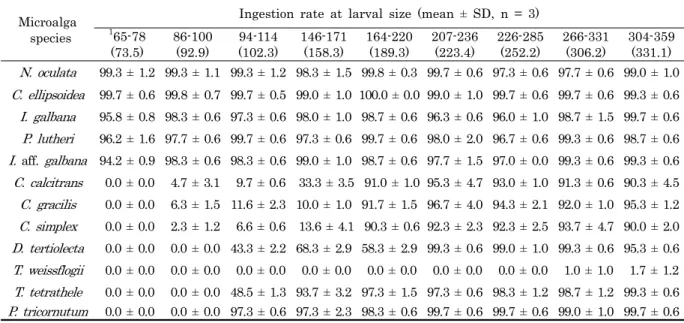
각장의 크기가 65.0-78.0 (평균 73.5) μm의 초기 D형 유 생은 착편모조류 3종 (I. galban, I. aff. galbana, P.

lutheri)와 녹조류 2종 (C. ellipsoidea, N. oculata) 을 94.2-99.7% 이상의 섭취율을 보였고, 나머지 먹이생물 7종은 섭취되지 않았다. 각장 86.0-100.0 (평균 92.9) μm의 크기 의 유생은 초기 D형 유생과 동일하게 착편모조류 3종과 녹조 류 2종은 97.7-99.7% 섭취가 되었고, 규조류인 C.

calcitrans, C. gracilis 및 C. simplex가 각각 4.7 ± 3.1%,

(4)

Microalga species

Ingestion rate at larval size (mean ± SD, n = 3)

1

65-78 (73.5)

86-100 (92.9)

94-114 (102.3)

146-171 (158.3)

164-220 (189.3)

207-236 (223.4)

226-285 (252.2)

266-331 (306.2)

304-359 (331.1) N. oculata 99.3 ± 1.2 99.3 ± 1.1 99.3 ± 1.2 98.3 ± 1.5 99.8 ± 0.3 99.7 ± 0.6 97.3 ± 0.6 97.7 ± 0.6 99.0 ± 1.0 C. ellipsoidea 99.7 ± 0.6 99.8 ± 0.7 99.7 ± 0.5 99.0 ± 1.0 100.0 ± 0.0 99.0 ± 1.0 99.7 ± 0.6 99.7 ± 0.6 99.3 ± 0.6 I. galbana 95.8 ± 0.8 98.3 ± 0.6 97.3 ± 0.6 98.0 ± 1.0 98.7 ± 0.6 96.3 ± 0.6 96.0 ± 1.0 98.7 ± 1.5 99.7 ± 0.6 P. lutheri 96.2 ± 1.6 97.7 ± 0.6 99.7 ± 0.6 97.3 ± 0.6 99.7 ± 0.6 98.0 ± 2.0 96.7 ± 0.6 99.3 ± 0.6 98.7 ± 0.6 I. aff. galbana 94.2 ± 0.9 98.3 ± 0.6 98.3 ± 0.6 99.0 ± 1.0 98.7 ± 0.6 97.7 ± 1.5 97.0 ± 0.0 99.3 ± 0.6 99.3 ± 0.6 C. calcitrans 0.0 ± 0.0 4.7 ± 3.1 9.7 ± 0.6 33.3 ± 3.5 91.0 ± 1.0 95.3 ± 4.7 93.0 ± 1.0 91.3 ± 0.6 90.3 ± 4.5 C. gracilis 0.0 ± 0.0 6.3 ± 1.5 11.6 ± 2.3 10.0 ± 1.0 91.7 ± 1.5 96.7 ± 4.0 94.3 ± 2.1 92.0 ± 1.0 95.3 ± 1.2 C. simplex 0.0 ± 0.0 2.3 ± 1.2 6.6 ± 0.6 13.6 ± 4.1 90.3 ± 0.6 92.3 ± 2.3 92.3 ± 2.5 93.7 ± 4.7 90.0 ± 2.0 D. tertiolecta 0.0 ± 0.0 0.0 ± 0.0 43.3 ± 2.2 68.3 ± 2.9 58.3 ± 2.9 99.3 ± 0.6 99.0 ± 1.0 99.3 ± 0.6 95.3 ± 0.6 T. weissflogii 0.0 ± 0.0 0.0 ± 0.0 0.0 ± 0.0 0.0 ± 0.0 0.0 ± 0.0 0.0 ± 0.0 0.0 ± 0.0 1.0 ± 1.0 1.7 ± 1.2 T. tetrathele 0.0 ± 0.0 0.0 ± 0.0 48.5 ± 1.3 93.7 ± 3.2 97.3 ± 1.5 97.3 ± 0.6 98.3 ± 1.2 98.7 ± 1.2 99.3 ± 0.6 P. tricornutum 0.0 ± 0.0 0.0 ± 0.0 97.3 ± 0.6 97.3 ± 2.3 98.3 ± 0.6 99.7 ± 0.6 99.7 ± 0.6 99.0 ± 1.0 99.7 ± 0.6

1
larval size (shell length of min-max, mean, n = 100) at sorted by mash size (40, 60, 80, 100, 125, 150, 170, 200, 230 μ m, respectively)

Table 4. Ingestion rates of twelve microalgae species according to the shell length of Crassostrea gigas larvae Larval

exterior appear

Evaluation

Normal Ingested Emptied

Table 3. Evaluate the ingestion of microalgae by Crassostrea gigas larvae

6.3 ± 1.5% 그리고 2.3 ± 1.2%가 섭취되었다.

초기 각정기 유생으로 발달하는 각장 94.0-114.0 (평균 102.3) μm 크기의 소두상 유생은 T. weissflogii를 제외하 고, 먹이생물 11종이 전체적으로 섭취된 것이 관찰되었지만, C. calcitrans, C. gracilis, C. simple, D. tertiolecta 및 T.

tetrathele는 각각 9.7 ± 0.6%, 11.6 ± 2.3%, 6.6 ± 0.6%, 43.3 ± 1.3%, 48.5 ± 1.3%였고, 착편모조류인 I. galbana, P. lutheri, I. aff. galbana 3종과 녹조류인 N. oculata와 C.

ellipsoidea 2종은 97.3-99.0% 이상의 높은 섭취율를 보였다.

그리고 각장 146.0-171.0 (평균 158.3) μm의 소형각정기 유 생은 D형 및 소두상 유생과 동일하게 착편모조류 3종 (I.

galbana, I. aff. galbana, P. lutheri)와 녹조류 3종 (C.

ellipsoidea, N. oculata, T. tetrathele)과 규조류인 P.

tricornutum이 93.7-99.0 이상 섭취가 되었고, C.

calcitrans, C. gracilis C. simplex 및 D. tertiolecta가 각 각 33.3 ± 3.5%, 10.0 ± 1.0%, 13.6 ± 4.1% 및 68.3 ± 2.9% 섭취되었다. 그러나 T. weissflogii는 섭취가 확인되지 않았다. 각장 164.0-220.0 (평균 189.3) μm의 중형각정기 유생은 D. tertiolecta와 T. weissflogii가 각각 58.3 ± 2.9%

및 0.0 ± 0.0 섭취되었고, 나머지 10종은 모두 90.3-100.0%

섭취되었다. 각장 207.0-285.0 μm의 유생은 T. weissflogii (0.0 ± 0.0%)를 제외하고는 11종은 92.3% 이상의 섭취율를 보였다. 한편, 각장 266.0-359.0 μm의 대형 정기와 부착기 유생은 조사 대상 미세조류 12종 모두 섭취가 확인되었지만, T. weissflogii는 1.0-1.7%로 매우 낮은 섭취율를 보였다 (Table 4).

이상의 미세조류 12종의 섭취율 결과를 이용하여 유생크기

별 섭취 가능한 먹이생물의 크기를 조사한 결과는 Fig. 1에서

(5)

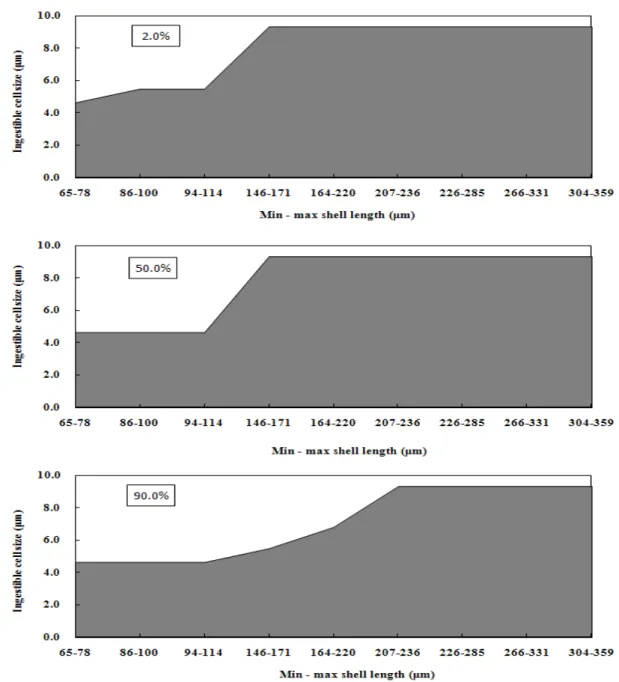
Fig 1. Ingestible cell size of microalgal species based on minor axis for different shell length of Crassostrea gigas larvae.

보는 것과 같다. 평균 각장 크기가 73.5 μm인 초기 D형 유 생은 단축의 길이가 4.6 μm 이하의 강모 (Spine) 가 없는 먹 이입자는 90.0% 이상 섭취가 가능하지만, 규조류와 같이 강모 가 있는 경우는 섭취가 되지 않았다. 평균 각장 102.3 μm의 유생은 초기 D형 유생과 마찬가지로 4.6 μm 이하의 강모 (Spine) 가 없는 먹이입자는 90.0% 이상 섭취가 가능하지만 세포크기가 4.6 μm 이하이지만, 강모가 있는 규조류는 50%

이하로 섭취 가능성은 떨어진다.

한편, 평균 각장 158.3 μm의 소형각정기 유생은 강모가 있어도 단축 기준으로 세포크기가 5.5 μm 이하에서는 90.0% 이상 섭취가 가능하지만 5.6-9.32 μm 크기의 입자는 50.0% 수준으로 떨어진다. 평균 각장 189.3 μm의 중형각정 기 유생은 단축 기준으로 세포크기가 6.8 μm 이하에서는 90.0% 이상 섭취가 가능하지만, 소형각정기와 마찬가지로 그 이상의 크기에서는 섭취 가능성이 50.0% 수준으로 떨어진다.

한편, 평균 각장 223.4 μm의 대형각정기 유생 이상에서는

(6)

미세조류의 세포크기가 단축기준으로 9.3 μm이하에서는 90.0% 이상 섭취가 가능하였지만, 이 이상의 크기에서는 2.0% 이하로 그의 섭취가 되지 않는다. 따라서 전체적으로 먹 이생물의 세포크기가 장축과 단축을 포함해서 10.0 μm를 초 과 하면 전 유생기에서 섭취가 그 의 불가능한 것으로 나타났 다 .

고 찰

조개류 인공종묘생산 과정에 이용되는 먹이생물은 적용 대 상생물에 대한 영양성, 소화성 및 형태 등 다양한 조건이 있지 만, 특히 세포 크기와 소화성은 전체 먹이효율을 결정하는 매 우 중요한 요소이다. 조개류 유생의 먹이입자의 포획능력은 면 반의 섬모활동과 입자크기 그리고 입자의 전기적 상태 등이 영 향을 미친다 (LaBarbera, 1978; Jørgensen, 1983;

Silvester and Sleigh, 1984). 이러한 기작으로 bacterioplankton도 포획할 수 있는 것으로 보고되고 있다 (Wright et al., 1982). 다음으로 구순 (labial palps)의 역할 로 입으로 먹이입자가 들어가기 전 사전 먹이입자의 크기를 선 별하고, 입자의 크기가 크면 위분 (pseudofeces)으로 배출 한 다 (Newell and Jordan, 1983; Shumway et al., 1985;

Defossez and Daguzan, 1996). 특히 굴 C. gigas은 초기 D형 유생에서 부착기 유생에 이르기까지 긴 부유유생 기간을 거치면서 성장 단계별 유생의 크기 차이가 크고, 이에 따른 소 화기관 발달정도도 달라지기 때문에 유생의 크기에 따라 공급 되는 먹이생물의 입자 크기를 조절해 주어야 한다. 이러한 이 유로 해양무척추 동물인 조개류 유생의 먹이 포획 및 섭취에 대하여 섭취기작과 섭취 가능한 먹이입자의 크기 (배양 미세조 류, 플라스틱 bead) 관한 연구는 많이 수행되었다 (Babinchak and Ukeles, 1979; Bayne, 1983;

Strathmann, 1987; Gallager, 1988; Riisgård, 1988;

Aldana-Aranda et al., 1994; Baldwin, 1995; Cognie et al., 2001; Ponis et al., 2003; Martínez-Fernández et al., 2004; Rico-Villa et al., 2009).

한편, 유생의 먹이생물 섭취율과 섭취된 식물성 플랑크톤의 섭취율과 소화도를 평가하는 방법으로 유생의 패각특성과 식 물성 플랑크톤의 광합성 색소세포의 자체 형광 특성을 이용해 서 형광현미경을 이용한 조사가 많이 수행되었다 (Babinchak and Ukeles, 1979; Lucas and Rangel, 1983;

Aldana-Aranda et al., 1991, 1994, 1997).

본 실험에서 형광현미경을 이용한 직접섭취여부를 조사한 결과, 전제 유생기동안 먹이생물의 최소 단경이 10.0 μm 이 상을 초과하면 섭취가 어려워 굴 부유유생의 먹이생물로써 가 치가 떨어지는 것으로 나타났다. 특히 평균 각장 100.0 μm 이하인 D형 유생의 경우는 5.0 μm 이상, 180 μm 이하의

중형각정기 유생은 7.0 μm 이상의 세포크기를 가진 먹이생 물은 먹이생물로서의 가치가 떨어지는 것으로 나타났다 . 비슷 한 크기인 버어지니아굴 C. virginica의 유생도 2에서 4 μm 크기의 먹이입자에서 가장 높은 섭취율을 보였고 , 대부분 10 μ m 이하의 먹이입자를 전체 유생기동안 선택적으로 섭취하 였다 (Baldwin and Newell, 1991). Mercenari mercenaria 유생은 평균 4.5 μm 입자크기에서 가장 효율적 인 먹이섭취율을 보였고 (Gallager 1988), 가리비류 (Patinopeacten opercularis, P. septemradiata) 유생은 먹 이입자의 크기가 7 μm 이상이면 포획효율이 감소되고, 1 μ m 이하는 20% 이하로 감소하는 것으로 보고되고 있다 (Moore, 1971; Møhlenberg and Riisgård, 1978). 이와 같 은 결과로 일반적으로 조개류 유생 사육에 이용되는 미세조류 는 세포 크기가 2-20 μm 정도의 미세조류 (Brown et al., 1997)로 자연 상태와 인공종묘 생산과정에서 굴 유생의 장내 먹이생물의 크기 조성은 5 μm 이상 되는 크기의 먹이생물은 관찰되지 않으며 , 특히 유생 사육에 공급되는 먹이생물은 1-5 μ m가 적당하고, 편모를 가지고 있는 경우에는 전체크기가 10 μm이하가 되어야 유생의 먹이로써 적당하다 (Walne, 1974; Wisely and Reid, 1978; Riisgård et al. 1980;

Fritz et al. 1984; Sprung 1984; Gallager 1988;

Riisgård 1988), 특히 2-4 μm에서 가자 활발한 섭취를 보였 고 (Wilsion 1980; Baldwin 1995), 동화율도 가장 높았다 (Riisgård et al. 1980; Sprung 1984; Riisgård 1988). 또 한 유생이 성장함에 따라 섭취되는 입자의 크기도 점점 커지는 데 (Baldwin 1995), 이러한 결과는 본 실험에 이용한 굴 C.

gigas도 동일한 결과를 보였다.

한편 , 대부분의 조개류 유생은 10 μm 이하의 입자크기에 서 가장 활발한 먹이 섭취율를 보였지만 , 버어지니아 굴 C.

virginica의 유생은 20-30 μm 크기입자, 뿐만 아니라, 이보 다 큰 입자도 섭취할 수 있는 것으로 보고되고 있는데 (Guillard 1958; Mackie 1969; Baldwin and Newell, 1991), 이는 먹이생물로 공급된 미세조류의 세포형태가 중요 한 것으로 판단된다 . 본 실험에서도 P. tricornutum (장축;

16.6 μm, 단축; 3.0 μm), T. tetrathele (장축; 14.4 μm, 단축 ; 9.3 μm)와 같이 세포의 크기가 정방형이 아닐 경우 섭 취 가능한 크기에 차이가 있다 . 본 실험에서 I. galbana, I.

aff. galbana 및 P. lutheri와 같은 착편모조류 3종의 전체 평 균 장축과 단축이 각각 5.3 μm와 4.5 μm로 P.

tricornutum의 단축 길이 3.0 μm보다 크기만, 초기 D형 유

생단계 (평균 각장 < 102.3 μm) 에서 착편모조류 3종은

94.2%이상 높은 섭취율를 보였지만, P. tricornutum는 관찰

되지 않았다 . 뿐만 아니라, 초기 각정기 유생단계 (평균 각장

102.3-158.3 μm) 에서 P. tricornutum은 97.3%이상의 높

(7)

은 섭취율를 보였지만 , T. tetrathele (장축; 14.4 μm, 단축;

9.3 μm) 와 D. tertiolecta (장축; 10.9 μm, 단축; 6.8 μ m) 같은 종은 50% 이하로 세포의 형태가 섭취율에 많은 영향 을 미치는 것으로 나타났다 . 따라서 세포의 장축이 10.0 μm 를 이상 크기 일지라도 단축이 이보다 작을 경우 유생의 크기 에 따라 섭취 가능성이 달라짐을 알 수 있다 . 뿐만 아니라, 규 조류와 같이 세포의 형태가 정방형으로 장축과 단축 모두 일정 크기의 유생에게 섭취가 될 수 있는 세포크기 일지라고 극모가 있을 경우 일정 크기 이하의 유생 (D형 유생) 에서는 섭취에 제약이 있음을 알 수 있다 . 이상의 결과는 굴 유생의 크기에 따른 먹이생물의 세포크기에 따른 섭취가능 시기를 결정하는 중요한 자료로 활용 가능하고 , 나아가 불필요한 먹이의 낭비를 막아 효율적인 먹이생물 관리로 보다 안정적인 유생사육과 차 후 인공배합사료 개발을 요구할 때 그 입자의 크기를 결정하는 기초적인 자료로 이용가능 할 것으로 판단된다 .

요 약

유생의 발달크기에 따라 미세조류 12종에 대하여 섭취 가능 성을 조사한 결과 유생의 크기에 따라 섭취 가능한 미세조류는 많은 차이를 보였다. 전체 유생크기에서 I. galban, I. aff.

galbana, P. lutheri, C. ellipsoidea, N. oculata는 94.2-99.7%의 섭취율를 보였고, C. calcitrans, C. gracilis, C. simplex는 평균 각장 189.3 ± 13.8 μm 크기인 중형 각 정기 이후 90.0% 이상의 섭취율을 보였다. P. triconutum, D. tertiolecta, T. tetrathele는 평균 각장 65.0-100.0 μm의 D형 유생은 섭취가 관찰되지 않았지만, 이후 유생에서는 각각 97.3-99.7%, 43.3-99.3%, 48.5-99.3% 섭취하였다. 그러나 T. weissflogii는 평균 각장 306.2 ± 14.7 μm 이상에서 1.0-1.7%의 섭취율을 보였지만, 전체 유생기동안 그의 섭취가 되지 않았다. 이상의 결과를 이용해 전체 50.0% 이상 섭취 가 능한 먹이생물의 세포크기를 조사한 결과, 평균 각장 102.3 μm 이하의 D형 단계는 장축과 단축 모두 4.6 μm 이하, 158.3 μm 미만에서는 장축기준으로 9.3 μm 미만까지 섭취 가 가능하고, 158.3 μm 이상 크기는 단축 기준 9.3 μm까지 섭취가 가능한 것으로 나타났다. 전제 유생기 동안 장축과 단 축을 포함해서 10.0 μm 이상은 섭취가 되지 않았다.

사 사

본 연구는 국립수산과학원 수산시험연구사업비 (RP-2011- AQ-090) 지원에 의해 수행된 연구결과입니다. 실험에 필요한 미세조류를 분양해 주신 한국미세조류은행에 감사드립니다 .

참고문헌

Abdel-Hamid, M.E., Mona, M.H., and Khalil, A.M.

(1992) Effects of temperature, food and food concentrations on the growth of the larvae and spat of the edible oyster Crassostrea gigas (Thunberg).

Journal of Marine Biology Association, 34: 195-202.

Albentosa, M., Perez-Camacho, A., Labarta, U., Beiras, R. and Fernández-Reiriz, M.J. (1993) Nutritional value of algal diets to clam spat Venerupis pullastra.

Marine Ecology Progress Service, 97: 261-269.

Albentosa, M., Fernandez-Reiriz, M.J., Perez-Camacho, A. and Labarta, U. (1999) Growth performance and biochemical composition of Ruditapes decussatus (L.) spat fed on microalgal and wheatgerm flour diets.

Journal of Experimental Marine Biology and Ecology, 232: 23-37

Aldana-Aranda, D., Lucas, A., Brulé, T., Andrade, M., García, E., Maginot, N. and Le Pennec, M. (1991) Observations on ingestion and digestion of unicellular algae by Strombus gigas larvae (Mollusca, Gastropoda) using epifluorescence microscopy. Aquaculture, 92: 359-366.

Aldana-Aranda, D., Patiño-Suárez, V. and Brulé, T.

(1994) Ingestion and digestion of eight algae by Strombus gigas larvae (Mollusca, Gastropoda) Studied by epifluorescence microscopy. Aquaculture, 126: 151-158.

Aldana-Aranda, D., Patiño-Suárez, V. and Brulé, T.

(1997) Nutritional potentialities of Chlamydomonas coccoides and Thalassiosira fluviatilis, as measured by their ingestion and digestion rates by the Queen Conch larvae (Strombus gigas). Aquaculture, 156:

9-20.

Babinchak, J. and Ukeles, R. (1979) Epifluorescence microscopy, a technique for the study of feeding in Crassostrea virgtnica veliger larvae. Marine Biology, 51: 69-76.

Badillo-Salas, C.E., Valenzuela-Espinoza, E., González- Gómez, M.A., Pares-Sierra, G., Ley-Lou, F. and Garcia-Esquivel, Z. (2009) Comparative growth of Pacific oyster (Crassostrea gigas) postlarvae with microfeed and microalgal diets. Aquaculture International, 17: 173-186.

Baldwin, B.S., Newell, R.I.E. (1991) Omnivorous feeding by planktotrophic larvae of the eastern oyster Crassostrea virginica. Marine Ecology Progress Service, 78: 285-301

Baldwin, B.S. (1995) Selective particle ingestion by oyster larvae (Crassostrea virginica) feeding on natural seston and cultured algae. Marine Biology, 123: 95-107.

Baldwin, B.S. and Newell, R.I.E. (1995) Feeding rate responses of oyster larvae (Crassostrea virginica) to seston quantity and composition. Journal of Experimental Marine Biology and Ecology, 189: 77–

91.

Bayne, B.L. (1983) Physiological ecology of marine

(8)

molluscan larvae. In: Verdonk NH, eds, The Mollusca, vol. III. pp. 299-343. Academic Press. New York.

Brown, M.R., Jeffrey, S.W., Volkman, J.K. and Dunstan, G.A. (1997) Nutritional properties of microalgae for mariculture. Aquaculture, 151: 315-331.

Bruce, J.R., Knight, M. and Parke, M.W. (1940) The rearing of oyster larvae on an algal diet. Journal of the Marine Biological Association of the united Kingdom, 24: 337-374.

Chrétiennot-Dinet, M.J., Vaulot, D., Galois, R., Spano, A.M. and Robert, R. (1991) Analysis of larval oyster grazing by flow cytometry. Journal of Shellfish Research, 10: 457-463.

Cognie, B., Barillé, L. and Rincé, Y. (2001) Selective feeding of the oyster Crassostrea gigas fed on a natural microphytobenthos assemblage. Estuaries, 24: 126-131.

Coutteau, P. and Sorgeloos, P. (1992) The use of algal substitutes and the requirement for live algae in hatchery and nursery rearing of bivalve molluscs:

An international survey. Journal of Shellfish Research, 11: 467-476.

Defossez, J.M. and Daguzan, J. (1996). About preferential ingestion of organic matter by bivalves.

Journal of Molluscan Study, 62: 394-397.

Devakie, M.N. and Ali A.B. (2000) Salinity-temperature and nutritional effects on the setting rate of larvae of the tropical oyster, Crassostrea iredalei (Faustino).

Aquaculture, 184: 105-114.

Enes, P. and Borges, M.T. (2003) Evaluation of microalgae and industrial cheese whey as diets for Tapes decussatus (L.) seed: effect on water quality, growth, survival, condition and filtration rate.

Aquaculture Research, 34: 299-309

Espinosa, E.P. and Allam, B. (2006) Comparative growth and survival of juvenile hard clams, Mercenaria mercenaria, fed commercially available diets. Zoo Biology, 25: 503-525

Ewart, J.W. and Epifanio, C.E. (1981) A tropical flagellate food for larval and juvenile oysters, Crassostrea virginica Gmelin. Aquaculture, 22;

297-300.

Fritz, L.W., Lutz, R.A., Foote, M.A., Van-Dover, C.L. and Ewart, J.W. (1984) Selective feeding and grazing rates of oyster (Crassostrea virginica) larvae on natural phytoplankton assemblages. Estuaries, 7:

513-518

Gallager, S.M. (1988) Visual observations of particle manipulation during feeding in larvae of a bivalve mollusca. Bulletin of marine Science, 43: 344-365.

Gerdes, D. (1983) The Pacific oyster Crassostrea gigas.

Part I. Feeding behavior of larvae and adults.

Aquaculture, 31: 195-219.

Helm, M.M. and Millican, P.F. (1977). Experiments in the hatchery of Pacific oyster (Crassostrea gigas Thunberg). Aquaculture, 11: 1-12.

His, E., Robert, R. and Dinet, A. (1989) Combined

effects of temperature and salinity on fed and starved larvae of the Mediterranean mussel, Mytilus galloprovincialis and the Japanese oyster Crassostrea gigas. Marine Biology, 100: 455-463.

Jørgensen, C.B. (1983) Fluid mechanical aspects of suspension feeding. Marine Ecology Progress Service, 11: 89-103.

Labarbera, M. (1978) Particle capture by a Pacific brittle star: experimental test of the aerosol suspension feeding model. Science, 201: 1147-l149.

Lemos, M.B.N., Nascimento, I.A., De Araujo, M.M.S., Pereira, S.A., Bahia, I. and Smith, D.H. (1994) The combined effects of salinity, temperature, antibiotics and aeration on larval growth and survival of the mangrove oyster, Crassostrea rhizophorae. Journal of Shellfish Research, 13: 187-192.

Lucas, A. and Rangel, D.C. (1983). Detection of the first larval feeding in Crassostrea gigas, using epifluorescence microscope. Aquaculture, 30: 369-374.

Martínez-Fernández, E., Acosta-Salmón, H. and Rangel-Dávalos, C. (2004) Ingestion and digestion of 10 species of microalgae by winged pearl oyster Pteria sterna (Gould, 1851) larvae. Aquaculture, 230:

417-423.

Min, K.S., Kim, T.I,. Hur, S.B., Hur, Y.B., Park, D.W.

and Lee. H.Y.M. (1999) Studies on the Artificial Spat Collection Method for the Pacific Oyster, Crassostrea gigas (Thunberg). Bulletin of national Fisheries Research and Development Institute, 57:

35-41.

Moore, H.J. (1971) The structure of latero-frontal cirri on the gills of certain lamellibranch mollusca and their role in suspension feeding. Marine Biology, 11:

23-27.

Møhlenberg, F. and Risgård, M.V. 1978. Efficiency of particle retention in 13 species of suspension feeding bivalves. Ophelia, 17: 239-246.

Myers, J.A. and Boisvert, R.N. (1990) The economics of producing algae and bivalve seed in hatcheries.

Aquaculture, 86: 163-179.

Newell, R.I.E. and Jordan, S.J. (1983) Preferential ingestion of organic material by the American oyster, Crassostrea virginica. Marine Ecology Progress Service, 13: 47-53.

Owen, G. (1974) Feeding and digestion in the bivalvia.

In: Lowenstein O. ed, Advances in Comparative Physiology and Biochemistry, vol. 5. pp 1-35.

Academic Press. New York. USA.

Ponis, E., Robert, R., Parisi, G. and Tredici, M. (2003) Assessment of the performance of Pacific oyster (Crassostrea gigas) larvae fed with fresh and preserved Pavlova lutheri concentrates. Aquaculture International, 11: 69-79.

Rico-Villa, B., Pouvreau, S. and Rovert, R. (2009) Influence of food density and temperature on ingestion, growth and settlement of Pacific oyster larvae, Crassostrea gigas. Aquaculture, 287: 395-401.

Riisgård, H.U., Randlov, A. and Kristensen, P.S. (1980)

(9)

Rates of water processing, oxygen consumption and efficiency of particle retention in veligers and young post-metamorphic MytiIus edulis. Ophelia, 19: 37-47.

Riisgård, H.U. (1988) Feeding rates in hard clam (Mercenaria mercenaria) veliger larvae as a function of algal (Isochrysis galbana) concentration. Journal of Shellfish Research, 7: 377-380

Robert, R. and Trintignac, P. (1997) Substitutes for live microalgae in mariculture: a review. Aquatic Living Resources, 10: 315-327.

Shumway, S.E., Cucci, T.L., Newell, R.L. and Yentsch, C.M. (1985) Particle selection, Ingestion, and absorption in filter-feeding bivalves. Journal of Experimental Marine Biology and Ecology, 91:

77-92.

Silverster, N.R. and Sleigh, M.A. (1984) Hydrodynamic aspects of particle capture by Mytilus. Journal of the Marine Biological Association of the united Kingdom, 64: 859-879.

Sprung, M. (1984) Physiological energetics of mussel larvae (Mytilus edulis). II. Food uptake. Marine Ecology Progress Service, 17: 295-305.

Strathmann, R.R. (1987) Larval feeding. In: Giese AC, Pearse JS, Pearse VB (eds) Reproduction of marine invertebrates. Vol. IX. General aspects: seeking unity in diversity. pp 465-550. Blackwell Scientific Publications. Palo Alto. California.

Urban, E.R. and Langdon, C.J. (1984) Reduction in costs of diets for the American oyster, Crassostrea virginica (Gmelin), by the use of non-algal supplements. Aquaculture, 38: 277-291.

Walne, P.R. (1974) Culture of bivalve molluscs. pp 173.

The white friars Press Ltd. London and Tondridge.

Wilson, J.H. (1980) Particle retention and selection by larvae and spat of Ostrea edulis in algal suspensions. Marine Biology, 57: 135-145.

Wisely, B. and Reid, B. (1978) Experimental feeding of sydney rock oysters (Carssostrea commercialis = Saccostrea cucullata): Ⅰ. optimum particle sizes and concentrations. Aquaculture, 15: 319-331.

Wright, R.T., Coffin, R.B., Ersing, C.P. and Person, D.

(1982) Field and laboratory measurements of bivalve filtration of natural marine bacterioplankton.

Limnology Oceanography, 27: 91-98.

수치

Table 3. Evaluate the ingestion of microalgae by Crassostrea gigas larvae
Fig 1. Ingestible cell size of microalgal species based on minor axis for different shell length of Crassostrea gigas  larvae

참조

관련 문서

On his part, CEO of Express Roads Authority, Saud Al-Naqqi said that the heavy rains of the previous day led to clogging parts of the express

Kuwait will celebrate on Sunday the fourth anniversary of the UN honoring and proclamation of His Highness the Amir, Sheikh Sabah Al-Ahmad Al-Jaber Al-Sabah as

• 이명의 치료에 대한 매커니즘과 디지털 음향 기술에 대한 상업적으로의 급속한 발전으로 인해 치료 옵션은 증가했 지만, 선택 가이드 라인은 거의 없음.. •

3 was standing, the truck hit a pedestrian 4 will be having Mom’s birthday party 5 will be staying at her friend’s house 6 is slowly accelerating. 7 he set off for

After choosing the type of bike, the next step is the right bike size. the right size for you from

The proposal of the cell theory as the birth of contemporary cell biology Microscopic studies of plant tissues by Schleiden and of animal tissues by Microscopic studies of

It considers the energy use of the different components that are involved in the distribution and viewing of video content: data centres and content delivery networks

After first field tests, we expect electric passenger drones or eVTOL aircraft (short for electric vertical take-off and landing) to start providing commercial mobility