Received: May 29, 2014; Revised: June 12, 2014;
Accepted: June 19, 2014
Corresponding author : Joung Wook Kang Tel: +82 (32) 860-7709 e-mail: [email protected] 1225-3480/24519
This is an Open Access article distributed under the terms of the Creative Commons Attribution Non-Commercial License with permits unrestricted non-commercial use, distribution, and reproducibility in any medium, provided the original work is properly cited.
수온과 염분 조건에 따른 동죽의 여수율과 먹이섭취
강종욱, 이선식
1, 한경남
인하대학교 해양과학과, 1인천광역시수산자원연구소
Clearance rate and feeding according to water temperature and salinity condition in the surf clam, Mactra veneriformis
Joung Wook Kang, Seon Sik Lee
1and Kyung Nam Han
Department of Ocean Sciences, Inha university, 100 Inharo, Incheon, 402-751, Korea,
1Incheon Fisheries Research Institute, 313, 247 Yeongheungnamro, Incheon, 409-871, Korea
ABSTRACT
Clearance rate and feeding of surf clam, Mactra veneriformis were determined for 5 different water temperature regime (5, 10, 15, 20, 25℃) and salinity regime (8, 14, 20, 26, 32 ‰) with small group (86.62 ± 7.10 mm in shell length) and large group (147.99 ± 10.83 mm in shell length). Clearance rate and feeding increased with water temperature up to 20℃, but rapidly decreased at 25℃. The minimal clearance rate and feedign was recorded at 5℃. surf clam showed low clearance rate and feeding at low salinity (below 20 ‰) and maximum values at high salinity (26-32 ‰).
Key words : Mactra veneriformis, Clearance rate, feeding, temperature, salinity
서 론
동죽 (Mactra veneriformis) 은 이매패강 (Class Bivalvia) 백합목 (Order Veneroida) 개량조개과 (Family Mactridae) 에 속하는 종으로 우리나라 서해와 남해안의 모래 진흙이나 진흙 갯벌 조간대에 주로 분포하는 중형의 부유물 여 과 섭식성 조개류로서 식용으로 선호되고 있다 (Hong, 2006).
3-4년전만 해도 1 kg당 1,000-1,500원에 거래되었으나, 최 근에는 바지락 생산 급감으로 동죽의 희소가치가 상승하여 2,500원 정도에 거래되고 있어 쉽사리 남획될 가능성이 많아 자원 고갈의 위험이 높다. 실제로 해양수산통계연보 (2013) 에 따르면 동죽 어업생산량이 2003년에는 21,240 M/T였으 나, 2012년에는 531 M/T로 계속 감소하다가 2013년에는 2,329 M/T로 약간 회복했으나 10년 전에 비해 1/10로 감소
한 실정이므로 인공종묘생산· 방류를 통한 자원회복이 시도 되어야 한다.
동죽은 발생학적인 연구 (Chung et al., 1988) 와 자원생태 학적인 연구 (Shin, 1992; Ryou and Chung, 1995; You, 1995; Shin and Koh, 1995), 병리학적인 연구 (Kim, 1988;
Lee, 1996; Han and Chai, 2008; Yu et al., 2009; You, 2012; Shin et al., 2013), 가공분야 연구 (Ryu and Ko, 1985) 가 진행되었으나, 아직까지 흔한 자원으로 인식되어 인 공종묘생산과 관련된 기초 생태, 생리 연구 성과는 미흡한 실 정이다.
한편 조개류의 양식산업화를 위해서는 패류의 대사 생태에 대한 기초연구가 필요하다. 이 중 수온과 염분은 동죽과 같은 조개류의 성장, 성숙, 생존, 분포 및 먹이생물의 섭취, 생물의 에너지 활용 및 대사활동에 밀접한 관계를 가지고 있으며 조개 류의 생산성에 많은 영향을 주는 것으로 알려져 있다 (Mills, 2000; Navarro et al., 2000). 또한, 여수율은 패류의 성장과 생존에 가장 큰 영향을 미치는 먹이섭취 능력과 밀접한 관련이 있다.
따라서, 본 연구는 동죽의 크기, 수온, 염분의 차이에 대한 여수율의 차이를 조사하여 인공종묘생산에 대한 기초 생물학 적 자료를 제공하기 위하여 실시하였다.
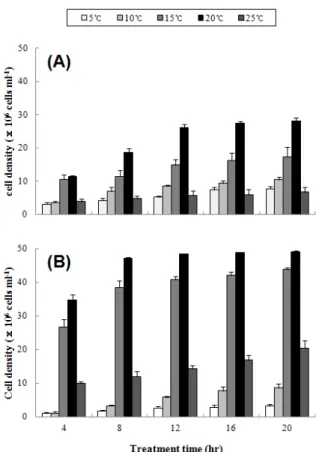
Fig 1. The dietary feeding of small group (A) and large group (B) of surf clam, Mactra veneriformis at different water temperatrues. Error bars represent standard deviation (n
= 3).
재료 및 방법
실험에 사용한 동죽은 인천광역시 수산자원연구소에서 인공 생산한 종묘로 각장 크기에 따라 소형그룹 (각장 86.62 ± 7.10 mm, 건중량 7.49 ± 2.51 mg), 대형그룹 (각장 147.99 ± 10.83 mm, 건중량 38.02 ± 11.82 mg) 으로 선별한 후 1 L 비이커에 대형그룹은 10개체씩, 소형그룹은 20개체씩 수용하 였고, 0.45 μm 여과해수를 이용하여 지수식으로 실험을 진행 하였다. 먹이생물은 Isochrysis galbana를 대형그룹에는 5 × 10⁷ cells/ml, 소형그룹에는 3 × 10⁷ cells/ml를 원심분리기 로 농축한 후 공급하였다. 수온 실험은 5, 10, 15, 20, 25℃의 5구간으로 구분하였으며, 실험수온에 대한 적응을 위해 1일 1℃씩 증감하고 실험수온에 도달하면 2일 금식 후 Multi-room incubator (VISION scientific co., LTD., Korea) 에서 실시하였다. 염분 구간별 실험은 8, 14, 20, 26, 32‰의 5구간으로 구분하였으며, 여름철 집중 강우로 인한 영 향을 규명하고자 순치과정을 생략하고 실시하였다.
여수율 측정을 위하여 4시간 간격으로 1 ml를 채수하여 Lugol's solution에 고정 후 hemacytometer를 이용하여 5회 반복 계수하였고, 동죽 건중량은 증류수로 세척한 육질부 만을 건조기에 넣어 80℃에서 48시간동안 건조시킨 후 전자저울로 소수점 셋째자리까지 측정하였다. 여수율은 Coughlan (1969) 공식을 이용하여 산출하였다.
CR = {Ln (C0 / Ct) / (DW × t)} × V
CR : 여수율(L/hr·g DW)
C0 : 실험개시시 공급된 먹이량 (cells/ml) Ct : 실험종료시 잔존한 먹이량 (cells/ml) DW : 동죽 육질부의 건중량 (g)
t : 실험진행시간 (hr) V: 실험액의 용량 (L)
모든 실험구는 3회 반복하였으며, 통계처리는 SPSS-통계 패키지를 이용한 일원분산분석 (one-way ANOVA) 을 통해 유의성 (P < 0.05) 을 분석하였다.
결 과
수온에 따른 20시간 동안의 먹이밀도 감소량은 Fig. 1에 나 타내었다. 소형그룹의 경우 5℃에서 7.7 × 10⁶ cells/ml로 가 장 낮은 값을 보였으며, 수온이 증가함에 따라 점차 증가해 2 0℃에서 28.1 × 10⁶ cells/ml로 가장 높았으나 25℃에서 6.7
× 106 cells/ml로 급격히 감소하며 유의적 차이를 보였다 (P
< 0.05). 대형그룹의 경우 5℃에서 3.1 × 10⁶ cells/ml로 가장
낮은 값을 보였고, 20℃에서 49.1 × 10⁶ cells/ml로 가장 높았 으나, 25℃에서 20.5 × 10⁶ cells/ml로 낮아지며 유의적 차이 를 보였다 (P < 0.05).
염분에 따른 20시간 동안의 먹이밀도 감소량은 Fig. 2에 나 타내었다. 소형그룹의 경우 8‰에서 8.1 × 10⁶ cells/ml로 가 장 낮은 값을 보였고, 26‰에서 28.1 × 10⁶ cells/ml로 가장 높게 나타나는 유의적 차이를 보였다 (P < 0.05). 대형그룹의 경우 8‰에서 17.0 × 10⁶ cells/ml로 가장 낮은 값을 보였으 며, 염분이 증가함에 따라 점차 증가해 32‰에서 49.1 × 10⁶ cells/ml로 가장 높은 유의적 차이를 보였다 (P < 0.05).
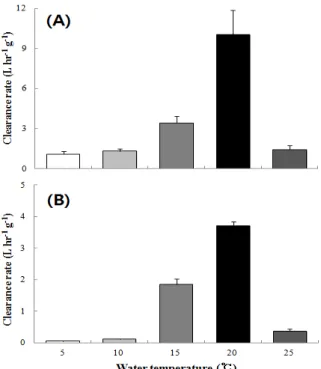
수온에 따른 여수율의 차이는 Fig. 3에 나타내었다. 소형그 룹의 경우 여수율은 5℃, 10℃에서 각각 1.084 ± 0.134, 1.299 ± 0.165 L/hr·g DW로 매우 낮은 값을 보였고, 20℃에 서 10.006 ± 1.828 L/hr·g DW로 가장 높은 값을 보였으며, 25℃에서 1.432 ± 0.274 L/hr·g DW로 급격히 낮은 값을 보 여 유의적인 차이를 나타내었다 (P < 0.05). 대형그룹의 경우 5℃에서 0.049 ± 0.011 L/hr·g DW로 매우 낮은 값을 보였으 며, 20℃에서 3.713 ± 0.125 L/hr·g DW로 가장 높은 값을
Fig 3. Clearance rate of small size group (A) and large size group (B) of surf clam, Mactra veneriformis at different water temperatrues. Error bars represent standard deviation (n = 3).
Fig. 2. The dietary feeding of small group (A) and large group (B) of surf clam, Mactra veneriformis at different salinity. Error bars represent standard deviation (n = 3).
Fig. 4. Clearance rate of small size group (A) and large size group (B) of surf clam, Mactra veneriformis at different salinity. Error bars represent standard deviation (n = 3).
보였고, 25℃에서 0.371 ± 0.063 L/hr·g DW로 낮은 값을 보 여 유의적인 차이를 나타내었다 (P < 0.05).
염분에 따른 여수율의 차이는 Fig. 4에 나타내었다. 소형그 룹의 경우 여수율은 8‰에서 1.472 ± 0.198 L/hr·g DW로 가 장 낮은 값을 보였고, 26, 32‰에서 각각 13.211 ± 2.870, 10.003 ± 1.828 L/hr·g DW로 높은 값을 보여 유의적인 차이 를 나타내었다 (P < 0.05). 대형그룹의 경우 여수율은 8‰에서 0.368 ± 0.144 L/hr·g DW로 가장 낮은 값을 보였고, 32‰에 서 각각 3.713 ± 0.125 L/hr·g DW로 가장 높은 값을 보여 유의적인 차이를 나타내었다 (P < 0.05).
고 찰
본 실험은 환경변화가 극심한 조간대에 서식하는 동죽에 대 한 수온과 염분에 의한 여수율 차이에 대해 알아보았다.
기존에 연구된 조개류 여수율에 관한 연구는 참굴 (MacDonal and Thompson, 1986), 진주담치 (Clausen and Riisgard, 1996), 개조개 (Lee et al., 2002), 바지락 (Kim and Koh, 2004) 등이 있는데, Yang et al. (2013) 의
연구에 따르면, 18℃에서 바지락 (각장 2.66-4.10 cm) 은 0.30-0.60 L/hr·g DW, 재첩 (각장 1.51-2.50 cm) 은 0.79-1.98 L/hr·g DW, 홍합 (각장 2.26-4.79 cm) 은 0.60-2.68 L/hr·g DW으로 본 실험에서의 동죽 여수율보다 상당히 낮은 값을 보였으며, Kim and Koh (2004) 의 연구에 서는 24℃에서 바지락의 여수율이 9.84-12.97 L/hr·g DW로 본 실험보다 높은 값을 보였다. 이러한 차이는 이매패류의 여 수율은 실험에 사용된 부유생물의 농도와 종, 측정시간, 용존 산소, 실험디자인과 생리활동에 영향을 미치는 내인성 요인 등 에 의해 결과가 달라질 수 있기 때문이다 (Werner and Hollibaugh, 1993; Chung et al., 1999; Riisgard, 2001;
Lee and Chung, 2001).
수온은 대사율, 활성도 및 에너지 균형 등에 영향을 미치는 직접적인 요인으로 작용한다 (Newell and Kofoed, 1977).
본 실험에서는 동죽 소형, 대형그룹 모두 5℃에서 가장 낮은 먹이감소량, 여수율을 보였는데, 이는 Ruditapes philippinarum (Shin and Lim, 2003), Meretrix petechialis (Lim et al., 2008), Gomphina veneriformis (Shin et al., 2009) 의 연구와 일치한다. 이러한 현상은 수온 과 점성은 반비례 관계에 있으므로 수온이 낮으면 점성이 높아 져서 여과과정에서 마찰력이 증가하므로 여수율이 낮아지기 때문이며 (Jøngensen et al., 1990; Podolsky, 1994), 변온 동물인 조개류는 대사과정을 통한 열발생이 없고 외부의 열에 의지하므로 저온에서는 생물이 스트레스를 받아 생리활동에 제약이 생기며 아가미의 섬모운동이 약화되어 여수율이 현저 히 낮아지기 때문이다 (Yang et al., 2013). 또한, 수온이 증 가할수록 점차 증가하여 20℃에서 최고값을 보였는데, 수온이 증가하면 이매패류의 여수율도 증가하며 (Sprung, 1995;
Sylvester et al., 2005), 이는 생물의 신진대사율은 10℃ 증 가에 따라 2-3배 증가한다는 Q10의 원리가 적용되기 때문이 다 (Robinson et al., 1983). 하지만, 25℃에서 급격한 감소 경향을 보였는데, 이는 수온 내성범위를 벗어나게 되면 여수율 이 급격히 떨어지는 결과를 초래하기 때문이다 (Newell et al., 1977; Buxton et al., 1981; Shin and Lim, 2003; Lee and Lee, 2005).
염분에 의한 삼투 조절 능력은 생태적 내성에 영향을 미치며 해양생물의 분포를 결정하는 중요한 요인 중의 하나이다 (Rippingale and Hodgkin, 1977). 본 실험에서의 염분별 여 수율은 소형, 대형그룹 모두 염분이 낮아질수록 여수율이 낮아 지는 경향을 보였는데, 이는 Mytilus edulis (Widdows, 1985)와 Ruditapes philippinarum (Shin et al., 2000) 가 20‰ 이하에서 호흡율과 여과율이 낮아졌다는 보고와 일치한 다. 이러한 현상은 염분의 변화가 세포내 수분과 염류 출입 간 의 일정한 균형 상태를 파괴시키며, 염분이 급격하게 변하면
세포 용적과 관련된 대사율의 감소를 줄이기 위하여 즉시 패각 을 닫고 대사를 감소시키기 때문이다 (Laung, 1972). 또한, 조개류는 낮은 염분 환경에서는 높은 염분수를 패각 내에 두면 서 패각을 닫고 섭식활동을 거의 하지 않으며, 일반적으로 외 부의 환경과 체내의 조직 사이에 삼투압의 균형을 유지할 수 있는 생리적인 기능이 없으며 (Davenport and wang, 1986), 저염분에서의 낮은 칼슘 농도로 인하여 먹이생물의 양과 질이 떨어지기 때문이다 (Wilbur and saleuddin, 1983).
또한, 본 연구에서 동죽 소형그룹의 여수율이 대형그룹보다 높게 나타났는데, 크기가 작은 개체가 큰 개체에 비하여 단위 체중당 더 큰 대사율을 가진다는 것은 많은 변온 동물에서 공 통된 현상이며 (Zeuthen, 1953), 개체 크기가 증가하면 단위 무게당 아가미 표면적이나 대사율이 감소하기 때문에 단위 무 게당 여수율도 감소한다는 결과와도 일치한다 (Johns et al., 1992; Riisgard, 2001; Park,, 2007; Filijueira et al., 2008).
이상의 연구를 종합하여 보면, 동죽의 최적 수온은 20℃이 며, 저수온 또는 25℃이상의 고수온에서는 여수율이 낮아지고, 염분의 경우 26-32‰이 최적의 환경이며, 20‰ 이하의 염분에 서는 여수율이 낮아진다는 사실을 확인하였다.
요 약
인공종묘로 생산된 동죽, Mactra veneriformis의 크기, 수 온, 염분 변화에 대한 여수율과 먹이섭이량의 차이를 조사하였 다. 수온의 경우 소형, 대형그룹의 여수율은 5℃에서 최소값을 보였으며 20℃에서 가장 높은 값을 보였으나, 25℃에서 급격 한 감소 경향을 보였다. 염분에 대한 소형그룹의 여수율은 2 6‰에서 가장 높은 값을 보였고 8‰에서 가장 낮은 값을 보였 다. 대형그룹은 32‰에서 가장 높은 값을 보였고, 8‰에서 가 장 낮은 값을 보였다. 본 연구를 통해 동죽의 최적 수온,염분 환경은 20℃, 27-32‰이며, 10℃ 이하 또는 25℃ 이상의 수온 과 20‰ 이하의 저염분에서 여수율이 낮아진다는 사실을 확인 할 수 있었다.
사 사
본 연구는 인하대학교 연구비 지원에 의해 수행되었습니다.
REFERENCES
Buxton, C.D., Newell, R.C. and Field, J.G. (1981) Response-surface analysis of the combined effects of exposure and acclimation temperatures on filtration, oxygen consumption and scope for growth in the oyster Ostrea odulis. Marine Ecology Progress Series, 6: 79-82.
Chung, E.Y., Kim, S.Y. and Lee, T.Y. (1985) A study on
sexual maturation of Mactra veneriformis Reeve.
Korean Journal of Malacology, 4(1): 30-40. [in Korean]
Chung, E.Y., Shin, Y.K., and Hur, S.B. (1999) Physiological rhythms in the oxygen consumption and filtration rates of the Manila Clam, Ruditatpes philippinarum. Korean Journal of Malacology, 15:
127-131. [in Korean]
Clausen, I. and Riisgard, H.U. (1996) Growth, filtration and respiration in the mussel Mytilus edulis: no evidence for physiological regulation of the filter-pump to nutritional needs. Marine Ecology Progress Series, 141: 37-45.
Coughlan J., (1969) The estimation of filtering rate from the clearance of suspensions. Marine Biology, 2:
356-358.
Davenport, J. and Wang, T,M. (1986) Response of the blood Cockle Anadara granosa (L) salinity, hypoxia and aerial exposure. Aquaculture, 56: 151-162.
Filgueira, R., Labarta U. and Fernández-Reiriz, M.J.
(2008) Effect of condition index on allometric relationships of clearance rate in Mytilus galloprovincialis Lamarck. Review of Oceanography and Marine Biology, 43(2): 391-398.
Han E.T. and Chai, J.Y. (2008) Mactra veneriformis, an intertidal clam, as a new second intermediate host for Acanthoparyphium marilae (Digenea:
Echinostomatidae). Korean Journal of Parasitology, 46(2): 101-104.
Hong, S.Y., (2006) Marine invertebrates in korean coasts. Academy press, 252 pp [in Korean].
Johns, H.D., Richards, O.G. and Southeran, T.A. (1992) Gill dimensios, water pumping rate and body size in the mussel Mytillus deulis L. Journal of Experimental Marine Biology Ecology, 155: 213-237.
Jørgensen C.B. Larsen R.S., and Riisgard H.U. (1990) Effect of temperature on the mussel pump. Marine Ecology Progress Series, 64: 89-97.
Kim, Y.G. (1988) Studies on A Trematode Parasitized on Bivalves V. On metacercaria of Echinostomatidae detected from Mactra veneriformis, Cyclina sinensis and Solen strictus. Journal of Fish Pathology, 1(1);
31-37. [in Korean]
Kim. C.W. and Kho, K.H. (2004) Effects of water temperature and salinity on dietary feeding of Manila clam (Ruditapes philippinarum). Korean Journal of Environmental Biology, 22: 28-34. [in Korean]
Laung, R. (1972) Some recent work on osmotic, ionic and volume regulation in marine animals.
Oceanography and Marine Biology Annual Review, 10: 97-136.
Lee, C.H. and Chung, E.Y. (2001) Determination of experimental conditions for measurement of the clearance rate of an intertidal bivalve, Glauconome chinensis. Korean Journal of Malacology, 17: 95-104.
Lee, C.H., Choi, Y.S., Bang, J.D. and Jo, S.G. (2002) Feeding of juvenile purple washington clam,
Saxidomus purpuratus (Sowerby): effects of algae concentration and temperature. Jouranl of Aquaculture, 15: 253-260.
Lee, J,S. and Lee, B.G. (2005) Relationship between clearance rates and metal uptake rates of Corbicula fluminea, Potamocorbula amurensis and Macoma balthica: influence of water temperature and body size. Korea Journal of Malacology, 21: 41-46. [in Korean]
Lee, J.Y. (1996) Study on the oxygen consumption of surf clam, Mactra veneriformis REEVE. Journal of Korean Fish Society, 29(5): 614-619. [in Korean]
Lim, K.H., Jang, K.S., Kim, I.S., Lee, J.H. and Shin, H.C. (2008) The influence of water temperature and salinity on the filtration rates of the hard clam, Meretrix petechialis. Korean Journal of Malacology, 24: 175-188. [in Korean]
MacDonald, B.A. and Thompson, R.J. (1986) Influence of temperature and food availability on the ecological energetics of the giant scallop Placopecten magellanicus. Ⅲ. Physiological ecology, the game-togenic cycle and scope for growth, Marine Biology, 93: 37-48.
Mills D. (2000) Combined effects of temperature and algal concentration on survival, growth and feeding physiology of Pinctata maxima (Jameson) spat.
Journal of shellfish Research, 19: 159-166.
Navarro, J.M., Leiva, G.E., Martinez G. and Anguilera, C. (2000) Interactive effects of diet and temperature on the scope for growth of the scallop Argopecten purpuratus during reproductive conditioning. Journal of Experimental Marine Biology Ecology, 147: 67-83.
Newell, R.C. and Kofoed, L.H. (1977) Adjustment of the components of energy balance in the gastropod Crepidula fornicata in response to thermal acclimation. Marine Biology, 44: 275-286.
Park, H.J. (2007) Filtration rate and oxygen consumption rate on various growth stage of Scapharca broughtonii spat. MS. Thesis, Chonnam National University, 33 pp. [in Korean]
Podolsky R.D. (1994) Temperature and water viscosity:
physiological versus mechanical effect on suspension feeding. Science, 265: 100-103.
Riisgard, H.U. (2001) On measurement of filtration rates in bivalves the stony road to reliable data: review and interpretation. Marine Ecology Pregress Series, 211: 275-291.
Rippingale, R.J. and Hodgkin, E.P. (1977) Food availability and salinity tolerance in a brackish water copepod. Austrian Journal of Marine and Freshwater Research, 28: 1-7.
Robinson W.R., Perters, R.H. and Zimmermann, J.
(1983) The effect of body size and temperature on metabolic rate of organisms. Canadian Journal of Zoology, 61: 281-288.
Ryou D.K. and Chung, S.C (1995) Settlement and recruitment of Mactra veneriformis R. around the inshore of Kunsan, Korea. Journal of Korean Fish
Society, 28(5); 667-676. [in Korean]
Ryu H.J. and Ko, Y.S. (1985) Changes in taste compounds of processed surf clam (Mactra veneriformis). Korean Journal of Food Science and Technology, 17(3): 223-226. [in Korean]
Shin H.C., Lee, J.H., Jeong, H.J., Lee, J.S. and Park, J.J. (2009) The influence of water temperature and salinity on filtration rates of the hard clam, Gomphina veneriformis (Bivalvia). Korean Journal of Malacology, 25(2): 161-171. [in Korean]
Shin, H.C. and Koh, C.H. (1995). Growth and production of Mactra vineriformis (Bivalvia) on the Sondo tidal flat, west coast of Korea. Journal of the Korean Society of Oceanography, 30(5): 403-412. [in Korean]
Shin, H.C. and Lim, K.H. (2003) The influence of water temperature and salinity on the filtration rates of the short-necked clam, Ruditapes philippinarum.
Korean Jouranl of Malacology, 19: 1-8. [in Korean]
Shin, H.C. (1992) Growth and population dynamics of Mactra veneriformis (Bivalvia). Ph. D. Thesis, National University of seoul. [in Korean]
Shin, Y.K., Park, J.J., Lim, H.S. and Lee, J.S. (2013) Copper toxocity on survival, respiration and organ structure of Mactra veneriformis (Bivalvia:
Mactridae). Korean journal of Maclacology, 29(2);
129-137.
Shin, Y.K., Kim, Y., Chung, E.Y. and Hur, S.B. (2000) Temperature and salinity tolerance of the Manila clam, Ruditapes philippinarum. Journal of the Korean Fisheries Society, 33: 213-218. [in Korean]
Sprung M. (1995) Physiological energetics of the zebra mussel Dreissena polymorpha in lakes. Ⅱ. Food uptake and gross growth efficiency. Hydrobiologia, 304: 133-146.
Sylvester F., Dorado, J., Boltobskoy, D., Juá'rez Á. and Cataldo, D. (2005) Filtration rates of the invasice pest bivalve Limnoperna fortunei as a function of
size and temperature. Hydrobiologia, 524: 71-80.
Werner, I. and Hollibaugh, J.T. (1993) Potamocorbula amurensis: Comparison of clearance rates and assimilation efficiencies for phytoplankton and bacterioplankton. Limnology and Oceanography, 38:
949-964.
Widdows, J. (1985) The effect of fluctuating and abrupt change in salinity on the performance of Mytilus edulis. In: Marine Biology of Polar Regions and Effect of Stress on Marine Organism. (ed. by Gray, J.S. and Christiansen, M.E.), pp. 556-566, Wiley-interscience.
Wilbur, K.M. and Saleuddin, A.S.M. (1983) Shell formation. In: the Mollusca Physiology (ed. by Wilbur, K.M. and Saleuddin, A.S.M.), pp. 236-287, Academic Press, New York. vol. 4, park 1.
Yang, S.Y., Lee, J.H. and Lee, B.G. (2013). Relationship of the clearance rate and nonylphenol uptake rate of three bivalve species with different size classes and temperature. Journal of the Korean Society of Oceanography, 18(2): 80-88. [in Korean]
You, D.G. (1995) Ecological studies on the population of surf clam, Mactra veneriformis reeve. Ph. D. Thesis, Jeju university. [in Korean]
You, J.H. (2012) Characterization of haemocytes and the effects of various environmental stresses on immune function in the surf clam, Mactra veneriformis. Ph.
D. Thesis, University of Gunsan. [in Korean]
Yu J.H., Park, K.I. and Park, S.W. (2009).
Characterization of haemocytes in the surf clam Mactra veneriformis. Journal of Fish Pathology, 22(3); 305-316.
Zeuthen, E. (1953) Oxygen uptake as related to body size in organisms. The Quatrerly review of Biology, 28(1): 1-12.
해양수산통계연보. http://www.fips.go.kr.