Effect of Oryzalin on the Gravitropic Response and Ethylene Production in Maize Roots
Chungsu Kim
1,2, Timothy J. Mulkey
3, Jong-Sik Kim
1* and Soon Young Kim
1*
1
Department of Biological Sciences, Andong National University, Andong 36729, Korea
2
Foot and Mouth Division, Animal and Plant Quarantine Agency, Anyang 14089, Korea
3
Department of Biology, Indiana State University, Terre Haute, IN 47809, USA
Received October 6, 2015 /Revised October 16, 2015 /Accepted October 16, 2015
Oryzalin is a dinitroaniline herbicide, which disrupts the arrangement of microtubules. Microtubules and microfilaments are cytoskeletal components that are thought to play a role in the sedimentation of statoliths and the formation of cell walls. Statoliths regulate the perception of gravity by columella cells in the root tip. To determine the effect of oryzalin on the gravitropic response, ethylene pro- duction in primary roots of maize was investigated. Treatment with 10
-4M oryzalin to the root tip inhibited the growth and gravitropic response of the roots. However, the treatment had no effect on the elongation zone of the roots. An application of 10
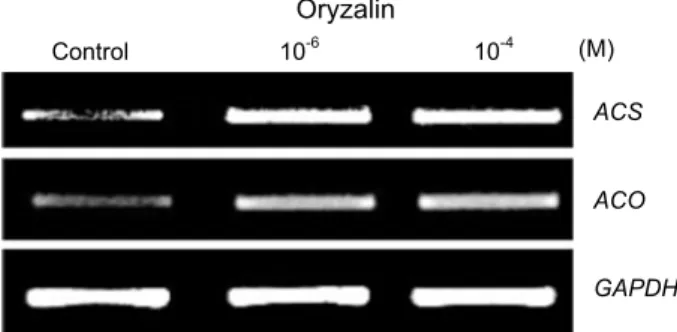
-4M oryzalin for 15 hr to the root tip caused root tip swelling. The application of 1-aminocycopropane-1-carboxylic acid (ACC), a precursor of ethyl- ene, to the root tip also inhibited the gravitropic response. To understand the role of oryzalin in the regulation of the growth and gravitropic response of roots, ethylene production in the primary roots of maize was measured following treatment with oryzalin. Oryzalin stimulated ethylene production via the activation of ACC oxidase (ACO) and ACC synthase (ACS), and it increased the expression of ACO and ACS genes. Indole-3-acetic acid (IAA) played a key role in the asymmetric elongation rates observed during gravitropism. The results suggest that oryzalin alters the gravitropic response of maize roots through modification of the arrangement of microtubules. This might reduce the dis- tribution of IAA in the upper and lower sides of the elongation zone and increase ethylene pro- duction, thereby inhibiting growth and gravitropic responses.
Key words : ACC, ethylene, gravitropic response, microtubule, oryzalin
*Corresponding authors
*Tel : +82-54-820-5647, Fax : +82-54-820-7705
*E-mail : [email protected] (Soon Young Kim)
*Tel : +82-54-820-5798 , Fax : +82-54-820-7705
*E-mail : [email protected] (Jong-Sik Kim)
This is an Open-Access article distributed under the terms of the Creative Commons Attribution Non-Commercial License (http://creativecommons.org/licenses/by-nc/3.0) which permits unrestricted non-commercial use, distribution, and reproduction in any medium, provided the original work is properly cited.
Journal of Life Science 2015 Vol. 25. No. 11. 1223~1229 DOI : http://dx.doi.org/10.5352/JLS.2015.25.11.1223
Introduction
It has been known that oryzalin is one of the dinitroani- line families, disrupting the microtubule arrangement by binding with tubulin, and acting in herbicide in plants [9, 15]. Microtubule, one of the cytoskeleton, plays important roles in the development of plant, the formation of cell wall, and the sedimentation of amyloplast in the columella cell of root tip [4]. The sedimentation of amyloplast in columella cell of the root tip is correlated with the sensing of gravity, resulting in the downward growth into the soil permits ab- sorption of water and minerals [3]. The orientation of micro-
tubule is changed according to the level of ethylene in plant cells [21].
Ethylene, a gaseous plant hormone, is one of the stress hormones and participates in various plant development and differentiation reactions including seed germination, fruit ripening and senescence [1]. Ethylene synthesis begins from methionine via two major intermediates, S-adenosyl- methionine (AdoMet) and 1-aminocycopropane-1-carboxylic acid (ACC), in sequence. The enzyme of ACC synthase (ACS) and ACC oxidase (ACO) regulate the steps from AdoMet to ACC and from ACC to ethylene, respectively. Several fac- tors regulate these two enzymes, especially auxin which stimulates the ethylene production through increasing the expression level of the ACS gene [21]. There are findings that ethylene regulates the root growth and gravitropism via alteration of auxin transport [6, 13], and ethylene is required for root penetration in soil with auxin [14].
In this research, we examine the effect of oryzalin on the
gravitropic response since microtubule is involved in sed-
imentation of amyloplast, which move downward of the cell
according to the gravity. According to Schwuchow and Sack [16], amiprophos-methyl and cytochalasin D, inhibitors of plant microtubule polymerization, increase the plastid sed- imentation in the protonema of Ceratodon. Blancaflor and Masson [3] suggested that the sedimentation of amyloplast is a key role of sensing the gravity, and the polymerization of cytoskeleton such as microtubule affects the gravitropism.
And ethylene also inhibits the growth of root and gravitrop- ism. However, there are not many evidences of involving the oryzalin and ethylene in the gravitropism. Therefore, we examined the role of oryzalin on the gravitropic response in maize root. An agar block system was used to apply or- yzalin to specific regions such as root tip or elongation zone in maize root. Further, we investigated the possibility that oryzalin plays a role in gravitropic response via ethylene production.
Material and Methods
Plant material
Maize seeds (Zea mays L., Golden × Bantam 70) were soaked in aerated tap water for 10 hr and then placed on wet paper towels held between opaque plastics trays in a vertical position. The trays were kept in the incubator at 2 7℃. The seedlings were used when the primary roots were approximately 1.5 cm long (40 hr after planting).
Measurement of ethylene production
Ethylene production was measured in 10 mm root seg- ments excised from the tips of maize roots. The root tips were placed in 10 ml, silicon-capped vials containing 1 ml of potassium phosphate buffer (50 mM, pH 6.8) containing the test compounds. The vials were shaken in the dark at 27℃ in an incubator. After incubation, 1 ml of gas sample was withdrawn from the vial with a syringe and injected to the gas chromatograph (HP5890 Series II; Hewlett- Packard, USA) equipped with an alumina column (80/100 Porapak-Q; 1.8-m x 2.1-mm).
Determination of root growth and gravitropic curvature Chemicals to be tested were incorporated into agar blocks (0.6% agar; 1 mm
3). The agar blocks were applied to the root tip and the seedling oriented horizontal or vertical in a chamber with near saturating humidity (>98%). Growth rate and curvature were monitored using a camera (Rexsa, DS- 400 PC-camera) and time-interval software (SupervisionCam
ver. 3.2.2.4; http://supervisioncam.com). Images were re- corded at 15 min intervals. The images were analyzed using UTHSCSA Image Tool Program (ver. 3.0; http://com- dent.uthscsa.edu/dig/itdes.html).
Assay of in vivo ACC oxidase (ACO) activity The analysis of ACO activity was performed in vivo as described by Wang and Woodson [18]. Root segments were incubated in a 50 mM potassium phosphate buffer (pH 6.8) containing 0.1 mM aminoethoxyvinylglycine (AVG). After 1 hr incubation, the root segments were washed with dis- tilled water, and infiltrated for 2 hr with 1 mM ACC at 27℃
in the dark. After the infiltration of ACC, roots are com- pletely washed with distilled water, and ethylene pro- duction was measured using the prior procedure in potas- sium phosphate buffer, without ACC or other chemicals. The ethylene production is regarded as in vivo ACO activity.
Assay of in vitro ACC synthase (ACS) activity ACS activity was determined by the modified method of Woester et al [19]. After incubation, root segments were ground on ice with potassium phosphate buffer (pH 8.0) containing 10 μM pyridoxal phosphate, 1 mM EDTA, 2 mM PMSF and 5 mM DTT. Samples were centrifuged at 15,000 rpm for 15 min. The supernatant (1 ml) was incubated for 1 hr with 5 mM AdoMet (0.1 ml) at 22℃. Ethylene pro- duction measured from this mixture was used for calculating ACS activity, using a blend of 0.1 ml of 20 mm HgCl
2and 0.1 ml of NaOH/NaOCl (saturated NaOH : 5% NaOCl = 1:1 [v/v]) that was incubated on ice for 10 min.
Extraction of total RNA and RT-PCR
Tissue samples were ground into a powder with a mortar and pestle under liquid nitrogen. The powder was sus- pended with an RNA extraction buffer [0.1 M Tris-HCl (pH 9.0), 0.1 M NaCl, and 1% SDS]. A volume of phenol: chloro- form: isoamylalcohol (25:24:1; v:v:v) equal to the volume of the buffer was added and the mixture incubated for 10 min at 50℃. The reaction mixture was centrifuged at 13,000 rpm for 15 min at 4℃; the supernatant was transferred into new tubes and incubated with 2.5 M LiCl for 30 min at -20℃.
The mixture was centrifuged for 15 min at 13,000 rpm (4℃);
the pellet was washed with 70% ethanol and dissolved in
DEPC-treated water. Total RNA was quantified at 260/280
using a microplate reader (Microplate Reader Infinite® 200,
Tecan Group Ltd, Morrisville, NC, USA).
Table 1. The gene specific primers used for RT-PCR experiments
Gene (accession no.) Forward (5’ to 3’) Reverse (5’ to 3’)
ZmACO20 (NM_001111765) ZmACS7 (NM_001152929) GAPDH
TGGTGAACATGGAGAAGCTG GTTGGACCTGATCGAGCAAT CTGGTTTCTACCGACTTCCTTC
ATCACTTGCCGGTAGTGGTC AGCTTCACTCCTGACCTCCA CGGCATACACAAGCAGCAAC ZmACO20 and ZmACS7 are primers for the ACC oxidase and ACC synthase gene from maize (Zea mays L.), respectively.
Time (hr)
0 2 4 6 8
Growth length (mm)
0 5 10 15 20 25 30
Control 10-6 M Oryzalin 10-4 M Oryzalin
Time (hr)
0 2 4 6 8
Growth length (mm)
0 10 20 30 40 50
Control 10-6 M Oryzalin 10-4 M Oryzalin
A B
Fig. 1. Effect of oryzalin on root growth in the root tip (A) and elongation zone (B) for 8 hr. Oryzalin was applied to the root tip or elongation zone using an agar block (0.6%, 1 mm
3). The growth was measured for 8 hr after treatment. Bars are mean values ± SE from 4 independent experiments.
The purified total RNA was used for first-strand comple- mentary DNA synthesis in a AccuPower® RT Premix (Bioneer, Korea). Polymerase chain reaction (PCR) con- ditions included 30 cycles of denaturing at 95℃ for 5 min, annealing at 55℃ for 20 s, and extension at 72℃ for 5 min;
and, a final elongation step at 72℃ for 10 min. The gene specific primers were used as listed in Table 1. ZmACO20 and ZmACS7 are primers for ACC oxidase and ACC syn- thase gene in maize, respectively. The gels were analyzed using Gel Image Analysis System (i-MAX-D500, Core, Korea).
Statistical analysis
All experiments were conducted at least three times, with no fewer than 40 primary roots each. To test for significance at p values of <0.05, the data mean values were calculated according to Student’s t-test.
Results and Discussion
Effects of oryzalin on the root growth
Agar blocks (0.6% agar; 1 mm
3) containing each concen- tration of oryzalin provided point application of the com-
pound to the maize roots. To examine the effect of oryzalin on the root growth, the point applications of agar blocks containing oryzalin were made to the elongation zone or tip of root separately. When oryzalin was applied to the root tip using an agar block, root growth was inhibited at 10
-4M oryzalin application, whereas it was not inhibited at 10
-6M oryzalin (Fig. 1A). The treatment of 10
-4M oryzalin in- hibited root growth within 2 hr, and finally inhibited 37%
of control at 8 hr. However, the application of oryzalin to the elongation zone did not inhibit the root growth at all (Fig. 1B).
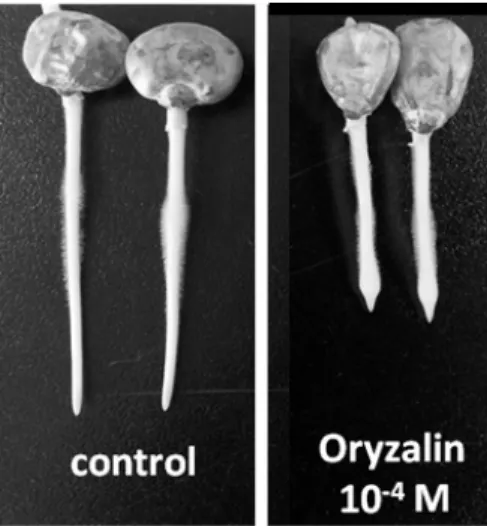
The application of oryzalin for 15 hr caused root tip swel-
ling (Fig. 2). This result suggested that oryzalin may cause
the accumulation of auxin in the root tip via inhibiting the
distribution on the plasma membrane of the auxin efflux car-
rier such as PIN complex, and oryzalin might reduce the
difference of indole-3-acetic acid (IAA) distribution between
upper and lower side of root resulting in the inhibition of
gravitropic response. The gravity signal is passed from root
cap to the elongation zone where asymmetric auxin dis-
tribution is established which induces curvature as a result
of differential growth in horizontally-oriented root [2]. To
examine the possibility of the role of oryzalin in the gravi-
Table 2. Effect of oryzalin on the gravitropic response in the 10
-4M IAA-pretreated roots at 4 hr and 8 hr
(unit: degree)
4 hr 8 hr
+ - + -
control 10
-4M oryzalin
40±5.93 28±5.50
68±2.94 43±3.63
53±1.96 32±4.16
68±1.52 46±2.00 (+: pretreated with IAA; - without IAA)
Fig. 2. Morphology of vertically-grown roots treated for 15 hr with 10
-4M oryzalin. Swelling in oryzalin-treated roots occurred in the root tip.
Time (hr)
0 2 4 6 8
Curvature (degree)
0 10 20 30 40 50 60
Control 10-6 M Oryzalin 10-4 M Oryzalin
Time (hr)
0 2 4 6 8
Curvature (degree)
0 20 40 60 80
Control 10-6 M Oryzalin 10-4 M Oryzalin
A B
Fig. 3. Effect of oryzalin on the gravitropic response in the root tip (A) and elongation zone (B) for 8 hr. Oryzalin was applied to the root tip or elongation zone using an agar block (0.6%, 1 mm
3). The gravitropic response was measured for 8 hr after treatment. Bars are mean values ± SE from 4 independent experiments.
tropic response, we applied the oryzalin to the root tip which may affect the IAA redistribution in the elongation zone when roots perceive gravity.
Effects of oryzalin on the gravitropic response Application of oryzalin to the tip region inhibited the gravitropic response at concentrations of 10
-6M and 10
-4M after 4 hr while inhibiting root growth (Fig. 3A). Especially, the gravitropic response was inhibited 17% and 42% of con- trol by the treatment of 10
-6M and 10
-4M oryzalin respectively. However, the treatment of oryzalin to the elon- gation zone did not affect the gravitropic response (Fig. 3B).
According to the Fig. 3B, 10
-4M oryzalin inhibited 14% of control in gravitropic response at 4 hr, and this inhibition
became disappeared at 8 hr. These results showed that both gravitropic response and root growth were inhibited by the application of oryzalin to the root tip rather than to the elon- gation zone.
Gravitropic response in roots results from differential growth between upper and lower side of roots in horizontal position. The gravity is transduced form the root tip to the elongation zone resulting in differential growth. It has been known that different distribution of IAA cause the differ- ential growth in horizontal root [12]. Roots, unlike stem, are sensitive to IAA, so higher concentration of IAA in the lower side results in inhibition of elongation [11]. Therefore, IAA is one of the major factors to induce the differential elonga- tion during the gravitropism curvature [10]. According to the Fig. 2 and Fig. 3A, oryzalin might reduce the difference of IAA amount between upper and lower side of root.
In order to examine the relationship between oryzalin and
IAA, roots were pre-treated with 10
-4M IAA solution for
1 hr vertically, and then oryzalin applied to the root tip us-
ing an agar block. In Table 2, oryzalin inhibited 30% and
37% of control in gravitropic response in roots pre-treated
with IAA and roots without IAA at 4 hr, respectively. At
Time (hr)
0 2 4 6 8
Curvature (degree)
0 20 40 60 80 100
Control 10-6 M ACC 10-4 M ACC
Fig. 4. Effect of ACC on the gravitropic response in the root tip for 8 hr. ACC was applied to the root tip using an agar block (0.6%, 1 mm
3). The gravitropic response was measured for 8 hr after treatment. Bars are mean values
± SE from 4 independent experiments.
Time (hr)
2 4 6 8
Ethylene production (μl/g)
0.0 0.5 1.0 1.5 2.0 2.5
Control 10-6 M Oryzalin 10-4 M Oryzalin
Fig. 5. Effect of oryzalin on the ethylene production in the root segments for 8 hr. Root segments were incubated for 4 hr in solution containing 10
-6M and 10
-4M oryzalin. At every 2 hr, 1 ml of gas sample was withdrawn from the vials for measuring ethylene production. Symbols are mean values ± SE from 3 independent experiments.
8 hr, oryzalin showed more inhibition in IAA pre-treated roots such as 40% of control. This result means that oryzalin in the root tip might reduce the difference of IAA amount in the elongation zone between upper and lower side of root, resulting in the inhibition of gravitropic response. This data suggests that oryzalin might play a role on the IAA redis- tribution in the elongation zone when the root perceived the gravity in the root tip.
It has been reported that ethylene inhibits the elongation of stem and roots [17]. Inhibition of root elongation by IAA can be reversed by the treatment of the tissue with ethylene antagonists [5]. Lee et al. [7] suggested that ethylene may modify positive curvature in the primary roots of maize by affecting gravity induced-lateral auxin transport. Kim et al.
[6] suggested that an optimal concentration of ethylene might be required for the regulation of gravitropism in maize roots. Yuan et al. [20] reported that cortical micro- tubule reoriented in wounding stem in pea from transverse to vertical orientation. It is well known that wounding in plants induce the ethylene production to protect them [1].
To examine the effect of ethylene in the gravitropism in roots, we measured the curvature in application of 1-amino- cycloprpane-1-carboxylic acid (ACC), a precursor of ethyl- ene, to the root tip using an agar block (Fig. 4). The curva- ture was inhibited about 30% of control in roots treated with 10
-4M ACC at 4 hr. However, ACC application to the elon- gation zone did not inhibit the gravitropic curvature (data not shown). And we measured modification of ethylene pro- duction in the presence of oryzalin. These data may provide
insight into the inhibition of growth and gravicurvature in the elongation zone by oryzalin.
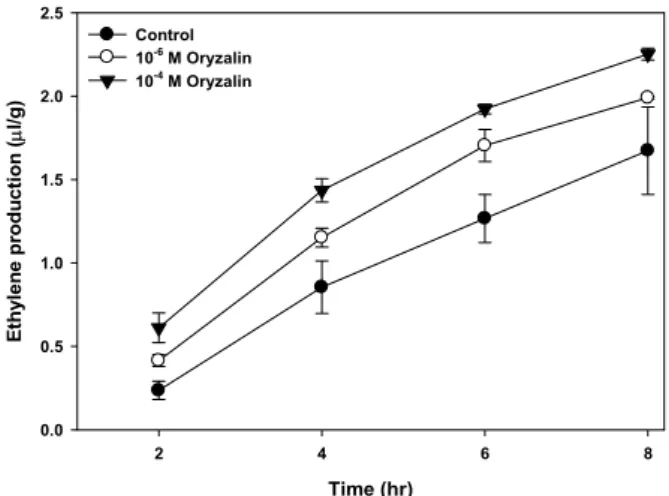
Effect of oryzalin on the ethylene production External application of oryzalin stimulated the ethylene production in the concentration of 10
-6M and 10
-4M oryzalin for 8 hr (Fig. 5). The treatment of 10
-4M oryzalin increased about 60% of control at 8 hr. Typically, ethylene affects the growth pattern of plants by reducing the rate of elongation and increasing lateral expansion, leading to swelling of the tissue and modifying the gravitropic response [1]. Thus, the inhibition of growth and gravicurvature by oryzalin applied to the root tip may be due to the reorientation of microtubule in elongation zone. Additionally, the more inhibition of cur- vature by in combination with IAA (Table 2) could be related to the modification of gravity-induced lateral auxin transport in the root by ethylene. Ruzicka et al. [13] reported that eth- ylene stimulated auxin biosynthesis and increased the ca- pacity of auxin transport by regulating the transcription of auxin transport components such as AUX1 and PIN2. The increase in auxin production due to ethylene could alter re- distribution of auxin, by polar auxin transport, from root cap to the elongation zone via outer cell layer, to the elonga- tion zone where auxin could inhibit cell elongation.
Recently, Ma and Ren [8] reported during the germination
of flax, the gravitropic response of the flax root becomes
weaker due to a decrease in auxin sensitivity and decrease
in auxin transport regulated by ethylene. Therefore, stim-
Oryzalin (-log M)
∞ 6 4
ACSactivity (μl/ethylene production hr-1mg-1)
0 1 2 3 4 5
ACO activity(μl/ethylene production hr-1mg-1)
0.0 0.2 0.4 0.6 0.8 1.0 1.2 1.4 ACS
ACO Col 4 Col 6
0 10-6 10-4