T.-D. Kim ・ Y.-S. Kim ・ J.-Y. Han ・ S. Lim ・ Y.-E. Choi ( ) 강원대학교 산림환경과학대학 산림자원학부
(Division of Forest Resources, College of Forest an Environmental Sciences, Kangwon National University, Chunchon 200-701, Korea)
e-mail: [email protected]
인삼 사포닌 생산을 위한 대사공학
김태동 ・ 김윤수 ・ 한정연 ・ 임순 ・ 최용의
Metabolic engineering for production of ginsenosides in Panax ginseng
Tae-Dong Kim ・ Yun-Soo Kim ・ Jung-Yeon Han ・ Soon Lim ・ Yong-Eui Choi
Received: 24 November 2009 / Accepted: 1 December 2009
ⓒKorean Society for Plant Biotechnology
Abstract Panax ginseng roots produce triterpene saponins called ginsenosides, which are high value secondary metab- olites and has been used as drugs, detergents, sweeteners, and cosmetics. In the recent years plant cell, tissue and organ cultures have developed as important alternative sources for the saponin production in Panax ginseng. Adventitious roots and hairy roots have been successfully induced and cultured for the improvement of saponin contents. Genetic and met- abolic engineering to regulate saponin biosynthesis in P.
ginseng might be important way to improve the medicinal values of P. ginseng. Here we introduced the protocol of genetic transformation and recent progress of functional characterization of genes involved in saponin biosynthesis in P. ginseng.
Keywords genetic transformation, isoprenoid pathway, Panax ginseng C.A. Meyer, saponin, triterpene
서 론
인삼 (Panax ginseng C.A. Meyer)은 두릅나무과 (Araliaceae) 에 속하는 다년생 초본 식물이며, 동양의학에서 대표적 으로 다루어지는 약재들 가운데 가장 널리 이용되고 있 다. 특히, 인삼의 뿌리는 면역체계의 조절, 항스트레스 작 용, 항암작용, 항당뇨작용 등과 같은 약리효과가 있는 것 으로 현대의학을 통해서 밝혀졌다 (Vogler et al. 1999; Shibata
2001; Yun 2001; Dey et al. 2003; Kiefer and Pantuso 2003).
또한 이러한 약리효과를 가진 인삼은 한국, 중국, 대만, 홍콩 및 일본을 포함한 아시아 지역뿐 만 아니라 최근에 는 인간의 삶의 질 (Quality of life, QOL)을 높이는 효과가 있다고 알려져 유럽 및 북아메리카 (미국, 캐나다) 지역 에서도 다양한 형태의 건강보조식품으로 판매되고 있다 (Ellis and Reddy 2002; Coleman et al. 2003).
인삼의 대표적 약리효과는 triterpenoid계 화합물인 진 세노사이드 (ginsenoside)에 의해서 나타나는 것으로 알려 지고 있으며, 지금까지 약 30 종류의 다양한 진세노사이 드가 인삼 및 인삼 가공품으로부터 분리되었다 (Shibata 2001). 다양한 스펙트럼을 가진 진세노사이드는 각기 다 른 화학적 구조를 가지고 있으며, 임상실험을 통하여 각 각의 진세노사이드는 각기 다른 약리효과를 나타내는 것 으로 알려졌다 (Shibata 2001; Kiefer and Pantuso 2003). 인 삼의 주요 생리활성 성분으로는 진세노사이드 이외에도 페놀성 성분, 폴리아세틸렌 성분, 알칼로이드 성분, 다당 체 등이 알려져 있으며(Park et al. 2003), 이들은 항암, 항 산화, 지질과산화 억제 등의 생리활성을 갖는 것으로 알 려져 있다 (Hwang et al. 1996; Choi et al. 2003; Han et al.
1985; Lim et al. 2005). 이러한 인삼의 약리학적인 연구결 과들은 인삼 사포닌 성분인 진세노사이드에 대한 관심을 증대시켰으며, 그들의 대량생산에 대한 필요성이 대두되 었다. 그러나 일반적 경작방법을 통하여 인삼의 유용물 질을 대량생산하는 것은 4-6년의 오랜 재배기간, 차광재 배에 의한 병충해 방제의 어려움, 윤작재배 등과 같은 문 제점을 포함하고 있기 때문에 새로운 대체생산방법에 대 한 개발이 절실히 요구되고 있다. 또한, 야생유전자원인 산삼의 무분별한 채취로 인해 유전자원 (germplasm)을 이 미 잃어버린 상태에 있는 인삼의 육종에 있어서도 새로 운 대체기술의 개발이 필요하다 (Kwon et al. 2000).
인삼으로부터 유용성분을 대량생산할 수 있는 대체수 DOI:10.5010/JPB.2009.36.4.352
Review
단으로써 식물 조직배양 기술은 매력적인 요소들을 가지 고 있다. 예를 들면, 재배방법에 비교하여 짧은 기간에 기내배양을 통하여 자식세대를 얻을 수 있어 육종 기간을 앞당길 수 있을 것이며, 체세포배 (somatic embryos), 부정 근 (adventitious root) 및 모상근 (hairy root)과 같은 특수화 된 조직을 유도하여 대량배양함으로써 특정 성분을 악천 후와 병충해 같은 환경적 제약없이 안정적으로 생산할 수 있다 (Lee et al. 1995; Choi et al. 1997; Choi et al. 2000;
Yoshikawa and Furuya 1987). 또한, 조직배양을 기반으로 한 형질전환 기술 (transfomation technolgy)은 다양한 유용 유전자의 도입을 통하여 인삼의 육종뿐만 아니라 대사물 질의 함량을 임의로 조절 할 수 있는 대사조절 공학 (metabolic engineering)을 가능하게 할 수 있다.
최근 인삼의 유용성분 (특히, 인삼 사포닌)에 대한 대 사공학을 연구하는 그룹들은 진세노사이드 (ginsenoside) 와 파이토스테롤 (phytosterol)의 생합성에 관련된 다양한 유전자를 발굴하였고, 발굴된 유전자들의 특성에 대한 결과를 발표하였다. 그러한 결과들은 발굴된 유전자들의 일부가 인삼의 사포닌과 파이토스테롤의 생산에 상당히 관련되어 있다는 것을 보여주었다 (Lee et al. 2004; Tansakul et al. 2006; Han et al. 2006; Han et al. 2009). 본 총설은 인 삼으로부터 유용성분을 대량생산하기 위한 생물공학의 기반기술인 조직배양 및 형질전환 기술에 대한 전반적인 발전 내용을 포함하며, 이러한 기반 기술을 이용한 최근 의 대사조절공학 연구결과들을 바탕으로 향후 인삼의 대 사조절 공학의 방향을 제시하고자 한다.
대사조절 공학을 위한 기반기술의 개발
식물을 이용한 대사공학은 다양한 기반기술을 필요로 한다. 우선, 특정한 형질을 암호화하는 유전자를 식물체 내로 도입시키기 위해서 식물의 다양한 절편체로부터 식 물체 또는 일부 기관을 재분화할 수 있는 조직배양 기술 이 확립되어야 한다. 그 다음으로, 암호화하는 유전자가 포함된 벡터를 성공적으로 식물체내로 전달할 수 있는 유전자 도입기술이 필요하다. 이러한 유전자의 도입을 위한 방법으로 유전자총 (gene gun 또는 paticle bombardment;
Janick 2007)을 이용하거나 매개체로 Agrobacteriom 균주 를 사용하여 식물체 재분화과정과 유전자 도입 과정을 거쳐 형질전환체를 개발할 수 있다. 인삼의 경우, 최초의 조직배양은 1983년 Furuya에 의해 보고되었으며, 그들은 인삼의 엽병에 2,4-dichlorophenoxyacetic acid (2,4-D)를 처 리하여 유도된 캘러스를 배양하여 인삼 사포닌을 생산하 였다 (Furuya et al. 1983). 그 이후로 Furuya 그룹은 캘러스 에 Agrobacterium rhizogenes를 감염시켜 모상근을 성공적 으로 유도하여 인삼 사포닌을 생산하였다 (Yoshikawa and
Furuya 1987). 인삼에서 모상근 배양이 성공적으로 보고 된 후, Choi 등 (2000)은 인삼의 캘러스로부터 모상근과 유사한 부정근 (hairy-like root)을 유도하여 사포닌을 생산 할 수 있다고 보고하였다. 이러한 부정근은 생장조절물 질에 의존한 생장 (plant growth regulator-dependent growth) 을 하기 때문에 다양한 생장조절제를 이용한 생장 및 사 포닌 함량 패턴을 조절할 수 장점을 가지고 있다. 이렇게 다양한 방법에 의해 유도된 재분화체 (regenerants)들을 이 용한 형질전환 방법도 여러 그룹에서 연구가 진행되었다 (Lee et al. 1995; Yang and Choi 2000; Chen and Punza 2002;
Lin et al. 1995; Choi et al. 2003; Han and Choi 2009).
식물체 재분화 기술
재조합 DNA기술을 이용하여 유용 유전자가 도입된 형 질전환 인삼을 개발하는 것은 미래 인삼산업이 한 단계 더 발전할 수 있는 계기가 될 수 있다. 특히 전체의 사포 닌 함량이 증가되거나 특정 사포닌이 강화된 인삼 식물 체를 생산하는 것은 인삼 육종에 매우 중요하다. 일반적 으로 인삼은 조직 배양체로부터 식물체를 분화시키는 것 이 어려운 것으로 알려져 있다. 주된 요인은 배양된 인삼 조직 유래의 재분화체로부터 뿌리가 형성되지 않거나 식 물체 생장을 위해 필요한 뿌리가 충분하게 형성되지 않 는다는 것이다 (Butenco et al. 1968; Chang and Hsing 1980, Shoyama et al. 1988; Arya et al. 1991). 따라서 재분화 시스 템 확립은 형질전환 식물체를 생산하는 데 있어서 대단 히 중요한 요소이다. 이러한 문제를 극복하기 위해서 체 세포배발생에 의한 식물체 재분화에 대한 연구가 보고된 바 있다. 캘러스 (Butenco et al. 1968; Chang and Hsing 1980) 및 자엽절편체 (Choi and Soh 1997; Choi et al. 1998abc, 1999ab)로부터 유기된 체세포배는 뿌리와 줄기가 잘 발 달된 정상적인 식물체로 분화되었다. Choi 등 (2001, 2003) 은 인삼 형질전환 식물체를 효과적으로 생산하기 위해서 자엽유래 배발생 캘러스를 이용하여 체세포배를 유도하 는 것이 이상적이지만, 자엽절편도 무난히 배양재료로 사용할 수 있고 배발생 캘러스 및 체세포배를 유도하기 위한 가장 적절한 재료 중에 하나라고 보고하였다. 수확 후 인삼 종자 내 접합자배는 아주 미숙하기 때문에 접합 자배를 배양재료로 이용하기 위해서는 수개월간 저온 침 적 (moist-chilling treatment)처리를 하여 접합자배가 약 5 mm 크기로 자란 후 이를 배양재료로 사용해야 한다 (Kuribayashi and Ohashi 1971).
인삼은 다년생 식물로서 생육속도가 매우 느리다. 이 러한 특성으로 인해 기내 (in vitro)에서 형질전환 식물체 를 선발하고 증식하기까지 장시간이 소요된다. 이것은 단기간에 사포닌의 고 생산과 생합성 관련 유전자의 기 능분석 및 발현조절에 대한 연구가 신속하게 이루어지기
어려운 요인이 될 수 있다. 반면에 부정근 (adventitious root)은 indole-3-butyric acid (IBA)나 naphthalene acetic acid (NAA)와 같은 생장조절제만으로도 증식율이 높고 (Kevers et al. 1999; Choi et al. 2000), 증식을 위해 사용된 옥신 (IBA 또는 NAA) 이나 쟈스모네이트 (jasmonic acid 또는 methyl jasmonate)와 같은 phytohormone 처리에 의한 생장 촉진 (Kim et al. 2004) 및 이차대사산물의 합성조절 (Yu et al. 2002; Kim et al. 2004)이 가능하기 때문에 형질전환 체의 라인선발 및 증식에 있어서 식물체를 이용하는 것 에 비해 용이하다. 따라서 형질전환 부정근을 이용한 대 사공학적 연구에 효과적으로 이용될 수 있는 장점을 가 지고 있다 (Lee et al. 2004; Han et al. 2006; Han and Choi 2009). 또한 생물반응기 배양기술을 이용한 부정근의 대 량증식이 가능하기 때문에 부정근 형질전환체는 사포닌 을 대량생산하기 위한 유용한 방법이라고 생각된다 (Yu et al. 2002).
Agrobacterium에 의한 형질전환
모상근은 A. rhizogenes가 감염된 숙주식물의 genome내 로 Ri-plasmid의 T-DNA가 도입되어 감염부위에서 형성된 다 (Chilton et al. 1982). A. rhizogenes에 의하여 형질전환된 모상근은 유전적인 측면과 생화학적인 측면 모두에서 매 우 안정적이며 물질 함유량 및 성분 조성이 모식물체 (donor plants)와 비교해서 동일하거나 오히려 높은 경우 도 있어 대부분 식물로부터 2차 대사산물의 획득에 좋은 재료로 활용되고 있다 (Lee et al. 1994; Shanks and Morgan 1999; Giri and Narasu 2000). 모상근은 외부에서 식물호르 몬의 공급이 없이도 활발하게 생장하며, 어떤 식물 종 (species)에 있어서는 개체의 분화가 자발적으로 또는 적 절한 생장 호르몬의 첨가에 의해 일어난다 (Ramsay and Kumar 1990). 인삼의 경우에도 모상근은 캘러스 또는 배 양세포보다 사포닌의 함량이 더욱 높게 나타났다 (Furuya et al. 1984; Yoshikawa and Furuya 1987). 인삼 모상근은 캘 러스 및 식물체의 뿌리, 잎, 줄기 절편체에 A. rhizogenes 을 접종하여 유도되었다 (Yoshikawa and Furuya 1987; Ko et al. 1990; Hwang et al. 1991; Ko et al. 1993; Lee et al.
1994; Yu et al. 2002). 다양한 절편체로부터 유도된 모상 근은 지속적인 선발과정을 통하여 선발되지 않은 모상근 에 비하여 약 4-5배 이상의 인삼 사포닌을 생산할 수 있 는 것으로 보고되었다 (Woo et al. 2004). 게다가 모상근은 biotic elicitation (yeast or bacteria extract) 과 abiotic elicitation (salicylic acid, jasmonic acid, or methyl jasmonate)에 의하여 인삼 사포닌을 포함한 다양한 2차 대사산물의 함량을 증 가시킬 수 있는 것으로 보고되었다 (Yu et al. 2000; Jeong et al. 2005; Kim et al. 2005). 또한 모상근에 elicitaton과 같 은 지속적 자극은 모상근이 자발적으로 순화 (habituation)
될 수 있는 능력을 가지고 있다 (Hoffmann and Hoffmann- Tsay 1994; Zheng and Wu 2004; Agostini et al. 1997). 따라 서, 최근 Yang과 Choi (2000)에 의해 개발된 인삼 모상근 으로부터 유도된 캘러스에서 식물체를 재분화하는 기술 은 새로운 형질을 획득한 식물체를 단기간에 생산할 수 있어 향후 분자육종을 위해 유용한 기술로 평가된다.
A. tumefaciens를 통한 최초의 인삼 형질전환 식물체 개 발은 Lee 등(1995)에 의해 시도되었다. 이때 도입된 유전 자는 A. tumefaciens strain LBA4404를 매개한 β-glucuronidase (GUS) 유전자이며, 인삼 자엽에 공동배양한 다음 체세포 배를 유도하여 식물체를 재생시켰다. 그 후 A. rhizogenes 에 의해 유도된 모상근으로부터 체세포배발생을 유도하 여 식물체를 얻었는데, 이 경우 형질전환 인삼 식물체의 뿌리가 빨리 자라는 특성을 보고하였다 (Yang and Choi 2000). 이러한 A. tumefaciens를 체세포배에 감염시켜 형질 전환 식물체를 유도하는 기술은 최근에는 제초제 저항 식물체의 생산을 가능하게 하였다. Choi 등 (2003)은 A.
tumefaciens을 이용하여제초제 저항성 유전자 (phosphino- thrichin acetyl transferase, PAT)를 인삼 체세포배에 도입하 여 basta 처리 하에서도 피해를 받지 않고 정상적인 생육 을 하는 제초제 내성 형질전환 식물체를 개발하였다 (Choi et al. 2003). 또한 이 연구에서 A. tumefaciens의 감염시 인 삼 배발생 캘러스를 0.5 M sucrose 또는 0.5 M MgSO4에서 30분 동안 전처리하면 β-glucuronidase (GUS) 유전자의 도 입이 현저히 증가됨을 보여 주었다 (Choi et al. 2003). 이 와 같이 형질전환 효율에 관여하는 요인은 배지내 첨가 하는 성분에 따라 영향을 받는다. 2001년 Choi 등에 의해 보고된 연구결과에서도 인삼의 신속하고 효과적인 형질 전환을 위해서 자엽절편체를 1.0 M sucrose로 plasmolyzing 처리되었을 때 β-glucuronidase (GUS) 유전자의 발현이 A.
tumefaciens와 공동배양 한 이후에 강하게 나타났음을 보 여주었다 (Choi et al. 2001). 캐나다의 한 연구그룹은 American ginseng (P. quinquefolius)에 rice chitinase gene을 A. tumefaciens LBA4404을 이용하여 도입한 결과, 도입된 유전자에 의하여 인삼의 잎집무늬마름병 (sheath blight)에 대한 저항성이 증가하는 것을 보고하였다 (Chen and Punja 2002). 최근 Han과 Choi (2009)는 A. tumefaciens를 이용하 여 체세포배발생에 의해 얻어진 기내 유묘의 뿌리 절편 체로부터 부정근 형질전환체를 직접 신속하게 얻을 수 있 는 방법을 고안하였다. 이러한 기술은 인삼 대사공학에 서 부정근의 중요성을 더욱 증가시키는 결과가 될 것 이 다. 지금까지 부정근은 인삼의 주요 이차대사산물을 대 량생산하기 위한 가장 이상적인 시스템으로 알려져 있 다. 예를 들면, 진세노사이드 합성에 관련된 다양한 유전 자들이 형질전환 식물체에서 유래된 부정근에서 성공적 으로 발현이 되었고 최종적으로 진세노사이드 함량을 조 절하였다 (Lee et al. 2004; Han et al. 2006; Han et al. 2009).
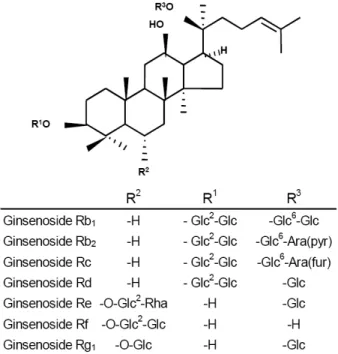
Fig. 1 Structure of triterpene aglycon and assembling of sugar molecules for final ginseonside production of Panax ginseng 또한, 부정근을 이용한 생물반응기 시스템이 확립되어 대량생산이 산업적으로 생산이 이루어지고 있다 (Hahn et al. 2004; Kim et al. 2005). 따라서 Han과 Choi (2009)의 방법을 이용하여 신속하게 진세노사이드 합성관련 유전 자가 들어간 부정근을 유도할 수 있다면 아직 기능이 밝 혀지지 않은 인삼 생합성관련 유전자의 기능분석을 위하 여 유용한 기술적 도구 (technical tool) 를 제공하는 것임 에 의심할 여지가 없다.
진세노사이드 대사공학
인삼의 사포닌 생합성에 관련된 유전자의 발굴 및 기 능의 분석은 인삼 생물공학 기술에 있어서 가장 기본적 이며 중요한 분야이다. 이러한 기본적인 지식을 기반으 로 유전공학 (genetic engineering)과 대사공학 (metabolic en- gineering)을 이용하여 유전자 도입을 통해 전체의 사포닌 이 강화되거나 특정 사포닌이 강화된 인삼 식물체의 개 발을 기대할 수 있다. 최근 우리는 인삼 triterpene 사포닌 및 phytosterol 합성에 관여된 squalene synthase (PgSS1) 유 전자를 인삼에 과잉발현시켰을 경우 triterpene 및 phytosterol 생합성이 증대된 인삼을 개발하였으며 (Lee et al. 2004), squalene epoxidase (PgSQE1 and PgSQE2)은 인삼 사포닌과 phytosterol의 분기점에서 중요한 전구체로 알려진 2,3- oxidosqualene 합성에 관련된 기능을 하는 유전자인 것을 확인하였다 (Han et al. 2009). 또한 dammarenediol synthase (DDS) 유전자가 knock-out된 형질전환 식물체을 이용하여
DDS 유전자가 dammarene-type triterpene 합성에 관련된 유 전자라는 것을 확인하였다 (Han et al. 2006).
진세노사이드 생합성
인삼의 뿌리에는 여러 가지 유효한 2차대사물이 축적 되어 있는데, 진세노사이드는 triterpenoid 사포닌으로서 인삼의 약효를 내는 대표적 물질이다. 진세노사이드는 인삼속 (Panax species) 식물들의 뿌리 (root)와 뿌리줄기 (rhizome)에서 유래된 주요 생리활성 물질로 여겨진다.
Triterpenoid는 광범위한 구조적 다양성과 생물학적 활성 을 가지고 있으며, 이러한 saponin은 약제, 세제, 감미료 그리고 화장품에 이용되면서 경제적으로 중요하게 여겨 지고 있다 (Hostettmann and Marston 1995). 인삼에는 30여 종의 진세노사이드가 있는 것으로 밝혀져 있고 (Shibata 2001), 각각의 진세노사이드 함량은 종 (species)에 따라 상당히 다르게 분포되어 있다. P. ginseng의 뿌리에는 최 소한 7종의 triterpenoid 사포닌 (건중량 약 5%; Shibata 2001)이 포함되어 있는 것으로 알려져 있으며, 그 밖에 다양한 phytosterol이 포함되어 있는 것으로 알려져 있다 (Matsumoto et al. 1986). 인삼의 주요 진세노사이드는 gin- senosides Rb1, Rb2, Rc, Rd, Re, Rf, Rg1과 같은 triterpenoid 사포닌이다. 각각의 진세노사이드는 항스트레스 활성, 항당료 활성, 항염증작용, 노화방지작용, 항암작용과 같 이 서로 다른 약리작용을 가지고 있는 것으로 보고되어 있다 (Shibata 2001; Kiefer and Pantuso 2003). 4환상의 dammarene- type과 5환상의 olanane-type의 triterpene 사포닌은 인삼뿌 리에서 생산되며, 대부분의 triterpene은 dammarene-type의 4환상의 골격을 가지고 있다 (Kushiro et al. 1997). Dammarene- type의 triterpene은 단지 P. ginseng (Kushiro et al. 1997)과 Gynostemma pentaphyllum (Cui et al. 1999)과 같은 일부 수 종에서만 확인되었다.
Triterpene과 sterol 생합성은 C5 isoprenoid 경로 (isoprenoid pathway)에 의해서 이루어지고 있다. Mevalonate는 sterol 과 triterpene 생합성을 위한 공통적 전구체이다 (Kuzuyama 2002). Squalene synthase는 sterol과 triterpenoid 생합성을 위 한 isoprenoid 경로의 첫 번째 단계로서 farnesyl diphosphate 로부터 squalene을 합성 촉매하는 효소이다 (Abe et al.
1993). 그리고 squalene은 squalene epoxidase의 산소화 촉매 작용 (oxygenation)에 의하여 2,3-oxidosqualene를 합성한다.
식물 중 phytosterol과 triterpene은 oxidosqualene cyclases (OSCs)의 촉매작용에 의해 2,3-oxidosqualene의 고리화 반 응(cyclization)의 생성물을 경유해서 합성된다 (Fig. 2). 이 단계에서 진세노사이드의 전구체인 dammarene-type의 4 환상의 골격을 형성하는 dammarenediol과 oleanane-type의 β-amyrin이 합성된다. Kushiro 등 (1998)은 OSC를 암호화 하는 여러 가지 유전자들을 분리하였으며, 이러한 유전
Fig. 2 The biosynthetic pathway of triterpenes in P. ginseng
자들은 서로 상동성이 높게 나타났다.
중간 생성물인 dammarenediol과 β-amyrin은 일련의 수 산화 (hydroxylation) 반응과 당화 (glycosidation) 반응을 통 해 진세노사이드로 변환된다. 진세노사이드 골격의 수산 화 반응에는 cytochrome P450s 효소가, 당화반응에는 glycosy- ltransferase가 관여할 것으로 여겨지고 있다. cytochrome P450은 protopanaxdiol의 6번 탄소 위치에서 수산화반응에 관여하며, 그 결과 protopanaxatriol이 된다 (Shibuya et al.
2006). Glycosyltransferase는 protopanaxdiol type의 3번 및 20 번 탄소와 protopanxatriol type의 6번 및 20번 탄소의 수산 기 (hydroxyl group)에서 당화반응에 관여한다 (Kushiro et al. 1997; Kushiro et al. 1998; Haralampidis et al. 2001; Choi et al. 2005).
사포닌 생합성 유전자의 기능 분석
인삼 사포닌 생합성에 관련된 유전자들을 발굴하고 기 능을 분석하는 작업들은 인삼의 대사공학을 연구하는데 있어서 매우 중요한 위치를 차지하고 있으며, 사포닌 함 량이 증가된 식물체 개발을 촉진시킬 수 있다. 따라서 최 근 인삼의 대사공학을 연구하는 많은 연구그룹들은 인삼 사포닌 생합성에 관련된 후보 유전자들을 확보하기 위하 여 다양한 방법을 이용하고 있다. Choi 등 (2005)은 methyl jasmonate를 처리한 모상근으로부터 얻은 cDNA을 이용하 여 expressed sequance tag (EST) 분석을 한 결과, 3,134 ESTs 를 확보하여 EST databases (dbEST)와 GeneBank databases 에 등록을 하였다. 이러한 EST분석 결과를 통하여 인삼
사포닌의 생합성에 관련될 가능성이 있는 OSCs, cytochrome P450, glycosyltransferase 등의 다양한 후보유전자들 (candidate genes)을 확보하였고, 현재 여러 연구그룹에서 이들의 기 능분석에 대한 연구를 진행 중에 있는 것으로 알려져 있 다. 또한, Nam 등 (2005)은 EST 분석이외에 protemics 분석 을 이용하여 인삼 사포닌 생합성에 대한 기능을 연구한 결과도 보고하였다. 최근 우리 연구그룹은 methyl jasmonate 를 처리한 부정근을 이용하여 4,226개의 ESTs를 확보하 였으며, 최종적으로 8개의 cytochrome P450 hydroxylase 후 보유전자와 5개의 glycosyltransferase 후보유전자들을 새 롭게 분리하여 현재 기능분석을 위한 실험을 진행 중에 있다.
인삼의 재분화체를 이용하여 사포닌 생합성관련 유전 자의 기능을 분석한 최초의 결과는 2004년 Lee 등에 의해 서 보고하였다. Lee 등 (2004)은 phytosterol과 triterpenoid의 생합성에 대한 squalene synthase (PgSS1)의 역할을 조사하 였다. 인삼의 형질전환 부정근의 PgSS1 유전자 과잉발현 은 squalene epoxidase, β-amyrin synthase와 cycloartenol syn- thase와 같은 downstream 유전자들의 up-regulation을 초래 하였다. 또한 인삼 형질전환체는 phytosterol (β-sitosterol, stigmasterol, campesterol)과 triterpene saponins (ginsenosides) 의 생산을 현저하게 증가시켰다.
Squalene synthase의 촉매반응에 이어지는 산소화 반응 은 squalene epoxidase가 촉매를 한다. 이 효소는 속도제한 효소 (rate-limiting enzyme)로서 2,3-oxidosqualene를 합성를 촉매하는 것으로 잘 알려져 있다. 최근 이 효소를 암호화 하는 유전자들을 이용하여 이들의 기능을 분석한 결과가
발표되었다. Han 등 (2009)은 두 개의 squalene epoxidase 유전자를 분리하였고, 각각 PgSQE1, PgSQE2로 명명하였 다. 이들 유전자들은 83%의 상동성을 가지고 있으며, N-terminal 영역에서의 상당한 아미노산의 차이를 나타내 고 있다. 이러한 차이는 인삼의 RNA 간섭 (RNAi) 재분화 체에서 두 유전자간의 기능에 많은 차이를 야기시키는 것으로 나타났다. PgSQE1의 경우 진세노사이드의 합성 을 조절하는 기능을 보이는 것으로 나타낸 반면에 PgSQE2 는 파이토스테롤합성에 관여하는 것으로 나타났다.
Oxidosqualene cyclase (OSC)에 대한 연구결과는 최근에 일본과 한국의 연구그룹에서 동시에 발표되었다. OSC를 암호화하는 유전자들 중에 dammarenediol synthase는 2,3- oxidosqualene을 고리화하여 dammarenediol II를 합성하는 데 중요한 역할을 하는 촉매제로 알려져 있다. Han 등 (2006)과 Tansakul 등 (2006)은 ginsenoside의 생합성에 관 련된 dammarenediol synthase (DDS) 유전자의 기능을 분석 하였다. 이들은 lanosterol synthase가 결여된 erg7 yeast mutant 에 DDS를 발현시킴으로써 dammarenediol이 합성됨을 보 여주였다. 또한, Han 등 (2006)은 RNA 간섭 (RNAi)으로 인해 dammarenediol synthase (DDS) 유전자 발현의 침묵 (silencing)을 초래하여 결국 인삼 뿌리의 ginsenoside 생산 이 84.5%로 감소됨을 보여주었다. 이러한 결과를 통해 DDS는 ginsenoside 생합성의 중요한 효소로 간주되며, DDS를 암호화하는 유전자의 과잉 발현을 통해 사포닌 생산을 증가시킬 수 있다는 가능성을 제시하였다.
최근 dammarenediol과 β-amyrin의 수산화 (hydroxylation) 반응과 당화 (glycosidation) 반응에 대한 연구결과가 P.
notoginseng에서 보고되었다. Yue and Zhong (2005)은 ginseno- side Rd의 당화에 관련된 UDPG:ginsenoside Rd glucosy- ltranseferse를 분리하여 ginsenoside Rd로부터 ginsenoside Rb1 을 합성하는데 성공하였으며, protopanaxdiol로부터 proto- panaxatriol을 합성하는데 관여하는 수산화효소 중 하나인 protopanaxdiol 6 hydroxylase (P6H)를 분리하여 protopanaxatriol 의 함량이 증가됨을 보여주었다 (Yue et al. 2008). 이들은 일련의 수산화 반응과 당화 반응을 통하여 ginsenoside heterogenity를 임으로 조절할 수 있을 것으로 보고하였다 (Wang and Zhong 2002). 또한 이러한 결과들은 현재 우리 가 EST로부터 분리한 glycosyltransferase 후보유전자와 cy- tochrome P450s 후보유전자가 다양한 ginsenoside 합성과 heterogenity에 중요한 역할을 할 수 있다는 것을 보여주 고 있다.
결 론
지난 20여 년간 인삼의 사포닌 생산성 향상 및 생합성 관련 유전자 발굴을 위한 연구에 많은 진전이 있었다. 모
상근 및 부정근 배양은 인삼사포닌을 효과적으로 다량 생산할 수 있는 육종기술로 제시되고 있다. 또한 대사공 학을 이용하여 유전자 도입을 통해 사포닌 생합성을 촉 진함으로써 전체의 사포닌이 강화되거나 특정 사포닌이 강화된 인삼 식물체의 개발을 기대할 수 있다.
실제적으로 인삼 triterpene 사포닌 및 phytosterol 합성에 관여된 squalene synthase (PgSS1) 유전자를 인삼에 과잉발 현시켰을 경우 triterpene 및 phytosterol 생합성이 증대되었 다. 앞으로 인삼사포닌 생합성에 관련된 유전자의 기능 분석 및 발현조절에 대한 연구를 통해 사포닌 대사과정 을 이해하는 것은 인삼의 생물공학적 기술을 개선하기 위한 중요한 방법들을 제시해 줄 수 있을 것이다.
사 사
본 연구는 과학기술부 WCU 사업 지원에 의해 수행되 었습니다.
인용문헌
Abe I, Rohmer M, Prestwich GD (1993) Enzymatic cyclization of squalene and oxidosqualene to sterols and triterpenes. Chem Rev 93:2189-2206
Agostini E, de Forchetti SM, Tigier HA (1997) Production of peroxidases by hairy roots of Brassica napus. Plant Cell Tiss Organ Cult 47:177-182
Arya S, Liu JR, Eriksson T (1991) Plant regeneration from protoplasts of Panax ginseng (C.A. Meyer) through somatic embryogenesis. Plant Cell Rep 10:277-281
Butenco RG, Brushwitzky IV, Slepyan LI (1968) Organogenesis and somatic embryogenesis in the tissue culture of Panax ginseng C. A. Meyer. Bot Zh 7:906-913
Choi YE, Soh WY (1997) Enhanced somatic single embryo for- mation by plasmolyzing pretreatment from cultured ginseng cotyledons. Plant Sci 130:197-206
Choi YE, Yang DC, Choi KT (1998a) Induction of somatic embryos by macrosalt stress from mature zygotic embryos of Panax ginseng. Plant Cell Tissue Organ Cult 52:177-182 Choi YE, Yang DC, Park JC, Soh WY, Choi KT (1998b) Re-
generative ability of somatic single and multiple embryos from cotyledons of Korean ginseng on hormone-free medium.
Plant Cell Rep 17:544-551
Choi YE, Yang DC, Yoon ES, Choi KT (1998c) Plant regeneration via adventitious bud formation from cotyledon explants of Panax ginseng C.A. Meyer. Plant Cell Rep 17:731-736 Choi YE, Yang DC, Yoon ES, Choi KT (1999a) High efficiency
plant production via direct somatic single embryogenesis from pre-plasmolysed cotyledons of Panax ginseng and possible dormancy of somatic embryos. Plant Cell Rep 18:
493-499
Choi YE, Yang DC, Yoon ES, Choi KT (1999b) Plant regeneration via direct embryo axis-like shoot and root formation from excised cotyledon explants of ginseng seedlings. In Vitro Cell Dev Biol Plant 35:210-213
Chang WC, Hsing YI (1980) Plant regeneration through somatic embryogenesis in root-derived callus of ginseng (Panax ginseng C. A. Meyer). Theor Appl Genet 57:133-135 Chilton MD, Tepfer D, Petit A, David C, Casse-Delbart F, Tempé
J (1982) Agrobacterium rhizogenes inserts T-DNA into the genomes of host plant root cells. Nature 295:432-434 Cui JF, Eneroth P, Bruhn JC (1999) Gynostemma pentaphyllum:
identification of major sapogenins and differentiation from Panax species. Eur J Pharm Sci 8:187-191
Choi SM, Son SH, Kwon OW, Seon JH, Paek KY (2000) Pilot-scale culture of adventitious roots of ginseng in a bi- oreactor system. Plant Cell Tissue Organ Cult 62:187-193 Choi DW, Jung JD, Ha YI, Park HW, In DS, Chung HJ, Liu JR
(2005) Analysis of transcripts in methyl jasmonate-treated ginseng hairy roots to identify genes involved in the bio- synthesis of ginsenosides and other secondary metabolites.
Plant Cell Rep 23:557-566
Chen WP, Punja ZK (2002) Agrobacterium-mediated transfor- mation of American ginseng with a rice chitnase gene. Plant Cell Rep 20:1039-1045
Choi YE, Yang DC, Kusano T, Sano H (2001) Rapid and efficient Agrobacterium-mediated genetic transformation by plasmolyzing pretreatment of cotyledons in Panax ginseng. Plant Cell Rep 20:616-621
Choi YE, Jeong JH, In JK, Yang DC (2003) Production of herbicide-resistant transgenic Panax ginseng through the introduction of phosphinotricin acetyl transferase gene and successful soil transfer. Plant Cell Rep 21:563-56
Choi M, Shin GJ, Choi GP, Do JH, Kim JD (2003) Synergistic effects of extracts from Korean red ginseng, saururus chinensis (Lour.) Baill and Rubus coreanus Miq on antioxidative activites in rats. Korean J Medical Crop Sci 14:27-30 Coleman CI, Hebert JH, Reddy P (2003) The effects of Panax
ginseng on quality of life. J Clin Pharm Ther 28:5-15 Dey L, Xie JT, Wang A, Wu J, Maleckar SA, Yuan CS (2003)
Anti-hyperglycemic effects of ginseng: comparison between root and berry. Phytomedicine 10:600-605
Ellis JM, Reddy P (2002) Effects of Panax ginseng on quality of life. Ann Pharmacother 36:375-379
Furuya T, Yoshikawa T, Ishii T, Kajii K (1983) Regulation of saponin production in callus cultures of Panax ginseng. Plant Med 47:200-204
Furuya T, Yoshikawa T, Orihara Y, Oda H (1984) Studies of the culture conditions for Panax ginseng cells in jar fermentors. J Nat Prod 47:70-75
Giri A, Narasu ML (2000) Transgenic hairy roots: recent trends and applications. Biotechnol Adv 18:1-22
Han BH, Park MH, Wee JJ (1985) Studies on antioxidant components of Korean ginseng (V). The mechanism of antioxidant activity of maltol and phenolic acid. Korean Biochem J 18:337-340
Han JY, Choi YE (2009) Rapid induction of Agrobacterium tumefaciens-mediated transgenic roots directly from adven- titious roots in Panax ginseng. Plant Cell Tiss Organ Cult 96:
143-149
Han JY, Kwon YS, Yang DC, Jung YR, Choi YE (2006) Expression and RNA interference-induced silencing of the dammarenediol synthase gene in Panax ginseng. Plant Cell Physiol 47:1653-1662
Han JY, In JG, Kwon YS, Choi YE (2010) Regulation of ginsenoside and phytosterol biosynthesis by RNA interferences of squalene epoxidase gene in Panax ginseng. Phytochemistry 71:36-46
Hahn EJ, Kim YS, Yu KW, Jeong CS, Paek KY (2004) Adventitious root cultures of Panax ginseng C.A. Meyer and ginsenoside production through large-scale bioreactor system.
J Plant Biotech 5:1-6
Han JY, Kwon YS, Yang DC, Jung YR, Choi YE (2006) Ex- pression and RNA interference-induced silencing of the dammarenediol synthase gene in Panax ginseng. Plant Cell Physiol 47:1653-1662
Haralampidis K, Trojanowska M, Osbourn AE (2001) Biosynthesis of triterpenoid saponin in plants. Adv Biochem Eng Biotechnol 75:31-49
Hoffmann F, Hoffmann-Tsay SS (1994) Growth regulator-free plant regeneration and habituated cell suspensions from carrot protoplasts. Differentiation 57:1-5
Hostettmann K, Marston A (1995) Chemistry and pharmacology of natrual products: Saponins. Cambridge Univ Press, NY Hwang B, Ko KM, Hwang SJ, Kang YH (1991) Production of
saponin by hairy root cultures of ginseng (Panax ginseng C.A.
Meyer) transformed with A. rhizogenes. Kor J Bot 34:289-296 Hwang WI, Oh S K (1996) Effects of petroleum extract of ginseng
root on some enzyme activity in human colon cancer cell.
Korean J Ginseng Res 10:27-35
Janick J (2007) The origins of horticultural technology and science. Acta Hort 759:41-60
Jeong GT, Park DH, Ryu HW, Hwang B, Woo JC, Doman KF, Kim SW (2005) Production of antioxidant compounds by culture of Panax ginseng C.A. Meyer hairy roots I. Enhanced pro- duction of secondary metabolite in hairy root cultures by elicitation. Appl Biochem Biotechnol 121:1147-115
Kwon WS, Lee MK, Choi KT (2000) Breeding process and characteristics of Yunpoong, a new variety of Panax ginseng C.A. Meyer. J Ginseng Res 24:1226-8453
Kiefer D, Pantuso T (2003) Panax ginseng. Am Fam Physician 68:1539-1542
Kevers C, Jacques P, Thonart P, Gaspar T (1999) In vitro root cultures of Panax ginseng and P. quinquefolium. Plant Growth Regul 27:173-178
Kim YS, Hahn EJ, Murthy HN, Paek KY (2004) Adventitious root growth and ginsenoside accumulation in Panax ginseng cultures as affected by methyl jasmonate. Biotechnol Lett 26:
1619_1622
Kim YS, Hahn EJ, Paek KY (2005) Effects of aeration and sparger type on growth and ginsenoside accumulation in bioreactor
cultures of ginseng adventitious root (Panax ginseng). Kor J Plant Biotech 32:111-116
Kushiro T, Ohno Y, Shibuya M, Ebizuka Y (1997) In vitro con- version of 2,3-oxidosqualene into dammarenediol by Panax ginseng microsome. Biol Pharm Bull 20:292-294
Kuzuyama T (2002) Mevalonate and nonmevalonate pathways for the biosynthesis of isoprene units. Biosci Biotechnol Biochem 66:1619-1627
Kushiro T, Shibuya M, Ebizuka Y (1998) β-Amyrin synthase:
cloning of oxidosqualene cyclase that catalyzes the formation of the most popular triterpene among higher plants. Eur J Biochem 256:238-244
Ko KS, Heo IO, Ko JS, Lee WJ (1990) Ginsenoside production by hairy root cultures of Panax ginseng transformed with Agrobacterium rhizogenes. Kor J Biotechnol Bioeng 5:263-268 Ko KM, Ahn JH, Hwang SJ, Kang YH, Hwang B (1993)
Production of secondary metabolites from hairy root of Panax ginseng transformed by Agrobacterium rhizogenes. Ⅱ. Im- provement of saponin contents and mass cultures of ginseng hairy root. Korean J Plant Tissue Culture 20:41-46
Kuribayashi T, Ohashi H (1971) Physiological and ecological studies in Panax ginseng. Ⅱ. Effects of various temperature and chemical control substances on the germination. Syoya- kugaku Zasshi 25:95-101
Lee MH, Jeong JH, Seo JW, Shin CG, Kim YS, In JG, Yang DC, Yi JS, Choi YE (2004) Enhanced triterpene and phytosterol biosynthesis in Panax ginseng overexpressing squalene syn- thase gene. Plant Cell Physiol 45:976-984
Lee HS, Kim SW, Lee KW, Eriksson T, Liu JR (1995) Agrobacterium-mediated transformation of ginseng (Panax ginseng) and mitotic stability of the inserted β-glucuronidase gene in regenerants from isolated protoplasts. Plant Cell Rep 14:545-549
Lee JS, Ko KM, Ahn JC, Bai DG, Park KY, Ko SR, Hwang B (1994) High yield saponin production by mass cultures of ginseng transformed tissue Ι. Induction, culture of transformed tissue and selection of high-saponin-producing clones in ginseng. Korean J Biotechnol Bioeng 9:157-164
Lim S, Bae KH, Shin CG, Kim YY, Kim YS (2005) Increasement of secondary metabolites and antioxidative activity in Panax ginseng adventitious root by methyl jasmonate. Kor J Plant Biotech 32:225-231
Lin W, Anuratha CS, Datta K, Potrykus I, Muthukrishnan S, Datta SK (1995) Genetic engineering of rice for resistance to sheath blight. Bio/Technology 13:686-691
Matsumoto T, Akihisa T, Soma S, Takido M, Takahashi S (1986) Composition of unsaponifiable lipid from seed oils of Panax ginseng and Panax quinquefolium. J Am Oil Chem Soc 63:
544-546
Nam MH, Kim SI, Liu JR, Yang DC, Lim YP, Kwon KH, Yoo JS, Park YM (2005) Proteomic analysis of Korean ginseng (Panax ginseng C.A. Meyer). J Chromatogra B 815:147-155 Park CK, Jeon BS, Yang JW (2003) The chemical components of
Korean ginseng. Food industry and Nutrition 8:10-24
Ramsay G, Kumar A (1990) Transformation of Vicia faba cotyledon and stem tissues by Agrobacterium rhizogenes:
Infectivity and cytological studies. J Exp Bot 41:841-847 Shoyama Y, Kamura K, Nishioka I (1988) Somatic embryogenesis
and clonal multiplication of Panax ginseng. Planta Med 54:
155-156
Shanks JV, Morgan J (1999) Plant ‘hairy root’ culture. Curr Opin Biotechnol 10:151-155
Shibata S (2001) Chemistry and cancer preventing activities of ginseng saponins and some related triterpenoid compounds. J Kor Med Sci 16[Suppl]:S28-S37
Shibuya M, Hoshino M, Katsube Y, Hayashi H, Kushiro T, Ebizuka Y (2006) Identification of β-Amyrin and sophoradiol 24-hydroxylase by expressed sequence tag mining and func- tional expression assay. FEBS J 273:948-959
Tansakul P, Shibuya M, Kushiro T, Ebizuka Y (2006) Dammarenediol-II synthase, the first dedicated enzyme for ginsenoside biosynthesis, in Panax ginseng. FEBS Letters 580:5143-5149
Vogler BK, Pittler MH, Ernst E (1999) The efficacy of ginseng. A systematic review of randomized clinical trials. Eur J Clin Pharmacol 55:567-575
Wang W, Zhong JJ (2002) Manipulation of ginsenoside heterogeneity in cell cutlures of Panax notoginseng by addition of jasmonates.
J Biosci Bioeng 93:48-53
Woo SS, Song JS, Lee JY, In DS, Chung HJ, Liu JR, Choi DW (2004) Selection of high ginsenoside producing ginseng hairy root lines using targeted metabolic analysis. Phytochem 65:
2751-2761
Yoshikawa T, Furuya T (1987) Saponin production by cultures of Panax ginseng transformed with Agrobacterium rhizogenes.
Plant Cell Rep 6:449-453
Yang DC, Choi YE (2000) Production of transgenic plants via Agrobacterium rhizogenes-mediated transformation of Panax ginseng. Plant Cell Rep 10:491-496
Yu KW, Gao W, Hahn E J, Paek KY (2002) Jasmonic acid im- proves ginsenoside accumulation in adventitious root culture of Panax ginseng C.A. Meyer. Biochem Eng J 11:211-215 Yun TK (2001) Panax ginseng - an non-organ-specific cancer
preventive? Lancet Oncol 2:49-55
Yu KW, Gao W, Son SH, Paek KY (2000) Improvement of ginsenoside productivity by jasmonic acid and some other elictors in hairy root culture of ginseng (Panax ginseng C.A.
Meyer). In Vitro Cell Dev Biol-Plant 36:424-428
Yue CJ, Zhong JJ (2005) Purification and characterization fo UDPG:ginsenoside Rd glucosyltransferase from suspended cells of Panax notoginseng. Process Biochem 40:3742-3748 Yue CJ, Zhou X, Zhong JJ (2008) Protopanaxadiol 6-hydroxylase
and its role in regulating the ginsenoside heterogeneity in Panax notoginseng cells. Biotechnol Bioeng 100:933-940 Zheng Z, Wu M (2004) Cadmium treatment enhances the pro-
duction of alkaloid secondary metabolites in Catharanthus roseus. Plant Science(Limerick) 166:507-514