한국가금학회지 제 39권 제 4호, 279~282 (2012) Korean J. Poult. Sci. Vol.39, No.4, 279~282 (2012) http://dx.doi.org/10.5536/KJPS.2012.39.4.279
279
Estimation of Genetic Parameters for Serum Clinical-Chemical Traits in Korean Native Chickens
Hee-Bok Park1, Dong-Won Seo2, Nu-Ri Choi2, Jun-Seung Choi2, Kang-Nyeong Heo3, Bo-Seok Kang3, Cheorun Jo2 and Jun-Heon Lee2,†
1Institute of Agriculture and Life Science, Gyeongsang National University, Jinju 660-701, Korea
2Department of Animal Science and Biotechnology, Chungnam National University, Deajeon 305-764, Korea
3Poultry Science Division, National Institute of Animal Science, RDA, Cheonan 331-801, Korea
ABSTRACT Clinical-chemical traits are commonly used biomarkers to examine the health status of individuals. There is an appreciable range of normal variation in most clinical-chemical traits and the determining factors of this variation have been relatively uninvestigated in chickens. The aim of this study was to estimate the genetic parameters (i.e., heritability, ge- netic correlation) for 8 clinical-chemical traits (glucose, total protein, creatinine, high-density lipoprotein cholesterol, total cholesterol, glutamic oxaloacetic transaminase, glutamic pyruvic transaminase and amylase) in an F1 intercross established by purebred breeding among the 5 lines of Korean native chickens. Phenotypic data were collected from approximately 600 F1
animals. The genetic parameters for the clinical-chemical traits estimated by a mixed animal model using the restricted ma- ximum likelihood method were presented. Estimated heritabilities ranged from 8.9% (glucose) to 39.6% (high-density lipopro- tein cholesterol). Interestingly, both the sign and the size of the genetic and phenotypic correlations were largely different between the same several pair of clinical-chemical traits. The findings in this study will provide useful information to address issues in both quantitative trait locus study and genetic management in Korean native chickens.
(Key words : clinical-chemical traits, genetic parameters, Korean native chickens)
†To whom correspondence should be addressed : [email protected]
INTRODUCTION
The Korean native chicken (KNC) is one of the most impor- tant chicken genetic resources in Korea. Recently, chicken meat consumption has been steadily increased in Korea. However, more than 90% were from imported breeds. Consumers demand more native chicken meat than before. Thus, KNC is important in both conservational and industrial aspects.
The first appearance of chicken in the Korean historical re- cords was 2,000 years ago in the three kingdom period. In the Josean dynasty, approximately 20 different chicken breeds were reported. However, many breeds were destroyed during the 2nd World War and Korean War. In 1970’s, a Korean pri- vate company named Hanhyup started the conservation pro- ject of KNC. In 1994, the governmental organization launched the project for the native chicken conservation. Recently, Na- tional Institute of Animal Science of Korea has conserved 5 lines (i.e., Red-Brown, Yellow-Brown, Black, White and Grey- Brown) with 9 sub-lines of native chicken in Korea (Kang et
al., 1992).
Clinical-chemical traits are commonly used biomarkers to examine the health status and robustness of individuals (Fox, 1989). There is a considerable range of quantitative variation in most clinical-chemical traits, but the determining factors of this variation have been very rarely investigated in chickens.
Therefore, the aim of this study was to estimate the genetic pa- rameters (i.e., heritability, genetic correlation) of quantitative variation in clinical-chemical phenotypes in a pedigreed KNC population.
MATERIALS AND METHODS
1. Animals
A two-generation resource pedigree using 5 lines of KNC was established and managed for this study. Within each line, three sires were mated to 4~5 dams to produce approximately 120 F1 chicks. A total of 597 F1 progeny from 70 full-sib fa- milies were used to perform phenotypic and genetic analyses.
Park et al. : Estimation of Genetic Parameters for Serum Clinical-Chemical Traits in Korean Native Chickens 280
2. Phenotypic Analysis
Following an overnight fast of at least 10 hours, chicken blood samples of 5 mL were collected at slaughter. These F1
chickens were slaughtered based on age, i.e., the average age at the time of slaughter was 145 days. The blood samples were collected from the wing vein (brachial vein) using Ve- nous Blood Collection Tube (BD, USA). In the separated serum, 11 clinical chemical traits [i.e., glucose (Glu), total protein (T-Pro), creatinine (Cre), high-density lipoprotein cho- lesterol (HDL-c), total cholesterol (T-Cho), glutamic oxaloa- cetic transaminase (GOT), glutamic pyruvic transaminase (GPT), and amylase (Amy), alkaline phosphatase (ALP), blood urea nitrogen (BUN), triglyceride (TG)] were analyzed using the SPOTCHEMTMEZ-SP4430 (ARKRAY, Japan).
3. Genetic Analysis
Before estimating heritabilities, we obtained descriptive sta- tistics and verified normal distribution of phenotypic data.
When putative outliers were observed, we omitted them based on the ascertainment of normality using the Minitab program (Minitab, USA). The Ryan-Joiner (RJ) score, a correlation co- efficient indicating degree of normality with a perfect score being 1, was used to assess the normality. A phenotypic distri- bution with the RJ score over 0.99 was considered as a nor- mal distribution in this study. The phenotypic values were transformed by natural logarithm (i.e., GOT, GPT, Crea, and Amy) as necessary. Heritabilities for each of the clinical che- mical traits were estimated with an animal model in ASREML program (Gilmour et al., 1995). The following linear mixed effects model was used to quantify the genetic and environ- mental variance components of each of the trait for the esti- mation of heritabilities:
Yijkl = μ + si + fj + dk + al + b1SWijkl + εijkl
where, Yijkl is the measured phenotype; mμ is the general po- pulation mean, si is the fixed effect of ith sex, fj is the fixed effect of the fasting time j, dk is the fixed effect of the slaugh- ter date k, al is random additive polygenic animal effect of lth individual, b1 is a regression coefficient, SWijkl is the cova- riate for the slaughter weight and εijkl is the random residual error. The mean and variance for random additive polygenic
animal effects can be defined as: a~ N(0, Aσa2
), where A is based on relationship matrix computed from the F1 intercross pedigree in this study and σa2
is the additive polygenic va- riance. The mean and variance for the residual random effect of individuals can be defined as: ε~N(0, Iσe2), where I is the identity matrix and σe2 is the residual variance (Hen- derson, 1986).
In addition, correlations (rxy) were estimated by:
varvar
where, rxy is the estimate of phenotypic and genetic correla- tion; Cov(x,y) is the phenotypic and genetic covariance bet- ween a pair of traits x and y, and var (x) and var (y) are esti- mated phenotypic or genetic variances of traits x and y, respec- tively, using Minitab (Minitab, USA) for phenotypic corre- lation and ASREML for genetic correlation.
Both correlation coefficients were categorized as low (0.1~ 0.3), medium (0.3~0.5), and high (0.5~1.0), regardless of sign (Cohen, 1988).
RESULTS AND DISCUSSION
1. Descriptive Statistics and Heritability Esti- mation
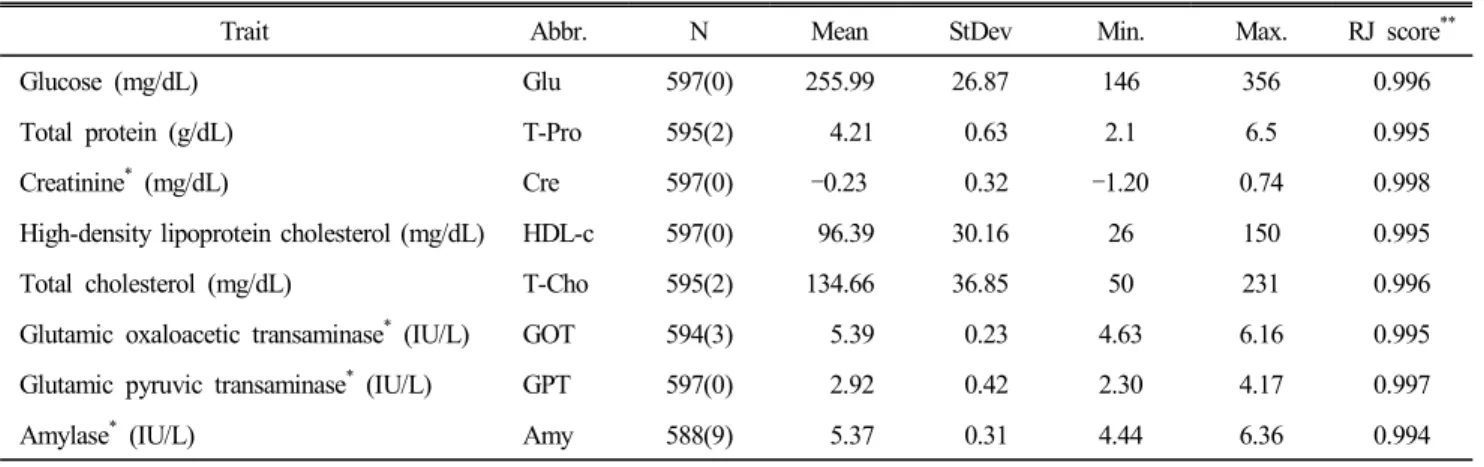
Table 1 shows the numbers, means, standard deviations, and ranges for the 8 clinical chemical traits in this study. Among the 11 initial traits, 3 traits (BUN, ALP, TG) were omitted because they were not normally distributed. The results of quantitative genetic analysis to estimate the heritabilities (h2) are also presented in Table 2. HDL-c, GPT, and Amy were found to have moderate heritablilities, with estimates of 39.6%, 33.7%
and 30.6% respectively. The heritability estimates for T-Cho, Cre, T-Pro and GOT were in the moderate to low range, with estimates of 28.6%, 25.2%, 15.1% and 13.2% respectively.
Hollands et al. (1980) reported that estimates of heritabilities of plasma cholesterol levels ranged from 19% to 30% in White Leghorns. Almgren et al. (2011) found heritabilities of approximately 22% for Glu, approximately 47% for T-Cho, and approximately 52% for HDL-c in a human family study.
However, Glu was found to be very low heritable, with heri-
Park et al. : Estimation of Genetic Parameters for Serum Clinical-chemical Traits in Korean Native Chickens 281
Table 1. Descriptive statistics for clinical chemical traits in Korean native chickens
Trait Abbr. N Mean StDev Min. Max. RJ score**
Glucose (mg/dL) Glu 597(0) 255.99 26.87 146 356 0.996
Total protein (g/dL) T-Pro 595(2) 4.21 0.63 2.1 6.5 0.995
Creatinine* (mg/dL) Cre 597(0) 0.23 0.32 1.20 0.74 0.998
High-density lipoprotein cholesterol (mg/dL) HDL-c 597(0) 96.39 30.16 26 150 0.995
Total cholesterol (mg/dL) T-Cho 595(2) 134.66 36.85 50 231 0.996
Glutamic oxaloacetic transaminase* (IU/L) GOT 594(3) 5.39 0.23 4.63 6.16 0.995 Glutamic pyruvic transaminase* (IU/L) GPT 597(0) 2.92 0.42 2.30 4.17 0.997
Amylase* (IU/L) Amy 588(9) 5.37 0.31 4.44 6.36 0.994
For no. of chickens (N), values in parentheses are the no. of chickens omitted according to ascertainment of normality.
*Data transformed using natural log.
**Ryan-Joiner score for normality assessment.
Table 2. REML estimates of additive genetic components (
), residual components (
) and heritablities (h2) for clinical chemical traits in Korean native chickens
h2 (%)
GLU 50.27 514.95 8.89
T-Pro 0.051 0.284 15.10
Cre 0.020 0.060 25.22
HDL-c 267.5 407.2 39.64
T-Cho 298.3 744.8 28.60
GOT 0.005 0.032 13.28
GPT 0.047 0.092 33.73
Amy 0.025 0.057 30.61
Table 3. Genetic (above diagonal) and phenotypic (below diagonal) correlations between 8 clinical-chemical traits
Glu T-Pro GPT Cre HDL-c T-Cho GOT Amy
Glu 0.15 0.21 0.61 0.71 0.33 0.82 0.50
T-Pro 0.19 0.35 0.34 0.37 0.48 0.57 0.72
GPT 0.15 0.18 0.64 0.29 0.15 0.57 0.29
Cre 0.18 0.26 0.51 0.30 0.41 0.71 0.59
HDL-c 0.23 0.05 0.25 0.26 0.80 0.85 0.38
T-Cho 0.22 0.28 0.26 0.26 0.79 0.58 0.34
GOT 0.16 0.09 0.36 0.37 0.31 0.30 0.75
Amy 0.04 0.07 0.08 0.12 0.06 0.05 0.16
tablility estimates of 8.9% in this study. This very low level of heritability is most likely due to the long range of fasting time differences caused during the blood collections. There- fore, the heritability estimates indicated that genetic compo- nents could explain between 8.9 % (Glu) and 39.6% (HDL-c) of the observed quantitative variation of clinical chemical traits in KNC. Recently, heritabilities of the same 8 clinical chemical traits were reported in crossbred pigs (Yoo et al., 2012). The estimated heritabilities ranged from 40.1% (GOT) to 96.8% (T-Cho and HDL-c), which were higher than those estimated in this study.
2. Genetic and Phenotypic Correlations
Genetic and phenotypic correlations were estimated bet- ween the clinical-chemical traits used for the heritability esti-
Park et al. : Estimation of Genetic Parameters for Serum Clinical-Chemical Traits in Korean Native Chickens 282
mation (Table 3). For example, high negative genetic correla- tion was observed between Glu and GOT (0.82), Glu and HDL-c (0.71), and Glu and Cre (0.61) but low negative value was observed between Glu and GPT (0.21), whereas negative moderate value was detected between Glu and T- Cho (0.33). In phenotypic terms, both the magnitude and the sign of the genetic and phenotypic correlations were largely different between the traits mentioned above. Low positive phenotypic correlations were observed between Glu and GOT (0.16), Glu and HDL-c (0.23), Glu and Cre (0.18), Glu and GPT (0.15), and Glu and T-Cho (0.22). Low positive genetic correlation between Glu and T-Pro (0.15), and strong positive genetic correlation was found between Glu and Amy (0.5).
Overall, a total of 15 pairs of traits out of 28 pairs of traits showed the different signs of correlations in this study.
Information of hereditary effects on clinical-chemical traits obtained in this study can be used for various purposes. Firstly, population-specific additive genetic variances for clinical che- mical measurements can provide informative data for genetic management and conservation of KNC populations. Secondly, the existence of genetic variance components in these traits suggests that the familial relatedness should account for when KNC are used for experiment in which clinical chemical measures are used as dependent variable (Williams-Blangero et al., 1994). Thirdly, the results will provide the useful in- formation to address genetic issues before conducting quanti- tative trait locus study for clinical chemical traits in chickens.
ACKNOWLEDGMENTS
This work was supported by a grant from the Next-Gene- ration BioGreen 21 Program (No. PJ0081330), Rural Develop- ment Administration, Republic of Korea.
LITERATURE CITED
Almgren P, Lehtovirta M, Isomaa B, Sarelin L, Taskinen MR, Lyssenko V, Tuomi T, Groop L, Botnia Study Group 2011 Heritability and familiality of type 2 diabetes and related quantitative traits in the Botnia Study. Diabetologia 54:
2811-2919.
Cohen J 1988 Statistical Power for the Behavioral Sciences.
2nd ed. Hillsdale, Erlbaum, NJ.
Fox RR 1989 Clinical Chemical Studies Applicable to Labo- ratory Animal Species and Their Interpretation: The Rabbit.
Pergamon Press, New York, NY.
Gilmour AR, Thompson R, Cullis BR 1995 Average informa- tion REML: An efficient algorithm for variance parameter estimation in linear mixed models. Biometrics 51:1440-1450.
Henderson C 1984 Applications of Linear Models in Animal Breeding. University of Guelph Press, Guelph.
Hollands KG, Grunder AA, Williams CJ 1980 Response to five generations of selection for blood cholesterol levels in White Leghorns. Poultry Sci 59:1316-1323.
Kang BS, Kim JD, Jung IC, Jung SB, Yang CB 1992 Quality meat production using crossbred Korean native chickens.
National Livestock Research Center Research Reports:
376-382.
Williams-Blangero S, Butler T, Brasky K, Murthy KK 1994 Heritabilities of clinical chemical traits in chimpanzees.
Lab Anim Sci 44:141-143.
Yoo CK, Cho IC, Lee JB, Jung EJ, Lim HT, Han SH, Lee SS, Ko MS, Kang T, Hwang JH, Park YS, Park HB 2012 QTL analysis of clinical-chemical traits in an F2 intercross bet- ween Landrace and Korean native pigs. Physiol Genomics 44:657-668.
(received: 2012. 10. 18, revised: 2012. 12. 6, accepted: 2012. 12. 11)