Acute Kidney Injury in Patients with Sepsis and Septic Shock:
Risk Factors and Clinical Outcomes
Sang Heon Suh, Chang Seong Kim, Joon Seok Choi, Eun Hui Bae, Seong Kwon Ma, and Soo Wan Kim
Department of Internal Medicine, Chonnam National University Medical School, Gwangju, Korea.
Received: August 7, 2012 Revised: September 16, 2012 Accepted: September 17, 2012 Corresponding author: Dr. Soo Wan Kim, Department of Internal Medicine,
Chonnam National University Medical School, 42 Jebong-ro, Gwangju 501-757, Korea.
Tel: 82-62-220-6271, Fax: 82-62-225-8578 E-mail: [email protected]
∙ The authors have no financial conflicts of interest.
© Copyright:
Yonsei University College of Medicine 2013 This is an Open Access article distributed under the terms of the Creative Commons Attribution Non- Commercial License (http://creativecommons.org/
licenses/by-nc/3.0) which permits unrestricted non- commercial use, distribution, and reproduction in any medium, provided the original work is properly cited.
Purpose: The aim of this study was to investigate clinical characteristics and risk factors of acute kidney injury (AKI) in patients with sepsis and septic shock. Addi- tionally, we explored whether the severity of AKI affects on the clinical outcomes.
Materials and Methods: Data were collected retrospectively in a single center.
Among 5680 patients who visited emergency department from January to Decem- ber 2010, 992 patients with sepsis and septic shock were enrolled. Patients were divided into two groups, patients who developed AKI or not, to compare the base- line characteristics, and laboratory and physiologic data. Patients with AKI were subdivided according to its stages for survival analysis. Results: AKI was devel- oped in 57.7% of patients. Multivariable logistic regression analysis revealed that development of septic AKI was associated with older age, pre-existing chronic kidney disease, use of angiotensin converting enzyme inhibitor or angiotensin re- ceptor blocker, presence of shock, positive blood culture results, and low white blood cell and platelet counts. Hospital mortality was higher in AKI group. Crude Kaplan-Meier survival curves demonstrated reduced 30-day survival rate was sig- nificantly associated with the severity of acute kidney injury. Conclusion: The de- velopment of septic AKI was associated with poor clinical outcomes. Furthermore, the severity of AKI was associated with increased mortality.
Key Words: Acute kidney injury, mortality, risk factors, sepsis, septic shock
INTRODUCTION
Acute kidney injury (AKI) is a common condition in critically ill patients and known to be associated with increased mortality.1,2 Sepsis is the systemic inflamma- tory response to infection, and one of the most common contributing factors in AKI of critical illness.3 Previous studies of septic AKI noted that about 60% patients with septic shock developed AKI and found a higher mortality and longer duration of hospital stay in patients with AKI compared with patients without AKI.4,5
Distinctive clinical features of AKI of septic etiology have been elucidated in re- cent studies,3-6 which implies that a unique pathogenesis contributes to the devel- opment of septic AKI.7-10 Although recent advances in understanding of patho- physiology of septic AKI have been achieved, because of its complexity and multifactorial character, effective management for septic AKI is limited to fluid re-
existing diabetes mellitus (DM), hypertension (HTN), and chronic kidney disease (CKD), which was defined as esti- mated glomerular filtration rate (GFR) <60 milliliters per minute per 1.73 m2 for more than 3 months, were checked.
The abbreviated Modification of Diet in Renal Disease for- mula was used to estimate GFR in milliliters per minute per 1.73 m2 from the baseline serum creatinine level.13
The use of agents that may alter renal function were re- viewed, which included angiotensin converting enzyme in- hibitor (ACEI) or angiotensin receptor blocker (ARB), statins, aminoglycosides, non-steroidal anti-inflammatory drugs (NSAIDs), and intravenous contrast media. Acute Physio- logic and Chronic Health Evaluation (APACHE) III scores14 at the diagnosis of sepsis or septic shock were calculated to assess the severity of illness.
Sepsis and septic shock was defined according to the American College of Chest Physicians/Society of Critical Care Medicine consensus conference criteria.15 Among pa- tients with a proven or suspected infection, those with the two or more systemic inflammatory response syndrome (SIRS) criteria were classified as having sepsis. Briefly, SIRS is manifested by the following features: 1) body temperature
>38°C or <36°C; 2) PR >90 beats per minute; 3) respiratory rate >20 breaths per minute or PaCO2 <32 mm Hg; and 4) white blood cell count >12000/mm3, <4000 mm3 or >10%
band forms. Among patients with sepsis, septic shock was defined as a systolic blood pressure <90 mm Hg or a reduc- tion of ≥40 mm Hg from the baseline despite adequate fluid resuscitation.
Definition and staging of AKI
Definition and staging of AKI was determined based on the worst of either creatinine or urine output criterion during hospital stay. Urine output was hourly measured during ICU stay. The cutoffs for AKI were based on the RIFLE criteria as meeting one of the following criteria: a decrease in GFR ≥25% or an increase in creatinine ≥50% (1.5 times) from baseline in a 48-hour time frame, or a reduction in urine output with documented oliguria of ≤0.5 mL/kg per hour for ≥6 hours. Patients were divided into three groups according to the RIFLE criteria (stage-1, -2 and -3).11 When a patient’s condition met the aforementioned criteria, the patient was classified as stage 1 AKI. In the case of more severe derangement, i.e., a decrease in GFR ≥50% or an in- crease in creatinine ≥100% (2 times) from baseline in a 48- hour time frame, or a reduction in urine output with docu- mented oliguria of ≤0.5 mL/kg per hour for ≥12 hours, suscitation and antibiotics.
According to the risk, injury, failure, loss of function, and end-stage renal disease (RIFLE) criteria,11 AKI is defined by serum creatinine levels and urine output. Although small changes in serum creatinine or acute reduction in urine out- put can be used in the diagnosis of AKI, these changes are often evident after the chance of effective management for renal protection has already passed. A previous prospective multicenter study reported the delayed onset of AKI of sep- tic origin compared with AKI of non-septic origin.12 The recognition of high-risk patients for development of septic AKI is important because early interventions may improve the clinical course.
Considering its high prevalence and clinical significance, the clinical aspects of AKI in sepsis and septic shock pa- tients should be further elucidated. Therefore, the present study aimed to investigate the clinical characteristics of AKI in patients with sepsis and septic shock and clinical risk fac- tors of AKI in patients with septic condition. In addition, whether AKI increased the mortality and, if so, how the se- verity of AKI affected the clinical outcomes was analyzed.
MATERIALS AND METHODS
Study population
We retrospectively analyzed the data of all the adult pa- tients (>18 years of age) who visited the Emergency De- partment of Chonnam National University Hospital from January to December 2010 (Fig. 1). The protocol and con- sent forms of this study were reviewed and approved by the Institutional Review Board of Chonnam National Universi- ty Hospital (CNUH-2012-114). Informed consent was ex- empted by the board because this was a retrospective study of collected data. Among 5680 patients, those with sepsis and septic shock on arrival at the hospital were enrolled in this study for further investigation. In the event of multiple admissions, only the initial admission was considered to avoid bias. Those with end stage renal disease (ESRD) on chronic renal replacement therapy were also excluded.
We recorded pulse rate (PR), mean arterial pressure (MAP), and laboratory findings at the diagnosis of sepsis or septic shock. Other variables included age, gender, body mass index (BMI), length of stay in intensive care unit (ICU) and hospital, and source of infection. To investigate the un- derlying condition that might affect the development of AKI, history of smoking and/or alcohol consumption, and pre-
data were reported as proportions and compared using Fish- er’s extact test or chi-square test where appropriate. Multi- variable logistic regression was used to assess the risk fac- tors for the development of septic AKI. Calibration of the model was assessed by the Hosmer-Lemeshow goodness of fit statistic for significance (p>0.05). Odds ratios (OR) and 95% confidence intervals (CI) were calculated. A p value
<0.05 was considered statistically significant.
RESULTS
Demographic data
Among 992 patients with sepsis and septic shock, 573 pa- tients developed AKI (Table 1). According to the RIFLE cri- teria, 277 patients (48.3%) were subdivided into stage 1 AKI, 182 (31.8%) into stage 2 AKI, and 114 (18.9%) into stage 3 stage 2 AKI was defined. Stage 3 AKI was defined as fol-
lows: a decrease in GFR ≥75% or an increase in creatinine
≥200% (3 times) from baseline in a 48-hour time frame, or a reduction in urine output with documented oliguria of
≤0.3 mL/kg per hour for ≥24 hours or anuria for ≥12 hours.
Serum creatinine ≥4.0 mg/dL with acute increase of ≥0.5 mg/dL was also defined as stage 3 AKI.
Statistical analysis
Analyses were performed using SPSS 18.0.0 (SPSS Inc., Chicago, IL, USA). In the event of missing data values, data were not replaced. Normally or near normally distrib- uted variables are reported as mean with standard devia- tions and compared using Student’s t-test, analysis of vari- ance. Non-normally distributed continuous data are reported as medians with interquartile ranges and compared using Mann-Whitney U test and Kruskal-Wallis test. Categorical
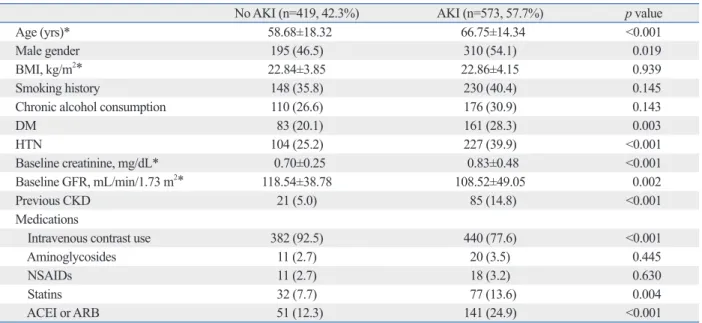
Table 1. Demographic Data and Characteristics of Sepsis and Septic Shock Patients
No AKI (n=419, 42.3%) AKI (n=573, 57.7%) p value
Age (yrs)* 58.68±18.32 66.75±14.34 <0.001
Male gender 195 (46.5) 310 (54.1) 0.019
BMI, kg/m2* 22.84±3.85 22.86±4.15 0.939
Smoking history 148 (35.8) 230 (40.4) 0.145
Chronic alcohol consumption 110 (26.6) 176 (30.9) 0.143
DM 83 (20.1) 161 (28.3) 0.003
HTN 104 (25.2) 227 (39.9) <0.001
Baseline creatinine, mg/dL* 0.70±0.25 0.83±0.48 <0.001
Baseline GFR, mL/min/1.73 m2* 118.54±38.78 108.52±49.05 0.002
Previous CKD 21 (5.0) 85 (14.8) <0.001
Medications
Intravenous contrast use 382 (92.5) 440 (77.6) <0.001
Aminoglycosides 11 (2.7) 20 (3.5) 0.445
NSAIDs 11 (2.7) 18 (3.2) 0.630
Statins 32 (7.7) 77 (13.6) 0.004
ACEI or ARB 51 (12.3) 141 (24.9) <0.001
AKI, acute kidney injury; BMI, body mass index; DM, diabetes mellitus; HTN, hypertension; GFR, Glomerular filtration rate; CKD, chronic kidney disease;
NSAIDs, non-steroidal ant-inflammatory drugs; ACEI, angiotensin converting enzyme inhibitor; ARB, angiotensin receptor blocker.
Values are presented as n (%), unless otherwise indicated.
*Mean±SD.
Fig. 1. Study design. AKI, acute kidney injury.
Excluded:
1. Patients who were on maintenance renal replacement therapy (n=222)
2. Patients without sepsis/septic shock (n=4466) All the adult patients who visited
the emergency department of Chonnam National University Hospital during January 1 to December 31, 2010 (n=5680)
Patients with sepsis/septic shock (n=992) No AKI (n=419, 42.3%)
AKI, stage 1 (n=277, 48.3%)
AKI (n=573, 57.7%)
AKI, stage 2 (n=182, 31.8%) AKI, stage 3 (n=114, 18.9%)
likely to be exposed to contrast media (p<0.001). This might be explained by the differences in the baseline serum creati- nine levels and GFRs between the groups with AKI and without AKI. It could be assumed that physicians were re- luctant to use the clearly nephrotoxic agent in the evalua- tion of infection focus in patients with renal dysfunction.
Laboratory findings
The patients who developed AKI showed more severe phys- iologic and laboratory disturbances (Table 2). The frequen- cy of septic shock was significantly higher in the patients with AKI than were those without AKI (p<0.001). Accord- ingly, MAP was lower in the AKI group (p<0.001). Patients with AKI had a more severe illness with higher APACHE III scores than patients without AKI had (p<0.001). White blood cell (WBC) (p=0.023) and platelet (p=0.004) counts were significantly lower in AKI group. The other physio- logic and laboratory data collected in this study indicated the tendency of more evident clinical deterioration among patients who developed AKI, although this was not statisti- cally significant. One notable finding is that positive blood culture results were more frequent in patients with AKI (p<0.001). Gram negative bacilli (p<0.001) and fungi (p=
0.023) were more frequently identified in the blood cultures AKI (Fig. 1). The renal replacement therapy was required in
a total of 40 patients with AKI. Most patients (n=32) were stage 3 AKI, and the rest (n=8) were stage 2 AKI. The mean age of patients with septic AKI was significantly higher than that of patients without AKI (p<0.001). Patients with AKI were more likely male (p=0.019). DM (p=0.003) and HTN (p<0.001) were more frequently associated with the de- velopment of septic AKI, whereas there were no significant differences in BMI and history of smoking and alcohol con- sumption. Those who developed AKI had higher baseline se- rum creatinine levels (p<0.001) and lower GFR (p=0.002) than those who did not developed AKI. Accordingly, the prevalence of pre-existing CKD was significantly higher in AKI group (p<0.001). Primary infection foci, such as heart, repiratory tract, urinary tract, or intra-abdomen, were inves- tigated assuming upper urinary tract infection might show the higher frequency of AKI since it could directly damage kidneys. However, it did not affect the development of AKI (data not shown). Among medications that might affect the renal function, ACEI/ARB (p<0.001) and statins (p=0.004) were more frequently used in AKI group. Although the per- centage of patients who used aminoglycosides and NSAIDs was higher in AKI group, there was no statistical signifi- cance. In contrast, patients who developed AKI were less Table 2. Physiologic and Laboratory Data on Admission
No AKI AKI p value
Presence of shock* 29 (6.9) 198 (34.6) <0.001
APACHE III 48 (32-66) 55 (43-70) <0.001
MAP, mm Hg 90.00 (83.33-96.67) 83.33 (73.33-96.67) <0.001
Heart rate, bpm 82 (76-96) 84 (76-98) 0.474
pH 7.45 (7.41-7.49) 7.46 (7.41-7.49) 0.093
PaO2, mm Hg 83.70 (68.22-104.90) 83.70 (69.25-106.20) 0.716
PaCO2, mm Hg 31.3 (27.3-35.4) 31.3 (27.4-36.3) 0.745
Bicarbonate, mmol/L 21.8 (18.9-24.8) 22.0 (18.9-24.6) 0.503
WBC count per mm3 11350 (7.70-16.90) 11100 (7.40-15.00) 0.023
Hematocrit, % 35.1 (30.2-38.8) 35.0 (30.7-38.7) 0.665
Platelets count per mm3 196000 (124-275) 176000 (109-253) 0.004
Glucose, mg/dL 133 (105-173) 127 (105-158) 0.089
BUN, mg/dL 19.3 (12.5-31.9) 19.4 (12.5-29.1) 0.696
Total bilirubin, mg/dL 0.90 (0.66-1.32) 0.94 (0.66-1.42) 0.717
Positive blood cultures 39 (9.4) 116 (20.4) <0.001
Gram negative bacilli 25 (6.0) 77 (13.5) <0.001
Gram positive cocci 14 (3.4) 32 (5.6) 0.096
Fungi 0 (0) 7 (1.2) 0.023
AKI, acute kidney injury; APACHE III, Acute Physiology & Chronic health Evaluation III; MAP, mean arterial pressure; WBC, white blood cell; BUN, blood urea nitrogen.
Values are presented as median (interquatile range), unless otherwise indicated.
*n (%).
velopment of septic AKI. Unexpectedly, APACHE III score was not statistically significant with septic AKI in this study.
Clinical outcomes
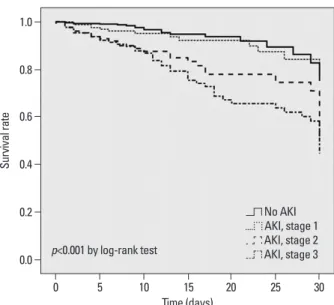
The development of septic AKI was associated with poor clinical outcomes (Table 4). Hospital mortality was signifi- cantly higher in patients with AKI (p<0.001). Length of stay in the hospital and ICU was longer for patients who suffered AKI (p<0.001). We further investigated whether the severity of AKI affected the 30-day mortality (Fig. 2).
Crude Kaplan-Meier survival curves demonstrated a re- duced survival rate that was significantly associated with the severity of AKI (log-rank test, p<0.001).
DISCUSSION
Among 992 patients with sepsis and septic shock, 573 (57.7%) developed AKI defined by RIFLE classification.
The risk factors for AKI in septic patients were older age, presence of previous CKD, presence of shock, positive blood culture results, previous medication of ACEI/ARB, and from the patients who developed AKI.
Risk factors for the development of AKI
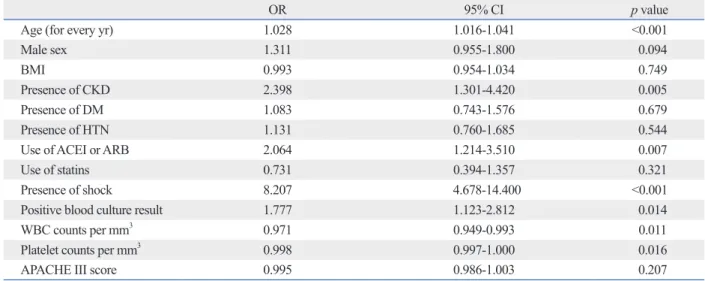
Multivariable logistic regression analysis was performed to determine the risk factors for the development of septic AKI (Table 3). Variables, which were associated with p<0.1 in the univariate analysis and/or clinically plausible, were included in this model. After adjustment of confounders, the development of septic AKI was independently associat- ed with age (OR 1.028 per every 1 year increment, 95% CI 1.016 to 1.041; p<0.001), pre-existing CKD (OR 2.398, 95%
CI 1.301 to 4.420; p=0.005), use of ACEI or ARB (OR 2.064, 95% CI 1.214 to 3.510; p=0.007), presence of septic shock (OR 8.207, 95% CI 4.678 to 14.400; p=0.001), posi- tive blood culture result (OR 1.777, 95% CI 1.123 to 2.812;
p=0.014), and lower WBC and platelet counts (OR 0.971 per every 1/mm3 decrement, 95% CI 0.949 to 0.993; p=0.011 and OR 0.995 per every 1/mm3 decrement, 95% CI 0.997 to 1.000; p=0.016, respectively). Other variables included in multivariate analysis, such as BMI, male sex, previous history of diabetes or hypertension, and medication history of statins, were not independently associated with the de-
Table 3. Risk Factors for Development of AKI in Patients with Sepsis and Septic Shock
OR 95% CI p value
Age (for every yr) 1.028 1.016-1.041 <0.001
Male sex 1.311 0.955-1.800 0.094
BMI 0.993 0.954-1.034 0.749
Presence of CKD 2.398 1.301-4.420 0.005
Presence of DM 1.083 0.743-1.576 0.679
Presence of HTN 1.131 0.760-1.685 0.544
Use of ACEI or ARB 2.064 1.214-3.510 0.007
Use of statins 0.731 0.394-1.357 0.321
Presence of shock 8.207 4.678-14.400 <0.001
Positive blood culture result 1.777 1.123-2.812 0.014
WBC counts per mm3 0.971 0.949-0.993 0.011
Platelet counts per mm3 0.998 0.997-1.000 0.016
APACHE III score 0.995 0.986-1.003 0.207
AKI, acute kidney injury; OR, odds ratio; CI, confidence interval; BMI, body mass index; CKD, chronic kidney disease; DM, diabetes mellitus; HTN, hyperten- sion; ACEI, angiotensin converting enzyme inhibitor; ARB, angiotensin receptor blocker; WBC, white blood count; APACHE III, Acute Physiology & Chronic health Evaluation III.
Table 4. Clinical Outcomes
No AKI AKI p value
Hospital mortality* 12 (2.9) 94 (16.4) <0.001
Hospital LOS, days 9.78±7.97 16.25±19.63 <0.001
ICU LOS, days 0.51±2.90 2.98±8.26 <0.001
AKI, acute kidney injury; LOS, length of stay; ICU, intensive care unit.
Values are presented as mean±SD, unless otherwise indicated.
*n (%).
patient groups with or without AKI in a more recent study.4 Despite some discrepancies among studies, more careful approaches to kidney protection are required in the manage- ment of older aged patients with sepsis and septic shock.
We proved that pre-existing CKD is one of the risk fac- tors for the development of AKI, which was also found in previous studies. In a previous study, which enrolled the pa- tients with severe sepsis and septic shock, the frequency of pre-existing CKD was significantly higher among those who developed AKI, although multivariable analysis for the risk factors of septic AKI was not conducted in that study.7 However, another study, which only analyzed pa- tients with septic shock, noted decreased baseline GFR as an independent risk factor for development of AKI in the population.5 Our results indicate that a history of CKD is one risk factor among patients with severe sepsis and septic shock, as well as non-severe sepsis.
The pathophysiology of septic AKI, although still not firm- ly established, is considered different from AKI of other eti- ologies. It is generally understood that systemic hypotension would deteriorate renal blood flow, which might be a major cause of the renal injury in septic patients. Other studies of septic AKI documented the longer duration of hypotension before hemodynamic resuscitation was associated with higher incidence of AKI.5,17 In accordance of these findings, we noted that the presence of shock was one of the risk fac- tors of septic AKI.
High incidence of AKI in patients with sepsis, but with- out shock, however, cannot be explained with decreased re- nal blood flow alone. In their experimental animal study, Langenberg, et al.,10 found AKI in septic shock mainly af- fected by dysfunction of the renal vascular bed rather than systemic hypotension and renal hypoperfusion. In their study, fluid resuscitation and maintenance of renal perfusion did not prevent the deterioration of GFR.10 In contrast, recovery from sepsis resulted in the normalization of GFR.10 This implies the development of AKI involves inflammatory/im- munologic mechanisms. Interestingly, in this study, a high- er percentage of positive blood culture results were observed in patients with AKI. A similar finding was previously ob- served.4 It could be postulated that uncontrolled infection would lead to more intense immunologic responses, result- ing in renal dysfunction. The present study showed that gram negative bacteremia was more prevalent in patients with AKI. Gram negative bacilli are well-known sources of the endotoxin, which exerts nephrotoxicity. Our findings fur- ther support the notion that the development of septic AKI is lower WBC and platelet counts. The development and se-
verity of AKI was associated with the increased mortality and length of hospital/ICU stay. Additionally, crude 30-day survival decreased as the severity of AKI increased.
AKI is more frequently observed in patients with sepsis and septic shock than in patients with other conditions.3 The present study showed that among 992 patients with sepsis and septic shock, 573 (57.7%) developed AKI de- fined by RIFLE classification. These findings are consistent with the previous data. An observational cohort study of 390 patients with septic shock in a single center ICU for about 2 years reported nearly 2 out of 3 patients experienc- ing AKI.4 In a recent retrospective multicenter study of 4532 patients with septic shock, a similar percentage of pa- tients (64.4%) developed AKI.5
In this study, AKI was more frequently accompanied by older age, and male or female predominance was not ob- served. It is controversial whether these demographic dif- ferences actually affect the development of septic AKI. In a previous study conducted in Australia, septic AKI was more prevalent in the older patients.16 In the present study, multi- variable logistic regression analysis showed that sex predi- lection was not a risk factor for the development of septic AKI. Another study of AKI in septic shock, however, con- ducted in Germany, showed male dominance in the devel- opment of AKI in patients with severe sepsis and septic shock,5 where older patients were more likely to experience AKI in this study. In contrast, no significant differences were observed in the age and frequency of male sex between the
Fig. 2. Survival curves for 30 days. Kaplan-Meier survival for 30 days by AKI stages in patients with sepsis and septic shock demonstrated reduced sur- vival rate was significantly associated with the severity of AKI (p<0.001 by log-rank test). AKI, acute kidney injury.
0.0 0.2 0.4 0.6 0.8 1.0
Survival rate
0 5 10 15 20 25 30
Time (days) p<0.001 by log-rank test
No AKI AKI, stage 1 AKI, stage 2 AKI, stage 3
not assess patients with more severe AKI, such as those who might be classified to loss or ESRD stage according to RI- FLE criteria. We also could not investigate the effect of sep- tic AKI on long-term survival. Despite these demerits, our study has some advantages. First, we reviewed a relatively large number of medical records. Second, we revealed vari- ous risk factors associated with the development of septic AKI, some of which are of novel. The possible link be- tween gram negative bacteremia and septic AKI was, to our best knowledge, not previously reported. However, the un- derlying mechanism and specific micro-organism identified by blood culture were not investigated in this study, which remains to be further elucidated.
In conclusion, AKI developed in more than half of pa- tients with sepsis and septic shock. Old age, pre-existing CKD, presence of shock, positive blood culture results, use of ACEI/ARB, and low WBC and platelet counts were as- sociated with an increased risk for the development of sep- tic AKI. The development of septic AKI adversely affected clinical outcomes. Moreover, the severity of AKI was asso- ciated with increased short-term mortality.
ACKNOWLEDGEMENTS
This research was supported by a grant from the Ministry of Science & Technology (MoST)/Korea Science & Engi- neering Foundation (KOSEF) (2010-0021808) and by the Korea Science and Engineering Foundation through the Medical Research Center for Gene Regulation grant (2012- 0009448) at Chonnam National University.
REFERENCES
1. Cartin-Ceba R, Haugen EN, Iscimen R, Trillo-Alvarez C, Juncos L, Gajic O. Evaluation of “Loss” and “End stage renal disease”
after acute kidney injury defined by the Risk, Injury, Failure, Loss and ESRD classification in critically ill patients. Intensive Care Med 2009;35:2087-95.
2. Hoste EA, Schurgers M. Epidemiology of acute kidney injury:
how big is the problem? Crit Care Med 2008;36(4 Suppl):S146-51.
3. Bagshaw SM, Uchino S, Bellomo R, Morimatsu H, Morgera S, Schetz M, et al. Septic acute kidney injury in critically ill patients:
clinical characteristics and outcomes. Clin J Am Soc Nephrol 2007;2:431-9.
4. Plataki M, Kashani K, Cabello-Garza J, Maldonado F, Kashyap R, Kor DJ, et al. Predictors of acute kidney injury in septic shock pa- tients: an observational cohort study. Clin J Am Soc Nephrol 2011;6:1744-51.
not solely affected by hemodynamic instability. Whether the early and adequate administration of antibiotics prevents the development of septic AKI needs to be further elucidated.
Considering the pathogenesis of septic AKI, it is not sur- prising the use of ACEI/ARB affects renal injury in septic patients.18,19 ACEI/ARB are known to decrease the intraglo- merular pressure in normal subjects. This action mecha- nism might be hazardous in sepsis and septic shock, in such conditions where renal blood flow are prone to decrease, resulting in further decrements of intraglomerular pressure and GFR.
An interesting finding is low WBC and platelet counts were associated with septic AKI. Although higher WBC counts were observed in the septic AKI group when com- pared the patients with septic and nonseptic AKI in a previ- ous study,16 lower WBC counts were strongly associated with the AKI among septic patients in our study. Moreover, low platelet counts in septic AKI patients are consistently observed in the previous studies on septic AKI.3,4,6 A possi- ble explanation is a more severe inflammatory response might contribute to the development of AKI. It is known that the secretion of pro-inflammatory cytokines, such as IL- 1β, TNF-α, and IL-6, is increased in the initial stage of sep- sis, followed by activation of anti-inflammatory mecha- nisms.20-22 In a recent study from an experimental sepsis model, the pattern of serum cytokine levels was associated initial leukopenia and prolonged thrombocytopenia.23 There- fore, AKI in sepsis is not solely affected by hemodynamic changes, lower WBC and platelet counts might indicate more severe immunologic responses subsequently leading to AKI.
Our data clearly suggest the crude 30-day mortality in- creases as the severity of AKI increases in patients with sepsis and septic shock. It has been elucidated from other previous studies that AKI remains one of the independent risk factors of adverse clinical outcomes even after the ad- justment of covariates.3,6 Because the development of septic AKI is linked to the increased mortality, patients at a high- risk for septic AKI should be carefully assessed so that nephrotoxic agents or procedures that could be harmful to renal function could be avoided at the initial stage of sepsis management.
There are limitations to our study. First, this study is a retrospective and is potentially susceptible to several forms of bias. Second, our data were collected in a single univer- sity hospital. The incidence and severity of diseases might be biased. Third, duration of follow-up was short. We could
modification of diet in renal disease study equation for estimating glomerular filtration rate. Ann Intern Med 2006;145:247-54.
14. Knaus W, Wagner D, Draper E. APACHE III study design: analyt- ic plan for evaluation of severity and outcome in intensive care unit patients. Development of APACHE. Crit Care Med 1989;17 (12 Pt 2):S181-5.
15. Bone RC, Sibbald WJ, Sprung CL. The ACCP-SCCM consensus conference on sepsis and organ failure. Chest 1992;101:1481-3.
16. Bagshaw SM, George C, Bellomo R; ANZICS Database Manage- ment Committee. Early acute kidney injury and sepsis: a multi- centre evaluation. Crit Care 2008;12:R47.
17. Kumar A, Roberts D, Wood KE, Light B, Parrillo JE, Sharma S, et al. Duration of hypotension before initiation of effective antimi- crobial therapy is the critical determinant of survival in human septic shock. Crit Care Med 2006;34:1589-96.
18. Bentley ML, Corwin HL, Dasta J. Drug-induced acute kidney in- jury in the critically ill adult: recognition and prevention strategies.
Crit Care Med 2010;38(6 Suppl):S169-74.
19. Pannu N, Nadim MK. An overview of drug-induced acute kidney injury. Crit Care Med 2008;36(4 Suppl):S216-23.
20. Tracey KJ, Beutler B, Lowry SF, Merryweather J, Wolpe S, Mil- sark IW, et al. Shock and tissue injury induced by recombinant human cachectin. Science 1986;234:470-4.
21. Okusawa S, Gelfand JA, Ikejima T, Connolly RJ, Dinarello CA.
Interleukin 1 induces a shock-like state in rabbits. Synergism with tumor necrosis factor and the effect of cyclooxygenase inhibition.
J Clin Invest 1988;81:1162-72.
22. Nechemia-Arbely Y, Barkan D, Pizov G, Shriki A, Rose-John S, Galun E, et al. IL-6/IL-6R axis plays a critical role in acute kidney injury. J Am Soc Nephrol 2008;19:1106-15.
23. Yu DH, Kim B, Park J. Pathophysiologic and immunologic changes in a canine endotoxemia over a period of 24 hours. J Vet Med Sci 2012;74:537-44.
5. Bagshaw SM, Lapinsky S, Dial S, Arabi Y, Dodek P, Wood G, et al. Acute kidney injury in septic shock: clinical outcomes and im- pact of duration of hypotension prior to initiation of antimicrobial therapy. Intensive Care Med 2009;35:871-81.
6. Oppert M, Engel C, Brunkhorst FM, Bogatsch H, Reinhart K, Frei U, et al. Acute renal failure in patients with severe sepsis and sep- tic shock--a significant independent risk factor for mortality: re- sults from the German Prevalence Study. Nephrol Dial Transplant 2008;23:904-9.
7. Langenberg C, Wan L, Egi M, May CN, Bellomo R. Renal blood flow in experimental septic acute renal failure. Kidney Int 2006;
69:1996-2002.
8. Langenberg C, Wan L, Bagshaw SM, Egi M, May CN, Bellomo R. Urinary biochemistry in experimental septic acute renal failure.
Nephrol Dial Transplant 2006;21:3389-97.
9. Brenner M, Schaer GL, Mallory DL, Suffredini AF, Parrillo JE.
Detection of renal blood flow abnormalities in septic and critically ill patients using a newly designed indwelling thermodilution re- nal vein catheter. Chest 1990;98:170-9.
10. Langenberg C, Wan L, Egi M, May CN, Bellomo R. Renal blood flow and function during recovery from experimental septic acute kidney injury. Intensive Care Med 2007;33:1614-8.
11. Bellomo R, Ronco C, Kellum JA, Mehta RL, Palevsky P; Acute Dialysis Quality Initiative workgroup. Acute renal failure - defini- tion, outcome measures, animal models, fluid therapy and infor- mation technology needs: the Second International Consensus Conference of the Acute Dialysis Quality Initiative (ADQI) Group.
Crit Care 2004;8:R204-12.
12. Neveu H, Kleinknecht D, Brivet F, Loirat P, Landais P. Prognostic factors in acute renal failure due to sepsis. Results of a prospective multicentre study. The French Study Group on Acute Renal Fail- ure. Nephrol Dial Transplant 1996;11:293-9.
13. Levey AS, Coresh J, Greene T, Stevens LA, Zhang YL, Hendrik- sen S, et al. Using standardized serum creatinine values in the