• 검색 결과가 없습니다.

Clinical Impact of Supplementation of Vitamins B1 and C on Patients with Sepsis-Related Acute Respiratory Distress Syndrome

N/A
N/A
Protected

Academic year: 2021

Share "Clinical Impact of Supplementation of Vitamins B1 and C on Patients with Sepsis-Related Acute Respiratory Distress Syndrome"

Copied!
7
0
0

로드 중.... (전체 텍스트 보기)

전체 글

(1)

Introduction

Sepsis is a life-threatening condition accompanied by organ dysfunction caused by a dysregulated host response to infec- tion

1

. Mortality rate ranges from 10% in patients with sepsis to more than 40% in patients with septic shock. Acute respiratory distress syndrome (ARDS) is a fatal condition that commonly develops in patients with sepsis. ARDS is not uncommon reason for intensive care unit (ICU) admission and require invasive mechanical ventilation (IMV)

2

. The mortality rate of ARDS still remains high despite of advances in critical care medicine and research

2,3

. The key pathogenetic mechanism of ARDS is the complex inflammatory response

4

, which results in hypoxemia and abrogation of aerobic metabolism. Adjunct

Clinical Impact of Supplementation of

Vitamins B1 and C on Patients with Sepsis- Related Acute Respiratory Distress Syndrome

Jung-Wan Yoo, M.D.

1

, Rock Bum Kim, M.D., Ph.D.

2

, Sunmi Ju, M.D.

1

, Seung Jun Lee, M.D., Ph.D.

1,3

, Yu Ji Cho, M.D., Ph.D.

1,3

, Yi Yeong Jeong, M.D., Ph.D.

1,3

, Jong Deog Lee, M.D., Ph.D.

1,3

and Ho Cheol Kim, M.D., Ph.D.

3,4

1

Department of Internal Medicine, Gyeongsang National University Hospital, Jinju,

2

Regional Cardiocerebrovascular Disease Center, Gyeongsang National University Hospital, Jinju,

3

Gyeongsang National University School of Medicine, Jinju,

4

Department of Internal Medicine, Gyeongsang National University Changwon Hospital, Changwon, Korea

Background: Although few studies have reported improved clinical outcomes with the administration of vitamin B1 and C in critically ill patients with septic shock or severe pneumonia, its clinical impact on patients with sepsis-related acute respiratory distress syndrome (ARDS) remains unclear. The purpose of this study was to evaluate the association with vitamin B and C supplementation and clinical outcomes in patients with ARDS.

Methods: Patients with ARDS requiring invasive mechanical ventilation, admitted to the medical intensive care unit (ICU) were included in this study. Clinical outcomes were compared between patients administered with vitamin B1 (200 mg/day) and C (2 g/day) June 2018–May 2019 (the supplementation group) and those who did not receive vitamin B1 and C administration June 2017–May 2018 (the control group).

Results: Seventy-nine patients were included. Thirty-three patients received vitamin B1 and C whereas 46 patients did not. Steroid administration was more frequent in patients receiving vitamin B1 and C supplementation than in those without it. There were no significant differences in the mortality between the patients who received vitamin B1 and C and those who did not. There were not significant differences in ventilator and ICU-free days between each of the 21 matched patients.

Conclusion: Vitamin B1 and C supplementation was not associated with reduced mortality rates, and ventilator and ICU-free days in patients with sepsis-related ARDS requiring invasive mechanical ventilation.

Keywords: Sepsis; Acute Respiratory Distress Syndrome; Vitamin B1; Vitamin C

Address for correspondence: Ho Cheol Kim, M.D., Ph.D.

Department of Internal Medicine, Gyeongsang National University Changwon Hospital, Gyeongsang National University School of Medicine, 11 Samjeongja-ro, Seongsan-gu, Changwon 51472, Korea

Phone: 82-55-214-3730, Fax: 82-55-214-8618

E-mail: [email protected] Received: Feb. 10, 2020 Revised: Apr. 19, 2020 Accepted: May. 13, 2020 Published online: Jun. 16, 2020

cc

It is identical to the Creative Commons Attribution Non-Commercial License (http://creativecommons.org/licenses/by-nc/4.0/).

Copyright © 2020

The Korean Academy of Tuberculosis and Respiratory Diseases.

(2)

pharmacological therapies in patients with ARDS have been tried, but their clinical benefit is yet to be proven robustly

5-7

.

Vitamin B1 is involved in aerobic metabolism

8

, and vitamin C has anti-inflammatory and anti-oxidative effects

9,10

. Vitamin B1 and C deficiencies have been reported in critically ill pa- tients with sepsis

11,12

. Two retrospective studies have reported that intravenous administration of vitamin B1 or C improves clinical outcomes in critically ill patients with septic shock or severe pneumonia

13,14

. However, recent studies did not show the clinical benefits of the combination of vitamin B1, C, and hydrocortisone

15,16

. The clinical implication of intravenous ad- ministration of vitamin B and C on patients with sepsis-related ARDS was not elucidated.

The aim of this study was to evaluate the clinical impact of vitamin B and C supplementation in patients with sepsis- related ARDS.

Materials and Methods

1. Patients

From June 2017 to May 2019, the clinical data of patients older than 18 year olds with sepsis-related ARDS who re- ceived IMV and admitted at the 13-bed medical ICU (MICU) of the tertiary hospital were retrospectively reviewed. All patients under IMV met the Berlin criteria for ARDS

17

. Since June 2018, vitamin B1 and C supplementation was initiated in MICU. Patients at 1-year before vitamin B1 and C supplemen- tation were designated to the control group, whereas those at 1-year after vitamin B1 and C supplementation was to the supplementation group. The characteristics and clinical out- comes were compared between the two groups.

The total supplementation of vitamin B1 was 200 mg/day as recommended by the guideline

18

. Vitamin B1 was intra- venously infused 50 mg every 6 hours. The optimal dose of vitamin C has not been established, although several studies have reported that high dose vitamin C administration was ef- fective in critically ill patients. Presently, we gave intravenously administered a total 2 g of vitamin C in accordance with a re- cent pharmacokinetic study which showed that at least 2 g of vitamin C was sufficient to maintain vitamin C concentration in the blood of critically ill patients

19

. Vitamin C was intrave- nously infused 500 mg every 6 hours. Vitamin B1 and C was given intravenously until death at MICU, reversal of shock, until MV weaning or discharge at MICU.

2. Data collection

Baseline (age, sex, body mass index, comorbidities) and clinical characteristics (presence of shock, acute kidney injury, and management) were assessed. The severities of illness Acute Physiology and Chronic Health Evaluation (APACHE) II score, and Sequential Organ Failure Assessment (SOFA) score were noted. Additionally, the data of various laboratory parameters (white cell count, hemoglobin, platelet, C-reactive protein, albumin, procalcitonin, partial pressure of carbon dioxide, and partial pressure of oxygen/fractionated inspired oxygen) were collected. Moreover, clinical outcomes (ventila- tor-free and ICU-free day at 30 days, mortality) were analyzed.

This study was approved by the Institutional Review Board of Gyeongsang National University Hospital (IRB No. 2019- 03-001). The requirement of informed consent was waived because of the retrospective nature of the study. The study was conducted in accordance with the ethical standards of institutional and/or national research committees and ad-

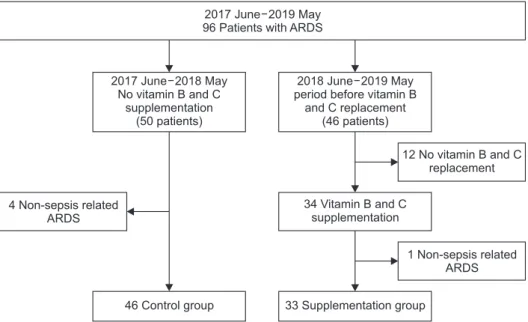
Figure 1. Patients in this study. ARDS:

acute respiratory distress syndrome.

2017 June 2019 May 96 Patients with ARDS

12 No vitamin B and C replacement

1 Non-sepsis related ARDS 2017 June 2018 May

No vitamin B and C supplementation

(50 patients)

2018 June 2019 May period before vitamin B

and C replacement (46 patients)

4 Non-sepsis related ARDS

34 Vitamin B and C supplementation

46 Control group 33 Supplementation group
(3)

hered to the tenets of the Declaration of Helsinki and its later amendments or comparable ethical standards.

3. Statistical analysis

Categorical variable are expressed as and compared with chi-square or Fisher’s exact tests. Continuous vari- ables are presented as median and interquartile range or as mean±standard deviation, unless indicated otherwise, and compared with Mann-Whitney U or Student’s t-tests. Factors associated with mortality were evaluated with Cox propor- tional hazards regression analysis. Propensity score matching

method was performed to consider for the differences in base- line and clinical characteristics. Matched variables were age, gender, APACHE II score, SOFA score, use of neuromuscular blocking (NM) blockers, steroid, and prone position. Based on the standard deviation of the logit of the estimated propensity score, 1:1 matching was performed using the nearest-neigh- bor method with a caliper width of 0.2 in a pairwise manner.

All tests of significance were two-tailed. A p-value of 0.05 was considered statistically significant. All data were analyzed with SPSS software version 18.0 (SPSS Inc., Chicago, IL, USA).

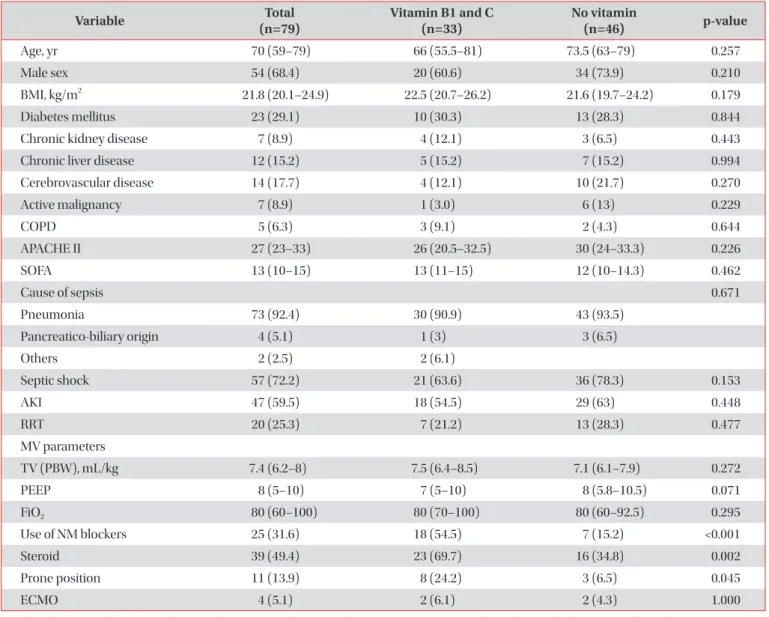
Table 1. Comparison of the baseline and the clinical characteristics between the patients with vitamin B1 and C and those without

Variable Total

(n=79) Vitamin B1 and C

(n=33) No vitamin

(n=46) p-value

Age, yr 70 (59–79) 66 (55.5–81) 73.5 (63–79) 0.257

Male sex 54 (68.4) 20 (60.6) 34 (73.9) 0.210

BMI, kg/m

2

21.8 (20.1–24.9) 22.5 (20.7–26.2) 21.6 (19.7–24.2) 0.179

Diabetes mellitus 23 (29.1) 10 (30.3) 13 (28.3) 0.844

Chronic kidney disease 7 (8.9) 4 (12.1) 3 (6.5) 0.443

Chronic liver disease 12 (15.2) 5 (15.2) 7 (15.2) 0.994

Cerebrovascular disease 14 (17.7) 4 (12.1) 10 (21.7) 0.270

Active malignancy 7 (8.9) 1 (3.0) 6 (13) 0.229

COPD 5 (6.3) 3 (9.1) 2 (4.3) 0.644

APACHE II 27 (23–33) 26 (20.5–32.5) 30 (24–33.3) 0.226

SOFA 13 (10–15) 13 (11–15) 12 (10–14.3) 0.462

Cause of sepsis 0.671

Pneumonia 73 (92.4) 30 (90.9) 43 (93.5)

Pancreatico-biliary origin 4 (5.1) 1 (3) 3 (6.5)

Others 2 (2.5) 2 (6.1)

Septic shock 57 (72.2) 21 (63.6) 36 (78.3) 0.153

AKI 47 (59.5) 18 (54.5) 29 (63) 0.448

RRT 20 (25.3) 7 (21.2) 13 (28.3) 0.477

MV parameters

TV (PBW), mL/kg 7.4 (6.2–8) 7.5 (6.4–8.5) 7.1 (6.1–7.9) 0.272

PEEP 8 (5–10) 7 (5–10) 8 (5.8–10.5) 0.071

FiO

2

80 (60–100) 80 (70–100) 80 (60–92.5) 0.295

Use of NM blockers 25 (31.6) 18 (54.5) 7 (15.2) <0.001

Steroid 39 (49.4) 23 (69.7) 16 (34.8) 0.002

Prone position 11 (13.9) 8 (24.2) 3 (6.5) 0.045

ECMO 4 (5.1) 2 (6.1) 2 (4.3) 1.000

BMI: body mass index; COPD: chronic obstructive pulmonary disease; APACHE: Acute Physiology and Chronic Health Evaluation; SOFA: Se- quential Organ Failure Assessment; AKI: acute kidney injury; RRT: renal replacement therapy; MV: mechanical ventilation; TV: tidal volume;

PBW: predicted body weight; PEEP: positive end-expiratory pressure; FiO

2

: fractioned inspired oxygen; NM: neuromuscular blocking; ECMO:

extracorporeal membrane oxygenation.

(4)

Results

1. The characteristics of the patients

During the 2-year study period, 96 patients with ARDS were admitted to the MICU (Figure 1). From June 2017 to May 2018, before vitamin B1 and C supplementation, 50 patients were admitted because of ARDS and sepsis-related ARDS was in 46 patients (control group). From June 2018 to May 2019, 46 patients with ARDS were admitted to MICU and 34 pa- tients (73.9%) of them received vitamin B1 and C supplemen- tation (supplementation group) with exception of one patient, 33 patients were diagnosed with sepsis-related ARDS. The characteristics were compared between the control (n=46) and supplementation (n=33) groups and the data are shown in Table 1. Median duration of vitamin B1 and C was 6 days and interquartile range was 3.5–10 days.

The median age of patients was 70 years old and 70%

among them were men. There was no significant difference in the baseline characteristics, and severity of illness scores. In mechanical ventilator parameters, there was no significant dif- ference in two groups. The NM agents were more used in vita- min B1 and C supplementation group than in control group.

Steroid administration and prone positioning of patients were significantly frequent in the supplementation group than those in control group. There were no significant differences in the proportion of patients who had acute kidney injury and or those who underwent renal replacement therapy or extra- corporeal membrane oxygen therapy.

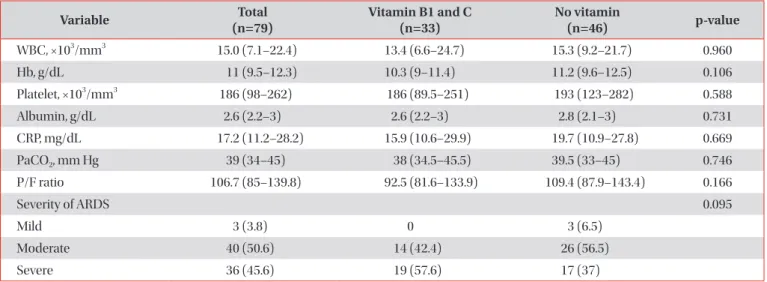
The values of laboratory parameters and severity of ARDS were compared and are shown in Table 2. Regarding the val- ues of laboratory parameters, no significant differences were observed between the two groups. There was a higher trend toward severe ARDS in the supplementation group than con- trol group (57.6% vs. 37%, p=0.095).

Table 2. Comparison of the laboratory results between the patients with vitamin B1 and C and those without

Variable Total

(n=79) Vitamin B1 and C

(n=33) No vitamin

(n=46) p-value

WBC, ×10

3

/mm

3

15.0 (7.1–22.4) 13.4 (6.6–24.7) 15.3 (9.2–21.7) 0.960

Hb, g/dL 11 (9.5–12.3) 10.3 (9–11.4) 11.2 (9.6–12.5) 0.106

Platelet, ×10

3

/mm

3

186 (98–262) 186 (89.5–251) 193 (123–282) 0.588

Albumin, g/dL 2.6 (2.2–3) 2.6 (2.2–3) 2.8 (2.1–3) 0.731

CRP, mg/dL 17.2 (11.2–28.2) 15.9 (10.6–29.9) 19.7 (10.9–27.8) 0.669

PaCO

2

, mm Hg 39 (34–45) 38 (34.5–45.5) 39.5 (33–45) 0.746

P/F ratio 106.7 (85–139.8) 92.5 (81.6–133.9) 109.4 (87.9–143.4) 0.166

Severity of ARDS 0.095

Mild 3 (3.8) 0 3 (6.5)

Moderate 40 (50.6) 14 (42.4) 26 (56.5)

Severe 36 (45.6) 19 (57.6) 17 (37)

WBC: white blood cell; Hb: hemoglobin; CRP: C-reactive protein; PaCO

2

: partial pressure of carbon dioxide; P/F: partial pressure of oxygen/

fractioned inspired oxygen; ARDS: acute respiratory distress syndrome.

Table 3. Comparison of the clinical outcomes between the patients with vitamin B1 and C and those without

Variable Total

(n=79) Vitamin B1 and C

(n=33) No vitamin

(n=46) p-value

14-Day mortality 37 (46.8) 15 (45.5) 22 (47.8) 0.835

30-Day mortality 50 (63.3) 18 (54.5) 32 (69.6) 0.172

ICU mortality 50 (63.3) 18 (54.5) 32 (69.6) 0.172

In hospital mortality 52 (66.7) 19 (59.4) 33 (71.7) 0.255

Mean VFD at day 30, day 4.8±9.2 7.7±10.8 2.7±7.3 0.014

Mean ICU-free day at day 30, day 4.2±8.3 6.9±9.8 2.2±6.5 0.009

Values are presented as number (%) otherwise indicated.

ICU: intensive care unit; VFD: ventilator free day.

(5)

2. Clinical outcomes and factors associated with 30-day mortality

The clinical outcomes are shown in Table 3. There were no significant differences in the rates of mortality between two groups. Both mean ventilator-free and ICU-free days at day 30 were significantly longer in the supplementation group than that in the control group (7.7±10.8 days vs. 2.7±7.3 days, p=0.014 and 6.9±9.8 days vs. 2.2±6.5 days, p=0.009).

The factors associated with 30-day mortality were evalu- ated using Cox proportional hazards regression analysis and are shown in Table 4. On univariate and multivariate analyses, APACHE II score was associated with 30-day mortality (haz- ard ratio [HR], 1.073; confidence interval [CI], 1.025–1.122;

p=0.002). Supplementation of vitamin B1 and C showed no association with 30-day mortality.

Propensity score matching yield 21 pairs of supplemented and control patients who had similar characteristics including age, sex, APACHE II score, SOFA score, use of NM blockers, steroid, and prone position. In matched patients, there were no significant differences in 30-day morality between supple- mentation and control group (57.1% vs. 66.7%, p=0.525).

Both mean ventilator-free and ICU-free days at day 30 were a longer trend toward supplementation group than control group, respectively (7.3±11 days vs. 2.4±7.7 days, p=0.079 and 6.9±9.8 vs. 2.2±6.5, p=0.096). Propensity matched analysis also showed that supplementation of vitamin B1 and C was not associated with 30-day mortality (HR, 0.808; 95% CI, 0.377–

1.730; p=0.808).

Discussion

In the current study, supplementation of vitamin B1 (200 mg/day) and vitamin C (2 g/day) showed no improvement in the mortality of patients with sepsis-related ARDS. The mean ventilator-free and ICU-free days at day 30 were longer in pa- tients supplemented with vitamin B1 and C than that in the

control patients but in matched group, there were no signifi- cant different. APACHE II score was associated with the 30- day mortality; however, supplementation with vitamin B1 and C showed no effect on 30-day mortality.

Sepsis is a common condition for ICU admission and ac- counts for a substantial mortality rate in critically ill patients

1

. ARDS is one of the life-threatening organ dysfunctions in sepsis

20

. The prevalence of ARDS was about 10% of all ICU admissions and mortality rate was high up to 40% in severe case

2

. Systemic inflammation is one of the pathogenetic mechanisms in sepsis-related ARDS

21,22

. Inflammation also plays a role in the generation of oxidative stress. Severe lung injury due to inflammation causes hypoxemia, which eventu- ally causes the dysfunction of aerobic metabolism. Mitigation of inflammatory and oxidative stress and facilitation of aerobic metabolism are presumably important to improve the clini- cal outcomes in patients with sepsis-related ARDS. Protective mechanical ventilation has been advanced to improve the clinical outcome in patients with ARDS. However, clinical tri- als assessing the efficacy of adjunct pharmacotherapy showed no consistent association with reduced mortality rate of pa- tients with ARDS

5-7

.

Vitamin C is hydrophilic and excreted in urine and has mul- tiple effects such as anti-inflammation, anti-oxidation, etc.

23

. Vitamin C is a cofactor for an enzyme which activates the endogeneous catecholamine production pathway

24

. Vitamin B1 (thiamine) is a water-soluble and crucial vitamin for aero- bic metabolism. It is a cofactor for pyruvate dehydrogenase, which converts pyruvate into acetyl-coenzyme A to enter the tricarboxylic acid cycle

8

. Moreover, vitamin B1 reduces oxalate excretion by acting as coenzyme in vitamin C metabolism

23

.

Some studies have reported that low vitamin C level in critically ill patients

12

. Vitamin C deficiency is associated with coagulation abnormalities, and endothelial dysfunction

25

. Vitamin B1 deficiency has been reported approximately up to 70% of critically ill patients and may be associated with in- creased mortality

26

. One study reported that thiamine supple- mentation was associated with lower creatinine levels and Table 4. The univariate and multivariate analysis for factors associated with 30-day mortality

Variable Univariate Multivariate

HR 95% CI p-value HR 95% CI p-value

Age 1.017 0.995–1.040 0.137 1.007 0.982–1.033 0.592

Male sex 0.953 0.526–1.727 0.875 0.807 0.439–1.484 0.490

APACHE II 1.073 1.025–1.122 0.002 1.073 1.025–1.122 0.002

RRT 1.014 0.539–1.908 0.966 0.830 0.422–1.634 0.590

Vitamin B1 and C 0.737 0.414–1.314 0.302 0.853 0.435–1.674 0.644

Steroid 0.979 0.562–1.705 0.941 1.018 0.540–1.922 0.955

Prone position 0.684 0.291–1.608 0.384 0.886 0.357–2.198 0.793

HR: hazard ratio; CI: confidence interval; APACHE: Acute Physiology and Chronic Health Evaluation; RRT: renal replacement therapy.

(6)

a lower rate of progression on renal replacement therapy in patients with septic shock

27

. Another study reported that early thiamine administration in patients with septic shock is asso- ciated with reduced 28-day mortality

28

.

Two retrospective studies (one on septic shock and the oth- er on severe pneumonia) reported that combined administra- tion of vitamin B1, C, and hydrocortisone was associated with improved clinical outcomes

13,14

. However, two recent studies demonstrated no such clinical benefits of early vitamin C and thiamine administration in patients with septic shock in emer- gency department

15,16

. Vitamin C monotherapy was ineffective to improve clinical outcome in patients with severe sepsis or septic shock receiving mechanical ventilation

29

. The clinical implication of combined vitamin B1 and C administration and the optimal dose remains undefined. The clinical data of vitamin B1 and C supplementation on patients with sepsis- related ARDS are still lacking. The present study evaluated the clinical benefit of vitamin B1 and C supplementation in patients with sepsis-related ARDS. There were no significant differences in mortalities between the supplementation and control groups. The ventilator-free and ICU-free days at day 30 were significantly longer in supplementation group than those in the control group. However, there was no significant differ- ent in 21 matched patients using propensity score matching method. Patients in control group were older and had more the proportion of comorbid diseases than those in supple- mentation group. This might affect the ventilator-free day and ICU-free day in unmatched groups. On multivariate analyses, the severity of illness was associated with 30-day mortality, but not with vitamin B1 and C supplementation. The current study showed no improvement in the mortality of patients with ARDS in the supplementation group, which contradicts the results of previous retrospective studies. The following reasons may explain the incongruence of results. First, dif- ferent characteristics of patients may be different among the studies. Second, the dose of vitamin B1 and C administered was lower than that administered in the previous studies. The current guideline did not support the administration of high doses vitamin, although the administration of high dose vita- min C (≥3 g/day) was associated with reduced mortality rate in some studies. Third, all patients assessed in this study did not receive steroid administration whereas most of patients in the two previous studies received steroid administration. Al- though, theoretically, the combined use of corticosteroid and vitamin C has a synergistic effect, the current sepsis guideline does not recommend corticosteroid administration except in case of refractory hypotension. The clinical benefit of steroid administration in patients with ARDS is still controversial. Ste- roid was used in patients with refractory septic shock, exacer- bation of existing airways disease. The use of steroid in ARDS was determined by the attending physician.

The current study has several limitations. The first, because of the single center, retrospective study design, selection bias

cannot be excluded. The second, some patient did not receive vitamin B1 and C administration during supplementation period, which limits the general interpretation of clinical out- comes of the present study. The third, we did not supplement high dose vitamin B1 and C as previous studies. The optimal dose of vitamin B1 and C supplementation was not defined, and moreover, the current guidelines does not recommend administration of high doses of vitamin B1 and C. The fourth, the biological levels of vitamin B1 and C were not measured.

Patients with low vitamin B1 and C levels might, therefore, have more clinical benefits than those with sufficient serum vitamin B1 and C levels. The fifth, all patients in the vitamin B1 and C supplementation group did not get steroids.

In conclusion, vitamin B1 (200 mg/day) and C (2 g/day) supplementation in patients with sepsis-related ARDS requir- ing invasive mechanical ventilation was not associated with reduced mortality rates, ventilator and ICU-free days. This finding suggests 2 g/day of vitamin C is inadequate to show survival benefit in patients with sepsis-related ARDS. Large prospective randomized controlled studies will be needed to conclusively verify the clinical benefit of vitamin B1 and C supplementation in patients with sepsis-related ARDS.

Authors’ Contributions

Conceptualization: Yoo JW. Methodology: Yoo JW. Formal analysis: Yoo JW, Kim RB. Data curation: Ju S, Lee SJ, Cho YJ, Jeong YY, Lee JD. Validation: Yoo JW, Kim HC. Investigation:

Lee JD, Kim HC. Writing - original draft preparation: Yoo JW.

Writing - review and editing: Yoo JW. Approval of final manu- script: all authors.

Conflicts of Interest

No potential conflict of interest was reported by the authors.

Funding

No funding to declare.

References

1. Singer M, Deutschman CS, Seymour CW, Shankar-Hari M, Annane D, Bauer M, et al. The Third International Consensus Definitions for Sepsis and Septic Shock (Sepsis-3). JAMA 2016;315:801-10.

2. Bellani G, Laffey JG, Pham T, Fan E, Brochard L, Esteban A, et

al. Epidemiology, patterns of care, and mortality for patients

with acute respiratory distress syndrome in intensive care

(7)

units in 50 countries. JAMA 2016;315:788-800.

3. Parhar KK, Zjadewicz K, Soo A, Sutton A, Zjadewicz M, Doig L, et al. Epidemiology, mechanical power, and 3-year outcomes in acute respiratory distress syndrome patients using stan- dardized screening: an observational cohort study. Ann Am Thorac Soc 2019;16:1263-72.

4. Reiss LK, Schuppert A, Uhlig S. Inflammatory processes dur- ing acute respiratory distress syndrome: a complex system.

Curr Opin Crit Care 2018;24:1-9.

5. Steinberg KP, Hudson LD, Goodman RB, Hough CL, Lanken PN, Hyzy R, et al. Efficacy and safety of corticosteroids for persistent acute respiratory distress syndrome. N Engl J Med 2006;354:1671-84.

6. National Heart, Lung, and Blood Institute ARDS Clinical Tri- als Network; Truwit JD, Bernard GR, Steingrub J, Matthay MA, Liu KD, et al. Rosuvastatin for sepsis-associated acute respira- tory distress syndrome. N Engl J Med 2014;370:2191-200.

7. Gao Smith F, Perkins GD, Gates S, Young D, McAuley DF, Tun- nicliffe W, et al. Effect of intravenous beta-2 agonist treatment on clinical outcomes in acute respiratory distress syndrome (BALTI-2): a multicentre, randomised controlled trial. Lancet 2012;379:229-35.

8. Attaluri P, Castillo A, Edriss H, Nugent K. Thiamine deficiency:

an important consideration in critically ill patients. Am J Med Sci 2018;356:382-90.

9. Carr AC, Maggini S. Vitamin C and immune function. Nutri- ents 2017;9:1211.

10. Berger MM, Oudemans-van Straaten HM. Vitamin C supple- mentation in the critically ill patient. Curr Opin Clin Nutr Metab Care 2015;18:193-201.

11. Donnino MW, Carney E, Cocchi MN, Barbash I, Chase M, Joyce N, et al. Thiamine deficiency in critically ill patients with sepsis. J Crit Care 2010;25:576-81.

12. Carr AC, Rosengrave PC, Bayer S, Chambers S, Mehrtens J, Shaw GM. Hypovitaminosis C and vitamin C deficiency in critically ill patients despite recommended enteral and par- enteral intakes. Crit Care 2017;21:300.

13. Marik PE, Khangoora V, Rivera R, Hooper MH, Catravas J.

Hydrocortisone, vitamin C, and thiamine for the treatment of severe sepsis and septic shock: a retrospective before-after study. Chest 2017;151:1229-38.

14. Kim WY, Jo EJ, Eom JS, Mok J, Kim MH, Kim KU, et al. Com- bined vitamin C, hydrocortisone, and thiamine therapy for patients with severe pneumonia who were admitted to the in- tensive care unit: Propensity score-based analysis of a before- after cohort study. J Crit Care 2018;47:211-8.

15. Shin TG, Kim YJ, Ryoo SM, Hwang SY, Jo IJ, Chung SP, et al.

Early vitamin C and thiamine administration to patients with septic shock in emergency departments: propensity score-

based analysis of a before-and-after cohort study. J Clin Med 2019;8:102.

16. Litwak JJ, Cho N, Nguyen HB, Moussavi K, Bushell T. Vitamin C, Hydrocortisone, and thiamine for the treatment of severe sepsis and septic shock: a retrospective analysis of real-world application. J Clin Med 2019;8:478.

17. Fan E, Brodie D, Slutsky AS. Acute respiratory distress syn- drome: advances in diagnosis and treatment. JAMA 2018;319:

698-710.

18. Singer P, Berger MM, Van den Berghe G, Biolo G, Calder P, Forbes A, et al. ESPEN guidelines on parenteral nutrition: in- tensive care. Clin Nutr 2009;28:387-400.

19. de Grooth HJ, Manubulu-Choo WP, Zandvliet AS, Spoelstra- de Man AME, Girbes AR, Swart EL, et al. Vitamin C pharma- cokinetics in critically ill patients: a randomized trial of four IV regimens. Chest 2018;153:1368-77.

20. Mikkelsen ME, Shah CV, Meyer NJ, Gaieski DF, Lyon S, Miltia- des AN, et al. The epidemiology of acute respiratory distress syndrome in patients presenting to the emergency depart- ment with severe sepsis. Shock 2013;40:375-81.

21. Englert JA, Bobba C, Baron RM. Integrating molecular patho- genesis and clinical translation in sepsis-induced acute respi- ratory distress syndrome. JCI Insight 2019;4:e124061.

22. Matthay MA, Zemans RL, Zimmerman GA, Arabi YM, Beitler JR, Mercat A, et al. Acute respiratory distress syndrome. Nat Rev Dis Primers 2019;5:18.

23. Marik PE. Vitamin C for the treatment of sepsis: the scientific rationale. Pharmacol Ther 2018;189:63-70.

24. Carr AC, Shaw GM, Fowler AA, Natarajan R. Ascorbate- dependent vasopressor synthesis: a rationale for vitamin C administration in severe sepsis and septic shock? Crit Care 2015;19:418.

25. Marik PE, Hooper MH. Doctor-your septic patients have scurvy! Crit Care 2018;22:23.

26. Cruickshank AM, Telfer AB, Shenkin A. Thiamine deficiency in the critically ill. Intensive Care Med 1988;14:384-7.

27. Moskowitz A, Andersen LW, Cocchi MN, Karlsson M, Patel PV, Donnino MW. Thiamine as a renal protective agent in septic shock: a secondary analysis of a randomized, double- blind, placebo-controlled trial. Ann Am Thorac Soc 2017;14:

737-41.

28. Woolum JA, Abner EL, Kelly A, Thompson Bastin ML, Morris PE, Flannery AH. Effect of thiamine administration on lactate clearance and mortality in patients with septic shock. Crit Care Med 2018;46:1747-52.

29. Ahn JH, Oh DK, Huh JW, Lim CM, Koh Y, Hong SB. Vitamin C

alone does not improve treatment outcomes in mechanically

ventilated patients with severe sepsis or septic shock: a retro-

spective cohort study. J Thorac Dis 2019;11:1562-70.

수치

Figure 1. Patients in this study. ARDS:
Table 1. Comparison of the baseline and the clinical characteristics between the patients with vitamin B1 and C and those  without Variable Total (n=79) Vitamin B1 and C(n=33) No vitamin(n=46) p-value Age, yr 70 (59–79) 66 (55.5–81) 73.5 (63–79)  0.257 Mal
Table 2. Comparison of the laboratory results between the patients with vitamin B1 and C and those without

참조

관련 문서