No Significance of the Free Cortisol Index Compared to Total Cortisol in Critically Ill Patients
Kyung Won Kim1,2, Sang Wan Kim1,3, Hee Joung Kim1, Chan Soo Shin1, Sung Jae Park4, Gil Joon Suh5, Seong Yeon Kim1 Department of Internal Medicine1, Seoul National University College of Medicine, Seoul; Healthcare System Gangnam Center2, Seoul National University Hospital, Seoul; Department of Internal Medicine3, Seoul National University Boramae Hospital, Seoul; Seoul National University Hospital Clinical Research Institute4, Seoul; Department of Emergency Medicine5, Seoul National University College of Medicine, Seoul, Korea
Received: 25 July 2010, Accepted: 13 December 2010 Corresponding author: Seong Yeon Kim
Department of Internal Medicine, Seoul National University College of Medicine, 101 Daehak-ro, Jongno-gu, Seoul 110-744, Korea
Tel: +82-2-2072-3216, Fax: +82-2-762-9662, E-mail: [email protected]
* This study was supported by a grant (04-2005-031-0) from the Seoul National University Hospital Research Fund.
Background: Some patients exhibit an inadequate response of cortisol to stressful conditions; this state is known as critical illness- related corticosteroid insufficiency. These patients have low serum binding protein concentrations, thereby suggesting that total se- rum cortisol may not be reflective of circulating cortisol activity. As the free cortisol index (FCI = total cortisol/corticosteroid-binding globulin) has been correlated with serum free cortisol, we measured FCI in Korean patients for the first time. In this study, we at- tempted to determine whether FCI was superior to total cortisol in predicting 30-day mortality.
Methods: We recruited 65 critically ill patients with relatively high Acute Physiology, Age and Chronic Health Evaluation (APACHE III) scores. Fourteen patients with pituitary disease but normal pituitary function were recruited from outpatient clinics. Total corti- sol and corticosteroid-binding globulin were measured in patients and controls during the short Synacthen test.
Results: The basal cortisol level and basal FCI level were higher in patients (n = 65) than in healthy controls (P < 0.001, respectively).
We found that total cortisol was strongly correlated with FCI (P < 0.001) in critically ill patients; however, neither total cortisol nor FCI were associated with 30-day mortality among patients. Only severe clinical criteria (such as APACHE-III scores and low albu- min) were associated with 30-day mortality.
Conclusion: Our results do not suggest that FCI is more accurate than total cortisol in predicting clinical outcomes in critically ill patients. (Endocrinol Metab 26:120-125, 2011)
Key Words: Critical illness, Adrenal insufficiency, APACHE, Mortality, Free cortisol index (FCI)
INTRODUCTION
Cortisol must be adequately secreted under stressful conditions because it is one of the essential hormones for maintaining and re- storing homeostasis following stressful events [1]. Acute physiologic stress, e.g., septic shock, increases adrenocorticotropic hormone (ACTH) and cortisol secretion through activation of the hypothala- mus-pituitary-adrenal (HPA) axis. However, some patients fail to mount an adequate cortisol response to overwhelming stress, and this inadequate response is referred to as “critical illness-related corticosteroid insufficiency (CIRCI)”.
Although it is generally agreed that adrenal failure may be com-
mon in subgroups of critically ill patients and should be treated immediately [2], the diagnosis and management of this disorder re- mains controversial. This controversy is based on several facts.
First, there is no gold-standard tool for diagnosis of CIRCI. Ideally, insulin tolerance test is used for assessing the entire axis, but this test is inappropriate in the critical care setting. Thus, investigations are limited to measurements of basal cortisol levels or the short Synacthen test (SST). Many criteria have been suggested for defin- ing CIRCI, yet this issue is still being debated [1,3,4]. However, the SST has been criticized that sepsis itself may evoke maximum cor- tisol secretion in individuals, thus SST may not be needed in maxi- mally stimulated situation such as sepsis. Second, it assesses adre- nal gland function directly, thereby potentially missing the diagno- sis of adrenal failure secondary to hypothalamic or pituitary failure.
Third, the total cortisol level, which is used in most criteria, does not provide an adequate assessment of adrenal cortical function.
Over 90% of circulating cortisol is bound to corticosteroid-binding globulin (CBG) with less than 10% in the free, biologically active
form [2]. Considering CBG levels decrease during critical illness, measurement of total cortisol concentrations can be underesti- mated. Free cortisol concentrations provide a more reliable indica- tor, but they are relatively difficult to measure in the clinical setting, and the normal range of free cortisol in critically ill patients is cur- rently unclear. To overcome these limitations, the free cortisol in- dex (FCI, serum cortisol divided by serum CBG concentration) was suggested to reflect the free cortisol. Forth, the benefit of glucocor- ticoids in sepsis is still unclear [1,5]. If there were a more confirma- tive diagnosis, the benefit would be greater.
Thus, it is important to define CIRCI to provide adequate treat- ment. As FCI has been shown to correlate with serum free cortisol [6,7] and can be measured more easily, we measured FCI in Korean patients for first time in this study. In this study, we investigated whether FCI was correlated with total cortisol, and was superior to total cortisol or not in predicting the clinical outcome. Although, sepsis itself may evoke maximum cortisol secretion in individuals, many studies used the SST to evaluate relative adrenal insuffi- ciency (RAI). Thus, we tested the SST in critically ill patients to compare our results with others. In addition, we evaluated which guidelines were better for diagnosing RAI. Although this study was not aimed to evaluate the efficacy of glucocorticoid supplementa- tion, we evaluated the prognostic value of certain criteria on RAI diagnosis.
MATERIALS AND METHODS
This study was conducted between November 2005 and Decem- ber 2006 in the Emergency Intensive Care Unit of the Seoul Na- tional University Hospital. The study protocol was approved by the Seoul National University Hospital Ethics Committee, and written informed consent was obtained from patients or their legal guard- ians.
1. Patients
We recruited 65 critically ill patients with higher Acute Physiol- ogy, Age and Chronic Health Evaluation (APACHE III) score (≥ 15) [8]. The APACHE III score was assessed using the worst clinical pa- rameters within 24 hour after admission to the intensive care unit.
Patients were excluded if they had a history of hypothalamic-pitu- itary or adrenal disease, if they had taken glucocorticoids or estro- gen in the preceding year or medications known to influence glu- cocorticoid secretion (e.g., ketoconazole) in the preceding six
months, or if they were pregnant or breast-feeding. Patients with cirrhosis, irreversible underlying disease such as advanced malig- nancy or AIDS, pulmonary embolism, and acute myocardial in- farction were also excluded. The patients were divided into three groups according to the following states: sepsis, septic shock, or other disease. Definitions of septic shock and sepsis followed the American College of Chest Physicians/Society of Critical Care Med- icine Consensus Conference Committee criteria [9]. Septic shock is defined as the presence of systemic inflammatory response syn- drome (SIRS), documented infection or positive blood culture and organ dysfunction in addition to hypotension despite adequate fluid resuscitation. Sepsis is defined as SIRS that has proven or sus- pected microbial etiology. SIRS is defined by the presence of two or more of the following criteria: fever (temperature > 38℃) or hy- pothermia (temperature < 36℃), tachycardia (> 90 beats/min), tachypnea (> 20 breaths/min), leucocytosis or leucopenia (white blood cell count > 12,000 or < 4000 cells/µL), or immature neutro- phils (bands > 10%). The criteria for organ dysfunction or a hypo- perfusion abnormality included the following: altered mental sta- tus, hypoxemia (PaO2 < 75 mmHg), oliguria (urine output < 30 mL/h), or elevated plasma lactate level (> 2 mmol/L). The defini- tion of hypotension was a systolic blood pressure < 90 mmHg or a reduction in systolic blood pressure of 40 mmHg or more from baseline. The patients with other diseases were those who did not meet the criteria of sepsis or septic shock, needed intensive care, and had a high APACHE III score. The category of other diseases consists of pneumonia, bleeding, pulmonary edema, trauma, rap- idly progressive glomerulonephritis, rhabdomyolysis, electrolyte imbalances.
2. Control
Fourteen patients with pituitary disease but a normal pituitary function were recruited from outpatient clinics. They had had pitu- itary diseases before, but they were cured after optimal treatment.
The controls had received no medication and had no evidence of any other endocrine or cancer, renal or liver dysfunction or infec- tion. Insulin tolerance tests were performed after an overnight fast on pituitary controls using regular insulin (0.1-0.2 U/kg i.v.). They showed normal GH and cortisol responses after the stimulation test (stimulated GH > 5 μg/L, stimulated cortisol > 18 μg/dL).
3. Clinical evaluation
Information relating to: 1) age and gender, 2) infection site(s) and
organisms, 3) severity of illness at baseline using the APACHE III scoring system, and 4) disease outcome including mortality were collected.
4. Laboratory measurements
An SST was performed while patients still met the inclusion cri- teria. Most patients (89%) performed the SST within 48 hour after admission to the intensive care unit. Blood samples were collected immediately before and 30 and 60 minutes after Synacthen (250 µg ACTH 1–24, Synacthen, CIBA, West Sussex, United Kingdom) was administered. Measurements of serum total cortisol were per- formed with the use of a standard radioimmunoassay (CIS BIO in- ternational CORT-CT2 kit, France). The intra- and inter-assay coef- ficients of variation were 4.3 and 4.2%, respectively. CBG was ana- lyzed by a commercial radioimmunoassay (CBG-RIA kit: Biosource Europe S.A., Nivelles, Belgium). This assay has a stated imprecision of generally less than 7% for between and within assay variation and a detection limit of 120 nmol/L (0.25 ± 0.02 µg/mL). FCI was calculated from the following equation: Total cortisol (nmol/L)/
CBG (mg/L).
Samples from individual subjects were analyzed together. Sam- ples were tested in duplicate.
5. Statistical analysis
Spearman rank correlation was used to assess whether there was a relationship between basal cortisol and basal FCI in the pituitary control group. In the patient group, Pearson correlation was used.
The plasma cortisol increment was defined as the difference be-
tween the basal cortisol and the highest concentration after the SST. Descriptive statistics are reported as the median score (inter- quartile range). Frequency comparisons were made with the chi- squared test or Fisher’s exact test. Two-group comparisons of nor- mally distributed data were performed by Student’s t-test. For data not normally distributed, the Mann-Whitney U test was used only if two groups were compared, and Kruskal-Wallis one-way analy- sis of variance was used if more than two groups were being com- pared. Statistical significance was set at P < 0.05. Statistical analyses were performed using the SPSS for Windows release 17 (SPSS, Chi- cago, IL, USA).
RESULTS
Control and patient groups
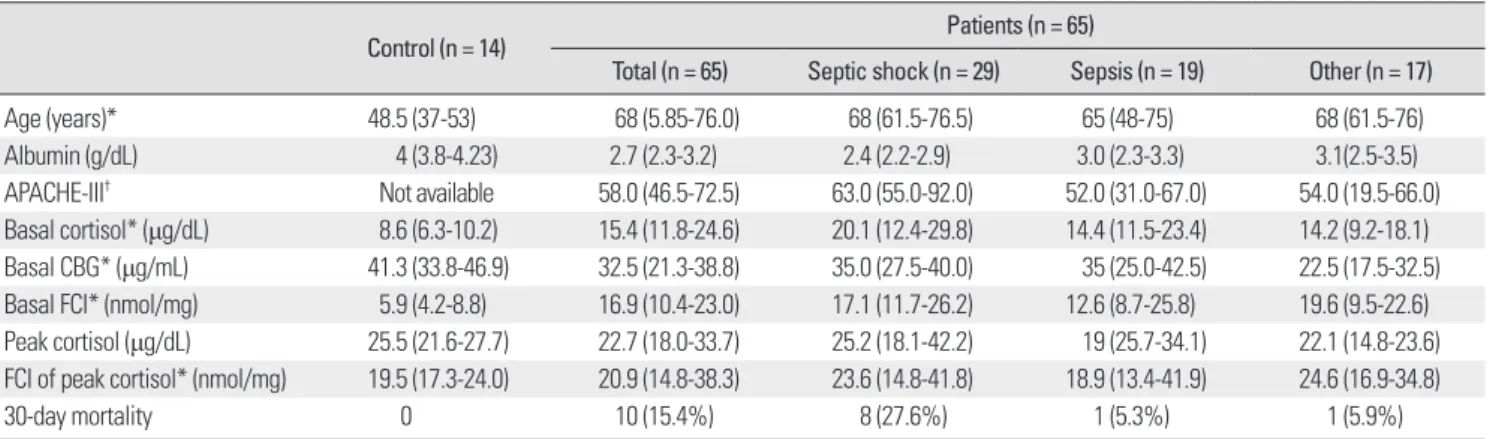
The median age of the controls was 48.5 (37-53) years, and they were younger than the patient group (P < 0.001) (Table 1). The basal cortisol level was 8.6 (6.3-10.2) μg/dL, which was lower than that of the patient group (P < 0.001). In the control group, basal cortisol and basal FCI were well correlated with each other (Spear- man rank correlation coefficient = 0.73, P = 0.003). In the patient group, basal cortisol and basal FCI were also well correlated (Pear- son correlation coefficient = 0.71, P < 0.001). The level of CBG was lower in the patient group (P = 0.005), accordingly basal FCI was higher in patients group (P < 0.001). Patients with septic shock had higher APACHE III scores (P = 0.013) and lower plasma albumin levels (P = 0.056) than patients with sepsis. Patients with septic shock had higher APACHE scores (P = 0.007), lower plasma albu-
Table 1. Comparison of basal characteristics amongst the patient and control groups
Control (n = 14) Patients (n = 65)
Total (n = 65) Septic shock (n = 29) Sepsis (n = 19) Other (n = 17)
Age (years)* 48.5 (37-53) 68 (5.85-76.0) 68 (61.5-76.5) 65 (48-75) 68 (61.5-76)
Albumin (g/dL) 4 (3.8-4.23) 2.7 (2.3-3.2) 2.4 (2.2-2.9) 3.0 (2.3-3.3) 3.1(2.5-3.5)
APACHE-III† Not available 58.0 (46.5-72.5) 63.0 (55.0-92.0) 52.0 (31.0-67.0) 54.0 (19.5-66.0) Basal cortisol* (μg/dL) 8.6 (6.3-10.2) 15.4 (11.8-24.6) 20.1 (12.4-29.8) 14.4 (11.5-23.4) 14.2 (9.2-18.1) Basal CBG* (μg/mL) 41.3 (33.8-46.9) 32.5 (21.3-38.8) 35.0 (27.5-40.0) 35 (25.0-42.5) 22.5 (17.5-32.5) Basal FCI* (nmol/mg) 5.9 (4.2-8.8) 16.9 (10.4-23.0) 17.1 (11.7-26.2) 12.6 (8.7-25.8) 19.6 (9.5-22.6) Peak cortisol (μg/dL) 25.5 (21.6-27.7) 22.7 (18.0-33.7) 25.2 (18.1-42.2) 19 (25.7-34.1) 22.1 (14.8-23.6) FCI of peak cortisol* (nmol/mg) 19.5 (17.3-24.0) 20.9 (14.8-38.3) 23.6 (14.8-41.8) 18.9 (13.4-41.9) 24.6 (16.9-34.8)
30-day mortality 0 10 (15.4%) 8 (27.6%) 1 (5.3%) 1 (5.9%)
The table shows means median score (interquartile range).
*P < 0.05 between control group and total patients.†P < 0.05 between septic shock patients and sepsis patients.
APACHE-III, Acute Physiology, Age and Chronic Health Evaluation-III score; CBG, corticosteroid-binding globulin; FCI, free cortisol index.
min levels (P = 0.036), higher basal cortisol levels (P = 0.044), and lower basal and 30 min CBG levels (P = 0.024 and P = 0.034) than patients with other diseases. There was a linear correlation be- tween total cortisol (or basal FCI) and higher APACHE III scores (P
= 0.006 and 0.075, respectively), not by clinical grouping (cortisol in septic shock vs. sepsis vs. other disease, P = 0.117).
Table 2 shows the characteristics of survivors and non-survivors.
APACHE III scores and albumin levels were significantly different between these groups. In the non-survivor group, the percentage of septic shock patients was higher than in the survivor group (P = 0.05). Neither cortisol nor FCI were predictable for mortality. The frequencies of critical illness-related corticosteroid insufficiency (CIRCI) and association with mortality
Table 3 shows 30-day in-hospital mortality according to currently suggested criteria. The mortality rate was 15.4% (10/65). Using the
currently most-validated criterion [4,10], the frequency of RAI (Δ cortisol < 9) was 58.5% (38/65). The cut-off level 18 was used be- cause a normal response was defined by a peak plasma cortisol of greater than 18 μg/dL. The rates of RAI were 22-69%, although there was no difference in mortality between the groups. Although septic shock patients were more likely to die, certain specific RAI criteria failed to reliably predict 30-day mortality. To analyze the mortality difference according to CIRCI in similar clinical condi- tion, we divided patients into 2 groups stratified by APACHE III score (less severe APACHE group [score ≤ 58, n = 33] and more se- vere [APACHE3 score > 58, n = 32] group). There was no mortality difference between CIRCI and non-CIRCI in similar clinical condi- tion. The mortality of CIRCI was not affected by sepsis, septic shock and other disease, either (data not shown).
DISCUSSION
We planned the present study to determine whether FCI is well correlated with total cortisol and provides more information for identification of patients who would benefit from corticosteroid treatment during critical illness. We found that basal total cortisol correlated well with basal FCI (P < 0.001) in critically ill patients, which means the patients with low total cortisol were more likely to have low FCI. Clinical severity resulted in higher APACHE III scores, lower albumin concentration, and higher basal cortisol;
however, only two of the former factors were associated with 30- day mortality. Accordingly, FCI did not provide any additional in- formation for predicting patient 30-day mortality. The prevalence of RAI was 22-69% according to currently suggested criteria [3,4,10,11]; none of these criteria was associated with 30-day mor- tality and we could not suggest which guideline was best for pre- dicting in 30-day mortality in the present study.
Activation of the HPA axis is one of several important responses
Table 3. 30-day mortality difference among the patient groups according to various critical illness-related corticosteroid insufficiency (CIRCI) criteria Septic shock
(n = 29) Sepsis
(n = 19) Other
(n = 17) Total
(n = 65) P
Basal cortisol <18 μg/dL (n = 38) [3] 4/13 (31%) 0/12 (0%) 1/13 (8%) 5/38 (13%) 0.058
Any cortisol <18 μg/dL (n = 15) 2/7 (29%) 0/3 (0%) 1/5 (20%) 3/15 (20%) 0.585
ΔCortisol < 9 μg/dL (n = 38) [3] 6/18 (33%) 1/10 (10%) 1/10 (10%) 8/38 (21%) 0.212
Basal cortisol <10 μg/dL or ΔCortisol < 9 μg/dL (n = 43) [4] 7/19 (37%) 1/11 (9%) 1/13 (8%) 9/43 (21%) 0.074 Basal cortisol < 15 μg/dL or ΔCortisol < 9 μg/dL (n = 45) [4,10] 6/18 (33%) 1/12 (8%) 1/15 (7%) 8/45 (18%) 0.083 30 min free cortisol index (<12 nmol/mg) (n = 14) [11] 2/5 (40%) 0/6 (0%) 0/3 (0%) 2/14 (14%) 0.122 Comparison among patients with septic shock, sepsis, and other diseases was calculated using chi-squared tests.
Table 2. Short Synacthen test results according to 30-day hospital mortality Survivors
(n = 55) Non-survivors
(n = 10) P
Age (years) 68 (57-75) 71 (66-81.3) 0.075
APACHE-III 56 (42-67) 79 (67.5-100.5) 0.001 Septic shock patients 12 (38.2%) 8 (80%) 0.05 Albumin (g/dL) 2.7 (2.4-3.3) 2.3 (2.1-2.9) 0.024 Basal Cortisol (μg/dL) 15.4 (11.8-23.4) 18.2 (8.9-28.8) 0.86 Cortisol at T30 (μg/dL) 21.5 (15.6-30.3) 20 (14.4-33.1) 0.87 Cortisol at T60 (μg/dL) 24 (18.3-33.2) 20.2 (13.0-33.1) 0.51 Peak cortisol (μg/dL) 24.3 (18.3-34.1) 20.8 (14.5-34.1) 0.59 Δ max cortisol (μg/dL) 7.6 (3.3-11.7) 2.3 (0.5-8.8) 0.16 Basal FCI (nmol/mg) 16.9 (11.0-21.9) 18.6 (8.7-51.9) 0.46 FCI at T30 (nmol/mg) 21.0 (13.6-34.5) 18.6 (13.4-35.9) 0.83 FCI at T60 (nmol/mg) 22.5 (15.6-41.9) 20.9 (12.8 -46.7) 0.86 Peak FCI (nmol/mg) 23.6 (15.6-38.9) 20.1 (9.4-42.4) 0.59 Δ FCI (nmol/mg) 7.6 (2.7-13.4) -0.9 (-4.3-13.4) 0.18 The table shows means median score (interquartile range).
T60, 60 min after the short Synacten test; T60, 60 min after the short; Syna- cthen test; Δ max, peak cortisol minus baseline cortisol.
to stressful events and critical illnesses. As adrenal response is fre- quently disturbed in critically ill patients, glucocorticoid replace- ment may be beneficial to some patients. Although the benefit was confined to the group of SST nonresponders (Δ cortisol < 100-250 nmol/L), moderate-dose hydrocortisone (200-300 mg/d) improved the 28-day mortality in patients with septic shock [12,13]. However, retrospective Corticus cohort study and a meta–analysis of six ran- domized, controlled trials demonstrated greater shock reversal with hydrocortisone but no benefit in terms of mortality [4,5]. Thus, this results made clinicians reluctant to prescribe corticosteroids, though Corticus study was criticized for selection bias (patients least likely to benefit from corticosteroids were enrolled in the study) [14]. Potential benefits of glucocorticoid therapy in critically ill patients include anti-inflammatory effects, inhibition of cytokine production, decreased arachidonic acid synthesis, increased anti- inflammatory cytokine expression, and effects on the cardiovascu- lar system to promote both improved vascular tone and catechol- amine responsiveness [1]. Adverse sequelae include hyperglycemia, insulin resistance, bone loss, muscle wasting, hypokalemia, and changes in mental status [1]. Considering the benefits of glucocorti- coid, the use of moderate-dose hydrocortisone seems rational in patients with septic shock who have responded poorly to fluid re- suscitation and vasopressor agents [4].
However, other studies reported that low total cortisol levels have been associated with favorable outcomes [5,15,16]. Although we could not find a significant difference in basal total cortisol and FCI concentrations between septic shock patients and sepsis pa- tients, severe patients were more likely to have higher cortisol level. If more patients were enrolled in our study, we might have found a significant trend between the groups.
The rate of CIRCI in the present study was 58.5% (CIRCI was de- fined when Δ cortisol was less than 9 μg/dL), which was higher than another Korean study [17]. However, we failed to show a mor- tality difference between CIRCI and non-CIRCI. It is still controver- sial as to whether cortisol could predict in-hospital mortality [18].
The mortality rate was similar in CIRCI groups defined by the vari- ous criteria in our study (Table 3). Although the same criteria were used for all groups, patients with shock were more likely to die than patients with sepsis or other diseases. As higher APACHE III scores reflect the seriousness of the clinical condition, the most im- portant prognostic factor was clinical severity rather than CIRCI in the current study. However, the limitations of the present study are that a small sample size was used and patients were enrolled from
a single institution; therefore, there was only a small number of in- hospital deaths (15.4%, which is relatively lower than others, i.e., 31.5-61%). This low death rate might be the reason why a signifi- cant correlation could not be detected between survival and the level of baseline serum cortisol or change in cortisol. Ethnic differ- ences may account for this discrepancy as well.
Cortisol levels vary broadly with disease severity making it diffi- cult to define appropriate responses. Indeed, only the free hor- mone is biologically active, whereas more than 90% of circulating cortisol is bound to proteins, predominantly CBG but also albumin [2]. Our control group was younger than patients’ group and their clinical condition was much different to patients’ group. As the cortisol secretion does not change during age [19], we speculate that the cortisol concentration of control group is similar to that of the aged. Also, it seems to be meaningful to assess the CBG con- centration in normal population. Circulating CBG concentrations are approximately 700 nmol/L [2], and this is consistent with our results (our basal CBG concentration of control group was 41.3 ± 10.5 μg/mL, i.e., 794.2 ± 20.2 nmol/L). During acute illness, partic- ularly sepsis, CBG levels fall by as much as 50%, resulting in a sig- nificant increase in the percentage of free cortisol [20]. A recent study of critically ill patients suggested that low cortisol binding proteins, rather than low free cortisol levels, may underlie reports of reduced total cortisol in critical illness [21]. However, direct de- termination of free cortisol levels is labor-intensive and impractical for routine clinical use. CBG was decreased among patients with critical illness in our study, which is consistent with another study.
Nevertheless, FCI was not superior to total cortisol in this study.
FCI was linearly correlated with total cortisol in critically ill pa- tients. Neither a change in cortisol nor a change in FCI provided additional information to predict mortality. As we did not try glu- cocorticoid supplementation in CIRCI patients, we cannot evaluate the efficacy of glucocorticoid therapy.
In the current study, calculating FCI, instead of total cortisol, did not help to distinguish between survivors and non-survivors.
Therefore, calculation of free cortisol concentration, instead of to- tal, most likely does not help to identify patients who could poten- tially benefit from glucocorticoid treatment.
REFERENCES
1. Venkataraman S, Munoz R, Candido C, Witchel SF: The hypothalamic- pituitary-adrenal axis in critical illness. Rev Endocr Metab Disord 8:365-
373, 2007
2. Stewart PM: Williams textbook of endocrinology. 11th ed. pp445-503, Philadelphia, Saunders, 2008
3. Arafah BM: Hypothalamic pituitary adrenal function during critical ill- ness: limitations of current assessment methods. J Clin Endocrinol Metab 91:3725-3745, 2006
4. Marik PE, Pastores SM, Annane D, Meduri GU, Sprung CL, Arlt W, Keh D, Briegel J, Beishuizen A, Dimopoulou I, Tsagarakis S, Singer M, Chrou- sos GP, Zaloga G, Bokhari F, Vogeser M: Recommendations for the diag- nosis and management of corticosteroid insufficiency in critically ill adult patients: consensus statements from an international task force by the Ame- rican College of Critical Care Medicine. Crit Care Med 36:1937-1949, 2008 5. Lipiner-Friedman D, Sprung CL, Laterre PF, Weiss Y, Goodman SV, Voge- ser M, Briegel J, Keh D, Singer M, Moreno R, Bellissant E, Annane D:
Adrenal function in sepsis: the retrospective Corticus cohort study. Crit Care Med 35:1012-1018, 2007
6. le Roux CW, Chapman GA, Kong WM, Dhillo WS, Jones J, Alaghband- Zadeh J: Free cortisol index is better than serum total cortisol in determin- ing hypothalamic-pituitary-adrenal status in patients undergoing surgery.
J Clin Endocrinol Metab 88:2045-2048, 2003
7. le Roux CW, Sivakumaran S, Alaghband-Zadeh J, Dhillo W, Kong WM, Wheeler MJ: Free cortisol index as a surrogate marker for serum free corti- sol. Ann Clin Biochem 39:406-408, 2002
8. Knaus WA, Wagner DP, Draper EA, Zimmerman JE, Bergner M, Bastos PG, Sirio CA, Murphy DJ, Lotring T, Damiano A: The APACHE III pro- gnostic system. Risk prediction of hospital mortality for critically ill hos- pitalized adults. Chest 100:1619-1636, 1991
9. American College of Chest Physicians/Society of Critical Care Medicine Consensus Conference: definitions for sepsis and organ failure and guide- lines for the use of innovative therapies in sepsis. Crit Care Med 20:864- 874, 1992
10. Cooper MS, Stewart PM: Corticosteroid insufficiency in acutely ill patie- nts. N Engl J Med 348:727-734, 2003
11. Dhillo WS, Kong WM, Le Roux CW, Alaghband-Zadeh J, Jones J, Carter G, Mendoza N, Meeran K, O’Shea D: Cortisol-binding globulin is impor- tant in the interpretation of dynamic tests of the hypothalamic-pituitary- adrenal axis. Eur J Endocrinol 146:231-235, 2002
12. Annane D, Sebille V, Charpentier C, Bollaert PE, Francois B, Korach JM, Capellier G, Cohen Y, Azoulay E, Troche G, Chaumet-Riffaud P, Bellis- sant E: Effect of treatment with low doses of hydrocortisone and fludrocor- tisone on mortality in patients with septic shock. JAMA 288:862-871, 2002
13. de Jong MF, Beishuizen A, Spijkstra JJ, Groeneveld AB: Relative adrenal insufficiency as a predictor of disease severity, mortality, and beneficial ef- fects of corticosteroid treatment in septic shock. Crit Care Med 35:1896- 1903, 2007
14. Marik PE, Pastores SM, Kavanagh BP: Corticosteroids for septic shock. N Engl J Med 358:2069-2070, 2008
15. Bendel S, Karlsson S, Pettila V, Loisa P, Varpula M, Ruokonen E: Free cor- tisol in sepsis and septic shock. Anesth Analg 106:1813-1819, 2008 16. Sam S, Corbridge TC, Mokhlesi B, Comellas AP, Molitch ME: Cortisol
levels and mortality in severe sepsis. Clin Endocrinol (Oxf) 60:29-35, 2004 17. Kwon YS, Kang E, Suh GY, Koh WJ, Chung MP, Kim H, Kwon OJ,
Chung JH: A prospective study on the incidence and predictive factors of relative adrenal insufficiency in Korean critically-ill patients. J Korean Med Sci 24:668-673, 2009
18. Gotoh S, Nishimura N, Takahashi O, Shiratsuka H, Horinouchi H, Ono H, Uchiyama N, Chohnabayashi N: Adrenal function in patients with com- munity-acquired pneumonia. Eur Respir J 31:1268-1273, 2008 19. Lamberts SW: Williams textbook of endocrinology. 11th ed. pp1185-1199,
Philadelphia, Saunders, 2008
20. Marik PE: Mechanisms and clinical consequences of critical illness associ- ated adrenal insufficiency. Curr Opin Crit Care 13:363-369, 2007 21. Hamrahian AH, Oseni TS, Arafah BM: Measurements of serum free corti-
sol in critically ill patients. N Engl J Med 350:1629-1638, 2004