434 CASE REPORT
DOI 10.4070 / kcj.2009.39.10.434
Print ISSN 1738-5520 / On-line ISSN 1738-5555 Copyright ⓒ 2009 The Korean Society of Cardiology
Open Access
Acute and Subacute Stent Thrombosis in a Patient With Clopidogrel Resistance: A Case Report
Sung Soo Kim, MD1,2, Myung Ho Jeong, MD1,2, Hyun-Kuk Kim, MD1,2, Soo Young Bae, MD1, Kyoung Ho Ryu, MD1, Kyung Hun Cho, MD1,2, Min Chul Kim, MD1,2, Keun Ho Park, MD1,2, Doo Sun Sim, MD1,2,
Young Joon Hong, MD1,2, Ju Han Kim, MD1,2, Youngkeun Ahn, MD1,2 and Jung Chaee Kang, MD1,2
1The Heart Research Center of Chonnam National University Hospital and
2Cardiovascular Research Institute of Chonnam National University, Gwangju, Korea
ABSTRACT
Drug-eluting stents (DES) are considered the treatment of choice for most patients with obstructive coronary artery disease when percutaneous intervention (PCI) is feasible. However, stent thrombosis seems to occur more frequently with DES and occasionally is associated with resistance to anti-platelet drugs. We have experienced a case of recurrent stent thrombosis in a patient with clopidogrel resistance. A 63-year-old female patient suffered from acute myocardial infarction and underwent successful PCI of the left anterior descending coronary artery (LAD) with two DESs. She was found to be hyporesponsive to clopidogrel and was treated with triple anti- platelet therapy (aspirin 100 mg, clopidogrel 75 mg, and cilostazol 200 mg daily). Three days after discharge, she developed chest pain and was again taken to the cardiac catheterization laboratory, where coronary angiography (CAG) showed total occlusion of the mid-LAD where the stent had been placed. After intravenous administra- tion of a glycoprotein IIb/IIIa inhibitor, balloon angioplasty was performed, resulting in Thrombolysis In Myo- cardial Infarction (TIMI) III antegrade flow. The next day, however, she complained of severe chest pain, and the electrocardiogram showed marked ST-segment elevation in V1-V6, I, and aVL with complete right bundle branch block. Emergent CAG revealed total occlusion of the proximal LAD due to stent thrombosis. She was successfully treated with balloon angioplasty and was discharged with triple anti-platelet therapy. (Korean Circ J 2009;39:434-438)
KEY WORDS: Thrombosis; Stents; Clopidogrel.
Introduction
In recent years, drug-eluting stents (DES) have been demonstrated to dramatically reduce the rate of reste- nosis and the need for repeat revascularization.1-3) De- spite these promising results, stent thrombosis seems to occur more frequently with DES and often seems to be associated with clopidogrel resistance.4) We report a
case of recurrent stent thrombosis associated with clo- pidogrel resistance in a patient with acute myocardial infarction.
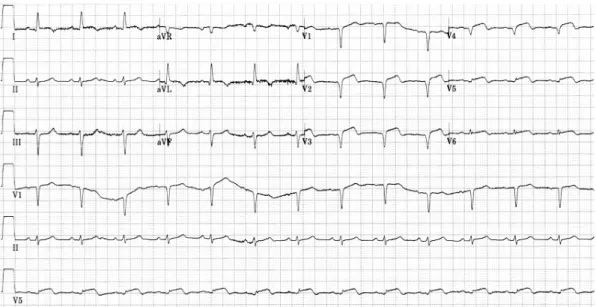
A 63-year-old female was transferred to the Emergency Department complaining of squeezing chest pain that had increased over the past twelve hours. The electrocar- diogram (ECG) showed ST-segment elevation in V1-V3 (Fig. 1). She underwent emergent coronary angiography (CAG), which revealed critical stenosis in the proximal and middle left anterior descending coronary artery (LAD). She was successfully treated with two paclitaxel- eluting stents (3.0×12 mm and 2.5×28 mm Taxus stents, Boston Scientific, Reading, PA, USA) in the pro- ximal and middle LAD (Fig. 2). She was treated with tri- ple antiplatelet therapy (aspirin 100 mg, clopidogrel 75 mg, and cilostazol 200mg daily) because she was found to be hyporesponsive to clopidogrel when tested for adenosine diphosphase (ADP)-induced platelet aggregation utiliz- ing the VerifyNow P2Y12 point-of-care assay (181/0
Received: May 28, 2009 Accepted: June 30, 2009
Correspondence: Myung Ho Jeong, MD, The Heart Research Center of Chonnam National University Hospital, 671 Jaebong-ro, Dong-gu, Gwangju 501-746, Korea
Tel: 82-62-220-6243, Fax: 82-62-228-7174 E-mail: [email protected]
○cc This is an Open Access article distributed under the terms of the Creative Commons Attribution Non-Commercial License (http://creativecommons.
org/licenses/by-nc/3.0) which permits unrestricted non-commercial use, distribution, and reproduction in any medium, provided the original work is properly cited.
P2Y12 reaction unit/%).
Three days after discharge, she again developed chest pain and presented to the emergency department with mental confusion associated with acute pulmonary ede- ma. The ECG showed ST-segment elevation in V1-V5 (Fig. 3) and the cardiac enzymes were elevated (creatine kinase-MB 34.0 U/L, Troponin-I 67.01 ng/mL, Tropo- nin-T 5.5 ng/mL). Emergency CAG, after intubation due to hypoxemia, showed total occlusion of the mid- LAD due to stent thrombosis (Fig. 4). After intravenous administration of a glycoprotein IIb/IIIa receptor blocker (ReoPro®), balloon angioplasty was carried out multiple
times using a 3.0 mm balloon at 10-12 atm because of recurrent, immediate thrombus formation and coronary occlusion. The next day, however, she complained of severe chest pain again, and the ECG showed marked ST-segment elevation in V1-V6, I, and aVL; and new- onset complete right bundle branch block with left an- terior fascicular block (Fig. 5). Emergent CAG revealed thrombotic total occlusion of the proximal LAD (Fig. 6).
She was successfully treated with balloon angioplasty and a final angiogram revealed improved flow over stent- ed LAD without intraluminal filling defect. Despite the cilostazol medication, ADP-induced platelet aggregation
Fig. 1. The electrocardiogram showed ST-segment elevation in V1-V3.
A B
Fig. 2. A: coronary angiogram revealed critical stenosis in the proximal and middle left anterior descending coronary artery (LAD) (arrows).
B: two paclitaxel-eluting stents (3.0×12 mm and 2.5×28 mm Taxus stents, Boston Scientific, Reading, PA, USA) were successfully placed in the occluded LAD.
436·Acute and Subacute Stent Thrombosis
showed that she was still hyporesponsive to clopidogrel (171/0 P2Y12 reaction unit/%). She was discharged af- ter uneventful recovery with triple anti-platelet therapy using an increased dose of aspirin (aspirin 200 mg, clo- pidogrel 75 mg, cilostazol 200 mg daily). The patient has been followed up at the outpatient department without further symptoms.
Discussion
We report this case to draw more attention to stent thrombosis associated with clopidogrel resistance after DES implantation. This case shows that a DES patient with clopidogrel resistance can be vulnerable to stent thrombosis even if treated with triple anti-platelet thera- py, which in recent studies has been shown to be more
effective in preventing stent thrombosis than conven- tional dual anti-platelet therapy. Recently, there have been safety concerns with DES due to late stent thrombosis.
Stent thrombosis is an uncommon but serious complica- tion of coronary artery stents that often presents as myo- cardial infarction (MI) or death. Over several trials, the incidence of stent thrombosis was 0.58-1.3% in DES.5)6)
Several factors have been associated with stent throm- bosis, including older age, black race, diabetes mellitus, bifurcation lesion, in-stent restenosis lesion, procedure- related factors such as stent malposition, greater stent length, postprocedure acute renal failure, non-compli- ance to anti-platelet agent and anti-platelet resistance.7-9) Anti-platelet resistance as an independent predictor of stent thrombosis, even several years after implantation of DES, increases the risk of stent thrombosis. In this
Fig. 3. The electrocardiogram showed newly developed ST-segment elevation in V1-V5.
A B
Fig. 4. A: emergent coronary angiogram showed near-total occlusion of the mid- left anterior descending coronary artery (LAD) due to stent thrombosis (arrow). Balloon angioplasty was carried out multiple times using a 3.0 mm balloon at 10-12 atm with the aid of platelet glyco- protein IIb/IIIa inhibitor. B: a final coronary angiogram showed Thrombolysis In Myocardial Infarction (TIMI) III antegrade flow with some remaining filling defects in the LAD.
patient, stent thrombosis may have been caused by sev- eral risk factors, especially anti-platelet resistance.
The treatment of anti-platelet resistance is as yet un- defined. Several therapeutic approaches (the addition of cilostazol or a glycoprotein IIb/IIIa inhibitor, increased dosage of clopidogrel and aspirin) might be taken for a patient with anti-platelet resistance. In our patient, al- though cilostazol (200 mg daily) was added to conven- tional dual anti-platelet therapy, recurrent stent throm- bosis occurred. Subsequently, the daily dose of aspirin was increased from 100 mg to 200 mg.
In the DES era, stent thrombosis is a fatal complica- tion and anti-platelet therapy has been shown to be very important in preventing stent thrombosis. Thus, assess- ment of the patient’s responsiveness to anti-platelet agents may be a crucial factor in monitoring these drugs’
therapeutic efficacy and improving clinical outcomes af-
ter implantation of DES. Recent studies have shown that adequate anti-platelet effects are not achieved in 5% to 45% of the patients taking aspirin and in 4% to 30% of patients taking clopidogrel10)11) and therefore suggest that many patients are resistant or only partially responsive to the anti-platelet agents. Currently, however, routine screening for anti-platelet resistance remains a persistent, unresolved issue and further evidence is neces- sary before it will be possible to recommend this testing as part of standard assessment of PCI candidates. In addi- tion, further prospective studies are needed to set guide- lines for optimal treatment of patients with antiplatelet resistance who are at increased risk of stent thrombosis, a catastrophic complication of DES implantation.
REFERENCES
1) Serruys PW, Degertekin M, Tanabe K, et al. Intravascular ultra- Fig. 5. The next day, she complained of chest pain, and the electrocardiogram showed ST-segment elevation in V1-V6, I, and aVL; and new- onset complete right bundle branch block with left anterior fascicular block.
Fig. 6. A: emergent coronary angiogram revealed thrombotic total occlusion of the proximal left anterior descending coronary artery (LAD) (arrow). Balloon angioplasty was performed several times using a 2.5 mm balloon. B: a final coronary angiogram showed Thrombolysis In Myocardial Infarction (TIMI) III antegrade flow with resolution of the thrombus burden.
A B
438·Acute and Subacute Stent Thrombosis
sound findings in the multicenter, randomized, double-blind RAVEL (Randomized study with the sirolimus-eluting Velocity balloon- expandable stent in the treatment of patients with de novo native coronary artery Lesions) trial. Circulation 2002;106:798-803.
2) Colombo A, Drzewiecki J, Banning A, et al. Randomized study to assess the effectiveness of slow- and moderate-release polymer- based paclitaxel-eluting stents for coronary artery lesions. Circul- ation 2003;108:788-94.
3) Zhang F, Ge J, Qian J, et al. Sirolimus-eluting stents in real-world patients with ST-segment elevation acute myocardial infarction.
Int Heart J 2007;48:303-11.
4) Kim JY, Yoon JH. Aspirin and clopidogrel resistance in drug elut- ing stent era. Korean Circ J 2007;37:135-47.
5) Schuhlen H, Kastrati A, Pache J, Dirschinger J, Schomig A. Inci- dence of thrombotic occlusion and major adverse cardiac events between two and four weeks after coronary stent placement: anal- ysis of 5,678 patients with a four-week ticlopidine regimen. J Am Coll Cardiol 2001;37:2066-73.
6) De la Torre-Hernandez JM, Alfonso F, Hernandez F, et al. Drug-
eluting stent thrombosis: results from the multicenter Spanish reg- istry ESTROFA (Estudio ESpanol sobre TROmbosis de stents FAr- macoactivos). J Am Coll Cardiol 2008;51:986-90.
7) Kuchulakanti, Chu WW, Torguson R, et al. Correlates and long- term outcomes of angiographically proven stent thrombosis with si- rolimus- and paclitaxel-eluting stents. Circulation 2006;113:1108-13.
8) Park SH, Hong GR, Seo HS, Tahk SJ. Stent thrombosis after suc- cessful drug-eluting stent implantation. Korean Circ J 2005;35:
163-71.
9) Kim SS, Jeong MH, Sim DS, et al. Very late stent thrombosis of drug eluting stent after discontinuation of dual anti-platelet therapy in a patient treated with both drug eluting and bare metal stents.
Korean Cir J 2009;39:205-8.
10) Gum PA, Kottke-Marchant K, Poggio ED, et al. Profile and pre- valence of aspirin resistance in patients with cardiovascular dis- ease. Am J Cardiol 2001;88:230-5.
11) Gurbel PA, Blinden KP, Hiatt BL, O’Connor CM. Clopidogrel for coronary stenting: response variability, drug resistance, and the effect of pretreatment platelet reactivity. Circulation 2003;107:2908-13.