10
Open Access
The Effect of Cilostazol on Stent Thrombosis After Drug-Eluting Stent Implantation
Doo-Soo Jeon, MD, Ki-Dong Yoo, MD, Chan-Suk Park, MD, Dong-Il Shin, MD, Sung-Ho Her, MD,
Hoon-Joon Park, MD, Yoon-Seok Choi, MD, Dong-Bin Kim, MD, Chong-Min Lee, MD, Chul-Soo Park, MD, Pum-Joon Kim, MD, Keon-Woong Moon, MD, Ki-Yuk Jang, MD, Hee-Yeol Kim, MD,
Wook-Sung Chung, MD, Ki-Bae Seung, MD, Jae-Hyung Kim, MD and Kyu-Bo Choi, MD
Division of Cardiology, Department of Internal Medicine, College of Medicine, The Catholic University of Korea, Seoul, Korea ABSTRACT
Background and Objectives: Placement of drug-eluting stents (DES) can be complicated by stent thrombosis;
prophylactic antiplatelet therapy has been used to prevent such events. We evaluated the efficacy of cilostazol with regard to stent thrombosis as adjunctive antiplatelet therapy. Subjects and Methods: A total of 1,315 patients (846 males, 469 females) were prospectively enrolled and analyzed for the frequency of stent thrombosis. Patients with known risk factors for stent thrombosis, except diabetes and acute coronary syndrome, were excluded from the study. All patients maintained antiplatelet therapy for at least six months. To evaluate the effects of cilostazol as another option for antiplatelet therapy, triple antiplatelet therapy (aspirin+clopidogrel+cilostazol, n=502) was compared to dual antiplatelet therapy (aspirin+clopidogrel, n=813). Six months after stent placement, all patients received only two antiplatelet drugs: treatment either with cilostazol+aspirin (cilostazol group) or clopidogrel+as- pirin (clopidogrel group). There were 1,033 patients (396 in cilostazol group and 637 in clopidogrel group) that maintained antiplatelet therapy for at least 12 months and were included in this study. Stent thrombosis was de- fined and classified according to the definition reported by the Academic Research Consortium (ARC). Results: During follow-up (561.7±251.4 days), 15 patients (1.14%) developed stent thrombosis between day 1 to day 657.
Stent thrombosis occurred in seven patients (1.39%) on triple antiplatelet therapy and four patients (0.49%) on dual antiplatelet therapy (p=NS) within the first six months after stenting. Six months and later, after stent implantation, one patient (0.25%) developed stent thrombosis in the cilostazol group, and three (0.47%) in the clopidogrel group (p=NS). Conclusion: During the first six months after DES triple antiplatelet therapy may be more effective than dual antiplatelet therapy for the prevention of stent thrombosis. However, after the first six months, dual antiplatelet treatment, with aspirin and cilostazol, may have a better cost benefit ratio for the pre- vention of stent thrombosis. (Korean Circ J 2010;40:10-15)
KEY WORDS: Drug-eluting stents; Cilostazol.
Introduction
Since Andreas Gruentzig performed the first successful
balloon angioplasty in 1977, percutaneous coronary in- terventions (PCI) have changed considerably. The im- plantation of drug-eluting stents (DES) was introduced in 2001 and has been a popular catheter-based me- thod used in clinical practice worldwide. The DES has noticeably reduced the frequency of restenosis, which was one of the most difficult problems associated with bare metal stents. Large scale studies have demonstrated the effectiveness of DES for reducing the frequency of restenosis and major cardiac events.1-7) However, long term follow up studies have reported various additional problems such as stent thrombosis. Treatment with dual antiplatelet therapy has reduced the frequency of stent thrombosis in patients treated with DES.8)
Received: January 21, 2009 Revision Received: May 11, 2009 Accepted: May 14, 2009
Correspondence: Ki-Dong Yoo, MD,Division of Cardiology, Department of Internal Medicine, College of Medicine, The Catholic University of Korea, St. Vincent Hospital, 93-6 Ji-dong, Paldal-gu, Suwon 442-723, Korea Tel: 82-31-249-7139, Fax: 82-31-247-7139
E-mail: [email protected] ○
○cc This is an Open Access article distributed under the terms of the Creative Commons Attribution Non-Commercial License (http://creativecommons.
org/licenses/by-nc/3.0) which permits unrestricted non-commercial use, distribution, and reproduction in any medium, provided the original work is properly cited.
The goal of this prospective randomized trial was to evaluate the efficacy of the antiplatelet agent cilostazol for the prevention of stent thrombosis in patients with DES intervention.
Subjects and Methods
Patients that received coronary artery intervention using the sirolimus-eluting stent (Cypher®, Cordis Cor- poration, USA) and the paclitaxel-eluting stent (Taxus®, Boston Scientific Corporation, USA) were prospecti- vely enrolled from August 2006 to February 2008 at the Catholic University of Korea, St. Mary’s Hospital, St. Paul’s Hospital, Uijeongbu St. Mary’s Hosptial, Dae- jeon St. Mary’s Hospital, St. Vincent’s Hospital, and Incheon St. Mary’s Hospital, all in Korea.
Patients with factors that increased their risk for the development of acute or subacute stent thrombosis such as patients with severe calcification on fluoroscopy, bi- furcated lesions treated with the T stent technique and Y stent technique, the stent cross-over technique used for bifurcated lesions with a side branch >2.5 mm, over- lapping of two stents in one vessel, >20% residual ste- nosis, dissection in the distal area of the stent, patients with chronic renal failure on dialysis, those with a low ejection fraction (<40%), and patients with severe pro- trusion of tissues or thrombus. In addition, patients on anticoagulation therapy because of atrial fibrillation and patients that had a left main coronary artery interven- tion were also excluded. Furthermore, patients that had to change antiplatelet medications during the trial due to complications and those that did not comply with taking their medication were also excluded. However, the interrupted use of aspirin for a procedure with the replacement by other antiplatelet agents temporarily was not an indication for exclusion. Coronary stenting was performed according to standard intervention techni- ques; the final balloon angiography, the method used for implantation of stents, and the use of glycoprotein IIb/IIIa blockers were based on the operator’s decisions.
All patients were instructed to take 100 mg aspirin for the rest of their lives. During the initial six months after the PCI, all patients received 300 mg clopidogrel administered as a loading dose, and 75 mg was given as a maintenance dose. Cilostazol, 100 mg, was given twice a day. The patients were divided into a triple antiplate- let therapy group and a dual antiplatelet therapy group.
Starting from six months after the PCI, two types of antiplatelet agents were administered until the com- pletion of the study. The antiplatelet agent used in ad- dition to aspirin, was clopidogrel or cilostazol, which was assigned randomly to the dual antiplatelet therapy group and the triple antiplatelet therapy group. The group that received aspirin and clopidogrel was the clopidogrel group, and the group that received aspirin
and cilostazol was the cilostazol group. All patients were regularly followed and examined in the outpatient clinic.
A comparison of the dual antiplatelet therapy group with the triple antiplatelet therapy group was perform- ed on patients taking antiplatelet agents for longer than six months after stent implantation. In addition, a com- parison of the clopidogrel group and the cilostazol group was performed on the patients taking antiplatelet agents for longer than 12 months after stent implantation. To resolve the problems associated with subjective defini- tions of stent thrombosis, the Academic Research Con- sortium (ARC), in 2007, divided stent thrombosis into three types: definite, probable, and possible, and based on the ARC the time of the occurrence; that is, from the intervention to the time of the onset of clinical symp- toms, early (within 1 month), late (within 1 year), and very late (after 1 year) groups were defined. We used the definition of stent thrombosis as defined by the ARC criteria.9) The study was terminated in patients that de- veloped stent thrombosis, at the last outpatient visit, or without drug interruption for longer than four days.
Statistics and data analysis
All data are presented as the mean±standard error using Statistical Package for the Social Sciences (SPSS) statistical software (SPSS, Inc, Chicago, IL, USA). For the comparison of categorical data in each therapy group, the chi-square test was applied, and for comparison of continuous data, the t-test was used. Cases with a p less than 0.05 were considered statistically significant.
Results
There were 1,315 patients that took antiplatelet agents according to the study protocol for longer than six mon- ths. The average follow up period was 561.7±251.4 days. The mean age of the patients was 63.4±10.8 years.
There were 846 men (64.3%) and 469 women (35.7%).
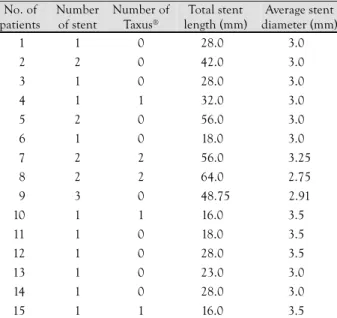
The patient diagnoses included: ST elevation myocar- dial infarction in 11.2%, non-ST elevation myocardial infarction or unstable angina in 58.2%, and stable an- gina in 30.6%. Stent thrombosis developed in 15 cases (1.14%). The onset of symptoms developed between day 1 after the intervention and day 657; eight patients de- veloped symptoms within 30 days (0.6%). The clinical characteristics of the patients that developed stent throm- bosis and the stents used are listed in Table 1 and 2.
Among 1,315 patients followed for six months after stent implantation, the dual antiplatelet therapy group included 813 patients, and the triple antiplatelet thera- py group 502 patients. The comparison of the two groups with regard to their age, gender, clinical diagnosis and the risk factors for coronary artery disease showed not significant differences. There were 41.6% of the patients with multivessel disease in the triple antiplatelet therapy
group compared to 28.9% in the dual antiplatelet th- erapy group (p<0.001). Comparison of the implanted DES in the dual antiplatelet therapy group with the triple antiplatelet therapy group showed that the num- ber of stents used (1.56±0.74, 1.70±0.94, p<0.001), the number of Taxus® stents (0.50±0.75, 0.74±0.1, p<0.001), the total length of the stents (34.08±20.08 mm, 40.16±24.03 mm, p<0.001), and the mean dia- meter of the stents (3.24±0.56 mm, 3.16±0.48 mm, p<0.05) in the two groups were significantly different.
Stent thrombosis developed in 11 cases (0.84%), and according to the ARC definitions, in the dual antipla- telet therapy group there were three and one definite
and possible cases, respectively; in the triple antiplate- let therapy group there were one, five and one definite, probable, and possible cases respectively. The compa- rison of the development of stent thrombosis according to treatment methods showed that the dual antiplate- let therapy group had four cases (0.49%), the triple an- tiplatelet therapy group had seven cases (1.39%); al- though the tendency was higher in the triple antiplate- let therapy group, the difference between the two groups was not statistically significant (Table 3).
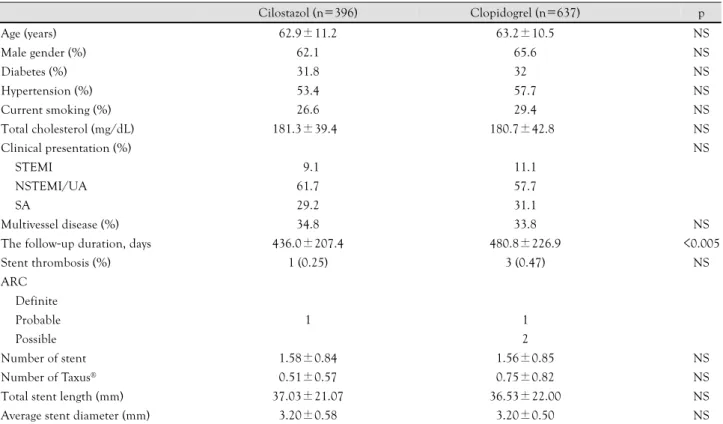
There were 1,033 patients that were followed for a minimum of 12 months, after the intervention. Accord- ing to the method of random addition of the second antiplatelet agent to aspirin, the patients were divided into the cilostazol treatment group (n=396) and the clopidogrel treatment group (n=637), and subsequently followed for a mean of 463.9±220.4 days. Comparison of the two groups showed no significant differences with regard to their age, gender, clinical diagnosis, risk factors for coronary artery disease, and the distribution of mul- tivessel disease. In addition, comparison of the implant- ed DES, the number of stents used (1.58±0.84, 1.56±
0.85, p=NS), the number of Taxus® stents (0.51±0.57, 0.75±0.82, p=NS), the total length of the stent (37.03
±21.07 mm, 36.53±22.00 mm, p=NS) and the av- erage diameter of the stent (3.20±0.58 mm, 3.20±
0.50 mm, p=NS), showed no significant differences between the two groups. The follow up observation pe- riod for the clopidogrel treatment group was signifi- cantly longer (436.0±207.4 days, 480.8±226.9 days, p<0.005); stent thrombosis developed in four cases (0.38%). According to the ARC definitions, two cases were probable and two cases were possible. In the cilo-
Table 1. Clinical characteristic of patients with stent thrombosis
No. of patients Protocol Age (years) Gender Diabetes Diagnosis Stent thrombosis
event (day) ARC
01 Dual 82 M - STEMI 001 Definite
02 Triple 78 F - NSTEMI 001 Definite
03 Triple 80 M + UA 001 Probable
04 Triple 70 F - UA 003 Probable
05 Dual 58 M - SA 005 Definite
06 Triple 79 F + NSTEMI 008 Probable
07 Triple 75 F - STEMI 010 Probable
08 Triple 66 M + SA 011 Probable
09 Triple 71 M + UA 082 Possible
10 Dual 57 M - STEMI 097 Possible
11 Dual 56 F - NSTEMI 135 Definite
12 Clopidogrel 70 M + UA 240 Possible
13 Clopidogrel 76 M + SA 250 Possible
14 Cilostazol 40 M - UA 619 Probable
15 Clopidogrel 50 M + STEMI 657 Probable
Dual: aspirin+clopidogrel, Triple: aspirin+clopidogrel+cilostazol, clopidogrel: aspirin+clopidogrel, cilostazol: aspirin+cilostazol. STEMI: ST elevation myocardial infarction, NSTEMI: Non ST elevation myocardial infarction, UA: unstable angina, SA: stable angina, ARC: Academic Research Consortium
Table 2. Stent characteristics of patients with stent thrombosis No. of
patients
Number of stent
Number of Taxus®
Total stent length (mm)
Average stent diameter (mm) 01 1 0 28.00 3.00 02 2 0 42.00 3.00 03 1 0 28.00 3.00 04 1 1 32.00 3.00 05 2 0 56.00 3.00
06 1 0 18.00 3.00
07 2 2 56.00 3.25 08 2 2 64.00 2.75 09 3 0 48.75 2.91 10 1 1 16.00 3.50
11 1 0 18.00 3.50
12 1 0 28.00 3.50 13 1 0 23.00 3.00 14 1 0 28.00 3.00 15 1 1 16.00 3.50
stazol treatment group, there was 1 case (0.25%) of stent thrombosis, and in the clopidogrel treatment group, there were three cases (0.47%). No statistically signifi-
cant difference between the cilostazol treatment group and the clopidogrel treatment group was not detected for stent thrombosis (Table 4).
Table 3. Clinical and procedural characteristics of patients in the dual therapy and triple therapy group
Dual therapy (n=813) Triple therapy (n=502) p
Age (years) 63.1±10.9 63.8±10.6 NS
Male gender (%) 64.0 64.4 NS
Diabetes (%) 31.4 33.3 NS
Hypertension (%) 55.7 57.9 NS
Current smoking (%) 30.6 29.8 NS
Total cholesterol (mg/dL) 180.4±42.1 181.1±40.6 NS
Clinical presentation (%) NS
STEMI 09.7 12.4
NSTEMI/UA 58.9 59.3
SA 31.4 28.3
Multivessel disease (%) 28.9 41.6 <0.001
Stent thrombosis (%) 4 (0.49) 7 (1.39) NS
ARC
Definite 3 1
Probable 0 5
Possible 1 1
Number of stent 1.56±0.74 1.70±0.94 <0.001
Number of Taxus® 0.50±0.75 0.74±0.1 <0.001
Total stent length (mm) 34.08±20.08 40.16±24.03 <0.001 Average stent diameter (mm) 3.24±0.56 3.16±0.48 <0.05 STEMI: ST elevation myocardial infarction, NSTEMI: non ST elevation myocardial infarction, UA: unstable angina, SA: stable angina, ARC: Academic Research Consortium
Table 4. Clinical and procedural characteristics of patients in the cilostazol group and the clopidogrel group
Cilostazol (n=396) Clopidogrel (n=637) p
Age (years) 62.9±11.2 63.2±10.5 NS
Male gender (%) 62.1 65.6 NS
Diabetes (%) 31.8 32.0 NS
Hypertension (%) 53.4 57.7 NS
Current smoking (%) 26.6 29.4 NS
Total cholesterol (mg/dL) 181.3±39.4 180.7±42.8 NS
Clinical presentation (%) NS
STEMI 09.1 11.1
NSTEMI/UA 61.7 57.7
SA 29.2 31.1
Multivessel disease (%) 34.8 33.8 NS
The follow-up duration, days 436.0±207.4 480.8±226.9 <0.005
Stent thrombosis (%) 1 (0.25) 3 (0.47) NS
ARC Definite
Probable 1 1
Possible 2
Number of stent 1.58±0.84 1.56±0.85 NS
Number of Taxus® 0.51±0.57 0.75±0.82 NS
Total stent length (mm) 37.03±21.07 36.53±22.00 NS
Average stent diameter (mm) 3.20±0.58 3.20±0.50 NS
STEMI: ST elevation myocardial infarction, NSTEMI: non ST elevation myocardial infarction, UA: unstable angina, SA: stable angina, ARC: Academic Research Consortium
Discussion
Since DES implantation can suppress the formation of the neointima following mechanical injury, it pre- vents restenosis, which was a significant complication associated with bare metal stents. However, although stent thrombosis developing after DES implantation is rare,10) in the papers presented at the 2006 European Society of Cardiology, and since then, the mortality and the incidence of myocardial infarction associated with DES have been reported to be higher than with bare metal stents, and thus there is significant concern about the safety of DES.8)11-18) However, studies have demonstrated that the frequency of early stent throm- bosis and late stent thrombosis in bare metal stents and DES are not significantly different.19-21) However, the risk for very late stent thrombosis with a DES has been reported to be higher than with a bare metal stent.
This was the motivation for changing the treatment guidelines for the duration of clopidogrel administ- ration. For patients with DES, at the time of its appro- val by the US food and drug administration for wide clinical use, the dual antiplatelet treatment of Cypher® for longer than three months and of Taxus® for longer than six months was recommended. However, the 2005 treatment guidelines of the American Heart Associa- tion/American College of Cardiology (AHA/ACC), re- commended clopidogrel for 12 months after DES im- plantation, and the 2007 treatment guidelines, recom- mended treatment for a minimum of 12 months; in ad- dition, the method of antiplatelet treatment has been changed.22)
The development of stent thrombosis could not be explained by one mechanism or a single causative factor.
It has been shown that in addition to patient factors, numerous factors such as stent problems, problems with the stent implantation procedure, reactions to antipla- telet agents, and the characteristics of the lesion are in- volved in combination. Risk factors associated with stent thrombosis such as, diabetes, chronic renal failure, left ventricular dysfunction, in cases performed on bifur- cated lesions or thin and long lesions, in cases where the stents were not dilated sufficiently and thus resi- dual stenosis remained, or dissection have been previ- ously reported. The AHA/ACC has stated that large scale studies are needed to study the risk factors associ- ated with antiplatelet treatment and stent thrombosis to determine optimal patient management.
Cilostazol is a phosphodiesterase III blocker; it is a drug that exerts the dual effects of suppression of th- rombus aggregation and proliferation of the neointima.
Lee et al.23)24) reported that after bare metal stent im- plantation, cilostazol has suppressive effects on the de- velopment of thrombi in patients with high risk factors for developing a thrombus, such as reducing restenosis
in patients with diabetes after DES implantation. Cilo- stazol is an antiplatelet agent widely used after stent im- plantation together with aspirin and clopidogrel. How- ever, a cost benefit analysis of triple therapy, adding cilostazol to the standard dual therapy, has not been conducted. In this study, 1,315 patients were enrolled with an average follow up of 561.7±251.4 days. Based on the ARC definitions, stent thrombosis developed in 15 cases (1.14%). The frequency of stent thrombosis is different, depending on the definition of stent throm- bosis used in a study. In studies reporting less than a 1% frequency of stent thrombosis, the length of the stent and the number of stents used were significantly different from this study. In a study on 260 patients comparing triple therapy and dual therapy including cilostazol, after DES implantation, stent thrombosis occurred in 0.4% in each group, with no significant dif- ference detected.25) However, in these prior studies, the ARC definitions were not used and thus the frequency of stent thrombosis was reported to be somewhat lower then in this study. With regard to patients with diabetes, during 15 months of follow up after DES implantation, if the definitions used included: definite, probable and possible, the frequency increased to 2.4%.26) Comparing our study with such studies, showed a lower frequency of stent thrombus in this study. In addition, we did not find a significant difference in the frequency of stent thrombosis according to dual or triple antiplate- let treatment. Therefore, with regard to the cost bene- fit ratio dual therapy is more cost effective than triple therapy. Within the first six months from the stent implantation, the prevention of stent thrombosis with the combination of aspirin and cilostazol was compar- able to the combination of aspirin and clopidogrel. Even after six months, the frequency of stent thrombosis was lower than in previous studies. The patients in our study continued to take two types of antiplatelet agents even after six months, which may have prevented stent th- rombosis. Further study is needed comparing mono- therapy and combination treatments. The limitations of this study include the following. Only patients with continuous intake of antiplatelet agents could be as- sessed in the outpatient clinics. Therefore, for patients that discontinued taking antiplatelet agents intention- ally or those that could not be assessed due to transfer to another hospital the study was terminated and thus many patients were lost. In addition, this study was an open label study, and the investigators were not blind to the treatment. In regard to the use of the ARC defi- nitions, some deaths might not have been classified inappropriately; therefore, the diagnosis of stent throm- bosis might not have been completely accurate. The tri- ple antiplatelet therapy group, had a significantly longer length of the stent and the number of stents used was greater; this suggests that there might have been some
bias in assigning patients to the triple therapy treatment group.
In conclusion, the results of this study showed no significant difference between triple and dual treatment groups for the prevention of stent thrombosis after DES.
Further study is need with large randomized blinded trials to determine optimal antiplatelet therapy for pa- tient undergoing stent implantation.
Acknowledgments
This work was financially supported by the grants of The research foundation of the internal medicine of The Catholic University of Korea.
Part of this study was presented as an abstract at the 51st Annual Scientific meeting of the Korean Society of Cardiology in 2007 and the ESC Congress in 2008.
REFERENCES
1) Kim KH, Jeong MH, Hong SN, et al. The clinical effects of drug eluting stents for the treatment of coronary in-stent restenosis.
Korean Circ J 2005;35:443-7.
2) Yang TH, Hong MK, Park KH, et al. Primary siroliums-eluting stent implantation for patients with acute ST-segment elevation myocardial infarction. Korean Circ J 2005;35:672-6.
3) Jeong YS, Cho KH, Park YW, Kim SM, Kim DI, Kim DS.
Siroliumus-eluting stent for the treatment of in-stent restenosis:
comparison with cutting balloon angioplasty. Korean Circ J 2006;
36:66-71.
4) Kim DB, Seung KB, Kim BJ, et al. Utilization pattern of drug- eluting stents and prognosis of patients who underwent drug- eluting stenting compared with bare metal stenting in the real world. Korean Circ J 2006;36:178-83.
5) Kim BK, Oh SJ, Jeon DW, et al. Clinical outcomes following si- rolimus-eluting stent implantation in patients with end-stage re- nal disease. Korean Circ J 2006;36:424-30.
6) Park JS, Kim YJ, Shin DG, et al. Clinical and angiographic outcome of sirolimus-eluting stent for the treatment of very long lesions. Korean Circ J 2006;36:490-4.
7) Kim W, Jeong MH, Cho JY, et al. The preventive effect on in- stent restenosis of overlapped drug-eluting stents for treating dif- fuse coronary artery disease. Korean Circ J 2006;36:17-23.
8) Park DW, Park SW. Stent thrombosis in the era of the drug-elut- ing stent. Korean Circ J 2005;35:791-4.
9) Cutlip DE, Windecker S, Mehran R, et al. Clinical end points in coronary stent trials: a case of standardized definitions. Circul- ation 2007;115:2344-51.
10) Park SH, Hong GR, Seo HS, Tahk SJ. Stent thrombosis after suc- cessful drug-eluting stent implantation. Korean Circ J 2005;35:
163-71.
11) Windecker S, Remondino A, Eberli FR, et al. Sirolimus-eluting and paclitaxel-eluting stents for coronary revascularization. N Engl J Med 2005;353:653-62.
12) Cutlip DE, Baim DS, Ho KK, et al. Stent thrombosis in the mo- dern era: a pooled analysis of multicenter coronary stent clinical
trials. Circulation 2001;103:1967-71.
13) Mauri L, Hsieh WH, Massaro JM, Ho KK, D’Agostino R, Cutlip DE. Stent thrombosis in randomized clinical trials of drug-elut- ing stents. N Engl J Med 2007;356:1020-9.
14) Daemen J, Wenaweser P, Tsuchida K, et al. Early and late coro- nary stent thrombosis of sirolimus-eluting and paclitaxel-eluting stents in routine clinical practice: data from a large two-institu- tional cohort study. Lancet 2007;369:667-78.
15) Iakovou I, Schmidt T, Bonizzoni E, et al. Incidence, predictors, and outcome of thrombosis after successful implantation of drug- eluting stents. JAMA 2005;293:2126-30.
16) Lagerqvist B, James SK, Stenestrand U, Lindback J, Nilsson T, Wallentin L. Long-term outcomes with drug-eluting stents versus bare-metal stents in Sweden. N Engl J Med 2007;356:1009-19.
17) Camenzind E, Steg PG, Wijns W. Stent thrombosis late after im- plantation of first-generation drug-eluting stents: a cause for concern. Circulation 2007;115:1440-55.
18) Kuchulakanti PK, Chu WW, Torguson R, et al. Correlates and long-term outcomes of angiographically proven stent thrombosis with sirolimus- and paclitaxel-eluting stents. Circulation 2006;
113:1108-13.
19) Stone GW, Moses JW, Ellis SG, et al. Safety and efficacy of sirolimus- and paclitaxel-eluting coronary stents. N Engl J Med 2007;356:998-1008.
20) Kastrati A, Mehilli J, Pache J, et al. Analysis of 14 trials com- paring sirolimus-eluting stents with bare-metal stents. N Engl J Med 2007;356:1030-9.
21) Doyle B, Rihal CS, O’Sullivan CJ, et al. Outcomes of stent th- rombosis and restenosis during extended follow-up of patients treated with bare-metal coronary stents. Circulation 2007;116:
2391-8.
22) King SB 3rd, Smith SC Jr, Hirshfeld JW Jr, et al. 2007 Focused update of the ACC/AHA/SCAI 2005 guideline update for per- cutaneous coronary intervention: a report of the American Col- lege of Cardiology/American Heart Association task torce on practice guidelines: 2007 writing group to review new evidence and update the ACC/AHA/SCAI 2005 guideline update for per- cutaneous coronary intervention, writing on behalf of the 2005 writing committee. Circulation 2008;117:261-95.
23) Lee SW, Park SW, Hong MK, et al. Triple versus dual antipla- telet therapy after coronary stenting: impact on stent thrombosis.
J Am Coll Cardiol 2005;46:1833-7.
24) Lee SW, Park SW, Kim YH, et al. Drug-eluting stenting fol- lowed by cilostazol treatment reduces late restenosis in patients with diabetes mellitus: the DECLARE-DIABETES trial (a ran- domized comparison of triple antiplatelet therapy with dual anti- platelet therapy after drug-eluting stent implantation in diabetic patients). J Am Coll Cardiol 2008;51:1181-7.
25) Lee SW, Park SW, Kim YH, et al. Comparison of triple versus dual antiplatelet therapy after drug-eluting stent implantation (from the DECLARE-Long trial). Am J Cardiol 2007;100:1103-8.
26) Maeng M, Jensen LO, Kaltoft A, et al. Comparison of stent th- rombosis, myocardial infarction, and mortality following drug- eluting versus bare-metal stent coronary intervention in patients with diabetes mellitus. Am J Cardiol 2008;102:165-72.