* Corresponding author: Woe-Yeon Kim, Ph.D. & Joon-Yung Cha, Ph.D. Division of Applied Life Science (BK21Plus), Plant Molecular Biology and Biotechnology Research Center (PMBBRC), Research Institute of Life Sciences (RILS), Gyeongsang National University, Jinju 52828, Republic of Korea. Tel: +82-55-772-1968, Fax: +82-55-772-2631, E-mail:
[email protected] & [email protected]
Research Article
Foliar application of humic acid or a mixture of catechol and vanillic acid enhanced growth and productivity of alfalfa
Laila Khaleda
1, Min Gab Kim
2, Jong-Rok Jeon
3, Joon-Yung Cha
1,* , and Woe-Yeon Kim
1,3,*
1
Division of Applied Life Science (BK21Plus), Plant Molecular Biology and Biotechnology Research Center (PMBBRC), Research Institute of Life Sciences (RILS), Gyeongsang National University, Jinju 52828, Republic of Korea
2
College of Pharmacy and Research Institute of Pharmaceutical Science, PMBBRC, Gyeongsang National University, Jinju 52828, Republic of Korea
3
Department of Agricultural Chemistry and Food Science & Technology, Institute of Agriculture and Life Science (IALS), Gyeongsang National University, Jinju 52828, Republic of Korea
ABSTRACT
Humic acid (HA) is known to consist of various kinds of polymeric organics, their detailed structures can vary depend on sample sources such as organic manure, composts, peat, and lignite brown coal, and largely exists in grassland soils. HA possesses diverse positive effects that not only increase plant growth but also improve soil fertility. Recently, we have manufactured a co-polymeric product of catechol and vanillic acid (CAVA) synthesized artificially, and found that CAVA as a HA mimic increases seed germination and salt tolerance in Arabidopsis. In this study, we examined whether HA or CAVA affects to seedling growth in alfalfa.
Foliar application of HA or CAVA increased alfalfa seedling growth including aerial and in root parts. HA or CAVA dramatically enhanced size of leaf and root, whereas HA significantly displayed higher bioactivity than CAVA. Taken together, CAVA acts like as a HA mimic in alfalfa that could apply as an alternation supplement to enhance plant growth and productivity.
(Key words : Alfalfa, Humic acid, Co-polymeric derivatives, Growth)
Ⅰ. INTRODUCTION
A major goal of sustainable agriculture is the production and enhancement of food, fiber and other plants using farming technique. Improvement of leaf biomass for livestock feed is one of the intense research interest in forage and feed biology.
Legumes improve soil fertility owing their deep-reaching root systems, accumulation into soil and rapid breakdown of root biomass (Stoddard et al., 2009; Luscher, et al., 2014; Kusvuran et al. 2014). The appropriate availability of essential nutrients in soils refers plant development and productivity (Marschner, 1986; Mengel and Kirkby, 1987). Forage legumes are important resources of protein and other nutrients which are considered as animal feed. Alfalfa (Medicago sativa L.) has been widely cultivated on over 32 million hectares in worldwide because of its forage, nutritional value and high
biomass producing quality (Fick et al., 1988; Veronesi et al., 2010; Xie et al., 2013). It has been well documented that crude protein and total digestible nutrients that plays an important role in livestock industry (Barnes et al., 1980; Hill et al., 1991).
Humic acids (HA) are a principal component of humic
substances which are the major organic constituents (Muscolo
et al., 2013). Interestingly, HA largely exists in grassland soils
(Stevenson, 1982). The bulk production of HA in an artificial
manner has been highlighted in agronomy owing to their
beneficial actions to soil, its physical and chemical properties
are involved to increase crop productivity (Nikbakht et al.,
2008). Toward this end, it has been demonstrated that CAVA
exhibits a humic-like activity for Arabidopsis thaliana (Col-0)
cultivated on MS agar (Cha et al., 2017). However, there are
some questions still remain; (i) Can the similar HA-like
activity of CAVA be re-created in soil-based plant cultivation
systems? (ii) Can the beneficial action of CAVA extend to crop productivity?
The aim of this study is to characterize the effect of the HA and CAVA on the alfalfa growth and productivity. Here, we found the foliar application of HA or CAVA increases the total biomass including fresh weight, leaf area, and root capacity of alfalfa.
Ⅱ. MATERIALS AND METHODS 1. Plant materials and growth conditions
Alfalfa (Medicago sativa L. var. “Vernal”) seeds were obtained from National Institute of Animal Science (NIAS, RDA, Republic of Korea). Alfalfa seeds were directly sown in the potting soil No. 2 (Farmhannong) and allowed to germinate at 23 °C under dark condition. When the cotyledon of alfalfa seedling is protruded on the soil surface, the seedlings were transferred to the 16/8 h (light/dark) cycle for growth and development.
2. Foliar application of HA and CAVA
HA was purchased from Sigma-Aldrich. Catechol (CA) and vanillic acid (VA) were also purchased from Sigma-Aldrich. A co-polymeric product of CA and VA (CAVA) was artificially synthesized as described previously (Cha et al., 2017). In this study, 100 mM sodium acetate buffer (pH 5.0)-based polymeric reactions were fully desalted with 5 kDa ultrafilter. Each powder was diluted to be a certain concentration in distilled water. To examine the seedling growth, foliar application of HA or CAVA (86 mg L
-1) were carried out twice by spraying at 8 and 15 days after germination of alfalfa. Plants were harvested at 22 d after germination and measured every physiological parameter shown, such as plant height and fresh weight. Sterilized H
2O sprayed to plant leaves as a control.
3. Determination of physiological parameters
Plants were harvested as mentioned above, and shoots and roots were divided to measure the fresh weight. Plant height
was measured in intact plants grown in soil. To measure leaf area, leaves attached in 6
thnode were collected and measured by ImageJ software (1.48v, http://imagej.nih.gov/ij). Experiments were carried with three (for determining the aerial and root growth) or nine (for leaf area) independent replicates.
4. Statistical analysis
All the measurements were subjected to Student’s t-test using Microsoft Excel 2007.
Ⅲ. RESULTS AND DISCUSSION
1. HA and CAVA increase the seedling growth in alfalfa
It has been previously reported that HA has positive effects for the development under abiotic stress responses in plants (Vaughan, 1974; Cacco and Dell Agnolla, 1984; Russo and Berlyn, 1990; Trevisan et al., 2010a). Previous study demonstrated that commercial HA as well as phenolic derivatives, CAVA (i.e.
HA mimic), promotes seed germination and salt tolerance in
model plant Arabidopsis (Cha et al., 2017). To examine whether
HA or CAVA has the positive effects in forage crops, alfalfa
was treated with foliar application of HA or CAVA. HA or
CAVA were carried out twice by spraying to aerial parts of
seedlings at 8 and 15 days after germination. At 22 d after
germination, the seedlings treated by H
2O (as a control), HA
(86 mg L
-1), or CAVA (86 mg L
-1) were photographed, and
the seedlings treated by HA showed better growth and large leaf
size as shown in Fig. 1A. To prove this morphological changes
by HA, we measured plant height and fresh weight (Fig. 1B
and 1C). Plant height significantly increased by HA or CAVA
treatment compared to H
2O treatment (Fig. 1B). In addition, HA
application significantly enhanced higher plant height of alfalfa
seedlings than CAVA treatment. Similar to plant height, HA or
CAVA application significantly displayed increase of fresh
weight compared to H
2O (Fig. 1C). However, no significant
differences was observed between HA and CAVA. These data
suggest that CAVA increases the seedling growth of alfalfa, and
showed HA-like bioactivity. Sharif et al. (2006) reported that
Fig. 1. Promotion of alfalfa seedling growth by HA or CAVA. The seedlings were grown in soil for 22 d with twice foliar application of HA or CAVA (86 mg L
-1). Water (H
2O) as a negative control was sprayed at the same time and method with HA or CAVA. (A) The picture taken at 22 d after germination. Plant height (B) and fresh weight (F.W.; per 3 plants) of aerial parts (C) were measured at 22 d. Data are means ± SE (n=3). Significant differences are shown as an asterisk (*P<0.05; **P<0.01; n.s., no significant differences). Abbreviations: HA, commercial humic acids; CAVA, a co-polymeric product derived from fungal laccase oxidation of catechol and vanillic acid.
Fig. 2. Increased leaf area by foliar application of HA or CAVA. The seedlings were grown in soil for 22 d with twice foliar application of HA or CAVA (86 mg L
-1). Water (H
2O) as a negative control was sprayed at the same time and method with HA or CAVA. (A) The picture of the leaves at 6
thnode was taken at 22 d after germination. Leaf area (B) in Fig. 2B was measured by ImageJ software. Data are means ± SE (n=9).
Significant differences are shown as an asterisk (**P<0.01; ***P<0.001; n.s., no significant differences).
Abbreviations: HA, commercial humic acids; CAVA, a co-polymeric product derived from fungal laccase oxidation of catechol and vanillic acid.
coal-derived HA increases the maize growth caused by the possible changes of soil properties. Sadiq et al. (2014) also mentioned that the application of coal-derived HA improves the soil quality and increases productivity of sunflower.
2. HA and CAVA promote leaf expansion in alfalfa
As shown in Fig. 1A, we observed that the leaf size was bigger in HA or CAVA treatment compared to H
2O. It may cause the increase of biomass as shown in Fig. 1C. To prove these leaf phenotypes in detail, leaves at 6
thnode were detached and photographed as shown in Fig. 2A. Foliar
application of HA or CAVA dramatically increased leaf size
compared to that of H
2O treatment. The leaf size was
measured using ImageJ software and analyzed as shown in
Fig. 2B. Similar to Fig. 2A, leaf area by HA or CAVA
application was 1.7-2 fold increase compared to H
2O
treatment. Previous study showed that HA affects on net
photosynthesis, root development, and nutrient contents in
creeping bentgrass (Liu et al., 1998). Therefore, the previous
studies support that the effects of HA increase the biomass of
alfalfa. Again, CAVA displays a similar activity with HA for
expanding the leaf size of alfalfa.
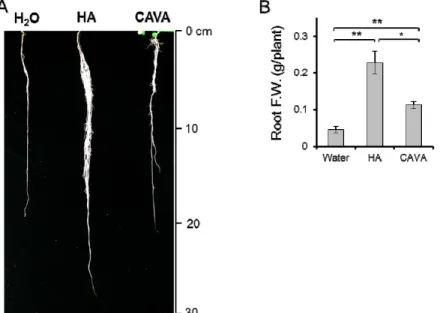
Fig. 3. Increased root capacity by foliar application of HA or CAVA. The alfalfa seedlings were grown in soil for 22 d with twice foliar application of HA or CAVA (86 mg L
-1). Water (H
2O) as a negative control was sprayed at the same time and method with HA or CAVA. (A) The picture of the root was taken at 22 d after germination.
Fresh weight (F.W.) of roots (B) was measured at 22 d. Data are means ± SE (n=3). Significant differences are shown as an asterisk (*P<0.05; **P<0.01). Abbreviations: HA, commercial humic acids; CAVA, a co-polymeric product derived from fungal laccase oxidation of catechol and vanillic acid.
3. HA or CAVA increase root capacity in alfalfa
Nutrients absorption depends on root architecture and capacity in plant (Comerford et al., 1994). HA increases the root mass in several plants such as creeping bentgrass, maize, and tomato (Vaughan, 1974; Liu et al., 1998; Dobbss et al., 2007; Zandonadi et al., 2007; Trevisan et al., 2010a; Trevisan et al., 2010b). To test this increase of root capacity in alfalfa, root phenotypes were monitored after foliar application of HA and humic mimic (i.e. CAVA) at 22 d (Fig. 3A). Interestingly, we found that HA dramatically enhanced root capacity together with increase of lateral roots, and CAVA looked more lateral roots than H
2O treatment. Thus, we measured root mass and the data showed that the root fresh weight of HA treatment were significantly increased that approximately five-fold higher than H
2O treatment, and two-fold higher than CAVA treatment (Fig. 3B). The root mass of CAVA was also 2.5-fold higher than H
2O. These data suggest that root mass is dramatically increased by HA application, and CAVA partially reenact the activity of HA increasing root capacity. The increase of root development occurred by HA application has been identified in cellular and molecular levels (Trevisan et al., 2010a). Auxin is
a major phytohormone triggering lateral root development and HA displayed as an auxin-like activity (Trevisan et al., 2010b).
In cellular levels, HA induced mitotic sites of lateral root emergence like as indole-3-acetic acid (IAA) in maize (Canellas et al., 2002; Zandonadi et al., 2007). Trevisan et al.
(2010b) found that HA induces the expression of early auxin-responsive gene, IAA19. These data suggest that HA may involve in root development that revealed at cellular and molecular levels in plants.
Ⅳ. CONCLUSION
HA possessing a typical structures and have many functional groups that enhances plant growth and productivity, also in abiotic stress tolerance in plants. Although HA markets have been increased in worldwide, the quality-control of HA should be followed due to the diversity of natural sources.
Previously, we have manufactured a co-polymeric product of
CA and VA (CAVA) by artificial synthesis, and found that its
bioactivity enhanced seed germination and salt tolerance in
Arabidopsis. Here, we also found that CAVA exhibits HA-likebioactivity increasing alfalfa seedling growth including leaf expansion and root mass. These positive effects of HA or CAVA could enhance photosynthesis and nutrient uptakes, and consequently driving to increase biomass of alfalfa.
Ⅴ. ACKNOWLEDGEMENTS
This work was supported by the National Research Foundation of Korea (NRF) grant funded by the Ministry of Education (MOE; NRF-2016R1D1A3B03934409) and Korea Institute of Planning and Evaluation for Technology in Food, Agriculture, Forestry and Fisheries (IPET) through Agri-Bio industry Technology Development Program funded by Ministry of Agriculture, Food and Rural Affairs (MAFRA; Grant No.
115085-2), Republic of Korea.
Ⅵ. REFERENCES
Barnes, D. K., Golen, B.P. and Baylor, J.E. 1980. Highlights in the USA and Canada. In Alfalfa and Alfalfa Improvement. Number 29 Agronomy Series. Madison, WI: Crop Science Society of America.
Cacco, G. and Dell Agnolla, G. 1984. Plant growth regulator activity of soluble humic substances. Canadian Journal of Soil Science.
64:25-28.
Canellas, L.P., Olivares, F.L., Okorokova-Façanha, A.L. and Façanha, A.R.
2002. Humic acids isolated from earthworm compost enhance root elongation, lateral root emergence, and plasma membrane H+-ATPase activity in maize roots. Plant Physiology. 130:1951-1957.
Cha, J.Y., Kim, T.W., Choi, J.H., Jang, K.S., Khaleda, L., Kim, W.Y.
and Jeon, J.R. 2017. Fungal laccase-catalyzed oxidation of naturally occurring phenols for enhanced germination and salt tolerance of Arabidopsis thaliana: A green route for synthesizaing humic-like fertilizers. Journal of Agricultural and Food Chemistry. 65:1167-1177.
Comerford, N.B., Smethurst, P.J. and Escamilla, J.A. 1994. Nutrient uptake by woody root systems. New Zealand Journal of Forestry Science. 24:195-212.
Fick, G.W., Holt, D.A. and Lugg, D.G. 1988. Environmental physiology and crop growth. In: Hanson, A.A., Barnes, D.K., Hill, R.R., eds.
Alfalfa and alfalfa improvement. Madison, WI: ASA/CSSA/SSSA, 163-194.
Hill, K.K., Jarvis-Eagan, N., Halk, E.L., Krahn, K.J., Liao, L.W., Mathewson, R.S., Merlo, D.J., Nelson, S.E., Rashka, K.E. and Loesch-Fries L.S. 1991. The development of virus-resistant alfalfa,
Medicago sativa L. Nature Biotechnology. 9:373-378.
Kusvuran, A. Ralice, Y. and Saglamtimur, T. 2014. Determining the biomass production Capacities of certain forage grasses and legume’s and their mixtures under Mediterranean regional conditions. Acta Advances in agricultural sciences. 2:13-24.
Liu, C., Cooper, R.J. and Bowman, D.C. 1998. Humic acid application affects photosynthesis, root development, and nutrient content of creeping bentgrass. HortScience. 33:1023-1025.
Luscher, A., Mueller-Harvey, I., Soussana, J.F., Rees, R.M. and Peyraud, J.L. 2014. Potential of legume based grass land livestock systems in Europe: a review. Grass and Forage Science. 1-23.
Marschner, H. 1986. Functions of mineral nutrients: micronutrients. In:
H Marschner, Mineral Nutrition of Higher Plants, pp. 269-340.
Mengel, K. and Kirkby, E.A. 1987. Nutrition and plant growth. In: K Mengel and EA Kirkby, Principles of Plant Nutrition, 4th edition, pp.
247-302.
Muscolo, A., Sidari, M. and Nardi, S. 2013. Humic substance: Relationship between structure and activity. Deeper information suggests univocal findings. Journal of Geochemical Exploration. 129:57-63.
Nikbakht, A., Kafi, M., Babalar, M., Xia, Y.P., Luo, A. and Eternadi, N.
2008. Effect of humic acid on plant growth, nutrient uptake, and postharvest life of Gerbera. Journal of Plant Nutrition. 31:2155-2167.
Russo, R.O. and Berlyn, G.P. 1990. The use of organic bio stimulants to help low input sustainable agriculture. Journal of Sustainable Agriculture. 1:19-42.
Sadiq, S.A., Baloch, D.M., Ahmed, N. and Hidayatullah. 2014. Role of coal-derived humic acid in the availability of nutrients and growth of sunflower under calcareous soil. Journal of Animal & Plant Sciences. 24:1737-1742.
Sharif, M., Khattak, R.A. and Sarir, M.S. 2006. Effect of different levels of lignitic coal derived humic acid on growth of maize plants.
Communications in Soil Science and Plant Analysis. 33:3567-3580.
Stevenson, F.J. 1982. Humus chemistry, genesis, composition, reactions.
John Wiley & Sons, Inc., New York.
Stoddard, F.L., Hovinen, S., Kontturi, M. Lindstom, K. and Nykanen, A.
2009. Legumes in Finnish agriculture: history, present status and future prospects. Agricultural and Food Science. 18:191-205.
Trevisan, S., Fracioso, O., Quaggiotti, S. and Nardi, S. 2010a. Humic substances biological activity at the plant-soil interface. Plant Signaling & Behavior. 5635-643.
Trevisan, S., Pizzeghello, D., Ruperti, B., Francioso, O., Sassi, A., Palme, K., Quaggiotti, S. and Nardi, S. 2010b. Humic substances induce lateral root formation and expression of the early auxin responsive IAA19 gene and DR5 synthetic element in Arabidopsis.
Plant Biology. 12:604-614.
Vaughan, D. 1974. Possible mechanism for humic acid action on cell elongation in root segments of Pisum sativum under aseptic
conditions. Soil Biology and Biochemistry. 6:241-247.
Veronesi, F., Brummer, E.C. and Huyghe, C. 2010. Alfalfa. In handbook of plant breeding: Fodder crops and amenity grasses, (Eds. B.
Boller, U.K. Posselt, and F. Veronesi), 395-437. Springer, New York, USA.
Xie, H., Hu, X., Zhang, C.R., Chen, Y.F. and Huang, X. 2013.
Molecular characterization of a stress related gene MsTPP in relation to somatic embryogenesis of Alfalfa. Pakistan Journal of Botany. 45:1285-1291.
Zandonadi, D.B., Canellas, L.P. and Façanha, A.R. 2007. Indolacetic
and humic acids induce lateral root development through a concerted plasmalemma and tonoplast H+ pumps activation.
Planta. 225:1583-1595.
(Received : September 12, 2017 | Revised : September 19, 2017 | Accepted : September 19, 2017)