Homework 2 of Computer Algorithms 2009
Instructor: Dae-Ki Kang April 10, 2009
Deadline: April 30, 2009
1. Write a program (in your favorite computer language) that calculates the following:
Given any integer 0 ≤ n ≤ 10000 not divisible by 2 or 5, some multiple of n is a number which in decimal notation is a sequence of 1’s. How many digits are in the smallest such a multiple of n?
(URL: http://icpcres.ecs.baylor.edu/onlinejudge/external/101/10127.html) 2. Prove Nicomachus’s Theorem shown as follows:
n
X
k=1
k3= ( n
X
k=1
k )2
(1)
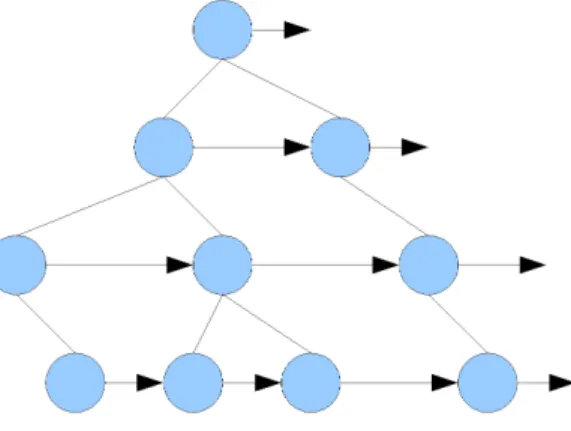
3. Suppose we have a binary tree. One of possible C language implementa- tions for its node would be like this:
struct NODE {
int val;
struct *NODE left;
struct *NODE right;
struct *NODE parent;
struct *NODE next;
}
We assume each node have two links for its children, one link for its parent, and one link for the first next node found at the same level of the node.
In the following figure 1, links for the next node are denoted by directed arrows.
(a) Using recursion, describe an algorithm (using pseudo code notation) that fills the next links. What is the time and space complexity for the algorithm?
1
Figure 1: A binary with next links
(b) Without recursion, describe an algorithm (using pseudo code nota- tion) that fills the next links. What is the time and space complexity for the algorithm? Can you devise an algorithm that takes O(n) time complexity and O(1) space complexity? (As for the space complexity, we don’t count the input memory for the tree itself.)
4. Solve the problem 2.16 of DPV.
5. Solve the problem 2.24 of DPV.
6. Solve the problem 3.5 of DPV.
7. Solve the problem 3.7 of DPV.
8. Solve the problem 3.22 of DPV.
9. Solve the problem 3.23 of DPV.
10. Solve the problem 3.24 of DPV.
2