nolysis, and leucocyte-mediated fibrinolysis4. Other reports have suggested explanations for the differential occurrence of dry socket in females, including menstrual cycle associa- tions and the use of oral contraceptives6,7. Poor oral hygiene and dislodgement of clot due to forceful spitting and suck- ing through straw have been suggested as predisposing fac- tors4,8,9.
Management of dry socket was initially with anti-bac- terial agents4,5,8, lavage, anti-fibrinolytic agents, steroidal anti-inflammatory agents, obtundents, and clot supportive agents1,3,9-12. The concept of dry socket management is chang- ing toward alternative interventions including plasma rich growth factors, low level laser therapy11,12, and other treat- ments such as the use of honey. However, none of these mo- dalities have proven 100% successful for prevention or for treatment1. Basic understanding about dry socket and man- agement concepts remain the subject of significant debate1. This study assessed second generation platelet rich growth factors (PRGF)—platelet rich fibrin (PRF) in the manage- ment of established dry socket.
I. Introduction
Dry socket may occur as a complication secondary to the removal of any tooth. However, most dry socket cases de- velop in the third molar region1,2. Dry socket is multifactorial in nature. In a dry socket, blood clots dissolve2,3. This may result from many factors including surgical trauma, infec- tion, type of extraction, patient factors, and surgeon factors3-5. Fibrinolytic activity is postulated to occur through plasmino- gen-mediated fibrinolysis, non-plasminogen-mediated fibri-
Srinivas Chakravarthi
Department of Oral and Maxillofacial Surgery, Sibar Institute of Dental Sciences, Takkellapadu, Guntur 522509, Andhra Pradesh, India
TEL: +91-866-2439127 FAX: +91-863-2292139 E-mail: [email protected] ORCID: http://orcid.org/0000-0003-1545-5748
This is an open-access article distributed under the terms of the Creative Commons Attribution Non-Commercial License (http://creativecommons.org/licenses/by-nc/4.0/), which permits unrestricted non-commercial use, distribution, and reproduction in any medium, provided the original work is properly cited.
CC
Platelet rich fibrin in the management of established dry socket
Srinivas Chakravarthi
Department of Oral and Maxillofacial Surgery, Sibar Institute of Dental Sciences, Guntur, India
Abstract(J Korean Assoc Oral Maxillofac Surg 2017;43:160-165)
Objectives: Dry socket may occur secondary to the removal of any tooth. However, most dry socket cases develop in the third molar region. Dry socket is multifactorial in nature and has been treated using various modalities with varying success rates. This study assessed the efficacy of platelet rich fibrin (PRF) in established dry socket.
Materials and Methods: Ten patients of either sex aged from 41 to 64 years with established dry socket according to established criteria were treated using PRF. Evaluation was performed by observing the reduction of pain using visual analogue scale, analgesic tablet use over the follow-up period, and healing parameters.
Results: Pain was reduced on the first day in all patients with decreased analgesic use. Pain was drastically reduced during follow-up on the first, second, third, and seventh days with a fall in pain score of 0 to 1 after the first day alone. The pain scores of all patients decreased to 1 by the first day except in one patient, and the scores decreased to 0 in all patients after 48 hours. Total analgesic intake ranged from 2 to 6 tablets (aceclofenac 100 mg per tablet) over the follow-up period of 7 days. Healing was satisfactory in all patients by the end of the seventh day.
Conclusion: PRF showed early pain reduction in established dry socket with minimal analgesic intake. No patients had allergic reactions to PRF as it is derived from the patient’s own blood. PRF showed good wound healing. Our study suggests that PRF should be considered as a treatment modality for established dry socket.
Key words: Osteogenesis, Tooth extraction, Tooth impaction, Wound Healing, Pain reduction
[paper submitted 2016. 10. 19 / revised 2016. 12. 22 / accepted 2017. 1. 26]
Copyright Ⓒ 2017 The Korean Association of Oral and Maxillofacial Surgeons. All rights reserved.
(Table 1) Patients willing to participate in the treatment pro- tocol using PRF were postoperatively assessed for various parameters like reduction of pain using visual analogue scale, reduction in analgesic use, and reduced symptoms and signs were noted. Those not willing to undergo PRF treatment were excluded from the study and were managed with other conventional modalities. Patients falling under the American Society of Anesthesiology category II, III, and IV, and preg- nant women were not included in the study. The procedure and follow-up protocol were explained to both the patient and a relative in their mother tongue and informed written con- sent was obtained according to the Declaration of Helsinki.
The study protocol was approved by the Institutional Ethics Committee.
1. Preparation of platelet rich fibrin
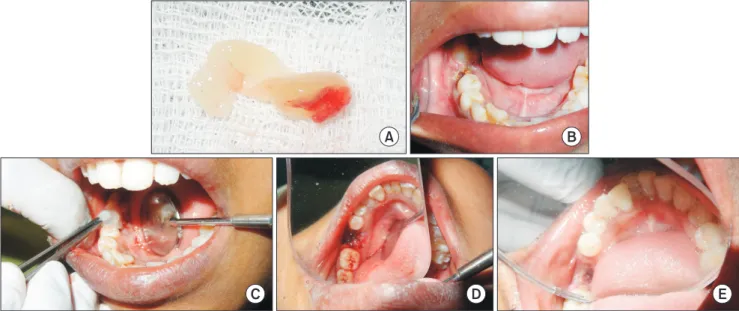
Ten milliliters of venous blood was drawn and centrifuged at 3,000 rpm for 10 minutes. Three layers were isolated after centrifugation with the first layer of red blood cells at the bottom, the second layer of white blood cells in the middle, and platelet rich fibrin on the surface. The standard operating procedure was followed. The wound was irrigated with nor- mal saline. PRF was placed in the socket and sutured using 3.0 mersilk with a figure of eight.(Fig. 1) Clinical parameters were assessed on the first, second, third, seventh, and fif- teenth days postoperatively for reduction in pain, analgesic
II. Materials and Methods
The study included 10 patients with aged from 41 to 64 years of either sex with dry socket diagnosis established ac- cording to the criteria of inclusion and were willing to par- ticipate in the PRF treatment protocol. Patients were enrolled from July to December 2015, the defined period of study.
Patient complaints falling within the criteria of dry socket included major symptoms like continuous throbbing pain ra- diating to the ear, temple, and neck, start of pain 1 to 3 days post extraction, foul taste, bad breath, pain not relieved even after medication, and signs including devoid of blood clot, infected or retained roots, localized swelling, and lymphade- nopathy. Such patients having a minimum of two symptoms and one sign were considered as established dry socket.
Fig. 1. A. Photograph showing prepared platelet rich fibrin (PRF). B. Intraoral photograph showing dry socket in right mandibular first molar region. C. Intraoperative photograph showing placement of PRF into dry socket. D. Intraoperative photograph showing closure of socket with a 3-0 mersilk suture. E. Intraoral photograph showing healed socket after 1 week.
Srinivas Chakravarthi: Platelet rich fibrin in the management of established dry socket. J Korean Assoc Oral Maxillofac Surg 2017
A B
C D E
Table 1. Criteria for diagnosis of dry socket (tick appropriate)
Feature Discription
Symptom
Sign
Continuous throbbing type of pain Radiating to ear, temple and neck Start of pain 1-3 days post extraction Foul taste
Bad breath
Pain not relieved even after medication Devoid of blood clot
Infected or retained roots Localised swelling Lymphadenopathy
Srinivas Chakravarthi: Platelet rich fibrin in the management of established dry socket. J Korean Assoc Oral Maxillofac Surg 2017
SPSS Statistics ver. 20.0 (IBM Co., Armonk, NY, USA) was used. Statistics were considered significant if P<0.05.
III. Results
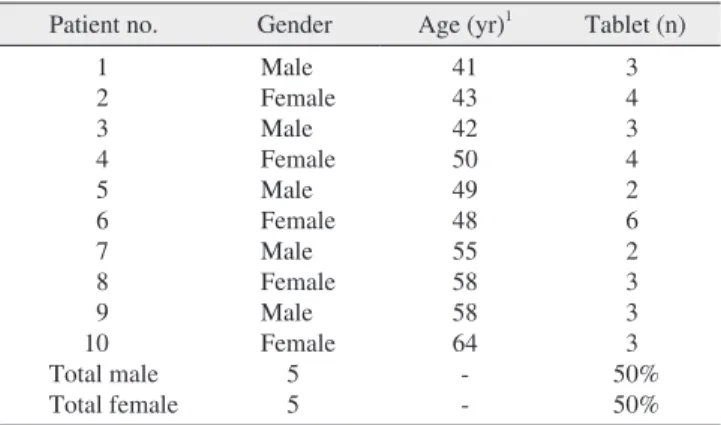
The study consisted of a total of ten patients (5 males and 5 females).(Table 2) Pain for all patients decreased to 1 by the first day except in one patient and decreased to 0 after 48 hours in all patients.(Tables 3-5) Severe pain was experienced by all patients before examination 6.80±0.789 (minimum- maximum pain score, 6-8), but was drastically reduced 3.00±
0.000 (minimum-maximum pain score, 3-3) during follow-up (P<0.005).(Tables 4, 5) Analgesic intake ranged from 2 to 6 tablets but decreased to 0.(Table 6)
intake, and satisfactory wound healing. Aceclofenac 100 mg tab was prescribed for all patients. Pain measured using a vi- sual analogue scale (0 to 10) and wound healing (0 to 3) were used as modified assessment scales13-15.
2. Statistical analysis
Data were tabulated using Microsoft excel (Microsoft, Redmond, WA, USA) and statistical analysis was carried out using the mean, percentage, Mann-Whitney test, Kruskal- Wallis test, and paired t-test. For statistical analysis, IBM
Table 4. Visual analogue scale results at different intervals using the Mann-Whitney test
Time interval Group Patient (n) Mean rank P-value
At the time of examination vs manipulation At the time of manipulation vs day 1 At the time of manipulation vs day 2 Day 1 vs day 2
Examination Manipulation Manipulation Day 1 Manipulation Day 2 Day 1 Day 2
10 10 10 10 10 10 10 10
15.50 5.50 15.50 5.50 15.50 5.50 15.05 5.95
0.001*
0.001*
0.001*
0.001*
*P<0.05 is considered significant.
Srinivas Chakravarthi: Platelet rich fibrin in the management of established dry socket. J Korean Assoc Oral Maxillofac Surg 2017 Table 3. Patients and percentage for each score at different time intervals (n=10)
Time interval Pain score
8 7 6 3 2 1 0
At the time of examination At the time of manipulation On day 1
On day 2 On day 3 On day 7
2 (20) 0 (0) 0 (0) 0 (0) 0 (0) 0 (0)
4 (40) 0 (0) 0 (0) 0 (0) 0 (0) 0 (0)
4 (40) 0 (0) 0 (0) 0 (0) 0 (0) 0 (0)
0 (0) 10 (100)
0 (0) 0 (0) 0 (0) 0 (0)
0 (0) 0 (0) 1 (10) 0 (0) 0 (0) 0 (0)
0 (0) 0 (0) 9 (90) 1 (10) 0 (0) 0 (0)
0 (0) 0 (0) 0 (0) 9 (90) 10 (100) 10 (100) Values are presented as number (%).
Srinivas Chakravarthi: Platelet rich fibrin in the management of established dry socket. J Korean Assoc Oral Maxillofac Surg 2017 Table 2. Total number of administered analgesic tablets with pa-
tient details
Patient no. Gender Age (yr)1 Tablet (n) 1
2 3 4 5 6 7 8 9 10 Total male Total female
Male Female Male Female Male Female Male Female Male Female
5 5
41 43 42 50 49 48 55 58 58 64 - -
3 4 3 4 2 6 2 3 3 3 50%
50%
1Mean (range) of age=50.8 yr (41-64 yr).
Srinivas Chakravarthi: Platelet rich fibrin in the management of established dry socket. J Korean Assoc Oral Maxillofac Surg 2017
Table 5. The visual analogue scale results at different interval days using Kruskal-Wallis test
Day Patient (n) Mean rank P-value
1 2 3 7
10 10 10 10
35.05 16.95 15.00 15.00
0.001*
*Statistically significant.
Srinivas Chakravarthi: Platelet rich fibrin in the management of established dry socket. J Korean Assoc Oral Maxillofac Surg 2017
reduction of pain was seen in 100% of patients by the third day with no analgesic intake. One patient showed very mild pain on the second day with intake of analgesic, which might be attributed to sociopsychological factors as the patient not having any deleterious habits, such as smoking that might have enhanced the pain condition. The resolution of pain was faster and this may be due to PRF. The kinine released from dry sockets will be antagonized by tissue growth factor, platelet-derived angiogenesis factor, platelet-derived growth factor, platelet-derived endothelial growth factor, interstitial growth factor, and platelet factor 4. These factors increase angiogenesis, chemotaxis, and epithelization with enhanced osteogenesis13,15.
PRF is biocompatible, effective, and safe because it is derived from the patient’s own blood16. Recent reports sug- gested rapid epithelization and faster bone regeneration with PRF17-24. A few reports have noted the use of PRF in the ex- traction socket showing better healing and reduced incidence of dry socket or prevention of dry socket incidence18,19,21. Our study showed effective pain reduction with patients showing reduced intake of analgesic within 24 hours. Epithelization was prompt in all cases. We were able to appreciate wound closure by the seventh day without any pain or infection. PRF is a potential novel treatment modality for dry socket13,20-24, and the PRF mixture has shown to be a good scaffold for bone regeneration in rats25.
Upon comparing studies with existing treatment modalities, including the use of ZOE, alvogyl, GECB (guaiacol, eugenol, chlorobutanol, balsam Peru mixture), pastille, vitamin C, Salicept patch, PRGF, topical anesthetic gel Oraqix (Dentsply Pharmaceutical, Karlskoga, Sweden) neocone, and low level laser therapy11,13,15,25-30, the use of PRGF showed faster and better alveolar mucosal healing and was complete within 7 days of starting the treatment, which is earlier than the ZOE group13,14. Many of these studies did not conclude on the best treatment modality and instead offer suggestions for pre- vention without any one existing protocol superseding oth- ers8,31,32. Dry socket occurs frequently after tooth extraction as a complication and causes discomfort to the patient. Due to its multifactorial etiology, it is necessary to follow preven- tive methods in daily practice32,33. The published literature shows a disparity in interventions and type of measurement scale, and the published results are difficult to compare31. From the published data, it is not possible to draw any clear conclusions on treatment protocol11-15,25-33. Each institution has adopted a different protocol and therefore, despite the many studies and publications, additional investigations are
IV. Discussion
Dry socket is a complication secondary to extraction and the cause is multifactorial1-5. The management of dry socket is varied3-9,11-15, and strategies have varying rate of suc- cess1,9-15. Kaya et al.11 showed use of alvogyl, Salicept patch, low laser therapy, and curettage with irrigation in dry sockets of 104 patients divided into four groups. They concluded that Salicept patches can be used as an alternative to alvogyl as dressing in dry socket management. Pal et al.13 studied 45 patients divided into three groups (15 each) and showed bet- ter healing and reduced symptoms with zinc oxide eugenol (ZOE) and gelatin-soaked sponge with PRGF compared to conventional irrigation with saline. The study also suggested that use of PRGF with gelatin might be an appropriate man- agement choice. Haraji et al.14 studied PRGF application in preventing dry socket in bilateral impactions of 40 patients divided in two groups, and showed good healing with PRGF and significant decrease in incidence of dry socket. The study showed beneficial effects of PRGF and suggested pro- phylactic use of PRGF after third molar extraction for the prevention of dry socket14. Singh et al.15 studied honey for the treatment of dry socket, which demonstrated a significant reduction of pain, inflammation, hyperemia, and soothing effect in 54 patients. Symptoms decreased with varying time duration, and the authors suggested the use of honey as a me- dicament in the management of dry socket.
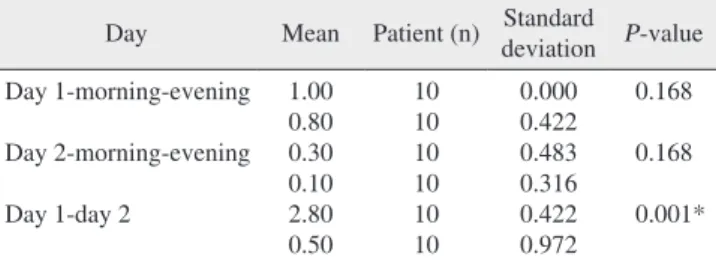
The literature review showed patient response with varying degrees of success using available modalities1,3. Our study used PRF to fill the socket after irrigation, which showed potential pain reduction within 24 hours.(Table 6) This was associated with reduction in analgesic intake. Patients used a maximum of 6 tablets and a minimum of 2 tablets (ace- clofenac 100 mg each). Preoperatively, the pain score was 6.80±0.078 and during treatment it was 3. At the first day, pain score was reduced to 1 in all but one patient. Complete
Table 6. Comparison of intake of analgesics using paired t-test
Day Mean Patient (n) Standard
deviation P-value Day 1-morning-evening
Day 2-morning-evening Day 1-day 2
1.00 0.80 0.30 0.10 2.80 0.50
10 10 10 10 10 10
0.000 0.422 0.483 0.316 0.422 0.972
0.168 0.168 0.001*
*Statistically significant.
Srinivas Chakravarthi: Platelet rich fibrin in the management of established dry socket. J Korean Assoc Oral Maxillofac Surg 2017
7. Muhonen A, Ventä I, Ylipaavalniemi P. Factors predisposing to postoperative complications related to wisdom tooth surgery among university students. J Am Coll Health 1997;46:39-42.
8. Noroozi AR, Philbert RF. Modern concepts in understanding and management of the "dry socket" syndrome: comprehensive review of the literature. Oral Surg Oral Med Oral Pathol Oral Radiol En- dod 2009;107:30-5.
9. Bloomer CR. Straws do not cause dry sockets when third molars are extracted. Tex Dent J 2012;129:25-32.
10. Reekie D, Downes P, Devlin CV, Nixon GM, Devlin H. The pre- vention of 'dry socket' with topical metronidazole in general dental practice. Br Dent J 2006;200:210-3; discussion 206; quiz 226.
11. Kaya GŞ, Yapici G, Savaş Z, Güngörmüş M. Comparison of alvo- gyl, SaliCept patch, and low-level laser therapy in the management of alveolar osteitis. J Oral Maxillofac Surg 2011;69:1571-7.
12. Jovanović G, Urić N, Krunić N, Tijanić M, Stojanović S. Assess- ment of the effectiveness of low level laser in the treatment of alveolar osteitis. Vojnosanit Pregl 2011;68:506-10.
13. Pal US, Singh BP, Verma V. Comparative evaluation of zinc oxide eugenol versus gelatin sponge soaked in plasma rich in growth fac- tor in the treatment of dry socket: an initial study. Contemp Clin Dent 2013;4:37-41.
14. Haraji A, Lassemi E, Motamedi MH, Alavi M, Adibnejad S. Effect of plasma rich in growth factors on alveolar osteitis. Natl J Maxil- lofac Surg 2012;3:38-41.
15. Singh V, Pal US, Singh R, Soni N. Honey a sweet approach to al- veolar osteitis: a study. Natl J Maxillofac Surg 2014;5:31-4.
16. Martínez-Zapata MJ, Martí-Carvajal A, Solà I, Bolibar I, Angel Expósito J, Rodriguez L, et al. Efficacy and safety of the use of autologous plasma rich in platelets for tissue regeneration: a sys- tematic review. Transfusion 2009;49:44-56.
17. Anitua E, Orive G. Use of PRGF to accelerate bone and soft tissue regeneration in postextraction sites. Implant Dialogue 2003;36:3- 18. Alexander RE. Dental extraction wound management: a case 14.
against medicating postextraction sockets. J Oral Maxillofac Surg 2000;58:538-51.
19. Plachokova AS, Nikolidakis D, Mulder J, Jansen JA, Creugers NH.
Effect of platelet-rich plasma on bone regeneration in dentistry: a systematic review. Clin Oral Implants Res 2008;19:539-45.
20. Aldecoa EA, Ortiz IA. A mew approach to bone regeneration:
plasma rich in growth factors. Vitoria: Puesta al Dia Publicaciones;
2001:172.
21. Sammartino G, Tia M, Marenzi G, di Lauro AE, D'Agostino E, Claudio PP. Use of autologous platelet-rich plasma (PRP) in peri- odontal defect treatment after extraction of impacted mandibular third molars. J Oral Maxillofac Surg 2005;63:766-70.
22. Simon D, Manuel S, Geetha V, Naik BR. Potential for osseous regeneration of platelet-rich plasma--a comparative study in man- dibular third molar sockets. Indian J Dent Res 2004;15:133-6.
23. Mozzati M, Martinasso G, Pol R, Polastri C, Cristiano A, Muzio G, et al. The impact of plasma rich in growth factors on clinical and biological factors involved in healing processes after third molar extraction. J Biomed Mater Res A 2010;95:741-6.
24. Rutkowski JL, Johnson DA, Radio NM, Fennell JW. Platelet rich plasma to facilitate wound healing following tooth extraction. J Oral Implantol 2010;36:11-23.
25. Song JY, Kweon H, Kwon KJ, Park YW, Kim SG. The bone regen- erative effect of silk fibroin mixed with platelet-rich fibrin (PRF) in the calvaria defect of rabbit. J Korean Assoc Oral Maxillofac Surg 2010;36:250-4.
26. Halberstein RA, Abrahmsohn GM. Clinical management and control of alveolalgia ("dry socket") with vitamin C. Am J Dent 2003;16:152-4.
27. Burgoyne CC, Giglio JA, Reese SE, Sima AP, Laskin DM. The ef- ficacy of a topical anesthetic gel in the relief of pain associated with localized alveolar osteitis. J Oral Maxillofac Surg 2010;68:144-8.
required to establish the best method to treat dry socket31-36. Published review and meta-analysis suggests placement of topical antibiotics including tetracycline, lincomycin, or clindamycin foam, whereas systemic antibiotics should be reserved for patients who are immunocompromised5,8.
Within the limitations of our study, PRF showed better results when compared to any other modalities mentioned in the literature1,13,14,31. Our study included only 10 patients in a single center. We have not compared sex differences but the literature shows a higher incidence of dry socket in females6. This study did not have control groups for comparison as this was a preliminary case series with 15 days of follow-up for clinical examination. A randomized, blind, multicenter long- term study with histopathological examination is needed to confirm the nature of new bone formed during implant place- ment.
V. Conclusion
PRF is a promising agent for the management of dry socket in a cost-effective manner. PRF does not have reactions like analgesics, as it is derived from the patient’s own blood without any additives. PRF showed early pain reduction in established dry socket with minimal analgesic intake. Our study suggests PRF as a potential treatment modality in the management of established dry socket.
Conflict of Interest
No potential conflict of interest relevant to this article was reported.
References
1. Daly B, Sharif MO, Newton T, Jones K, Worthington HV. Local interventions for the management of alveolar osteitis (dry socket).
Cochrane Database Syst Rev 2012;12:CD006968.
2. Fridrich KL, Olson RA. Alveolar osteitis following surgical re- moval of mandibular third molars. Anesth Prog 1990;37:32-41.
3. Blum IR. Contemporary views on dry socket (alveolar osteitis): a clinical appraisal of standardization, aetiopathogenesis and man- agement: a critical review. Int J Oral Maxillofac Surg 2002;31:309- 4. Vezeau PJ. Dental extraction wound management: medicating 17.
postextraction sockets. J Oral Maxillofac Surg 2000;58:531-7.
5. Caso A, Hung LK, Beirne OR. Prevention of alveolar osteitis with chlorhexidine: a meta-analytic review. Oral Surg Oral Med Oral Pathol Oral Radiol Endod 2005;99:155-9.
6. Garcia AG, Grana PM, Sampedro FG, Diago MP, Rey JM. Does oral contraceptive use affect the incidence of complications after extraction of a mandibular third molar? Br Dent J 2003;194:453-5;
discussion 445.
28. Faizel S, Thomas S, Yuvaraj V, Prabhu S, Tripathi G. Comparision between neocone, alvogyl and zinc oxide eugenol packing for the treatment of dry socket: a double blind randomised control trial. J Maxillofac Oral Surg 2015;14:312-20.
29. Rani A, Mohanty S, Sharma P, Dabas J. Comparative evaluation of Er:Cr:YSGG, diode laser and alvogyl in the management of alveo- lar osteitis: a prospective randomized clinical study. J Maxillofac Oral Surg 2016;15:349-54.
30. Haghighat A, Bahri Najafi R, Bazvand M, Badrian H, Khalighine- jad N, Goroohi H. The effectiveness of GECB pastille in reduc- ing complications of dry socket syndrome. Int J Dent 2012;2012:
587461.
31. Taberner-Vallverdú M, Nazir M, Sánchez-Garcés MÁ, Gay-Escoda C. Efficacy of different methods used for dry socket management:
a systematic review. Med Oral Patol Oral Cir Bucal 2015;20:e633- 9.
32. Kolokythas A, Olech E, Miloro M. Alveolar osteitis: a com- prehensive review of concepts and controversies. Int J Dent 2010;2010:249073.
33. Sharif MO, Dawoud BE, Tsichlaki A, Yates JM. Interventions for the prevention of dry socket: an evidence-based update. Br Dent J 2014;217:27-30.
34. Torres-Lagares D, Serrera-Figallo MA, Romero-Ruíz MM, Infante- Cossío P, García-Calderón M, Gutiérrez-Pérez JL. Update on dry socket: a review of the literature. Med Oral Patol Oral Cir Bucal 2005;10:81-5; 77-81.
35. Fazakerley M, Field EA. Dry socket: a painful post-extraction complication (a review). Dent Update 1991;18:31-4.
36. Cardoso CL, Rodrigues MT, Ferreira Júnior O, Garlet GP, de Car- valho PS. Clinical concepts of dry socket. J Oral Maxillofac Surg 2010;68:1922-32.