Focused Issue of This Month · 유 방 암
서 론
변 형 근치 유방절제술(modified radical mastectomy) 을 받은 군과 부분 유방절제술 및 액와 곽청술과 술후 방사선 치료를 받은 군에 대한 대규모 무작위 연구들을 통 한 양 군의 무병 생존율과 전체 생존율이 유사하다는 보고 이래 유방보존술은 계속해서 발달해 왔다(1, 2).
유럽에서는 유방보존술이 현재 조기 유방암에서 표준치 료로 받아들여지고 있으며 Whelan 등(3)은 I, II기 유방암 환자의 약 70%에서 유방보존술이 시행되고 있다고 보고하 였다. 또한 세계적으로 국가 전체 통계에 대한 자료는 거의 없으나, Cutuli 등(4)이 2001년부터 2002년까지의 프랑스 전국의 수술을 집계한 자료에 의하면 총 1,159예 중 림프절
전이가 있었던 예가 44.4%이었음에도 불구하고 수술 방법 으로 유방보존술이 77.5%, 유방절제술이 22.5%로 시행된 것을 볼 때 유방보존술이 표준 수술로 받아들여지고 있음을 알 수 있다. 국내의 경우 유방보존술이 1996년 18.7%에서 2004년 41.9%로 증가추세를 보이고는 있으나 유럽의 경우 와는 대조적으로 빈도가 낮은 편이다(5).
Veronesi 등(6)은 705예에 대한 무작위 전향적 연구에 서 종괴절제술(lumpectomy)에 비하여 유방 4분획절제술 (quadrantectomy)이 전체 생존율의 차이는 없지만 7.0%
대 2.2%로 국소재발을 의미있게 감소시킨다는 보고를 하 였고, 이에 따른 수준 1 증거(level 1 evidence)에 의하여 절제연을 넓게 확보할수록 안전하다는 사실이 강조되어 왔 다. 하지만 넓게 절제할수록 유방의 변형이 심해지는 경우
유방암의 종양성형술
Oncoplastic Breast Surgery
배 영 태 | 부산의대 외과 | Young -tae Bae, MD
Division of Breast Surgery, Pusan National University College of Medicine E - mail : [email protected]
J Korean Med Assoc 2009; 52(10): 981 -995
F
or the majority of patients with breast cancer, a surgery that minimizes breast loss combined with radiotherapy has become a popular treatment of choice. The wider clearance margins are necessary for the lower risk of local recurrences, although the greater amount of breast tissue should be removed and the risk of deformation of the breast is higher. Satisfactory cos- metic results can be achieved by oncoplastic breast surgery. The aims of this paper are to review articles of oncoplastic surgery for breast cancer and to summarize the full range of immediate reconstructions from local flaps to sophisticated perforator flaps. It is important for a surgeon to minimize breast loss while the operation and maintain the patient’s feeling that her breasts are still a part of her own body after the operation. The oncoplastic breast surgery will become an integral element of the surgical treatment of breast cancer in the future.Keywords: Breast cancer; Breast conserving surgery; Breast reconstruction;
Immediate breast reconstruction
핵 심 용 어: 유방암; 유방보존술; 유방재건술; 즉시유방재건술
Abstract
981_995특집-배영태 2009.10.9 5:54 PM 페이지981 NO.3 InPut
가 많으므로 광범위 절제술이 필요하다고 판단되는 경우 종 양학적 안전성과 미용학적 효과 사이에 갈등이 생기게 된 다. 유방보존술의 미용적 효과는 종양의 크기와 위치, 유방 의 크기, 수술 절제 범위 등에 의해 결정된다(7 ~ 9).
Cochrane 등(10)의 보고에 의하면, 전체 유방 용량에서 제 거되는 양이 10~20% 이상일 경우 미용적 효과는 나빠지는 것으로 알려져 있다. 따라서 만족할 만한 미용적 효과를 얻 기 위해 종양제거술 후 즉시 성형술을 시행하여야 안전한 절제연의 확보로 종양학적 안정성도 함께 보장받을 수 있 다. 이것을 소위 종양성형술(oncoplastic surgery)이라 한 다(11, 12).
국내 유방보존술이 차지하는 비율이 낮은 이유는 종양 외과의들에게 아직 종양성형술의 개념이 보편적으로 받아
Figure 1A.Preoperative view of a 51- year-old patient suffering symptomatic macromastia with invasive carcinoma in the upper outer quadrnat of the right breast and the ductal carcinoma in situ in the upper outer quadrant of left breast.
Figure 1B.Intraoperative view showing the completion of bila- teral breast reduction with a Wise - pattern inferior pedicle technique.
Figure 1C. The aesthetic outcome of bilateral breast reduction with a Wise-pattern inferior pedicle technique.
특 집
Oncoplastic Breast Surgery들여지지 않고 있어 환자에게 종양성형술을 적극적으로 추천하고 있지 않기 때문으로 생각된다. 따라서 본 논문 은 유방보존수술의 적응증을 확대시키고 즉시 재건술을 통해 환자들의 삶의 질을 향상시킬 수 있도록 유방암의 종 양성형술에 대한 개념을 문헌 고찰과 함께 정리해 보고자 한다.
종양성형술(Oncoplastic Surgery)의 정의
종양성형술의 정의는 아직 명확히 확립되어 있지 않다 (13). 1998년에 Audretsch 등(14)에 의해 처음으로 이 용 어가 사용되었으며, 종괴절제술(lumpectomy) 이나 유방
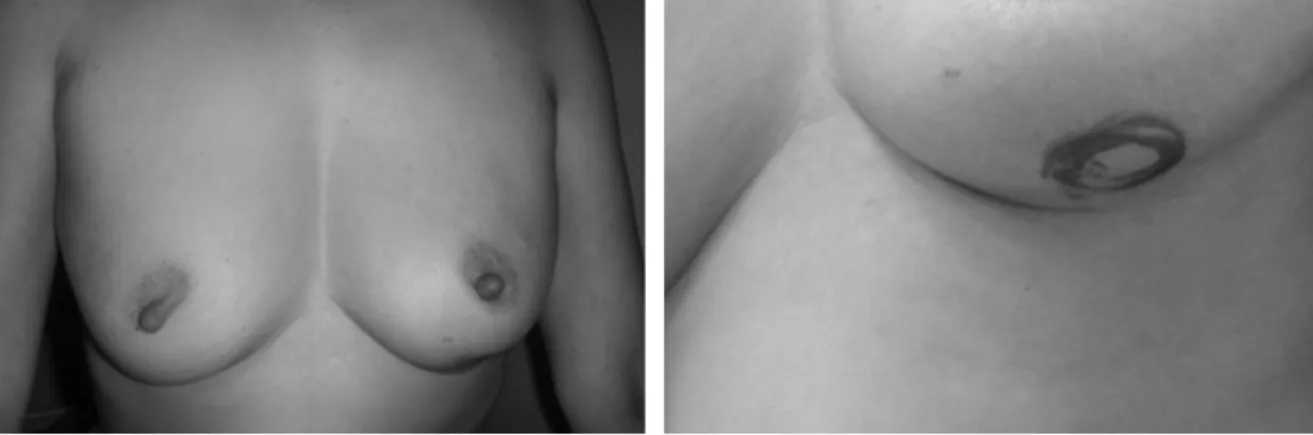
Figure 2A. Preoperative view of the left breast with a tumor located at lower pole of left breast (Lt.) and close-up view (Rt.).
Figure 2B. A partial mastectomy and thoracoeipigasric flap was designed.
Figure 2C. Intraoperative view showing rotation of thoraco- epigastric flap into the defect of lower pole of left breast after partial mastectomy.
Figure 2D. View of showing skin closure and a complete recon- struction by rotation of thoracoepigastric flap.
981_995특집-배영태 2009.10.9 5:54 PM 페이지983 NO.3 InPut
4분획절제술(quadrantectomy) 등의 부분 유방절제술과 동시에 유방 변형을 예방하기 위한 즉시 재건술을 시행하는 것을 말한다. 또한 Malycha 등(15)은 종양성형술을 한 명 의 외과의에 의해 시행되는 종양학적 제거술(oncologic extirpation)과 재건술(reconsturction)의 이음매 없는 연 결 시술이라 하였다. 그러나 유방전절제술 후 이루어지는 지연적 재건술이나 유방암 수술 후 발생하는 흉벽 결손의 재건에까지도 이 용어는 확대되어 사용되고 있다(13, 16).
Skillman과 Humzah(17)는 종양성형술의 개념이 받아들 여지기 위해서 외과의는 최소한 축소성형술, 광배근 피판술 등의 기술을 습득해야 하고 성형의는 종양학적 지식에 대한 습득이 필요하다고 하였다. 종양성형술을 시행함으로써 보 다 더 넓게 유방을 절제할 수 있기 때문에 안전한 변연부의 확보가 가능하며, 종양학적으로 더 안전하여 유방 전절제를 피할 수 있다(12, 18, 19). 2002년 이후로 영국에서 12개월 간의 유방암 종양성형술의 임상의제도(fellowships)가 발 족되면서 많은 임상의가 배출되었고 현재 세계 곳곳에서 종 양성형술에 대한 자문의로 활동하고 있다(20).
유방재건의 시기
(Timing of Reconstruction)
유방재건술의 종류에는 종양의 제거술(extirpational surgery)과 동시에 시행하는 즉시 유방재건술(immediate
breast reconstruction)과 수 개월 혹은 수년 후에 시행하는 지연 유방재건술(delayed breast reconstruction)이 있다.
최근에는 유방절제술 후의 유방재건술이 지연 재건술에서 즉시 재건술로 이향하는 추세이다. 지연 유방재건술을 받는 환자는 유방절제술 후 신체적으로 회복될 시간적 여유를 가 질 수 있으며 환자와 재건술을 시행할 성형외과 의사와의 의사소통이 충분히 이루어질 수 있어 유방절제술 후 유방재 건의 필요성을 절감하고 재건 후 결과에 대한 만족도가 높 아질 수 있다. 그러나 실제로는 시간이 경과할수록 유방 소 실로 인한 우울증이 발생할 수 있으며, 유방절제술 후의 반 흔 형성, 방사선조사 등으로 인해 생긴 피부의 섬유화와 연 조직 수축으로 피하의 반흔조직까지 모두 제거해야 하는 경 우가 발생하기도 한다. 특히 지연 재건술을 시행하는 경우 소실된 대칭적인 유방하주름을 차후에 새로 만들어 주여야 하는 등 기술적인 문제 등이 많으나, 즉시 재건술을 시행하 면 지연적 재건의 단점을 피할 수 있고 수술의 횟수를 줄임 으로써 경제적 이득도 얻을 수 있다(21~26).
1990년대 초까지 유방재건은 원발 병소 제거 후 재발이 없는 경우 2년까지 기다려야 한다는 인식이 있었다(27). 그 러나 M. D. Anderson 암센터에서 1996년도에 발표한 보 고에 따르면 즉각적 유방재건술이 종양 재발의 발견에 방해 요인이 되지는 않으며(28), 더 효능적이고 경제적이며 기술 적으로도 편리하기 때문에 현재까지도 가능하면 유방절제 술 후 즉시 성형술을 시행할 것을 추천하고 있다(29).
Figure 2E.Postoperative front and oblique views of thoracoepigastric flap after three months.
특 집
Oncoplastic Breast Surgery부분유방결손 재건술 (Reconsruction of the Partial Mastectomy Defect)
유방보존술을 시행함에 있어 유방은 크면서 종양의 크기 가 작은 경우에는 보존술 후의 유방 변형이 거의 없지만, 유 방 크기에 비해 종양이 큰 경우 종양성형술을 시행하지 않 으면 유방보존술 후 심각한 유방 변형이 남게 되어 유방보 존술의 장점이 없어지게 된다(30). 또한 종양성형술은 일반 적으로 종양절제술 후 지연적 재건술을 시행하는 것보다 즉 각적 재건술을 시행하는 것이 술후 변형을 예방하는 데 더 욱 효과적이다(12, 31). 따라서 종양절제술과 함께 재건술 을 동시에 시행하면 수술적, 경제적 이점 뿐만 아니라 정신 적 이점까지도 얻을 수 있다(26, 32).
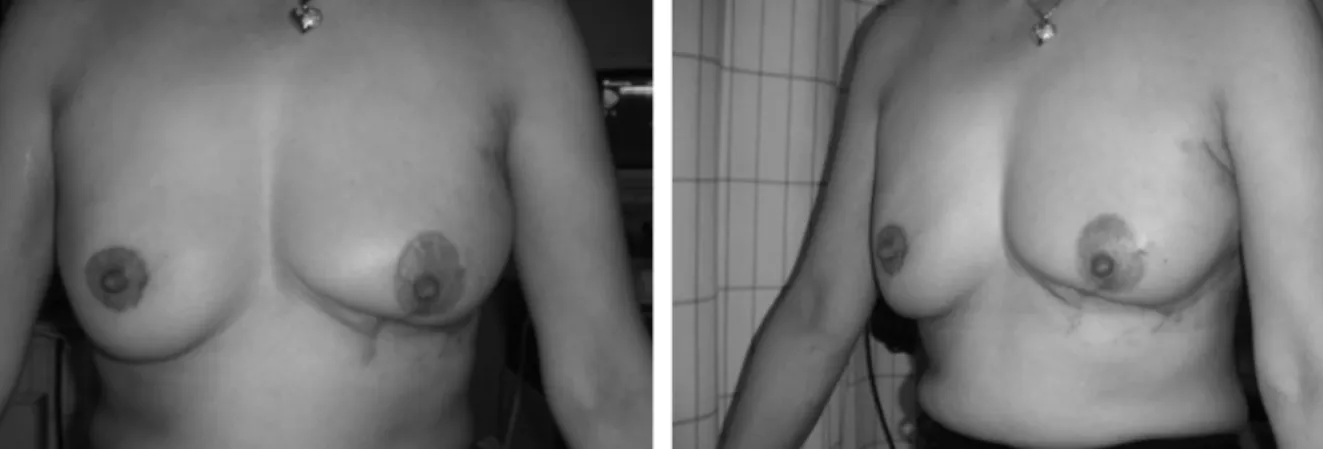
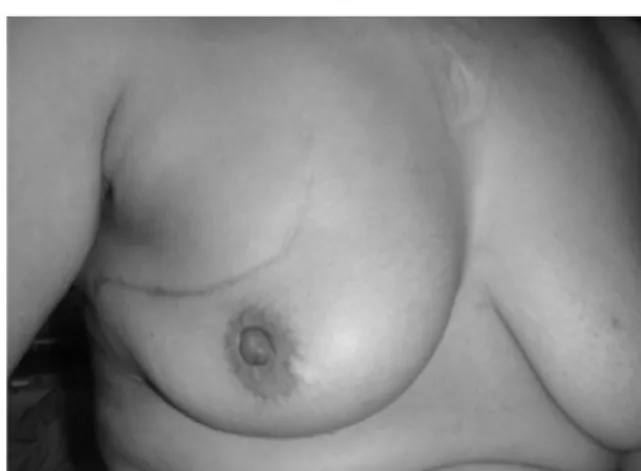
Figure 3A. Preoperative view of rotational flap designed to per- form a wide excision and transfer subaxillary skin and subcutaneous fat into the upper outer quadrant.
Figure 3B. Intraoperative view showing a partial mastectomy and incision of rotational flap.
Figure 3C. Immediate postoperative view showing skin closure and completion of rotational flap.
Figure 3D. Postoperative view shows aesthetic outcome after six months.
981_995특집-배영태 2009.10.9 5:54 PM 페이지985 NO.3 InPut
유방 재건술에 있어 중요한 요소는 유방결손의 크기이다.
국소 피판으로 재건하는 방법은 수술이 쉽고 수술 후 회복 이 용이하나, 조직을 획득할 수 있는 용량이 적고 병변 위치 에 따른 제한으로 어려움이 따른다. 줄기 피판술(pedicle flap)이나 유리 피판술(free flap) 등의 원격 피판술(distant flaps)은 풍부한 용량의 조직 획득으로 훌륭한 미용 성적을 낼 수 있지만, 수술 시간이 길어지고 유방 종양성형술에 경 험이 많은 의사가 필요하다는 단점이 있으며 피판 소실 및 지방 괴사 등의 합병증이 존재한다. Losken 등(33)은 부분 유방재건에 대한 종양성형술은 크게 유선조직의 회전술 (glandular rotation), 외측 흉벽 전진술(lateral thoracic wall advancement), 유방고정술(mastopexy)과 축소 유 방성형술(reduction mammoplasty)을 이용한 치료적 유 방성형술(therapeutic mammaplasty) 등으로 구성된 조직 이동술(volume displacement procedures)과 유방조직 이외의 조직으로 결손 부위를 메우는 술식인 조직 대체술 (volume replacement procedures)의 두 가지로 분류할 수 있으며, 큰 유방이나 하수된 유방에서 치료적 축소 유방 성형술이 유용한 수술방법이라 하였다.
종양이 유방의 하방에 위치한 경우 부분유방절제술 후 성 형술을 같이 시술하지 않으면 유방의 변형이 심해지기 때문 에 처음에는 치료적 축소 유방성형술이 종양이 유방의 하방 에 위치한 경우에 국한되어 시술되었다(8). 축소 유방성형 술의 이론적 장점은 미용적 효과 이외에도 반대측 유방 조 직을 채취하는 것인데, 가능한 많은 유방조직을 제거함으로 써 그만큼 유방암의 재발 위험도가 감소하게 되고 방사선 치료의 효율도 증가할 수 있으며 거대 유방에 따른 증상도 개선할 수 있다(Figure 1). Garusi 등(34)에 따르면 축소 유방성형술을 시행하면서 반대편 유방의 채취한 조직 중 약 4%에서 잠복암이 발견되기 때문에 고위험군에서는 건강한 유방 조직을 많이 떼어낼수록 암 예방에 이점이 있다고 볼 수 있다. 또한 Boice 등(35)이 조사한 스웨덴의 전국적인 전향적 통계에 의하면 양쪽 유방을 미용적 축소성형술 시행 한 예에서 유방암 발병의 빈도가 건강한 예의 대조군에 비 해 약 28% 감소하였으며, 특히 40세 이후에 축소성형술은 받은 경우 통계적 의미가 있었다. 이후 Fryzek 등(36)은 이
를 9년 더 연장하여 관찰하였고, 그 결과 역시 유방 축소성 형술로써 건강한 유방을 많이 제거할수록 암의 발병을 감소 시키는 것으로 밝혀졌다. 축소 성형술을 선호하는 이유 중 하나는 유방의 크기를 감소시키면 술 후 방사선 치료시 남 아있는 유방에 조사되는 방사선 양이 감소하고 균일하게 조 사할 수 있기 때문이며 결과적으로는 방사선 조사에 의한 부작용이 감소하기 때문이다(37, 38). 그러나 축소성형술 은 추가적인 피부의 상처가 불가피하게 발생하게 되며 축소 유방 내의 지방괴사, 표피함유 낭종(epidermal inclusion cyst) 등을 형성하기도 한다(39).
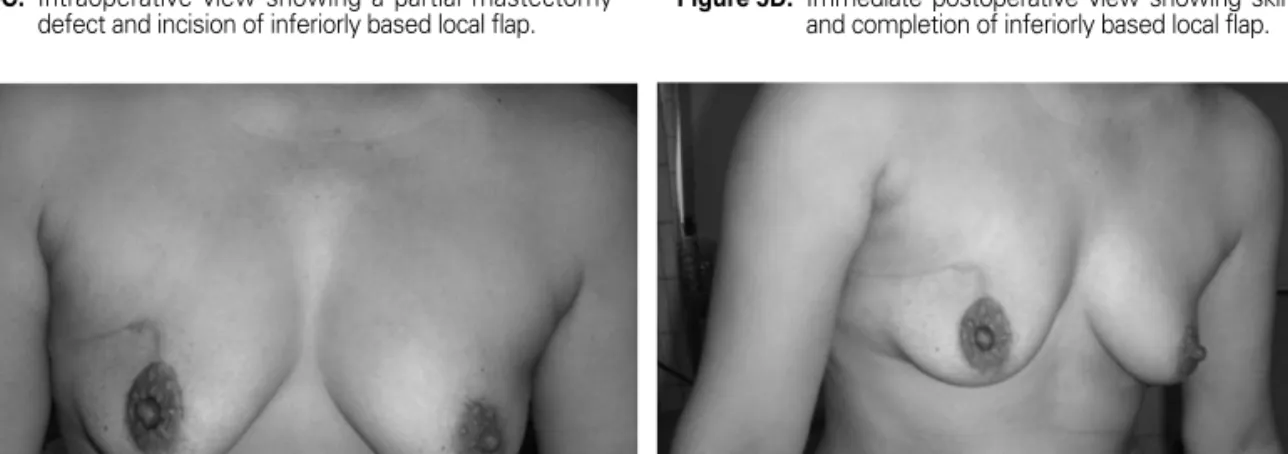
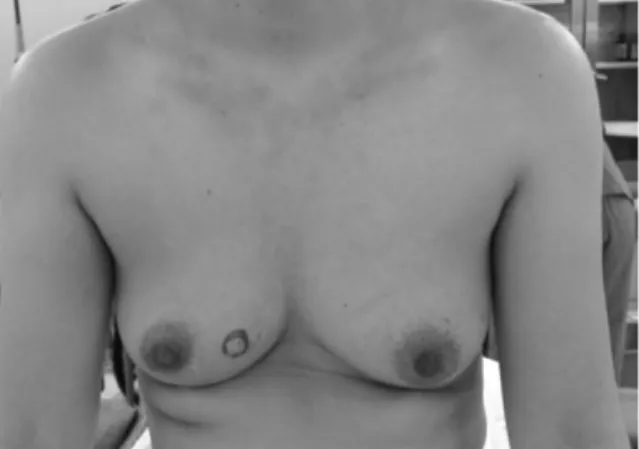
두 번째 방법은 유방조직 이외의 조직, 즉 근막, 피하지 방, 혹은 근육 피판 등을 이용하여 결손 부위를 메우는 술식 인 조직 대체술(volume replacement procedures)이다 (9, 18, 32, 40~42). 이러한 방법들 중에 종양이 유방의 하 내측에 위치한 경우 흉복벽 피판술(thoracoepigastric flap)로써 결손 부위를 메워줄 수 있으며(Figure 2)(43), 종 양이 유방의 외측에 위치한 경우에는 겨드랑이 밑(suba- xillary) 피부를 포함하여 피하 지방조직을 유방 결손부위를 메우는 수술방법을 선택할 수 있다(Figure 3)(30). 또한 종 양이 상부 유방에 위치한 경우 유방의 상부조직과 함께 피 하지방과 피부를 포함하여 부분유방절제술을 시행한 후 결 손 부위로 상부축(superiorly based)을 중심으로 하여 회전 시켜 넣거나(Figure 4)(32), 하부축(inferiorly based)을 중 심으로 회전하여 넣을 수 있다(Figure 5). 종양이 유방의 외 하부에 위치한 경우에는 결손부위에 외흉배근막 피판술 (lateral thoracodorsal fasciocutaneous flap)을 시행해 볼 수 있는데 전거근(serratus anterior muscle) 근육의 근 막과 피부 및 피하지방을 결손부위로 이동시켜 메우면 된다 (Figure 6)(44, 45).
조직 대체술은 형태, 크기, 대칭성을 복원할 수 있으며 대 칭성을 회복시키기 위한 반대편 유방의 수술을 시행하지 않 아도 되지만, 추가적인 수술 시간이 필요하고 제공 부위 (donor site)의 합병증과 피판 상실, 회복기간의 연장 등의 단점이 있다. 뿐만 아니라 국소 조직으로 유방 봉우리를 만 들기 충분하지 않은 결손 부위는 조직을 추가시켜야 한다.
이러한 경우 광배근피판이 최선의 선택이며 횡복직근피판
특 집
Oncoplastic Breast Surgery은 피하는 것이 좋지만, 만약 건강한 횡복직근피판을 사용 할 수 있다면 유방의 일부만을 제거하는 것보다 국소 재발 의 위험이 감소되도록 유방전절제술을 시행하는 것이 낫다 (30). 광배근 피판술(latissimus dorsi myocutaneous flap)은 Tansini(46) 에 의해 1896년에 유방암 수술 후 흉벽 재건에 시행된 예가 처음 기술되었다. 이후 거의 사용되지 않 다가 1976년에 Olivari (47)에 의하여 다시 시행되기 시작하 였으며 당시 방사선 조사에 의한 흉벽 결손에 광배근을 처음 으로 사용하였다. 부분 유방절제술 후의 즉시 재건술에는 국 소 피판, 축소 유방성형술 등이 주로 이용되고 있지만, 피판
이 결손 부위를 메우기에 불충분한 경우에는 광배근 피판술 을 시행할 수 있으며 이는 좋은 선택이다. 뿐만 아니라 광배 근피판술은 유방보존술이 불가능한 경우, 즉 유방 크기에 비 해 종양이 큰 경우에도 유방보존술을 가능하게 한다(48). 유 방부분결손의 재건술에 광배근을 사용한 것은 Noguchi 등 (49)에 의해 처음으로 기술되었다.
Tomita 등(50)은 술 후 방사선 조사를 받은 환자의 유방은 섬유화 등에 의해 수축하기 때문에 정상쪽 유방보다 재건하 는 유방의 크기를 약 1.2 ~1.3배 더 크게 재건하는 것이 바람 직하다고 하였다.
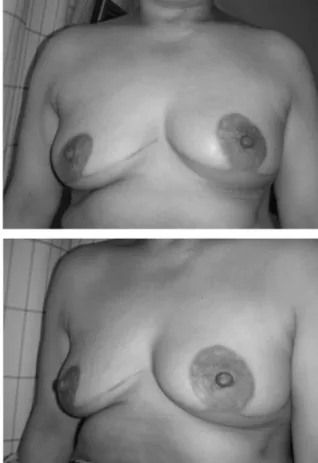
Figure 4A. Preoperative view showing a patient with a mass located in the upper outer quadrant of right breast and planned for partial mastectomy and repairing of the defect with a superiorly based local flap.
Figure 4B. Intraoperative view showing a partial mastectomy and incision of superiorly based local flap.
Figure 4C. Immediate postoperative view showing skin closure and completion of superiorly based local flap.
Figure 4D. Postoperative view showing aesthetic outcome after six months.
981_995특집-배영태 2009.10.9 5:54 PM 페이지987 NO.3 InPut
Figure 5B. A view showing a mass located in the mid-upper quadrant of right breast and the planned for partial mastectomy and repairing of the defect with a in- feriorly based local flap.
Figure 5A. Preoperative view of a 44- year-old patient with in- vasive ductal carcinoma in the mid-upper quadrant of right breast.
Figure 5C. Intraoperative view showing a partial mastectomy defect and incision of inferiorly based local flap.
Figure 5D. Immediate postoperative view showing skin closure and completion of inferiorly based local flap.
Figure 5E. Postoperative view showing aesthetic outcome of front and oblique views after six months.
특 집
Oncoplastic Breast SurgeryFigure 6A. A patient with a mass located in transition zone of the upper and lower outer quadrants of the left breast. A partial mastectomy and lateral thoracodorsal fascio- cutaneous flap was designed.
Figure 6B. A intraoperative view of the lateral thoracodorsal fasciocutaneous flap dissected and rotated into the lateral breast defect.
Figure 6C. Immediate postoperative view showing skin closure and completed reconstruction by a rotation of lateral thoracodorsal fasciocutaneous flap.
Figure 6D. Postoperative view three-month after lateral thoraco- dorsal fasciocutaneous flap.
981_995특집-배영태 2009.10.9 5:54 PM 페이지989 NO.3 InPut
전유방재건술
(Reconsruction of Total Mastectomy Defect)
유방절제술 후 유방재건 시기에 대한 전항적 무작위 연구 는 아직 보고된 바가 없어 아직 지침이 세워지지 않고 있으 며 논란의 여지가 있지만 최근의 추세는 지연적 재건에서 즉시적 재건쪽으로 향하고 있다. 즉시 전유방재건술 중 최 근에 많이 시행되고 있는 대표적인 수술 방법은 피부보존 유방전절제술(skin-sparing mastectomy)이다. 피부보존
유방전절제술은 1991년 Toth와 Lappert(51)에 의해 처음 으로 서술되었으며, 유방의 피부를 최대한 보존하여 보형물 과 자가 조직으로 유방의 재건을 극대화할 수 있는 술식이 다. Gerber 등(52)에 의하면 이 술식을 유방 근치 전절제술 과 비교한 장기 추적의 결과상 재발률에 큰 차이는 없었다.
유방재건에 사용되는 조직은 보형물과 자가 조직으로 크 게 구분할 수 있다. 보형물은 실리콘 겔(silicone gel)이나 식염수를 사용하거나 그 둘을 혼합한 것인 실리콘 막내부에 식염수로 채워진 보형물 등이 있다. Hodgson와 Malata
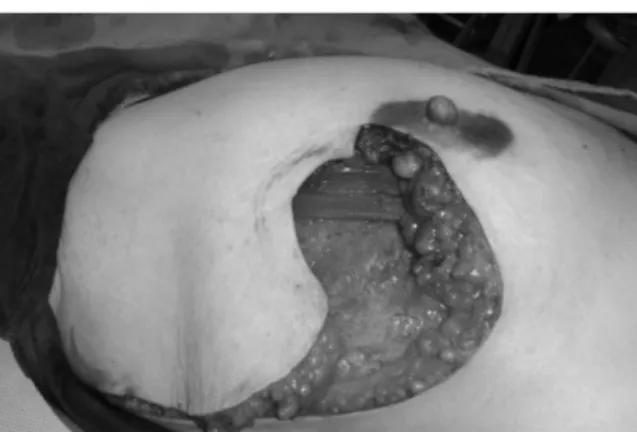
Figure 7A.Preoperative view of patient with ductal carcinoma in situ in the upper and lower outer quadrants of left breast with diffuse microcalcification.
Figure 7B. The drawing of supra-areolar incision for standard nipple areolar sparing mastectomy.
Figure 7C.The nipple was inverted by index finger and the milk ducts were exposed. After cutting the milk ducts with tips of Mezenbaum scissors, the tissue was sent for frozen section. This procedure was repeated to ex- pose the clear margin of nipple-areolar complex.
Figure 7D. Intraoperative view by transillumination with the dissected skin flap containing subcutaneous fat and superficial fascia of the gland to avoid any breast parenchyma remained on the skin flap.
특 집
Oncoplastic Breast Surgery(53)은 작거나 중간 크기의 유방이면서 하수가 없는 경우가 보형물의 적응증이라 정의하였다. 그러나 보형물을 사용하 여 재건술을 시행하는 경우 피막구축(capsule contrac- tion)이나 삽입물 주위에 반흔이 생길 수 있으며 유방이 단 단해 지거나 통증이 발생할 수 있다. 덴마크의 전국적인 통 계에 의하면 보형물 삽입한 환자의 약 45%가 3개월내, 67%
가 6개월 내에 합병증을 경험하였으며, 이들 중 외과적 치 료가 필요한 예는 21%이었다(54). 발생한 합병증의 대부분 은 피막구축, 비대칭, 다른 부위로 보형물이 밀려나가는 것 등이었다. 또한 Contant 등(55)의 보고에 따르면 실리콘 보
형물로 즉시 전유방재건술을 시행한 후 방사선 조사를 하는 경우 초기 합병증 빈도는 15%, 후기 합병증의 빈도는 21%
정도이며, 이 중 피막구축이 가장 흔한 합병증이었다. 이러 한 합병증 등으로 삽입물과 주위의 피막의 제거가 필요한 경우도 있다. 심지어 Vandeweyer와 Derae-maecker(56) 는 즉시 재건술 후 방사선 치료를 시행하는 경우 보형물의 피막 구축 등의 합병증이 발생할 수 있으므로 즉시 재건술 후 방사선 치료가 필요한 환자에게는 보형물 사용을 해서는 안된다고 주장하기도 하였다.
반면 자가 조직 피판은 대부분의 환자에서 보형물 삽입보 다 미용적으로 우수하며 환자가 이물감을 느끼지 않는 장점 을 가진다. 자가 조직 피판술 중 광배근피판술은 근치적 유 방절제술이 주로 시행된 1970년 이후 주된 수술법으로 주 목을 받았는데 광배근피판술의 단점은 충분한 양의 피판을 보급할 수 없다는 것이다. 따라서 부족한 피부와 근육을 대 체하기 위하여 추가로 피판 하방에 유방삽입물을 함께 넣어 사용하기도 했다(Figure 7)(57~60). 그러나 보형물을 같이 사용한 경우 피막 섬유증 등의 보형물의 합병증으로 인하여 약 50%에서 재수술을 시행한 보고가 있으며(61), 눈에 띄 는 큰 수술반흔이 남는 등의 단점이 있어 유방재건술 중 제 1의 선택에서 횡복직근피판에 밀려나게 되었다(62).
줄기 횡복직근피판술(pedicled transverse rectus ab- dominis myocutaneous flap, TRAM flap)은 상복벽 동맥
Figure 7E.A specimen mammographic view showing diffuse microcalcifications and adequate margins.
Figure 7F. A view of skin closure of nipple areolar sparing mas- tectomy with immediate reconstruction with latis- simus dorsi flap with implant.
Figure 7G.Postoperative view six-month after of nipple areolar sparing mastectomy with immediate reconstruction with latissimus dorsi flap with implant.
981_995특집-배영태 2009.10.9 5:54 PM 페이지991 NO.3 InPut
(superior gastroepiploic artery)을 공급 혈관으로 하여 하 복부의 지방, 피부를 포함한 횡복직근으로 유방을 재건한 다. 이 술식은 유방삽입물 없이도 크고 부드러우면서 자연 스러운 유방을 만들어줄 수 있기 때문에 자가조직을 이용한 유방재건에 많이 이용되고 있다. 유리 횡복직근 피판술 (free TRAM flap)은 소량의 복직근과 그 위를 덮고있는 지 방과 피부를 하복부에서 완전히 분리하여 심부하복벽동맥 을 흉벽의 내유혈관에 미세 혈관술을 이용하여 연결함으로 써 혈관 공급을 재건시키는 방법이다. 유리 횡복직근피판술 은 상복벽동맥보다 더 굵은 심부하복벽동맥을 통해 더 많은 혈류를 공급받는다. 따라서 유리피판술은 혈류도 더 우수하 면서 복직근과 근막이 더 많이 보존할 수 있으므로 줄기 피 판술에 비해 제공부 합병증이 현저히 감소하는 것으로 알려 져 최근에는 유방재건술의 표준 술식으로 인정되고 있다.
최근에는 천공지피판(perforator flap)의 개념이 도입되면 서 유방 재건에 심부하복벽동맥 분지 피판(deep inferior epigastric perforator flap)이 추가되어 환자의 상태나 수 술적 여건에 따라 피판의 선택의 폭이 더 다양해 졌다.
천공지 피판술(Breast Reconstruction Using Perforator Flaps)
전유방을 재건하는 경우 조직이 풍부한 하복부 피판이 가 장 많이 이용되고 있다. 최근에는 줄기 횡직근 피판(pedi- cled TRAM flap)과 유리 횡복직근 피판(free TRAM flap) 에 이어 천공지 피판, 즉 심부하복벽천공지 피판(deep inferior epigastric artery)이 주로 시행되고 있다. 또한 표 층 하복벽동맥천공지 피판(superficial inferior epigastric artery perforator flap)도 추가되어 술자의 선호도에 따라 유방재건술의 방법이 선택되고 있다.
이전에는 줄기 횡복직근 피판술이 가장 선호되는 자가이 식술이었으며, 이는 지방, 피부를 포함하여 횡복직근을 분 리한 후 흉부 쪽으로 회전시켜 유방 봉우리를 만드는 술식 이다. 피판술 실패의 고위험군, 즉 흡연자, 비만, 그리고 방 사선조사의 기왕력이 있는 경우 합병증 빈도가 높기 때문에 유리 횡복직근피판술이 추천된다. 유리 횡복직근피판술은
소량의 복직근과 그 위를 덮고 있는 지방과 피부를 완전히 분리하여 미세 혈관술을 사용하여 유방을 재건하는 것이다 (63). 줄기 복횡직근피판술은 1982년 Hartrampf 등(64)에 의해 처음으로 서술되었으며, 유리 횡복직근피판술은 1979 년 Holmstrom(65)에 의해 처음 기술되었다. 줄기 횡복직 근피판술의 장점은 수술 시간의 단축과 노련한 미세혈관 술 자의 불필요함, 수혈 빈도의 감소 등이며, 유리 횡복직근피 판술의 장점은 우수한 혈액 공급, 낮은 빈도의 복벽 윤곽 변 형과 유방하주름 유지 등이다(66). 줄기 횡복직근피판술의 조기 합병증으로는 피판의 괴사, 혈종, 감염, 장액종 등이 있으며 후기 합병증으로는 탈장, 지방괴사 등이 있다(63).
Kroll 등(67)은 지방괴사가 줄기 횡직근피판술과 유리 복직 근 피판술에서 각각 18%, 9%로 차이를 보인다고 보고하였 으며, 복부 윤곽 변형이 유리 횡복직근피판술에 비해 유리 횡복직근피판술이 3.8 배 이상 높은 빈도를 보인다는 보고 도 있다(68).
하복부피판의 획기적인 발전은 심부 하복벽천공지피판 에서 시작되었으며, 이 수술은 유리 횡복지근피판처럼 하복 부 피부와 지방을 이용하여 복직근을 제거하지 않고도 근육 섬유를 박리해냄으로써 복직근과 근막을 보존할 수 있어 유 리 횡복지근피판술을 대체할 수 있다(69, 70). 심부 하복벽 천공지피판은 유리 횡복직근피판보다 복벽 손상이 덜하다 는 장점이 있긴 하지만 일상생활을 함에 있어 의미있는 차 이는 없는 것으로 알려져 있다(71).
가장 최근에는 표층 하복벽동맥천공지피판이 시행되고 있으며 이 방법은 복부근육에 전혀 이상을 초래하지 않는 것으로 보고되고 있다(71~73). 표층 하복벽동맥천공지피 판은 유리 횡복직근피판, 심부 하복벽천공지피판 등과 같이 하복부 피부와 지방조직의 피판을 이용하는 방법이다(73).
표층 하복벽동맥피판의 줄기 혈관은 표층 하복벽동맥이며, 이 혈관은 어떠한 근육도 관통하지 않는다. 이 수술의 장점 은 복직근과 근막을 절단하지 않기 때문에 복근력이 손상받 지 않는다는 것이며, 단점은 이 혈관의 해부학적 변형이 다 양하기 때문에 약 30%의 환자에서만 이 수술이 가능하다는 점이다.
이외에도 상볼기동맥천공지피판(superior gluteal
특 집
Oncoplastic Breast Surgeryartery perforator free flap)(74), 하볼기동맥천공지피판 (inferior gluteal free flap)(75), 그리고 Harii 등(76, 77) 이 처음 기술한 두덩정강근피판(gracilis myocutaneous flap)이 유방 재건에 이용되고 있다. 이러한 피판 수술에서 미세혈관 문합시 2002년까지는 대부분의 경우 받는(reci- pient) 혈관으로 주로 흉배동맥(thoracodorsal vessels)이 이용되었으나, 최근에는 내유동맥(internal mammary vessels)이 주로 이용되고 있다.
결 론
종양성형술의 개념을 명확히 확립하고 알릴 수 있는 가장 확실한 방법은 대부분의 경우 유방암의 치료를 담당하는 의 사인 외과의가 유방성형술, 특히 축소성형술 및 광배근피판 술 등에 대하여 보다 정확하고 폭넓은 지식을 가지는 것이 다. 그러한 상황에서만이 그들은“종양성형외과의”로서 유 방암에 대한 완전한 수술적 치료를 해낼 수 있을 것이다.
현재까지 국내 유방보존술이 차지하는 비율은 비교적 낮 은 편이며 외과의들에게 아직 종양성형술의 개념이 보편적 으로 아직 받아들여지지 않고 있고, 따라서 환자에게 종양 성형술에 대해 적극적으로 추천하고 있지 않고 있는 실정이 다. 이것은 서로 다른 2개의 팀이 수술에 관여하는 경우 외 과의와 성형의 간의 원활한 정보 교환의 부재, 그리고 성형 의의 종양학에 대한 지식 부족 등이 그 원인으로 생각해 볼 수 있다. 향후 외과의는 성형술에 대한 풍부한 지식을, 성형 의는 종양에 대한 정확한 지식을 습득하여 서로 다른 두 명의 술자가 수술을 시행하더라도 세밀한 정보교환 등을 통하여 유방암에 대한 보다 명확한 치료 계획을 세워야 할 것이며, 종양성형술에 대한 개념을 확립해 나감으로써 환자에게 보 다 나은 삶의 질과 함께 완전한 치료를 도모해야 할 것이다.
참고문헌
11. Veronesi U, Cascinelli N, Mariani L, Greco M, Saccozzi R, Luini A, Aguilar M. Marubini E. Twenty-year follow-up of a ran- domized study comparing breast-conserving surgery with radical mastectomy for early breast cancer. N Engl J Med
2002; 347: 1227-1232.
12. Fisher B, Anderson S, Bryant J, Margolese RG, Deutsch M, Fisher ER, Jeong JH, Wolmark N. Twenty-year follow-up of a randomized trial comparing total mastectomy, lumpectomy, and lumpectomy plus irradiation for the treatment of invasive breast cancer. N Engl J Med 2002; 347: 1233-1241.
13. Whelan T, Levine M, Gafni A, Sanders K, Willan A, Mirsky D, Schnider D, McCready D, Reid S, Kobylecky A, Reed K.
Mastectomy or lumpectomy? Helping women make informed choices. J Clin Oncol 1999; 17: 1727-1735.
14. Cutuli B, Cottu PH, Guastalla JP, Mechin H, Costa A, Jourdan R. A French national survey on infiltrating breast cancer:
analysis of clinico-pathological features and treatment mo - dalities in 1159 patients. Breast Cancer Res Treat 2006; 95:
55-64.
15. Ahn SH, Yoo KY. Chronological changes of clinical charac- teristics in 31,115 new breast cancer patients among Koreans during 1996-2004. Breast Cancer Res Treat 2006; 99: 209- 214.
16. Veronesi U, Volterrani F, Luini A, Saccozzi R, Del Vecchio M, Zucali R, Galimberti V, Rasponi A, Di Re E, Squicciarini P.
Quadrantectomy versus lumpectomy for small size breast cancer. Eur J Cancer 1990; 26: 671- 673.
17. Clough KB, Cuminet J, Fitoussi A, Nos C, Mosseri V. Cos- metic sequelae after conservative treatment for breast cancer:
classification and results of surgical correction. Ann Plast Surg 1998; 41: 471- 481.
18. Clough KB, Nos C, Salmon RJ, Soussaline M, Durand JC.
Conservative treatment of breast cancers by mammaplasty and irradiation: a new approach to lower quadrant tumors.
Plast Reconstr Surg 1995; 96: 363- 370.
19. Noguchi M, Saito Y, Mizukami Y, Nonomura A, Ohta N, Koyasaki N, Taniya T, Miyazaki I. Breast deformity, its cor- rection, and assessment of breast conserving surgery. Breast Cancer Res Treat 1991; 18: 111-118.
10. Cochrane RA, Valasiadou P, Wilson AR, Al-Ghazal SK, Ma- cmillan RD. Cosmesis and satisfaction after breast-conserving surgery correlates with the percentage of breast volume excised. Br J Surg 2003; 90: 1505-1509.
11. Al-Ghazal SK, Fallowfield L, Blamey RW. Does cosmetic outcome from treatment of primary breast cancer influence psychosocial morbidity? Eur J Surg Oncol 1999; 25: 571- 573.
12. Clough KB, Lewis JS, Couturaud B, Fitoussi A, Nos C, Falcou MC. Oncoplastic techniques allow extensive resections for breast-conserving therapy of breast carcinomas. Ann Surg 2003; 237: 26-34.
13. Rutgers EJ. Guidelines to assure quality in breast cancer surgery. Eur J Surg Oncol 2005; 31: 568-576.
14. Audretsch W. Reconstruction of the partial mastectomy defect: classification and method. In: Spear SL, ed. Surgery of the Breast: Principles and Art. 1th ed. Philadelphia: Lippincott- Raven, 1998: 155-196.
15. Malycha PL, Gough IR, Margaritoni M, Deo SV, Sandelin K, Buccimazza I, Agarwal G. Oncoplastic breast surgery: a global perspective on practice, availability, and training. World J Surg 2008; 32: 2570 - 2577.
981_995특집-배영태 2009.10.9 5:54 PM 페이지993 NO.3 InPut
16. Baildam AD. Oncoplastic surgery of the breast. Br J Surg 2002; 89: 532-533.
17. Skillman JM, Humzah MD. The future of breast surgery: a new subspecialty of oncoplastic breast surgeons? Breast 2003; 12: 161-162.
18. Raja MA, Straker VF, Rainsbury RM. Extending the role of breast-conserving surgery by immediate volume replacement.
Br J Surg 1997; 84: 101-105.
19. Giacalone PL, Roger P, Dubon O, El Gareh N, Daures JP, Laffargue F. Lumpectomy vs oncoplastic surgery for breast- conserving therapy of cancer. A prospective study about 99 patients. Ann Chir 2006; 131: 256- 261.
20. Baildam A, Bishop H, Boland G, Dalglish M, Davies L, Fatah F, Gooch H, Harcourt D, Martin L, Rainsbury D, Rayter Z, Sheppard C, Smith J, Weiler- Mithoff E, Winstanley J, Church J. Oncoplastic breast surgery-a guide to good practice. Eur J Surg Oncol 2007; 33: 1- 23.
21. Brandberg Y, Malm M, Blomqvist L. A prospective and randomized study, “SVEA”, comparing effects of three methods for delayed breast reconstruction on quality of life, patient-defined problem areas of life, and cosmetic result.
Plast Reconstr Surg 2000; 105: 66-76.
22. Schain WS, Wellisch DK, Pasnau RO, Landsverk J. The sooner the better: a study of psychological factors in women undergoing immediate versus delayed breast reconstruction.
Am J Psychiatry 1985; 142: 40-46.
23. Schain WS, Jacobs E, Wellisch DK. Psychosocial issues in breast reconstruction. Intrapsychic, interpersonal, and practical concerns. Clin Plast Surg 1984; 11: 237- 251.
24. Al-Ghazal SK, Fallowfield L, Blamey RW. Comparison of psychological aspects and patient satisfaction following breast conserving surgery, simple mastectomy and breast recon- struction. Eur J Cancer 2000; 36: 1938-1943.
25. Al-Ghazal SK, Sully L, Fallowfield L, Blamey RW. The psy- chological impact of immediate rather than delayed breast reconstruction. Eur J Surg Oncol 2000; 26: 17-19.
26. Dean C, Chetty U, Forrest AP. Effects of immediate breast reconstruction on psychosocial morbidity after mastectomy.
Lancet. 1983; 1: 459-462.
27. Kroll SS, Ames F, Singletary SE, Schusterman MA. The on- cologic risks of skin preservation at mastectomy when com- bined with immediate reconstruction of the breast. Surg Gy- necol Obstet 1991; 172: 17- 20.
28. Singletary SE. Skin-sparing mastectomy with immediate breast reconstruction: the M. D. Anderson Cancer Center experience. Ann Surg Oncol 1996; 3: 411-416.
29. Chevray PM, Robb GL. Breast reconstruction. In: Hunt KK, Robb GL, Strom EA, Ueno NT, eds. M.D. Anderson Cancer Care Series Breast Cancer. 2nd ed. New York: Springer Sience, 2008: 235 -269.
30. Clough KB, Kroll SS, Audretsch W. An approach to the repair of partial mastectomy defects. Plast Reconstr Surg 1999; 104:
409-420.
31. Slavin SA, Love SM, Sadowsky NL. Reconstruction of the radiated partial mastectomy defect with autogenous tissues.
Plast Reconstr Surg 1992; 90: 854- 869.
32. Kroll SS, Singletary SE. Repair of partial mastectomy defects.
Clin Plast Surg 1998; 25: 303- 310.
33. Losken A, Styblo TM, Carlson GW, Jones GE, Amerson BJ.
Management algorithm and outcome evaluation of partial mastectomy defects treated using reduction or mastopexy techniques. Ann Plast Surg 2007; 59: 235-242.
34. Garusi C, Petit JY, Rietjens M, Lanfrey E. Role of plastic surgery in the conservative treatment of breast cancer. Ann Chir Plast Esthet 1997; 42: 168-176.
35. Boice JD Jr, Persson I, Brinton LA, Hober M, McLaughlin JK, Blot WJ, Fraumeni JF Jr, Nyren O. Breast cancer following breast reduction surgery in Sweden. Plast Reconstr Surg 2000; 106: 755 -762.
36. Fryzek JP, Ye W, Nyren O, Tarone RE, Lipworth L, Mc- Laughlin JK. A nationwide epidemiologic study of breast cancer incidence following breast reduction surgery in a large cohort of Swedish women. Breast Cancer Res Treat 2006; 97:
131-134.
37. Losken A, Elwood ET, Styblo TM, Bostwick J 3rd. The role of reduction mammaplasty in reconstructing partial mastectomy defects. Plast Reconstr Surg 2002; 109: 968-977.
38. Smith ML, Evans GR, Gurlek A, Bouvet M, Singletary SE, Ames FC, Janjan N, McNeese MD. Reduction mammaplasty:
its role in breast conservation surgery for early-stage breast cancer. Ann Plast Surg 1998; 41: 234- 239.
39. Fajardo LL, Bessen SC. Epidermal inclusion cyst after re- duction mammoplasty. Radiology 1993; 186: 103-106.
40. Rainsbury RM, Paramanathan N. Recent Progress with Breast - Conserving Volume Replacement Using Latissimus Dorsi Miniflaps in UK Patients. Breast Cancer 1998 25; 5: 139- 147.
41. Dixon JM, Venizelos B, Chan P. Latissimus dorsi mini-flap: a technique for extending breast conservation. Breast 2002; 11:
58-65.
42. Kijima Y, Yoshinaka H, Owaki T, Funasako Y, Aikou T. Im- mediate reconstruction using inframammary adipofascial flap of the anterior rectus sheath after partial mastectomy. Am J Surg 2007; 193: 789 -791.
43. Audretsch W. Reconstruction of the partial mastectomy defect: classification and method. In: Spear SL, ed. Surgery of the Breast: Principles and Art. 2nd ed. Philadelphia: Lippincott Willium and Wilkins, 2006: 198-216.
44. Holmstrom H, Lossing C. The lateral thoracodorsal flap in breast reconstruction. Plast Reconstr Surg 1986; 77: 933-943.
45. Koh SH, Seo HI, Bae YT. Immediate conservative breast reconstruction technique using lateral thoracodorsal fascio- cutaneous Flap. J Br Cancer 2007; 10: 217- 222.
46. Tansini I. Nuovo processo per l’amputazione della mamella per cancre. Riforma Med 1896; 12: 3-5.
47. Olivari N. The latissimus flap. Br J Plast Surg 1976; 29: 126- 128.
48. Page DL, Johnson JE. Controversies in the local management of invasive and non-invasive breast cancer. Cancer Lett 1995;
90: 91- 96.
49. Noguchi M, Taniya T, Miyazaki I, Saito Y. Immediate trans- position of a latissimus dorsi muscle for correcting a post- quadrantectomy breast deformity in Japanese patients. Int Surg 1990; 75: 166-170.
50. Tomita K, Yano K, Matsuda K, Takada A, Hosokawa K.
Esthetic outcome of immediate reconstruction with latissimus dorsi myocutaneous flap after breast-conservative surgery and skin-sparing mastectomy. Ann Plast Surg 2008; 61: 19 - 23.
51. Toth BA, Lappert P. Modified skin incisions for mastectomy:
the need for plastic surgical input in preoperative planning.
Plast Reconstr Surg 1991; 87: 1048 -1053.
Peer Reviewers’ Commentary
본 논문은 점점 증가하고 있는 유방암의 절제술 후 유방의 변형 혹은 결손을 교정하기 위한 여러 재건방법을 소상히 고 찰하였다. 유방암의 종양학적 측면의 중요성 뿐만 아니라 여성 신체의 중요 부분인 유방 절제 후 미적 보완에 중점을 두 고 기술하였다. 유방암의 수술시기, 절제 범위, 재건 시기, 이용 가능한 조직 여부 등에 따라 유방 인근 조직, 보형물 이 용, 복부 및 등의 줄기 근피판과 유리피판술 등에 이르기까지 다양한 방법의 장단점을 가려 훌륭한 재건술을 소개하였다.
이 분야의 치료와 재건에 좋은 지표가 되리라 사료된다.
[정리:편집위원회]
특 집
Oncoplastic Breast Surgery52. Gerber B, Krause A, Dieterich M, Kundt G, Reimer T. The oncological safety of skin sparing mastectomy with con- servation of the nipple-areola complex and autologous reconstruction: an extended follow-up study. Ann Sur 2009;
249: 461- 468.
53. Hodgson EL, Malata CM. Implant-based breast reconstruction following mastectomy. Breast Dis 2002;16: 47- 63.
54. Henriksen TF, Fryzek JP, Holmich LR, McLaughlin JK, Krag C, Karlsen R, Kjoller K, Olsen JH, Friis S. Reconstructive breast implantation after mastectomy for breast cancer: clinical outcomes in a nationwide prospective cohort study. Arch Surg 2005; 140: 1152-1161.
55. Contant CM, van Geel AN, van der Holt B, Griep C, Tjong Joe Wai R, Wiggers T. Morbidity of immediate breast recon- struction (IBR) after mastectomy by a subpectorally placed silicone prosthesis: the adverse effect of radiotherapy. Eur J Surg Oncol 2000; 26: 344- 350.
56. Vandeweyer E, Deraemaecker R. Radiation therapy after immediate breast reconstruction with implants. Plast Reconstr Surg 2000; 106: 56- 60.
57. Bostwick J 3rd, Scheflan M. The latissimus dorsi musculo- cutaneous flap: a one-stage breast reconstruction. Clin Plast Surg 1980; 7: 71-78.
58. McCraw JB, Maxwell GP. Early and late capsular “defor- mation” as a cause of unsatisfactory results in the latissimus dorsi breast reconstruction. Clin Plast Surg 1988; 15: 717-726.
59. Tschopp H. Evaluation of long-term results in breast recon- struction using the latissimus dorsi flap. Ann Plast Surg 1991;
26: 328 - 340.
60. Paepke S, Schmid R, Fleckner S, Paepke D, Niemeyer M, Schmalfeldt B, Jacobs VR, Kiechle M. Subcutaneous mas- tectomy with conservation of the nipple-areola skin: broad- ening the indications. Ann Surg 2009; 250: 288-292.
61. Tarantino I, Banic A, Fischer T. Evaluation of late results in breast reconstruction by latissimus dorsi flap and prosthesis implantation. Plast Reconstr Surg 2006; 117: 1387-1394.
62. Schneider WJ, Hill HL Jr, Brown RG. Latissimus dorsi myocutaneous flap for breast reconstruction. Br J Plast Surg 1977; 30: 277- 281.
63. Erdmann D, Sundin BM, Moquin KJ, Young H, Georgiade GS.
Delay in unipedicled TRAM flap reconstruction of the breast: a review of 76 consecutive cases. Plast Reconstr Surg 2002;
110: 762-767.
64. Hartrampf CR, Scheflan M, Black PW. Breast reconstruction with a transverse abdominal island flap. Plast Reconstr Surg 1982; 69: 216 - 225.
65. Holmstrom H. The free abdominoplasty flap and its use in breast reconstruction. An experimental study and clinical case report. Scand J Plast Reconstr Surg 1979; 13: 423- 427.
66. Larson DL, Yousif NJ, Sinha RK, Latoni J, Korkos TG. A comparison of pedicled and free TRAM flaps for breast reconstruction in a single institution. Plast Reconstr Surg 1999; 104: 674- 680.
67. Kroll SS, Gherardini G, Martin JE, Reece GP, Miller MJ, Evans GR, Robb GL, Wang BG. Fat necrosis in free and pedicled TRAM flaps. Plast Reconstr Surg 1998; 102: 1502-1507.
68. Nahabedian MY, Manson PN. Contour abnormalities of the abdomen after transverse rectus abdominis muscle flap breast reconstruction: a multifactorial analysis. Plast Reconstr Sur. 2002; 109: 81- 90.
69. Allen RJ, Treece P. Deep inferior epigastric perforator flap for breast reconstruction. Ann Plast Surg 1994; 32: 32- 38.
70. Blondeel PN. One hundred free DIEP flap breast reconstruc- tions: a personal experience. Br J Plast Surg 1999; 52: 104 - 111.
71. Bajaj AK, Chevray PM, Chang DW. Comparison of donor-site complications and functional outcomes in free muscle-sparing TRAM flap and free DIEP flap breast reconstruction. Plast Reconstr Surg 2006; 117: 737-750.
72. Grotting JC. The free abdominoplasty flap for immediate breast reconstruction. Ann Plast Surg 1991; 27: 351- 354.
73. Chevray PM. Breast reconstruction with superficial inferior epigastric artery flaps: a prospective comparison with TRAM and DIEP flaps. Plast Reconstr Surg 2004; 114: 1077-1085.
74. Allen RJ, Tucker C Jr. Superior gluteal artery perforator free flap for breast reconstruction. Plast Reconstr Surg 1995; 95:
1207-1212.
75. Paletta CE, Bostwick J 3rd, Nahai F. The inferior gluteal free flap in breast reconstruction. Plast Reconstr Surg 1989; 84:
875- 885.
76. Harii K, Ohmori K, Sekiguchi J. The free musculocutaneous flap. Plast Reconstr Surg 1976; 57: 294-303.
77. Arnez ZM, Pogorelec D, Planinsek F, Ahcan U. Breast reconstruction by the free transverse gracilis (TUG) flap. Br J Plast Surg 2004; 57: 20 - 26.
981_995특집-배영태 2009.10.9 5:54 PM 페이지995 NO.3 InPut