66
Association between Lung Cancer Susceptibility Variants Identified by Genome-Wide Association Studies and the Survival of Non-Small Cell Lung Cancer
Purpose: Nowadays, chromosomal regions containing genes associated with the risk of lung cancer are identified by a number of genome-wide association studies (GWASs). As part of the study, GWAS has identified the association of six chromosomal regions, 1q23, 4q22, 4q31, 5p15, 6p21, and 15q25, as being associated with lung cancer risk in the European population. We investigated the impact of genetic variants identified in GWASs for lung cancer susceptibility on the survival outcomes in patients with early stage non-small cell lung cancer (NSCLC). Materials and Methods: Three hundred and sixty-three patients with surgically resected NSCLC were enrolled. Eight single nucleotide polymorphisms (SNPs), rs2808630 on 1q23, rs7671167 on 4q22, rs1489759 and rs2202507 on 4q31, rs2736100 and rs402710 on 5p15, rs1052486 on 6p21 and rs16969968 on 15q25, were genotyped using a polymerase chain reaction-restriction fragment length polymorphism assay.
The associations between genotypes and overall survival (OS) and disease-free survival (DFS) were analyzed. Results: None of the eight SNPs were significantly associated with OS or DFS. In addition, when the patients were categorized according to age, gender, smoking status, tumor histology and pathologic stage, there were no significant associations between the eight SNPs and the survival outcomes. Conclusion: These results suggest that the genetic variants identified by GWASs for lung cancer susceptibility may not affect the prognosis of early stage NSCLC. (J Lung Cancer 2012;11(2):66
70)
Key Words: Non-small cell lung carcinoma, Survival, Disease susceptibility
Mi Jeong Hong, M.S.1, Yi Young Choi, M.S.1, Sook Kyung Do, B.S.1, Hyo-Sung Jeon, Ph.D.1,2 Seung Soo Yoo, M.D.2,3 Won Kee Lee, Ph.D.4 Shin Yup Lee, M.D.2,3 Jaehee Lee, M.D.3 Seung Ick Cha, M.D.3 Chang Ho Kim, M.D.3 Eungbae Lee, M.D.5 and Jae Yong Park, M.D.1,2,3
1Department of Biochemistry and Cell Biology, Kyungpook National Univer- sity School of Medicine, 2Lung Cancer Center, Kyungpook National Univer- sity Medical Center, 3Department of Internal Medicine, 4Statistic Center,
5Department of Thoracic Surgery, Kyungpook National University School of Medicine, Daegu, Korea
Received: November 15, 2012 Accepted: November 22, 2012 Address for correspondence Eungbae Lee, M.D.
Department of Thoracic Surgery, Kyungpook National University School of Medicine, 101, Dongin-dong 2-ga, Daegu 700-422, Korea
Tel: 82-53-200-2861 Fax: 82-53-200-2027 E-mail: [email protected] Jae Yong Park, M.D.
Department of Internal Medicine, Lung Cancer Center, Kyungpook National University Medical Center, Kyungpook National University School of Medi- cine, 807, Hoguk-ro, Buk-gu, Daegu 702-210, Korea
Tel: 82-53-200-2631 Fax: 82-53-200-2027 E-mail: [email protected]
This work was supported by Kyung- pook National University Research Fund, 2012.
INTRODUCTION
The tumor-node-metastais (TNM) staging system is the best index for determining the survival outcome after surgical resection of early-stage non-small cell lung cancer (NSCLC) (1). However, patients with the same pathologic stage of the disease display marked variability in recurrence and survival, likely due to heterogeneity of gene/protein expression profiles (2). A better understanding of the molecular pathways that influence the lung cancer phenotype may lead to the identification of patients at high risk of recurrence, and thus, interventions could be directed toward those who are most likely to benefit from them.
Recently, a number of genome-wide association studies (GWASs) have identified chromosomal regions containing genes associated with the risk of lung cancer. In addition, GWASs have aided our understanding of diverse molecular pathways underlying lung cancer by identifying a number of genes potentially involved in the pathogenesis of this disease (3-8). There is a growing realization that genetic polymor- phisms influence not only the development of cancer, but also cancer progression and prognosis (9,10). Therefore, we have hypothesized that genetic variants associated with susceptibility to lung cancer in these GWASs may affect malignant pheno- types of lung cancer and thereby affect the prognosis of lung cancer patients. To test this hypothesis, we investigated the impact of genetic variants identified in GWASs for lung cancer susceptibility on the survival outcomes in patients with early stage NSCLC.
MATERIALS AND METHODS
This study included patients (n=363) with stage I, II, or IIIA (micro-invasive N2) NSCLC who underwent curative surgical resection at the Kyungpook National University Hospital (KNUH, Daegu, Korea) between September 1998 and December 2007, and whose tumor tissues were available for DNA. All of the patients included were ethnic Koreans.
Further, those patients who received chemotherapy or radiotherapy prior to surgery were excluded so as to avoid the effects on DNA. All the tissues were provided by the National Biobank of Korea, KNUH, which is supported by the Ministry
of Health, Welfare and Family Affairs. All materials derived from the National Biobank were obtained under the approved protocols of the Institutional Review Board. The pathologic staging of the tumors was determined according to the International System for Staging Lung Cancer (1). This study was approved by the Institutional Review Board of the KNUH.
We examined eight single nucleotide polymorphisms (SNPs) in the six chromosomal regions that were associated with lung cancer susceptibility in GWASs (3-8). The rs2808630T>C (*2447 [the nucleotide 3' of the translation termination codon denoted by *1]) in the C-reactive protein (CRP) gene on 1q23;
the rs7671167C>T (IVS5-24587) in the family with sequence similarity 13A (FAM13A) gene on 4q22; the rs1489759A>G (-93355 from translation start site) in the hedgehog-interacting protein (HHIP) gene and the rs2202507A>C (-195893 from translation start site) in the glycophorin A (GYPA) gene on 4q31; the rs2736100T>G (IVS2-3777) in the telomerase reverse transcriptase (TERT) gene and the rs402710G>A (IVS16+9) in the cleft lip and palate transmembrane protein 1-like (CLPTM1L, also known as cisplatin resistance-related protein 9 [CRR9p]) gene on 5p15; the rs1052486A>G (S619P) in the HLA-B associated transcript 3 (BAT3) gene on 6p21; and the rs16969968G>A (D398N) in the nicotine acetylcholine receptor alpha subunit 5 (CHRNA5) gene on 15q25 were geno- typed by a polymerase chain reaction-restriction fragment length polymorphism analysis. The distribution of genotypes was tested for Hardy-Weinberg equilibrium with the good- ness-of-fit χ2 test. Differences in the distribution of genotypes according to the clinicopathologic factors of the patients were compared using χ2 tests for categorical variables. The primary outcomes used for this study were the overall survival (OS) and the disease-free survival (DFS). The OS was measured from the day of surgery until the date of death or to the date of the last follow-up. DFS was calculated from the day of surgery until recurrence or death from any cause. The association of OS and DFS with genotypes and haplotypes was investigated using the Kaplan-Meier method and assessed using the log-rank test.
Hazard ratios and 95% confidence intervals (CIs) were esti- mated using multivariate Cox proportional hazards models, with adjustment for age (≤64 years vs. >64 years), gender (male vs. female), smoking status (never-smoker vs. ever-smoker), pathologic stage (I vs. II∼IIIA) and adjuvant therapy (yes vs.
no). All statistical testing was conducted with SPSS version
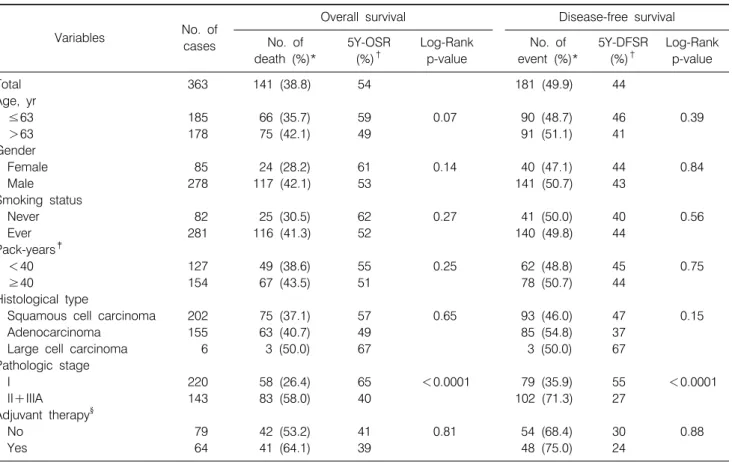
Table 1. Univariate Analysis for Overall Survival and Disease-Free Survival by Age, Gender, Smoking Status, Histological Type, Pathologic Stage, and Adjuvant Therapy
Variables No. of
cases
Overall survival Disease-free survival
No. of death (%)*
5Y-OSR (%)†
Log-Rank p-value
No. of event (%)*
5Y-DFSR (%)†
Log-Rank p-value
Total 363 141 (38.8) 54 181 (49.9) 44
Age, yr
≤63 185 66 (35.7) 59 0.07 90 (48.7) 46 0.39
>63 178 75 (42.1) 49 91 (51.1) 41
Gender
Female 85 24 (28.2) 61 0.14 40 (47.1) 44 0.84
Male 278 117 (42.1) 53 141 (50.7) 43
Smoking status
Never 82 25 (30.5) 62 0.27 41 (50.0) 40 0.56
Ever 281 116 (41.3) 52 140 (49.8) 44
Pack-years‡
<40 127 49 (38.6) 55 0.25 62 (48.8) 45 0.75
≥40 154 67 (43.5) 51 78 (50.7) 44
Histological type
Squamous cell carcinoma 202 75 (37.1) 57 0.65 93 (46.0) 47 0.15
Adenocarcinoma 155 63 (40.7) 49 85 (54.8) 37
Large cell carcinoma 6 3 (50.0) 67 3 (50.0) 67
Pathologic stage
I 220 58 (26.4) 65 <0.0001 79 (35.9) 55 <0.0001
II+IIIA 143 83 (58.0) 40 102 (71.3) 27
Adjuvant therapy§
No 79 42 (53.2) 41 0.81 54 (68.4) 30 0.88
Yes 64 41 (64.1) 39 48 (75.0) 24
*Row percentage, †Five year-overall survival rate (5Y-OSR) and 5 year-disease free survival rate (5Y-DFSR), proportion of survival derived from Kaplan-Meier analysis, ‡In ever-smokers, §In pathologic stage II+IIIA: 59 cases received chemotherapy, 2 cases received radiotherapy, and 3 cases received chemotherapy, and radiotherapy.
15.0 (SPSS Inc., Chicago, IL, USA).
RESULTS
Clinical and pathologic characteristics of the patients and their association with OS are shown in Table 1. There were 141 deaths (38.8%), and the estimated 5-year OS and DFS for all patients was 54% (95% CI, 48∼60%) and 43% (95% CI, 37∼50%), respectively. The pathologic stage was significantly associated with OS and DFS [Log-Rank P (PL-R)<1×10⁻⁴, both]. The genotype frequencies of the eight SNPs were in the Hardy-Weinberg equilibrium. There was no significant differ- ence in the genotype distributions of the eight SNPs according to patient- or tumor-related factors, such as age, gender, smoking status, pathologic stage, or adjuvant therapy (data not shown). As shown in Table 2, none of the eight SNPs were significantly associated with OS or DFS. In addition, when the
patients were categorized according to age, gender, smoking status, tumor histology, and pathologic stage, there were no significant associations between the eight SNPs and survival outcomes (data not shown).
DISCUSSION AND CONCLUSION
Several studies have reported that certain functional SNPs can contribute to cancer susceptibility and survival (10-13).
Therefore, it was hypothesized that some of the genetic variants associated with lung cancer susceptibility in GWASs (3-8) can also affect the natural history of lung cancer, such as the stage or grade of disease, the rate of disease progression or the propensity for metastasis, thereby influencing the survival out- comes. In the present study, however, no significant associa- tions were found between the eight genetic variants identified in the GWASs and the survival outcomes of patients with early
Table 2. Overall Survival and Disease-Free Survival according to Genotypes in Patients with Non‐Small Cell Lung Cancer Gene/SNPGenotypeNo. of cases (%)*
Overall survivalDisease‐free survival No. of deaths (%)†5Y‐OSR (%)‡HR (95% CI)§ p‐value§No. of events (%)†5Y‐DFSR (%)‡HR (95% CI)§ p‐value§ CRP/rs2808630TT267 (77.4)103 (38.6) 511.00133 (49.8) 431.00 TC 74 (21.4) 32 (43.2) 601.01 (0.74‐1.65)0.64 39 (52.7) 451.00 (0.68‐1.43)0.99 CC 4 (1.2) 2 (50.0) 671.21 (0.29‐5.04)0.80 2 (50.0) 331.32 (0.32‐5.45)0.70 FAM13A/rs7671167CC 82 (23.8) 31 (37.8) 541.00 43 (52.4) 421.00 CT183 (53.0) 74 (40.4) 571.08 (0.71‐1.65)0.72 95 (51.9) 431.11 (0.77‐1.59)0.59 TT 80 (23.2) 30 (37.5) 470.96 (0.58‐1.59)0.87 34 (42.5) 470.79 (0.50‐1.25)0.32 HHIP/rs1489759AA152 (43.7) 63 (41.5) 531.00 80 (52.6) 411.00 AG166 (47.7) 61 (36.8) 560.82 (0.57‐1.18)0.29 78 (47.0) 470.80 (0.58‐1.10)0.17 GG 30 (8.6) 12 (40.0) 481.15 (0.62‐2.16)0.65 16 (53.3) 361.06 (0.62‐1.83)0.82 GYPA/rs2202507AA 94 (26.9) 46 (48.9) 441.00 53 (56.4) 371.00 AC188 (53.9) 69 (36.7) 590.80 (0.55‐1.17)0.25 90 (47.9) 480.90 (0.64‐1.27)0.53 CC 67 (19.2) 22 (32.8) 550.82 (0.49‐1.38)0.45 31 (46.3) 400.93 (0.60‐1.47)0.77 AA 94 (26.9) 46 (48.9) 441.00 53 (26.9) 371.00 AC+CC255 (73.1) 91 (35.7) 570.80 (0.56‐1.16)0.24121 (47.5) 460.91 (0.65‐1.26)0.55 TERT/rs2736100TT128 (36.6) 51 (39.8) 541.00 63 (49.2) 441.00 TG155 (44.3) 61 (39.4) 480.98 (0.66‐1.43)0.90 78 (50.3) 381.10 (0.78‐1.55)0.59 GG 67 (19.1) 23 (34.3) 650.71 (0.42‐1.18)0.18 33 (49.3) 511.01 (0.66‐1.56)0.96 TT+TG283 (80.9)112 (39.6) 511.00141 (49.8) 421.00 GG 67 (19.1) 23 (34.3) 650.72 (0.45‐1.14)0.16 33 (49.3) 510.96 (0.65‐1.43)0.85 CLPTM1L/rs402710GG186 (53.8) 78 (41.9) 551.00 98 (52.7) 431.00 GA134 (38.7) 47 (35.1) 540.80 (0.56‐1.16)0.24 60 (44.8) 480.80 (0.58‐1.11)0.18 AA 26 (7.5) 11 (42.3) 471.08 (0.57‐2.04)0.82 14 (53.9) 341.00 (0.57‐1.75)0.99 BAT3/rs1052486AA 97 (27.3) 34 (35.1) 581.00 47 (48.5) 451.00 AG164 (46.2) 63 (38.4) 550.97 (0.64‐1.47)0.88 82 (50.0) 431.02 (0.71‐1.46)0.94 GG 94 (26.5) 42 (44.7) 481.10 (0.69‐1.75)0.69 48 (51.1) 431.00 (0.67‐1.52)0.98 CHRNA5/rs16969968GG326 (91.8)129 (39.6) 541.00165 (50.6) 431.00 GA 28 (7.9) 11 (39.3) 521.14 (0.62‐2.12)0.67 15 (53.6) 421.17 (0.69‐1.99)0.56 AA 1 (0.3) 0 (0.00)100 0 (0.00)100 *Column percentage, † Row percentage, ‡ Five year‐overall survival rate (5Y‐OSR) and 5 year‐disease free survival rate (5Y‐DFSR), proportion of survival derived from Kaplan‐Meier analysis, § Hazard ratios (HRs), 95% confidence intervals (CIs) and corresponding p‐values were calculated using multivariate Cox proportional hazard models, adjusted for age, gender, smoking status, tumor histology, pathologic stage and adjuvant therapy.
stage NSCLC.
Several potential limitations of the present study warrant mention. Our study had a modest sample size, which enables the identification of variants that exert a relatively large effect on survival outcomes; however, it does not have sufficient statistical power for the detection of variants that exert small effects on survival outcomes; and therefore, there may be type II errors. Second, because the variants identified in GWASs are haplotype-tagging, the possibility that functional variants are strongly linked with the examined variants may influence survival outcomes cannot be excluded. In addition, because genetic polymorphisms often vary between ethnic groups, further studies are needed to clarify the association of those lung cancer susceptibility variants identified in GWASs with the prognosis of patients with lung cancer in diverse ethnic populations.
In conclusion, the present study demonstrates that the genetic variants identified by GWASs for lung cancer susceptibility are not significantly associated with the prognosis of patients with early stage NSCLC. However, because this is the first study of genetic variants identified in GWASs in relation to the survival of lung cancer, additional studies with larger and more diverse study populations are required in order to confirm our findings.
REFERENCES
1. Detterbeck FC, Boffa DJ, Tanoue LT. The new lung cancer staging system. Chest 2009;136:260-271.
2. Herbst RS, Heymach JV, Lippman SM. Lung cancer. N Engl J Med 2008;359:1367-1380.
3. Amos CI, Wu X, Broderick P, et al. Genome-wide association scan of tag SNPs identifies a susceptibility locus for lung cancer at 15q25.1. Nat Genet 2008;40:616-622.
4. Hung RJ, McKay JD, Gaborieau V, et al. A susceptibility locus for lung cancer maps to nicotinic acetylcholine receptor subunit genes on 15q25. Nature 2008;452:633-637.
5. McKay JD, Hung RJ, Gaborieau V, et al. Lung cancer sus- ceptibility locus at 5p15.33. Nat Genet 2008;40:1404-1406.
6. Wang Y, Broderick P, Webb E, et al. Common 5p15.33 and 6p21.33 variants influence lung cancer risk. Nat Genet 2008;
40:1407-1409.
7. Young RP, Whittington CF, Hopkins RJ, et al. Chromosome 4q31 locus in COPD is also associated with lung cancer. Eur Respir J 2010;36:1375-1382.
8. Young RP, Hopkins RJ, Hay BA, Whittington CF, Epton MJ, Gamble GD. FAM13A locus in COPD independently asso- ciated with lung cancer: evidence of a molecular genetic link between COPD and lung cancer. Appl Clin Genet 2011;4:1-10.
9. Loktionov A. Common gene polymorphisms, cancer progres- sion and prognosis. Cancer Lett 2004;208:1-33.
10. Guo H, Bai Y, Xu P, et al. Functional promoter -1271G>C variant of HSPB1 predicts lung cancer risk and survival. J Clin Oncol 2010;28:1928-1935.
11. Park JY, Park JM, Jang JS, et al. Caspase 9 promoter poly- morphisms and risk of primary lung cancer. Hum Mol Genet 2006;15:1963-1971.
12. Yoo SS, Choi JE, Lee WK, et al. Polymorphisms in the CASPASE genes and survival in patients with early-stage non-small-cell lung cancer. J Clin Oncol 2009;27:5823-5829.
13. Kim M, Kang HG, Lee SY, et al. Comprehensive analysis of DNA repair gene polymorphisms and survival in patients with early stage non-small-cell lung cancer. Cancer Sci 2010;101:
2436-2442.