J. Exp. Biomed. Sci. 2011, 17(1): 7~12
Free Living Amoeba-Bacteria Interactions: Analysis of Escherichia coli Interactions with Nonpathogenic or Pathogenic Free Living Amoeba
Suk-Yul Jung†
Department of Biomedical Laboratory Science, Molecular Diagnosis Research Institute, Namseoul University, 21 Maeju-ri, Seonghwan-eup, Seobuk-gu, Cheonan-city, Choongnam 331-707, Korea
Free-living amoebae ingest several kinds of bacteria. In other words, the bacteria can survive within free-living amoeba. To determine how Escherichia coli K1 isolate causing neonatal encephalitis and non-pathogenic K12 interact with free-living amoebae, e.g., Acanthamoeba castellanii (T1), A. astronyxis (T7), Naegleria fowleri, association, invasion and survival assays were performed. To understand pathogenicity of free-living amoebae, in vitro cytotoxicity assay were performed using murine macrophages. T1 destroyed macrophages about 64% but T7 did very few target cells. On the other hand, N. fowleri which needed other growth conditions rather than Acanthamoeba destroyed more than T1 as shown by lactate dehydrogenase (LDH) release assay. In association assays for E. coli binding to amoebae, the T7 exhibited significantly higher association with E. coli, compared with the T1 isolates (P<0.01). Interestingly, N.
fowleri exhibited similar percentages of association as T1. Once E. coli bacteria attach or associate with free-living amoeba, they can penetrate into the amoebae. In invasion assays, the K1 (0.67%) within T1 was observed compared with K12 (0%). E. coli K1 and K12 exhibited high association with N. fowleri and bacterial CFU. To determine the fate of E. coli in long-term survival within free-living amoebae, intracellular survival assays were performed by incubating E.
coli with free-living amoebae in PBS for 24 h. Intracellular E. coli K1 within T1 (2.5%) and T7 (1.8%) were recovered and grown, while K12 were not found. N. fowleri was not invaded and here it was not recovered.
Key Words: Escherichia coli, Acanthamoeba castellanii, A. astronyxis, Naegleria fowleri, Association, Invasion, Survival
INTRODUCTION
Acanthamoeba are single-celled protozoan organisms that are widely distributed in the environments including soil, tap water, swimming pools, and even air (Khan, 2006;
Marciano-Cabral and Cabral, 2003) and cause blindness and fatal granulomatous encephalitis (GAE) (Khan, 2007).
Naegleria fowleri is a free-living amoeba found in wide- spread areas in moist soil, water and sediment, and exists as a virulent pathogen causing fatal primary amoebic meningoencephalitis (PAME) in experimental animals and
humans (Jung et al., 2009). In encephalitis by the amoebae, GAE is mostly limited to immunocompromised patients but PAME is acutely occurred in healthy patients. In addition to its role in causing human infections, it is now well established that Acanthamoeba acts as a host for bacterial pathogens, including Escherichia coli (Jung et al., 2007), Legionella pneumophila (Rowbotham, 1980) and Coxiella burnetii (Q fever) (La Scola & Raoult, 2001). Thus, amoebae may act as vectors to transmit bacterial pathogens to the susceptible hosts. The relationship of bacteria with amoeba may serve (i) to protect bacteria in hostile environ- ments; (ii) the amoebic intracellular environment might assist bacteria to adapt to survival in mammalian phagocytic cells, suggesting that amoeba-bacteria are involved in complex interactions (Greub and Raoult, 2004). It has been hypothesized that the ability of bacteria to resist killing by amoeba may have led to their evolution to produce human diseases, i.e., evade human immune cells such as macro-
*Received: 15 October, 2010 / Revised: 1 December, 2010 Accepted: 2 December, 2010
†Corresponding author: Suk-Yul Jung, Department of Biomedical Laboratory Science, Molecular Diagnosis Research Institute, Namseoul University, 21 Maeju-ri, Seonghwan-eup, Seobuk-gu, Cheonan-city, Choongnam 331-707, Korea.
Tel: 82-41-580-2723, Fax: 82-41-580-2832 e-mail: [email protected]
phages (Greub and Raoult, 2004). Alsam et al. (2006) have shown that the invasive E. coli K1 but not the non-invasive K-12 can survive within Acanthamoeba (Alsam et al., 2006).
On the other hand, there is very few report of Naegleria interactions with bacteria. In 1985 year, Newsome et al.
(1985) observed that intracellular vacuoles of N. fowleri containing L. pneumophila in the process of binary fission that was accompanied by alignment of mitochondria and ribosome-like structures along the vacuole membrane. N.
fowleri could provide an intracellular environment conducive to multiplication of L. pneumophila. The ability of bacteria to resist killing by amoeba may have led to their evolution to produce human disease, i.e., evade human immune cells such as macrophages (Greub and Raoul, 2004). In present study, to determine how free-living amoebae interact or associate with bacteria, pathogenic and non-pathogenic isolates of free-living amoebae and pathogenic and non- pathogenic E. coli were co-cultured and thus the resulting amoebae number and colony forming unit (CFU) were investigated.
MATERIALS AND METHODS Culture of free-living amoeba and E. coli strains
All chemicals were purchased from Sigma Labora- tories (Korea), unless otherwise stated. The following Acanthamoeba and Naegleria isolates were used; (i) a clinical isolate of A. castellanii belonging to the T1 geno- type, isolated from a encephalitis patient (American Type Culture Collection, ATCC 50494), and (ii) an environmental isolate of A. astronyxis belonging to the T7 genotype, isolated from the soil (ATCC 30137). All amoebae isolates used were grown according to previous procedures (Jung et al., 2008). Simply PYG medium [proteose peptone 0.75%
(w/v), yeast extract 0.75% (w/v) and glucose 1.5% (w/v)]
in T-75 tissue culture flasks (Nunc, Denmark). This resulted in more than 95% amoebae in trophozoite forms, which were subsequently used in experiments. Trophozoites of N.
fowleri (Carter NF69 strain, ATCC No. 30215) were cultured under axenic conditions in Nelson's medium at 37℃ (Willaert, 1971). E. coli K1, used in the present study,
is a strain RS218 (serotype O18:K1:H7) and is a clinical isolate from the cerebrospinal fluid of a neonate with meningitis. A laboratory non-invasive E. coli strain, HB101 (K12) was used as a non-pathogen. All bacteria were grown in Luria-Bertani (LB) broth overnight.
Cultures of macrophage RAW 264.7
Adherent murine macrophage RAW 264.7 (ATCC No.
TIB-71) was routinely cultured at 37℃ in Dulbecco's modified eagle's medium (DMEM; Invitrogen, Korea) with 4 mM L-glutamine adjusted to contain 1.5 g/L sodium bicarbonate and 4.5 g/L glucose (Raschke et al., 1978). For the in vitro cytotoxcity, 3 × 10⁵ cells/ml of macrophages was grown in 24-well culture plates. Confluent monolayers were formed within 24 h and used for the in vitro cyto- toxicity.
Cytotoxicity assays
To determine the pathogenic potential of each amoeba isolate used in this study, cytotoxicity assays were performed as previously described (Jung et al., 2008). Briefly, HBMEC was grown to confluency in 24-well plates by inoculating 106 cells/ml per well. Free-living amoeba (5 × 10⁵ amoebae/
0.5 ml per well) were incubated with cell monolayers in serum free medium of RPMI 1640.
Following optimal incubation, the supernatants were collected and examined for host cell cytotoxicity by measuring lactate dehydrogenase (LDH) release (cytotoxicity detection kit; Roche Applied Science). The percentage of LDH release was calculated as follows: [LDH activity in experimental sample (measured by optical density at 590 nm) - LDH activity in control samples/total LDH activity release-LDH activity in control samples × 100 = % cyto- toxicity].
E. coli association, invasion and survival assays
To study E. coli interactions with live free-living amoebae, association, invasion and survival assays were performed as previously described (Alsam et al., 2006; Jung et al., 2007). Briefly, free-living amoebae trophozoites (5 × 10⁵ amoebae/ml per well) were inoculated in 24-well plates in PYG medium. The plates were incubated at 30℃ for 18~
24 h to obtain confluent cultures. After this incubation, media were aspirated and wells were washed once with phosphate buffered saline (PBS). Following this, amoebae were incubated with E. coli strains (2 × 10⁶ CFU per well/
0.5 ml of PBS) and plates incubated for 60 min at room temperature. Next, wells were washed with PBS for 3× to remove non-adherent bacteria. Amoebae were counted using a haemocytometer. Finally, amoebae were lysed by adding SDS (0.5% final conc.) to each well for 30 min and the number of bacteria was enumerated by plating on nutrient agar plates. The percent bacterial association was calculated as follows: recovered E. coli (CFU)/total E. coli (CFU) × 100 = % E. coli associated with amoebae. In addition, the ratio of bacteria to amoebae was calculated as follows:
recovered E. coli (CFU)/number of amoebae = E. coli / amoebae ratio.
For invasion assays, the co-cultures were incubated for 60 min at room temperature. Following this, amoebae were washed with PBS for 3× to remove non-adherent bacteria, followed by the addition of 1 ml gentamicin (100 μg/ml) for 45 min to kill extracellular bacteria. Next steps were performed as same with association assays. For survival assays to determine the long-term effects of amoebae and E. coli interactions, Briefly, amoebae were incubated with E. coli as above and post-gentamicin treatment, wells were washed for 3× with PBS and subsequently incubated in 0.5 ml of PBS for 24 h at 30℃. Finally, amoebae and E.
coli were enumerated as described.
RESULTS
Cytotoxicity of free-living amoebae, Acanthamoeba and Naegleria against murine macrophages
To understand pathogenicity of free-living amoebae, Acanthamoeba and Naegleria, in vitro cytotoxicity assays were performed using murine macrophages. The pathogenic T1 and N. fowleri induce encephalitis but the stages of diseases are obviously different due to acute and chronic infections (Jung et al., 2009). T1 and N. fowleri exhibited severe monolayer disruptions and produced more than 64%
macrophages death as determined by LDH assays (Fig. 1).
In contrast, T7 of A. astronyxis induced little cytotoxicity
to macrophages (Fig. 1). Based on these data, both clinical isolates of A. castellanii (T1) and N. fowleri were considered as pathogenic strains, while the environmental isolate of A.
astronyxis (T7) was considered as weak-pathogenic thought to be non-pathogenic.
E. coli association with free-living amoebae
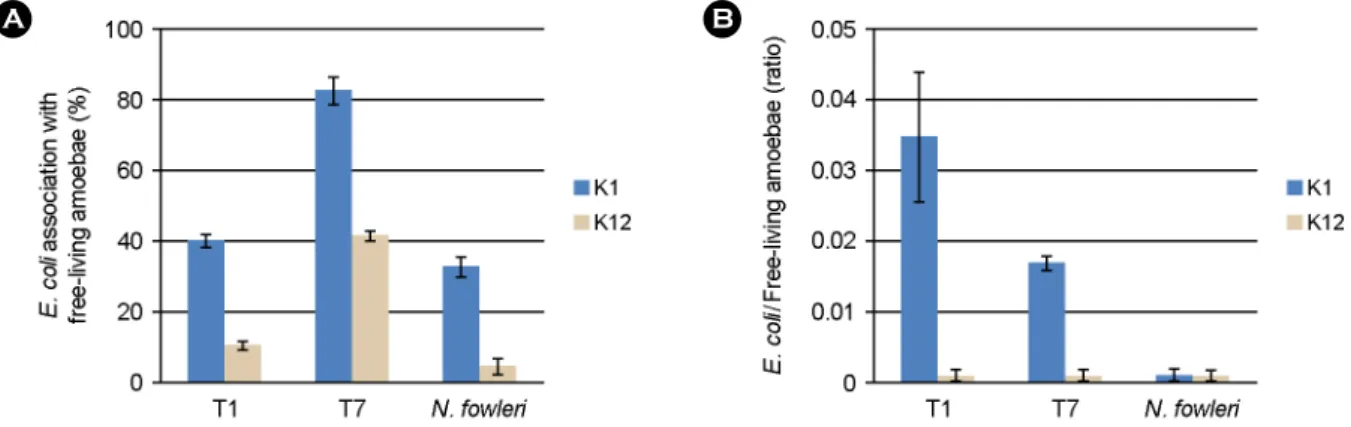
Jung et al. (2008) previously reported that pathogenic E. coli K1 associate with A. castellanii less than non- pathogenic E. coli K12. In here, how E. coli K1 and K12 associate with other free-living amoeba, N. fowleri was compared with pathogenic A. castellanii and non-pathogenic A. astronyxis. In these experiments, the term association is used to describe E. coli, both adherent to as well as intracellular of amoebae. The results revealed that the T7 exhibited significantly higher association with E. coli, compared with the T1 isolates (P<0.01), using paired T- test, one-tail distribution (Fig. 2). Interestingly, N. fowleri exhibited similar percentages of association as T1 (Fig. 2).
This suggests that the virulence properties of E. coli may play a role in their interactions with Acanthamoeba (Fig. 2).
On the other hand, pathogenicity of amoebae may be important factor in the association of E. coli. The K1 association with T1 was about 40% (compared to 83%
with T7 of non-pathogenic strain), while K12 associated with the T1 was 11% (compared to 42% with the T7). In support, the ratio of E. coli K1 with T1 was determined at Fig. 1. In vitro cytotoxicity of free-living amoebae against murine macrophages. The clinical A. castellanii (T1) and N. fowleri exhibited high murine macrophages cytotoxicity, while the environ- mental A. astronyxis (T7) had no effects. Results are the mean of three experiments performed in duplicate. Error bars represent standard deviations.
3.3 CFU per amoeba (0.3 CFU for K12), 10.9 CFU of K1 per T7 (7.2 CFU for K12) and 2.1 CFU of K1 per N.
fowleri (0.5 CFU for K12). Interestingly, pathogenic T1 and N. fowleri exhibited similar susceptibility.
E. coli invasion into free-living amoebae
Once E. coli bacteria attach or associate with free-living amoeba, they can penetrate into the amoebae. At this point, to determine the E. coli within amoebae, invasion assays were performed. Even though the percentages are low as compared with association data, the K1 (0.67%) within T1 was observed compared with K12 (0%) (Fig. 3). On hand, the K1 (0.22%) within T7 was compared with K12 (0%) (Fig. 3). Their resulting CFU ratios are consistent with % of survival of E. coli. Very interestingly, even though E.
coli K1 and K12 exhibited high association with N. fowleri and bacterial CFU, their invasion was not observed with
0% and 0 CFU.
E. coli survival within free-living amoebae in view of long-term interactions
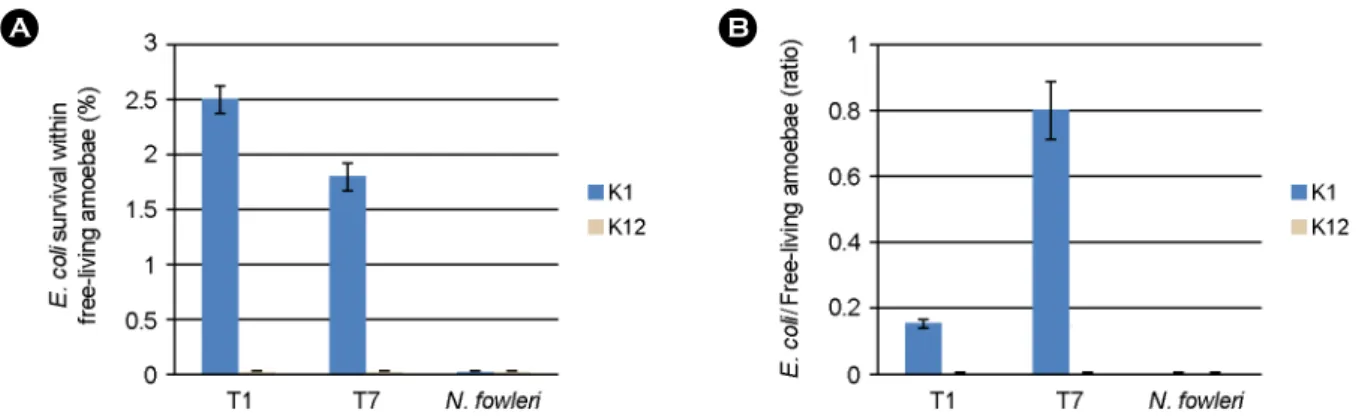
To determine the fate of E. coli in long-term survival within free-living amoebae, intracellular survival assays were performed by incubating E. coli with free-living amoebae in PBS for 24 h. Intracellular E. coli K1 within T1 (2.5%) and T7 (1.8%) were recovered and grown, while K12 were not found (Fig. 4). There CFU ratios were increased as compared with invasion assays. On the other hand, N. fowleri was not invaded and here it was not recovered. Any N. fowleri was not found under a bright microscope (data not shown). This suggested that N. fowleri have obscure machinery in cytoplasm as compared with pathogenic A. castellanii.
A B
Fig. 2. E. coli association with free-living amoebae. (A) and (B) represent percent bacterial association with amoebae and ratio of bacteria per amoeba, respectively. Results are presented as the mean ± standard deviations of three independent experiments performed in duplicate.
A B
Fig. 3. E. coli invasion into free-living amoebae. (A) and (B) represent percent bacterial invasion into amoebae and ratio of bacteria per amoeba, respectively. Results are presented as the mean ± standard deviations of three independent experiments performed in duplicate.
DISCUSSION
It is well known that free-living amoebae interact with a lot of bacteria and can play a role as a host. Acanthamoeba can interact with L. pneumophila, Vibrio cholera, Listeria monocytogenes, etc. Acanthamoeba has been suggested to be a key step in the evolution of this environmental bacterium to produce human infections (Gao et al., 1997).
On the other hand, there is few report of Naegleria about the interactions with bacteria but it can ingest L. pneumophila which is digested into Naegleria vacuoles. These are further strengthened with the finding that even though there is not mentioned about Naegleria, Acanthamoeba resembles human macrophages in many ways, particularly in their phagocytic activity and cell surface receptors (Yan et al., 2004). However, free-living amoebae are not intracellular parasites but extracellular parasites. On view of some bacteria, e.g., Mycobacterium, it can survive and multi- plicate in macrophages. Finally, it can destroy and evade immune defense mechanism of macrophages. However, this is not well described but if there are a huge number of bacteria rather than amoebae, the bacteria can destroy the amoebae. Of course, dead bacteria can act as a prey for amoeba growth.
It has been tried to describe pathogenic and non- pathogenic E. coli-pathogenic and non-pathogenic amoebae interactions. According to previous report (Jung et al., 2008), association, invasion and survival assays of E. coli K1 and mutants were performed. E. coli associated with, invaded
into and survived into Acanthamoeba even though their rates were different. In particular, invaded E. coli multi- plicated and grew within Acanthamoeba as shown with CFU ratio of a bacterial growth indicator.
Selwa et al. (2006) has applied T4 to several pathogenic E. coli including mutants, e.g., outer membrane protein A (OmpA) mutant, lipopolysaccharide (LPS) mutant. The invasive K1 showed a significantly higher association with A. castellanii than the non-invasive K12. Once inside the cell, E. coli K1 remained viable and multiplied within A.
castellanii, while E. coli K12 was killed. The precious mechanisms of E. coli K1 intracellular survival remain unknown but it had ability to inhibit the fusion of lysosomes with phagosomes as a critical step in the intracellular survival of this bacterium (Bozue and Johnson, 1996). On the other hand, pathogenic N. fowleri exhibited high association with and/or attach to E. coli K1 and K12.
However, any E. coli strains were not observed at invasion assays which were are indicators of bacterial penetrations.
There were small numbers of E. coli in Acanthamoeba and the K1 could be multiplied within Acanthamoeba. Inter- estingly, the size of A. astronyxis T7 is a little bigger than T4. The association percentages and CFU of E. coli K1 and K12 to T7 were higher than T4 but invasion and survival ratio were not consistent with the association. There have not yet been reported about it. However, with all data here, author suggests that as higher radius of amoebae is with, more bacteria can only attach and bind with more amoeba receptors. In particular, E. coli K1 and K12 could associate with nonpathogenic K7 about 3-fold more than K1 and N.
A B
Fig. 4. Long-term survival of E. coli within free-living amoebae. (A) and (B) represent percent bacterial survival into amoebae for 24 h in PBS and ratio of bacteria per amoeba, respectively. Results are presented as the mean ± standard deviations of three independent experiments performed in duplicate.
fowleri. On the other hand, they were not invaded and survived well into pathogenic T1 as shown by invasion and survival assays.
Even if there was few number of E. coli associated with Naegleria, the E. coli strains were not survived within Naegleria. These facts implied the biological differences of Acanthamoeba and Naegleria. To understand precious mechanisms of the differences, molecular approaches and electron microscopic observation should be applied.
Acknowledgements
Funding for this paper was provided by Namseoul university.
REFERENCES
Alsam S, Jeong SR, Sissons J, Dudley R, Kim KS, Khan NA.
Escherichia coli interactions with Acanthamoeba: a symbiosis with environmental and clinical implications. J Med Microbiol.
2006. 55: 689-694.
Bozue JA, Johanson W. Interaction of Legionella pneumophila with Acanthamoeba castellanii: uptake by coiling phago- cytosis and inhibition of phagosome-lysosome fusion. Infect Immun. 1996. 64: 668-673.
Gao LY, Harb OS, Abu Kwaik Y. Utilization of similar mechanisms by Legionella pneumophila to parasitize two evolutionarily distant host cell, mammalian macrophages and protozoa.
Infect Immun. 1997. 65: 4738-4746.
Greub G, Raoult D. Microorganisms resistant to free-living amoebae. Clin Microbiol Rev. 2004. 17: 413-433.
Jung SY, Alsam S, Kim KS, Khan NA. Pathogen-pathogen interactions: a comparative study of Escherichia coli inter-
actions with the clinical and environmental isolates of Acanthamoeba. World J Microbiol Biotechnol. 2008. 24:
2339-2348.
Jung SY, Kim JH, Song KJ, Lee YJ, Kwon MH, Kim K, Park S, Im KI, Shin HJ. Gene silencing of nfa1 affects the in vitro cytotoxicity of Naegleria fowleri in murine macrophages.
Mol Biochem Parasitol. 2009. 165: 87-93.
Jung SY, Matin A, Kim KS, Khan NA. The capsule plays an important role in Escherichia coli K1 interactions with Acanthamoeba. Int J Parasitol. 2007. 37: 413-423.
Khan NA. Acanthamoeba: biology and increasing importance in human health. FEMS Microbiol Rev. 2006. 30: 564-595.
Khan NA. Acanthamoeba invasion of the central nervous system.
Int J Parasitol. 2007. 37: 131-138.
La Scola B, Raoult D. Survival of Coxiella burnetii within free- living amoeba Acanthamoeba castellanii. Clin Microbiol Infect. 2001. 7: 75-79.
Marciano-Cabral F, Cabral G. Acanthamoeba spp. as agents of disease in humans. Clin Microbiol Rev. 2003. 16: 273-307.
Newsome AL, Baker RL, Miller RD, Arnold RR. Interactions between Naegleria fowleri and Legionella pneumophila. Infect Immun. 1985. 50: 449-452.
Raschke WC, Baird S, Ralph P, Nakoinz I. Functional macro- phage cell lines transformed by Abelson leukemia virus. Cell.
1978. 15: 261-267.
Rowbotham TJ. Preliminary report on the pathogenicity of Legionella pneumophila for freshwater and soil amoebae. J Clin Pathol. 1980. 33: 1179-1983.
Willaert E. Isolement et culture in vitro des amibes de genre Naegleria. Ann Soc Belg Med Trop 1971. 51: 701-708.
Yan L, Cerny RL, Cirillo JD. Evidence that hsp90 is involved in the altered interactions of Acanthamoeba castellanii variants with bacteria. Eukaryot Cells. 2004. 3: 567-578.