Journal of Bacteriology and Virology 2009. Vol. 39, No. 2 p.61 – 69 DOI 10.4167/jbv.2009.39.2.61
Chemical Composition and Antimicrobial Activity of the Essential Oil of Chrysanthemum indicum Against Oral Bacteria
Eun-Kyung Jung*
Department of Dental Hygiene, Ulsan College, Ulsan, Korea
The chemical components of the essential oil obtained from Chrysanthemum indicum L. were analyzed by GC-MS.
Seventy-three compounds accounting for 96.65% of the extracted essential oil were identified. The main compounds in the oil were α-pinene (4.4%), 1,8-cineole (10.4%), α-thujone (6.05%), camphor (10.12%), terpinen-4-ol (3.4%), bornyl acetate (6.1%), borneol (3.6%), cis-chrysanthenol (3.4%), β-caryophyllene (5.1%), germacrene D (10.6%), and α-cadinol (3.0%). The essential oil of C. indicum exhibited stronger antibacterial activity against all oral bacteria tested (MICs, 0.1 to 1.6 mg/ml; MBCs, 0.2 to 3.2 mg/ml) than their major compounds. Furthermore, the MICs/MBCs were reduced to one half ~ one sixteenth as a result of the combinations included the essential oil with ampicillin or gentamicin for all oral bacteria. A strong bactericidal effect was exerted in drug combinations. The in vitro data suggest that the essential oil of C. indicum with other antibiotics may be microbiologically beneficial and synergistic.
Key Words: Chrysanthemum indicum, Essential oil, Antibacterial activity, Oral bacteria
INTRODUCTION
Chrysanthemum indicum L. (Compositae), spreading widely in Korea is a well-known herb and medicinal plant with small yellow flowers (1, 2). C. indicum has been used in mixed spices, as a food additives for masking flavors, and used in teas and alcoholic beverages (combined with the flowers) in Korea from the ancient times (1~3). The C.
indicum has a long history using as an Oriental traditional medicine for the treatment of several infectious diseases such as pneumonia, colitis, stomatitis, cancer, fever, and sore and used to treat vertigo, pertussis, and hypertensive symptoms (2, 4~7). Its flowers are also commonly used as tea to treat some eye diseases (8). Furthermore, recently its
extracts has been reported to have central and peripheral analgesic properties, lowering blood pressure as well as anti-inflammatory activities, also exhibited inhibitory activity against bacteria and viruses (4, 5, 7, 9). Several chemical compounds isolated from C. indicum flowers were also found to exhibit inhibitory activity against nitric oxide (NO) in lipopolysaccharide-activated macrophages and rat lens aldose reductase (5, 10).
In the present study, the chemical compositions of essential oil from C. indicum were identified by GC-MS method, and their antibacterial properties against oral bacteria were evaluated using broth microdilution method and the checkerboard method to obtain a fractional inhibitory concentration (FIC) index.
MATERIALS AND METHODS
Plant material and extraction of the essential oil The aerial parts of C. indicum were collected in September 2003 from the area of Mt. Mireuk in Korea. The identity was confirmed by Dr. Bong-Seop Kil, College of Natural 61
Received: January 23, 2009/ Revised: February 23, 2009 Accepted: March 24, 2009
*Corresponding author: Prof. Eun-Kyung Jung. Department of Dental Hygiene, Ulsan College, San 160-1 Hwajeong-Dong, Dong-Gu, Ulsan, 682-715, Korea.
Phone: +82-52-230-0798, Fax: +82-52-230-0791, e-mail: [email protected]
**This work was supported in part by research funds of Ulsan College.
Science, Wonkwang University. A voucher specimen (DJ- 03-C25) was deposited at the herbarium of the College of Natural Science, Wonkwang University. The aerial parts of C. indicum (1 kg) were air dried and then distilled for 3 h, using a modified Clevenger type apparatus in order to obtain the essential oil. Anhydrous sodium sulphate was used to absorb the little water that the essential oil contained.
The essential oil was stored in a deep freezer (-70℃) to minimize the loss of volatile compounds.
Analysis of the chemical composition of the essential oil
The oil was analyzed by GC and GC-MS. GC analysis was performed on a Hewlett Packard (HP) model 5890 series II gas chromatograph, with a flame ionization detector (FID), a split ratio of 1:35 using fused silica capillary column, Supelcowax 10 (60 m × 0.32 mm. i.d., 0.25 μm film thickness). The temperature of the column was pro- grammed from 50℃ to 230℃ at 2℃/min, then kept constant at 230℃ for 30 min for the Supelcowax 10 column.
The injector and detector temperatures for both analyses were 250℃, respectively. The carrier gas was nitrogen, at a flow rate of 1.86 ml/min for the Supelcowax 10 column.
Peak areas were measured by electronic integration. The relative amounts of the individual components were based on the peak areas. The GC-MS was carried out on an HP model 5970 mass spectrometer operating in the EI mode at 70 eV, combined with the GC described above, fitted with an innowax column (60 m × 0.25 mm, i.d., 0.25 μm film thickness) and SPB-1 column (30 m × 0.32 mm, i,d., 0.25 μm film thickness). The temperature of the column was programmed from 40℃ to 230℃ at 2℃/min. The injector and ion source temperatures were the same as above. The carrier gas was helium at a flow rate of 1.25 ml/min for both analyses. The identification of the chemical constituents was based on comparisons of their relative retention times and mass spectra with those obtained from authentic sample and/or the NIST/NBS and Wiley libraries spectra.
Bacterial strains
Antimicrobial activities of the essential oil and some of
its major compounds against some oral bacteria and a few reference strains were determined by the broth dilution method. The oral bacterial strains used in this study were:
facultative anaerobic bacteria [Streptococcus mutans ATCC 25175, Streptococcus sanguinis ATCC 10556, Streptococcus sobrinus ATCC 27607, Streptococcus ratti KCTC (Korean collection for type cultures) 3294, Streptococcus criceti KCTC 3292, Streptococcus anginosus ATCC 31412, and Streptococcus gordonii ATCC 10558], microaerophilic bac- teria (Actinobacillus actinomycetemcomitans ATCC 43717), and obligate anaerobic bacteria (Fusobacterium nucleatum ATCC 10953, Prevotella intermedia ATCC 25611, and Porphylomonas gingivalis ATCC 33277). The reference strains as facultative anaerobic bacteria used in this study were: Escherichia coli ATCC 25922, Staphylococcus aureus ATCC 29213, Staphylococcus epidermidis ATCC 12228, and Streptococcus pyogenes ATCC 21059. Brain-heart infusion broth supplemented with 1% yeast extract (Difco Laboratories, Detroit, MI, USA) was used for all bacterial strains except P. intermedia and P. gingivalis. For P.
intermedia and P. gingivalis, brain-heart infusion broth containing hemin 5 μg/ml (Sigma Chemical Co., St. Louis, MO, USA) and menadione 1 μg/ml (Sigma) was used.
Minimum inhibitory concentrations/minimum bacteri- cidal concentrations assay
The minimum inhibitory concentrations (MICs) were determined for the essential oil and some of its major compounds by the broth dilution method (11, 12), and it was carried out in triplicate. The antibacterial activities were examined after incubation at 37℃ for 18 h (facultative anaerobic bacteria), for 24 h (microaerophilic bacteria), and for 1~2 days (obligate anaerobic bacteria) under anaerobic conditions. MICs were determined as the lowest concen- trations of test samples that resulted in a complete inhi- bition of visible growth in the broth. Following anaerobic incubation of MICs plates, the minimum bactericidal concentrations (MBCs) were determined on the basis of the lowest concentration of the essential oil that kills 99.9%
of the test bacteria by plating out onto each appropriate agar plate. Ampicillin and gentamicin were used as standard
Table 1. Continued
C. indicum Compounds RIa RIb
Peak Area (%)c
Borneol 1703 1150 3.60 Piperitone 1721 1220 0.13 Carvone 1732 1210 0.14 cis-Chrysanthenol 1754 1150 3.40 Myrtenol 1793 1177 0.01
trans-Carveol 1832 1181 0.20
p-Cymen-8-ol 1835 1165 0.21
cis-Carveol 1862 1196 0.10
Sesquiterpene hydrocarbons (22.91)
α-Copaene 1493 1370 0.30 α-Gurjunene 1525 1389 0.10 Berkheyaradulen 1531 1377 0.16 β-Elemene 1589 1381 1.20 β-Caryophyllene 1594 1418 5.10 α-Humulene 1665 1440 0.50 trans-β-Farnesene 1668 1454 0.85 α-Muurolene 1686 1464 0.20 γ-Cadinene 1690 1497 0.20 Germacrene D 1705 1465 10.6
α-Zingiberene 1715 1490 1.30 β-Selinene 1717 1471 0.21 cis,trans-α-Farnesene 1726 1447 0.30
δ-Cadinene 1762 1505 1.50 β-Sesquiphellandrene 1770 1515 0.18
ar-Curcumene 1773 1472 0.21
Oxygenated sesquiterpenes (5.97) Caryophyllene oxide 1979 1556 0.78
trans-Nerolidol 2043 1555 0.09 Globulol 2058 1568 0.10
Guaiol 2105 1576 0.20
Spathulenol 2125 1551 0.40 Eugenol 2146 1323 0.11 α-Cedrol 2150 1575 0.06 α-Cadinol 2173 1628 3.00 Torreyol 2179 1619 0.21 T-Muurolol 2234 1615 1.00 cis,trans-Farnesol 2298 1695 0.02 Table 1. Constituents of the essential oil of Chrysanthemum
indicum
C. indicum Compounds RIa RIb
Peak Area (%)c Monoterpene hydrocarbons (14.88)
Tricyclene 1006 919 0.16 α-Pinene 1012 930 4.40 α-Thujene 1029 924 0.08 Camphene 1071 943 2.14 β-Pinene 1111 966 0.94 Sabinene 1124 965 1.40
Myrcene 1167 984 0.91
α-Terpinene 1184 1007 0.43 Limonene 1196 1021 0.31 α-Phellandren 1212 994 1.40
cis-β-Ocimene 1240 1029 1.10
γ-Terpinene 1247 1050 0.74 trans-β-Ocimene 1257 1035 0.03
p-Cymene 1273 1011 0.83
Terpinolene 1283 1078 0.01 Oxygenated monoterpenes (52.14)
1,8-Cineole 1215 1023 10.40 α-Terpinolene 1286 1078 0.23 cis-3-Hexen-1-ol 1386 836 0.05 α-Thujone 1423 1080 6.05 β-Thujone 1440 1091 0.32 trans-Sabinene hydrate 1465 1052 0.41
α-Terpinyl acetate 1470 1329 1.63 Chrysanthenone 1508 1096 2.30 Camphor 1517 1124 10.12 Linalool 1546 1106 0.37 Pinocarvone 1562 1134 0.87 cis-Chrysanthenyl acetate 1570 1243 0.40
Bornyl acetate 1578 1265 6.10
Terpinen-4-ol 1601 1158 3.40 Umbellulone 1639 1165 0.70 trans-Chrysanthenyl
acetate 1675 1186 0.30
trans-Piperitol 1676 1205 t
α-Terpineol 1701 1169 0.70
antibiotics in order to compare the sensitivity with the essential oil and some of its major compounds against test bacteria.
Checker board dilution test
The antibacterial effects of a combination of the essential oil, which evidenced the most profound antimicrobial activity, and antibiotics were evaluated via the checkerboard test, as described previously (12). The antimicrobial com- binations assayed herein included the essential oil with ampicillin or gentamicin. The FIC index (FICI) is the sum of the FICs of each of the drugs, which were defined as the MICs of each drug when used in combination divided by the MICs of each drug when used alone. The interaction was defined as synergistic in cases in which the (FICI) was less than or equal to 0.5, additive in cases in which the (FICI) was greater than 0.5 and less than or equal to 1.0, indifferent when the (FICI) was greater than 1.0 and less than or equal to 2.0, and antagonistic in cases in which the (FICI) was greater than 2.0 (12, 13).
RESULTS
Chemical composition of the essential oil
A light golden yellow essential oil of C. indicum was obtained with a yield of 0.5% dry weight. Results of the
GC and GC-MS analyses for the essential oil are shown in Table 1, where the compounds were listed in order of their elution from the Supelcowax 10 column. Seventy-three compounds accounting for 96.65% of the extracted essential oil were identified. Fifteen monoterpene hydrocarbons (14.88%), twenty-six oxygenated monoterpenes (52.14%), sixteen sesquiterpene hydrocarbons (22.91%), eleven oxygenated sesquiterpenes (5.97%), and other compounds (0.75%) were identified in the essential oil. The main compounds in the oil were α-pinene (4.40%), 1,8-cineole (10.40%), α-thujone (6.05%), camphor (10.12%), terpinen- 4-ol (3.40%), bornyl acetate (6.10%), borneol (3.60%), cis-chrysanthenol (3.40%), β-caryophyllene (5.10%), germa- crene D (10.60%), and α-cadinol (3.00%).
Antibacterial activities of the essential oil
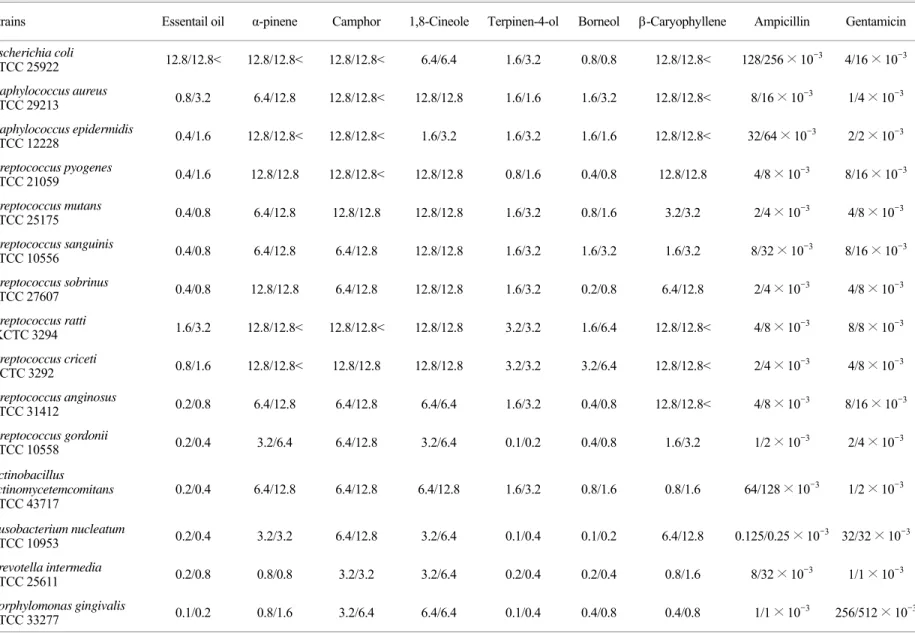
Antibacterial activities of the essential oil of C. indicum or some of its major compounds against some oral bacteria and reference strains were determined by the MICs through the broth dilution method carried out in triplicate (11). The results of the antibacterial activity (Table 2) showed that the essential oil exhibited moderate activities against most of tested streptococci species (MICs, 0.2 to 0.8 mg/ml;
MBCs, 0.4 to 1.6 mg/ml), expect S. ratti, and also the essential oil showed the strong antimicrobial activity against obligate anaerobic bacteria: F. nucleatum, P. intermedia, and P. gingivalis (MICs, 0.1 to 0.2 mg/ml; MBCs, 0.2 to 0.8 mg/ml), while E. coli and S. aureus appeared to be less sensitive (MICs, 0.8 to 12.8 mg/ml; MBCs, 3.2 to >12.8 mg/
ml). The monoterpene hydrocarbons α-pinene, oxygenated monoterpenes camphor, 1,8-cineole, terpinon-4-ol, and borneol and sesquiterpene hydrocarbon β-caryophyllene showed moderate antimicrobial activity against all bacteria tested (MICs, 0.4 to 12.8 < mg/ml; MBCs, 0.8 to 12.8 <
mg/ml). The tested components of the essential oil showed less antimicrobial activity than the essential oil.
In combination with the essential oil, the MICs/MBCs for ampicillin were reduced by ≥8-fold in S. mutans, S.
sanguinis, S. ratti, S. anginosus, S. gordonii, F. nucleatum, P. intermedia, and P. gingivalis, suggesting a synergistic effect as defined by a FICI of ≤ 0.5, except S. sobrinus, S.
Table 1. Continued
C. indicum Compounds RIa RIb
Peak Area (%)c
Others (0.75) 1,2,4-Trimethylbenzene 1236 979 0.07
n-Hexanol 1355 851 0.02
1-Octen-3-ol 1453 969 0.04 Tricosane 2300 2300 0.50 Tetracosane 2400 2400 0.12
Total identified (96.65%)
a Retention index on a polar Supelcowax 10 column.
b Retention index on an apolar SPB-1 column.
c Peak area percentage is based on a polar Supelcowax 10 column, and values represent average of three determinations.
t; Trace (<0.05%)
Table 2. The essential oil and its major components of C. indicum for some oral bacteria with a few reference strains
Strains Essentail oil α-pinene Camphor 1,8-Cineole Terpinen-4-ol Borneol β-Caryophyllene Ampicillin Gentamicin Escherichia coli
ATCC 25922 12.8/12.8< 12.8/12.8< 12.8/12.8< 6.4/6.4 1.6/3.2 0.8/0.8 12.8/12.8< 128/256 × 10-3 4/16 × 10-3 Staphylococcus aureus
ATCC 29213 0.8/3.2 6.4/12.8 12.8/12.8< 12.8/12.8 1.6/1.6 1.6/3.2 12.8/12.8< 8/16 × 10-3 1/4 × 10-3 Staphylococcus epidermidis
ATCC 12228 0.4/1.6 12.8/12.8< 12.8/12.8< 1.6/3.2 1.6/3.2 1.6/1.6 12.8/12.8< 32/64 × 10-3 2/2 × 10-3 Streptococcus pyogenes
ATCC 21059 0.4/1.6 12.8/12.8 12.8/12.8< 12.8/12.8 0.8/1.6 0.4/0.8 12.8/12.8 4/8 × 10-3 8/16 × 10-3 Streptococcus mutans
ATCC 25175 0.4/0.8 6.4/12.8 12.8/12.8 12.8/12.8 1.6/3.2 0.8/1.6 3.2/3.2 2/4 × 10-3 4/8 × 10-3 Streptococcus sanguinis
ATCC 10556 0.4/0.8 6.4/12.8 6.4/12.8 12.8/12.8 1.6/3.2 1.6/3.2 1.6/3.2 8/32 × 10-3 8/16 × 10-3 Streptococcus sobrinus
ATCC 27607 0.4/0.8 12.8/12.8 6.4/12.8 12.8/12.8 1.6/3.2 0.2/0.8 6.4/12.8 2/4 × 10-3 4/8 × 10-3 Streptococcus ratti
aKCTC 3294 1.6/3.2 12.8/12.8< 12.8/12.8< 12.8/12.8 3.2/3.2 1.6/6.4 12.8/12.8< 4/8 × 10-3 8/8 × 10-3
Streptococcus criceti
KCTC 3292 0.8/1.6 12.8/12.8< 12.8/12.8 12.8/12.8 3.2/3.2 3.2/6.4 12.8/12.8< 2/4 × 10-3 4/8 × 10-3 Streptococcus anginosus
ATCC 31412 0.2/0.8 6.4/12.8 6.4/12.8 6.4/6.4 1.6/3.2 0.4/0.8 12.8/12.8< 4/8 × 10-3 8/16 × 10-3 Streptococcus gordonii
ATCC 10558 0.2/0.4 3.2/6.4 6.4/12.8 3.2/6.4 0.1/0.2 0.4/0.8 1.6/3.2 1/2 × 10-3 2/4 × 10-3 Actinobacillus
actinomycetemcomitans
ATCC 43717 0.2/0.4 6.4/12.8 6.4/12.8 6.4/12.8 1.6/3.2 0.8/1.6 0.8/1.6 64/128 × 10-3 1/2 × 10-3 Fusobacterium nucleatum
ATCC 10953 0.2/0.4 3.2/3.2 6.4/12.8 3.2/6.4 0.1/0.4 0.1/0.2 6.4/12.8 0.125/0.25 × 10-3 32/32 × 10-3 Prevotella intermedia
ATCC 25611 0.2/0.8 0.8/0.8 3.2/3.2 3.2/6.4 0.2/0.4 0.2/0.4 0.8/1.6 8/32 × 10-3 1/1 × 10-3 Porphylomonas gingivalis
ATCC 33277 0.1/0.2 0.8/1.6 3.2/6.4 6.4/6.4 0.1/0.4 0.4/0.8 0.4/0.8 1/1 × 10-3 256/512 × 10-3 Data represent as MIC/MBC (mg/ml)
Antimicrobial Activity of the Essential Oil65
criceti, and A. actinomycetemcomitans and tested some reference strains (FICI of ≥ 0.625) (Table 3). The combi-
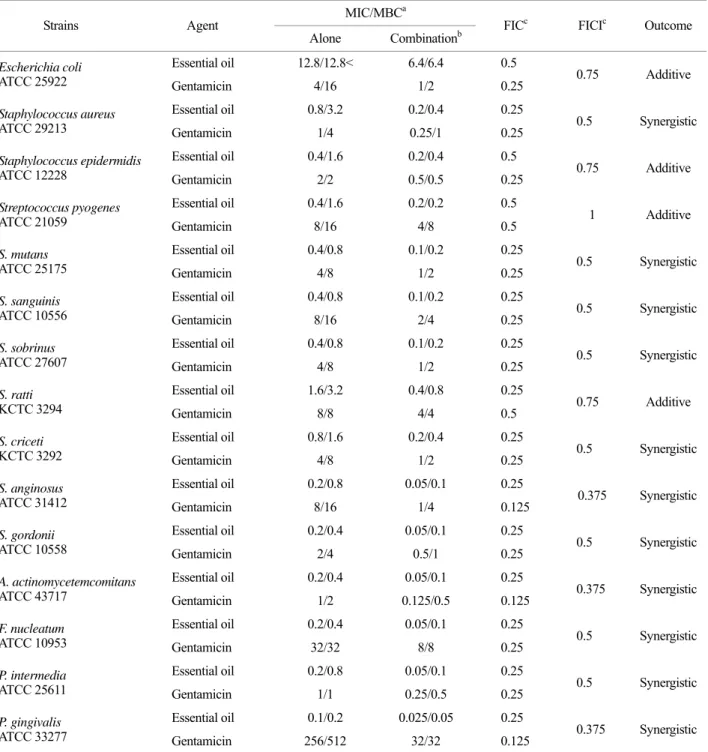
nation of gentamicin with the essential oil resulted in a reduction of the MICs/MBCs by ≥8-fold for most of tested Table 3. Checkerboard assay of the essential oil of C. indicum and ampicillin against some oral bacteria with a few reference strains
MIC/MBCa Strains Agent
Alone Combinationb FICc FICIc Outcome Essential oil 12.8/12.8< 6.4/6.4 0.5
Escherichia coli
ATCC 25922 Ampicillin 128/256 32/128 0.25 0.75 Additive Essential oil 0.8/3.2 0.4/0.4 0.5
Staphylococcus aureus
ATCC 29213 Ampicillin 8/16 2/4 0.25 0.75 Additive Essential oil 0.4/1.6 0.2/0.4 0.5
Staphylococcus epidermidis
ATCC 12228 Ampicillin 32/64 16/32 0.5 1 Additive Essential oil 0.4/1.6 0.2/0.4 0.5
Streptococcus pyogenes
ATCC 21059 Ampicillin 4/8 2/2 0.5 1 Additive Essential oil 0.4/0.8 0.1 /02 0.25
S. mutans
ATCC 25175 Ampicillin 2/4 0.5/1 0.25 0.5 Synergistic Essential oil 0.4/1.6 0.1/0.2 0.25
S. sanguinis
ATCC 10556 Ampicillin 8/32 2/4 0.25 0.5 Synergistic Essential oil 0.4/0.8 0.2/0.2 0.5
S. sobrinus
ATCC 27607 Ampicillin 2/4 0.5/1 0.25 0.75 Additive Essential oil 1.6/3.2 0.4/0.8 0.25
S. ratti
KCTC 3294 Ampicillin 4/8 1/2 0.25 0.5 Synergistic Essential oil 0.8/1.6 0.4/0.4 0.5
S. criceti
KCTC 3292 Ampicillin 2/4 0.5/1 0.25 0.75 Additive Essential oil 0.2/0.8 0.05/0.1 0.25
S. anginosus
ATCC 31412 Ampicillin 4/8 0.5/2 0.125 0.375 Synergistic Essential oil 0.2/0.4 0.05/0.1 0.25
S. gordonii
ATCC 10558 Ampicillin 1/2 0.025/0.5 0.25 0.5 Synergistic Essential oil 0.2/0.4 0.1/0.2 0.5
A. actinomycetemcomitans
ATCC 43717 Ampicillin 64/128 8/16 0.125 0.625 Additive Essential oil 0.2/0.4 0.05/0.1 0.25
F. nucleatum
ATCC 10953 Ampicillin 0.125/0.25 0.015/0.031 0.125 0.375 Synergistic Essential oil 0.2/0.8 0.05/1 0.25
P. intermedia
ATCC 25611 Ampicillin 8/32 2/4 0.25 0.5 Synergistic Essential oil 0.1/0.2 0.025/0.1 0.25
P. gingivalis
ATCC 33277 Ampicillin 1/1 0.25/0.5 0.25 0.5 Synergistic
a Essential oil MIC/MBC: mg/ml; ampicillin MIC/MBC: μg/ml.
b The checkerboard test as previously described (13). The MICs and MBCs of the essential oil of C. indicum with ampicillin against some oral bacteria with a few reference strains are indicated.
c The interaction was defined as synergistic if the FICI was less than or equal to 0.5, additive if the FICI was greater than 0.5 and less than or equal 1.0, indifferent if the FICI was greater than 1.0 and less than or equal to 2.0, and antagonistic if the FICI was greater than 2.0 (12, 13)
bacteria except E. coli, S. epidermidis, S. pyogenes, and S.
ratti with the MICs/MBCs of 1/1 to 256/512 μg/ml for
gentamicin becoming 0.125/0.3 to 32/32 μg/ml (Table 4).
Table 4. Checkerboard assay of the essential oil of C. indicum and gentamicin against some oral bacteria with a few reference strains MIC/MBCa
Strains Agent
Alone Combinationb FICc FICIc Outcome Essential oil 12.8/12.8< 6.4/6.4 0.5
Escherichia coli
ATCC 25922 Gentamicin 4/16 1/2 0.25 0.75 Additive Essential oil 0.8/3.2 0.2/0.4 0.25
Staphylococcus aureus
ATCC 29213 Gentamicin 1/4 0.25/1 0.25 0.5 Synergistic Essential oil 0.4/1.6 0.2/0.4 0.5
Staphylococcus epidermidis
ATCC 12228 Gentamicin 2/2 0.5/0.5 0.25 0.75 Additive Essential oil 0.4/1.6 0.2/0.2 0.5
Streptococcus pyogenes
ATCC 21059 Gentamicin 8/16 4/8 0.5 1 Additive Essential oil 0.4/0.8 0.1/0.2 0.25
S. mutans
ATCC 25175 Gentamicin 4/8 1/2 0.25 0.5 Synergistic Essential oil 0.4/0.8 0.1/0.2 0.25
S. sanguinis
ATCC 10556 Gentamicin 8/16 2/4 0.25 0.5 Synergistic Essential oil 0.4/0.8 0.1/0.2 0.25
S. sobrinus
ATCC 27607 Gentamicin 4/8 1/2 0.25 0.5 Synergistic Essential oil 1.6/3.2 0.4/0.8 0.25
S. ratti
KCTC 3294 Gentamicin 8/8 4/4 0.5 0.75 Additive Essential oil 0.8/1.6 0.2/0.4 0.25
S. criceti
KCTC 3292 Gentamicin 4/8 1/2 0.25 0.5 Synergistic Essential oil 0.2/0.8 0.05/0.1 0.25
S. anginosus
ATCC 31412 Gentamicin 8/16 1/4 0.125 0.375 Synergistic Essential oil 0.2/0.4 0.05/0.1 0.25
S. gordonii
ATCC 10558 Gentamicin 2/4 0.5/1 0.25 0.5 Synergistic Essential oil 0.2/0.4 0.05/0.1 0.25
A. actinomycetemcomitans
ATCC 43717 Gentamicin 1/2 0.125/0.5 0.125 0.375 Synergistic Essential oil 0.2/0.4 0.05/0.1 0.25
F. nucleatum
ATCC 10953 Gentamicin 32/32 8/8 0.25 0.5 Synergistic Essential oil 0.2/0.8 0.05/0.1 0.25
P. intermedia
ATCC 25611 Gentamicin 1/1 0.25/0.5 0.25 0.5 Synergistic Essential oil 0.1/0.2 0.025/0.05 0.25
P. gingivalis
ATCC 33277 Gentamicin 256/512 32/32 0.125 0.375 Synergistic
a Essential oil MIC/MBC: mg/ml; gentamicin MIC/MBC: μg/ml.
b The checkerboard test as previously described (13). The MICs and MBCs of the essential oil of C. indicum with gentamicin against some oral bacteria with a few reference strains are indicated.
c The interaction was defined as synergistic if the FICI was less than or equal to 0.5, additive if the FICI was greater than 0.5 and less than or equal 1.0, indifferent if the FICI was greater than 1.0 and less than or equal to 2.0, and antagonistic if the FICI was greater than 2.0 (12, 13)
DISCUSSION
Seventy-three compounds were identified in the oil extracted from C. indicum, representing 96.65% of the total oil. The main compounds with concentrations higher than 3% as percentage peak area of GC analysis were α-pinene (4.4%), 1,8-cineole (10.4%), α-thujone (6.05%), camphor (10.12%), terpinen-4-ol (3.4%), bornyl acetate (6.1%), bor- neol (3.6%), cis-chrysanthenol (3.4%), β-caryophyllene (5.1%), germacrene D (10.6%), and α-cadinol (3.0%). It was noteworthy that the compositions of the C. indicum essential oil were in partial agreement with those reported by other authors previously by high content of camphor on the essential oils of other Chrysanthemum species (7, 14, 15). Phytochemical profile of this plant has shown the presence of flavonoids, terpenoids and phenolic compounds (1, 4, 16, 17). The essential oil is very rich in terpenoids which exert inhibitory action against microorganisms such as S. aureus, E. coli and Streptococcus pneumoniae by dis- rupting their membranes (18).
The results of the antibacterial activity showed that the essential oil of C. indicum exhibited moderate activities against most of tested streptococci species (MICs, 0.2 to 0.8 mg/ml; MBCs, 0.4 to 1.6 mg/ml), and also the essential oil showed the strong antimicrobial activity against obligate anaerobic bacteria: F. nucleatum, P. intermedia, and P.
gingivalis (MICs, 0.1 to 0.2 mg/ml; MBCs, 0.2 to 0.8 mg/ml). The major components of the essential oil from C.
indicum, terpinon-4-ol, borneol, and β-caryophyllene were indicated as stronger antibacterial activity than α-pinene, camphor, and 1,8-cineole. In combination with the essential oil, the MICs/MBCs for ampicillin and gentamicin were reduced by ≥8-fold in tested some of oral bacteria and reference bacteria, suggesting a synergistic effect as defined by a FICI of ≤ 0.5.
Some oils have been shown to have applications in food preservation, aromatherapy, and pharmacological properties as antibacterial, antifungal, antioxidant, spasmolytic, anti- plasmodial, anti-inflammatory, and anticancer activities (11, 15, 18, 19). The essential oils of Chrysanthemum have
been found to have antibacterial, antifungal, and antioxidant activities (7, 10, 20). In general, there is a correlation between the antifungal activity and the percentage of some major components (20). Camphor and 1,8-cineole as well as borneol were well-known chemical with their pronounced antimicrobial properties (7, 11, 15). In this study, the essen- tial oil of C. indicum exhibited stronger antibacterial activity than some of its major compounds. In addition, our results are consistent with previous findings that the components in lower amount such as α-terpineol, terpinen-4-ol, ρ-cymene, and linalool could also contribute to the antimicrobial activity of the oils (7, 15, 19). In fact, it was also possible that the components in lower percentage might be involved in some type of synergism with the other active compounds, synergistic activity of 1,8-cineole and camphor against some bacteria had already been reported (11, 15, 19).
These results also indicate the possibility of exploitation of the essential oil of C. indicum as an effective inhibitor of oral bacteria, for example, a component of toothpaste and/or gargling solution. However, for medicinal purposes, the safety and toxicity of this essential oil need to be addressed.
Acknowledgement
I thank Prof. B. S. Kil, College of Natural Science, Wonkwang University for the confirmation of plant authenticity.
REFERENCES
1) Chang KM, Kim GH. Volatile aroma composition of Chrysanthemum indicum L. flower oil. J Food Sci Nutr 2008;13:122-7.
2) Chun HS, Kim JM, Choi EH, Chang N. Neuroprotective effects of several Korean medicinal plants traditionally used for stroke remedy. J Med Food 2008;11:246-51.
3) Hong CU. Essential oil composition of Chrysanthemum boreale and Chrysanthemum indicum. J Korean Soc Agric Chem Biotechnol 2002;45:108-13.
4) Chen XY, Li J, Cheng WM, Jiang H, Xie XF, Hu R.
Effect of total flavonoids of Chrysanthemum indicum
on the apoptosis of synoviocytes in joint of adjuvant arthritis rats. Am J Chin Med 2008;36:695-704.
5) Cheng W, Li J, You T, Hu C. Anti-inflammatory and immunomodulatory activities of the extracts from the inflorescence of Chrysanthemum indicum Linne. J Ethnopharmacol 2005;101:334-7.
6) Jiang H, Huang X, Yang Y, Zhang Q. Studies on the antilipid peroxidation of nine sorts of Chinese herbal medicines with the function of protecting liver. Zhong Yao Cai 1997;20:624-6.
7) Shunying Z, Yang Y, Huaidong Y, Yue Y, Guolin Z.
Chemical composition and antimicrobial activity of the essential oils of Chrysanthemum indicum. J Ethno- pharmacol 2005;96:151-8.
8)Matsuda H, Morikawa T, Toguchida I, Harima S, Yoshikawa M. Medicinal flowers. VI. Absolute stereo- structures of two new flavanone glycosides and a phenylbutanoid glycoside from the flowers of Chrysan- themum indicum L.: their inhibitory activities for rat lens aldose reductase. Chem Pharm Bull 2002;50:972 -5.
9) Oertel C. Serological studies on the behavior of tomato aspermy virus in Chrysanthemum indicum L. Zentralbl Bakteriol Parasitenkd Infektionskr Hyg 1967;121:276 -86.
10) Kong LD, Cai Y, Huang WW, Cheng CH, Tan RX.
Inhibition of xanthine oxidase by some Chinese medicinal plants used to treat gout. J Ethnopharmacol 2000;73:199-207.
11) Cha JD, Jeong MR, Jeong SI, Moon SE, Kim JY, Kil BS, Song YH. Chemical composition and antimicrobial activity of the essential oils of Artemisia scoparia and A. capillaris. Planta Med 2005;71:186-90.
12) Jung EK. Antimicrobial activity of extract and fractions
from Drynaria fortunei against oral bacteria. J Bacteriol Virol 2007;37:61-8.
13) Cha JD, Jeong MR, Jeong SI, Lee KY. Antibacterial activity of sophoraflavanone G isolated from the roots of Sophora flavescens. J Microbiol Biotechnol 2007;
17:858-64.
14)Guo QS, Wang YJ, Yang XW, Xu WB. Character- ization of chemical components of essential oil from cupitulum of Chrysanthemum morifolium cultivated in Tongxiang city. Zhongguo Zhong Yao Za Zhi 2008;33:
624-7.
15) Kim KJ, Kim YH, Yu HH, Jeong SI, Cha JD, Kil BS, You YO. Antibacterial activity and chemical compo- sition of essential oil of Chrysanthemum boreale. Planta Med 2003;69:274-7.
16)Mladenova K, Tsankova E, van Hung D. New sesquiterpenoids from Chrysanthemum indicum var.
tuneful. Planta Med 1988;54:553-5.
17) Yu JS, Yu JP. Separation and purification of flavonoids from Chrysanthemum indicum with macroporous resin.
Zhongguo Zhong Yao Za Zhi 2007;32:2123-7.
18) Aridogan BC, Baydar H, Kaya S, Demirci M, Ozbaşar D, Mumcu E. Antimicrobial activity and chemical composition of some essential oils. Arch Pharm Res 2002;25:860-4.
19) Cha JD, Jung EK, Kil BS, Lee KY. Chemical compo- sition and antibacterial activity of essential oil from Artemisia feddei. J Microbiol Biotechnol 2007;17: 2061 -5.
20) Alvarez-Castellanos PP, Bishop CD, Pascual-Villalobos MJ. Antifungal activity of the essential oil of flower- heads of garland chrysanthemum (Chrysanthemum coronarium) against agricultural pathogens. Phyto- chemistry 2001;57:99-102.