Background and PurposezzThe rate and outcomes of neurologic complications of patients receiving extracorporeal membrane oxygenation (ECMO) are poorly understood. The pur- pose of this study was to identify these parameters in ECMO patients.
MethodszzAll patients receiving ECMO were selected from the Nationwide Inpatient Sam- ple between 2001–2011. The rate and outcomes of neurologic complications [acute ischemic stroke, intracranial hemorrhage (ICH), and seizures] among these patients was determined.
Discharge status, mortality, length of stay, and hospitalization costs were compared between patients with and without neurologic complications using chi-squared tests for categorical variables and Student’s t-test for continuous variables.
ResultszzIn total, 23,951 patients were included in this study, of which 2,604 (10.9%) suf- fered neurologic complications of seizure (4.1%), stroke (4.1%), or ICH (3.6%). When com- pared to patients without neurologic complications, acute ischemic stroke patients had sig- nificantly higher rates of discharge to a long-term facility (12.2% vs. 6.8%, p<0.0001) and a significantly longer mean length of stay (41.6 days vs. 31.9 days, p<0.0001). ICH patients had significantly higher rates of discharge to a long-term facility (9.5% vs. 6.8%, p=0.007), signifi- cantly higher mortality rates (59.7% vs. 50.0%, p<0.0001), and a significantly longer mean length of stay (41.8 days vs. 31.9 days) compared to patients without neurologic complications.
These outcomes did not differ significantly between seizure patients and patients without neurologic complications.
ConclusionszzGiven the increasing utilization of ECMO and the high costs and poor outcomes associated with neurologic complications, more research is needed to help determine the best way to prevent these sequelae in this patient population.
Key Wordszz extracorporeal membrane oxygenation, stroke, neurology/neurologic (deficits, disease, injury).
Neurologic Complications of Extracorporeal Membrane Oxygenation
INTRODUCTION
Extracorporeal membrane oxygenation (ECMO) is an increasingly used technique provid- ing cardiopulmonary support to patients with severe refractory cardiac and respiratory fail- ure. Standard ECMO involves venous drainage from the femoral vein or left atrium with artificial extracirculatory oxygen exchange and return of the blood to the body through the same veins (venovenous) or to the arterial system through the femoral artery or as- cending aorta (venoarterial).1 ECMO is commonly used in neonates and infants with con- genital heart defects or respiratory distress syndrome, and it is also increasingly being used as a transplant bridge in adults who survive cardiopulmonary resuscitation, and in patients with cardiogenic shock and severe respiratory failure.2,3
Some studies have demonstrated that neurologic complications are rather common Deena M Nasr
Alejandro A Rabinstein
Department of Neurology, Mayo Clinic, Rochester, MN, USA
pISSN 1738-6586 / eISSN 2005-5013 / J Clin Neurol 2015;11(4):383-389 / http://dx.doi.org/10.3988/jcn.2015.11.4.383
Received April 14, 2015 Revised June 5, 2015 Accepted June 8, 2015 Correspondence Deena M Nasr, DO Department of Neurology, Mayo Clinic, 200 1st Street SW, Rochester, MN 55905, USA Tel +1-507-284-2511 E-mail [email protected]
cc This is an Open Access article distributed under the terms of the Creative Commons Attribution Non-Com- mercial License (http://creativecommons.org/licenses/by-nc/3.0) which permits unrestricted non-commercial use, distribution, and reproduction in any medium, provided the original work is properly cited.
JCN
Open Access ORIGINAL ARTICLEECMO Neurological Complications
JCN
among patients receiving ECMO.4 These complications are generally related to thrombosis with infarction, or hemor- rhage.5 Intracranial hemorrhage (ICH) in particular has been associated with higher rates of mortality.4,6 However, much of the evidence regarding the incidence and outcomes of neu- rologic complications among ECMO patients is limited to small case series.7
A large, multihospital database, the Nationwide Inpatient Sample (NIS) of the Healthcare Cost and Utilization Project (HCUP) of the Agency for Healthcare Research and Quality, was studied between 2001–2011. We sought to characterize the rate and outcomes of neurologic complications among patients receiving ECMO.
METHODS
Patient population
The NIS hospital discharge database for the period 2001–
2011 was obtained from the HCUP of the Agency for Health- care Research and Quality. This database represents 20% of all inpatient discharges from nonfederal hospitals in the Unit- ed States. Patients included in this study were selected using the International Classification of Diseases 9th Revision (ICD- 9) procedure code for extracorporeal membranous oxygen- ation, 3965.
Demographic characteristics, indications, and comorbidities
The demographic information analyzed included age and gender. Age was categorized into neonates (<1 month), in- fants (1 month to 1 year), children (1–17 years), adults (18–
64 years), and seniors (≥65 years). These age groups were similar to those in the Extracorporeal Life Support Organi- zation (ELSO) registry, with the exception that adults were defined as aged ≥18 years in the present study and a sepa- rate group of patients aged ≥65 years was also included.8
Comorbidities and complications included in this study were congenital heart disease [clinical classification software code (CCS): 213], sepsis (CCS: 2), cardiac arrest (CCS: 107), shock (CCS: 249), respiratory distress syndrome (CCS: 221), and respiratory failure, insufficiency, arrest (CCS: 131). The prevalence of these comorbidities among ECMO patients in each age group was studied. The Charlson Comorbidity In- dex was calculated for each patient.9
Outcomes
The primary endpoints of this study were the following neu- rologic complications: ICH (ICD-9: 430, 431, 4320, 4321, 4329), acute ischemic stroke (ICD-9: 433.X1, 434.X1, 436, 437.0, 437.1, 437.4, 437.5, 437.7, 437.8, and 437.9), and sei- zure (CCS: 83). The discharge status (discharge to home or
Fig. 1. Number of patients treated with extracorporeal membrane oxygenation (ECMO) during the period 2001–2011. Graphical representation of ECMO utilization in the United States Nationwide Inpatient Sample from the period 2001–2011. ECMO utilization increased from 1,613 patients in 2001 to 3,597 patients in 2011. Utilization in adults increased from 309 patients in 2001 to 2004 patients in 2011; these data for the pediatric population are 1,027 and 1,434 patients, respectively.
Number of ECMO patients
All patients Pediatric Adults
2001 2002 2003 2004 2005 2006 2007 2008 2009 2010 2011 Year
4,000 3,500 3,000 2,500 2,000 1,500 1,000 500 0
Nasr DM and Rabinstein AA
JCN
discharge to long-term facility), in-hospital mortality, length of stay, and 2011-adjusted hospitalization costs of patients with neurologic complications with patients who did not suffer neurologic complications were compared. Rates of neurologic complications were also compared across age groups and comorbidities/indications. A separate analysis of the rate of neurologic complications was also performed by age group, and trends in the utilization of ECMO during the period 2001–2011 were examined.
Statistical analysis
Chi-squared tests were used to compare categorical vari- ables, and the Student’s t-test was used to compare continu- ous variables, assuming a cutoff for statistical significance of p<0.05. Probability values for outcomes were obtained using the no-neurologic-complications group as a reference group.
Discharge weights were applied to make the data nationally representative. Two multivariate analyses were performed;
one was designed to determine the comorbidities and de- mographic characteristics associated with neurologic com- plications (stroke, ICH, or seizure) and in-hospital mortali- ty; all comorbidities, indications, and demographic factors were forced into this model. Except where stated otherwise, the data are presented as mean±SD values. All statistical anal- yses were performed using the SAS-based statistical package
JMP (www.jmp.com).
RESULTS
Patient population
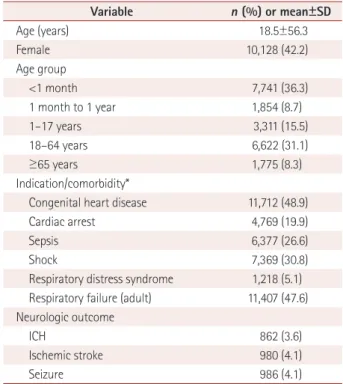
In total, 23,951 patients were included in this study. The number of patients receiving ECMO increased from 1,613 patients in 2001 to 3597 patients in 2011 (Fig. 1). The num- ber of pediatric patients receiving ECMO increased from 1,027 to 1,434 during the same time period, while the number of adult ECMO patients increased from 309 to 2004 (Fig. 1).
Age data were available for 21,304 patients; these patients were 18.5±56.3 years old, and 7,741 patients (36.3%) were younger than 1 month and 8,398 patients (39.4%) were ≥18 years old. The most common indication/comorbidity was congenital heart disease (n=11,712, 48.9%) followed by adult respiratory failure (n=11,407, 47.6%) and shock (n=7,369, 30.8%). These data are summarized in Table 1. The most common indications/comorbidities by age group were con- genital heart disease for patients aged <1 month (86.8%) and aged between 1 month and 1 year (71.0%). Respiratory fail- ure was the most common indication in patients aged 1–17 years (70.5%), 18–64 years (77.0%), and ≥65 years (66.6%).
These data are summarized in Supplementary Table 1 (in the online-only Data Supplement).
Neurologic complications and outcomes
A total of 2,604 patients (10.9%) suffered neurologic com- plications of seizure (n=986, 4.1%), stroke (n=980, 4.1%), or ICH (n=862, 3.6%). When compared to patients without neurologic complications, acute ischemic stroke patients had a significantly higher rate of discharge to a long-term facility (12.2% vs. 6.8%, p<0.0001), a significantly longer mean length of stay (41.6 days vs. 31.9 days, p<0.0001), and significantly higher costs (US$ 639,528 vs. US$ 501,184, p<0.0001). When compared to patients without neurologic complications, ICH patients had a significantly higher rate of discharge to a long- term facility (9.5% vs. 6.8%, p=0.007), a significantly higher mortality rate (59.7% vs. 50.0%, p<0.0001), a significantly lon- ger mean length of stay (41.8 days vs. 31.9 days, p=0.01), and significantly higher hospitalization costs (US$ 641,636 vs. US$
501,184, p=0.002). The outcomes did not differ significantly between seizure patients and patients without neurologic complications. These data are summarized in Table 2.
The results of univariate analyses of variables associated with neurologic complications are presented in Table 3. Pa- tients aged <1 month had the lowest rate of acute ischemic stroke (2.5%), while patients aged between 1 month and 1 year had the highest rate (6.4%, p<0.0001). Patients with shock had the highest rate of acute ischemic stroke (6.0% vs.
Table 1. Demographics and outcomes
Variable n (%) or mean±SD
Age (years) 18.5±56.3
Female 10,128 (42.2)
Age group
<1 month 7,741 (36.3)
1 month to 1 year 1,854 (8.7)
1–17 years 3,311 (15.5)
18–64 years 6,622 (31.1)
≥65 years 1,775 (8.3)
Indication/comorbidity*
Congenital heart disease 11,712 (48.9)
Cardiac arrest 4,769 (19.9)
Sepsis 6,377 (26.6)
Shock 7,369 (30.8)
Respiratory distress syndrome 1,218 (5.1) Respiratory failure (adult) 11,407 (47.6) Neurologic outcome
ICH 862 (3.6)
Ischemic stroke 980 (4.1)
Seizure 986 (4.1)
*Indications for extracorporeal membrane oxygenation (ECMO) do not add up to 100% since many of the patients suffered multiple comor- bidities.
ICH: intracerebral hemorrhage.
ECMO Neurological Complications
JCN
3.2%, p<0.0001), while those with respiratory distress syn- drome had the lowest rate (2.5% vs. 4.2%, p<0.0001). Patients aged <1 month also had the lowest rate of ICH (1.8%), while those aged between 1 month and 1 year had the highest rate (9.9%, p<0.0001). Respiratory distress syndrome was associ- ated with the lowest rate of ICH (1.2% vs. 3.7%, p<0.0001). Pa- tients aged <1 month had the lowest rate of seizure (1.7%), while those aged between 1 month and 1 year had the highest (13.9%, p<0.0001). Cardiac arrest was the comorbidity associ-
ated with the highest rate of seizure (8.3% vs. 3.1%, p<0.0001), and respiratory distress syndrome was associated with the lowest rate (2.0% vs. 4.2%, p<0.0001). The results of analyses of variables associated with neurologic complications by age are summarized in Supplemental Table 2–6 (in the online- only Data Supplement).
Multivariate analysis
Variables predictive of neurologic complications (stroke, Table 2. Outcomes of ECMO-associated neurologic complications
Outcome No neurologic complication
Ischemic
stroke p ICH p Seizure p
Home, n (%) 5,266 (24.7) 394 (21.4) 0.001 174 (20.2) 0.002 304 (30.8) <0.0001
Long term, n (%) 1,452 (6.8) 225 (12.2) <0.0001 82 (9.5) 0.007 57 (5.8) 0.08
Death, n (%) 10,671 (50.0) 949 (51.5) 0.18 515 (59.7) <0.0001 455 (46.2) 0.01
LOS (days), mean±SD 31.9±82.6 41.6±106.6 <0.0001 41.8±112.8 0.01 29.5±67.5 0.16
Costs, US$ mean±SD 501,184±923,942 639,528±1,202,380 <0.0001 641,636±1,188,231 0.002 474,168±887,208 0.22 ECMO: extracorporeal membrane oxygenation, LOS: length of stay.
Table 3. Rate of neurologic complications by demographic, comorbidity, and indication characteristics
Baseline characteristics Acute ischemic stroke p ICH p Seizure p
Gender 0.44 <0.0001 0.06
Male 554 (4.0) 422 (3.1) 540 (3.9)
Female 426 (4.2) 440 (4.4) 446 (4.4)
Age group <0.0001 <0.0001 <0.0001
<1 month 190 (2.5) 139 (1.8) 131 (1.7)
1 month to 1 year 119 (6.4) 184 (9.9) 258 (13.9)
1–17 years 188 (5.7) 202 (6.1) 300 (9.1)
18–64 years 343 (5.2) 196 (3.0) 167 (2.5)
≥65 years 62 (3.5) 43 (2.5) <10 (0.3)
Indication/comorbidity
Congenital heart disease <0.0001 <0.0001 0.38
Yes 404 (3.5) 363 (3.1) 496 (4.2)
No 576 (4.7) 499 (4.1) 491 (4.0)
Cardiac arrest <0.0001 <0.0001 <0.0001
Yes 246 (5.2) 221 (4.6) 398 (8.3)
No 734 (3.8) 642 (3.4) 588 (3.1)
Sepsis 0.64 <0.0001 0.003
Yes 267 (4.2) 331 (5.2) 222 (3.5)
No 713 (4.1) 531 (3.0) 764 (4.4)
Shock <0.0001 <0.0001 0.02
Yes 445 (6.0) 322 (4.4) 270 (3.7)
No 535 (3.2) 541 (3.3) 716 (4.3)
Respiratory distress syndrome 0.003 <0.0001 <0.0001
Yes 30 (2.5) 15 (1.2) 24 (2.0)
No 950 (4.2) 847 (3.7) 962 (4.2)
Respiratory failure (adult) <0.0001 <0.0001 0.002
Yes 561 (4.9) 591 (5.2) 518 (4.5)
No 419 (3.3) 271 (2.2) 468 (3.7)
Data are n (%) values.
ICH: intracerebral hemorrhage.
Nasr DM and Rabinstein AA
JCN
ICH, or seizure) on multivariate analysis included cardiac ar- rest [odds ratio (OR)=1.30, 95% confidence interval (CI)=
1.17–1.45, p<0.0001], sepsis (OR=1.12, 95%CI=1.01–1.24, p=0.03), and shock (OR=1.24, 95%CI=1.12–1.37, p<0.0001).
Compared to neonates, all age groups had significantly lower odds of neurologic complications on multivariate analysis, with the risk being highest for infants aged between 1 month and 1 year. These data are summarized in Table 4.
Variables predictive of mortality on multivariate analysis included cardiac arrest (OR=1.49, 95%CI=1.38–1.60, p<
0.0001), sepsis (OR=1.12, 95%CI=1.05–1.20, p=0.0009), shock (OR=1.20, 95%CI=1.13–1.29, p<0.0001), and respira- tory failure (OR=1.16, 95%CI=1.08–1.25, p<0.0001). ICH was the only neurologic complication associated with higher odds of mortality (OR=2.31, 95%CI=1.89–2.84, p<0.0001).
Adult patients (aged 18–64 years) had significantly higher odds of mortality compared with the pediatric cohort (OR=1.88, 95%CI=1.69–2.09, p<0.0001), as did seniors (aged
≥65 years; OR=2.34, 95%CI=2.04–2.68, p<0.0001). These data are summarized in Table 4.
DISCUSSION
The findings of this study show that the rates of ICH, acute ischemic stroke, and seizure among patients receiving ECMO were each approximately 4%, but nearly 11% of patients treated with ECMO had one of these neurologic complica-
tions. Compared to patients without neurologic complica- tions, those suffering neurologic complications of acute isch- emic stroke and ICH had higher rates of discharge to a long- term facility, and ICH patients had higher rates of mortality.
Lengths of stay and hospitalization costs were also signifi- cantly higher among acute ischemic stroke and ICH pa- tients. It was also found that the rate of neurologic compli- cations was lower among neonates than in the other age groups. Furthermore, patients with cardiac arrest and shock had significantly higher rates of neurologic morbidity and mortality than those without these conditions.
The present findings also demonstrated that the number of patients receiving ECMO in the United States is increasing rapidly, especially among adults. There was a 40% increase in the number of pediatric patients receiving ECMO during the period 2001–2011, and an impressive 650% increase in the number of adult patients receiving ECMO. Given these rapid increases in the number of patients receiving ECMO, it is important to have a comprehensive understanding of the in- cidence of neurologic complications among them. Several studies have shown that patients suffering neurologic com- plications while on ECMO have higher rates of long-term disability and suffer significantly higher morbidity and mor- tality rates.10,11 The present study confirms this finding, albeit on a much larger scale, and also shows that hospitalization costs are more than US$ 100,000 higher among patients with neurologic complications than among those without such Table 4. Multivariate predictors of mortality
Variable Death OR (95%CI) p Neurologic complications
OR (95%CI) p
Female gender 1.12 (1.02–1.22) 0.01 1.12 (1.02–1.22) 0.01
Age group
<1 month Reference Reference Reference Reference
1 month to 1 year 0.87 (0.77–0.97) 0.01 4.83 (4.10–5.68) <0.0001
1–17 years 1.05 (0.94–1.17) 0.36 2.27 (2.02–2.56) <0.0001
18–64 years 1.88 (1.69–2.09) <0.0001 1.44 (1.21–1.72) <0.0001
≥65 years 2.34 (2.04–2.68) <0.0001 0.93 (0.72–1.19) 0.55
Indication/comorbidity
Congenital heart disease 0.97 (0.89–1.05) 0.46 0.99 (0.87–1.12) 0.86
Cardiac arrest 1.49 (1.38–1.60) <0.0001 1.30 (1.17–1.45) <0.0001
Sepsis 1.12 (1.05–1.20) 0.0009 1.12 (1.01–1.24) 0.03
Shock 1.20 (1.13–1.29) <0.0001 1.24 (1.12–1.37) <0.0001
Respiratory distress syndrome 0.59 (0.51–0.68) <0.0001 0.94 (0.69–1.27) 0.71
Respiratory failure (adult) 1.16 (1.08–1.25) <0.0001 1.03 (0.92–1.15) 0.59
Neurologic complication
Ischemic stroke 0.73 (0.63–0.83) <0.0001 NA NA
ICH 2.31 (1.89–2.84) <0.0001 NA NA
Seizure 0.84 (0.73–0.87) 0.02 NA NA
CI: confidence interval, ICH: intracerebral hemorrhage, OR: odds ratio.
ECMO Neurological Complications
JCN
complications. Given the higher rates of morbidity and mor- tality and the high costs associated with neurologic compli- cations, future studies should investigate the development of methods for preventing neurologic complications such as ischemic stroke and ICH.
Several studies have highlighted the high rates of mortality among adult ECMO patients.12-14 In a series of 87 adult pa- tients, Matteen et al.4 found a stroke rate of 8%, an ICH rate of 10%, and a seizure rate of 0%. Overall, 50% of patients in their series suffered neurologic complications defined as stroke, ICH, seizure, encephalopathy, brain death, or coma.
Similar to the present study, Matteen et al.4 found that in- creasing age was associated with higher rates of death and neurologic morbidity. In a series of 607 adult patients, Lan et al.10 found that ischemic and hemorrhagic stroke affected 7%
of the patients and was associated with significantly higher odds of death. In a meta-analysis of 1,866 adult patients with cardiogenic shock, Cheng et al.15 found that stroke occurred in approximately 6% of patients, which is a similar rate to rate of approximately 5% reported herein.
The neurologic outcomes of pediatric patients receiving ECMO have been studied previously,16 and several risk fac- tors for central nervous system complications have been identified, including the use of vasopressor/inotropic medi- cations, infection, serum bicarbonate, pulmonary failure, aci- dosis, elevated creatinine, and myocardial stunning.17 In a retrospective review of approximately 5,000 pediatric pa- tients (aged 1 month to 18 years) from the ELSO database receiving ECMO, Cengiz et al.17 found that approximately 13% of patients developed acute severe central nervous sys- tem complications, with the rate of neurologic complications and mortality increasing with age. Other studies from the ELSO registry have found rates of ischemic stroke of 7.4%
and 4% in neonates and children, respectively, and ICH rates of 7% and 6%. Clinical seizures were reported in 9.4% of ne- onates and 5.9% of children.18 Similar rates of neurologic complications are reported herein; however, neonates had significantly lower rates of neurologic complications than other pediatric patients in the present study.
Limitations
This study was subject to certain limitations. First, it was not possible to distinguish between patients receiving venoarte- rial and venovenous ECMO. It is possible that complication rates differ according to the type of ECMO received by pa- tients. However, many studies comparing venoarterial to ve- novenous ECMO have found no difference in complication rates.19-21 Second, it was also not possible to determine whether the duration of ECMO support was associated with neuro- logic complications, since this information was not available
in the NIS database. Neurologic complications were instead identified using discharge data in the form of ICD-9 codes;
therefore, the data are potentially subject to coding errors.
Third, long-term outcomes among patients included in this database could not be studied, and it was not possible to de- termine whether any particular neurologic complication seen in this study resulted from the original insult that trig- gered the use of ECMO or if it was a complication of the ECMO procedure itself. Whether ECMO is a risk factor for neurologic complications per se, or if patients with these spe- cific neurologic conditions are just more likely to require ECMO has yet to be ascertained. Fourth, it is possible that many of these patients were not examined with neuroimag- ing; thus, the incidence of stroke or ICH could be underesti- mated. One neuroimaging and neuropathologic study of 74 children receiving ECMO found that more than 20% of pa- tients had ischemic infarctions,22 and another study using T2-weighted MRI among ECMO patients found that nearly all imaging patients had microhemorrhages on MRI.11 Final- ly, no adjustment for multiple comparisons was made in the present analyses, and so it is possible that some of the find- ings were due to chance. For example, multivariate analysis of mortality predictors revealed that stroke and seizure pa- tients had lower odds of death than those who did not suffer these complications; this is almost certainly a chance finding.
The utilization of ECMO is increasing exponentially in the United States, especially among adult patients. Neurologic complications such as ICH, acute ischemic stroke, and sei- zures affect approximately 11% of patients. ICH is an inde- pendent predictor of mortality, while stroke is associated with a higher rate of discharge to a long-term facility. Given the increasing utilization of ECMO and the high costs and poor outcomes associated with neurologic complications, more research is needed to determine the best way to prevent neurologic complications in this patient population.
Supplementary Materials
The online-only Data Supplement is available with this arti- cle at http://dx.doi.org/10.3988/jcn.2015.11.4.383.
Conflicts of Interest
The authors have no financial conflicts of interest.
REFERENCES
1. Marasco SF, Lukas G, McDonald M, McMillan J, Ihle B. Review of ECMO (extra corporeal membrane oxygenation) support in critical- ly ill adult patients. Heart Lung Circ 2008;17 Suppl 4:S41-S47.
2. Bulas DI, Taylor GA, O’Donnell RM, Short BL, Fitz CR, Vezina G.
Intracranial abnormalities in infants treated with extracorporeal membrane oxygenation: update on sonographic and CT findings.
AJNR Am J Neuroradiol 1996;17:287-294.
3. Australia and New Zealand Extracorporeal Membrane Oxygenation
Nasr DM and Rabinstein AA
JCN
(ANZ ECMO) Influenza Investigators, Davies A, Jones D, Bailey M, Beca J, Bellomo R, et al. Extracorporeal Membrane Oxygenation for 2009 Influenza A(H1N1) Acute Respiratory Distress Syndrome. JAMA 2009;302:1888-1895.
4. Mateen FJ, Muralidharan R, Shinohara RT, Parisi JE, Schears GJ, Wi- jdicks EF. Neurological injury in adults treated with extracorporeal membrane oxygenation. Arch Neurol 2011;68:1543-1549.
5. Graziani LJ, Gringlas M, Baumgart S. Cerebrovascular complications and neurodevelopmental sequelae of neonatal ECMO. Clin Perinatol 1997;24:655-675.
6. Risnes I, Wagner K, Nome T, Sundet K, Jensen J, Hynås IA, et al. Ce- rebral outcome in adult patients treated with extracorporeal mem- brane oxygenation. Ann Thorac Surg 2006;81:1401-1406.
7. Cardarelli MG, Young AJ, Griffith B. Use of extracorporeal mem- brane oxygenation for adults in cardiac arrest (E-CPR): a meta-anal- ysis of observational studies. ASAIO J 2009;55:581-586.
8. Paden ML, Conrad SA, Rycus PT, Thiagarajan RR; ELSO Registry.
Extracorporeal Life Support Organization Registry Report 2012.
ASAIO J 2013;59:202-210.
9. Charlson ME, Pompei P, Ales KL, MacKenzie CR. A new method of classifying prognostic comorbidity in longitudinal studies: develop- ment and validation. J Chronic Dis 1987;40:373-383.
10. Lan C, Tsai PR, Chen YS, Ko WJ. Prognostic factors for adult pa- tients receiving extracorporeal membrane oxygenation as mechani- cal circulatory support--a 14-year experience at a medical center. Ar- tif Organs 2010;34:E59-E64.
11. Liebeskind DS, Sanossian N, Sapo ML, Saver JL. Cerebral micro- bleeds after use of extracorporeal membrane oxygenation in chil- dren. J Neuroimaging 2013;23:75-78.
12. Fischer S, Bohn D, Rycus P, Pierre AF, de Perrot M, Waddell TK, et al. Extracorporeal membrane oxygenation for primary graft dysfunc- tion after lung transplantation: analysis of the Extracorporeal Life Support Organization (ELSO) registry. J Heart Lung Transplant 2007;
26:472-477.
13. Li J, Long C, Lou S, Hei F, Yu K, Wang S, et al. Venoarterial extracor- poreal membrane oxygenation in adult patients: predictors of mor- tality. Perfusion 2009;24:225-230.
14. Massetti M, Tasle M, Le Page O, Deredec R, Babatasi G, Buklas D, et al. Back from irreversibility: extracorporeal life support for prolonged cardiac arrest. Ann Thorac Surg 2005;79:178-183; discussion 183-184.
15. Cheng R, Hachamovitch R, Kittleson M, Patel J, Arabia F, Moriguchi J, et al. Complications of extracorporeal membrane oxygenation for treatment of cardiogenic shock and cardiac arrest: a meta-analysis of 1,866 adult patients. Ann Thorac Surg 2014;97:610-616.
16. Rehder KJ, Turner DA, Cheifetz IM. Extracorporeal membrane oxy- genation for neonatal and pediatric respiratory failure: an evidence- based review of the past decade (2002-2012). Pediatr Crit Care Med 2013;14:851-861.
17. Cengiz P, Seidel K, Rycus PT, Brogan TV, Roberts JS. Central ner- vous system complications during pediatric extracorporeal life sup- port: incidence and risk factors. Crit Care Med 2005;33:2817-2824.
18. Hervey-Jumper SL, Annich GM, Yancon AR, Garton HJ, Muraszko KM, Maher CO. Neurological complications of extracorporeal mem- brane oxygenation in children. J Neurosurg Pediatr 2011;7:338-344.
19. Kugelman A, Gangitano E, Pincros J, Tantivit P, Taschuk R, Durand M. Venovenous versus venoarterial extracorporeal membrane oxy- genation in congenital diaphragmatic hernia. J Pediatr Surg 2003;38:
1131-1136.
20. Rais-Bahrami K, Van Meurs KP. Venoarterial versus venovenous ECMO for neonatal respiratory failure. Semin Perinatol 2014;38:71-77.
21. Zahraa JN, Moler FW, Annich GM, Maxvold NJ, Bartlett RH, Custer JR. Venovenous versus venoarterial extracorporeal life support for pediatric respiratory failure: are there differences in survival and acute complications? Crit Care Med 2000;28:521-525.
22. Lazar EL, Abramson SJ, Weinstein S, Stolar CJ. Neuroimaging of brain injury in neonates treated with extracorporeal membrane oxy- genation: lessons learned from serial examinations. J Pediatr Surg 1994;29:186-190; discussion 190-191.