Clinical Pediatric Hematology-Oncology Volume 28ㆍNumber 1ㆍApril 2021 CASE REPORT
46
A Case of Severe Iron Deficiency Anemia Due to Pediculus Capitis
Andrew Van Hersh1, Samantha Wirkowski1, Benjamin McMillon1, Amelia Balderston1, Alexis Hamelink2 and Kerry McGowan1,3
1Department of Pediatrics, University of Louisville, Departments of 2Pharmacy and 3Pediatrics, Norton Children’s Hospital, Louisville, KY, USA
Infestation with Pediculus capitis, or head lice, is a common occurrence in the pe- diatric population. These ectoparasites survive by feeding on human blood. While a nuisance, lice are typically considered harmless and the amount of blood imbibed is not usually considered to be of clinical significance. We present a case of a 10- year-old female with severe, prolonged head lice infestation with concomitant iron deficiency anemia that was unable to be attributed to other causes.
pISSN 2233-5250 / eISSN 2233-4580 https://doi.org/10.15264/cpho.2021.28.1.46 Clin Pediatr Hematol Oncol 2021;28:46∼48
Received on March 17, 2021 Revised on April 8, 2021 Accepted on April 16, 2021
Key Words: Anemia, Iron deficiency, Child, Pediculus, Lice infestation
Corresponding Author:
Kerry McGowan
Department of Pediatrics, Norton Children’s Cancer Institute, 471 S.
Floyd Street, Suite 445, Louisville, KY 40202, USA
Tel: +1-502-852-8450 Fax: +1-502-852-8453
E-mail: [email protected] ORCID ID: orcid.org/0000-0002-6519-0381
Copyright ⓒ 2021 Korean Society of Pediatric Hematology-Oncology
This is an Open Access article distributed under the terms of the Creative Commons Attribution Non-Commercial License (http://creativecommons.org/licenses/
by-nc/4.0) which permits unrestricted non-commercial use, distribution, and reproduction in any medium, provided the original work is properly cited.
Introduction
Pediculosis capitis, or head lice, is a common com- plaint in the pediatric population that affects approx- imately 6 to 12 million children each year in the United States [1] and is usually managed by primary care phy- sicians. Treatment for head lice includes the use of top- ical pediculicides and in some cases oral pyrethroid along with non-pharmacologic environmental cleaning.
However, management can be difficult due to increasing resistance to topical pediculicides and re-infestation with persisting lice in the patient’s environment. Despite the difficulty of management, infestation with head lice is considered a common nuisance of childhood that does not usually result in significant health consequences.
Lice feed on the blood supply of mammalian hosts.
The quantity of the blood imbibed from each feed per louse was reported by a single study to be 0.0001579 mL [2]. The study assumed 3-4 feedings per day (although admittedly, the true number of feedings per day per louse is unknown). Using these parameters, it was found that in a severely infested patient (approximately 2,675 lice), a patient could lose 0.7 mL of blood per day, and even as much as 2.3 mL per day. However, several case reports have documented a correlation between lice infestation and iron deficiency anemia in both children [3-5] and adults [6-10], particularly in the setting of prolonged infestation. In each of these cases, despite extensive workup no other etiology for iron deficiency anemia could be found. Notably, in the pediatric cases, the iron deficiency anemia did not recur once the lice infestation
A Case of Severe Iron Deficiency Anemia Due to Pediculus Capitis
Clin Pediatr Hematol Oncol 47
Fig. 1. Hair with noticeable nits remaining after combing through
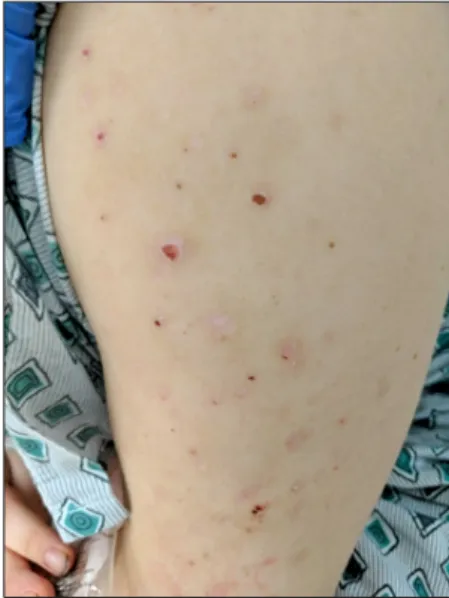
multiple times. Fig. 2. Skin with several excoriated scabbed areas from P. corporis.
had been cleared [3,4]. Here, we report a 10-year-old child with severe iron deficiency anemia in the setting of chronic, heavy lice infestation.
Case Report
The patient is a 10-year-old female who presented to the Emergency Department after worsening fatigue and shortness of breath on exertion for the past month. She also had increased pallor and complaints of diffuse ab- dominal pain. She was described as a “picky eater”, how- ever, her diet included iron rich foods such as red meat and pork. The patient had recent onset of menarche within the past 6 months. Her periods had been every 4 weeks and lasting 2 days. She uses 1-2 pads daily without any excessive bleeding. There were no reports of nose- bleeds, melena, or hematochezia.
Her examination at the time of admission was notable for heavy lice infestation along hair shafts (Fig. 1) and she additionally had excoriated lesions located on her upper back and arms (Fig. 2). It was reported that she has had infestations off and on for the past 5 years.
Etiology of the excoriations noted on the neck, back and upper arms were thought to be related to pediculosis corporis. The areas of skin excoriation were localized to areas of skin in contact with her clothing and no evi- dence of serpiginous burrows were noted which made
scabies an unlikely diagnosis.
On admission her complete blood count demonstrated a hemoglobin level of 3.6 g/dL with MCV of 63.2 fL, iron of 14 µg/dL and ferritin of 2.3 ng/mL. Complete meta- bolic panel was unremarkable. Inflammatory markers were negative. Stool studies revealed negative lactoferrin assay, negative stool culture, negative shiga toxin, and negative stool ova and parasites. Celiac disease testing was also negative, as was fecal occult blood testing. Ab- dominal ultrasound revealed no focal lesions, masses, hemorrhages, or structural abnormalities. She responded well to blood transfusion which was continued until he- moglobin was approximately 7 g/dL. In addition, she was started on oral iron supplementation for treatment of iron deficiency. To treat the lice infestation, permethrin 1% lotion and shampoo for her head lice was used. The patient was discharged on day two of admission with im- proved symptoms and hemoglobin at discharge was 7.9 g/dL.
The patient followed up 13 days after discharge and at that time showed improvement in hemoglobin to 11.8 g/dL. Unfortunately, the patient still had lice infestation noted at that time. She had undergone retreatment ap- proximately one week after initial diagnosis and the en- vironment and other family members had been treated.
Andrew Van Hersh, et al
48 Vol. 28, No. 1, April 2021
Discussion
The most common causes of iron deficiency anemia in the pediatric population include poor iron intake (nutritional deficiencies), poor iron absorption, inappro- priate hemoglobin synthesis, and blood loss (most com- monly, menorrhagia or GI losses).
Our patient’s history, physical exam, and workup were not consistent with any common etiologies for iron defi- ciency anemia. Her menstrual history was not suggestive of heavy blood loss but could have contributed to the se- verity of anemia.
The patient did have severe and chronic pediculosis capitis infestation with concern for pediculosis corporis.
Although a causal relationship has not been established in medical literature between lice infestation and ane- mia, a handful of cases have postulated a correlation in susceptible individuals [3-10]. Based on the calculations established by Speare et al. [2], the amount of blood im- bibed by the average louse in an average burden of in- festation is clinically insignificant. One milliliter of blood contains 0.5 mg of iron. Children age 6-11 years require 1.17 mg/day of iron to satisfy daily requirements. Heavy lice infestation (with an approximation of 2,000 lice) will remove approximately 0.7 mL of blood per day (0.35 mg of iron), but may even lose up to 2.3 mL (1.15 mg of iron) per day in severe infestation estimating 10 blood meals per day. Therefore, we assert that long term infestation of high burden, particularly in postmenarchal females, may lead to clinically significant anemia. This patient’s case, along with previous case reports mentioned, fur- ther corroborates symptomatic anemia due to iron defi- ciency in cases of severe infestation. Given that most pa- tients with mild anemia are not symptomatic there may be several cases of iron deficiency that are undiagnosed.
Iron deficiency may cause impaired immunity, psycho- motor and cognitive delay especially in young children
[11]. Given the increased incidence of lice infestation in the school aged population, there may be several chil- dren at risk. Iron deficiency may be a sequela to moder- ate to severe lice infestation and providers should con- sider screening for anemia in patients with considerable infestation, a relapsing – remitting course or multiple in- festations over a short time span. Future studies are needed to determine the incidence of iron deficiency as- sociated with severe lice infestation.
Conflict of Interest Statement
The authors have no conflict of interest to declare.
References
1. CDC. Lice: head lice - epidemiology & risk factors. Washington, DC: Centers for Disease Control and Prevention, 2019. (Ac- cessed March 1, 2021, at https://www.cdc.gov/parasites/lice/
head/epi.html)
2. Speare R, Canyon DV, Melrose W. Quantification of blood intake of the head louse: pediculus humanus capitis. Int J Dermatol 2006;45:543-6.
3. Ronsley R, Ling F, Rehmus W, Dmytryshyn A. Lice infestation causing severe anemia in a 4-year-old child. Can Fam Physi- cian 2019;65:473-5.
4. Burke S, Mir P. Pediculosis causing iron deficiency anaemia in school children. Arch Dis Child 2011;96:989.
5. Medina Á, López D, Vásquez LR. Severe pediculosis capitis in a nursery school girl. Biomedica 2019;39:631-8.
6. Althomali SA, Alzubaidi LM, Alkhaldi DM. Severe iron defi- ciency anaemia associated with heavy lice infestation in a young woman. BMJ Case Rep 2015;2015:bcr2015212207.
7. Hau V, Muhi-Iddin N. A ghost covered in lice: a case of se- vere blood loss with long-standing heavy pediculosis capitis infestation. BMJ Case Rep 2014;2014:bcr2014206623.
8. Woodruff CM, Chang AY. More than skin deep: severe iron deficiency anemia and eosinophilia associated with pedicu- losis capitis and corporis infestation. JAAD Case Rep 2019;
5:444-7.
9. Guss DA, Koenig M, Castillo EM. Severe iron deficiency ane- mia and lice infestation. J Emerg Med 2011;41:362-5.
10. Nara A, Nagai H, Yamaguchi R, et al. An unusual autopsy case of lethal hypothermia exacerbated by body lice-induced severe anemia. Int J Legal Med 2016;130:765-9.
11. Subramaniam G, Girish M. Iron deficiency anemia in children. Indian J Pediatr 2015;82:558-64.