Enhancement of β-cyclodextrin Production and
Fabrication of Edible Antimicrobial Films Incorporated with Clove Essential Oil/β-cyclodextrin Inclusion
Complex
Mohamed G. Farahat*
Botany and Microbiology Department, Faculty of Science, Cairo University, 12613 Giza, Egypt
Received: October 1, 2019 / Revised: November 24, 2019 / Accepted: November 26, 2019
Introduction
Microbial contamination of food products accelerates the deterioration process and increases the risk of food- borne illness caused by potentially life-threatening pathogens. Ordinarily, food contamination originates
superficially therefore, proper surface treatment and packaging is crucial for assuring food quality and safety [1]. Recently, edible films have gained much interest in preserving various food products, retaining their firmness and restricting weight loss that occurs due to loss of moisture [2−4]. Chitosan is an abundantly available biodegradable polysaccharide that demon- strates remarkable film-forming properties [5−7].
Furthermore, the edible films could be used as a vehicle for additives such as antioxidants and antimicrobials, Edible films containing antimicrobial agents can be used as safe alternatives to preserve food products.
Essential oils are well-recognized antimicrobials. However, their low water solubility, volatility and high sensitivity to oxygen and light limit their application in food preservation. These limitations could be overcome by embedding these essential oils in complexed product matrices exploiting the encapsulation efficiency of β-cyclodextrin. This study focused on the maximization of β-cyclodextrin production using cyclodextrin glucanotransferase (CGTase) and the evaluation of its encapsulation efficacy to fabricate edible antimicrobial films. Response surface methodology (RSM) was used to optimize CGTase production by Brevibacillus brevis AMI-2 isolated from mangrove sediments. This enzyme was partially purified using a starch adsorption method and entrapped in calcium alginate. Cyclodextrin produced by the immobilized enzyme was then confirmed using high performance thin layer chromatography, and its encapsulation effi- ciency was investigated. The clove oil/β-cyclodextrin inclusion complexes were prepared using the co- precipitation method, and incorporated into chitosan films, and subjected to antimicrobial testing. Results revealed that β-cyclodextrin was produced as a major product of the enzymatic reaction. In addition, the incorporation of clove oil/β-cyclodextrin inclusion complexes significantly increased the antimicrobial activity of chitosan films against Staphylococcus aureus, Staphylococcus epidermidis, Salmonella Typhimurium, Escherichia coli, and Candida albicans. In conclusion, B. brevis AMI-2 is a promising source for CGTase to synthesize β-cyclodextrin with considerable encapsulation efficiency. Further, the obtained results suggest that chitosan films containing clove oils encapsulated in β-cyclodextrin could serve as edi- ble antimicrobial food-packaging materials to combat microbial contamination.
Keywords: β-cyclodextrin glucanotransferase, Brevibacillus, RSM, optimization, immobilization
*Corresponding author
Tel: +20-1116080701, Fax: +20-235727556 E-mail: [email protected]
© 2020, The Korean Society for Microbiology and Biotechnology
and allows increasing the shelf life of foodstuffs.
Although synthetic chemical compounds have long been used as preservatives to inhibit a wide variety of food- borne pathogens, their potential negative impact on human health has prompted research on the use of natu- rally occurring alternatives. Thus, it has been an increasing concern in using natural antimicrobials including, bacteriocins from microbial sources [8, 9], ani- mal-based proteins such as lactoferrin [10], and essen- tial oils (EOs) derived from plants [11, 12]. Of these natural antimicrobial agents, plant-derived EOs have gained extensive popularity due to the growing social awareness and demand for safer products that present a more close-to-natural image. Being secondary metabo- lites produced by aromatic plants, EOs have shown potent antimicrobial effect against several pathogenic and spoilage microorganisms [13−16]. In particular, clove essential oil (CEO) has been reported as a potent antimicrobial agent against various microbes owing to the presence of eugenol as the major active constituent [17−19]. It has been suggested that eugenol exerts the bactericidal action by the destruction of the cytoplasmic membranes and altering the integrity of the cell mem- brane. The disruptive action of eugenol on cytoplasmic membrane increases the permeability and causes the losses of vital intracellular materials leading to bacterial death [20, 21]. Recently, the antimicrobial effect of CEO is thought to be due to the destruction of cell structure and inhibition of DNA and proteins synthesis [22].
Regarding antifungal activity, CEO and eugenol are found to reduce the quantity of ergosterol, a specific fun- gal cell membrane component, and inhibit the forma- tion of germ tubes in Candida albicans [23].
Nonetheless, despite these auspicious properties, EOs have poor water solubility, intense aroma, high volatil- ity and high sensitivity in the presence of light, and oxygen, which mainly limit their application as natural preservatives [24, 25]. Hence, encapsulation of EOs in cyclodextrins seems to be a promising, and efficient approach for overcoming these problems by masking the flavor of essential oils, protecting them against oxidation damage, and allowing for EOs to persist for longer time periods under a wide variety of environmental conditions [26, 27]. Cyclodextrins (CDs) are cyclic, water-soluble ring-shaped oligosaccharides, which are composed of several D-glucose units linked by α-D-(1-4) linkages and
their three-dimensional structure considered as a trun- cated cone. The most common molecules are α-CD, β- CD and γ-CD, which consist of six, seven and eight D- glucose units, respectively, that possess a cage-like supramolecular structure [28]. Because of their hydro- phobic cavity and hydrophilic external surface, CDs exhibit the ability to interact with hydrophobic bioac- tive compounds and molecules (guest molecules), encapsulating them in their cavity, forming host-guest inclusion complexes (ICs) [28]. Besides their applications in encapsulation of EOs, CDs have numerous applica- tions in the pharmaceutical, cosmetics, and textile industries. CDs are produced from the enzymatic con- version, degradation, and cyclization of starch by cyclo- dextrin glucanotransferase (CGTase) as a result of an intramolecular transglycosylation reaction [29−31].
The present investigation addresses the enhanced enzy- matic production of β-cyclodextrin using cyclodextrin glucanotransferase derived from Brevibacillus brevis AMI-2 with emphasis on its application.
Materials and Methods
Sample collection
Mangrove sediments were collected from Abu Minqar Island, at the Red Sea (27°12'42.0"N 33°52'10.0"E). The top 5−10 cm of sediments were sampled using sterile disposable wooden spatula during low tides. The collected mangrove sediments were placed in sterile polyethylene bags and transported to the laboratory on ice.
Isolation of CGTase-producing bacteria
CGTase-producing bacteria were isolated on Horikoshi II agar (1% soluble starch, 0.5% peptone, 0.5% yeast extract, 0.1% K2HPO4, 0.02% MgSO4· 7H2O, 1% Na2CO3, 0.03% phenolphthalein (PHP), 0.01% methyl orange and 1.5% agar) according to the method described previously [32]. Samples were suspended in sterile saline and vigor- ously vortexed for 15 min, and then serially diluted in sterile saline, and 100 μl of each dilution were plated in a triplicate onto Horikoshi II agar plates. After 24−72 h of incubation at 37℃, yellowish colored zones were detected around the CGTase-producing colonies. These bacterial isolates were picked and re-streaked on the same medium. Discrete colonies were transferred to slants of the same growth culture medium without PHP
and methyl orange and maintained at 4℃.
Inoculum preparation and culture conditions
Modified Horikoshi II broth (20 g/l soluble starch, 5 g/l peptone, 5 g/l yeast extract, 1 g/l K2HPO4, 0.2 g/l MgSO4· 7H2O, and 10 g/l Na2CO3) was used as a seed and production medium. Bacterial isolates were cultivated overnight at 37℃ with shaking at 200 rpm. Cells were then collected by centrifugation at 6000 × g for 5 min, re-suspended in a sterile phosphate buffered saline to give an optical density (OD600) reading of 1.2, and were used as inocula. The production medium was inoculated with a bacterial isolate (2% v/v) and cultivated in shake flasks (200 rpm) at 37℃ for 72 h. Bacterial cells were removed by centrifugation at 21,000 × g for 30 min at 4℃ and the cell-free supernatant was used as a crude enzyme.
Enzyme assay
The CGTase activity was measured as β-cyclodextrin (β-CD) forming activity by the PHP method [33]. Fifty- microliters crude enzyme were added to 1 ml of 2%
soluble starch in 50 mM Tris-HCl buffer (pH 7.0) and incubated at 55℃ for 15 min. Afterwards, 4 ml of 4 mM PHP in ethanol and 125 mM Na2CO3 (pH 11.0) were added and the color intensity was measured at 550 nm using a double beam UV-Vis spectrophotometer (UV- 1800, Shimadzu, Japan). One unit of the CGTase activity was defined as the amount of enzyme that catalyzes the production of 1 µmol of β-CD per minute under the reaction conditions. A standard curve was prepared using β-CD in 50 mM Tris HCl buffer (pH 7.0) and the protein content was assayed by Bradford method [34].
The specific activity of CGTase was expressed as U/mg protein.
Identification of bacterial isolates
CGTase-producing bacteria were identified by matrix- assisted laser desorption-ionization time-of-flight mass spectrometry (MALDI-TOF/MS). A fresh colony of each bacterial isolate was spotted into the target steel plate using a sterile toothpick. To each bacterial spot, 1 μl of 70% formic acid and 1 μl of a saturated solution of α-cyano-4-hydroxycinnamic acid were applied and allowed to dry. Spectra were obtained using the Flex- Control MicroFlex LT mass spectrometer analyzed
using FlexControl 3.0 software (Bruker Daltonics GmbH, Germany) as previously described [35].
16S rRNA gene amplification and phylogenetic analysis Genomic DNA was extracted and purified using Quick-DNA™ Fungal/Bacterial Miniprep Kit (Zymo Research, USA) according to manufacturer's protocol and the 16S rRNA gene was amplified by polymerase chain reaction (PCR) using the universal primers 27F (5'-AGAGTTTGATCCTGGCTCAG-3') and 1492R (5'CGGTTACCTTGTTACGACTT-3'). PCR was conducted in 50 μl reaction mixtures containing 25 μl OneTaqTM 2X master mix (NEB, England), 50 ng genomic DNA tem- plate, 0.4 μM of each primer, and nuclease-free water was added to make volume up to 50 μl. The amplification was processed with the following parameters: initial denaturation at 94℃ for 3 min, denaturation at 94℃
for 30 s, annealing at 55℃ for 30 s, extension at 68℃ for 1.5 min for 32 cycles, and a final extension at 68℃ for 5 min. Amplicons were purified using DNA clean & con- centrator kit (Zymo Research) and sequenced at Macro- gen (Korea). The forward and reverse DNA sequence reads were assembled using codoncode aligner software v12.1.2 and analyzed using BLAST (http://blast.ncbi.
nlm.nih.gov/Blast.cgi) and the EzTaxon-e server data- base [36]. Multiple sequence alignments were imple- mented utilizing ClustalW, and the phylogenetic tree was constructed using the neighbor-joining method using MEGA7 with bootstrap values based on 1000 rep- lications [37].
Optimization of CGTase production using response surface methodology (RSM)
The central composite design (CCD) was used to ana- lyze the interaction among six cultural factors and deter-
Table 1. Range of variables of the central composite design.
Factor Unit Coded levels
-1 +1
Starch concentration % 1.0 5.0
Yeast extract concentration g/l 0.1 5.0
Salinity (NaCl concentration) % 0.5 3.0
Incubation period h 48.0 96.0
Temperature ℃ 30.0 60.0
pH 6.0 10.0
mine their optimal values (Table 1). The modeling was conducted using Design Expert (version 6.0.8, Stat-Ease, Inc., USA) statistical software including analysis of variance (ANOVA) that generated 90 experiments to obtain the interactions between the process variables and the response. To validate the statistical model, an experiment under the optimal condition predicted by the model was conducted and the actual experimental value was compared with the predicted one.
Purification and immobilization of CGTase
CGTase was purified by starch adsorption method with some modifications [38]. The most active strain des- ignated AMI-2 was cultivated under the optimized con- ditions for enzyme production then cells were harvested by centrifugation at 9400 × g for 20 min at 4℃. Insoluble corn starch (5%) was added to the supernatant then ammonium sulfate was added to 20% saturation with continuous stirring at 4℃ to allow enzyme adsorption for 2 h. The starch-adsorbed enzyme was collected by cen- trifugation at 6000 × g for 20 min at 4℃ and the pellet was washed three times with phosphate buffer (50 mM, pH 7.5). Afterwards, the enzyme was eluted by adding 1 mM β-CD (in 50 mM phosphate buffer) with gentle stirring for 30 min at 37℃. After centrifugation at 21,000
×g for 30 min at 4℃, the supernatant was dialyzed against 10 mM phosphate buffer (pH 7.5) and freeze- dried. The lyophilized enzyme was immobilized into calcium alginate microspheres using endogenous emul- sification method [39]. The operational stability of the immobilized enzyme was determined by quantifying its activity in consecutive cycles of repeated use of the enzyme.
Cyclodextrin production and product specificity of CGTase
To determine the type of CD produced by the immobi- lized CGTase, 100 ml of 10% soluble starch were added to the immobilized enzyme and incubated at 50℃ for 4 h.
Then the products were analyzed against standard solutions of α-, β-, and γ- CD by high-performance thin layer chromatography (HPTLC) using Camag® HPTLC system (Muttenz, Switzerland).
Purification and crystallization of β-cyclodextrin
β-CD was purified from other impurities and crystal-
lized according to the method reported by Sophianopoulos and Warner [40]. Briefly, isopropanol was added to the produced CDs mixture to final concentration of 35% (v/v) in a stoppered conical flask and the pH of the mixture was adjusted to 11 by addition of NaOH (0.1 M).
Afterwards, the solution was incubated in a water bath at 70℃ for 20 h. After cooling, the mixture was neutralized to pH 7.5 with 0.1 M HCl, allowed to stand at room temperature for 48 h, and then the insoluble material was removed by filtration. Subsequently, iso- propanol was added to the filtrate to final concentration of 60% (v/v) and the pH was raised to 11. After 20 h incu- bation at 70℃, the hot solution was filtered and neutral- ized to pH 7.5 and allowed to crystalize at 4℃ for 5 days.
Then β-CD crystals were collected by filtration and re- dissolved in isopropanol (35%, v/v) and the abovemen- tioned processes were repeated 3 times. The final precip- itated β-CD crystals were filtered and dried at 70−75℃
under vacuum. The purified β-CD was freeze-dried and used for the preparation of inclusion complex (IC) with clove essential oil (CEO).
Preparation of Clove oil/β-CD Inclusion Complex (IC) The essential oil was extracted from Syzygium aromaticum flowers (clove) by steam distillation method [41]. The inclusion complex of CEO and β-CD was prepared using a co-precipitation method with minor modifications [42]. Briefly, 5 g of the purified β-CD was dissolved in 100 ml of an ethanol/distilled water solution (1:2, v/v) at 60℃ then allowed to cool to 40℃. Five- hundred milligrams of CEO were dissolved in ethanol and added to the β-CD solution dropwise. After sonica- tion at 90 W for 4 h, the solution was incubated over- night at 4℃. The precipitated CEO/β-CD complex was harvested by vacuum filtration and washed three times with 30% ethanol solution and dried in a vacuum oven at 40℃ for 6 h. The dried complex powder was stored in an airtight glass desiccator at room temperature until use.
CEO/β-CD-Chitosan film formulation
The edible chitosan-based film incorporated with CEO/β-CD inclusion complex was prepared by dissolving 1 g of chitosan (CS) in 100 ml of acetic acid solution (1%
v/v) with continuous stirring at 30℃. Then glycerol was added as a plasticizer at 30% (w/w of CS) and various
concentrations of the prepared CEO/β-CD complex were added to reach a final concentration 0.25, 0.5, 0.75, 1.0, 1.25 or 1.5% (w/v) [27]. Fifteen-milliliter volumes of the film solutions were poured in Petri dishes and dried at 37℃ for 24 h, films without CEO/β-CD were used as control. The dried films were separated from the dishes and used for antimicrobial assays.
Antimicrobial activity
Antimicrobial potential of CEO/β-CD-Chitosan film was tested against Escherichia coli ATCC 8739, Salmonella enterica subsp. enterica (ATCC 14028), Pseudomonas aeruginosa (ATCC 9027), Staphylococcus aureus subsp. aureus (ATCC 6538), Staphylococcus epidermidis (ATCC 12228), Bacillus subtilis (ATCC 6633), and Candida albicans (ATCC 10231) according to method reported previously [43]. Regarding B. subtilis, spores suspension was prepared and harvested following the method described by previously [44]. For antibacterial testing, the edible β-CD/EO-Chitosan film with 2 cm diameter was placed into a sterile Petri dish. The surface of the film was inoculated with 100 μl of bacterial (or spore) suspension (108 CFU/ml). Then the inoculum was covered with a sterile polyethylene film and incubated at 37℃ for 24 h. After that, the inoculum was transferred into a sterile tube and diluted to 100 ml with sterilized phosphate-buffered saline. Bacterial suspensions were subjected to serial dilution and 100 μl aliquots of each dilution were homogeneously plated on Luria-Bertani (LB) agar (tryptone 10 g/l, yeast extract 5 g/l, NaCl 10 g/l).
The LB agar plate was incubated at 37℃ for 48 h and the bacterial colonies were counted to evaluate antimi- crobial performance. For the control, the inoculum was pipette onto films without CEO/β-CD with the other con- ditions kept constant. Antifungal activity was conducted by the same assay but Sabouraud dextrose agar was
used instead of LB agar. The data are expressed as log reductions relative to control.
Statistical analysis
Experiments were performed in triplicates; the analy- sis of variance (ANOVA) and duncan's test were con- ducted using IBM SPSS statistics 20 software. The results were considered significant at p < 0.05.
Results
Isolation and identification of CGTase-producing bacteria Screening of mangrove sediment samples collected from Abu Minqar Island resulted in the isolation of 16 bacterial strains showing yellowish colored zones around their growth, indicating the potential of CGTase produc- tion (Fig. S1). The presumptive CGTase-producing isolates were subjected to quantitative determination of CGTase activity. For this purpose, enzyme assay was conducted and results revealed that the enzyme was produced in extracellular fractions of all investigated strains with specific activities ranged from 0.2 to 78.4 U/mg protein. Consequently, five promising isolates des- ignated AMI-1, AMI-2, AMI-3, AMI-4, and AMI-5 were selected and identified by MALDI-TOF/MS. Of these five strains, only four were successfully identified by MALDI- TOF/MS analysis. Further identification was confirmed by 16S rRNA gene amplification and sequencing and results revealed that CGTase-producing isolates are belonging to five different genera (Table 2). Near full- length 16S rRNA gene sequences (1,410−1,425 bp) were obtained and deposited in the GenBank under the accession numbers MK184206 (Bacillus circulans AMI- 1), MH938812 (Brevibacillus brevis AMI-2), MK184207 (Paenibacillus macerans AMI-3), MK184208 (Vibrio parahaemolyticus AMI-4), and MK184209 (Oceanobacillus
Table 2. Identification and characterization of CGTase-producing bacteria.
Isolate MALDI-TOF/MS 16S rRNA Amplicon size
(bp)
Accession number
CGTase activity (U/mg)
AMI-1 Bacillus circulans B. circulans 1,420 MK184206 08.6 ± 0.7
AMI-2 Brevibacillus brevis B. brevis 1,410 MH938812 78.4 ± 2.8
AMI-3 Paenibacillus macerans P. macerans 1,424 MK184207 12.2 ± 0.9
AMI-4 Vibrio parahaemolyticus V. parahaemolyticus 1,415 MK184208 01.1 ± 1.3
AMI-5 Not identified Oceanobacillus picturae 1,421 MK184209 04.8 ± 0.36
picturae AMI-5). Based on the results of the quantitative determination of CGTase activity, B. brevis strain AMI-2 manifested superior activity was selected for further investigations. A phylogenetic tree of B. brevis strain AMI-2 and the most related species was constructed (Fig. S2).
Optimization of CGTase production using RSM
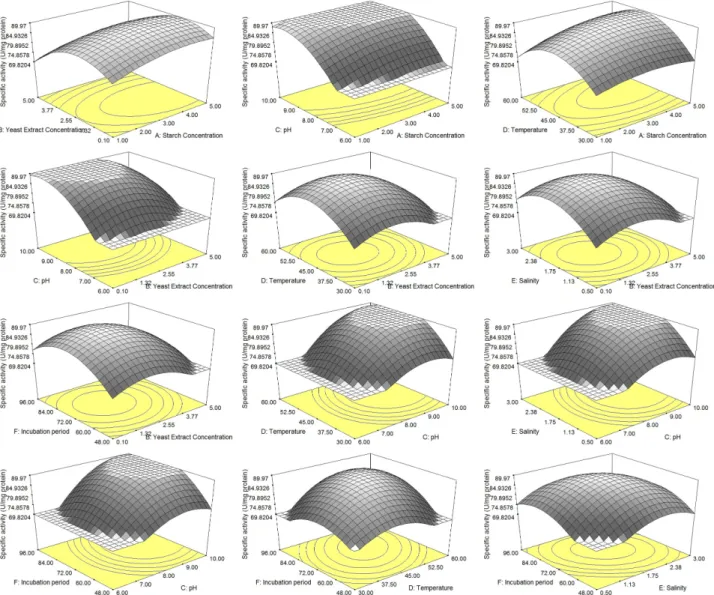
The combined effect of various cultural variables on CGTase production by B. brevis strain AMI-2 was evaluated using RSM to predict the optimized condition for maximum CGTase production. Results obtained from 90 experiments were analyzed using Design Expert soft- ware to predict the optimum conditions (Table S1). The
three-dimensional response surface curves were plotted to clarify the interaction of independent variables and to determine the optimum condition (Fig. 1). The optimal levels of a predicted desired activity (98.99 U/mg) were as follows: starch concentration 4.43%, yeast extract 1.67 g/l, initial pH 9.75, salinity 2.25%, incubation period 81.24 h, and incubation temperature 52.77℃. Accord- ingly, an experiment under the optimal condition pre- dicted by the model was conducted to validate the statistical model. The actual (experimental) values were found to be very close to the predicted values. The pre- dicted response for CGTase production was 98.99 U/mg protein, whilst the actual response was 97.26 U/mg protein.
Fig. 1. Three-dimensional response surfaces plots showing the effect of interaction various factors on CGTase production.
Purification and immobilization of CGTase
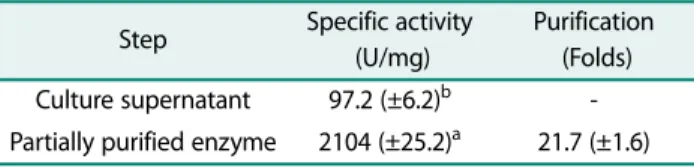
The CGTase from B. brevis strain AMI-2 was purified by starch adsorption method where the crude enzyme was adsorbed to corn starch and followed by elution of the adsorbed enzyme using β-CD solution. Accordingly, the enzyme was purified at a single step up to 21.69 fold yielding 2104 U/mg protein (Table 3). Moreover, the purified enzyme was immobilized into calcium alginate microspheres and the operational stability of the immo- bilized enzyme was evaluated in successive cycles of recurring use of the enzyme. The immobilized enzyme strikingly retained up to 87% of its initial activity after 20 cycles of reaction.
Cyclodextrin production and product specificity of CGTase
In order to specify the glucanotransferase reaction product and determine the conversion ratio, the immobilized CGTase from B. brevis strain AMI-2 was incubated with 10% (w/v) soluble starch as a substrate at 50℃ for 4 h, subsequently, the reaction mixture was analyzed by HPTLC that unveiled the production of 0.69% α-CD, 91.25% β-CD, and 8.04% γ-CD. Chiefly, CGTase formed β-CD with a small amount of γ-CD and a negligible quantity of α-CD, notably the yield was 51.18, 4.43, and 0.39 g/l, respectively (Table 4). To benefit the advantage of its encapsulation ability, the produced β- CD was purified from the other CDs and crystallized.
Furthermore, the purified β-CD was used for the prepa- ration of inclusion complex with clove essential oil.
Preparation of antimicrobial CEO/β-CD-Chitosan film Essential oil was extracted from clove by steam distil- lation method and encapsulated in the purified β-CD using co-precipitation method. Subsequently, the pro- duced CEO/β-CD complex was incorporated into a newly fabricated edible chitosan film and antimicrobial activity was appraised. The fabricated CEO/β-CD-chitosan films exhibited a significant antimicrobial activity against all investigated strains particularly S. aureus subsp. aureus and S. epidermidis (Fig. 2). The survival of assessed microorganisms decreased with the increase of CEO/
β-CD concentration, which clarifies the antimicrobial activity of CEO/β-CD. The developed CEO/β-CD-chitosan film exhibited the greatest inhibition effect when used at 1.5% concentration against S. epidermidis and S. aureus, respectively, their count was reduced by more than 5 log CFU. No significant antimicrobial activity was observed against B. subtilis spores by using CEO/β-CD at concentrations less than 0.75%, however, 4.3 log reduction was achieved at 1.5% CEO/β-CD. The Log reduction of E. coli, S. enterica subsp. enterica, and P.
aeruginosa ranged from 3.2 to 3.5 in case of using chi- tosan film supplemented with 1.5% CEO/β-CD indicat- ing a relatively poor antimicrobial activity against the investigated Gram-negative bacteria. Besides, chitosan film supplemented with 1.5% CEO/β-CD also exhibited a significant antimicrobial activity against C. albicans causing 4.28 log reduction in CFUs.
Discussion
Antimicrobial edible films are presented as an emergent technology capable of increasing the safety and shelf-life of food products. The present investigation addressed the efficient bioconversion of starch into β-CD by β-CGTase derived from B. brevis strain AMI-2 and fabrication of edible CEO/β-CD-chitosan films that exhibited a promising antimicrobial activity. In this context, 15 CGTase-producing bacterial strains were isolated from mangrove sediments. It has been sug- gested that mangrove is a highly productive ecosystem with great microbial diversity [45, 46]. Even though MALDI-TOF is recommended as a rapid microbial iden- Table 3. Partial purification of CGTase by starch adsorption
method. The same letter in each column indicates no signifi- cant difference according to Duncan’s multiple range test (p <
0.05). Symbol: ± represents standard deviation.
Step Specific activity (U/mg)
Purification (Folds) Culture supernatant 97.2 (±6.2)b - Partially purified enzyme 2104 (±25.2)a 21.7 (±1.6)
Table 4. Types and ratio of cyclodextrin produced by immo- bilized CGTase. The same letter in each column indicates no significant difference according to Duncan’s multiple range test (p < 0.05). Symbol: ± represents standard deviation.
Cyclodextrin type Production (g/l) Conversion (%) α-CD 00.39 (±0.06)c 00.69 (±0.09)c β-CD 51.18 (±5.98)a 91.25 (±2.09)a γ-CD 04.43 (±0.70)b 08.04 (±2.10)b
tification technique due to its accuracy and low-cost compared to other microbial identification methods [47, 48], the present study revealed that 16S rRNA gene analysis is more discriminative compared with MALDI- TOF method. Where O. picturae strain AMI-5 was mis- identified by MALDI-TOF method; this limitation may be due to the absence of reference spectra of many marine and environmental bacteria in the database. Similar findings regarding the identification of marine bacteria by MALDI-TOF were reported [49]. According to quanti- tative screening, 5 potent CGTase-producing strains were selected and identified as B. circulans AMI-1, B.
brevis AMI-2, P. macerans AMI-3, V. parahaemolyticus AMI-4, and O. picturae AMI-5. As far as the author knows, there are no published data on CGTase produc- tion by Vibrio and Oceanobacillus species. On the other hand, CGTase production from various species belong- ing to Bacillus, and Paenibacillus has been extensively described [50−53]. Herein, B. brevis AMI-2 was selected owing to its admirable CGTase activity compared with
other investigated strains and subjected to optimization studies. It was noteworthy that RSM optimization enhanced the enzyme production (about 1.24-folds) from 78.4 U/mg to 97.2 U/mg with good correlation between predicted and experimental results confirming the vali- dation of the response model. The statistical optimiza- tion indicated the improved CGTase productivity in the presence of relatively high concentrations of NaCl (2.25%) under alkaline conditions (pH 9.75) and elevated temperature (52.77℃). It is assumed that marine bacteria, since they live in the sea, are salt-tolerant organisms and their activities have adapted to the presence of NaCl. Moreover, many reports are available on produced of CGTases from numerous alkalotolerant and alkalo- philic strains [51, 54, 55]. Nowadays, RSM is widely reported as an effective statistical technique for design- ing experiments, building models, evaluating the inter- active effects of variables, and pointing the optimum conditions to improve the complex biological processes, especially enzyme production [56−59]. Furthermore, the Fig. 2. Antimicrobial assessment of CEO/β-CD-Chitosan film against various microorganisms. Columns headed by the same letter were not significantly different according to Duncan’s multiple range test (p < 0.05). Data were expressed as meand +/- standard deviations
enzyme produced under optimum conditions was puri- fied to more than 20-fold by starch adsorption method.
These results agreed with several studies whose utilized starch adsorption method as an efficient and inexpen- sive technique to purify various CGTases [60−62]. Also, alginate-immobilized CGTase exhibited a feasible activ- ity and retained up to 87% of its initial activity after 20 cycles of batching. Immobilization has been realized as a powerful tool to improve the stability, and activity of CGTase by using relatively expensive materials such as chitosan, and silica [63, 64]. In agreement, silica micro- spheres-immobilized CGTase from Thermoanaerobacter sp. retained 60% of its initial catalytic activity after 15 cycles of repeated batches showing its good chemical and mechanical resistance [65] while it maintained 61% of its initial activity after 100 cycles of batch by immobili- zation on chitosan [63]. In this investigation, the immo- bilized CGTase converted up to 56% of starch into CDs after 4 h incubation at 50℃. In a previous study, CGTase derived from B. circulans ATCC 21783 converted 41% of starch to CDs [60]. Results clarified that β-CD was the major product of CGTase derived from B. brevis AMI-2 where the bioconversion profile was 0.69% α-CD, 91.25%
β-CD, and 8.2% γ-CD. The same profile was reported for CGTase from B. brevis CD162 but with a relatively dif- ferent ratio that was 1.1% for α-CD, 33.2% for β-CD, and 9.9% for γ-CD [66]. It has been suggested that the ratio of the produced CDs is not only dependent on the source of CGTase, but also on the reaction conditions, such as temperature, incubation time, and substrate concentra- tion. Immobilized CGTase from P. macerans ACTT 8244 converted 44% of the soluble starch to CDs and the pro- duction profile was 79% α-CD, 16% β-CD, and 5% γ-CD after 6 h but significant change was in the products was observed (43% α-CD, 56% β-CD , and 1% γ-CD) after 24 h incubation [53]. CGTases is classified into three different types, α-CGTase, β-CGTase, and γ-CGTase according to the major CD product [67], thus CGTase derived from B.
brevis AMI-2 is classified as β-CGTase. In this respect, the primary product of starch bioconversion (β-CD) was purified and crystalized yielding 51.18 g/l. In this context, it is worthwhile to exploit the merit encapsulation effi- ciency of β-CD towards the essential oils. Thus, CEO was extracted and encapsulated in β-CD forming CEO/β- CD inclusion complex. Widely accepted, plant essential oils are good antimicrobial compounds and capable of
preventing the growth of foodborne bacteria [68−70]. A recent study regarding the antimicrobial activity of CEO indicated the superior effect of encapsulation of the essential oil compared to free counterparts [71]. Previous studies proved the improving of antioxidant activity along with enhancing water solubility and high thermal stability of β-CD-encapsulated essential oils and over- coming the restrictions related to their volatility, oxida- tion and poor water solubility [72, 73]. Apparently, the edible CEO/β-CD-chitosan film addressed here exhibited potent antimicrobial activity against both Gram-positive and Gram-negative bacteria as well as yeast. However, a preeminent antimicrobial activity was observed against Gram-positive compared to that against Gram-negative bacteria and yeast. Generally, Gram-negative bacteria were more resistant to various essential oils than Gram- positive which may be due to the characteristic differ- ence of the outer membrane between Gram-positive bac- teria and Gram-negative bacteria [27, 74, 75]. It has been suggested that the hydrophilic cell wall structure of Gram-negative bacteria, constituted essentially by a lipopolysaccharide, blocks the penetration of hydrophobic components of EOs rendering Gram-negative bacteria more resistant toward EOs than Gram-negative bacteria [25]. These findings are in good harmony with several reports concerning the enhanced antimicrobial activity of various essential oils coupled with β-CD [26, 76−78].
Edible films are one of the technologies through which many natural substances could be utilized to extend shelf life on many fresh food products. Therefore, it is highlighted the potential application of the CEO/β-CD- chitosan edible films as antimicrobial agents to assure food safety and quality. The present findings shed light on the potentiality of B. brevis AMI-2 as a promising source for the production of CGTase under optimized conditions to synthesize β-cyclodextrin with considerable encapsulation efficiency. Moreover, the obtained results suggest the application of chitosan films in which clove oil is encapsulated in β-cyclodextrin as an edible antimi- crobial food-packaging material to combat microbial con- tamination.
Conflict of Interest
The author has no financial conflicts of interest to declare.
References
1. Malhotra B, Keshwani A, Kharkwal H. 2015. Antimicrobial food packaging: potential and pitfalls. Front Microbiol. 6: 611.
2. Niu B, Shao P, Chen H, Sun P. 2019. Structural and physiochemical characterization of novel hydrophobic packaging films based on pullulan derivatives for fruits preservation. Carbohydr. Polym.
208: 276-284.
3. Liu X, Han W, Zhu Y, Xuan H, Ren J, Zhang J, et al. 2018. Anti- oxidative and antibacterial self-healing edible polyelectrolyte multilayer film in fresh-cut fruits. J. Nanosci. Nanotechnol. 18:
2592-2600.
4. Shaikh M, Haider S, Ali TM, Hasnain A. 2019. Physical, thermal, mechanical and barrier properties of pearl millet starch films as affected by levels of acetylation and hydroxypropylation. Int. J.
Biol. Macromol. 124: 209-219.
5. Pereira dos Santos E, Nicácio PHM, Coêlho Barbosa F, Nunes da Silva H, Andrade ALS, Lia Fook MV, et al. 2019. Chitosan/essential oils formulations for potential use as wound dressing: physical and antimicrobial properties. Materials (Basel) 12: 2223.
6. Gao HX, He Z, Sun Q, He Q, Zeng WC. 2019. A functional polysac- charide film forming by pectin, chitosan, and tea polyphenols.
Carbohydr. Polym. 215: 1-7.
7. Zhong Y, Zhuang C, Gu W, Zhao Y. 2019. Effect of molecular weight on the properties of chitosan films prepared using elec- trostatic spraying technique. Carbohydr. Polym. 212: 197-205.
8. Abanoz HS, Kunduhoglu B. 2018. Antimicrobial activity of a bac- teriocin produced by Enterococcus faecalis KT11 against some Pathogens and antibiotic-eesistant bacteria. Korean J. Food Sci.
Anim. Resour. 38: 1064-1079.
9. Miceli de Farias F, dos Santos Nascimento J, Cabral da Silva Santos O, de Freire Bastos M do C. 2019. Study of the effectiveness of staphylococcins in biopreservation of Minas fresh (Frescal) cheese with a reduced sodium content. Int. J. Food Microbiol.
304: 19-31.
10. Sun C, Li Y, Cao S, Wang H, Jiang C, Pang S, et al. 2018. Antibacterial activity and mechanism of action of bovine lactoferricin deriva- tives with symmetrical amino acid sequences. Int. J. Mol. Sci. 19:
2951.
11. Silva F, Domingues FC. 2017. Antimicrobial activity of coriander oil and its effectiveness as food preservative. Crit. Rev. Food Sci.
Nutr. 57: 35-47.
12. Hu Q, Zhou M, Wei S. 2018. Progress on the antimicrobial activity research of clove oil and eugenol in the food antisepsis field.
J. Food Sci. 83: 1476-1483.
13. Elshafie HS, Gruľová D, Baranová B, Caputo L, De Martino L, Sedlák V, et al. 2019. Antimicrobial activity and chemical compo- sition of essential oil extracted from Solidago canadensis L. grow- ing wild in Slovakia. Molecules 24(7). pii: E1206.
14. de Rostro-Alanis MJ, Báez-González J, Torres-Alvarez C, Parra- Saldívar R, Rodriguez-Rodriguez J, Castillo S. 2019. Chemical composition and biological activities of oregano essential oil and its fractions obtained by vacuum distillation. Molecules 24(10).
pii: E1904.
15. Almeida ET da C, de Souza GT, de Sousa Guedes JP, Barbosa IM, de Sousa CP, Castellano LRC, et al. 2019. Mentha piperita L.
essential oil inactivates spoilage yeasts in fruit juices through the perturbation of different physiological functions in yeast cells.
Food Microbiol. 82: 20-29.
16. Shi Y, Huang S, He Y, Wu J, Yang Y. 2018. Navel orange peel essential oil to control food spoilage molds in potato slices. J. Food Prot.
81: 1496-1502.
17. Marchese A, Barbieri R, Coppo E, Orhan IE, Daglia M, Nabavi SF, et al. 2017. Antimicrobial activity of eugenol and essential oils containing eugenol: A mechanistic viewpoint. Crit. Rev. Microbiol.
43: 668-689.
18. Zhang Y, Wang Y, Zhu X, Cao P, Wei S, Lu Y. 2017. Antibacterial and antibiofilm activities of eugenol from essential oil of Syzygium aromaticum (L.) Merr. & L. M. Perry (clove) leaf against periodontal pathogen Porphyromonas gingivalis. Microb. Pathog. 113: 396- 402.
19. Mohamed MSM, Abdallah AA, Mahran MH, Shalaby AM. 2018.
Potential alternative treatment of ocular bacterial infections by oil derived from Syzygium aromaticum flower (Clove). Curr. Eye Res. 43: 873-881.
20. Devi KP, Sakthivel R, Nisha SA, Suganthy N, Pandian SK. 2013.
Eugenol alters the integrity of cell membrane and acts against the nosocomial pathogen Proteus mirabilis. Arch Pharm. Res.
36: 282-292.
21. Devi KP, Nisha SA, Sakthivel R, Pandian SK. 2010. Eugenol (an essential oil of clove) acts as an antibacterial agent against Salmonella typhi by disrupting the cellular membrane. J. Ethno- pharmacol. 130: 107-115.
22. Xu J-G, Liu T, Hu Q-P, Cao X-M. 2016. Chemical composition, anti- bacterial properties and mechanism of action of essential oil from clove buds against Staphylococcus aureus. Molecules 21:
1194.
23. Pinto E, Vale-Silva L, Cavaleiro C, Salgueiro L. 2009. Antifungal activity of the clove essential oil from Syzygium aromaticum on Candida, Aspergillus and dermatophyte species. J. Med. Microbiol.
58: 1454-1462.
24. Kfoury M, Auezova L, Greige-Gerges H, Fourmentin S. 2015.
Promising applications of cyclodextrins in food: Improvement of essential oils retention, controlled release and antiradical activity.
Carbohydr. Polym. 131: 264-272.
25. Burt S. 2004. Essential oils: their antibacterial properties and potential applications in foods—a review. Int. J. Food Microbiol.
94: 223-253.
26. Kotronia M, Kavetsou E, Loupassaki S, Kikionis S, Vouyiouka S, Detsi A. 2017. Encapsulation of Oregano (Origanum onites L.) essential oil in β-Cyclodextrin (β-CD): synthesis and characteriza- tion of the inclusion complexes. Bioengineering 4(3). pii: E74.
27. Sun X, Sui S, Ference C, Zhang Y, Sun S, Zhou N, et al. 2014. Anti- microbial and mechanical properties of β-cyclodextrin inclusion with essential oils in chitosan films. J. Agric. Food Chem. 62: 8914- 8918.
28. Del Valle EMM. 2004. Cyclodextrins and their uses: A review.
Process Biochem. 39: 1033-1046.
29. Qi Q, Zimmermann W. 2005. Cyclodextrin glucanotransferase:
From gene to applications. Appl. Microbiol. Biotechnol. 66: 475- 485.
30. Zain WSWM, Illias RM, Salleh MM, Hassan O, Rahman RA, Hamid AA. 2007. Production of cyclodextrin glucanotransferase from alkalophilic Bacillus sp. TS1-1: Optimization of carbon and nitro- gen concentration in the feed medium using central composite design. Biochem. Eng. J. 33: 26-33.
31. Leemhuis H, Kelly RM, Dijkhuizen L. 2010. Engineering of cyclo- dextrin glucanotransferases and the impact for biotechnological applications. Appl. Microbiol. Biotechnol. 85: 823-835.
32. Park CS, Park KH, Kim SH. 1989. A rapid screening method for alkaline β-cyclodextrin glucanotransferase using phenolphthalein- methyl orange-containingsolid medium. Agric. Biol. Chem. 53:
1167-1169.
33. Goel A, Nene SN. 1995. Modifications in the Phenolphthalein method for spectrophotometric estimation of beta cyclodextrin.
Starch‐Stärke 47: 399-400.
34. Bradford MM. 1976. A rapid and sensitive method for the quanti- tation of microgram quantities of protein utilizing the principle of protein-dye binding. Anal. Biochem. 72: 248-254.
35. Assis GBN, Pereira FL, Zegarra AU, Tavares GC, Leal CA, Figueiredo HCP. 2017. Use of MALDI-TOF mass spectrometry for the fast identification of gram-positive fish pathogens. Front. Microbiol. 8:
1492.
36. Yoon SH, Ha SM, Kwon S, Lim J, Kim Y, Seo H, et al. 2017. Introduc- ing EzBioCloud: A taxonomically united database of 16S rRNA gene sequences and whole-genome assemblies. Int. J. Syst. Evol.
Microbiol. 67: 1613-1617.
37. Kumar S, Stecher G, Tamura K. 2016. MEGA7: molecular evolu- tionary genetics analysis version 7.0 for bigger datasets. Mol. Biol.
Evol. 33: 1870-1874.
38. Ferrarotti SA, Rosso AM, Maréchal MA, Krymkiewicz N, Maréchal LR. 1996. Isolation of two strains (S-R type) of Bacillus circulans and purification of a cyclomaltodextrin-glucanotransferase. Cell Mol. Biol. (Noisy-le-grand) 42: 653-657.
39. Deng Z, Wang F, Zhou B, Li J, Li B, Liang H. 2019. Immobilization of pectinases into calcium alginate microspheres for fruit juice application. Food Hydrocoll. 89: 691-699.
40. Sophianopoulos AJ, Warner IM. 1992. Purification of beta-cyclo- dextrin. Anal. Chem. 64: 2652-2654.
41. Tongnuanchan P, Benjakul S. 2014. Essential Oils: Extraction, bio- activities, and their uses for food preservation. J. Food Sci. 79:
1231-1249.
42. Ayala-Zavala JF, Soto-Valdez H, González-León A, Álvarez-Parrilla E, Martín-Belloso O, González-Aguilar GA. 2008. Microencapsula- tion of cinnamon leaf (Cinnamomum zeylanicum) and garlic (Allium sativum) oils in β-cyclodextrin. J. Incl. Phenom. Macrocycl.
Chem. 60: 359-368.
43. Ye Y, Zhu M, Miao K, Li X, Li D, Mu C. 2017. Development of anti- microbial gelatin-based edible films by incorporation of trans-
anethole/β-cyclodextrin inclusion complex. Food Bioprocess Technol. 10: 1844-1853.
44. Lawrence HA, Palombo EA. 2009. Activity of essential oils against Bacillus subtilis spores. J. Microbiol. Biotechnol. 19: 1590-1595.
45. Liang JB, Chen YQ, Lan CY, Tam NFY, Zan QJ, Huang LN. 2007.
Recovery of novel bacterial diversity from mangrove sediment.
Mar. Biol. 150: 739-747.
46. Mendes L, Tsai S, Mendes LW, Tsai SM. 2014. Variations of bacterial community structure and composition in mangrove sediment at different depths in southeastern Brazil. Diversity 6: 827-843.
47. Rahi P, Prakash O, Shouche YS. 2016. Matrix-assisted laser desorp- tion/ionization time-of-flight Mass-Spectrometry (MALDI-TOF MS) based microbial identifications: challenges and scopes for microbial ecologists. Front. Microbiol. 7: 1359.
48. Strejcek M, Smrhova T, Junkova P, Uhlik O. 2018. Whole-cell MALDI-TOF MS versus 16S rRNA gene analysis for identification and dereplication of recurrent bacterial isolates. Front. Microbiol.
9: 1294.
49. Timperio AM, Gorrasi S, Zolla L, Fenice M. 2017. Evaluation of MALDI-TOF mass spectrometry and MALDI BioTyper in comparison to 16S rDNA sequencing for the identification of bacteria isolated from Arctic sea water. PLoS One 12: e0181860.
50. Eş I, Ribeiro MC, dos Santos Júnior SR, Khaneghah AM, Rodriguez AG, Amaral AC. 2016. Production of cyclodextrin glycosyltrans- ferase by immobilized Bacillus sp. on chitosan matrix. Bioprocess Biosyst. Eng. 39: 1487-1500.
51. de Araújo Coelho SL, Magalhães VC, Marbach PAS, Cazetta ML.
2016. A new alkalophilic isolate of Bacillus as a producer of cyclo- dextrin glycosyltransferase using cassava flour. Braz. J. Microbiol.
47: 120-128.
52. Blanco KC, De Lima CJB, Monti R, Martins J, Bernardi NS, Contiero J. 2012. Bacillus lehensis - An alkali-tolerant bacterium isolated from cassava starch wastewater: Optimization of parameters for cyclodextrin glycosyltransferase production. Ann. Microbiol. 62:
329-337.
53. Ivanova V. 2010. Immobilization of cyclodextrin glucanotransfer- ase from Paenibacillus macerans atcc 8244 on magnetic carriers and production of cyclodextrins. Biotechnol. Biotechnol. Equip.
24: 516-528.
54. Reddy SV, More SS, Annappa GS. 2017. Purification and proper- ties of beta-cyclomaltodextrin glucanotransferase from Bacillus flexus SV 1. J. Basic Microbiol. 57: 974-981.
55. Mora MMM, Sánchez KH, Santana RV, Rojas AP, Ramírez HL, Torres-Labandeira JJ. 2012. Partial purification and properties of cyclodextrin glycosiltransferase (CGTase) from alkalophilic Bacillus species. Springerplus 1: 61.
56. Li Y, Zhu C, Zhai X, Zhang Y, Duan Z, Sun J. 2018. Optimization of enzyme assisted extraction of polysaccharides from pomegranate peel by response surface methodology and their anti-oxidant potential. Chin. Herb Med. 10: 416-423.
57. Vijayaraghavan P, Arasu MV, Anantha Rajan R, Al-Dhabi NA. 2019.
Enhanced production of fibrinolytic enzyme by a new Xan- thomonas oryzae IND3 using low-cost culture medium by
response surface methodology. Saudi J. Biol. Sci. 26: 217-224.
58. Khan YM, Munir H, Anwar Z. 2019. Optimization of process vari- ables for enhanced production of urease by indigenous Aspergillus niger strains through response surface methodology. Biocatal Agric. Biotechnol. 20: 101202.
59. Baş D, Boyacı İH. 2007. Modeling and optimization II: Comparison of estimation capabilities of response surface methodology with artificial neural networks in a biochemical reaction. J. Food Eng.
78: 846-854.
60. Vassileva A, Atanasova N, Ivanova V, Dhulster P, Tonkova A. 2007.
Characterisation of cyclodextrin glucanotransferase from Bacillus circulans ATCC 21783 in terms of cyclodextrin production. Ann.
Microbiol. 57: 609-615.
61. Costa H, Gastón JR, Lara J, Martinez CO, Moriwaki C, Matioli G, et al. 2015. Cyclodextrin glycosyltransferase production by free cells of Bacillus circulans DF 9R in batch fermentation and by immobilized cells in a semi-continuous process. Bioprocess Biosyst.
Eng. 38: 1055-1063.
62. Rajput KN, Patel KC, Trivedi UB. 2016. β-cyclodextrin production by cyclodextrin glucanotransferase from an alkaliphile Microbac- terium terrae KNR 9 using different starch substrates. Biotechnol.
Res. Int. 2016: 1-7.
63. Schöffer JDN, Klein MP, Rodrigues RC, Hertz PF. 2013. Continuous production of β-cyclodextrin from starch by highly stable cyclo- dextrin glycosyltransferase immobilized on chitosan. Carbohydr.
Polym. 98: 1311-1316.
64. Ibrahim ASS, Al-Salamah AA, El-Toni AM, El-Tayeb MA, Elbadawi YB. 2014. Cyclodextrin glucanotransferase immobilization onto functionalized magnetic double mesoporous core-shell silica nanospheres. Electron. J. Biotechnol. 17: 55-64.
65. Matte CR, Nunes MR, Benvenutti EV, Schöffer J da N, Ayub MAZ, Hertz PF. 2012. Characterization of cyclodextrin glycosyltransfer- ase immobilized on silica microspheres via aminopropyltrime- thoxysilane as a “spacer arm.” J. Mol. Catal. B Enzym. 78: 51-56.
66. Kim MH, Sohn CB, Oh TK. 1998. Cloning and sequencing of a cyclodextrin glycosyltransferase gene from Brevibacillus brevis CD162 and its expression in Escherichia coli. FEMS Microbiol. Lett.
164: 411-418.
67. Tonkova A. 1998. Bacterial cyclodextrin glucanotransferase.
Enzyme Microb. Technol. 22: 678-686.
68. Kang J, Liu L, Wu X, Sun Y, Liu Z. 2018. Effect of thyme essential oil against Bacillus cereus planktonic growth and biofilm formation.
Appl. Microbiol. Biotechnol. 102: 10209-10218.
69. Shi C, Zhang X, Guo N. 2018. The antimicrobial activities and action-mechanism of tea tree oil against food-borne bacteria in fresh cucumber juice. Microb. Pathog. 125: 262-271.
70. Quendera AP, Barreto AS, Semedo-Lemsaddek T. 2018. Antimi- crobial activity of essential oils against foodborne multidrug- resistant enterococci and aeromonads in planktonic and biofilm state. Food Sci. Technol. Int. 25: 101-108.
71. Radünz M, da Trindade MLM, Camargo TM, Radünz AL, Borges CD, Gandra EA, et al. 2019. Antimicrobial and antioxidant activity of unencapsulated and encapsulated clove (Syzygium aromaticum, L.) essential oil. Food Chem. 276: 180-186.
72. Celebioglu A, Yildiz ZI, Uyar T. 2018. Thymol/cyclodextrin inclu- sion complex nanofibrous webs: Enhanced water solubility, high thermal stability and antioxidant property of thymol. Food Res.
Int. 106: 280-290.
73. Abada MB, Hamdi SH, Gharib R, Messaoud C, Fourmentin S, Greige-Gerges H, et al. 2019. Post-harvest management control of Ectomyelois ceratoniae (Zeller) (Lepidoptera: Pyralidae): new insights through essential oil encapsulation in cyclodextrin. Pest Manag. Sci. 75: 2000-2008.
74. Gadisa E, Weldearegay G, Desta K, Tsegaye G, Hailu S, Jote K, et al.
2019. Combined antibacterial effect of essential oils from three most commonly used Ethiopian traditional medicinal plants on multidrug resistant bacteria. BMC Complement Altern. Med. 19:
24.
75. Pandini JA, Pinto FGS, Scur MC, Santana CB, Costa WF, Temponi LG, et al. 2017. Chemical composition, antimicrobial and antioxi- dant potential of the essential oil of Guarea kunthiana A. Juss.
Braz. J. Biol. 78: 53-60.
76. Herrera A, Rodríguez FJ, Bruna JE, Abarca RL, Galotto MJ, Guarda A, et al. 2019. Antifungal and physicochemical properties of inclusion complexes based on β-cyclodextrin and essential oil derivatives. Food Res. Int. 121: 127-135.
77. Matshetshe KI, Parani S, Manki SM, Oluwafemi OS. 2018. Prepara- tion, characterization and in vitro release study of β-cyclodextrin/
chitosan nanoparticles loaded Cinnamomum zeylanicum essential oil. Int. J. Biol. Macromol. 118: 676-682.
78. Chen G, Liu B. 2016. Cellulose sulfate based film with slow- release antimicrobial properties prepared by incorporation of mustard essential oil and β-cyclodextrin. Food Hydrocoll. 55: 100- 107.