Antioxidant Activity, Macamide B Content and Muscle Cell Protection of Maca (Lepidium meyenii) Extracted Using Ultrasonification-Assisted Extraction
Enkhbolor Buyanbadrakh1, Hyeong-Suk Hong1, Kang-Woo Lee2, Wen Yan Huang3, and Jun-Hyun Oh1*
1Department of Plant and Food Sciences, Sangmyung University, Cheonan 31066, Republic of Korea
2SSbiopharm Ltd., Cheonan 31056, Republic of Korea
3Department of Food and Biotechnology, Korea University, Sejong 30019, Republic of Korea
Received: November 19, 2019 / Revised: December 2, 2019 / Accepted: December 5, 2019
Introduction
Maca (Lepidium meyenii), an annual or biennial plant of the family of Brassicaceae, is mainly grown in Andean region of Peru where the altitude is between 3,500 and 4,500 m above sea level [1]. Maca is rich in nutrients and secondary metabolites with a variety of biological activities. Its main chemical compositions are polysac-
charides, flavones, microelements and amino acids [2].
Some studies reported that maca comprised of various classes of bioactive compounds such as saponins, alka- loids, steroid hormones, and polyphenol compounds [3].
Dried maca hypocotyls also contain several classes of secondary metabolites, including alkaloids, amino acids, glucosinolates, polysaccharides, fatty acids and maca- mides [4].
Macamides are secondary amides only found in maca and formed from benzylamine and a fatty acid moiety with varying hydrocarbon chain lengths [5]. Macamides are considered as biomarkers for maca, and the isolation This study aims to evaluate the efficacy of the Ultrasonication-Assisted (UA) extraction on the functionality of the herbaceous biennial plant maca (Lepidium meyenii). The specific objectives include comparison of the antioxidant activities among various maca extracts, determination of the macamide B content of the extracts, and in vitro evaluation of maca on cell viability and creatine kinase (CK) activity. The antioxidant activities of the water, ethanol, and UA extracts were compared by determining the total phenolic and fla- vonoid contents, the 2, 2-diphenyl-1-picrylhydrazyl (DPPH) radical scavenging activities, and the ferric reducing antioxidant power (FRAP) of the extracts. The macamide B content of maca extracts were ana- lyzed by HPLC. The effects of the extracts on muscle cell viability and creatine kinase activity were also determined using C2C12 myoblasts. UA extraction significantly increased the total phenolic content (2.90 GAE µg/mg, p < 0.05), without affecting the flavonoid content. DPPH radical scavenging activity did not exhibit any statistical difference among the extracts. The ethanol and UA extracts exhibited significantly higher FRAP than the water extract (p < 0.05). The macamide B content of ethanol and UA extracts were 0.087 and 0.083 µg/mg, respectively. The water and UA extracts exhibited higher C2C12 muscle cell viability than the ethanol extract, and both extracts resulted in a significantly lower CK level than the H2O2-treated control group. This research suggests that the maca extract can protect muscle cells and serve as an antifa- tigue agent under oxidative stress conditions.
Keywords: Maca, Lepidium meyenii, macamide B, ultrasonification-assisted extraction, creatine kinase
*Corresponding author
Tel: +82-41-550-5295, Fax: +82-41-550-5296 E-mail: [email protected]
© 2020, The Korean Society for Microbiology and Biotechnology
and identification of macamides in maca have been studied extensively [5−7]. Xia et al. [8] identified 7 maca- mides using a HPLC, which were 9-oxo-10E,12Z-octa- decadienoicacid, 9-oxo-10E,12E-octadecadienoicacid, N- benzyl-9-oxo-10E,12Z-octadecadienamide, N-benzyl-9- oxo-10E,12E-octadecadienamide, N-benzyl-9Z,12Z,15Z- octadecatrienamide, N-benzyl-9Z,12Z-octadecadienam- ide, and N-benzyl-hexadecanamide. Among these identi- fied macamides, N-benzyl-hexadecanamide (macamide B) was one of the major macamides and frequently served as a biomarker for maca [7, 8].
Owing to its chemical components, maca is known to possess various health-improving and beneficial effects on fertility, energy, memory, osteoporosis, prostate, and skin [9]. It is commonly claimed by the nutrition indus- try that maca has the ability to improve energy effi- ciency and modulate the response against oxidative stress [10, 11]. Berlowski et al. [10] reported that maca played an important role as an antioxidant by radical scavenging or by maintaining intracellular ATP produc- tion in conditions of oxidative stress. The polysaccharides present in maca root also exhibited strong antioxidant activities by scavenging capacities on hydroxyl, DPPH, and superoxide anion radicals [11]. Recently, Wang and Zhu [12] summarized the health effects of maca; benefi- cial effects on male and female reproductive systems, antifatigue, antioxidation, neuroprotection, anticancer, hepatoprotection, antimicrobial and pesticidal activity, immune-regulation, prevention against ultraviolet radi- ation and so on. Rodríguez-Huamán et al. [13] reported that maca increased cell viability and decreased cell cytotoxicity in PC12 cells. Maca also exhibited inhibitory activity against the proliferation of the HT-29 cancer cell line with IC50 of 12.8 µmol/l [13]. Choi et al. [14] reported that lipid-soluble extract from maca powder improved swimming endurance capacity in mice. The anti-fatigue effect of maca was evaluated by the forced swimming test using different mice models, including male Kun- ming mice and ICR mice [11]. Dried yellow maca root powder, macamides, polypeptides and polysaccharides could be used for anti-fatigue purpose [15]. Further research showed that maca root powder at a dose of 400 mg/kg/d for 30 days prolonged swimming duration, increased liver glycogen content, and decreased blood lactic acid of male Kunming mice [16].
Ultrasonification-assisted (UA) extraction has gained
considerable attention due to its positive influence on heat and mass transfer, resulting in an efficient extraction of bioactive compounds in a shorter time and lower temperatures than traditional methods [17, 18].
UA extraction has been considered as a useful technique to recover, identify, and quantify alkaloid components from medicinal and food materials [17]. Chen et al. [9]
optimized the UA extraction process to extract and iden- tify macamides from maca at some conditions; solid/
solvent ratio of 1:10, extraction temperature of 40℃, extraction time of 30 min, and extraction power of 200 W.
This study aims to evaluate the efficacy of UA extraction on the functionality of maca root as compared to the conventional extraction methods such as hot water and ethanol extraction. The specific objectives of this research are to 1) compare the antioxidant activities among the maca extracts, 2) determine macamide B con- tents present in maca extracts, and 3) evaluate the in vitro effects of maca extracts on the cell viability and creatine kinase activity.
Materials and Methods
Extraction of maca
The maca roots cultivated from Peru was used for this study. The dried maca roots were ground and stored in a freezer until use. The ground maca powder (12.5 g) was mixed with either 125 ml of distilled water or 75% (v/v) ethanol and maca extract was obtained using a soxhlet extractor at 100℃ for 5 h (water extract), and at 60℃ for 3 h (ethanol extract). For UA extraction, the maca powder (2.5 g) was placed in 25 ml of 75% (v/v) ethanol.
The extraction was performed in an ultrasonic bath (Asia Ultrasonic, Co., Korea) operated at 60 kHz and 400 W for 1 h at room temperature. After UA extraction, the aqueous extract was filtered, concentrated in a vacuum rotary evaporator (Eyela, Rikakikai Co., China), and freeze-dried prior to further use.
Total phenolic content
The total phenolic content of the maca extracts was determined using the Folin-Ciocalteu method with minor modifications. A portion of 0.02 ml of the diluted extracts was mixed with 0.1 ml Folin-Ciocaleu reagent (Sigma Co., USA), followed by the addition of 0.3 ml
sodium carbonate (20% aqueous solution). The mixture was kept in the dark for 2 h, and the absorbance was measured at 765 nm using a spectrophotometer (VIS/UV mini 1240, Shimadzu, Japan). The total phenolic content of the extracts/mg) was expressed as gallic acid equiva- lents (GAE, µg/mg) [19].
Flavonoid content
An aliquot of 1 ml of maca extract (1 mg/ml) was added to 1 ml of 2% aluminum chloride methanolic solu- tion, allowed to stand for 15 min, and the absorbance was measured at 430 nm. The standard curve was con- structed using quercetin (6.25−100 µg/ml) (Sigma Co.).
The total flavonoid content (mg/ml) in the samples was expressed as quercetin equivalent (QE, mg/ml) [20].
Determination of DPPH radical scavenging activity The free radical scavenging activity was measured using 2, 2-diphenyl-1-picrylhydrazyl (DPPH) as described by Brand-Williams [21]. Ascorbic acid (Sigma Co.) was used as positive control. After taking 100 µl of the diluted sample into a 96-well plate, 100 µl of DPPH reagent (Sigma Co.) was added into the wells. The mixture was placed at room temperature under dark condition for 30 min. Then, the absorbance of mixture solution was measured at 520 nm using a plate reader (Synergy H1, Bio Tec, USA). The radical scavenging activity was determined by following equation: DPPH radical scavenging activity (%) = ((Absorbance of the control− Absorbance of the sample)/Absorbance of the control) × 100 [22].
Ferric reducing antioxidant power (FRAP)
The FRAP assay was performed according to Lee and Chang [23]. The FRAP working solution contained 1 ml of 10 mmol neocuproine 2, 4, 6-tripyridyl-s-triazine (TPTZ) solution (dissolved in 40 mmol hydrochloric acid), 1 ml of 20 mmol ferric chloride solution, and 10 ml of the acetate buffer solution (pH 3.6). A mixture of 60 µl of maca extracts and 180 µl of the FRAP solution was allowed to react for 5 min under the dark condition. The absorbance of the colored product of the ferrous tripyrid- yltriazine complex was determined at 593 nm using a plate reader (Synergy H1). The FRAP of the maca extract was calculated from the Trolox standard curve and expressed as Trolox equivalent (TE, mg/g) [24].
HPLC analysis for macamide B
One gram of ground maca powder was extracted with 40 ml of ethyl ether in an ultrasonicator (Asia Ultrasonic, Co.) operated at 400 W for 15 min at 50℃. After centrifu- gation at 5,000 rpm for 10 min, the supernatant was concentrated to dryness at 50℃ by a rotary evaporator (Eyela, Rikakikai Co.). The residue was made up to exactly 10 ml with acetonitrile using a volumetric flask.
The sample was finally filtered through a 0.22 µm filter prior to HPLC analysis.
The HPLC analysis for macamide B was performed on a Shimadzu LC-20AD XR consisting of an auto sampler and binary pump system (Shimadzu) coupled with a photodiode array (PDA) detector (SPD-M20A). An aliquot of 10 µl of sample solution was injected and analyzed using a Agilent Poraris 5 C18-A 5 µm (250 mm × 4.6 mm) column (Agilent Technologies, USA) with an isocratic elution (acetonitrile:water:formic acid, 90:9.98:0.02) for 30 min. The flow rate was set at 0.6 ml/min, and the col- umn temperature was 30℃. HPLC chromatograms of macamide B were recorded at 210 nm [6]. The macamide B standard (N-benzyl-hexadecanamide, Cat# CFN90843) was purchased from Sigma Co.
Cell culture and cytotoxicity test
The skeletal muscle cell line C2C12 myoblasts (CRL- 1772, ATCC, USA) were maintained in high glucose Dulbecco's Modified Eagle Medium (DMEM) supple- mented with 10% FBS and 1% penicillin solution and were cultured at 37℃ in 5% CO2 condition. C2C12 myo- blasts were seeded into 96-well plate (1 × 10⁴ cell/well) for 24 h and the medium was changed to 0.01−5 mg/ml concentration of various maca samples for an additional 24 h. After the sample treatment, 10 µl of MTT 3-(4,5- dimethylthiazol-2-yl)-2,5-diphenyltetrazolium bromide, a tetrazole) (MTT) (M5655, Sigma Co.) solution (5 mg/
ml) was added to each well for 3 h to evaluate the cyto- toxicity of C2C12 myoblasts. The formazan precipitates were dissolved in 100 µl of DMSO (D0458, Samchun Chemicals, Korea) and the absorbance was measured at 595 nm [25].
Cytoprotective effects of maca extract
The C2C12 myoblasts were seeded into 96-well plate (1 × 10⁴ cell/well) and cultured for 24 h. Then, fresh hydrogen peroxide (H2O2) (H1009, Sigma Co.)solution
(final concentration of 0.5 mmol) and the maca samples (final concentration of 1 mg/ml) were co-treated for another 24 h. Then, 10 µl of MTT solution (5 mg/ml) was added to each well for 3 h to evaluate the cytoprotective effects of maca samples. The formazan precipitates were dissolved in 100 µl of DMSO and the absorbance was measured at 595 nm [26].
Creatine kinase activity
The creatine kinase (CK) activity was examined by commercial kits (ab155901, ABCAM, UK). Briefly, C2C12 myoblasts were seeded (2.0 × 10⁶ cell/well) into six-well plates and cultured for 24 h, then the H2O2 solu- tion (final concentration, 0.5 mmol) and maca samples (final concentration, 1 mg/ml) were co-treated for another 24 h. The C2C12 myoblasts were washed twice by cold Phosphate-buffered saline (PBS) and homoge- nized in CK assay buffer, centrifuged to remove insolu- ble materials and the supernatant was diluted and combined with reaction mix to read the OD value at 450 nm in kinetics mode for 60 min.
Statistical analysis
Each experiment was repeated three times. One way analysis of variance (ANOVA) was performed using SPSS software (version 11.5, SPSS Ins., USA). Differ- ences among means were analyzed using Duncan’s Mul- tiple Range Test (DMRT), and the significance level was defined at p < 0.05.
Results and Discussion
Total phenolic content
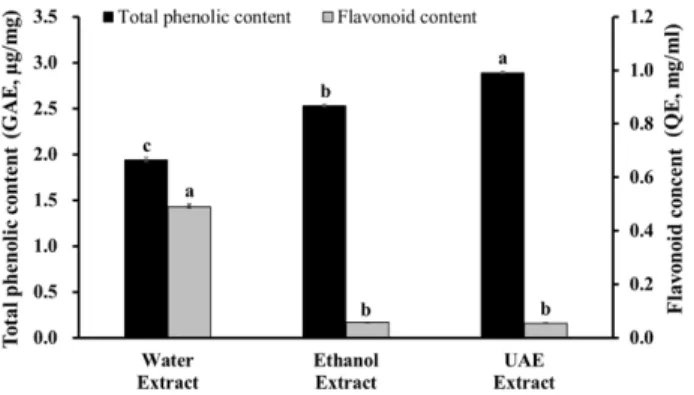
The total phenolic content (TPC) of water, ethanol, and ultrasonification-assisted (UA) extracts of maca roots are presented in Fig. 1. The TPC was determined as 1.94, 2.53, and 2.90 GAE µg/mg for water, ethanol, and UA extracts of maca roots, respectively. This result is in a good agreement with the report that the total polyphenolic contents from maca extracts ranged from 0.09 to 3.29 mg/ml depending on the extraction solvents [27].
There are considerable reports that ultrasonification treatment significantly can increase the extraction yields and polyphenolic compounds from natural plants [17, 18, 28]. As compared to water stirrer extraction, the
ultrasonification treatment for 3 h at 60℃ with 70%
ethanol resulted in a 104.03% increase in TPC of Crataegus pinnatifida Bunge fruit [28]. In this research, the UA extract of maca roots also resulted in a signifi- cant increase in the TPC (p < 0.05).
In general, the extracts containing higher TPCs also exhibited higher flavonoid contents [28]. However in this study, the ethanol and UA extracts containing higher TPCs exhibited lower flavonoid content than the water extract. Flavonoids are part of polyphenols and include anthocyanindins, flavanols, flavones, flavonols, flavo- nones and isoflavonones. The discrepancy between the TPCs and flavonoid contents in maca roots may be attributed to the different individual phenolics and fla- vonoid compounds present in maca root. The ultrasonifi- cation treatment did not affect the flavonoid content in maca extract, thereby exhibiting no statistical difference in flavonoid contents between the ethanol extract and UA extract.
DPPH radical scavenging activity
DPPH radical scavenging activity is a common indica- tor to evaluate the antioxidant activity of natural extracts. The antioxidant activity of primary antioxi- dants can be assessed by evaluating the hydrogen donat- ing ability to free radicals, resulting in conversion of harmful free radicals to non-toxic species during propa- gation steps of lipid oxidation [15]. The DPPH radical scavenging activities of water, ethanol, and UA extracts were 38.8%, 40.6% and 41.8%, respectively. Park et al.
Fig. 1. Total phenolic content and flavonoid content of maca extracts. GAE and QE indicate gallic acid equivalent and quercetin equivalent, respectively. UA indicates ultrasonification- assisted. Error bars represent standard deviation (n = 3). Different letters (a, b) represent significant differences among the samples at p < 0.05.
[29] also reported that the DPPH radical scavenging activity of 70% ethanol extracts obtained from maca root was determined as approximately 43%. In their report, the free radical scavenging activities of maca root exhib- ited higher activity than maca leaves, and the activity was significantly dose dependent. Sandoval et al. [30]
reported that the DPPH radical scavenging activity of maca roots were ranged from 21.64% to 71.38% depend- ing on the concentration of maca extracts (0.03 to 0.3 mg/ml).
The DPPH radical scavenging activity in this study did not exhibit any statistical difference among the extracts. The statistical indifference of DPPH radical scavenging activity among the treatments in this study may be attributed to the TPCs among the treatments.
There are some reports regarding the compounds responsible for antioxidant activity of maca extract [31, 32]. Gan et al. [31] reported that phenols and alka- loids were the most important substances for antioxi- dant activity of maca, of which the antioxidant effect of alkaloids seemed to be higher than that of phenols. In addition, Caicai et al. [32] studied two fractions of poly- saccharides (MLP-1 and MLP-2) and demonstrated their antioxidant capability.
FRAP
The FRAP method is a method using the principle of reducing Fe3+ to Fe2+ by phenolic compounds as antioxi- dants. Therefore, FRAP provides a direct estimate of antioxidant activities or reductants present in the extracts, and also the ability of the analytes to reduce
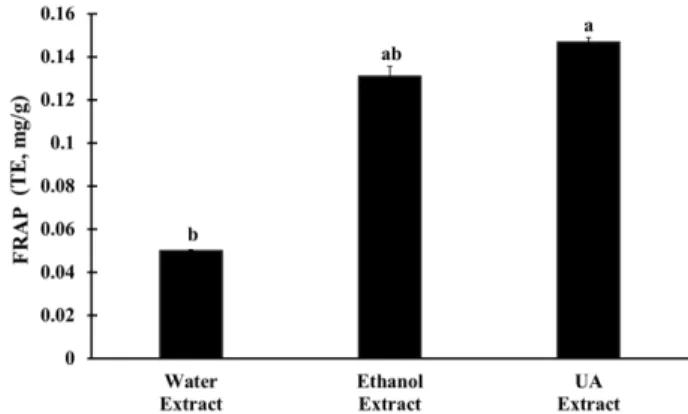
the Fe3+/Fe2+ pair. The ethanol and UA extracts of maca root exhibited significantly higher FRAP activities than the water extract (p < 0.05) (Fig. 3). This result exhibited almost similar trend with the total phenolic contents of maca extracts. Gan et al. [31] also reported that the TPCs exhibited significant linear correlations to FRAP in maca extracts. There was no statistical difference in FRAP between the ethanol and UA extracts.
Overall, the antioxidant activity of maca extracts determined in this study was comparable with other lit- eratures. The degree of antioxidant activity of maca extracts was mainly dependent on the extraction sol- vents, and the ultrasonification treatment did not affect the antioxidant activity of maca roots significantly.
Macamide B content
Macamides are believed to be found only in maca and considered as the bioactive marker compounds in maca [8]. Among the identified macamides, N-benzyl- 9Z,12Z,15Z-octadecatrienamide, N-benzyl-9Z,12Z-octa- decadienamide, and N-benzyl-hexadecanamide (maca- mide B) were the major macamide compounds [6].
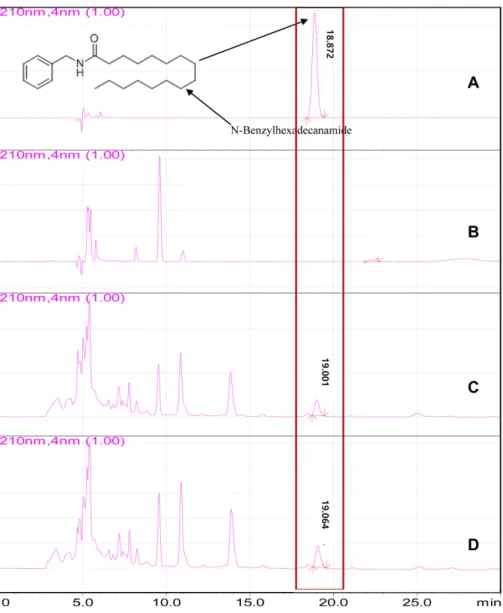
Therefore, macamide B was selected as a biomarker in this study. Fig. 4. presents the HPLC chromatograms of macamide B standard and macamide B present in water, ethanol, and UA extracts of maca root. The reten- tion time of macamide B of standard was determined as 18.872 min.
The calculated macamide B contents of water, ethanol, and UA maca root extracts are presented in Table 1.
Macamide B was not detected in water extract, presum- Fig. 2. DPPH radical scavenging activity of maca extracts.
UA indicates ultrasonification-assisted. Error bars represent standard deviation (n = 3). The superscript letter (a) represents significant differences among the samples at p < 0.05.
Fig. 3. Ferric reducing antioxidant power of maca extracts.
UA indicates ultrasonification-assisted. Error bars represent standard deviation (n = 3). Different letters (a, b) represent sig- nificant differences among the samples at p < 0.05.
able due to insolubility of macamide B in water. Maca- mide B has a long chain fatty acid and N-benzylamide,
resulting in sparingly solubility in polar solvent such as water. The macamide B contents of ethanol and UA maca root extracts were determined as 0.087 and 0.083 µg/mg, respectively. This result is in a good agreement with the report that the macamide B contents in maca were determined from 0.095 to 0.194 mg/g [12]. There was no significant difference in macamide B contents between the ethanol and UA maca root extracts.
Cytotoxicity test
In the cytotoxicity test with the skeletal muscle cell, all of the maca extracts exhibited a dose-dependent pat- tern as the concentration increased from 0.01 to 5 mg/ml Fig. 4. HPLC chromatograms of (A) N-benzylhexadecanamide (macamide B) standard, (B) macamide B present in water extract, (C) ethanol extract, and (D) ultrasonification-assisted extract (D).
Table 1. Macamide B contents of maca extracts analyzed by HPLC.
Maca extract
Retention time (min)
Area
Macamide B content (μg/mg)
Water extract - - -
Ethanol extract 19.001 179142 0.087 ± 0.142 Ultrasonification-
assisted extract 19.064 171387 0.083 ± 0.017 -, indicates “not detected”.
(Fig. 5). The maca extracts maintained greater than 80%
cell viability up to the concentration of 1 mg/ml. How- ever cell viability at the concentration of 5 mg/ml was significantly decreased, indicating that the maca extract at concentrations up to 1 mg/ml would not affect the cell viability. There was no significant difference in cell via- bility among the water, ethanol, and UA maca root extracts. Therefore, the concentration of 1 mg/ml was determined to be used for further test toward the muscle cell.
Cytoprotective effects of maca extract
Oxidative stress is caused by increment of cellular reactive oxygen species (ROS) level. H2O2 treatment in cell line can increase ROS level, thereby inducing oxida- tive damage and cell death [33−35]. To investigate the cytoprotective effects of the maca extracts, H2O2 was treated with C2C12 myoblasts to induce oxidative stress.
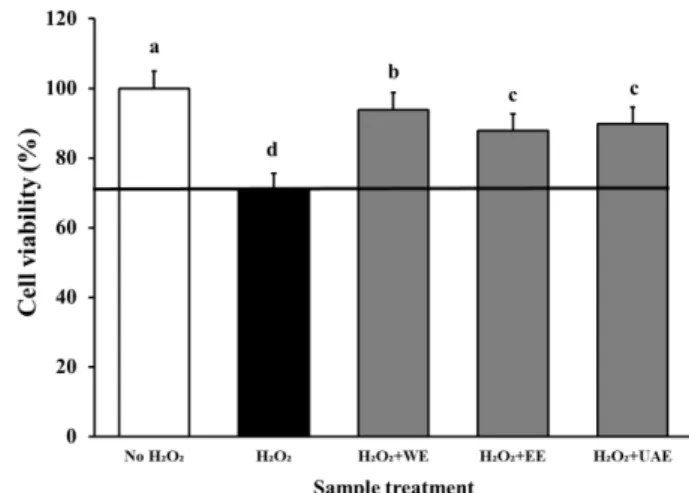
As estimated by the MTT assay, the H2O2-treated control group induced approximately 30% of cytotoxicity as compared with the normal control group (no H2O2 treatment) (Fig. 6). However, the treatment of the cell with the maca extracts induced less reduction of cell viability than the H2O2-treated control group. The results indicated that the water and UA maca root extracts exhibited higher cytoprotective effects in oxida- tive stress condition than the ethanol extract. Rodríguez- Huamán [13] reported that 10 µg of maca methanol extract increased the cell viability of PC12 cell by 31% at
6 h-pretreatment of the extract. Their result indicated that the methanol extraction of maca confirmed the anti- oxidant capacity of maca.
Effects of maca extracts on creatine kinase activity Creatine kinase (CK) converts creatine into phospho- creatine and ADP to maintain energy homeostasis during muscle contraction [36]. The level of CK was evaluated after H2O2 and sample treatment. The H2O2- Fig. 5. Cell viability of maca extracts. UA indicates ultrasonifica-
tion-assisted. Error bars represent standard deviation (n = 3).
Different letters (a, b) represent significant differences among the samples at p < 0.05.
Fig. 6. Cell viability of maca extracts in the presence of hydrogen peroxide. WE, EE and UAE indicate water extract, ethanol extract, and ultrasonification-assisted extract, respec- tively. Error bars represent standard deviation (n = 3). Different letters (a, b, c, d) represent significant differences among the samples at p < 0.05.
Fig. 7. Creatine kinase activity of maca extracts in the pres- ence of hydrogen peroxide. WE, EE and UAE indicate water extract, ethanol extract, ultrasonification-assisted extract, respectively. Error bars represent standard deviation (n = 3).
Different letters (a, b, c, d) represent significant differences among the samples at p < 0.05.
treated control group exhibited significantly higher CK level than the normal control group (Fig. 7). The treat- ments with the water extract and UA extracts resulted in significantly lower CK level than the H2O2-treated control group, which indicated the cell protective effects under the oxidative stress conditions.
Increased CK level indicates the cell damage and symptoms of fatigue which is activated and released in muscle through Phosphocreatine (PCr) system under the oxidative stress conditions [37]. In the previous stud- ies, blood CK levels were significantly inhibited by vari- ous sample treatments in exercise-induced fatigue [38− 41]. Furthermore, several in vivo studies demonstrated the anti-fatigue effects of maca treatment in mice [42− 44]. Therefore, the results in this study suggest that maca treatment can play significant roles in muscle pro- tection and anti-fatigue under oxidative stress condition in cellular levels.
Acknowledgments
This research was financially supported by the Ministry of Small and Medium-sized Enterprises (SMEs) and Startups (MSS), Korea, under the
“Regional Specialized Industry Development Program (R&D, P0006422)” supervised by the Korea Institute for Advancement of Technology (KIAT).
Conflict of interest
The authors have no financial conflicts of interest to declare.
References
1. Chen L, Li J, Fan L. 2017. The nutritional composition of maca in hypocotyls (Lepidium meyenii Walp.) cultivated in different regions of China. J. Food Qual. 2017: 1-8.
2. Zhou Y, Li P, Brantner A, Wang H, Shu X, Yang J, et al. 2017. Chemical profiling analysis of Maca using UHPLC-ESI-Orbitrap MS coupled with UHPLC-ESI-QqQ MS and the neuroprotective study on its active ingredients. Sci. Rep. 7: 44660.
3. Tang W, Jin L, Xie L, Huang J, Wang N, Chu B, et al. 2017. Structural characterization and antifatigue effect in vivo of maca (Lepidium meyenii Walp) polysaccharide. J. Food Sci. 82: 757-764.
4. McCollom MM, Villinski JR, McPhail KL, Craker LE, Gafner S. 2005.
Analysis of macamides in samples of Maca (Lepidium meyenii) by HPLC-UV-MS/MS. Phytochem. Anal. 16: 463-469.
5. Zhang L, Li G, Wang S, Yao W, Zhu F. 2017. Physicochemical prop- erties of maca starch. Food Chem. 218: 56-63.
6. Chen J-J, Zhao Q-S, Liu Y-I, Gong P-F, Cao L-L, Wang X-D, et al.
2017. Macamides present in the commercial maca (Lepidium meyenii) products and the macamide biosynthesis affected by postharvest conditions. Int. J. Food Prop. 20: 3112-3123.
7. Chain FE, Grau A, Martins J, Catalán CAN. 2014. Macamides from wild Maca, Lepidium meyenii Walpers (Brassicaceae). Phytochem.
Lett. 8: 145-148.
8. Xia C, Deng J, Chen J, Zhu Y, Song Y, Zhang Y, et al. 2019. Simulta- neous determination of macaenes and macamides in maca using an HPLC method and analysis using a chemometric method (HCA) to distinguish maca origin. Rev. Bras. Farmacogn.
6: 702-709.
9. Chen S-X, Li K-K, Pubu D, Jiang S-P, Chen B, Chen L-R, et al. 2017.
Optimization of ultrasound-assisted extraction, HPLC and UHPLC-Q-TOF-MS/MS analysis of main macamides and macaenes from maca (Cultivars of Lepidium meyenii Walp). Molecules 22: 2196.
10. Berlowski A, Zawada K, Wawer I, Paradowska K. 2013. Antioxi- dant properties of medicinal plants from Peru. Food Nutr. Sci. 4:
71-77.
11. Li J, Chen L, Li J, Duan Z, Zhu S, Fan L. 2017. The composition analysis of Maca (Lepidium meyenii Walp.) from xinjiang and its antifatigue activity. J. Food Qual. 2017: 2904951.
12. Wang S, Zhu F. 2019. Chemical composition and health effects of maca (Lepidium meyenii). Food Chem. 288: 422-443.
13. Rodríguez-Huamán Ă, Casimiro-Gonzales S, Chávez-Pérez JA, Gonzales-Arimborgo C, Cisneros-Fernández R, Aguilar-Mendoza LĂ, et al. 2016. Antioxidant and neuroprotector effect of Lepidium meyenii (maca) methanol leaf extract against 6-hydroxy dopa- mine (6-OHDA)-induced toxicity in PC12 cells. Toxicol. Mech.
Methods 27: 279-285.
14. Choi EH, Kang JI, Cho JY, Lee SH, Kim TS, Yeo IH, et al. 2012. Sup- plementation of standardized lipid-soluble extract from maca (Lepidium meyenii) increases swimming endurance capacity in rats. J. Funct. Foods 4: 568-573.
15. Li S, Hao L, Kang Q, Cui Y, Jiang H, Liu X. 2017. Purification, charac- terization and biological activities of a polysaccharide from Lepidium meyenii leaves. Int. J. Biol. Macromol. 103: 1302-1310.
16. Tang W, Jin L, Xie L, Huang J, Wang N, Chu B, et al. 2017. Structural characterization and antifatigue effect in vivo of maca (Lepidium meyenii Walp) polysaccharide. J. Food Sci. 82: 757-764.
17. Zhang Y, Liu C, Qi Y, Li S, Pan Y, Li Y. 2015. Circulating ultrasound- assisted extraction, countercurrent chromatography, and liquid chromatography for the simultaneous extraction, isolation, and analysis of the constituents of Uncaria tomentosa. J. Chromatogr.
A. 1388: 36-42.
18. Chavan Y, Singhal RS. 2013. Ultrasound-assisted extraction (UAE) of bioactives from arecanut (Areca catechu L.) and optimization study using response surface methodology. Innov. Food Sci.
Emerg. 17: 106-113.
19. Lo KM, Cheung PCK. 2005. Antioxidant activity of extracts from the fruiting bodies of Agrocybe aegerita var. alba. Food Chem. 89:
533-539.
20. Hwang ES, Thi ND. 2014. Antioxidant contents and antioxidant activities of hot-water extracts of aronia (Aronia melancocarpa)
with different drying methods. Korean J. Food Sci. Technol. 46:
303-308.
21. Brand-Williams W, Cuvelier ME, Berset C. 1995. Use of a free radi- cal method to evaluate antioxidant activity. Food Sci. Technol. 28:
25-30.
22. Wang KJ, Zhang YJ, Yang CR. 2005. Antioxidant phenolic com- pounds from rhizomes of Polygonum paleaceum. J. Ethnophar- macol. 96: 483-487.
23. Lee YK, Chang YH. 2019. Physicochemical and antioxidant prop- erties of methanol extract from Maca (Lepidium meyenii Walp.) leaves and roots. Food Sci. Technol. 39: 278-286.
24. Iris F, Benzie F, Strain JJ. 1996. The ferric reducing ability of plasma (FRAP) as a measure of “antioxidant power”: the FRAP assay. Anal. Biochem. 239: 70-76.
25. Lee MH, Jang MH, Kim EK, Han SW, Cho SY, Kim CJ. 2005. Nitric oxide induces apoptosis in mouse C2C12 myoblast cells. J.
Pharmacol. Sci. 97: 369-376.
26. Bosutti A, Degens H. 2015. The impact of resveratrol and hydro- gen peroxide on muscle cell plasticity shows a dose-dependent interaction. Sci. Rep. 5: 8093.
27. Kwon Y-S, Jeon In-S, Hwang J-H, Lim D-M, Kang Y-S, Chung H-J.
2009. Biological activities of maca (Lepidium meyenii) extracts. J.
Korean Soc. Food Sci. Nutr. 38: 817-823.
28. Park S-J, Kwon S-P, Rha Y-A. 2017. Enhanacement of antioxidant activities of Crataegus pinnatifida bunge fruit by ultrasonification extraction processes. J. Korean Soc. Food Sci. Nutr. 46: 891-895.
29. Park S-J, Kim O-L, Rha Y-A. 2017. Component analysis and antiox- idant activity of Maca. Culi. Sci. Hos. Res. 23: 137-144.
30. Sandoval M, Okuhama NN, Angeles FM, Melchor VV, Condezo LA, Lao J, et al. 2002. Antioxidant activity of the cruciferous vegetable Maca (Lepidium meyenii). Food Chem. 79: 207-213.
31. Gan J, Feng Y, He Z, Li X, Zhang H. 2017. Correlations between antioxidant activity and alkaloids and phenols of maca (Lepidium meyenii). J. Food Qual. 2017: 3185945.
32. Caicai K, Limin H, Liming Z, Zhiqiang Z, Yongwu Y. 2018. Isolation, purification and antioxidant activity of polysaccharides from the leaves of maca (Lepidium meyenii). Int. J. Biol. Macromol. 107:
2611-2619.
33. Droge W. 2002. Free radicals in the physiological control of cell function. Physiol. Rev. 82: 47-95.
34. Bergamini CM, Gambetti S, Dondi A, Cervellati C. 2004. Oxygen, reactive oxygen species and tissue damage. Curr. Pharm. Des. 10:
1611-1626.
35. Siu PM, Wang Y, Alway SE. 2009. Apoptotic signaling induced by H2O2-mediated oxidative stress in differentiated C2C12 myo- tubes. Life Sci. 84: 468-481.
36. Perry CG, Heigenhauser GJ, Bonen A, Spriet LL. 2008. High-intensity aerobic interval training increases fat and carbohydrate meta- bolic capacities in human skeletal muscle. Appl. Physiol. Nutr.
Metab. 33: 1112-1123.
37. Ydfors M, Hughes MC, Laham R, Schlattner U, Norrbom J, Perry CG. 2016. Modelling in vivo creatine/phosphocreatine in vitro reveals divergent adaptations in human muscle mitochondrial respiratory control by ADP after acute and chronic exercise. J.
Physiol. 594: 3127-3140.
38. An H, Seo S, Sim K, Kim J, Kim E, Lee M, et al. 2006. Antifatigue effect of chlorella vulgaris in mice. Korean J. Food Nutr. 19: 169- 175.
39. Wang J, Li S, Fan Y, Chen Y, Liu D, Cheng H, et al. 2010. Anti- fatigue activity of the water-soluble polysaccharides isolated from Panax ginseng CA Meyer. J. Ethnopharmacol. 130: 421-423.
40. Xu C, Lv J, Lo YM, Cui SW, Hu X, Fan M. 2013. Effects of oat β- glucan on endurance exercise and its anti-fatigue properties in trained rats. Carbohydr. Polym. 92: 1159-1165.
41. Huang Y, Wang Y, Li W, Zhan J, Lei J, Li N, et al. 2019. Evaluation of anti-fatigue property of Porphyridium cruentum in mice. Trop. J.
Pharm. Res. 18: 579-584.
42. Yang Q, Jin W, Lv X, Dai P, Ao Y, Wu M, et al. 2016. Effects of maca- mides on endurance capacity and anti-fatigue property in pro- longed swimming mice. Pharm. Biol. 54: 827-834.
43. Li J, Sun Q, Meng Q, Wang L, Xiong W, Zhang L. 2017. Anti-fatigue activity of polysaccharide fractions from Lepidium meyenii Walp (maca). Int. J. Biol. Macromol. 95: 1305-1311.
44. Tang W, Jin L, Xie L, Huang J, Wang N, Chu B, et al. 2017. Structural characterization and antifatigue effect in vivo of maca (Lepidium meyenii Walp) polysaccharide. J. Food Sci. 82: 757-764.