Common Causes of Postmenopausal Bleeding in Korean Women: 10-Year Outcomes from a Single Medical Center
The common causes of postmenopausal bleeding (PMB), according to the data from the western world, are atrophy, hormone replacement therapy (HRT), endometrial cancer, etc.
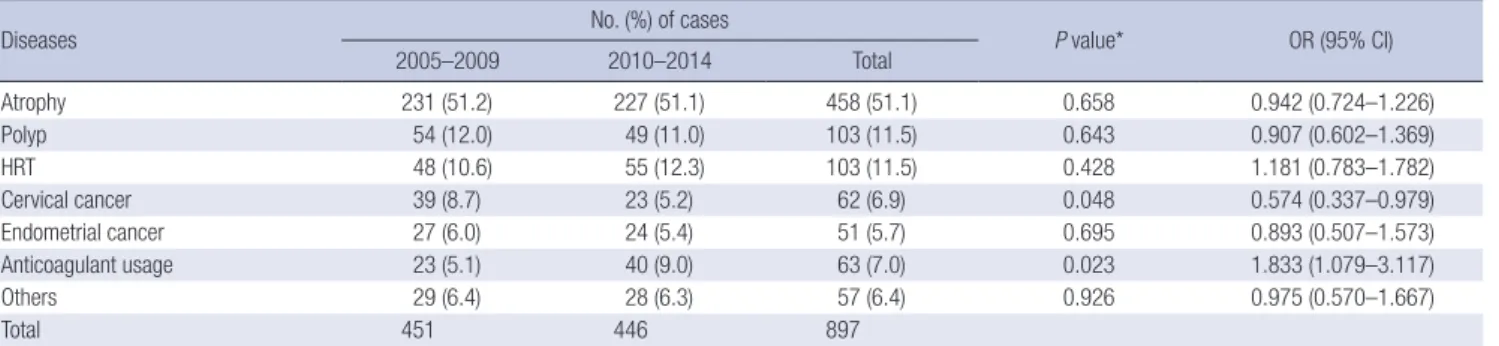
We conducted a retrospective study to assess whether the causes of PMB in Korean postmenopausal women are similar to those already known. This retrospective study used 10-year medical records (March 2005 to December 2014) of 792 PMB women in the Yonsei University Health System. The data were divided into 2 categories by 5-year intervals to compare the differences between the 2 periods. The most common cause of PMB in Korean women was atrophy (51.1%). Polyps and HRT were the second, followed by anticoagulant medications, cervical cancer, and endometrial cancer. The proportion of patients with cervical cancer significantly decreased during the second half of the decade (8.7% vs. 5.2%; P = 0.048). Although no significant change was noted for HRT, its rank was higher during the latter 5-year period. Only the most common cause of PMB was the same as the conventional data. Interestingly, the proportion of patients with cervical cancer decreased during the latter half of the decade, reflecting the changes in the nation’s cancer prevalence rate, while the use of HRT increased.
Keywords: Postmenopausal Bleeding; Common Cause of Postmenopausal Bleeding;
Korean Postmenopausal Women; Hormone Replacement Therapy Min Kyoung Kim,1,2 Yeon Soo Jung,3
Seung Joo Chon,4 Bo Hyon Yun,1,2 SiHyun Cho,2,5 Young Sik Choi,1,2 Byung Seok Lee,1,2 and Seok Kyo Seo1,2
1Department of Obstetrics and Gynecology, Severance Hospital, Yonsei University College of Medicine, Seoul, Korea; 2Institute of Women’s Life Medical Science, Yonsei University College of Medicine, Seoul, Korea; 3Department of Obstetrics and Gynecology, Wonju Severance Christian Hospital, Yonsei University Wonju College of Medicine, Wonju, Korea; 4Department of Obstetrics and Gynecology, Gil Hospital, Gachon University College of Medicine, Incheon, Korea; 5Department of Obstetrics and Gynecology, Gangnam Severance Hospital, Yonsei University College of Medicine, Seoul, Korea
Received: 12 October 2016 Accepted: 30 January 2017 Address for Correspondence:
Seok Kyo Seo, MD, PhD
Department of Obstetrics and Gynecology, Severance Hospital, Institute of Women’s Life Medical Science, Yonsei University College of Medicine, 50 Yonsei-ro, Seodaemun-gu, Seoul 03722, Korea
E-mail: [email protected]
https://doi.org/10.3346/jkms.2017.32.5.830 • J Korean Med Sci 2017; 32: 830-834
INTRODUCTION
Postmenopausal bleeding (PMB) is a common medical prob- lem with a prevalence rate as high as 10% in the general popu- lation (1,2). It is important to evaluate the cause of PMB because of its association with gynecologic malignancies (2-6). Early di- agnosis may help improve survival rates, hence several diagnos- tic tools such as transvaginal ultrasonography or hysteroscopy have been implemented for early and accurate detection of ma- lignancy (1,4,7-10). Recently, cancer prevalence rates have been changing due to better cancer screening modalities and health insurance coverage. Especially, cervical cancer incidence has been steadily decreasing, whereas that of endometrial cancer has been modestly increasing worldwide according to recent statistics (11-14). These changes in cancer incidence rates may also affect the number of patients per cause of PMB.
The common causes of PMB according to the data from the West are vaginal or endometrial atrophy, hormone replacement therapy (HRT), endometrial cancer, endometrial or cervical pol- yps, endometrial hyperplasia, and other miscellaneous diseas- es (15,16). However, data on causes of PMB in Asia are lacking.
Therefore, we conducted a retrospective study to assess wheth- er the causes of PMB in Korean postmenopausal women are similar to that already known.
MATERIALS AND METHODS
Women who were at least 45 years old and stopped menstruat- ing for more than 12 months were defined as postmenopausal.
Hospital database searching was done using the keyword “post- menopausal bleeding” or “vaginal bleeding” in the diagnosis.
Total of 1,769 women were selected initially, and after exclud- ing those with the exclusion criteria as mentioned below, a total of 792 postmenopausal patients who attended Yonsei Universi- ty Health System, Seoul, Korea with vaginal bleeding as the chief complaint were enrolled in this study. Retrospective evaluation of the 10-year medical records (March 2005 to December 2014) of the study population was conducted. The data were arranged into the following categories: history, diagnosis, method used for confirmation of diagnosis, sonographic data, and previously prescribed medication. Since a single patient may have several diagnoses, total number of cases exceeded the number of pa- Obstetrics & Gynecology
tients. Therefore, total of 897 diagnoses were counted. All data were entered into an Excel database (Microsoft, Seattle, WA, USA) for analysis.
The exclusion criteria were as follows: unidentified patholo- gy, no specific diagnosis, and trauma (i.e. previous large loop excision of the transformation zone [LLETZ] status, biopsy sta- tus, etc.). Patients with other medical conditions such as Behçet’s disease or pancytopenia were also excluded. The most common- ly known etiology for PMB, vaginal or endometrial atrophy, was defined by sonographic data as an endometrial thickness of less than 5 mm, and by the histopathological results from biopsy or Pap smear.
The study population was divided into 2 groups: patients who visited our hospital during the first 5 years (2005–2009) and those who came during the latter 5 years (2010–2014). The 2 groups’
PMB causes were statistically compared using Pearson’s χ2 test.
Statistical analysis was conducted with SPSS software ver.20 (IBM, Armonk, NY, USA). Statistical significance was set at P < 0.05.
Ethics statement
This study was conducted according to the tenants of the Dec- laration of Helsinki and was approved by the Institutional Re- view Board at Yonsei University Health System, Severance Hos- pital (4-2015-1005). Written informed consent was waived due to the study’s retrospective nature and because the study data did not include any personal identifying information.
RESULTS
The most common cause of PMB in Korean women was vagi- nal or endometrial atrophy (51.1%). Endometrial and cervical polyps were the second common cause (11.5%). HRT was also on the second rank (11.5%), followed by anticoagulant medica- tions (7.0%), cervical cancer (6.9%), endometrial cancer (5.7%), and other miscellaneous causes (Table 1). Although there were many tibolone users in the HRT group, the most common HRT medication that induced PMB was the combined estrogen and progesterone derivatives (EPT). For the anticoagulant medica-
tion group, aspirin was the most common medication followed by coumadin.
Out of the 792 patients included in the study population, 402 patients were allocated to the first 5-year group and 390 patients to the latter group. The mean age was slightly older in the latter 5-year group (62.1 ± 9.16 vs. 61.9 ± 9.26 years). The 3 most com- mon causes were similar between the first and second halves of the decade. However, the percentage of cervical cancer decreased significantly during the second half of the decade (5.2% vs. 8.7%;
P = 0.048). In addition, the percentage of endometrial cancer also decreased in the latter group but without significance (5.4%
vs. 6.0%). Although no significant change in percentage was not- ed for HRT, its rank was higher during the latter half of the de- cade (2nd vs. 3rd). Most of the HRT included continuous pro- gesterone treatment. The cyclic progesterone treatment was used by only 6 patients (12.5% of HRT users) during the first half de- cade, and only 5 patients (9.1% of HRT users) in the latter half.
Furthermore, there were more anticoagulant users in the latter group (9.0% vs. 5.1%; P = 0.023).
DISCUSSION
This study evaluated the common causes of PMB among Kore- an postmenopausal women and apparently, has shown differ- ent results compared to the previously known causes from Cau- casians and other ethnicities. The leading cause of PMB was vaginal or endometrial atrophy, but all the other causes were differently ranked. Endometrial and cervical polyps were more prevalent and endometrial cancer was relatively rare. Although requiring further studies, a report from Hong Kong (3) showed that the prevalence of endometrial cancer among women with PMB in Hong Kong was 3.8%, which is much lower than the previously reported 10% in developed countries (17). This is one representative example which depicts the possibility that endometrial cancer prevalence rate may be quite different in the Asian population.
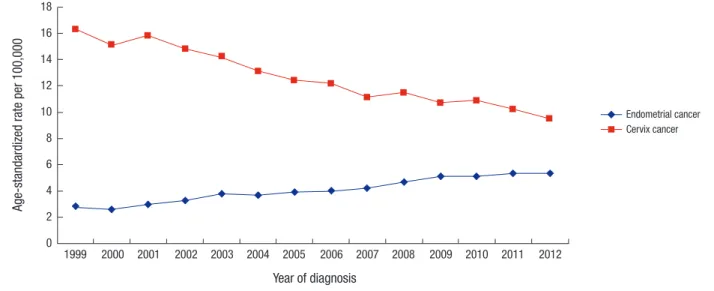
The incidence of endometrial cancer in Korea is increasing according to previous research (Fig. 1) (12,13). However, this
Table 1. Etiology of PMB during 2005–2009 and 2010–2014
Diseases No. (%) of cases
P value* OR (95% CI)
2005–2009 2010–2014 Total
Atrophy 231 (51.2) 227 (51.1) 458 (51.1) 0.658 0.942 (0.724–1.226)
Polyp 54 (12.0) 49 (11.0) 103 (11.5) 0.643 0.907 (0.602–1.369)
HRT 48 (10.6) 55 (12.3) 103 (11.5) 0.428 1.181 (0.783–1.782)
Cervical cancer 39 (8.7) 23 (5.2) 62 (6.9) 0.048 0.574 (0.337–0.979)
Endometrial cancer 27 (6.0) 24 (5.4) 51 (5.7) 0.695 0.893 (0.507–1.573)
Anticoagulant usage 23 (5.1) 40 (9.0) 63 (7.0) 0.023 1.833 (1.079–3.117)
Others 29 (6.4) 28 (6.3) 57 (6.4) 0.926 0.975 (0.570–1.667)
Total 451 446 897
PMB = postmenopausal bleeding, HRT = hormone replacement therapy, OR = odds ratio, CI = confidence interval.
*P value: Pearson χ2 test.
study demonstrated that the incidence of PMB caused by en- dometrial cancer did not show significant change. As indicated by cancer statistics in Korea (1993–2012) (12), although the in- cidence rate increased, the actual number is not substantially high. This may explain why there is some disparity between this study and the previous ones.
Among the endometrial cancer patients in the study popula- tion, the average endometrial thickness (ET) including the mass size measured by gynecologic sonography was 48 mm. Sixty-six percent of patients were shown to have an endometrial mass and 78.7% had ET more than 10 mm (Fig. 2). The percentages of patients with ET ≥ 5 mm and < 10 mm, and < 5 mm were 8.5% and 12.8%, respectively. Various reports debated the most sensitive cut-off value for ET to detect endometrial cancer by sonography. An optimal cut-off of 5 mm is being proposed (4,18) and our data clearly exceeds this limit. Hysteroscopy also aids the diagnosis, allowing visual confirmation and endometrial biopsy during the procedure, evidently increasing the screen-
ing sensitivity (7,8,10,18). For patients without PMB, the 5 mm cut-off could be recommended as described from previous stud- ies (4,18). However, since this study result reveals that certain number of patients with ET less than 5 mm were also found to have cancer, biopsy can be considered even in patients with ET
< 5 mm when PMB coexists. Further prospective studies will be needed to confirm this.
Another notable change that appeared from our results is the decreased incidence in cervical cancer over the years. Accord- ing to several studies (11,12,14,19), both incidence and mortali- ty rates of cervical cancer in Korea have been declining. In coun- tries where organized cytological screening has been implement- ed, such as the US and Korea, this trend has been kept steady (Fig. 1). Due to the national cervical cancer screening program and the nation’s improved socioeconomic status, early diagno- sis allowed early treatment, which helped decrease cervical can- cer mortality. Additionally, human papilloma virus (HPV) vac- cination was introduced into clinical practice in Korea in 2007, which will further help reducing cervical cancer incidence. De- spite the decreasing trend, Korean age-standardized cervical cancer incidence is still higher than the age-standardized inci- dence of the world population, which may explain why cervical cancer was ranked higher in the list of Korean PMB causes. Park et al. (11) explained this by the relatively higher proportion of the elderly in the Korean population compared to the demogra- phics of the world population.
Last, HRT usage was shown to have increasing trend in the latter 5-year group. Previous data (20,21) described decreased number of HRT users in the post-Women’s Health Initiative (WHI) era, however recently in Korea, the number seems to increase again with the rising number of tibolone users (Fig. 3). Accord- ing to the Long-Term Intervention on Fractures with Tibolone (LIFT) study (22), invasive breast cancer risk was decreased by Fig. 1. Age-standardized incidence curves of cervical and endometrial cancer, Korea Central Cancer Registry, National Cancer Center (12,13).
Age-standardized rate per 100,000
Year of diagnosis
1999 2000 2001 2002 2003 2004 2005 2006 2007 2008 2009 2010 2011 2012 18
16 14 12 10 8 6 4 2 0
Endometrial cancer Cervix cancer
Fig. 2. Sonographic characteristics of endometrial cancer patients’ endometrium.
Percentage of patients (%)
Mass (+)
EM ≥ 10 mm EM < 5 mm
5 mm ≤ EM < 10 mm 80
70 60 50 40 30 20 10 0
66
78.7
8.5 12.8
using tibolone. It was also shown to be as effective as EPT for postmenopausal symptoms but without causing as much PMB (20,21,23), therefore eventually the number of tibolone users continued to increase. From this study population, the latter 5-year period included more number of tibolone users than the first half of the decade (23.6% vs. 18.8%), which also reflects this phenomenon. However, as described elsewhere in literature (23), EPT is still the most common HRT-related cause of PMB and this study population also comprises more of EPT users than tibolone. This also may be the reason that the prevalence of PMB associated with HRT seems to be stationary although the number of women using HRT was previously decreased.
The limitation of this study is that the study population was recruited from a single tertiary medical center. Selection bias may be present in this study population since cancer patients are mostly converged to tertiary centers to get appropriate med- ical care. However, the percentage of gynecologic malignancy patients was not high enough to make significant difference in the high ranking causes of PMB. It would be reasonable to sim- ply refer to the decreasing prevalence trend over the years. An- other limitation is that the comparisons between initial and lat- ter ‘5-year’ groups may be too short of a duration to investigate the change of cancer prevalence. Further studies with longer follow-ups will be needed to make definite conclusions.
Meanwhile, the strength of this study is that it was the first to evaluate the causes of PMB in an Asian population. Given the different ethnic background, the genetic susceptibility to cer- tain diseases differs among populations. This study clearly re- vealed different etiologies of PMB in Korean women compared to the previous data. Further studies including other Asian na- tionalities will be needed to confirm our results.
In conclusion, only the most common cause of PMB was the same as in previous data, while other causes were all ranked differently in Korean postmenopausal women. Interestingly,
cervical cancer was noted as the fourth common cause of PMB, showing greater percentage than the previous western data. The percentage of cervical cancer decreased during the latter half of the decade, reflecting the changes in the nation’s cancer preva- lence rate. Additionally, the use of HRT increased.
DISCLOSURE
The authors have no potential conflicts of interest to disclose.
AUTHOR CONTRIBUTION
Conceptualization: Cho S, Lee BS, Seo SK. Data curation: Chon SJ, Yun BH. Formal analysis: Chon SJ, Seo SK. Investigation: Kim MK, Jung YS. Writing - original draft: Kim MK, Choi YS. Writing - review & editing: Lee BS, Seo SK.
ORCID
Min Kyoung Kim http://orcid.org/0000-0002-1753-2674 Yeon Soo Jung http://orcid.org/0000-0001-8371-3521 Seung Joo Chon http://orcid.org/0000-0003-3977-8568 Bo Hyon Yun http://orcid.org/0000-0001-5703-797X SiHyun Cho http://orcid.org/0000-0003-2718-6645 Young Sik Choi http://orcid.org/0000-0002-1157-4822 Byung Seok Lee http://orcid.org/0000-0002-4669-8892 Seok Kyo Seo http://orcid.org/0000-0003-3404-0484 REFERENCES
1. Breijer MC, Mol BW. Transvaginal ultrasound measurement of the endo- metrium remains the first line test for investigating postmenopausal bleed- ing but integration of patient characteristics into testing may further im- prove diagnostic algorithms. BJOG 2016; 123: 447.
2. Salman MC, Bozdag G, Dogan S, Yuce K. Role of postmenopausal bleed- ing pattern and women’s age in the prediction of endometrial cancer. Aust N Z J Obstet Gynaecol 2013; 53: 484-8.
3. Wong AS, Lao TT, Cheung CW, Yeung SW, Fan HL, Ng PS, Yuen PM, Sa- hota DS. Reappraisal of endometrial thickness for the detection of endo- metrial cancer in postmenopausal bleeding: a retrospective cohort study.
BJOG 2016; 123: 439-46.
4. Dueholm M, Marinovskij E, Hansen ES, Møller C, Ørtoft G. Diagnostic me- thods for fast-track identification of endometrial cancer in women with postmenopausal bleeding and endometrial thickness greater than 5 mm.
Menopause 2015; 22: 616-26.
5. Smith PP, O’Connor S, Gupta J, Clark TJ. Recurrent postmenopausal bleed- ing: a prospective cohort study. J Minim Invasive Gynecol 2014; 21: 799- 803.
6. Izetbegovic S, Stojkanovic G, Ribic N, Mehmedbasic E. Features of post- menopausal uterine haemorrhage. Med Arch 2013; 67: 431-4.
7. Loiacono RM, Trojano G, Del Gaudio N, Kardhashi A, Deliso MA, Falco G, Sforza R, Laera AF, Galise I, Trojano V. Hysteroscopy as a valid tool for Fig. 3. The percentage change of use of total hormone, ET/EPT, tibolone after publi-
cation of WHI results in 2002 (21).
ET = estrogen therapy, EPT = estrogen plus progesterone therapy, WHI = post-Wom- en’s Health Initiative.
% Change
Year
20 10 0 -10 -20 -30 -40 -50 -60
0
-5.2
2.2 8.2
-12.7 -23.9
-25.4 -6.0
2002 2003 2004 2005 2006 2007 2008 2009 Total ET/EPT Tibolone
-30.2 -36.6
-40.6 -44.3
-50.4 -50.9 -49.1 -44.0
-36.0 -38.6 -37.0 -35.6 -30.3
2.2
endometrial pathology in patients with postmenopausal bleeding or as- ymptomatic patients with a thickened endometrium: hysteroscopic and histological results. Gynecol Obstet Invest 2015; 79: 210-6.
8. Dueholm M, Hjorth IM, Secher P, Jørgensen A, Ørtoft G. Structured hys- teroscopic evaluation of endometrium in women with postmenopausal bleeding. J Minim Invasive Gynecol 2015; 22: 1215-24.
9. Breijer MC, van Hanegem N, Visser NC, Verheijen RH, Mol BW, Pijnen- borg JM, Opmeer BC, Timmermans A. Does probability guided hysteros- copy reduce costs in women investigated for postmenopausal bleeding?
ScientificWorldJournal 2015; 2015: 605312.
10. Cavkaytar S, Kokanali MK, Ceran U, Topcu HO, Sirvan L, Doganay M. Roles of sonography and hysteroscopy in the detection of premalignant and malignant polyps in women presenting with postmenopausal bleeding and thickened endometrium. Asian Pac J Cancer Prev 2014; 15: 5355-8.
11. Park Y, Vongdala C, Kim J, Ki M. Changing trends in the incidence (1999–
2011) and mortality (1983–2013) of cervical cancer in the Republic of Ko- rea. Epidemiol Health 2015; 37: e2015024.
12. Jung KW, Won YJ, Kong HJ, Oh CM, Cho H, Lee DH, Lee KH. Cancer sta- tistics in Korea: incidence, mortality, survival, and prevalence in 2012. Can- cer Res Treat 2015; 47: 127-41.
13. Lim MC, Moon EK, Shin A, Jung KW, Won YJ, Seo SS, Kang S, Kim JW, Kim JY, Park SY. Incidence of cervical, endometrial, and ovarian cancer in Ko- rea, 1999–2010. J Gynecol Oncol 2013; 24: 298-302.
14. Shin MH, Oh HK, Ahn YO. Ten year trend of cancer incidence in Seoul, Korea: 1993--2002. J Prev Med Public Health 2008; 41: 92-9.
15. Berek JS, Novak E. Berek & Novak’s Gynecology. 15th ed. Philadelphia, PA: Wolters Kluwer Health/Lippincott Williams & Wilkins, 2012.
16. Fritz MA, Speroff L. Clinical Gynecologic Endocrinology and Infertility.
8th ed. Philadelphia, PA: Wolters Kluwer Health/Lippincott Williams &
Wilkins, 2011.
17. Moodley M, Roberts C. Clinical pathway for the evaluation of postmeno- pausal bleeding with an emphasis on endometrial cancer detection. J Ob- stet Gynaecol 2004; 24: 736-41.
18. Dueholm M, Hjorth IM, Secher P, Jørgensen A, Ørtoft G. Reproducibility of endometrial pathologic findings obtained on hysteroscopy, transvagi- nal sonography, and gel infusion sonography in women with postmeno- pausal bleeding. J Minim Invasive Gynecol 2015; 22: 1036-44.
19. Oh CM, Jung KW, Won YJ, Shin A, Kong HJ, Jun JK, Park SY. Trends in the incidence of in situ and invasive cervical cancer by age group and histo- logical type in Korea from 1993 to 2009. PLoS One 2013; 8: e72012.
20. Kyvernitakis I, Kostev K, Hars O, Albert US, Hadji P. Discontinuation rates of menopausal hormone therapy among postmenopausal women in the post-WHI study era. Climacteric 2015; 18: 737-42.
21. Kim JY, Sang JH, Park HM. The change of hormone therapy in postmeno- pausal women in Korea before and after women’s health initiative study:
2000–2009. Korean J Obstet Gynecol 2010; 53: 1110-7.
22. Cummings SR, Ettinger B, Delmas PD, Kenemans P, Stathopoulos V, Ver- weij P, Mol-Arts M, Kloosterboer L, Mosca L, Christiansen C, et al. The ef- fects of tibolone in older postmenopausal women. N Engl J Med 2008;
359: 697-708.
23. Hammar ML, van de Weijer P, Franke HR, Pornel B, von Mauw EM, Nij- land EA; TOTAL Study Investigators Group. Tibolone and low-dose con- tinuous combined hormone treatment: vaginal bleeding pattern, efficacy and tolerability. BJOG 2007; 114: 1522-9.