Blood Culture Proven Early Onset Sepsis and Late Onset Sepsis in Very-Low-Birth-Weight Infants in Korea
Neonatal sepsis remains one of the most important causes of death and co-morbidity in very-low-birth-weight (VLBW) infants. The aim of this study was to determine the current incidences of early-onset sepsis (EOS) and late-onset sepsis (LOS), the distribution of pathogens, and the impact of infection on co-morbidities in VLBW infants. We analyzed the data including sepsis episode from 2,386 VLBW infants enrolled in Korean Neonatal Network from January 2013 to June 2014. We defined EOS as a positive blood culture occurring between birth and 7 days of life and LOS after 7 days of life. Sepsis was found in 21.1% of VLBW infants. The risk of sepsis was inversely related to birth weight and gestational age. EOS was found in only 3.6% of VLBW infants, however the mortality rate was as high as 34.1%. EOS was associated with the increased odds for bronchopulmonary dysplasia and intraventricular hemorrhage. The vast majority of EOS was caused by Gram- positive organisms, particularly coagulase-negative staphylococci (30.6%). LOS developed in 19.4% of VLBW infants with a 16.1% mortality rate. Pathogens in LOS were dominated by coagulase-negative staphylococci (38.3%). Twenty-five percent and fifty percent of first LOS episode occurred after 12 days and 20 days from birth, respectively. Younger and smaller VLBW infants showed the earlier occurrence day for the 25% of first LOS episode.
This study provides a recent nationwide epidemiology of sepsis in VLBW infants in Korea.
Based on this study, successful strategies to reduce infections would improve survival and reduce morbidity.
Keywords: Sepsis; Infant; Very-Low-Birth-Weight; Risk Factors; Korean Neonatal Network; South Korea
Soon Min Lee,1* Meayoung Chang,2* and Ki-Soo Kim3
1Department of Pediatrics, Yonsei University College of Medicine, Seoul; 2Department of Pediatrics, School of Medicine, Chungnam National University, Daejeon; 3Department of Pediatrics, University of Ulsan College of Medicine, Seoul, Korea
* Soon Min Lee and Meayoung Chang contributed equally to this work.
Received: 30 April 2015 Accepted: 25 September 2015 Address for Correspondence:
Ki-Soo Kim, MD
Division of Neonatology, Department of Pediatrics, University of Ulsan College of Medicine, 88 Olympic-ro 43-gil, Songpa-gu, Seoul 05505, Korea
Tel: +82.2-3010-3377, Fax: +82.2-3010-6978 E-mail: [email protected]
Funding: This research was supported by a fund (2013-E63008_
01) by Research of Korea Centers for Disease Control and Prevention.
http://dx.doi.org/10.3346/jkms.2015.30.S1.S67 • J Korean Med Sci 2015; 30: S67-74
INTRODUCTION
Neonatal care has advanced, improving the survival of very-low- birth-weight (VLBW) infants. However, such patients remain at a high risk for sepsis (1). Up to 20% of mortalities in VLBW in- fants are caused by sepsis, and infants with sepsis are at a near- ly-threefold risk of mortality than those without sepsis (2,3).
Moreover, neonatal sepsis is a major cause of morbidity and poor neurodevelopmental outcomes among VLBW infants (4).
Early-onset sepsis (EOS) typically caused by organisms trans- mitted vertically before or at the time of birth, is present in ap- proximately 2%-7% of infants. EOS has been associated with significantly increased odds for mortality, intraventricular hem- orrhage (IVH), retinopathy of prematurity (ROP), and broncho- pulmonary dysplasia (BPD) (5-7). Factors that were found to significantly increase the risk of EOS were low gestational age, low birth weight, low Apgar score, and maternal chorioamnio- nitis (7). Late-onset sepsis (LOS), occurring after 7 days of life, may be caused by pathogens acquired during delivery or dur- ing the course of hospital care (1). The risk factors of LOS include prematurity, a need for central venous access, and prolonged hospitalization (1). Patent ductus arteriosus (PDA), BPD, nec-
rotizing enterocolitis (NEC) were significantly associated with increased rate of LOS (2).
Pathogens causing neonatal infections and their antibiotic susceptibility patterns may change over time and differ among countries. It is therefore important to monitor the epidemiology of neonatal infections to make decisions on policy and clinical practice (8). However, until the Korean Neonatal Network (KNN) was established, Korea did not have a national longitudinal neo- natal infection surveillance system. Thus, only limited data on neonatal sepsis in Korea were reported (9,10).
This study was undertaken to determine the current incidenc- es of EOS and LOS, the distribution of infecting pathogens, and the impact of infection on co-morbidities in VLBW infants cared for in the KNN.
MATERIALS AND METHODS Study population
Data on EOS and LOS, infecting organisms, maternal and in- fant demographic data, and clinical data were analyzed using KNN registry. A total of 2,386 VLBW infants who were born from January 1, 2013 to June 31, 2014 in or transferred to one of the Pediatrics
55 KNN centers within 28 days of life were enrolled. Trained staff collected data on mothers and infants from birth to hospi- tal discharge or death. External audits were done periodically to review the quality and reliability of data extracted from patient records in the KNN.
Outcomes
EOS was identified by clinical symptoms and a positive blood culture drawn in the first 7 days of life, and LOS was defined as infection occurring thereafter. Proven sepsis was defined as a positive result for one or more bacterial or fungal cultures ob- tained from blood of the infants with clinical signs of infection or treated with appropriate antibiotics for 5 or more days or un- til death without sign of infection (11). Series of samples that were repeatedly positive for the same organism within 7 days were considered as part of the same episode. If a different or- ganism was noted in a subsequent culture, this was considered another episode. KNN registry included up to three episode of bacteria sepsis and up to two episodes of fungal sepsis.
Gestational age was determined by obstetric estimates. We defined antifungal prophylaxis as when the systemic antifungal agents for the prevention of fungal infections were administered shortly after birth. Congenital infection was confirmed via TO- RCH evaluation. Meningitis was defined as a positive spinal cul- ture for infants treated with more than 5 days of antibiotic med- ication. IVH was graded according to the method of Papile et al (12). NEC was classified according to the system of Bell et al. (13).
BPD was defined by NIH classification (14). The main cause of death was collected for all infants who died, according to the doctor’s documentation.
Statistical analysis
For analyzing the rates of sepsis/1,000 hospital days and inci- dences of sepsis, gestational age was categorized as 4 groups;
24 weeks’ gestation or less, 25-28 weeks’ gestation, 29-32 weeks’
gestation, and 33 weeks’ gestation, and birth weight was cate- gorized as 5 groups; less than 500 g, 500-749 g, 750-999 g, 1,000- 1,249 g and 1,250-1,499 g. Infection rates were expressed as the rates of sepsis, EOS and LOS per 1,000 hospital days and per- centage of all live births in each categories. Univariate analyses for continuous variables were performed using Student’s t-test.
Categorical variables, including the primary outcome, were ex-
amined using a chi-square analysis. Data are presented as mean and standard deviation, as the data were found to be normally distributed. Multivariate analyses were used to identify the in- dependent association of EOS or LOS with neonatal outcome variables. Multivariate analysis adjusted for the significant fac- tors through univariate analysis was done. Kaplan-Meier plot- ting was used to estimate the occurrence of the first LOS episo- de from lifetime data. Log-rank test was done for compare the probability among the categorized group divided by the birth weight (less than 500 g, 500-999 g, and 1,000-1,499 g) and gesta- tional age (24 weeks’ gestation or less, 25-28 weeks’ gestation, and 29 weeks’ gestation or more). Comparison of 1, 2, and 3 quar- tile estimated time for occurring first episode of LOS among the birth weight groups and gestational age groups using F-test was done. Calculations were performed with SPSS software version 21.0 (IBM Corp., Chicago, IL, USA) and SAS version 9.2 (SAS In- stitute, Cary, NC, USA). P values less than 0.05 were considered sta-tistically significant.
Ethics statement
The KNN study received ethical approval from the local institu- tional review board in each participating center prior to joining the network. Informed consent for participating in KNN was written by the parents.
RESULTS
Incidence of EOS and LOS and demographic characteristics Sepsis was found in 21.1% of 2,386 VLBW infants. The risk of sepsis was inversely related to birth weight and gestational age (Table 1). The rates of all sepsis episodes per 1,000 hospital days were also comparable for birth-weight and gestational-age cat- egories. The rate of sepsis decreased with increasing birth weight to 7.35 for infants 500 to 749 g, 4.66 for infants 750 to 999 g, 4.14 for those 1,000 to 1,249 g, and 2.58 for those 1,250 to 1,499 g. Sim- ilarly, the infection rate was inversely related to gestational age.
This rate of infection declined to 7.92 at ≤ 24 weeks, 5.63 at 25 to 28 weeks, 3.62 at 29 to 32 weeks, and only 1.65 for infants born at 33 weeks or more (Table 1). Among 2,386 VLBW infants en- rolled in KNN, 85 infants had positive blood cultures in the first 7 days; thus, the incidence of EOS was 36 per 1,000 live births (Table 2). Among the 2,281 VLBW infants who survived until 7
Table 1. Rates of sepsis/1,000 hospital days and incidence of sepsis versus birth weight and gestational age Birth weight (g) No. No. with sepsis Rate/1,000
hospital days Incidence (%) GA (week) No. No. with sepsis Rate/1,000
hospital days Incidence (%)
< 500 59 23 6.41 39.0 ≤ 24 116 46 7.92 39.7
500-749 328 133 7.35 40.6 25-28 797 264 5.63 33.1
750-999 542 150 4.66 27.7 29-32 1,103 175 3.62 15.9
1,000-1,249 631 121 4.14 19.2 ≥ 33 370 19 1.65 5.1
1,250-1,499 826 77 2.58 9.3 Total* 2,386 504 4.97 21.1
*Same in the birth weight group. GA, gestational age.
days of age, 442 infants showed positive blood cultures after 7 days of age, and 632 microorganisms were noted due to multi- ple sepsis episodes. The overall incidence of LOS was 194 per 1,000 live births (Table 3). Only 23 infants (1%) had both EOS and LOS. The majority of infants (72%) had a single episode of LOS; 21% had two episodes, 5% had three episodes, and 1%
had four or more episodes. The majority of episodes (60%) oc- curred in extremely low birth weight infants (96% were born at
≤ 32 weeks gestation). Infants with lower birth weights were more likely to have multiple episodes (< 500 g, 29%; 500-749 g, 39%; 750-999 g, 20%; 1,000-1,249 g, 9%; 1,250-1,499 g, 3%;
P < 0.001).
The first LOS episode based on lifetime data was estimated to occur at a median age of 20 days (range 7-198 days; 25th per-
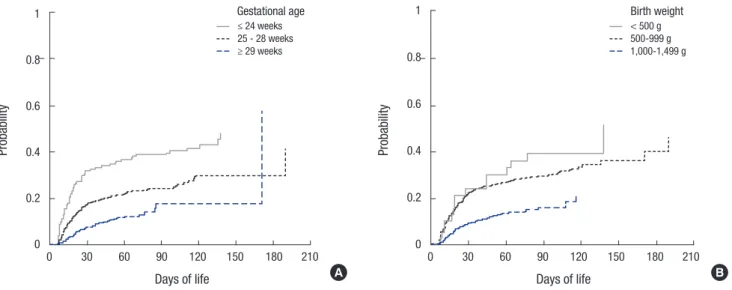
centile: 12 days; 75th percentile: 33 days; Fig. 1). Using a log-rank test, we calculated the expected number of LOS episodes as time progressed in each group by dividing by the gestational age and birth weight. When the VLBW infants were divided into three groups according to birth weight (< 500 g, 500-999 g, and ≥ 1,000 g), there were significant differences in the occurrence of the first LOS sepsis episode (P < 0.001). The infants were also divid- ed into three gestational age groups: ≤ 24 weeks, 25-28 weeks, and ≥ 29 weeks. Significant differences among the groups ver- sus gestational age were found (P < 0.001) (Fig. 2). Comparison of quartile estimated time among three groups according to the birth weight, showed no significance difference, using F-test.
Comparison of 25 percent of LOS episode estimated time among three groups according to the gestational age, showed signifi- cant difference (P = 0.012) (Table 4).
Distribution of pathogens causing EOS, LOS and direct mortality
The majority of EOS events were caused by Gram-positive or- ganisms (56.5%). Coagulase-negative staphylococcus (CONS) was the most common pathogen, accounting for 30.6% of all infections. Gram-negative pathogens accounted for 40.0% of infections, with most common E. coli occurring in 11.8% of pa- tients. Fungal pathogens were relatively rare compared to bac- teria (3.5%).
The majority (72.0%) of LOS episodes were caused by Gram- positive organisms. CONS was the most common late-onset pathogen (38.3%) of all infections, comprising 53.2% of Gram- positive infections. Gram-negative pathogens accounted for 15.3% of all microorganisms. Klebsiella and Enterobacter spe- cies were the most common Gram-negative pathogens. Fungal organisms were responsible for 12.0% of LOS episodes (Table 5).
Overall, 100 of the 504 infants with sepsis died (19.8%). The main cause of death was confirmed as infection for 13 of 85 VL- Table 2. Rates of EOS episodes/1,000 hospital days and incidence of sepsis versus birth weight and gestational age
Birth weight (g) No. No. with EOS Rate/1,000 HD Incidence (%) GA (week) No. No. with EOS Rate/1,000 HD Incidence (%)
< 500 59 5 1.00 8.5 ≤ 24 116 12 1.46 10.3
500-749 328 29 1.04 8.8 25-28 797 51 0.75 6.4
750-999 542 22 0.50 4.1 29-32 1,103 20 0.31 1.8
1,000-1,249 631 19 0.47 3.0 ≥ 33 370 2 0.14 0.5
1,250-1,499 826 10 0.26 1.2 Total* 2,386 85 0.70 3.6
*Same in the birth weight group. EOS, early-onset sepsis; GA, gestational age; HD, hospital days.
Table 3. Rates of LOS episodes/1,000 hospital days and incidence of sepsis versus birth weight and gestational age
Birth weight (g) No. No. with LOS Rate/1,000 HD Incidence (%) GA (week) No. No. with LOS Rate/1,000 HD Incidence (%)
< 500 48 19 3.83 39.6 ≤ 24 83 37 4.55 44.6
500-749 286 111 4.02 38.8 25-28 747 226 3.32 30.3
750-999 514 136 3.10 26.5 29-32 1,083 161 2.49 14.9
1,000-1,249 618 107 2.65 17.3 ≥ 33 368 18 1.24 4.9
1,250-1,499 815 69 1.80 8.5 Total* 2,281 442 3.05 19.4
*Same in the birth weight group. LOS, late-onset sepsis; GA, gestational age; HD, hospital days.
Fig 1.
Probability
Days of life
0 30 60 90 120 150 180 210
1
0.8
0.6
0.4
0.2
0
Fig. 1. Days to first episode of LOS in VLBW infants using Kaplan Meier curves. Quar- tile estimates according to the time variable duration showed as follows; 25 percen- tile of the first LOS episode occurred after the12 days from birth, 50% percentile af- ter 20 days from birth, and 75 percentile after 33 days from birth.
BW infants with EOS (15.3%). Death rates of EOS differed sig- nificantly by pathogen type; interestingly, 38.2% of Gram-nega-
tive organisms noted mortality, while all infants with Gram-pos- itive organisms and fungal infections remained alive. The over- Table 4. Comparison of 1, 2, and 3 quartile estimated time for occurring first episode of LOS among the birth weight groups and gestational age groups using F-test
Percentile Birth weight group
P value Gestational age group
P value
< 500 g 500-999 g 1,000-1,499 g ≤ 24 weeks 25-28 weeks ≥ 29 weeks
25 11 (8-19) 12 (10-12) 13 (11-15) 0.562 9 (8-12) 12 (10-13) 14 (13-17) 0.012
50 19 (11-45) 19 (16-22) 20 (18-22) 0.883 16 (12-20) 19 (17-22) 21 (20-24) 0.114
75 61 (19-138) 33 (28-41) 32 (27-37) 0.070 29 (21-54) 33 (29-41) 34 (28-39) 0.766
LOS, late-onset sepsis.
Table 5. Distribution of Pathogens and Direct Death Caused by EOS and LOS
Organisms† EOS LOS
n (%) Death*, n (%) n (%) Death*, n (%)
Gram positive organisms 48 (56.5) 0 (0) 455 (72.0) 11 (2.4)
Staphylococcus coagulase negative 26 (30.6) 242 (38.3) 3 (1.2)
Staphylococcus aureus coagulase positive 9 (10.6) 72(11.4) 4 (5.6)
Staphylococcus other 5 (5.9) 81 (12.8) 1 (1.2)
Streptococcus other 6 (7.1) 16 (2.5) 1 (6.3)
Streptococcus group B 1 (1.2) 5 (0.8) 0
Enterococcus species 1 (1.2) 39 (6.2) 2 (5.1)
Gram negative organisms 34 (40.0) 13 (38.2) 97 (15.3) 9 (9.3)
Escherichia coli 10 (11.8) 4 (40.0) 14 (2.2) 0
Klebsiella species 6 (7.1) 2 (33.3) 24 (3.8) 4 (16.7)
Pseudomonas species 6 (7.1) 2 (33.3) 6 (0.9) 1 (16.7)
Acinetobacter species 5 (5.9) 4 (80.0) 11 (1.7) 0
Enterobacter species 3 (3.5) 0 24 (3.8) 2 (8.3)
Burkholderia species 3 (3.5) 0 6 (0.9) 1 (16.7)
Serratia species 0 0 9 (1.4) 1 (11.1)
Clostridium species 1 (1.2) 1 (100) 0 0
Stenotrophomonas maltophilia 0 0 3 (0.5) 0
Other-bacterial 0 0 4 (0.6) 1 (25.0)
Fungus 3 (3.5) 0 (0) 76 (12.0) 5 (6.6)
Total 85 (100) 13 (15.3) 632 (100) 26 (4.1)
*Death was included only if the written cause of death was infection. Death counts differ from the overall mortality (Table 6). Death was shown as the number of mortality and percent for each individual pathogen. †Organisms counts differ from the infants with LOS due to the multiple episode of LOS. EOS, early onset sepsis; LOS, late-onset sepsis; n, number of organism.
Fig. 2. Kaplan Meier probability curve for first episode of LOS according to gestational age groups (A) and birth weight groups (B). The younger the gestational age, the higher the probability of first LOS episode. The smaller the birth weight, the higher the probability of first LOS episode (log-rank test for trend P < 0.001).
Probability
Days of life
0 30 60 90 120 150 180 210
1
0.8
0.6
0.4
0.2
0
≤ 24 weeks 25 - 28 weeks
≥ 29 weeks
A
Probability
Days of life
0 30 60 90 120 150 180 210
1
0.8
0.6
0.4
0.2
0
< 500 g 500-999 g 1,000-1,499 g
B
Gestational age Birth weight
all mortality rate for infants with EOS, regardless of cause of death, was 34.1% compared to 11.1% for infants with negative cultures (P < 0.001; Table 7).
Overall, 16.0% of the infants with LOS died. The mortality rate of LOS for each pathogen indicated that infection was the most common cause of death, including infection due to Gram- negative organisms (9.3%), followed by Candida (6.6%), and Gram-positive organisms (2.4%). The mortality rate of CONS sepsis was only 1.2% (Table 5).
Twelve percent of infants died on the same day as when the blood culture was taken; 35% died within 3 days, and 40% died within 7 days. Infants infected with Gram-negative organisms were more likely to die acutely within 3 days of the positive blood culture (58%).
Patient characteristics and co-morbidities associated with EOS and LOS
The mean gestation, mean birth weight, and mean Apgar score were significantly lower in the EOS group than in the control group. Vaginal delivery and initial resuscitation were more com- mon in the EOS group than in the control group (Table 6). Mul- tivariate analyses for the major morbidities and mortality with EOS were adjusted for the gestation and initial resuscitation.
After adjusted the gestation and initial resuscitation, VLBW with
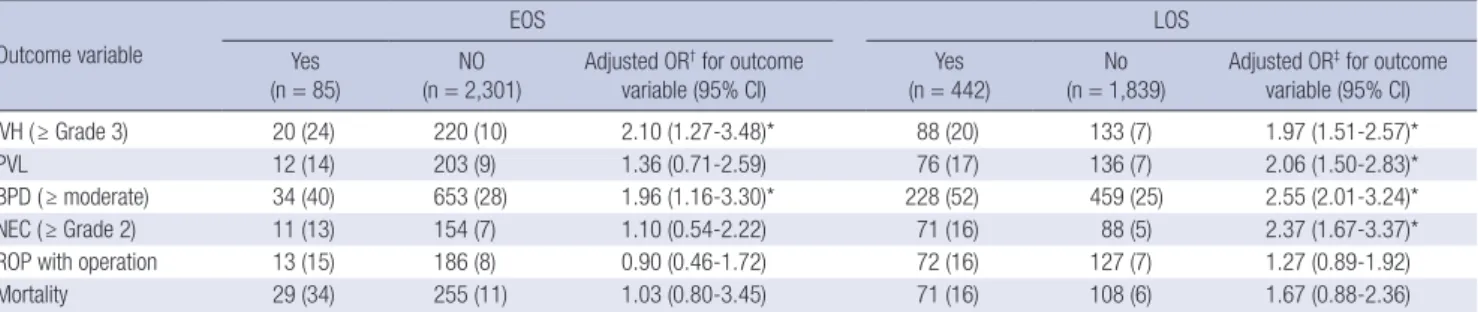
EOS were at an increased risk of IVH (≥ G3) (OR 2.10 ,95% CI 1.27-3.48) and BPD (≥ mod) (OR 1.96, 95%CI 1.16-3.30) (Table 7). In the LOS group, the mean gestation, birth weight, and Ap- gar score were significantly lower. Antenatal steroid use, and initial resuscitation were found to be significantly more com- mon in the LOS group (Table 6). After adjusted the gestation, antenatal steroid use, and initial resuscitation to determine major morbidities and mortality of infants with LOS, VLBW with LOS were at an increased risk of IVH (≥ G3) (OR 1.97, 95%
CI 1.51-2.57), PVL (OR 2.06, 95% CI 1.50-2.83), BPD (≥ mod) (OR 2.55, 95% CI 2.01-3.24), and NEC (≥ G2) (OR 2.37, 95% CI 1.67-3.37) (Table 7).
DISCUSSION
This was the first large-scale study of neonatal sepsis in VLBW infants from 55 neonatal intensive care units (NICUs) in South Korea. The KNN was established in April 2013 as an infrastruc- ture for NICU quality improvement, with the goal of improving the survival rate and decreasing the number of sepsis episodes.
Before the KNN was established, there were only limited reports about neonatal sepsis in Korea, due to the small number of en- rolled NICUs and the short duration of studies and retrospec- tive studies (9,10).
Table 6. Patient Characteristics of EOS and LOS Control group
(n = 2,301) EOS
(n = 85) OR (95%CI) Control group
(n = 1,839) LOS
(n = 442) OR (95%CI)
Gestational age (week) 28.5 ± 3.1 26.1 ± 2.4 0.72 (0.69-0.81)* 29.0 ± 3.0 27.0 ± 2.7 0.80 (0.77-0.83)*
Birth weight (g) 1,080.0 ± 283.9 867.0 ± 280.4 0.99 (0.99-0.99)* 1,121.3 ± 269.9 935.5 ± 271.3 0.10 (0.99-0.99)*
SGA 378 (16%) 10 (12%) 0.68 (0.35-1.32) 308 (17%) 63 (14%) 0.83 (0.62-1.11)
1 min AS 4.6 ± 2.0 3.8 ± 2.1 0.85 (0.76-0.94)* 4.8 ± 2.0 3.9 ± 1.9 0.81 (0.77-0.86)*
5 min AS 6.7 ± 1.8 5.8 ± 2.1 0.80 (0.73-0.89)* 6.9 ± 1.7 6.1 ± 1.8 0.81 (0.77-0.86)*
Pathologic chorioamnionitis 652 (28%) 31 (36%) 1.50 (0.93-2.38) 514 (28%) 131 (30%) 1.19 (0.94-1.52)
PROM 801 (35%) 37 (44%) 3.85 (0.48-17.31) 651 (35%) 145 (33%) 1.17 (0.32-8.34)
Antenatal steroid 1,682 (73%) 70 (82%) 1.79 (0.95-3.23) 1,338 (73%) 350 (79%) 1.59 (1.22-2.09)*
C/Sec 1,729 (75%) 52 (61%) 0.59 (0.44-0.82)* 1,378 (75%) 337 (76%) 1.08 (0.84-1.37)
Initial resuscitation 1,997 (87%) 81 (95%) 2.35 (1.17-4.58)* 1,560 (85%) 415 (94%) 2.11 (1.27-5.15)*
Data expressed as number (%). *P < 0.05. EOS, early-onset sepsis; LOS, late-onset sepsis; n, number; SGA, small for gestational age; AS, Apgar score; PROM, premature rup- ture of amniotic membrane; C/sec, Cesarean section.
Table 7. Major Morbidities and Mortality of VLBWI With and Without EOS or LOS
Outcome variable
EOS LOS
Yes
(n = 85) NO
(n = 2,301) Adjusted OR† for outcome
variable (95% CI) Yes
(n = 442) No
(n = 1,839) Adjusted OR‡ for outcome variable (95% CI)
IVH ( ≥ Grade 3) 20 (24) 220 (10) 2.10 (1.27-3.48)* 88 (20) 133 (7) 1.97 (1.51-2.57)*
PVL 12 (14) 203 (9) 1.36 (0.71-2.59) 76 (17) 136 (7) 2.06 (1.50-2.83)*
BPD ( ≥ moderate) 34 (40) 653 (28) 1.96 (1.16-3.30)* 228 (52) 459 (25) 2.55 (2.01-3.24)*
NEC ( ≥ Grade 2) 11 (13) 154 (7) 1.10 (0.54-2.22) 71 (16) 88 (5) 2.37 (1.67-3.37)*
ROP with operation 13 (15) 186 (8) 0.90 (0.46-1.72) 72 (16) 127 (7) 1.27 (0.89-1.92)
Mortality 29 (34) 255 (11) 1.03 (0.80-3.45) 71 (16) 108 (6) 1.67 (0.88-2.36)
Data expressed as number (%).*P < 0.05; †Analyses for the major morbidities and mortality with and without EOS were adjusted for gestation and initial resuscitation; ‡Analy- ses for the morbidities and mortality with and without LOS was adjusted for gestation, antenatal steroid use, and initial resuscitation. EOS, early-onset sepsis; LOS, late-onset sepsis; IVH, intraventricular hemorrhage; PVL, periventricular leukomalacia; BPD, bronchopulmonary dysplasia; NEC, necrotizing enterocolitis; ROP, retinopathy of prematurity.
There have been several nationwide epidemiological studies of infections among NICUs in other countries such as the Neo- natal Research Network of the National Institute of Child Health and Human Development (NICHD) in the USA and the neona- tal networks in Canada, Australia, New Zealand, and Japan (14- 17). There has been considerable variability in the reported in- cidence of sepsis (2). VLBW infants born in the Neonatal Re- search Network (NRN) Centers of Japan in 2012 demonstrated an overall 8% incidence rate of sepsis (18). Among 5447 VLBW infants born at NICHD centers in the USA between 1998 and 2000, sepsis was present in 22% of all patients (3). Infants at less than 32 weeks of gestation in Level III NICUs of the Australian and New Zealand neonatal network (ANZNN) in 2012 showed a 12% rate of sepsis (17). In this study, during the 18 months of collection from January 2013, the overall incidence of sepsis was 21% of infants. The incidence of sepsis in the KNN was high- er than that of the Japanese NRN and similar to those of the NI- CHD and other networks.
Early onset sepsis is variably defined as either occurring with- in 7 days after birth or within 48-72 hr of birth. EOS, defined as occurring within 7 days in Japan, was 3.6% (18). In the NICHD study, EOS was defined as occurring within 72 hr of birth and was noted in 1.5% of infants (3). From the data of ANZNN, EOS was defined as occurring within 48 hr of birth and was reported for 0.9% of infants (17). Sepsis was diagnosed more frequently at the low gestational age. The rate of EOS was 6% at 22 weeks and 1% at 28 weeks (19). In our study, EOS occurred in 3.6% of infants, with rates of 10.3% and more than 28 weeks.
The incidence of LOS showed variable range according to country and hospital. From the NICHD study, LOS was present in 22% of infants, and the rates of LOS were 58% at 22 weeks and 20% at 28 weeks (20). In our study, the incidence of LOS was shown to be 19.4% among the 2,281 infants who survived for more than 7 days after birth. In a report from the Nether- lands, the incidence of LOS in VLBW infants was 14.9 per 1,000 patient days. In the German study, in their first year of reporting LOS incidence in VLBW infants, the rate was 8.3 per 1,000 pa- tient days, and the overall incidence of sepsis was 4.7 per 1,000 patient days (21). In the NICHD study, the rate of the first epi- sode of LOS was 3.8 per 1,000 patient days (11). In this study, the rate of LOS episodes was 3.1 per 1,000 patient days. The in- fection rate was inversely related to birth weight and gestation.
Infants below 500 g found to have a short duration of hospital- ization due to high mortality; thus, rates per hospital day for in- fants below 500 g were lower than those for infants between 500 and 749 g.
The patterns of pathogens responsible for neonatal sepsis have changed with time and vary from place to place (22). In the United Kingdom, organisms causing EOS are predominat- ed by group B streptococcus. However, in the NICHD, a marked reduction in group B streptococcal sepsis (from 5.9 to 1.0 per
1,000; P < 0.001) and an increase in Escherichia coli sepsis (from 3.2 to 6.8 per 1,000; P = 0.004) were noted (23). Infants with EOS were more likely to die than uninfected infants (37% vs. 13%;
P < 0.001), especially if they were infected with Gram-negative organisms (11). In a recent study from Canada, however, CONS was found to be the most common organism identified in EOS among both full-term and preterm infants. However, mortality rate due to CONS was low in infants with EOS (6). In our study, Gram-positive organisms were the most predominant organ- isms of EOS in Korea. Coagulase-negative Staphylococcus was noted as the highest at 31%, followed by Staphylococcus aureus.
Microorganism populations isolated in infants with LOS were dominated by Gram-positive cocci, predominantly CONS (62.5%) (14,24,25). In the NICHD study, CONS was the most common LOS pathogen (48% of all infections). Infections caused by yeast- like fungi constituted 7.9% of all the cases (14,21). Gram-nega- tive pathogens (35%) and fungi (35%) were the pathogens most associated with mortality in LOS, followed by CONS (18%). In our study, CONS (38%) was the most common pathogen of LOS, and Staphylococcus aureus appeared in 11% of cases. The mor- tality rate of CONS sepsis was only 1.2%, and that of Staphylo- coccus aureus sepsis was 5.6%. The mortality rate of Gram-neg- ative sepsis was 9.3%, and that of fungal sepsis was 6.6%. Accord- ing to a previous report, methicillin-resistant Staphylococcus aureus (MRSA) accounts for 80% of isolated Staphylococcus au- reus cases in intensive care units and has become a threat to critically ill populations in Korea, including neonates. Kim et al.
reported that LOS due to MRSA in Korea comprised 18.8% of cases (26). In this study, it has limitation about no information of LOS due to MRSA.
Neonatal sepsis is associated with increased mortality and morbidity among premature infants. From the data collected by the Israel Neonatal Network, EOS was associated with signif- icantly increased odds of severe IVH (OR: 2.24), severe ROP (OR:
2.04), and BPD (OR: 1.74). EOS was also associated with an in- creased risk of death and/or severe neurologic morbidity (OR:
2.92) (5). The percentage of infants with EOS was higher among those with PROM > 48 hr than among those with PROM < 48 hr (P < 0.001) (25). In our study, mean gestation, birth weight, mean APGAR score, cesarean section and initial resuscitation were significantly different between the EOS group and the con- trol group. In analyzing the risk factor of EOS, gestational age was strongly associated with the risk of EOS (OR: 0.72). In ac- cord with other studies, VLBW with EOS were at an increased risk of IVH (≥ G3) (OR 2.10) and BPD (≥ mod) (OR 1.96). How- ever, there was no significant association with increased risk of death.
From the data collected by the Polish Neonatology Surveil- lance Network, the occurrence of LOS was significantly associ- ated with increased length of mechanical ventilation (OR: 2.65) and continuous positive airway pressure (OR: 2.51), as well as
the duration of antibiotic use (OR: 2.98) (27). Surgical proce- dures and lower gestational age were significantly associated with the risk of LOS (21). Infants who developed LOS were sig- nificantly more likely to develop BPD. In the NICHD study, in- fants with PDA (OR: 1.2), BPD (OR: 1.3), and NEC (OR: 2.7) had a higher incidence of LOS. There was no association between LOS and RDS, severe IVH, or PVL. In our study, VLBW infants with LOS were at an increased risk of IVH (≥ G3) (OR 1.97), PVL (OR 2.06), BPD (≥ mod) (OR 2.55), and NEC (≥ G2) (OR 2.37). It is quite similar to other studies.
A large multicenter study from the German Neonatal Net- work showed that SGA was a risk factor of LOS (OR: 1.31; 95%
CI: 1.02-1.68; P = 0.03) (11). In contrast, a Norwegian popula- tion-based study on ELBW infants found no association between SGA and sepsis (28). In our study, SGA showed no significant risk of sepsis.
The majority of extreme low birth weight (ELBW) survivors in our study (65%) had at least one infection during their NICU birth stay. The occurrence of more than one infection was ob- served frequently among those with ELBW and LOS. However, no significant difference was noted in the occurrence of the tim- ing of the first LOS episode among the birth weight groups and gestation groups.
Our study had several limitations. Differences of policy and treatment between the NICUs still remained. No more than five episodes of infection were collected, although these included most of the episodes of sepsis. Data regarding antenatal antibi- otics use and antibiotics sensitivity were not collected.
This study provides a recent nationwide epidemiology of sep- sis in VLBW infants in Korea. Based on this study, successful strat- egies to reduce infections among VLBW infants would improve survival and reduce neonatal morbidity. International compar- isons and efforts for quality improvement will be needed.
DISCLOSURE
The authors have no conflicts of interest to disclose.
AUTHOR CONTRIBUTION
Conception and design of the study: Lee SM, Chang MY, Kim KS. Acquisition of data: Lee SM. Statistical Analysis: Lee SM.
First Draft of the manuscript: Lee SM, Chang MY. Revision and critical review of the manuscript: Lee SM, Chang MY, Kim KS.
ORCID
Soon Min Lee http://orcid.org/0000-0003-0174-1065 Meayoung Chang http://orcid.org/0000-0001-5368-3296 Ki-Soo Kim http://orcid.org/0000-0003-1547-5220
REFERENCES
1. Hornik CP, Fort P, Clark RH, Watt K, Benjamin DK Jr, Smith PB, Manzo- ni P, Jacqz-Aigrain E, Kaguelidou F, Cohen-Wolkowiez M. Early and late onset sepsis in very-low-birth-weight infants from a large group of neonatal intensive care units. Early Hum Dev 2012; 88: S69-74.
2. Stoll BJ, Gordon T, Korones SB, Shankaran S, Tyson JE, Bauer CR, Fan- aroff AA, Lemons JA, Donovan EF, Oh W, et al. Late-onset sepsis in very low birth weight neonates: a report from the National Institute of Child Health and Human Development Neonatal Research Network. J Pediatr 1996; 129: 63-71.
3. Stoll BJ, Hansen N, Fanaroff AA, Wright LL, Carlo WA, Ehrenkranz RA, Lemons JA, Donovan EF, Stark AR, Tyson JE, et al. Changes in patho- gens causing early-onset sepsis in very-low-birth-weight infants. N Engl J Med 2002; 347: 240-7.
4. Alshaikh B, Yusuf K, Sauve R. Neurodevelopmental outcomes of very low birth weight infants with neonatal sepsis: systematic review and me- ta-analysis. J Perinatol 2013; 33: 558-64.
5. Klinger G, Levy I, Sirota L, Boyko V, Lerner-Geva L, Reichman B; Israel Neonatal Network. Outcome of early-onset sepsis in a national cohort of very low birth weight infants. Pediatrics 2010; 125: e736-40.
6. Ozkan H, Cetinkaya M, Koksal N, Celebi S, Hacimustafaoglu M. Cul- ture-proven neonatal sepsis in preterm infants in a neonatal intensive care unit over a 7 year period: coagulase-negative Staphylococcus as the predominant pathogen. Pediatr Int 2014; 56: 60-6.
7. Wójkowska-Mach J, Borszewska-Kornacka M, Domańska J, Gadzinows- ki J, Gulczyńska E, Helwich E, Kordek A, Pawlik D, Szczapa J, Klamka J, et al. Early-onset infections of very-low-birth-weight infants in Polish neo- natal intensive care units. Pediatr Infect Dis J 2012; 31: 691-5.
8. Vergnano S, Menson E, Kennea N, Embleton N, Russell AB, Watts T, Robinson MJ, Collinson A, Heath PT. Neonatal infections in England:
the NeonIN surveillance network. Arch Dis Child Fetal Neonatal Ed 2011;
96: F9-14.
9. Jeong IS, Jeong JS, Choi EO. Nosocomial infection in a newborn inten- sive care unit (NICU), South Korea. BMC Infect Dis 2006; 6: 103.
10. Shim GH, Kim SD, Kim HS, Kim ES, Lee HJ, Lee JA, Choi CW, Kim EK, Choi EH, Kim BI, et al. Trends in epidemiology of neonatal sepsis in a tertiary center in Korea: a 26-year longitudinal analysis, 1980-2005. J Korean Med Sci 2011; 26: 284-9.
11. Stoll BJ, Hansen N, Fanaroff AA, Wright LL, Carlo WA, Ehrenkranz RA, Lemons JA, Donovan EF, Stark AR, Tyson JE, et al. Late-onset sepsis in very low birth weight neonates: the experience of the NICHD Neonatal Research Network. Pediatrics 2002; 110: 285-91.
12. Papile LA, Burstein J, Burstein R, Koffler H. Incidence and evolution of subependymal and intraventricular hemorrhage: a study of infants with birth weights less than 1,500 gm. J Pediatr 1978; 92: 529-34.
13. Bell MJ, Ternberg JL, Feigin RD, Keating JP, Marshall R, Barton L, Broth- erton T. Neonatal necrotizing enterocolitis. Therapeutic decisions based upon clinical staging. Ann Surg 1978; 187: 1-7.
14. Ehrenkranz RA, Walsh MC, Vohr BR, Jobe AH, Wright LL, Fanaroff AA, Wrage LA, Poole K; National Institutes of Child Health and Human De- velopment Neonatal Research Network. Validation of the National In- stitutes of Health consensus definition of bronchopulmonary dysplasia.
Pediatrics 2005; 116: 1353-60.
15. Kusuda S, Fujimura M, Sakuma I, Aotani H, Kabe K, Itani Y, Ichiba H,
Matsunami K, Nishida H; Neonatal Research Network Japan. Morbidity and mortality of infants with very low birth weight in Japan: center vari- ation. Pediatrics 2006; 118: e1130-8.
16. The Canadian Neonatal Network TM. Available at http://www.canadi- anneonatalnetwork.org/portal [accessed on 2 November 2014].
17. Australian & New Zealand Neonatal Network (ANZNN). National Peri- natal Epidemiology and Statistics Unit (NPESU). Available at https://
npesu.unsw.edu.au/data-collection/australian-new-zealand-neonatal- network-anznn [accessed on 2 December 2014].
18. Neonatal Research Network Japan. Available at http:nrn.shiga-med.
ac.jp/Englishdefault.htm [accessed on 25 January 2015].
19. Stoll BJ, Hansen NI, Bell EF, Shankaran S, Laptook AR, Walsh MC, Hale EC, Newman NS, Schibler K, Carlo WA, et al. Neonatal outcomes of ex- tremely preterm infants from the NICHD Neonatal Research Network.
Pediatrics 2010; 126: 443-56.
20. Stoll BJ, Hansen NI, Sánchez PJ, Faix RG, Poindexter BB, Van Meurs KP, Bizzarro MJ, Goldberg RN, Frantz ID 3rd, Hale EC, et al. Early onset neo- natal sepsis: the burden of group B Streptococcal and E. coli disease con- tinues. Pediatrics 2011; 127: 817-26.
21. Wójkowska-Mach J, Gulczyńska E, Nowiczewski M, Borszewska-Kor- nacka M, Domańska J, Merritt TA, Helwich E, Kordek A, Pawlik D, Gad- zinowski J, et al. Late-onset bloodstream infections of Very-Low-Birth- Weight infants: data from the Polish Neonatology Surveillance Network in 2009-2011. BMC Infect Dis 2014; 14: 339.
22. Shah AJ, Mulla SA, Revdiwala SB. Neonatal sepsis: high antibiotic resis-
tance of the bacterial pathogens in a neonatal intensive care unit of a tertiary care hospital. J Clin Neonatol 2012; 1: 72-5.
23. Stoll BJ, Hansen N. Infections in VLBW infants: studies from the NICHD Neonatal Research Network. Semin Perinatol 2003; 27: 293-301.
24. Benjamin DK Jr, Stoll BJ, Fanaroff AA, McDonald SA, Oh W, Higgins RD, Duara S, Poole K, Laptook A, Goldberg R, et al. Neonatal candidia- sis among extremely low birth weight infants: risk factors, mortality rates, and neurodevelopmental outcomes at 18 to 22 months. Pediatrics 2006;
117: 84-92.
25. Rosenthal VD, Lynch P, Jarvis WR, Khader IA, Richtmann R, Jaballah NB, Aygun C, Villamil-Gómez W, Dueñas L, Atencio-Espinoza T, et al.
Socioeconomic impact on device-associated infections in limited-resource neonatal intensive care units: findings of the INICC. Infection 2011; 39:
439-50.
26. Kim EA. Methicillin-resistant Staphylococcus aureus (MRSA) infection in neonates. Neonatal Med 2013; 20: 354-60.
27. Makhoul IR, Sujov P, Smolkin T, Lusky A, Reichman B; Israel Neonatal Network. Pathogen-specific early mortality in very low birth weight in- fants with late-onset sepsis: a national survey. Clin Infect Dis 2005; 40:
218-24.
28. Westby Wold SH, Sommerfelt K, Reigstad H, Rønnestad A, Medbø S, Farstad T, Kaaresen PI, Støen R, Leversen KT, Irgens LM, et al. Neonatal mortality and morbidity in extremely preterm small for gestational age infants: a population based study. Arch Dis Child Fetal Neonatal Ed 2009;
94: F363-7.