INTRODUCTION
Allergic Rhinitis (AR) is a common allergic disease that is de- fined as inflammation of the nasal mucosa. It is characterized by symptoms of rhinorrhea, sneezing, itching sensation, and nasal congestion.1 Clinical symptoms of AR are mainly triggered by inhalant allergens, of which the house dust mite is the most common aeroallergen in patients with respiratory allergy.2,3 The main treatment modalities for children who suffer from AR in- clude medication and allergen avoidance.4 Although allergen avoidance is the core principle for successful therapy, complete avoidance is difficult to obtain for a house dust mite allergen in the environments of tropical countries.1,5
Nasal cellulose powder (NCP) has been approved as a reme- dy for AR.6 The NCP can react with moisture on the nasal mu- cous membrane, creating gel-like substance covering the nasal mucosa. This protective layer has been proposed to prevent an inhaled allergen from binding to receptors.7
Previous studies have suggested that NCP can reduce symp-
toms of persistent rhinitis from birch pollen allergy and dust mite allergy in adults.8-12 However, evidence for the efficacy of this product has not been provided in dust mite-sensitized AR children. The current study was conducted to determine the ef- ficacy of NCP in improving clinical symptoms, nasal airflow lim- itations, and nasal inflammatory cell measures in dust mite-sen- sitized AR children.
MATERIALS AND METHODS
This randomized, double-blind, placebo-controlled trial was conducted at the Pediatric Allergy and Immunology Unit, Ra-
Efficacy of Nasal Cellulose Powder in the Symptomatic Treatment of Allergic Rhinitis: A Randomized, Double-Blind, Placebo-
Controlled Trial
Wiparat Manuyakorn,* Natchanun Klangkalya, Wasu Kamchaisatian, Suwat Benjaponpitak, Cherapat Sasisakulporn, Wanlapa Jotikasthira
Division of Allergy and Immunology, Department of Pediatrics, Faculty of Medicine, Ramathibodi Hospital, Mahidol University, Bangkok, Thailand
This is an Open Access article distributed under the terms of the Creative Commons Attribution Non-Commercial License (http://creativecommons.org/licenses/by-nc/4.0/) which permits unrestricted non-commercial use, distribution, and reproduction in any medium, provided the original work is properly cited.
Purpose: Nasal Cellulose Powder (NCP), which can prevent from binding an allergen to nasal mucosa, may reduce allergic rhinitis (AR) symptoms in dust mite-sensitized children. This study was conducted to assess the efficacy of NCP in improving clinical symptoms of a nasal airflow limitation and the response of nasal inflammatory cells. Methods: Children with dust mite-sensitized AR aged 6-18 years were recruited. After a 4-week run- in period, NCP or a placebo was administered, 1 puff per nostril 3 times daily for 4 weeks. The nasal provocation test (NPT) with Dermatophagoides pteronyssinus (Der p) was performed before and after treatment. The daily symptom scores (DSS), daily medication scores (DMS), the peak nasal in- spiratory flows (PNIF), nasal airway resistance (NAR), as well as the maximum tolerated dose of NPT and eosinophil counts in nasal scraping, were evaluated. Results: Sixty children (30 NCP and 30 placebos) were enrolled. Before treatment, there were no significant differences in age, dust mite control measures, DSS, DMS, PNIF, NAR, the maximum tolerated dose of NPT, or nasal eosinophil scores between children receiving NCP and pla- cebos. After treatment, there were no significant differences between the NCP and placebo groups in the median (range) of the outcomes—DSS:
2.06 (0.18-3.77) vs 1.79 (0.08-7.79), P=0.756; DMS: 1.60 (0-5.13) vs 0.56 (0-4.84), P=0.239; PNIF (L/min): 110 (60-160) vs 100 (50-180), P=0.870; NAR (Pa/cm3/s): 0.40 (0.20-0.97) vs 0.39 (0.24-1.32), P=0.690; the maximum tolerated dose of NPT and the nasal eosinophil scores: 1 (0-4) vs 1 (0-4), P=0.861. Conclusions: NCP treatment may not be more effective than placebo treatment in dust mite-sensitized AR children.
Key Words: Allergic rhinitis; cellulose powder; children; house dust mite; nasal provocation test
Correspondence to: Wiparat Manuyakorn, MD, PhD, Division of Allergy and Immunology, Department of Pediatrics, Faculty of Medicine, Ramathibodi Hospital, Mahidol University, Rama 6 Rd, Ratchathewi, Bangkok 10400, Thailand.
Tel: +66-2-201-1494; Fax: +66-2-201-1760; E-mail: [email protected] Received: December 19, 2016; Revised: March 24, 2017; Accepted: April 4, 2017
•There are no financial or other issues that might lead to conflict of interest.
Allergy Asthma Immunol Res. 2017 September;9(5):446-452.
https://doi.org/10.4168/aair.2017.9.5.446 pISSN 2092-7355 • eISSN 2092-7363
mathibodi Hospital, Bangkok, Thailand between March and November of 2015. The study was reviewed and approved by the Human Rights and Ethic Committee of the Faculty of Medi- cine, Ramathibodi Hospital, Mahidol University, Bangkok, Thai- land. All of the subjects or their parents provided written inform- ed consent. This clinical trial was registered at Thai Clinical Tri- als Registry (No. TCTR20150325001).
Subjects
Children with AR aged between 6-18 years underwent the skin prick tested (SPT) and the nasal provocation test (NPT). Chil- dren who were positive to Der p allergen and had a history of AR symptoms for at least 1 year were enrolled. The exclusion criteria included: 1) manifestations of allergic symptom exacer- bation, 2) other co-morbid allergic diseases, such as asthma, acute or chronic sinusitis, acute upper or lower respiratory tract infections, septal deformities, 3) multiple sensitization from SPT, 4) prior allergen immunotherapy, 5) current use of intranasal corticosteroids due to severe rhinitis symptoms.
Baseline characteristics were recorded at screening. During a 4-week run-in treatment period, the children recorded their symp- toms and use of rescue medications on daily diary record cards.
The symptoms of nasal congestion, itching, rhinorrhea, and sne- ezing were all evaluated. The patients graded their symptom se- verity over the past 12 hours on a scale of 0-3: 0=absent, 1=mild, 2=moderate, and 3=severe.13,14 The sum of these individual scores was referred to as a daily symptom score (DSS). The daily medication score (DMS) was calculated from the patient’s daily diary record card on their use of rescue medications (oral anti- histamines and pseudoephedrine) and it was then noted on their daily diary record cards. Children were not permitted to use intranasal corticosteroids children during the experimental trial period. DMS was calculated based upon the magnitude and duration of clinical effect.15,16 The daily combined score (DCS) was the sum of the DSS and DMS scores.15 The nasal airflow limi- tations (peak nasal inspiratory flow [PNIF] and nasal airway re- sistance [NAR]), as well as nasal eosinophil count, were evaluat- ed at baseline and after treatment. The children were random- ized to NCP (NoAl; Nasaleze International Ltd., Douglas, UK) or a placebo, with 1 puff each nostril 3 times daily for 4 weeks (Fig.
1). The placebo was lactose powder which had the same particle size and appearance as the NCP. This placebo was supplied in the same container. The containers were labeled with serial numbers. Both the patients and the investigators were blinded to these randomization codes. The randomization codes for NCP and the placebo were not revealed until all of the patients completed the study and all of the data were recorded. The medi- cations, studied i.e., the NCP and the placebo, were supplied and supported by Nasaleze International Ltd. The participant’s com- pliance with the treatment was assessed by using the medica- tion daily record card. Text messages were sent 3 times a day to remind the subjects of taking take their study medication.
Nasal airflow limitation assessment
NAR was measured in each nostril separately by using active anterior rhinomanometry (Multifunctional Spirometer HI-801;
Chest M.I., Inc., Tokyo, Japan). The PNIF was measured by us- ing a nasal peak flow meter (In-Check Nasal; Clement Clarke, Harlow, UK).
NPT
The patients were asked to stop antihistamines and anti-leu- kotrienes for 1 week, oral ketotifen for 2 weeks, and oral or topi- cal decongestants for 1 day before the NPT.17 The NPT protocols were as follows: first, baseline symptom scores were recorded, then anterior rhinomanometry was performed, and finally PNIF measured. To exclude any non-specific nasal hyper-reactivity, the patients were initially tested with a saline solution (0.9% NaCl).
If the results of the saline solution NPT were negative, then the dust mite NPT was performed. A house dust mite (HDM) solu- tion at different concentrations of the Der p allergen extract (50, 200, and 500 AU/mL) was applied to both nostrils at 15-minute intervals, in order to find the maximum tolerated dose. The to- tal nasal symptom scores, the PNIF, and the NAR were assessed after each provocation. The NPTs were considered positive if one of the following criteria were met: 1) the NAR was increased by at least 20% of the baseline value, plus changes in the total nasal symptom scores from the baseline value by at least 3 points, 2) the NAR was increased by at least 40% of the baseline value, regardless of the total nasal symptom scores, and 3) PNIF was reduced by at least 20%.18,19 After finishing the tests, the patients were asked to stay in the clinic for at least 30 minutes for clinical observation. Nasal irrigation, oral antihistamines, as well as oral decongestants, were given to patients with troublesome nasal symptoms.
Nasal scraping for nasal smear eosinophilia (NSE) grading The nasal mucosal specimens were obtained by scraping the middle one-third of the inferior turbinate by using a Rhino-Pro- Fig. 1. Study protocol. NCP, nasal cellulose powder; NPT, nasal provocation test; PNIF, peak nasal inspiratory flow; SPT, skin prick test; TNSS, total nasal symptoms score.
beTM Nasal Cytology Curette (ASI, Arlington, TX, USA) in both nasal cavities. The specimens were spread on microscope slides and then stained with Wright-Giemsa stain.20 The specimens were examined by using oil immersion under a light microscope and graded according to the NSE grading system.21 The same technician, who was blinded to the patient’s identity and ran- domization, evaluated all of the specimens. For each slide, 5 randomly chosen magnification fields were examined and the eosinophil cell counts were recorded and graded on a 4-point scale.21
Statistical analysis
The randomization was provided centrally in a block of 4. Anal- ysis was performed on all of the randomized patients who had both Visit0 and Visit1 follow-up data and had continued the study medication. A sample size of 28 patients (the treatment arm) was expected to have an 80% power to detect a difference of 9.4 between the NCP and placebo treatments in the mean to- tal symptom scores from the nasal challenge,12 with a standard deviation (SD) of 12.2 and a 2-sided alpha error of 0.05. All sta- tistical analyses were conducted using the SPSS 17.0 Software Package (IBM, Chicago, IL, USA). Nonparametric tests were used as follows: the χ2 test for the differences in the distributions of the actual frequencies of the scores; the Mann-Whitney U test for the medians and the correlations between the groups; and the Wilcoxon signed-rank test for the medians and the correla- tions within each group. A P value of <0.05 was considered to indicate statistical significance.
RESULTS
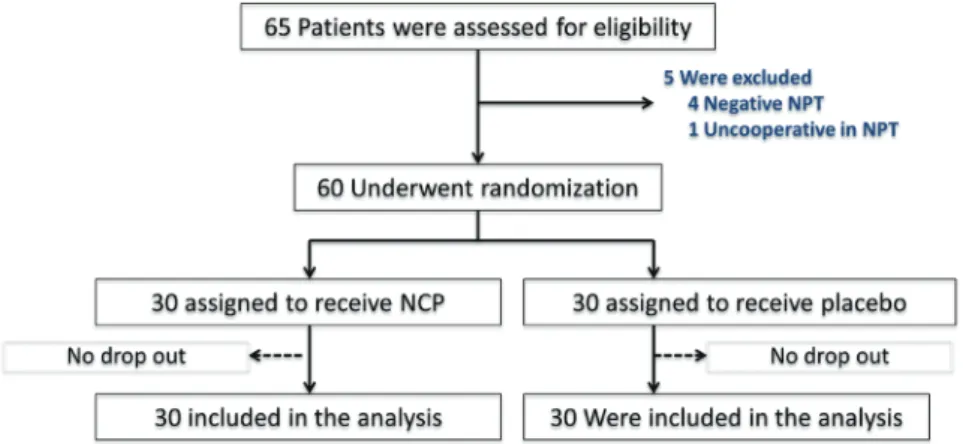
A total of 65 children with AR were screened and 60 children were randomized to 2 treatment modalities: NCP (n=30) and placebo (n=30). There was no patient discontinuation (Fig. 2).
The mean age of the children was 11.6 years; 75 percent were male. The baseline demographic characteristics at entry were
similar between the 2 treatment groups. There were no signifi- cant differences in the baseline values for the primary objective variables, including the DSS, DMS, PNIF, NAR, or NSE grading between the 2 groups (Table 1). The overall drug use compliance was 90.5%. There were no significant differences in the drug use compliance between the NCP and placebo groups (93% vs 88%, P=0.15). There were no systemic adverse reactions that occurred during the study.
Comparison between outcomes at baseline and after treatment There was no significant difference between baseline and post- treatment DMS and DCS in either the NCP or placebo group.
However, there was a significant decrease in the median DSS from baseline to posttreatment in the placebo group (2.48 [range:
0.40, 9.54] vs 1.79 [range: 0.08, 7.79], P=0.03). Children that re- ceived the placebo treatment had significantly lower median congestion scores when compared with the baseline scores (0.69 [range: 0, 2.27] vs 0.38 [range: 0, 1.44], P=0.005), but there were no significant differences in the DSS between baseline and post- treatment scores in the NCP group. Children in the placebo group had significantly lower median frequencies of congestion and rhinorrhea after treatment (4 [range: 0, 7] vs 2 [range: 0, 7], P=
0.006) and (2 [range: 0, 7] vs 0.5 [range: 0, 7], P=0.04, respective- ly). While children in the NCP group had a significantly lower median frequency of rhinorrhea after treatment (3 [range: 0, 7]
vs 1.5 [range: 0, 7], P=0.02). There was no significant difference in PNIF or NSE grade between baseline and posttreatment in either the NCP or the placebo group. Surprisingly, the NAR was significantly increased from the baseline values in both the NCP and placebo groups (0.33 [range: 0.17, 0.88] to 0.40 [range: 0.20, 0.97] Pa/cm3/s, P=0.005 and 0.33 [range: 0.20, 0.89] to 0.39 [range:
0.24, 1.32] Pa/cm3/s, P=0.002, respectively) (Table 2).
Comparison of outcomes between the NCP and placebo groups after treatment
There were no significant differences in the median values of
Fig. 2. Diagram of the study flow. NCP, nasal cellulose powder; NPT, nasal provocation test.
DSS, DMS, DCS, PNIF, and NAR between the NCP and placebo groups after treatment. There were no significant differences in the NSE grade between the 2 treatment groups (Table 2). The changes in the maximal tolerated dose of NPT did not differ sig- nificantly between the NCP and placebo groups. Twenty-one patients in the 2 groups had positive NPT values at the same dose of Der p as before treatment.
Subgroup analysis
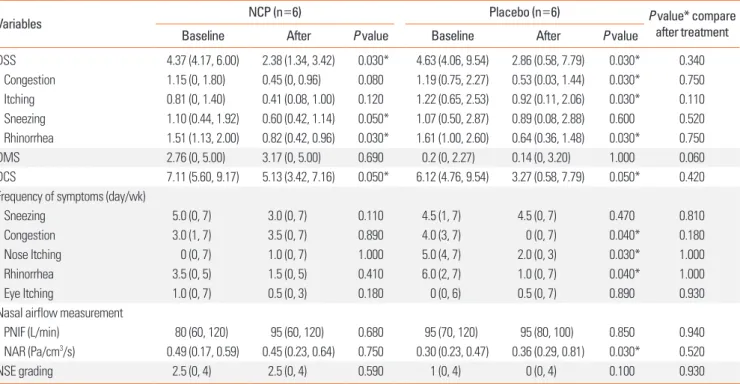
When conducting subgroup analysis for patients with moder- ate to severe symptom severity (in the DSS more than 4), signif- icant improvements in the DSS and DCS from baseline were ob- served in both the NCP and placebo groups—DSS (4.37 [range:
4.17, 6.00] vs 2.38 [range: 1.34, 3.42], P=0.03 and 4.63 [range:
4.06, 9.54] vs 2.86 [range: 0.58, 7.79], P=0.03) and DCS (7.11 [range: 5.60, 9.17] vs 5.13 [range: 3.42, 7.16], P=0.05) and 6.12
[range: 4.76, 9.54] vs 3.27 [range: 0.58, 7.79], P=0.05). However, significant improvements in the frequencies of the symptoms of congestion, nose itching, and rhinorrhea were observed only in the placebo group (4 [range: 3, 7] vs 0 [range: 0, 7], P=0.04; 5 [range: 4, 7] vs 2 [range: 0, 3], P=0.03; and 6 [range: 2, 7] vs 1 [range: 0, 7], P=0.04), respectively. In addition, children who received the placebo treatment had a significant increase in NAR when compared with the baseline values. No significant differ- ences were observed in either of the after treatment outcomes between the NCP and placebo groups (Table 3).
DISCUSSION
NCP was registered as a medical device for the treatment of AR. The current study has evaluated the efficacy of NCP in con- firmed dust mite-sensitized AR. Our randomized, double-blind, Table 1. Patients’ baseline characteristics and variables at the entry to study
Characteristics and variables NCP (n=30) Placebo (n=30) P value
Age (year) 11.86 (6.55, 15.89) 12.28 (7.12, 16.00) 0.510
Sex
Male 21 (70) 24 (80) 0.370
Female 9 (30) 6 (20)
SPT size (mm) 9.5 (3, 17) 11 (5, 20) 0.120
House adjacent to road 11 (36.7) 11 (36.7) 1.000
House adjacent to factory 4 (13.3) 4 (13.3) 1.000
Living with smoker 11 (36.7) 11 (36.7) 1.000
Doll playing 5 (16.7) 6 (20.0) 0.740
Encase mattress 23 (76.7) 21 (70.0) 0.560
Frequency of washing bed sheets 1 (0.25, 3.00) 1 (0.25, 2.00) 0.080
Season at enrollment 0.640
Summer (Jan-Apr) 7 (23.3) 10 (33.3)
Rainy (May-Aug) 14 (46.7) 11 (36.7)
Winter (Sep-Dec) 9 (30.0) 9 (30.0)
DSS 2.15 (0.47, 6.00) 2.48 (0.40, 9.54) 0.520
Congestion 0.48 (0, 1.80) 0.69 (0, 2.27) 0.180
Itching 0.24 (0, 1.40) 0.51 (0, 2.53) 0.500
Sneezing 0.80 (0, 1.92) 0.56 (0, 2.87) 0.700
Rhinorrhea 0.56 (0, 2.0) 0.52 (0, 2.6) 0.750
DMS 0 (0, 0) 0 (0, 0.26) 0.500
Antihistamine 0.27 (0, 1) 0.11 (0, 1) 0.310
Decongestant 0 (0, 1.5) 0.11 (0, 1.0) 0.390
DCS 4.03 (0.47, 9.17) 4.03 (0.4, 9.54) 0.930
Nasal airflow measurement
PNIF (L/min) 100 (60, 150) 90 (50, 200) 0.430
NAR (Pa/cm3/s) 0.33 (0.17, 0.88) 0.33 (0.20, 0.89) 0.890
NSE grading 1 (0, 4) 2 (0, 4) 0.740
Values are presented as median (range) or number (%). P value corresponds to the Mann-Whitney U test and χ2 test.
NCP, nasal cellulose powder; DSS, daily symptom score; DMS, daily medication score; DCS, daily combined score; PNIF, peak nasal inspiratory flow; NSE, nasal smear eosinophilia.
placebo-controlled study has shown a similar efficacy of NCP and the placebo in clinical symptom scores, nasal eosinophil counts, and objective measurements of nasal airflow limitation.
These results are in contrast to those of previous double-blind placebo-controlled studies, which have demonstrated the effi- cacy of NCP over the placebo treatment in patients with birch pollen AR, in terms of reductions in symptom scores8,11 and res- cue medication use.9 These differences may be explained from the amount and presence of allergen exposure to AR patients.
In tropical countries, such as Thailand, dust mite allergens are present all the year. This is in contrast to birth pollen which is a seasonal allergen. The amount of allergen has been shown to have an impact on the efficacy of NCP in children and adoles- cents suffering from birth pollen AR. The best efficacy of NCP has been demonstrated during low or moderate pollen counts.8 In the current study, we did not measure the levels of dust mite allergen in the environments of the enrolled children. The lev- els of dust mite antigen may have had an effect on the efficacy of NCP in dust mite-sensitized AR.
The Hawthorne effect22 is a social psychological change in the behavior of research participants as a response to the observa- tions and the assessments which could possibly have had an impact on the clinical symptoms scores, as has been reported
from our enrolled subjects. Since there was a similarity between the appearances of the NCP and the placebo, the treatment mo- dalities were randomized and the patients were blinded to the treatment allocations. The Hawthorne effect would occur simi- larly in both groups. Previous studies have reported and pro- posed that the Hawthorne effect can be controlled by double blind-studies.23 Our investigation team and the patients were also blinded to the treatment allocations in order to minimize the Hawthorne effect.22
The severity of clinical symptoms of AR may have had an ef- fect on the efficacy of NCP. However, several previous studies have evaluated the efficacy of NCP in patients who have stopped the use of intranasal steroids or have never used them before and during the enrollment,8,9,11 which is similar to our study. A recent study has demonstrated the efficacy of NCP in enhanc- ing oxymetazoline-increased PNIF in adults with moderate to severe persistent perineal AR.24 A real-life study on the effects of NCP as an add-on to intranasal as-needed treatment, in sub- jects with pollen AR has demonstrated a decrease in combined symptom and medication scores (CSMS) in patients receiving NCP when compared to those receiving placebos.25 Further stud- ies on the efficacy of NCP as add-on treatment to intranasal ste- roids are needed to demonstrate the efficacy of NCP in patients Table 2. Clinical and inflammatory outcomes at baseline and after treatment
Variables NCP (n=30) Placebo (n=30) P value* compare after
4 wk of treatment between group
Baseline After 4 wk P value Baseline After 4 wk P value
DSS 2.15 (0.47, 6.00) 2.06 (0.18, 3.77) 0.090 2.48 (0.40, 9.54) 1.79 (0.08, 7.79) 0.030* 0.760
Congestion 0.48 (0, 1.8) 0.36 (0, 1.67) 0.280 0.69 (0, 2.27) 0.38 (0, 1.44) 0.005* 0.940
Itching 0.24 (0, 1.40) 0.25 (0, 1.16) 0.110 0.51 (0, 2.53) 0.33 (0, 2.06) 0.260 0.520
Sneezing 0.80 (0, 1.92) 0.45 (0, 1.14) 0.090 0.56 (0, 2.87) 0.59 (0, 2.88) 0.560 0.620
Rhinorrhea 0.56 (0, 2.00) 0.63 (0, 1.32) 0.880 0.52 (0, 2.60) 0.42 (0, 1.48) 0.070 0.210
DMS 1.25 (0, 5.50) 1.60 (0, 5.13) 0.380 0.54 (0, 5.72) 0.56 (0, 4.84) 0.960 0.240
DCS 4.03 (0.47, 9.17) 4.09 (0.18, 7.16) 0.250 4.03 (0.40, 9.54) 3.16 (0.10, 8.70) 0.230 0.250
Frequency of symptoms (day/wk)
Congestion 3.0 (0, 7) 2.5 (0, 7) 0.320 4.0 (0, 7) 2.0 (0, 7) 0.006* 0.450
Nose itching 2.0 (0, 7) 1.0 (0, 7) 0.070 3.0 (0, 7) 2.0 (0, 7) 0.090 0.580
Sneezing 3.0 (0, 7) 3.0 (0, 7) 0.260 3.0 (0, 7) 3.0 (0, 7) 0.430 0.720
Rhinorrhea 3.0 (0, 7) 1.5 (0, 7) 0.020* 2.0 (0, 7) 0.5 (0, 7) 0.040* 0.370
Eye itching 1.0 (0, 7) 0 (0, 7) 0.070 2.0 (0, 7) 1.0 (0, 7) 0.430 0.040*
Nasal airflow measurement
PNIF (L/min) 100 (60, 150) 110 (60, 160) 0.770 90 (50, 200) 100 (50, 180) 0.360 0.870
NAR (Pa/cm3/s) 0.33 (0.17, 0.88) 0.40 (0.20, 0.97) 0.005* 0.33 (0.20, 0.89) 0.39 (0.24, 1.32) 0.002* 0.690
NSE grading 1 (0, 4) 1 (0, 4) 0.090 2 (0, 4) 1 (0, 4) 0.140 0.860
Values are presented as median (range).
NCP, nasal cellulose powder; DSS, daily symptom score; DMS, daily medication score; DCS, daily combined score; PNIF, peak nasal inspiratory flow; NSE, nasal smear eosinophilia.
*Statistical significance. P value corresponds to the Mann-Whitney U test for the analysis between NCP and placebo; and the Wilcoxon signed-rank test for the anal- ysis within each group.
Table 3. Clinical and inflammatory outcomes at baseline and after treatment; subgroup analysis in subjects with moderate-severe severity (DSS≥4)
Variables NCP (n=6) Placebo (n=6) P value* compare
after treatment
Baseline After P value Baseline After P value
DSS 4.37 (4.17, 6.00) 2.38 (1.34, 3.42) 0.030* 4.63 (4.06, 9.54) 2.86 (0.58, 7.79) 0.030* 0.340
Congestion 1.15 (0, 1.80) 0.45 (0, 0.96) 0.080 1.19 (0.75, 2.27) 0.53 (0.03, 1.44) 0.030* 0.750
Itching 0.81 (0, 1.40) 0.41 (0.08, 1.00) 0.120 1.22 (0.65, 2.53) 0.92 (0.11, 2.06) 0.030* 0.110
Sneezing 1.10 (0.44, 1.92) 0.60 (0.42, 1.14) 0.050* 1.07 (0.50, 2.87) 0.89 (0.08, 2.88) 0.600 0.520 Rhinorrhea 1.51 (1.13, 2.00) 0.82 (0.42, 0.96) 0.030* 1.61 (1.00, 2.60) 0.64 (0.36, 1.48) 0.030* 0.750
DMS 2.76 (0, 5.00) 3.17 (0, 5.00) 0.690 0.2 (0, 2.27) 0.14 (0, 3.20) 1.000 0.060
DCS 7.11 (5.60, 9.17) 5.13 (3.42, 7.16) 0.050* 6.12 (4.76, 9.54) 3.27 (0.58, 7.79) 0.050* 0.420
Frequency of symptoms (day/wk)
Sneezing 5.0 (0, 7) 3.0 (0, 7) 0.110 4.5 (1, 7) 4.5 (0, 7) 0.470 0.810
Congestion 3.0 (1, 7) 3.5 (0, 7) 0.890 4.0 (3, 7) 0 (0, 7) 0.040* 0.180
Nose Itching 0 (0, 7) 1.0 (0, 7) 1.000 5.0 (4, 7) 2.0 (0, 3) 0.030* 1.000
Rhinorrhea 3.5 (0, 5) 1.5 (0, 5) 0.410 6.0 (2, 7) 1.0 (0, 7) 0.040* 1.000
Eye Itching 1.0 (0, 7) 0.5 (0, 3) 0.180 0 (0, 6) 0.5 (0, 7) 0.890 0.930
Nasal airflow measurement
PNIF (L/min) 80 (60, 120) 95 (60, 120) 0.680 95 (70, 120) 95 (80, 100) 0.850 0.940
NAR (Pa/cm3/s) 0.49 (0.17, 0.59) 0.45 (0.23, 0.64) 0.750 0.30 (0.23, 0.47) 0.36 (0.29, 0.81) 0.030* 0.520
NSE grading 2.5 (0, 4) 2.5 (0, 4) 0.590 1 (0, 4) 0 (0, 4) 0.100 0.930
Values are presented as median (range).
NCP, nasal cellulose powder; DSS, daily symptom score; DMS, daily medication score; DCS, daily combined score; PNIF, peak nasal inspiratory flow; NSE, nasal smear eosinophilia.
*Statistical significance. P value corresponds to the Mann-Whitney U test for the analysis between NCP and placebo; and the Wilcoxon signed-rank test for the anal- ysis within each group.
with moderate to severe persistent perennial AR.
The efficacy of NCP in preventing allergic symptoms after a dust mite challenge has been demonstrated in a small random- ized controlled trial with adults using 2 puffs of NCP per nostril before the NPT with Der p1 and Dermatophagoides farina (Der f1).12 It has been shown that patients had less rhinorrhea/sneez- ing and better PNIF in the NCP group than in the placebo group.12 Nevertheless, the current study has demonstrated that treatment with NCP at 1 puff per nostril 3 times a day for 4 weeks did not improve the nasal symptom scores, PNIF, NAR, or NSE grades, more than treatment with the placebo. One apparent difference from a previous study is that the dosage of NCP was lower. However, the dosage of 1 puff per nostril 3 times a day is the recommended dosage from the manufacturer. In addition, this dosage and 4 weeks of treatment have been shown to have an efficacy in reducing AR symptoms in seasonal AR.8,11,12 High- er doses of NCP may need to be studied in order to evaluate the efficacy of NCP in dust mite-sensitized AR patients.
The strength of the current study is that all of the enrolled pa- tients were confirmed to have AR symptoms due to dust mites by performing dust mite nasal challenge tests. We have also eval- uated objective measurements of nasal obstruction (PNIF and nasal resistance), clinical nasal symptoms scores, medication scores, and nasal eosinophil counts. The limitations of the cur-
rent study were as follows. A daily diary record card could im- prove patient compliance with the studied drug when only us- ing. The nasal powders were supplied in a plastic container which delivered the powder from a nozzle when squeezed. The exact amounts of the delivered powder were not standardized and the patterns of its a deposition in the nose are not well studied.8 As a result, the exact amounts of the studied drug when enter- ing the nose of the enrolled patients could not be correctly mea- sured. Nasal symptom scores were evaluated by the self-report- ed scoring questionnaire filled out by the patients. Inherent bi- ases from the patient’s feelings at the time they filled out in the score may occur. However, this effect would have a minimal im- pact on the results of our study. Since, both the patients and the investigators were blinded to the medication assignment, the medication assignment was randomized and the objective mea- surement of nasal obstruction were also possible. Furthermore, the dust mite levels in the environment were not measured. The levels of the dust mite antigen may have had an effect on the ef- ficacy of NCP in dust mite-sensitized AR children.
To our knowledge, this is the first study that has evaluated the efficacy of NCP in dust mite-sensitized AR children. We have shown that NCP treatment at 1 puff per nostril 3 times a day for 4 weeks has had a similar effect to the placebo treatment. Fur- ther studies are needed to validate the efficacy of NCP in dust
mite-sensitized AR children.
CONCLUSION
NCP treatment may not generate a significant clinical improve- ment in dust mite-sensitized AR children when compared with placebo treatment.
ACKNOWLEDGMENTS
This study was supported by Research fund, Faculty of Medi- cine, Ramathibodi Hospital, Mahidol University. Nasaleze In- ternation Ltd. (Douglas, UK) supplied study medications and provided randomization.
REFERENCES
1. Bousquet J, Reid J, van Weel C, Baena Cagnani C, Canonica GW, Demoly P, et al. Allergic rhinitis management pocket reference 2008.
Allergy 2008;63:990-6.
2. Sritipsukho P. Aeroallergen sensitivity among Thai children with allergic respiratory diseases: a hospital-based study. Asian Pac J Al- lergy Immunol 2004;22:91-5.
3. Han DH, Ahn JC, Mun SJ, Park SK, Oh SY, Rhee CS. Novel risk fac- tors for allergic rhinitis in Korean elementary school children: AR- CO-kids phase II in a community. Allergy Asthma Immunol Res 2015;7:234-40.
4. Brozek JL, Bousquet J, Baena-Cagnani CE, Bonini S, Canonica GW, Casale TB, et al. Allergic Rhinitis and its Impact on Asthma (ARIA) guidelines: 2010 revision. J Allergy Clin Immunol 2010;126:466-76.
5. Portnoy J, Miller JD, Williams PB, Chew GL, Miller JD, Zaitoun F, et al. Environmental assessment and exposure control of dust mites:
a practice parameter. Ann Allergy Asthma Immunol 2013;111:465- 507.
6. Bouic PJ. A review of the efficacy and safety of NasalezeTM in the pre- vention and management of allergic rhinitis. Open Allergy J 2008;
1:1-4.
7. Diethart B, Emberlin JC, Lewis R. Hydroxypropylmethylcellulose gel application delays Der p 1 diffusion in vitro. Nat Sci (Irvine) 2010;
2:79-84.
8. Åberg N, Dahl Å, Benson M. A nasally applied cellulose powder in seasonal allergic rhinitis (SAR) in children and adolescents; reduc- tion of symptoms and relation to pollen load. Pediatr Allergy Im- munol 2011;22:594-9.
9. Emberlin JC, Lewis RA. A double blind, placebo controlled trial of inert cellulose powder for the relief of symptoms of hay fever in adults.
Curr Med Res Opin 2006;22:275-85.
10. Aivazis V, Bourli E, Maratou E, Mavroudi A, Fountzila E, Aivazi D, et al. Study of mucociliary clearance and peak nasal inspiratory flow rate in children with allergic rhinitis before and after therapy with
natural cellulose powder. Proceedings of the World Allergy Con- gress 2005; 2005 Jun 26-Jul 1; Munich, Germany. [place unknown]:
Nea Pediatrica Chronica; 2005.
11. Åberg N, Ospanova ST, Nikitin NP, Emberlin J, Dahl Å. A nasally ap- plied cellulose powder in seasonal allergic rhinitis in adults with grass pollen allergy: a double-blind, randomized, placebo-controlled, parallel-group study. Int Arch Allergy Immunol 2014;163:313-8.
12. Emberlin JC, Lewis RA. A double blind, placebo-controlled cross over trial of cellulose powder by nasal provocation with Der p1 and Der f1. Curr Med Res Opin 2007;23:2423-31.
13. Pipkorn U. Budesonide and nasal allergen challenge testing in man.
Allergy 1982;37:129-34.
14. Dolovich J, Moote DW, Mazza JA, Clermont A, PetitClerc C, Danzig M. Efficacy of loratadine versus placebo in the prophylactic treat- ment of seasonal allergic rhinitis. Ann Allergy 1994;73:235-9.
15. Calderon MA, Bernstein DI, Blaiss M, Andersen JS, Nolte H. A com- parative analysis of symptom and medication scoring methods used in clinical trials of sublingual immunotherapy for seasonal allergic rhinitis. Clin Exp Allergy 2014;44:1228-39.
16. Amar SM, Harbeck RJ, Sills M, Silveira LJ, O’Brien H, Nelson HS. Re- sponse to sublingual immunotherapy with grass pollen extract: mo- notherapy versus combination in a multiallergen extract. J Allergy Clin Immunol 2009;124:150-156.e1-5.
17. Scadding GW, Hansel TT, Durham SR. Nasal provocation testing.
In: Adkinson NF, Bochner BS, editors. Middleton’s allergy: princi- ple and practice. 8th ed. Philadelphia (PA): Elsevier; 2014. 652-63.
18. Tantilipikorn P, Vichyanond P, Lacroix JS. Nasal provocation test:
how to maximize its clinical use? Asian Pac J Allergy Immunol 2010;
28:225-31.
19. Linder A. Symptom scores as measures of the severity of rhinitis.
Clin Allergy 1988;18:29-37.
20. Özgür A, Arslanoğlu S, Etıt D, Demıray U, Önal HK. Comparison of nasal cytology and symptom scores in patients with seasonal aller- gic rhinitis, before and after treatment. J Laryngol Otol 2011;125:
1028-32.
21. Howarth PH, Persson CG, Meltzer EO, Jacobson MR, Durham SR, Silkoff PE. Objective monitoring of nasal airway inflammation in rhinitis. J Allergy Clin Immunol 2005;115:S414-41.
22. Sedgwick P, Greenwood N. Understanding the Hawthorne effect.
BMJ 2015;351:h4672.
23. Sapp M. Research design. In: Sapp M, editor. Basic psychological measurement, research designs, and statistics without math. Spring- field (IL): Charles C. Thomas Publisher; 2006. 74-89.
24. Valerieva A, Popov TA, Staevska M, Kralimarkova T, Petkova E, Val- erieva E, et al. Effect of micronized cellulose powder on the efficacy of topical oxymetazoline in allergic rhinitis. Allergy Asthma Proc 2015;36:e134-9.
25. Popov TA, Valerieva A, Church MK, Staevska M, Kralimarkova T, Petkova E, et al. Real-life study on the effect of micronized cellulose powder as add-on to intranasal as-needed treatment of subjects with pollen allergic rhinitis. J Allergy Clin Immunol 2016;137 Sup- pl: AB402.