INTRODUCTION
Allergic rhinitis is a very common disease with the cardinal symptoms of nasal itching, sneezing, rhinorrhea, and nasal congestion. The prevalence rate of allergic rhinitis diagnosis in Korean elementary school students has been continuously in- creasing, from 15.5% in 1995 to 20.4% in 2000 and 28.5% in 2006.1,2 In addition, the age of onset is becoming increasingly younger.1 Chronic disease such as allergic rhinitis affects the quality of life (QOL) of children going through the process of growth and development by substantially interrupting their daily activities. The symptoms of allergic rhinitis can cause sleep disturbance, fatigue, poor concentration, and limitations in daily activities.3 However, the symptoms of allergic rhinitis appear to be milder than those of asthma or atopic dermatitis.4 Thus, they tend to be underestimated by parents and even by doctors. A standardized tool for evaluating allergic rhinitis spe- cific QOL is necessary because the ultimate goal of treatment is for the improvement of patients’ QOL.
Development of a Questionnaire for the Assessment of Quality of Life in Korean Children With Allergic Rhinitis
Jeong Hee Kim,
1,3* Young Mee Ahn,
2Hyung Jin Kim,
1,3Dae Hyun Lim,
1,3Byong Kwan Son,
1,3Hee Suk Kang,
3Young Eun Song,
3Hee Young Lee
31Department of Pediatrics, School of Medicine, Inha University Hospital, Incheon, Korea
2Department of Nursing, Inha University, Incheon, Korea
3Environmental Health Center for Allergic Rhinitis, Inha University Hospital, Ministry of Environment, Incheon, Korea
Children with allergic rhinitis have a different living environ- ment and culture. Thus, they may have a different proportion of subtypes of allergic rhinitis.5 They also may experience difficul- ties differently in their daily lives. The previously released QOL assessment tool6 for children with rhinitis may not properly re- flect the discomfort of Korean children. Korean children have different living patterns, such as study hours and indoor activity time, and their environment than do children in other coun- tries. More than 45% of Korean students spend up to 4 hours a week in after school lessons in mathematics.7 Therefore, it is necessary to have a QOL assessment tool for Korean children with allergic rhinitis that reflects their unique lifestyle, taking into account the domestic environment and daily activities.
Purpose: Korean children have their own unique lifestyle based on their living environment and culture. This study aimed to develop a questionnaire to evaluate the quality of life in Korean children with allergic rhinitis. Methods: After a preliminary survey, an initial questionnaire was developed.
Questions were modified to be easily understood by young children aged 6 to 7 years. The modified questionnaire was tested on children aged 6 to 12 years old. Item scores, defined as the proportion of children whose answer score was 1 point or higher was multiplied by the average answer score of each question, were used to identify questions that have practical application to the quality of life in Korean children with allergic rhinitis.
Differences in answer scores between children with allergic rhinitis and those who were healthy were assessed by a Wilcoxon rank-sum test. The relationship between nasal index scores and quality of life scores was determined by a Spearman rank order test. Results: An initial questionnaire was composed of 21 items. We identified 19 questions with item scores above 0.5 in children with allergic rhinitis, many of which were related to nasal symptoms and 10 questions that were different between the allergic rhinitis group and the control group. The final questionnaire included the 10 questions that had both high item scores and a significant difference in the answer scores between the two groups. Conclusions: The devel- oped questionnaire is essential and practical for assessing discomfort related to the symptoms felt by Korean children with allergic rhinitis.
Key Words: Allergic rhinitis; quality of Life; children; questionnaire
This is an Open Access article distributed under the terms of the Creative Commons Attribution Non-Commercial License (http://creativecommons.org/licenses/by-nc/3.0/) which permits unrestricted non-commercial use, distribution, and reproduction in any medium, provided the original work is properly cited.
Correspondence to: Jeong Hee Kim, MD, PhD, Department of Pediatrics, Inha University Hospital, 27 Inhang-ro, Jung-gu, Incheon 400-103, Korea.
Tel: +82-32-890-3618; Fax: +82-32-890-2844; E-mail: [email protected] Received: October 16, 2013; Revised: May 9, 2014; Accepted: May 14, 2014.
•There are no financial or other issues that might lead to conflict of interest.
Allergy Asthma Immunol Res. 2014 November;6(6):541-547.
http://dx.doi.org/10.4168/aair.2014.6.6.541 pISSN 2092-7355 • eISSN 2092-7363
Also, a QOL assessment tool for children with allergic rhinitis developed previously in Korea did not have a process to choose essential questions for children with allergic rhinitis. Further, some questions contain words that are not suitable for children in the lower grades.8
Modern people are asked to respond to lots of surveys. Though there is a tool to evaluate a QOL precisely, the survey can be re- fused if it is impractical. Thus, a tool to assess the QOL in patients especially for the children should be practical with fewer essen- tial questions. Therefore, the goal of this study was to develop a QOL assessment tool to evaluate the QOL of Korean children with allergic rhinitis in an easy and more accurate manner in or- der to properly manage Korean children with allergic rhinitis.
MATERIALS AND METHODS
The initial item development, revision of sentences, final item selection, validation of the tool QOL-KCAR (Quality of Life in Korean Children with Allergic Rhinitis), and response of the tool were conducted with different subjects. Written informed consent was obtained from each subject and their parents. The Institutional Review Board of Inha University Hospital ap- proved this study.
Initial questionnaire Item development
After comparison and analysis of previously reported ques- tionnaires,6,9,10 we surveyed children with allergic rhinitis, their parents, and professional specialists about disturbances in dai- ly life related to allergic rhinitis. According to the results of the preliminary survey, a questionnaire was developed.
Regarding the scales for the responses, we considered 3- or 5-point scales. To make assessment easier for school-aged chil- dren, we created 2 types of answer sheets with either 3-point scales (Never-0, Often-1, Always-2) or 5-point scales (Never-0, A little-1, Sometimes-2, Often-3, Always-4). Five-point scales were determined after a correlation analysis. We developed the initial questionnaire items with 5-point scales for response op- tions after conducting a pretest with children with allergic rhi- nitis. Patients with allergic rhinitis were asked to recall their ex- periences during the 7 days when they responded to the tool in the clinic. The questionnaire was administered by one of this study’s researchers.
The tool’s reliability was assessed by measuring Cronbach’s α of internal consistency.
Sentence Revision
When we interviewed children with allergic rhinitis with the initial questionnaire, we found that young children could not understand some of the questions because of their limited vo- cabularies. They also answered the same questions differently when the questions were worded slightly differently. We modi-
fied this tool by making the vocabulary and sentence structure easier for young children aged 6 to 7 years to understand. First, the researcher interviewed children with allergic rhinitis with the initial questionnaire tool and assessed their vocabulary. To determine which wording would correctly convey the meaning of each question to young children, we wrote three sentences for each item with slightly different wording. The three sentenc- es with the same meaning were placed in the same tool. We compared the responses of 7 years old children to the questions after the children had read the questions by themselves with the responses of the same children after the researcher had read the questions to them. The modified questionnaire was composed of the sentences of each item with the highest con- cordance rate for the two answers.
Final questionnaire Final item selection
To develop a tool composed of practical questions related to the discomfort experienced by children with allergic rhinitis, the modified QOL assessment tool was administered to an al- lergic rhinitis group and a healthy control group. The allergic rhinitis group comprised children aged 6 to 12 years with aller- gic rhinitis. Allergic rhinitis was defined on the basis of a history of 2 or more nasal symptoms including sneezing, nasal conges- tion, rhinorrhea, itching and a positive skin test. The healthy control group comprised children aged 6 to 12 years with nei- ther past nor current allergic diseases. Each item score (= pro- portion X answer score) was calculated by multiplying the pro- portion of children who answered greater than a score of 1 on the question by the average answer score of the children. We selected the items for which the item score was greater than 0.5 in children with allergic rhinitis. We also chose items for which the answer score differed between the allergic rhinitis group and the healthy control group. Then, we ultimately selected the items that qualified for both criteria.
Validation of the tool
The nasal index score (NIS) and QOL assessment before treat- ment and after 2 to 4 weeks of treatment in patients with aller- gic rhinitis were compared to validate the questionnaire tool.
The NIS was calculated by giving scores from 0 to 3 (for symp- toms; none=0; mild, but weak=1; obvious, but tolerable=2; in- tolerable, affecting daily activities and sleep=3) for each of the 4 symptoms of nasal congestion, rhinorrhea, sneezing, and na- sal itching felt by patients, with total scores ranging from 0 to 12.
Response of the tool
Children of 6-12 years with allergic rhinitis were asked to an- swer the question to indicate how easy or difficult it was to an- swer the final tool with 10 questions. Also response time from start to finish of the questionnaire was measured.
Table 1. Items of the initial questionnaire QOL-KCAR
Group (number of items) Item (21) Question number Nasal symptoms (6) Stuffy, blocked nose Q21
Itchy nose Q7
Sneezing Q18
Runny nose Q14
Rub nose Q9
Blow nose Q16
Eye symptoms (4) Watery eyes Q11
Swollen eyes Q5
Itchy eyes Q15
Rub eyes Q17
Other symptoms (3) Mouth-breathing Q1
Headache Q2
Tiredness Q4
Daily life (4) Playing outdoors Q13
School activities Q8
Study Q20
Sleep disturbance Q6
Medical management (4) Take medicine Q10
Thirsty Q12
Sleepy Q19
Clinic visit Q3
KQOL-CR, Korean quality of life-children with rhinitis.
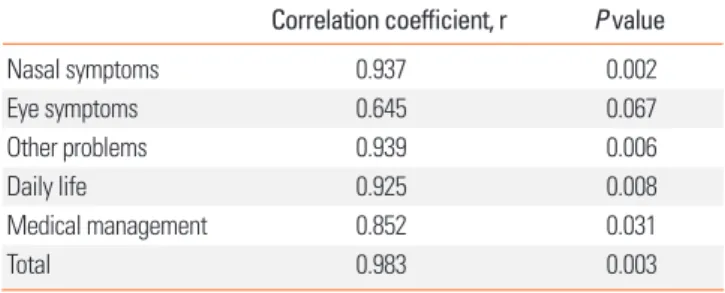
tionship between 3- and 5-point scales of the tool in 7 children with allergic rhinitis. There was a very strong, positive correla- tion between the 3-point and 5-point scales except for eye symptoms (Table 2). Therefore, we used 5-point scales for the tool considering the tool’s sensitivity. The initial QOL tool was administered to 208 children with allergic rhinitis aged 6 years and older. The internal consistency of the tool was very high as measured by a Cronbach’s α of 0.921 (Data were not shown).
Sentence revision
Children aged 6 to 8 years prefer certain words over others in certain sentences. We evaluated the responses of 60 children aged 6 to 8 years to the 63 questions for the 21 items and com- pared the answers they gave when they read the questionnaire by themselves with the answers they gave when the questions were explained to them by the researcher. We selected 21 sen- tences with the highest concordance score between the two re- sponses.
Among the words uncomfortable, bothered, annoyed, and hard, the children preferred the word bothering for going to the hospital, the word hard for headache, and the word annoying for sleep disturbance. For nose symptoms, the children re- sponded to the word uncomfortable instead of hard. In the sen- tences regarding medication, hard and bothered were under- stood with a similar frequency. For the words understood with a similar frequency, both words were used in the completed sentence, such as ‘How hard was it or how much were you bothered…?’. Note that in the sentences written in Korean we used both wordings in one sentence with the conjunction ‘or’.
Final questionnaire Final item selection
The allergic rhinitis group comprised 109 children (Table 3) and the healthy control group comprised 99 children. The mean age of the allergic rhinitis group was 10.1±1.8 years and the mean age of the healthy control group was 10.1±1.7 years.
There was no significant difference in age between the two groups (P=0.98).
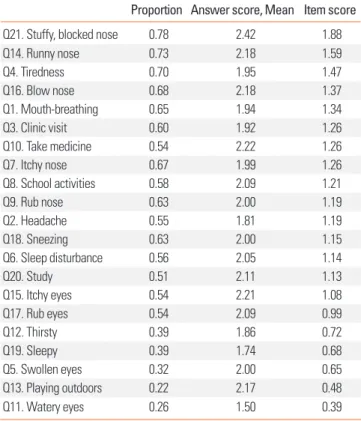
To select practical questions that addressed the discomfort due to the disease of children with allergic rhinitis, the score for each question (item score) was calculated. The results showed that the questions related to nasal symptoms, such as nasal
Table 2. Correlation coefficients between 3 scales and 5 scales of the tool Correlation coefficient, r P value
Nasal symptoms 0.937 0.002
Eye symptoms 0.645 0.067
Other problems 0.939 0.006
Daily life 0.925 0.008
Medical management 0.852 0.031
Total 0.983 0.003
Statistics
Statistical analyses were performed by using SAS (ver. 9.4; SAS Institute Inc., Cary, NC, USA). The internal reliability of the ini- tial questionnaire items was assessed with a Cronbach’s α.
A correlation analysis was conducted between 3- and 5-point scales by a Spearman rank order test. A test for normality of the data was done with a Shapiro-Wilk test. A Wilcoxon rank sum test was applied to investigate differences in medians of answer score between the allergic rhinitis and health control. A Wilcox- on signed rank test was used to compare the median of the NIS and QOL scores before and after the treatment in children with allergic rhinitis. A Spearman rank order test was run to deter- mine the relationship between NIS and QOL scores.
RESULTS
Initial questionnaire Item development
We developed 5 groups of 21 questions regarding nasal symp- toms (6), eye symptoms (4), other problems (3), medical man- agement issues (4), and daily life (4) after a review of preexisting tools and the preliminary survey from pediatric patients, their parents, and professional specialists (Table 1).
A Spearman rank order test was used to determine the rela-
congestion, rhinorrhea, and nose blowing, had high scores (Ta- ble 4). From this analysis, 19 questions with an item score of 0.5 or higher were selected.
In addition, answers from the allergic rhinitis group were com- pared with the answers from the healthy control group. Ten questions with different answer scores between the two groups based on a significance level of 0.05 were selected (Table 5).
Ten questions (6 questions on nasal symptoms, 1 questions on eye symptoms, 2 questions on medical management, and 1 questions on other problems) that had an item score of 0.5 or higher and also had answer score differed significantly between the allergic rhinitis group and the healthy control group were
Table 5. Item and answer scores between allergic rhinitis and control group
Allergic rhinitis group (n=108) Healthy control group (n=53)
P value Item
score
Answer score Item
score
Answer score
Median Mean SD Median Mean SD
Q1. Mouth-breathing 1.26 1 1.94 1.03 0.64 0 1.89 1.02 0.001
Q2. Headache 0.99 1 1.81 1.01 1.23 1 1.86 0.94 0.158
Q3. Clinic visit 1.15 1 1.92 1.15 0.98 1 1.86 1.11 0.405
Q4. Tiredness 1.37 1 1.95 0.99 1.36 1 2.00 1.04 0.883
Q5. Swollen eyes 0.65 0 2.00 0.97 1.36 0 1.73 1.01 0.097
Q6. Sleep disturbance 1.14 1 2.05 1.06 0.83 0 2.00 0.87 0.126
Q7. Itchy nose 1.34 1 1.99 0.97 0.62 0 1.5 0.80 < 0.001
Q8. School activities 1.21 1 2.09 1.09 1.17 1 2.00 1.15 0.663
Q9. Rub nose 1.26 1 2.00 1.07 0.60 0 2.13 0.99 < 0.001
Q10. Take medicine 1.19 1 2.22 1.11 0.60 0 1.78 0.81 0.009
Q11. Watery eyes 0.39 0 1.50 0.88 0.42 0 1.47 0.74 0.764
Q12. Thirsty 0.72 0 1.86 1.09 0.38 0 1.82 0.87 0.030
Q13. Playing outdoors 0.48 0 2.17 1.31 0.38 0 1.67 0.89 0.940
Q14. Runny nose 1.59 1 2.18 1.17 1.00 0 2.04 1.11 0.006
Q15. Itchy eyes 1.19 1 2.21 1.17 0.79 0 1.83 0.94 0.119
Q16. Blow nose 1.47 1 2.18 1.06 0.85 0 1.96 1.19 0.002
Q17. Rub eyes 1.13 1 2.07 1.1 0.72 0 2.00 1.11 0.033
Q18. Sneezing 1.26 1 2.00 1.05 0.66 0 1.67 0.73 0.003
Q19. Sleepy 0.68 0 1.74 1.04 0.47 0 1.47 0.8 0.324
Q20. Study 1.08 1 2.11 1.12 0.87 0 2.19 1.21 0.210
Q21. Stuffy, blocked nose 1.88 2 2.42 1.17 1.04 0 1.77 1.09 < 0.001
Table 4. Item scores in children with allergic rhinitis
Proportion Answer score, Mean Item score
Q21. Stuffy, blocked nose 0.78 2.42 1.88
Q14. Runny nose 0.73 2.18 1.59
Q4. Tiredness 0.70 1.95 1.47
Q16. Blow nose 0.68 2.18 1.37
Q1. Mouth-breathing 0.65 1.94 1.34
Q3. Clinic visit 0.60 1.92 1.26
Q10. Take medicine 0.54 2.22 1.26
Q7. Itchy nose 0.67 1.99 1.26
Q8. School activities 0.58 2.09 1.21
Q9. Rub nose 0.63 2.00 1.19
Q2. Headache 0.55 1.81 1.19
Q18. Sneezing 0.63 2.00 1.15
Q6. Sleep disturbance 0.56 2.05 1.14
Q20. Study 0.51 2.11 1.13
Q15. Itchy eyes 0.54 2.21 1.08
Q17. Rub eyes 0.54 2.09 0.99
Q12. Thirsty 0.39 1.86 0.72
Q19. Sleepy 0.39 1.74 0.68
Q5. Swollen eyes 0.32 2.00 0.65
Q13. Playing outdoors 0.22 2.17 0.48
Q11. Watery eyes 0.26 1.50 0.39
Table 3. Characteristics of subjects with allergic rhinitis (N=109)
Variable n (%) % of CRS
Age, years (Mean±SD) 10.11±1.797
Sex, male/female 67 (62.04)/41 (37.96) Classification of allergic rhinitis
Mild intermittent 17 (15.97) 43.59
Mild persistent 24 (21.93) 56.25
Moderate to severe intermittent 8 (7.02) 61.54 Moderate to severe persistent 60 (55.26) 65.91 CRS, chronic rhinosinusitis,
ultimately selected. With eye symptoms placed in the group of other problems, the final questionnaire was composed of three groups of questions (6 nasal symptoms, 2 other problems, and 2 medical management issues: Q1, 7, 9, 10, 12, 14, 16, 17, 18, and 21). Each question had a 5-point scale; thus, the final QOL as- sessment tool had a score distribution of 0 to 40 (Table 6).
Validation of the tool
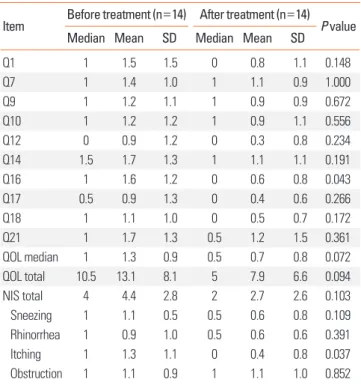
The validity of the final tool with 10 questions was verified in allergic rhinitis patients. The NIS and QOL were assessed in 18 patients diagnosed with allergic rhinitis (mean age, 10.05±1.88 years) before and 2 to 4 weeks after treatment. Although there were no statistically significant difference, the NIS decreased
from 4.4±2.8 before treatment to 2.7±2.6 after treatment (P=
0.103), and QOL improved from 13.1±8.1 to 7.9±6.6. The an- swer scores differed per question before and after the treatment (Table 7).
The correlation coefficient between NIS and QOL was 0.25 (P=0.0125) in allergic rhinitis patients.
Response of the tool
After validation of the tool, 32 children completed the final questionnaire. The average age was 9.6±2.8 years (range 6.8-14, male 20, female 12). The mean time to finish the questionnaire was 102.8±43.2 seconds. Among them, 18 (56.2%) found that it was very ease to answer the questionnaire, 11 (37.5%) somewhat ease, 1 (3%) somewhat difficult, and 1 (3%) very difficult.
DISCUSSION
Allergic rhinitis is not only limited to the physical symptoms of the nose and eyes but also provokes disturbances in the gen- eral well-being of the affected subjects.4 This study aimed to de- velop a questionnaire to measure the disease related QOL of Korean children with allergic rhinitis. Allergic rhinitis is not just a mild disease, because it can lead to or aggravate other diseas- es such as sinusitis, otitis media, and asthma when not properly controlled. Also, considering that its prevalence is continuously increasing compared with the prevalence of asthma2, it is very important to manage it effectively.
Because Korean children have a living environment and life- style that differ from those of children in other countries, the types and symptoms of allergic rhinitis in Korean children might differ as well. Therefore, this study was aimed at develop- ing the QOL-KCAR, which can properly reflect Korean chil- dren’s actual difficulties in daily activities due to their allergic rhinitis. For this tool to be practically used for the management of children with allergic rhinitis, assessment of QOL should be easy and disease-specific. Thus, this study tried to develop a questionnaire comprised of essential disease-specific items.
Table 6. Final questionnaire for assessment of QOL
Items related with rhinitis None (Never) A little Sometimes Often Always
1. How hard was it for you because you had to breathe in and out through your mouth? 0 1 2 3 4
2. How uncomfortable was your itchy nose? 0 1 2 3 4
3. How uncomfortable was it rubbing your nose? 0 1 2 3 4
4. How hard or annoying was taking medication or using nose spray for your allergies? 0 1 2 3 4 5. How hard was it for you to get thirsty after taking medication or spraying it into your nose? 0 1 2 3 4
6. How uncomfortable was your runny nose? 0 1 2 3 4
7. How uncomfortable was it to blow your nose? 0 1 2 3 4
8. How uncomfortable was it to rub your eyes? 0 1 2 3 4
9. How hard was it to have a sneezing? 0 1 2 3 4
10. How uncomfortable was it to have a stuffy nose? 0 1 2 3 4
QOL, quality of life.
Table 7. The comparison between the nasal index score (NIS) and the Quality of Life (QOL) before and after treatment
Item Before treatment (n=14) After treatment (n=14) P value
Median Mean SD Median Mean SD
Q1 1 1.5 1.5 0 0.8 1.1 0.148
Q7 1 1.4 1.0 1 1.1 0.9 1.000
Q9 1 1.2 1.1 1 0.9 0.9 0.672
Q10 1 1.2 1.2 1 0.9 1.1 0.556
Q12 0 0.9 1.2 0 0.3 0.8 0.234
Q14 1.5 1.7 1.3 1 1.1 1.1 0.191
Q16 1 1.6 1.2 0 0.6 0.8 0.043
Q17 0.5 0.9 1.3 0 0.4 0.6 0.266
Q18 1 1.1 1.0 0 0.5 0.7 0.172
Q21 1 1.7 1.3 0.5 1.2 1.5 0.361
QOL median 1 1.3 0.9 0.5 0.7 0.8 0.072
QOL total 10.5 13.1 8.1 5 7.9 6.6 0.094
NIS total 4 4.4 2.8 2 2.7 2.6 0.103
Sneezing 1 1.1 0.5 0.5 0.6 0.8 0.109
Rhinorrhea 1 0.9 1.0 0.5 0.6 0.6 0.391
Itching 1 1.3 1.1 0 0.4 0.8 0.037
Obstruction 1 1.1 0.9 1 1.1 1.0 0.852
To develop such a QOL assessment tool, questions were se- lected after review the previously developed questionnaires. The preexisting QOL tools are the QOL assessment tool for chil- dren6,11,12 with rhinitis and the QOL assessment tool for adult9 with rhinoconjunctivitis. Additional questions were developed after interviews of allergic rhinitis patients and their parents and after having multiple discussions with allergists who treated children with allergic rhinitis.
The initial questionnaire comprised 21 questions that covered the areas of nasal symptoms, eye symptoms, other problems, daily life, and medical management. Each question had a quantitative scale that addressed the subjective difficulties of symptoms or activities related to symptoms instead of the in- tensity or frequency of the symptoms themselves. Score scales were considered to prevent concentration toward the center.
Because 7-point scales can be unsuitable for school children, 3- and 5-point scales were compared. Five-point scales were cho- sen by taking into account the sensitivity of the tool. The vocab- ulary and sentence structure of the selected questions were then modified. Children with allergic rhinitis and second grad- ers at an elementary school were interviewed with the initial questionnaire. We investigated the wording they preferred in sentences. For example, when the question asked, “How hard was it for you to go to a doctor?” some children simply answered
“I did not have a hard time but it was bothersome.” Thus, they used the word bothersome to describe the action of going to a doctor. They used the words hard and annoying with similar fre- quency when discussing medication. In those cases, both words were used to compose the question in Korean. In addition to modify sentences with the best word, we noted on the question- naire that words such as uncomfortable, hard, annoying, and bothering should be understood to have the same meaning to prevent the children from having difficulty in giving accurate answers owing to words.
Each question’s item score was calculated to analyze how much each question reflected the difficulty experienced by chil- dren with allergic rhinitis. The mean answer score of the 21 questions was 1.50-2.42. The score for nasal obstruction was the highest and that for watery eyes was the lowest. Two questions with an item score at or lower than 0.5 (Q13 playing outdoors, and Q11 watery eyes) were excluded from the final question- naire. Items that did not differ significantly between the allergic rhinitis patient group and the healthy control group (Q2 head- ache, Q3 clinic visit, Q4 tiredness, Q5 swollen eyes, Q6 sleep dis- turbance, Q8 school activities, Q11 watery eyes, Q19 sleepiness, and Q20 study) were additionally excluded. Therefore, the final questionnaire comprised 10 questions.
Concerning the excluded questions, headache did not reflect a disease-specific discomfort, because the healthy children had a higher item score than that in the allergic rhinitis patients.
Considering that the subjects were physically active schoolchil- dren, we expected difficulties in playing outside, school activi-
ties, and study compared to healthy children. However, the comparative analysis showed that the difficulties in such activi- ties were not that great, because the item scores were similar between the patient group and the healthy control group in Ko- rean children. These findings are consistent with the results of other studies.6,13
To validate the final questionnaire, the NIS and QOL were as- sessed before and after treatment. As the NIS decreased after treatment, QOL showed improvement. Each item score de- creased after the treatment, thus showing that the question- naire is reliable. The correlation coefficient between NIS and QOL was about 0.25. The poor correlation between QOL and NIS reflects that the degree of objective symptoms and the dis- comfort felt by an individual do not match. About 94% of chil- dren responded that it was “very easy” or “somewhat easy” to answer the question. Response time of the Questionnaire was less than 3 minutes. Thus, the final QOL-KCAR was found to be easy to answer.
This instrument was developed for the evaluation of the qual- ity of life in Korean children with allergic rhinitis. However, this tool was not evaluated to have capacity to distinguish between patients with allergic rhinitis and different groups of patients such as patients with chronic rhinosinusitis. The quality of life by using this tool may not be different between allergic rhinitis and chronic rhinosinusitis since nasal diseases share many symptoms and 20%-75% of patients with allergic rhinitis have chronic rhinosinusitis.14 In this study about 56% of this study’s subjects with allergic rhinitis also had chronic sinusitis. Further studies are needed so that this tool can distinguish the QOL of patients with AR from that in patients with other nasal diseases.
In conclusion, the QOL-KCAR assessment tool comprising 10 questions was developed to assess the practical difficulties ex- perienced in daily activities of Korean children with allergic rhi- nitis. To effectively manage allergic rhinitis, not only the pa- tient’s objective symptoms but also the subjective QOL reflect- ing discomfort due to the disease should be assessed. The QOL- KCAR is expected to be useful as a suitable tool for assessing QOL in Korean children with allergic rhinitis.
ACKNOWLEDGMENTS
This study was supported by a research grant from Inha Uni- versity Environmental Health Center and Inha University. The authors thank the all Inha University Environmental Health Center members and study participants.
REFERENCES
1. Hong SJ, Ahn KM, Lee SY, Kim KE. The prevalences of asthma and allergic diseases in Korean children. Korean J Pediatr 2008;51:343- 50.
2. Jee HM, Kim KW, Kim CS, Sohn MH, Shin DC, Kim KE. Prevalence
of asthma, rhinitis and eczema in Korean children using the Inter- national Study of Asthma and Allergies in Childhood (ISAAC) Questionnaires. Pediatr Allergy Respir Dis 2009;19:165-72.
3. Kakumanu S, Glass C, Craig T. Poor sleep and daytime somnolence in allergic rhinitis: significance of nasal congestion. Am J Respir Med 2002;1:195-200.
4. Leynaert B, Neukirch C, Liard R, Bousquet J, Neukirch F. Quality of life in allergic rhinitis and asthma. A population-based study of young adults. Am J Respir Crit Care Med 2000;162:1391-6.
5. Min YG, Jung HW, Kim HS, Park SK, Yoo KY. Prevalence and risk factors for perennial allergic rhinitis in Korea: results of a nation- wide survey. Clin Otolaryngol Allied Sci 1997;22:139-44.
6. Juniper EF, Howland WC, Roberts NB, Thompson AK, King DR.
Measuring quality of life in children with rhinoconjunctivitis. J Al- lergy Clin Immunol 1998;101:163-70.
7. Organization for Economic Co-operation and Development (FR).
Quality time for students: learning in and out of school. Paris:
OECD Publishing; 2011.
8. Jin JY, Yang HJ, Jeon YH, Kim KW, Kim WK, Par YM, Yoon HS, Yum HY, Pyun BY. Development and validation of the Questionnaire for
Quality-of-Life Specific to Allergic Rhinitis in Korean children (QQOL-ARK): a multicenter study. Korean J Asthma Allergy Clin Immunol 2009;29:242-8.
9. Petersen KD, Kronborg C, Gyrd-Hansen D, Dahl R, Larsen JN, Løw- enstein H. Quality of life in rhinoconjunctivitis assessed with ge- neric and disease-specific questionnaires. Allergy 2008;63:284-91.
10. Jung MK, Hong SJ, Lee SH, Hong SJ, Son JW, Kang W, Lee YW, Hong CS, Lee JK, Park JW. Development and validation of a Kore- an Allergic Rhinitis-Specific Quality of Life Questionnaire (KAR- QLQ). Korean J Asthma Allergy Clin Immunol 2008;28:113-20.
11. Juniper E. Rhinitis and quality of life. Rev Fr Allergol 2001;41:111-5.
12. Meltzer EO. Quality of life in adults and children with allergic rhini- tis. J Allergy Clin Immunol 2001;108:S45-53.
13. Meltzer EO, Nathan RA, Seiner JC, Storms W. Quality of life and rhinitic symptoms: results of a nationwide survey with the SF-36 and RQLQ questionnaires. J Allergy Clin Immunol 1997;99:S815-9.
14. Berrettini S, Carabelli A, Sellari-Franceschini S, Bruschini L, Abru- zzese A, Quartieri F, Sconosciuto F. Perennial allergic rhinitis and chronic sinusitis: correlation with rhinologic risk factors. Allergy 1999;54:242-8.