ISSN 2234-3806 • eISSN 2234-3814
http://dx.doi.org/10.3343/alm.2016.36.3.271 www.annlabmed.org 271
Ann Lab Med 2016;36:271-274
http://dx.doi.org/10.3343/alm.2016.36.3.271
Letter to the Editor
Clinical Chemistry
Influence of Vitamin C and Maltose on the Accuracy of Three Models of Glucose Meters
Jooyoung Cho, M.D.1, Sunyoung Ahn, M.D.1, Jisook Yim, M.D.1, Younjung Cheon, M.T.2, Seok Hoon Jeong, M.D.2, Sang-Guk Lee, M.D.1, and Jeong-Ho Kim, M.D.1
Department of Laboratory Medicine1, Severance Hospital, Yonsei University College of Medicine, Seoul; Department of Laboratory Medicine2, Gangnam Severance Hospital, Yonsei University College of Medicine, Seoul, Korea
Dear Editor,
Glucose meters are increasingly used in hospitals and home settings. These handheld devices provide instant readings and are therefore, beneficial for glucose-level monitoring in patients with diabetes [1]. Nonetheless, there have been concerns re- garding the measurement accuracy of glucose meters. Some substances, such as vitamin C and maltose, are considered re- sponsible for errors in glucose measurements using point-of- care testing glucose meters [1-3]. Vitamin C is widely used in the treatment of cancer, viral infections, severe burns, and chronic fatigue syndrome because of the antioxidant effects [4].
Maltose can be upregulated in patients undergoing peritoneal dialysis involving icodextrin as an osmotic agent [3]. High con- centrations of vitamin C and maltose in blood can lead to false increase in glucose meter readings, resulting in misdiagnosis of hypoglycemia and potential fatalities [1]. Therefore, there is an urgent need for interference-resistant glucose meters [5]. We evaluated the interference of vitamin C and maltose with glu- cose readings obtained using the following three meters: Ac- cuchek Inform (Roche Diagnostics, Indianapolis, IN, USA), Starstrip (Nova Biomedical, Waltham, MA, USA), and Barozen H plus (i-SENS Inc., Seoul, Korea). These three models are based on the glucose dehydrogenase-pyrroloquinoline quinone
(GDH-PQQ), modified glucose oxidase (GOD), and GDH-flavin adenine dinucleotide (FAD) assays, respectively [5, 6].
After prior depletion of glucose by overnight storage at room temperature, we prepared three pooled blood specimens [4]
from EDTA-treated whole blood samples and added glucose (CAS 50-99-7, Duksan Pure Chemicals Co., Ansan, Korea) at fi- nal concentrations of 60, 126, or 300 mg/dL. To study the effect of various concentrations of vitamin C (0, 3, 15, or 30 mg/dL) [7] or maltose (0, 10, 40, 200, or 500 mg/dL) [8], we added 0.15 mL of the vitamin C or maltose stock solutions (control:
normal saline) to 3 mL of pooled blood specimens. The stock solutions were prepared from L-ascorbic acid (CAS 50-81-7, Sigma-Aldrich, St. Louis, MO, USA) and D (+) -maltose mono- hydrate (CAS 6363-53-7, Junsei Chemical Co., Tokyo, Japan).
Then, we compared the whole blood glucose readings of the specimens, with and without an interfering substance, using three glucose meters. We also measured the plasma glucose levels in each sample with Hitachi 7600 chemistry analyzer (Hi- tachi, Tokyo, Japan) for a benchmark comparison. Each sample was tested in duplicate. Assessment of interference and accu- racy for each glucose meter was performed according to the criteria of the International Organization for Standardization (ISO) 15197:2013(E) [9].
Received: October 29, 2015
Revision received: December 26, 2015 Accepted: February 11, 2016 Corresponding author: Sang-Guk Lee
Department of Laboratory Medicine, Severance Hospital, Yonsei University College of Medicine, 50-1 Yonsei-ro, Seodaemun-gu, Seoul 03722, Korea Tel: +82-2-2228-2455, Fax: +82-2-364-1583
E-mail: [email protected]
© The Korean Society for Laboratory Medicine.
This is an Open Access article distributed under the terms of the Creative Commons Attribution Non-Commercial License (http://creativecommons.org/licenses/by-nc/3.0) which permits unrestricted non-commercial use, distribution, and reproduction in any medium, provided the original work is properly cited.
Cho J, et al.
Possible interferents on glucose meter
272 www.annlabmed.org http://dx.doi.org/10.3343/alm.2016.36.3.271 Accuchek Inform glucose level readings at all concentrations
were subject to significant positive interference ( >10% devia- tion from control sample levels) from vitamin C presence at con-
centrations of 15 and 30 mg/dL, whereas no significant positive interference was observed for Barozen H plus and Starstrip models (Fig. 1). However, Starstrip failed to produce readings in Fig. 1. Glucose level measurements in different concentrations of interferents. Glucose was added to blood at various concentrations: low (60 mg/dL), medium (126 mg/dL), and high (300 mg/dL). The X-axis represents the level of interferent, and the Y-axis represents the level of glucose. Experiments with vitamin C as an interferent are shown in (A), (B), and (C). Experiments with maltose are shown in (D), (E), and (F).
Three models of glucose meters were evaluated: Accuchek Inform (Roche Diagnostics), Starstrip (Nova Biomedical), and Barozen H plus (i-SENS Inc.). Hitachi 7600 chemistry analyzer (Hitachi) was used for a benchmark comparison.
200 160 120 80 40 0
400 360 320 280 240 200
280 240 200 160 120 80
200 160 120 80 40 0
400 360 320 280 240 200 280
240 200 160 120 80
0 3 15 30
0 3 15 30
0 3 15 30
0 10 40 200 500
0 10 40 200 500 0 10 40 200 500
Vitamin C (mg/dL)
Vitamin C (mg/dL)
Vitamin C (mg/dL)
Maltose (mg/dL)
Maltose (mg/dL) Maltose (mg/dL)
Vitamin C interference study Low glucose (60 mg/dL)
Vitamin C interference study High glucose (300 mg/dL)
Vitamin C interference study Medium glucose (126 mg/dL)
Maltose interference study Low glucose (60 mg/dL)
Maltose interference study High glucose (300 mg/dL) Maltose interference study
Medium glucose (126 mg/dL)
Measured glucose (mg/dL)Measured glucose (mg/dL) Measured glucose (mg/dL)Measured glucose (mg/dL)Measured glucose (mg/dL)
Measured glucose (mg/dL)
A
C
B
D
F E
Roche Accuchek Barozen H Plus Nova Starstrip Hitachi 7600
Roche Accuchek Barozen H Plus Nova Starstrip Hitachi 7600
Roche Accuchek Barozen H Plus Nova Starstrip Hitachi 7600
Cho J, et al.
Possible interferents on glucose meter
http://dx.doi.org/10.3343/alm.2016.36.3.271 www.annlabmed.org 273
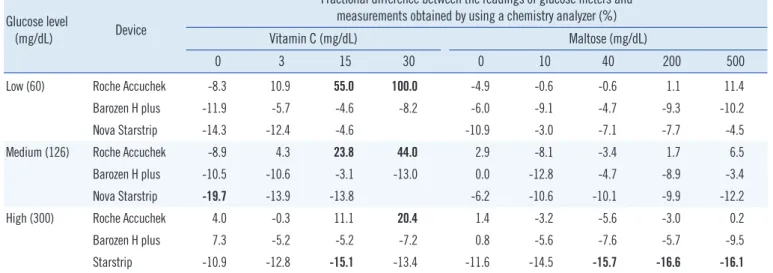
Table 1. Accuracy of whole-blood glucose concentration readings using three glucose meter models compared with the measurements ob- tained by using a chemistry analyzer
Glucose level
(mg/dL) Device
Fractional difference between the readings of glucose meters and measurements obtained by using a chemistry analyzer (%)
Vitamin C (mg/dL) Maltose (mg/dL)
0 3 15 30 0 10 40 200 500
Low (60) Roche Accuchek -8.3 10.9 55.0 100.0 -4.9 -0.6 -0.6 1.1 11.4
Barozen H plus -11.9 -5.7 -4.6 -8.2 -6.0 -9.1 -4.7 -9.3 -10.2
Nova Starstrip -14.3 -12.4 -4.6 -10.9 -3.0 -7.1 -7.7 -4.5
Medium (126) Roche Accuchek -8.9 4.3 23.8 44.0 2.9 -8.1 -3.4 1.7 6.5
Barozen H plus -10.5 -10.6 -3.1 -13.0 0.0 -12.8 -4.7 -8.9 -3.4
Nova Starstrip -19.7 -13.9 -13.8 -6.2 -10.6 -10.1 -9.9 -12.2
High (300) Roche Accuchek 4.0 -0.3 11.1 20.4 1.4 -3.2 -5.6 -3.0 0.2
Barozen H plus 7.3 -5.2 -5.2 -7.2 0.8 -5.6 -7.6 -5.7 -9.5
Starstrip -10.9 -12.8 -15.1 -13.4 -11.6 -14.5 -15.7 -16.6 -16.1
The values in bold represent the values that deviated by more than 15% from those determined by a chemistry analyzer.
two out of three measurements in specimens, which contained 30 mg/dL vitamin C (Fig. 1). In contrast to the effect of vitamin C, no significant interference at any maltose concentration was noted for all the three models tested (Fig. 1). Owing to interfer- ence from high concentrations of vitamin C (15 and 30 mg/dL), Accuchek Inform showed unacceptable accuracy levels ( >
15% difference from the value obtained by the chemistry ana- lyzer; Table 1). Starstrip generally showed lower readings than those determined by the chemistry analyzer, especially at higher glucose concentrations: a negative bias >15% was detected in four out of nine measurements (Table 1).
Vitamin C is a strong antioxidant that inactivates free radicals and can be oxidized at the surface of electrochemical strips pro- ducing electrons and increasing the current [1]. Icodextrin, an osmotic agent used in peritoneal dialysis, is metabolized in the systemic circulation into various glucose polymers, mainly malt- ose [10]. It can interfere with readings obtained using GDH- PQQ-based method, because GDH-PQQ catalyzes the oxidation of not only glucose but also other sugars [1]. Thus, vitamin C and maltose can cause positive interference resulting in misdi- agnosis of true glucose levels. However, GDH currently used in Accuchek Inform was modified by the manufacturer to increase enzyme specificity for glucose and to diminish probability of in- correct high glucose readings [8]. In this study, all three glucose meters showed reliable results in presence of maltose. However, at higher vitamin C concentrations, Accuchek Inform showed a positive bias, while Starstrip occasionally malfunctioned.
In conclusion, high concentrations of vitamin C may affect
blood glucose measurements depending on the glucose meter used. Therefore, caution is required while monitoring the glucose level, using a glucose meter, of patients receiving high dose of vi- tamin C. There is a need for continuous technical improvement and further studies for possible interferents of glucose meters.
Authors’ Disclosures of Potential Conflicts of Interest
No potential conflicts of interest relevant to this article were re- ported.
REFERENCES
1. Yoo EH and Lee SY. Glucose biosensors: an overview of use in clinical practice. Sensors 2010;10:4558-76.
2. Kim SK, Hahm JR, Kim HS, Kim S, Jung TS, Jung JH, et al. Spurious elevation of glucose concentration during administration of high dose of ascorbic acid in a patient with type 2 diabetes on hemodialysis. Yonsei Med J 2013;54:1289-92.
3. Riley SG, Chess J, Donovan KL, Williams JD. Spurious hyperglycaemia and icodextrin in peritoneal dialysis fluid. BMJ 2003;327:608-9.
4. Moon HW, Kim JY, Kang ES, Chung WS. Interference with the measure- ment of blood glucose in different systems after intravenous high dose ascorbic acid supplement. Korean J Lab Med 2005;25:294-9.
5. Heller A and Feldman B. Electrochemical glucose sensors and their ap- plications in diabetes management. Chem Rev 2008;108:2482-505.
6. Kim YB, Seo JY, Lee SY, Park HD. Performance evaluation of glucome- ter Barozen H based on ISO 15197 standards. Lab Med Online 2015;
5:6-14.
7. Tang Z, Du X, Louie RF, Kost GJ. Effects of drugs on glucose measure- ments with handheld glucose meters and a portable glucose analyzer.
Cho J, et al.
Possible interferents on glucose meter
274 www.annlabmed.org http://dx.doi.org/10.3343/alm.2016.36.3.271 Am J Clin Pathol 2000;113:75-86.
8. Ng WY, Tiong CC, Jacob E. Maltose interference-free test strips for blood glucose testing at point-of-care: a laboratory performance evalua- tion. Diabetes Technol Ther 2010;12:889-93.
9. International Organization for Standardization. In vitro diagnostic test systems: Requirements for blood-glucose monitoring systems for self-
testing in managing diabetes mellitus. ISO 15197. Geneva: ISO, 2013(E).
10. Floré KM and Delanghe JR. Analytical interferences in point-of-care testing glucometers by icodextrin and its metabolites: an overview. Perit Dial Int 2009;29:377-83.