275 Korean Chem. Eng. Res., 55(2), 275-278 (2017)
https://doi.org/10.9713/kcer.2017.55.2.275 PISSN 0304-128X, EISSN 2233-9558
단 신
Modeling on Hydrogen Effects for Surface Segregation of Ge Atoms during Chemical Vapor Deposition of Si on Si/Ge Substrates
Kee-Youn Yoo and Hyunsik Yoon†
Department of Chemical and Biomolecular Engineering, Seoul National University of Science & Technology, 232, Gongneung-ro, Nowon-gu, Seoul, 01811, Korea
(Received 18 November 2016; Received in revised form 6 December 2016; accepted 12 December 2016)
Abstract − Heterogeneous semiconductor composites have been widely used to establish high-performance microelec- tronic or optoelectronic devices. During a deposition of silicon atoms on silicon/germanium compound surfaces, germanium (Ge) atoms are segregated from the substrate to the surface and are mixed in incoming a silicon layer. To suppress Ge segregation to obtain the interface sharpness between silicon layers and silicon/germanium composite layers, approaches have used silicon hydride gas species. The hydrogen atoms can play a role of inhibitors of silicon/germanium exchange.
However, there are few kinetic models to explain the hydrogen effects. We propose using segregation probability which is affected by hydrogen atoms covering substrate surfaces. We derived the model to predict the segregation probability as well as the profile of Ge fraction through layers by using chemical reactions during silicon deposition.
Key words: Silicon, Germanium, Segregation, Hydrogen, Chemical reaction
1. Introduction
Microelectronic and optoelectronic devices often need inter- faces between two different materials to be clearly defined [1-4].
However, the interface sharpness may be degraded when one of the components of a multicomponent material segregates to the sur- face. Surface segregation of a constituent can be observed during a deposition, and it originates from the difference of the surface ener- gies of the materials [5-13]. Especially, germanium atoms often segregate during the deposition of silicon on a silicon/germanium (Si/Ge) heterogeneous surface due to the surface energy reduction.
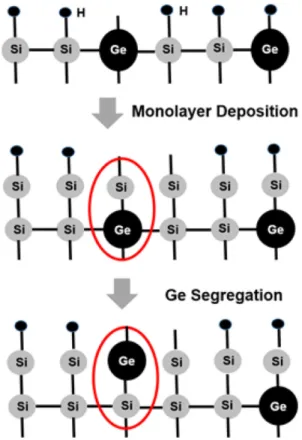
To understand the mechanism of the surface segregation, the two- state-exchange model has been described [7]. From the theory, a complete monolayer is assumed to be formed instantaneously, then, there are exchange events during the time interval required to coat the monolayer. There have been several reports to use the model for predicting the Ge distribution during solid source molecular beam epi- taxy (MBE), and they can successfully explain the Ge incorpora- tion during alloy layer deposition [8]. To overcome the degradation of the interface sharpness from solid source MBE, there have been methods to use gas-source MBE or chemical vapor deposition [8- 13]. From the techniques, they can produce high-quality interface due to the utilization of gaseous hydrides. Although they discussed the hydrogen effects on the segregation of Ge, however, there has not been a kinetic model to predict the segregation during gas-source MBE. In this work, we propose a model explaining the surface seg-
regation of germanium atoms during GSMBE Si overlayer growth on a heterogeneous SiGe alloy substrate. This model uses a possi- bility concept of the segregation and shows that hydrogen atoms covering the substrate surfaces can reduce it. The model is in good agreement with experimental data obtained from other groups.
And we describe the hydrogen coverage effect on Ge profile during silicon deposition.
2. Results and Discussion
In the two-state exchange model [7-11], a Si monolayer is depos- ited at a time completely, and only Ge atoms of the surface front can contribute to the segregation with the deposited Si atoms on the Ge atoms during the time interval required Si monolayer. Exchange of Ge and Si atoms at the bulk state could be neglected since its acti- vation barriers are much larger than the activation energies for the surface segregation [11]. In this work, we calculated the Ge frac- tion during Si deposition on a Si/Ge heterogeneous surface by a gaseous source such as disilane. The ratio of surface concentra- tions of Ge and Si on the growth front (n+1th layer) is obtained by the germanium concentration segregated from the nth layer and the silicon concentration is given by the summation of Si deposition rate to n+1th layer and the inverse reaction of segregation of ger- manium atoms in the n+1th layer and the consumption of silicon atoms exchanged with germanium atoms in the nth layer. The rela- tion can be derived as below.
(1) where CSi,n and CGe,n are the solid concentrations of Si and Ge atoms in the nth layer, Csi is the concentration of Si from incoming
CGe n 1, + CSi n 1, +
--- KCGe n, CSi–KCGe n, ---
†To whom correspondence should be addressed. = E-mail: [email protected]
This is an Open-Access article distributed under the terms of the Creative Com- mons Attribution Non-Commercial License (http://creativecommons.org/licenses/by- nc/3.0) which permits unrestricted non-commercial use, distribution, and reproduc- tion in any medium, provided the original work is properly cited.
276 Kee-Youn Yoo and Hyunsik Yoon
Korean Chem. Eng. Res., Vol. 55, No. 2, April, 2017
disilane. K is the segregation probability proposed by Li et al. [12]
K = k/(k + k-1) (2)
where, k is the rate constant for the segregation, k-1 is the rate con- stant for the reverse reaction of the segregation.
(3)
(4)
ω0 is the vibration frequency, Ea is the activation energy for the Ge segregation and Es is the Gibbian free energy of segregation.
We put the Ea and Es as 1.63 eV and 0.28 eV, which are determined by Fukatsu et al. [7-11].
When we consider the effects of hydrogen covering silicon sur- faces on the segregation probability K, we modified it as below.
(5)
where θ is the hydrogen coverage. In this model, we assumed that two vacant sites are needed for the exchange between silicon and germanium. When we divide with the total surface concentration of a monolayer Ctot, which is equal to Csi if there is only silicon atoms in incoming flux, Eq. (1) is changed to
(6)
where xn is the fraction of germanium in nth layer. After rearrange-
ment of the Eq. (6), the relation of xn+1 and xn can be derived as below.
(7) When we solve the Eq. (7), we can obtain the Ge fraction of n- th layer as below.
(8) To verify the model proposed, we compared with experimental data obtained from previous reports of other groups, especially to explain the hydrogen effects during Si deposition on a SiGe het- erogeneous substrate. In the gas-source MBE, we used a hydride reactant such as disilane. Gate et al. explained chemisorption mecha- nism with silane or disilane [14,15]. In the chemical vapor depo- sition [16,17], first, disilane atoms are adsorbed on the substrate.
Hydrogen atoms partially cover the substrates, but do not termi- nate the Ge atoms. It has been reported that the hydrogen atoms are desorbed at 425 °C on Ge surfaces and at 500~600 °C on Si surface [13]. When we consider the deposition condition above 450 °C, the assumption that hydrogen atoms do not terminate Ge atoms is reasonable. Adsorbed SiHx atoms react so fast, become the adsorbed SiH molecules. Then the adsorbed SiH molecules react with each other, then hydrogen desorption occurs between two SiH molecules.
Si2H6(g) + 2 Si (s) (or Ge) → 2 SiH3(s) (9) SiH3 (s) + Si (S) → H(s) + SiH2 (s) (10)
2SiH2 (s) → 2SiH(s) + H2 (g) (11)
2SiH (s) → 2Si(s) + H2 (g) (12)
where Si(s) refers to a vacant site of a silicon substrate, and SiH3(s), SiH2(s), SiH(s) are the adsorbed sites by the ad-species. Typically, the surface reactions of (10), (11) can be assumed to be very fast compared with the adsorption of reactants (9) and the hydrogen desorption step (12) [18]. In the steady-state, the adsorption rate is equal to the desorption rate and the growth rate as below.
(13) where kad is the rate constant for the adsorption of disilane, PSi2H6 is the partial pressure of disilane and kd is the rate constant of hydrogen desorption and θ is the fraction of sites covered by hydrogen atoms. The rate constant for the adsorption and hydro- gen desorption is given by [16]
kad = (2pmkBT)-0.5 (14)
(15)
where m is the mass of disilane, Ed is the activation energies for desorption of hydrogen molecules and the value can be obtained as 52 kcal/mol [16]. From Equation (13), we could obtain the relation of the hydrogen coverage θ with the partial pressure of disilane and the substrate temperature as below.
k ω0exp Ea kBT ---
⎝– ⎠
⎛ ⎞
=
k–1 ω0exp Ea+Es kBT ---
⎝– ⎠
⎛ ⎞
=
K k 1( –θ)2 k 1( –θ)2+k–1 ---
=
xn 1+ 1 x– n 1+ --- Kxn
1 Kx– n ---
=
xn 1+ =Kxn
xn=x1Kn 1–
RSi=kadPSi2H6=2kdθ2
kd Bexp Ed kBT ---
⎝– ⎠
⎛ ⎞
=
Fig. 1. Schematic illustration Ge segregation during Si deposition.
Modeling on Hydrogen Effects for Surface Segregation of Ge Atoms during Chemical Vapor Deposition of Si on Si/Ge Substrates 277
Korean Chem. Eng. Res., Vol. 55, No. 2, April, 2017 (16)
Figure 2 shows the relation of hydrogen coverage and pressure, temperature. The hydrogen coverage increases with increasing the partial pressure of disilane. The reason for decrease of hydrogen coverage in high temperature is that hydrogen molecules are desorbed from the substrate easily.
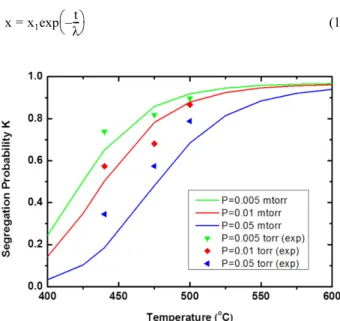
As discussed in Equation (5), Ge segregation parameter K should be dependent on the hydrogen coverage. For example, if the hydrogen atom covers silicon atoms, it is difficult to be exchanged with germanium atoms due to the lack of dangling bonds of silicon atoms. When we consider the hydrogen coverage effects on the segregation, the segregation probability K depends on the partial pressure of disilane and substrate temperature. To compare with experimental data from Zaima, et al. [13], we transformed the decay length to the probability parameter. Zaima et al. used expo- nential decay described as [13].
(18)
where t is the distance from the substrate and l is the decay length.
The relation between the probability parameter K and the decay length l can be derived as below.
(19)
Fig. 3 shows a graph of segregation parameter K, which is con- trolled by a partial pressure of disilane and a substrate temperature.
The segregation is suppressed at low temperature and high partial pressure of disilane. Also, the model can predict the experimental results with good agreement. From the model, we can predict the profile of Ge concentration through the layer. As shown in Fig. 4, we can obtain sharp interface in low temperature and high partial pres- sure of disilane.
3. Conclusions
We established a model to predict the hydrogen effects on Ge segregation events. By using a segregation probability scheme, we modified the probability parameter by considering the vacant sites, which are not covered by hydrogen atoms. We derived the hydro- gen coverage by kinetic reactions, and the model shows a good agreement with experimental results. From the model, we can pre- dict the Ge fraction profile through layers in different partial pres- sures of disilane and substrate temperatures.
θ 1
1+ 2kd/ k( adPSi2H6) ---
=
x x1exp t λ---
⎝ ⎠–
= ⎛ ⎞
K exp 1
λ---
⎝ ⎠–
= ⎛ ⎞ Fig. 2. Graph of hydrogen coverage on a partial pressure of disilane
and a substrate temperature.
Fig. 3. Graph of segregation probability K with different disilane par- tial pressure and temperature.
Fig. 4. Graph of Ge fraction profile through layers with different (a) partial pressure of disilane and (b) substrate temperature.
278 Kee-Youn Yoo and Hyunsik Yoon
Korean Chem. Eng. Res., Vol. 55, No. 2, April, 2017
References
1. Moutanabbir, O. and Gösele, U., “Heterogeneous Integration of Compound Semiconductors,” Annu. Rev. Mater. Res., 40, 469- 500(2010).
2. Heyns, M. and Tsai, W., “Ultimate Scaling of CMOS Logic Devices with Ge and III-V Materials,” MRS Bull., 34(7), 485-488(2009).
3. Pearsall, T. P., Bevk, J., Feldman, L. C., Bonar, J. M. and Man- nerts, J. P., “Structually Induced Optical Transitions in Ge-Si Superlattices,” Phys. Rev. Lett., 58(7), 729(1987).
4. Li, J.-Y., Huang, C.-T., andSturm, J. C., “The Effect of Hydrogen on the Surface Segregation of Phosphorus in Epitaxially Grown Relaxed Si0.7Ge0.3 Films by Rapid Thermal Chemical Vapor Depo- sition,” Appl. Phys. Lett., 101(14), 142112(2012).
5. Johll, H., Samuel, M., Koo, R. Y., Kang, H. C., Yeo, Y.-C. and Tok, E. S., “Influence of Hydrogen Surface Passivation on Sn Segre- gation, Aggregation, and Distribution in GeSn/Ge(001) Materi- als,” J. Appl. Phys., 117(20), 205302(2015).
6. Harris, J. J., Ashenford, D. E., Foxon, C. T., Dobson, P. J. and Jpyce, B. A., “Kinetic Limitations to Surface Segregation During MBE Growth of III-V Compounds:Sn in GaAs,” Appl. Phys. A, 33(2), 87(1984).
7. Fukatsu, S., Fujita, K., Yaguchi, H., Shiraki, Y. and Ito, R., “Selflim- itation in the Surface Segregation of Ge Atoms During Si Molecular Beam Epitaxial Growth,” Appl. Phys. Lett., 59(17), 2103(1991).
8. Godbey, D. and Ancona, M., “Ge segregation During the Growth of a SiGe Buried Layer by Molecular Beam Epitaxy,” Vac. Sci. Technol.
B, 11(3), 1120(1993).
9. Ohtani, N., Mokler, S., Xie, M. H., Zhang, J. and Joyce, B. A.,
“Surface Hydrogen Effects on Ge Surface Segregation During Sili- con Gas Source Molecular Beam Epitaxy,” Jpn. J. Appl. Phys., 33, 2311(1994).
10. Ohtani, N., Mokler, S., Xie, M. H., Jhang, J. and Joyce, B. A.,
“RHEED Investigation of Ge Surface Segregation During Gas Source MBE of Si/Si1-xGex Heterostructures,” Surf. Sci., 284(3), 305 (1993).
11. Ohtani, N., Mokler, S. and Joyce, B. A., “Simulation Studies of Ge Surface Segregation During Gas Source MBE Growth of Si/
Si1-xGex Heterostructures,” Surf. Sci., 295(3), 325(1993).
12. Li, Y., Hembree, G. and Venables, J. A., “Quantitative Auger Elec- tron Spectroscopic Analysis of Ge Surface Segregation in Si/Ge/
Si(100) Heterostructures,” Appl. Phys. Lett., 67(2), 276(1995).
13. Zaima, S., Kato, K., Kitani, T., Matsuyama, T., Ikeda, H. and Yasuda, Y., “Surfactant Effect of H Atoms on the Suppression of Ge Segregation in Si Overgrowth on Ge (n ML)/Si(100) Substrates by Gas Source Molecular Beam Epitaxy,” J. Cryst. Growth., 150, 944(1995).
14. Gates, S. M., Greenlief, C. M., Beach, D. B. and Holbert, P. A.,
“Decomposition of Silane on Si(111)-(7*7) and Si(100)-(2*1) Surfaces Below 500 Degrees C,” J. Chem. Phys., 92(5), 3144(1990).
15. Gates, S. M. and Kulkarni, S. K., “Kinetics of Surface Reac- tions in Very Low-Pressure Chemical Vapor Deposition of Si From SiH4,” Appl. Phys. Lett., 58(25), 2963(1991).
16. Park, S.-S., Park, J.-H., Kim, S.-J. and Jung, S.-C., “The Micro- wave-assisted Photocatalytic Degradation of Methylene Blue Solution Using TiO2 Balls Prepared by Chemical Vapor Depo- sition,” Korean Chem. Eng. Res., 46(6), 1063-1068(2008).
17. Hong, J.-H., Kim, S.-H. and Hahn, Y.-B., “Formation of Si Nano Dots and Silicon Carbon Nitride Films by Plasma Enhanced Chemical Vapor Deposition,” Korean Chem. Eng. Res., 42(4), 447-450(2004).
18. Hu, X. F., Xu, Z., Dim, D., Downer, M. C., Parkinson, P. S., Gong, B., Hess, G. and Ekerdt, J. G., “In situ Optical Second-harmonic- generation Monitoring of Disilane Adsorption and Hydrogen Desorption During Epitaxial Growth on Si (001),” Appl. Phys.
Lett., 71(10), 1376(1997).