Ⅰ. 서 론
치과용 시멘트는 치과보철물의 합착, 와동이장재, 단 열재, 일시충전재, 근관충전재, 치수 및 지추질환처치등 그 사용목적에 따라 10여종 이상으로 분류되고 있으며, 근래에는 인산아연계 시멘트 보다 자극이 적은 아연화유 지놀계, 카복실레이트계 시멘트를 사용하는 경향이 점차 증가되고 있다.
치과보철물의 유지는 주조체의 유지형태나 적합성에 따라 차이가 있으나 차이경조직이나 보철물과 치과용 시 멘트 사이의 접착력에 따라서도 크게 달라진다.
치과용 시멘트의 접착과 유지력에 관하여는 Swartz와 Phillips(1), Buonocore(8), Myers외 3인(9), Fusayama외 2인(10), Oldham외 2인(13), Mizrahi와 Smith(21, 23), Phillips외 2인(24), Richter외 2인(26), Lee외 3인(30), Williams와 Smith(31), Stevens(51), Maldonado외 2인
(66), Arfaei와 Asgar(67)및 Fusayama외 3인(68)등의 연구 보고가 있는데 Kaufman외 2인(5), Ady와 Fairhurst(42), Moser외 2인(48), Barton외 3인(53)및 Saito외 3인(61)등은 치과용 합금과의 접착력을 측정하였고, Buonocore(2), Buonocore외 2인(3), Davidson(4), Myers외 2인(7), Bowen(11, 12, 14, 15, 16, 17), Mizrahi와 Smith(21), Brauer와 Termini(35), Beech(34, 36, 41), Chan외 2인(56), Causton외 2인(57), Levine외 2인(65), Jedrychowski외 2인(69), 및 Caston과 Johnson(71)등은 치아경조직과의 접착 및 유 지력을 실험한 바 있다.
치과용 카복실레이트계 시멘트에 관하여는 Smith(18,
28)가 발표한 이래 Mortimer와 Tranter(20), Phillips외 2
인(24) 및 Powers외 2인(46)등은 물리적 및 역학적 성질에
관하여, Friend(19), Kafalias외 2인(50) 등은 조작차이에
의한 특성의 변화를, McLean(38)은 5년간의 임상성적 등 을 보고한 바 있으며, Moser외 3인(60)은 경화시의 열 반 응에 관하여, Truelore외 2인(32), Jendressen과 Trowbridge(40) 등은 생물학적 평가를 하였고 Beagrie외 2인(39), Plant(25) 및 Barnes와 Turner(29), El- Kafrawy(47) 등은 치수에 대한 영향을, Mizrahi와 Smith(23)는 결합강도를, Lawrence와 Swith(43)는 충전 재를 넣을 때의 강도 변화를, Brown과 Combe(44)는 스 테인레스스틸의 충전재를 넣었을 때의 영향을 보고하였 으며, Barton외 3인(53)은 탄성이 높은 티탄산칼슘 (potassium titanate)을 넣을 때 역학적 성질이 크게 증 가함을 보고하였으며, Ady와 Fairhurst(42), Saito외 3인
(61), Moser외 2인(65), Causton과 Johnson(71)등은 상아질 과의 접착성 등을 보고한 바 있다.
그러나 국내 치과계에서는 치과용 시멘트의 제반 실험 에 관하여는 김(33,62,70), 장(37), 김(45, 58), 조(54), 김(55), 이(59),
윤(63) 등의 보고가 있으나 접착력 측정에 관한 자료는 희
소한 실정이다.
따라서 본 실험은 현재 한국치과계에서 그 사용이 증 가되고 있는 각종 치과용 카복실레이트계 시멘트를 재료 로 10여종의 치과용 합금 및 치아경조직과 상호간 결합 시켰을 때 나타나는 접착력을 Instron시험길르 이용하여 인산아연계 시멘트와 비교 측정한 바 있어 그 결과를 발 표하는 바이다.
Ⅱ. 실험재료 및 방법
1. 시편제작
현재 국내에서 사용되고 있는 치과용 카복실레이트계
※ 본 논문의 요지는 1979년 11월 27일 제31회 대한치과의사협회 종합학술대회에서 발표하였음.
- 대한 치과 보철학회지 Vol. 17 No. 1, 1979 -
카복실레이트계 시멘트의 접착력에 관한 비교 연구※
서울대학교 대학원 치의학과 보철학전공
<지도교수 장 완 식>
이 한 무
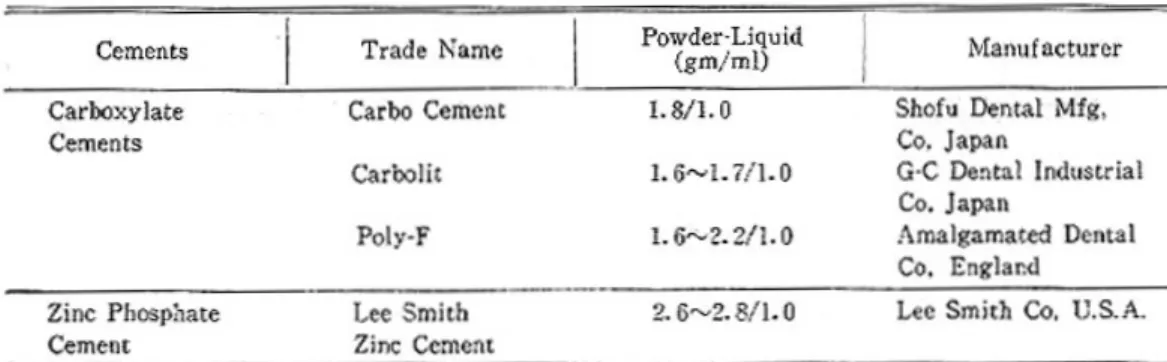
시멘트에서 3종, 인산아엔계 시멘트에서 1종등, 4종을 실험재료로 하여(제1표), 치과용 합금으로 사용되는 금, 파라듐, 은. 인디움, 동, 니켈, 크롬 및 도재용 합금등 10 여종의 합금(제2표)과 영구치의 법랑질, 상아질등 치아경 조직을 대상으로 상호간을 결합시켰을 때의 접착력을 측 정하기 위하여 합금시편은 Mortimer와 Tranter(20), Mizrahi와 Smith(21), Ady와 Fairhurst(42), Moser외 2 인(48), Saito외 3인(61)및 Arfaei와 Asgar(67)등의 방법에 따라 8.0㎜×3.0㎜의 시편제작용 주형(제1도)에서 얻은 왁스시편을 주조하여 제작하였고, 치아경조직 시편은 Bowen과 Rodriguez(6), Oldham외 2인(13), Mizrahi와 Smith(21, 23), Grieve(22), Phillips외 2인(24), Richter외 2 인(26), Beech(36, 41), Kafalias외 2인(50), Chan외 2인(56),
Table 1 : Cements used.
Table 2 : Alloys used.
Fig. 1
(Upper) Mold for preparation of adhesive strength test specimens.
(Lower) Schematic sections of the adhesive strength test specimens.
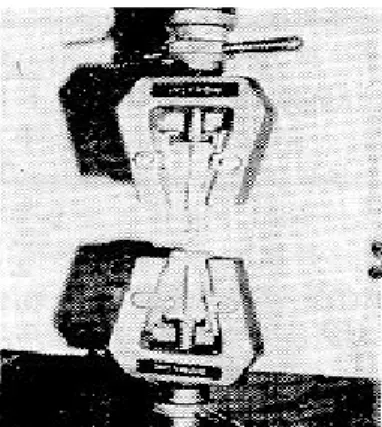
Prodger와 Symonds(64) 및 Maldonado외 2인(66) 등의 방법에 따라 연령과 성별차이나 우식 증상이 없는 발치 된 영구치를 15.00㎜×20.0㎜의 상온중합레진으로 고정 한 다음, 법랑질 시편은 상악중절치 순면에서, 상아질 시 편은 구치의 교합면에서 각각 평판하게 시편절단기 (Technicut)(제2도)에서 8.0㎜×3.0㎜로 삭제하여 제작 하였다(제1도). 모든 시편의 단면은 400 및 600grit의 실리콘카바이드 연마포 위에서 평탄하게 연마한 후 카복 실레이트계와 인산아연계 시멘트를 표준 접주도로 혼합 하여 두개의 시편을 고정하고 23±2℃와 95%이상의 비 례습도의 조건하에 1일에서 1주일간 처리한 다음 실험에 사용하였다.
2. 측정기구 및 방법
접착력측정은 Swartz와 Phillips(1), Bowen과 Rodriguez(6), Oldham외 2인(13), Mortimer와 Tranter(20), Mizrahi와 Smith(21), Grieve(22), Phillips외 2인(24), Richter외 2인(26), Beech(36), Powers외 2인(46), Kafalias외 2인(50), Barton외 3인(53), Levine외 2인(65), Maldonado외 2인(66), Fusayama외 3인(68) 및 Jedrychowski외 2인(69)등의 방법에 따라 결합된 시편 을 Instron 시험기(Instron Universal Testing Instrument, Model 1122, England)(제3, 4도)의 상하 면 grips사이에 설치하고 인장력을 받을 때 저항을 받지 않도록 chain을 장치한 후,5kN의 하중을 0.20㎜/min.
의 속도로 가하면서 결합된 시편이 분리될 때의 수치를 시험기에 부속되어 있는 기록장치에서 0.50㎜/min.의 속도로 측정하여 접착력을 산출하였으며, 여기에 사용된 공식은 아래와 같다.
P ㎏ Adhesive Strength =
W∙H =
㎤ P = Ultimate tensile load
W = Specimen diameter H = Specimen thickness
Ⅲ. 실험성적 및 고찰
1. 치과용합금과의 접착강도
3종의 카복실레이트계 시멘트와 금, 파라듐, 은, 인디 움, 동, 니켈, 크롬 및 도재용 합금등 10여종의 각종 치 Fig. 2 : Technicut Fig. 3 : Assembly to break the adhesive bond in
position in an Instron Tester.
Fig. 4 : Instron Universal Testing Machine, Model 1122, England.
Adhesive Strength = P/(WㆍH)= ㎏ /㎠
P = Ultimate tensile load W = Specimen diameter H = Specimen thickness
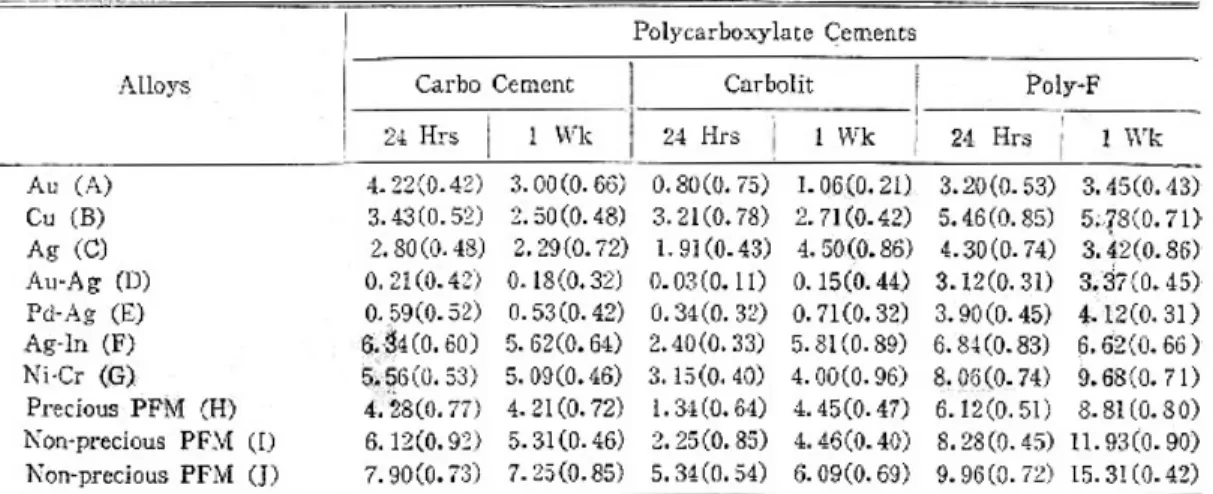
과용합금 상호간의 접착력을 측정한 결과는 제3표 및 제 5, 6도와 같다.
전반적으로 동, 인디움, 니켈, 크롬계등 비귀금속계 합 금과는 높은 접착력을 보였으나 금, 은, 파라듐등 귀금속 계 합금에서는 낮은 수치를 보였다. 1968년 Smith(20) 및 Mizrahi 와 Smith(21, 23), Mortimer 와 Tranter(20) 및 Phillips 외 2인(24)등은 스테인레스스틸, 황동, 은, 니켈 및 크롬계등 합금에 접착력이 높다고 하였으며, Grieve(22)는 금합금과는 접착되지 않는다고 하였다.
Smith(28)는 카복실레이트계 시멘트는 은, 동, 수은, 철등 금속이온과 chelate되어 화학적 접착을 하나 금합금과는 화학반응을 하지 않기 때문에 완전한 접착은 어렵고 기
계적유지를 얻어야 된다고 하였다. McLean(38)도 금이나 도재와는 전혀 화학적인 접착을 하지 않는다고 하였으 며, 금합금에는 카복실레이트계 시멘트와 접착될 수 있 는 적당한 금속이온이 결여되어 있다고 하였다. Saito외 3인(61)은 화학적으로 안전성이 있는 귀금속계 합금보다는 활성이 없는 비귀금속계 합금에 강한 접착력이 있다고 하였다. 그러나 Ady 와 Fairhurst(42)는 순금과도 화학적 접착이 있다고 하였으며 24K의 금이나 순동의 경우는 비슷한 수치로 접착력이 감소되었다고 하였는데 Moser 외 2인(48)은 금합금은 활성이 너무 없기 때문에 오히려 접착력이 증가된다는 상반되는 보고를 하였고, 동의 경 우는 상당히 높은 접착력을 갖는다고 하였다. Smith(18) Table 3 : Adhesive strengths between combinations of various dental casting alloys and different brands of
polycarboxylate cement after various time intervals.*
Fig. 5 : Comparison of adhesive strengths to various dental casting alloys of different brands of polycarboxylate cement after one day interval.
Fig. 6 : Comparison of adhesive strengths to various dental casting alloys of different brands of polycarboxylate cement after one week interval.
는 스테인레스스틸과 크롬계 합금과는 화학적 접착을 한 다고 하였으며, Barton외 3인(53)은 스테인레스스틸, 알 루미나, 은-석분말, 티탄산염칼륨, 흑연섬유등을 카복실 레이트계 시멘트에 넣을 때 인장강도등 기계적 성질이 증가된다고 하였고, Lawrence 와 Smith(43)는 인산아연, 산화알루미늄등의 충전재를 넣을 때 인장강도는 증가된 다고 하였으며, Brown 과 Combe(27,44)는 스테인레스스 틸을 넣을 때 압축, 인장력은 모두 증가된다고 하였다.
시간차이에 따르는 변화는 1일보다 1주일 후에서 전반적 으로 낮은 수치를 보였는데, Going 과 Mitchem(49)는 1 개월 후에서는 1일보다 인장강도가 40%감소 된다고 하 였다. 제품별로는 Poly-F군이 가장 높은 접착력을 보였 으며 Carbolit군은 1일에서 전반적으로 낮은 수치를 나 타냈으나 1주일에는 증가되는 현상을 보였다.
2. 인산아연계 시멘트와의 비교
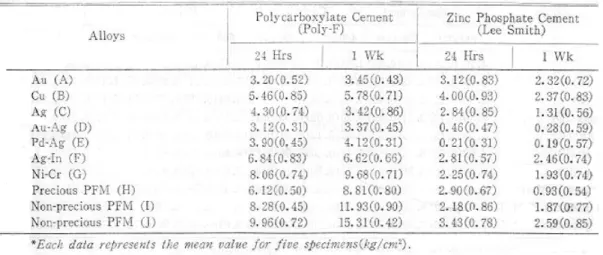
카복실레이트계 시멘트의 Poly-F와 인산아연계 시멘 트의 Lee Smith와의 접착력을 비교한 결과는 제4표 및 제7도와 같다. 카복실레이트계 시멘트는 동(B), 은-인디 움(F), 니켈-크롬(G)계 및 도재용 합금(H.I.J)에는 높은 접착력을 나타냈으나 인산아연시멘트는 금-은(D), 파라 듐-은(E)계 및 합금을 제외하고는 합금차이에 따르는 큰 변화는 볼 수 없었고 전반적으로 카복실레이트 시멘 트보다 낮은 수치를 보였다. 특히 카복실레이트 시멘트 는 금-은(D), 파라듐-은(E), 니켈-크롬(G)계 및 도재용 합금(H.I.J)에서는 인산아연 시멘트보다 4-6배 높은 접 착력을 보였다.
시간차이에 따르는 변화를 보면 카복실레이트 시멘트 는 은(C), 은-인디움(F)계 합금을 제외하고는 모두 1일보 다 1주일에서 증가하는 반면, 인산아연시멘트는 1일보다 1주일에서 모두 감소 되었다.
Swartz 와 Phillips(1)에 의하면 인산아연시멘트는 치 질이나 회복물에는 실제 접착되지 않는다고 하였는데 Smith(18)는 인산아연계 시멘트는 기계적으로 접착되며 카복실레이트계 시멘트는 화학적으로 접착된다고 하였 다. 본 실험에서 금합금의 경우 두 시멘트의 차이가 근소 하게 나타났는데, Stevens(52)는 제2형 금합금에서 인산 아연계와 카복실레이트계 시멘트는 모두 비슷한 접착력 이 있다고 하였고, Jendresen 과 Trowbridge(40)는 금인 레이를 제거할 때의 유지력은 두 시멘트 모두 비슷한 결
Table 4 : The adhesive strength of a polycarboxylate cement to various dental alloys compared with that of a zinc phosphate cement after various time inervals.*
Fig. 7 : Comparison of adhesive strengths of polycarboxylate cement and zinc phosphate cement at various time intervals.
과로 나타났으며, Lee 외 3인(30)은 금합금과의 접착은 인 산아연계 시멘트에서 더욱 감소된다고 하였고, Lawrence 와 Smith(43)는 금합금과의 접착은 카복실레 이트계 시멘트가 인산아연계 시멘트보다 4배정도 높다고 하였다. Jendressen 과 Trowbridge(40), Ady 와 Fairhurst(42), Saito 외 3인(61), Moser 외 2인(48)등은 금 합금 및 스테인레스스틸을 사용하여 카복실레이트계와 인산아연계시멘트를 비교한바, 카복실레이트계 시멘트 에서 접착강도는 높은 것으로 나타났고, 인산아연계 시 멘트는 제1형, 제3형 금합금에는 가장 접착력이 낮았고, 스테인레스스틸과도 접착력은 감소된다고 하였다. 인산 아연계 시멘트와의 비교연구에서 Phillips 외 2인(24)은 압축강도는 인산아연계 시멘트가 2배정도 높으나 인장강 도는 상호 비교된다고 하였고, Mortimer 와 Smith(28) 및 Grieve(22)는 압축강도는 카복실레이트 시멘트에서 낮 다고 하였다. Phillips외 2인(24)는 카복실레이트 시멘트 는 압축강도는 낮으나 인장강도는 같은 범위로 나타났다 고 하였고, Smith(28)는 인장강도는 인산아연계 보다 30% 높다고 하였다. Ady 와 Fairhurst(42)도 접착강도는 카복실레이트계가 인산아연계보다 높다고 하였고, Grieve(22)는 인장강도는 유사하다고 하였으며, 인산아연 계와 아연화유지놀계 시멘트에서 압축과 인장강도는 서 로 상관관계가 있으나 카복실레이트계 시멘트는 이 관계 가 없다고 하였다. 즉 카복실레이트계 시멘트는 압축강
도는 낮더라도 접착강도는 인산아연계 시멘트와 유사하 다고 하였다.
3. 표면처리와 접착강도와의 관계
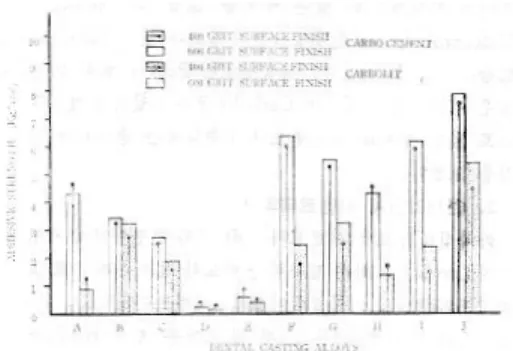
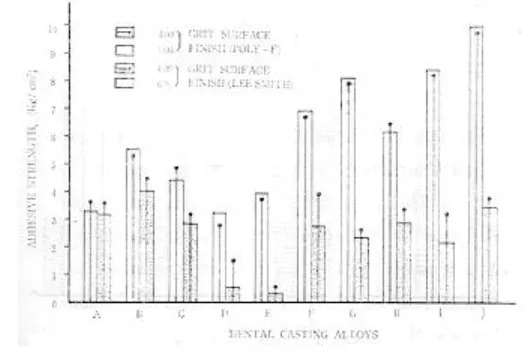
10종의 주조용 합금을 400 및 600 grit의 실리콘카바 이드 연마포 위에서 각각 연마하여 각종 시멘트와 접착 강도를 비교한 결과는 제5표 및 제8, 9도와 같다. 접착 면의 처리는 접착강도에 상당한 영향을 주었는데 카복실 레이트계 시멘트는 전반적으로 600 grit인 섬세한 면에 서 높은 접착력을 보이는 반면, 인산아연계 시멘트는 400 grit인 거칠은 면에서 높은 수치로 나타났다. 합금별
Table 5 : The adhesive strengths between various dental casting alloys and different brands of dental cement as affected by surface roughness.*
Fig.8 : The effect of surface texture of various dental casting alloys on the adhesive strength of Carbo Cement and Carbolit.
*Each data represents the mean value for five specimens(㎏ /㎠ ).
Standard deviations are in parentheses.
로 보면 Carbo 와 Carbolit 시멘트는 금(A), 금-은(D), 파라듐-은(E)계 및 도재용 귀금속합금(H)에서, Poly-F 시멘트는 금(A), 은(C)계 및 도재용 귀금속합금(H) 등에 서는 오히려 400 grit인 거칠은 면과의 접착력이 다소 높 은것으로 나타났으며, 특히 인산아연계 시멘트인 Lee Smith는 금-은(D), 은-인디움(F) 및 도재용 비귀금속합 금(I)등에서는 표면처리에 따라 상당한 차이를 보였다.
Arfaei 와 Asgar(67)는 상아, 알루미늄원반, 금합금인 레이, 금관, 평면의 상아질 및 법랑질 등을 사용하여 치 과용 시멘트의 접착강도를 측정하였는데, Myers 외 3인
(9)은 집중적(convergence angle)에 따라, Kaufman외 2인(5), Ady 와 Fairhurst(42)는 접착물의 표면상태에 따 라 그 유지력은 달라진다고 하였다. Moser 외 2인(48)은 3 종의 카복실레이트계 시멘트에서 스테인레스 스틸의 원 반으로 접착강도를 측정한바 전반적으로 600 grit의 섬 세한 면에서 더 높게 나타났으면 인산아연제 시멘트는 400 grit에서 높았는데 섬세한 면은 응력집중(stress concentration)을 일으키는 거칠은 면을 제거함으로서
표면력(surface potential)이 증가된다고 하였다. 또 인 산아연계 시멘트의 경우 섬세한면에서 접착강도가 낮은 것은 기계적 유지력이 감소되어 인장력이 낮아지는 때문 이라고 하였다. 또한 카복실레이트 시멘트는 제1형, 제3 형 금합금과는 거칠은 면에서 높은 수치를 보였고, 스테 인레스스틸 및 코발트계 합금과는 섬세한 면에서 접착 력이 더 높다고 하였다.
Arfaei 와 Asgar(67)도 카복실레이트계 시멘트는 인산 아연계나 EBA계 시멘트 보다 접착력이 높았는데 접착강 도는 압축, 인장강도 및 피막도와는 관계가 없다고 하였 다. 본 실험에서 카복실레이트계 시멘트는 금합금과는 400 grit의 거칠은 면과의 접착력이 다소 높은것으로 나 타났는데 Grieve(22)는 카복실레이트계 시멘트는 금과는 화학적 결합을 하는 것이 아니고 물리적으로 인산아연계 시멘트처럼 금합금표면의 불규칙한면에 서로 부착된다 고 하였다.
4. 치아경조직과의 접착 강도
카복실레이트계 및 인산아연 시멘트와 치아경조직과 의 접착강도를 법랑질과 상아질에서 시간차이에 따라 비 교 측정한 결과는 제6표 및 제 10도와 같다. 전반적으로 카복실레이트계 시멘트는 법랑질에서 상아질 보다 접착 력이 높은 것으로 나타났으며, 법랑질, 상아질 모두 1일 보다 1주일 후에서 증가하는 현상으로 나타났다. 인산아 연시멘트는 치질에 따르는 큰 차이는 없었고, 카복실레 이트계 시멘트보다 낮은 수치로 나타났고, 법랑질에서는 1일보다 1주일 후에서 증가하였으나 상아질에서는 시간 차이에 따르는 변화는 없었다.
Barton의 3인(53)및 Arfaei 와 Asgar(67)은 카복실레이 트계 시멘트에서 polyacrylic산은 법랑질을 부식하여 접 착력을 높이고, 시멘트와 기계적접착을 용이하게 하며, 칼슘과 카복실레이트 시멘트 사이에 이온화결합을 유도 Fig. 9 : The effect of surface texture of various dental
casting alloys on the adhesive strength of Poly-F and Lee Smith Cement.
Table 6 : Relative adhesive strengths of polycarboxylate cements and zinc phosphate cement to enamel and dentin.*
*Each data represents the mean value for five specimens(㎏ /㎠ ).
Standard deviations are in parentheses.
하기 때문에 법랑질과는 접착력이 높다고 하였다. 또 polyacrylic산은 치아구성분인 칼슘과 복합체를 형성하 고 또한 아연과 접착하여 치아의 칼슘성분에 연결자역할 을 한다고 하였다. Levine외 2인(65)은 법랑질은 칼슘량이 많기 때문에 접착력이 높아진다고 하였고, Mitchem(49) 및 Stevens(52)등은 polyacrylic산은 법랑질과 석회질의 칼슘이온과의 chelating의 화학적인 결합현상으로 접착 이 강해진다고 하였고, 상아질은 칼슘이 적고 다공성구 조(porous nature)로 되어 있어 접착력이 감소된다고 하 였다. 이에 대해 Smith(28)는 polyacrylic산은 분자량이 크고 독성이 낮으며 단백질과 접착될 수 있는 증력이 있 기 때문에 상아질 치세관을 통해 확산되는데 한계성을 갖게 되기 때문이라고 하였고, Beech(34)는 칼슘이온과 polyacrylic산의 carboxyl groups과의 작용때문에 법랑 질과 접착이 높다고 하였다. 그러나 상아질은 유기물이 많고, polyacrylic산과 상아질과의 작용은 확실치 않기 때문에 접착력은 감소된다고 하였다.
Phillips외 2인(24)는 법랑질과 접착은 치아의 조성, 표 면구조나 표면의 처리에 따라 달라진다고 하였고, Jedrychowski외 2인(69)는 법랑질 표면은 37-50% 인산, 70%의 아연화용액, 알카리, 효소등으로 처리하여 유기, 무기물을 제거하였을 때 접착력은 증가된다고 하였고, Beech(41)는 상아질 표면은 hypercalcification하여 처리 함으로써 칼슘이온의 농도가 증가될 때 접착력은 높아지 며, 인장, 접착강도도 법랑질의 경우와 비슷하게 나타난 다고 하였다. 또 무기용액으로 상아질의 칼슘이온을 침 전시킨 결과 접착강도는 인장강도 이상으로 증가된다고 하였다.
Brauer 와 Temini(35)는 치질에 화학적 처치를 하여, 또 Buonocore(2)는 85%의 인산으로 법랑질을 처리함으 로서 접착력을 증가시켰다고 하였다. Levin외 2인(65)는 상아질에서 칼슘이온농도를 증가시키기 위하여 석회화 용액의 유도체를 사용하였고, Arfaei와 Asgar(67)는 상아 질과의 접착력을 증가시키기 위하여 카복실레이트계 시 멘트에 1% NaF를 넣어 상아질 표면을 처리하였을 때 가 장 효과적이었다고 하였다. Stevens(52)도 불소를 넣는 경 우 유지력은 증가된다고 하였는데 카복실레이트계 시멘 트에서 피막도와 유지력과는 무관하다고 하였다. 인산아 연계 시멘트와의 비교에서 Mizrahi 와 Smith(21)은 카복 실레이트계 시멘트는 법랑질이나 상아질에서 모두 인산 아연계 시멘트보다 접착력이 높게 나타났으며, Mortimer 와 Tranter(20)도 법랑질과의 접착강도는 인산 아연계 보다 높았으며, Phillips 외 2인(24)는 압축강도는 인산아연계에서 2배 높았고, 인장강도는 상호 비교되었
으며, 접착력은 카복실레이트계 시멘트가 더 높았고, 인 산아연계 시멘트에서는 접착력은 법랑질에서 보다 높은 것으로 나타났다고 하였다.
Ⅳ. 결 론
현재 한국치과계에서 사용되고 있는 카복실레이트계 시멘트, 인산아연계 시멘트등 4종의 치과용 시멘트를 재 료로 금, 파라듐, 은, 인디움, 동, 니켈, 크롬 및 도재용 합금등 10여종의 치과용 합금과 법랑질, 상아질등 치아 경조직을 대상으로 상호간 결합시켰을 때 나타나는 접착 력을 Instron 시험기를 이용하여 비교 측정한 바 다음과 같은 결과를 얻었다.
1. 모든 합금에서 카복실레이트계 시멘트는 인산아연 계 시멘트보다 접착력이 높은 것으로 나타났다.
2. 카복실레이트계 시멘트는 동, 인디움, 니켈, 크롬계 합금에서는 높은 접착력은 보였으나 금, 은, 파라듐계 합 금에서는 낮은 수치를 보였다.
3. 표면연마는 접착력에 상당한 영향을 주었으며 카복 실레이트계 시멘트는 인산아연계 시멘트와는 달리 접착 면이 평탄할수록 높은 접착력을 보였다.
4. 카복실레이트계 시멘트는 상아질보다 법랑질에서 접착력이 높은 것으로 나타났다.
(본 논문을 작성함에 있어 시종 심려와 지도를 하여주 신 장완식 교수님께 감사드리며 아울러 본 실험에 여러 모로 지도와 격려를 하여주신 보철과 여러 교수님과 특 히 Instron시험기 측정에 도움을 주신 김철위 교수님께 감사를 드립니다.)
Fig. 10 : The adhesive strengths of polycarboxylate cements and zinc phosphate cement to enamel and dentin after various time intervals.
REFERENCES
1) Swartz, M. L., and Phillips, R. W. : A method of measuring the adhesive characteristics of dental cement, J. A. D. A., 50:1972, 1955.
2) Buonocore, M. G. : A simple method of increasing the adhesion of acrylic filling materials to enamel surfaces, J. Dent. Res., 34:849, 1955.
3) Buonocore, M., Wileman, W., and Brudevold, F. : A resport on a resin composition capable of bonding to human dentine surfaces, J. Dent.
Res., 35:846, 1956.
4) Davidson, H. D. : The effect of zinc oxyphosphate cement upon the enamel following placement of orthodontic bands, Am. J. Orthod., 42:792, 1956.
5) Kaufman, E. G., Coelho, D. H., and Colin, L. : Factors influencing the retention of cemented gold casting, J. Pros. Dent., 11:478, 1961.
6) Bowen, R. L., and Rodriguez, M. S. : Tensile strength and modulus of elasticity of tooth structure and several restorative materials, J. A.
D. A., 64:378, 1962.
7) Myers, C. L., Ryge, G., and Glenn, J. : In vivo test for bonding to dentin, I. A. D. R., 40:97, 1962(Abst).
8) Buonocoreg, M. G. : Principles of abhesive retention and adhesive restorative materials, J.
A. D. A., 67:382, 1963.
9) Myers, G. E., Ryge, G., Heyde, J. B., and Glenn, J. F. : In vivo test for bonding strength, J. Dent.
Res., 42:907, 1963.
10) Fusayama, T., Ide, K., and Hosoda, H. : Relief of resistance of cement of full cast crowns, J. Pros.
Dent., 14:95, 1964.
11) Bowen, R. L. : Adhesive bonding of various materials to hard tooth tissues, I. Method of determining bond strength, J. Dent Res., 44:690, 1965.
12) Bowen, R. L. : Adhesive bonding of various materials to hard tooth tissues, II. Bonding to dentin promoted by a surface-active comonomer, J. Dent, Res., 44:895, 1965.
13) Oldham, D. F., Swartz, M. L., and Phillips, R. W.
: Retentive properties of dental dements, J. Pros.
Dent., 14:760, 1964.
14) Bowen, R. L. : Adhesive bonding of various materials to hard tooth tissues, III. Bonding to dentin improved by pretreatment and the use of surface-active comonomer, J. Dent. Res., 44:903, 1965.
15) Bowen, R. L. : Adhesive bonding of various materials to hard tooth tissues, IV. Bonding to dentin, enamel and fluorapatite improved by the use of a surface-active comonomer, J. Dent.
Res., 44:906, 1965.
16) Bowen, R. L. : Adhesive bonding of various materials to hard tooth tissues, V. The effect of asurface-active comonomer on adhesion to diverse substrates, J. Dent. Res., 44:1365, 1965.
17) Bowen, R. L. : Adhesive bonding of various materials to hard tooth tissues, VI. Forces developing in direct-filling materials during hardening, J. A. D. A., 74:439, 1967.
18) Smith, D. C. : A new dental cement, Brit. Dent.
J., 125:381, 1968.
19) Friend, L. A. : Handling properties of a zinc polycarboxylate cement. An investigation, Brit.
Dent. J., 127:359, 1969.
20) Mortimer, K. V., and Tranter, T. C. : A preliminary laboratory evaluation of polycarboxylate cements, Brit. Dent. J., 127:365, 1969.
21) Mizrahi, E., and Smith, D. C. : Direct cementation of orthodontic brackets to dental enamel, An investigation using a zinc ploycarboxylate cement, Brit. Dent. J., 127:371, 1969.
22) Grieve, A. R. : A study of dental cements, Brit.
Dent. J., 127:405, 1969.
23) Mizrahi, E., and Smith, D. C. : The bond strength of a zinc polycarboxylate cement. Investigations into the behaviour under varying conditions, Brit. Dent. J., 127:410, 1969.
24) Phillips, R. W., Swartz, M. L., and Rdodes, B. : An evaluation of a carboxylate adhesive cement, J. A. D. A., 81:1353, 1970.
25) Plant, C. G. : The effect of polycarboxylate
cement on the dental pulp, Brit. Dent. J., 129:424, 1970.
26) Richter, W. A. Mitchem, J. C., and Brown, J. D. : Predictability of retentive values of dental cements, J. Pros. Dent., 24:298, 1970.
27) Brown, D., and Combe, E. C. : Studies on reinforced adhesive cements, J. Dent. Res., 50:690, 1970.
28) Smith, D. C. : A review of the zinc polycarboxylate cements, J. C. D. A., 37:22, 1971.
29) Barnes, D. S., and Turner, E. P. : Initial response of human pulp to zinc polycarboxylate cement, J.
C. D. A. 37:265, 1971.
30) Lee, H. L., Cupples, A. L., Schubert, R. J., and Swartz, M. L. : An adhesive dental restorative material, J. Dent. Res., 50:125, 1971.
31) Williams, P. D., and Smith, D. C. : Measurement of the tensile strength of dental restorative materials by use of a diametral compression testg, J. Dent. Res., 50:436, 1971.
32) Truelove, E. L., Mitchell, D. F., and Phillips, R.
W. : Bilolgic evaluation of a carboxylate cement, J. Dent. Res., 50:166, 1971.
33) Kim, C. W. : Recent research on dental cements, J. K. D. A. 5:14, 1971.
34) Beech, D. R. : A spectroscopic study of the interaction between human tooth enameland polyacrylic acid(polycarboxylate cement), Archs’
Oral. Biol., 17:907, 1972.
35) Brauer, G. M., Termini, D. J. : Bonding of bovine enamel to restorative resin : Effect of pretreatment of enamel, J. Dent. Res., 51:151, 1972.
36) Beech, D. R. : Bonding of alky12-cyanoacrylates to human dentin and enamel, J. Dent. Res., 51:1438, 1972.
37) Chang, Y. I. : The effects of pretreatment solution of the direct bonding system on the enamel surface, J. of Kor. Acd. of Orthod, 3:21, 1972.
38)McLean, J. W. : Polycarboxylate cements : Five years experience in general practice, Brit. Dent.
J., 132:9, 1972.
39) Beagrie, G. S., Main, J. H. P., and Smith, D. C. :
Inflammatory reaction evoked by zinc polyacrylate and zinc eugenate cements, Brit.
Dent. J., 132:351, 1972.
40) Jendressen, M. D., and Trowbridge, H. O. : Biologic and physical properties of a zinc polycarboxylate cement, J. Pros. Dent., 28:264, 1972.
41) Beech, D. R. : Improvement in the adhesion of polyacrylate cements to human dentine, Brit.
Dent. J., 135:442, 1973.
42) Ady, A. B., and Fairhurst, C. W. : Bond strength of two types of cement to gold casting alloy J.
Pros. Dent., 29:217, 1973.
43) Lawrence, L. G., and Smith, D. C. : Strength modification of polycarboxylate cement with fillers, J. C. D. A., 39:405, 1973.
44) Brown, D., and Combe, E. C. : Effects of stainless steel fillers on the properties of polycarboxylate cement, J. Dent. Res., 52:388, 1973.
45) Kim, K. N. : The effect of zinc phosphate cement on the solubility of powdered enamel and dentin, The new medical J., 16:575, 1973.
46) Powers, J. M, Johnson, Z. G., and Craig, R. G. : Physical and mechanical properties of zinpolyacrylate dental cements, J. A. D. A., 88:38:e 1974.
47) El-Kafrawy, A. H., and Others. : Pulp reaction to a polycarboxylate cement in monkeys, J. Dent.
Res., 53; 15, 1974.
48) Moser, J. B., Brown, D. B., and Greener, E. H. c Short-term bond strengths between adhesiv, cements and dental alloys, J. Dent. Res., 530:1377, 1974.
49) Going, R. E., Mitchem, J. C. : Cements for perm:
anent luting: a summarizing review, J. A. D. A., 91:107, 1975.
50) Kafalias, M. C., Swartz, M. L., and Phillips, R.
W. : Effect of manipulative variables on the properties of a polycarboxylate cement, Aust, Dent. J., 20:73, 1975.
51) Stevens, L. : Retention with specific and mechanical adhesive lutes, Aust. Dent. J., 20:112, 1975.
52) Stevens, L. : The properties of four dental
cements, Aust. Dent. J., 20:361, 1975.
53) Barton, J. A., Brauer, G. M., Antonucci, J. M., and Raney, M. J. : Reinforced polycarboxylate cements, J. Dent. Res., 54:310, 1975.
54) Cho, K. Z. : An experimental study on the effect of polycarboxylate cement to the dental pulp, J.
K. D. A., 13:57, 1975.
55) Kim, S. K. : An experimental study on pin retention of the dental cements, J. Kor. Aca. of Prostho., 13:23, 1976.
56) Chan, K. C., Svare, C. W. and Horton, D. J. : The effect of varnish on dentinal bonding strength of five dental cements, J. Pros. Dent., 35:403, 1976.
57) Causton, B. E., Samara-wickrama, D. Y. D., and Johnson, N. W. : Effect of calcifying fluid on bonding of cements and composites to dentine in vitro, Brit. Dent. J., 140:399, 1976.
58) Kim, K. N. : A Study on the acidity of certain dental cements, J. K. D. A., 14:509, 1976.
59) Lee, S. H. : Pulp response to some dental cements, J. K. D. A., 14:659, 1976.
60) Moser, J. B., Broadbent, J. M., Combe, E. C., and Greener, E. H. : Some polycarboxylate cements, Thermal analytical studies, Brit. Dent, J., 141, 379, 1976.
61) Saito, C., Sakai, Y., Node, H. and Fusayama, T. : Adhesion of polycarboxylate cements to dental casting alloys, J. Pros. Dent., 35:543, 1976.
62) Kim, C. W. : Comparative studies on the bond
strengths between various dental cements, J. K.
D. A., 15:745, 1977.
63) Yoon, D. J. : Pulp reactions to temporary cements, J. of Kor. Aca. Prosth., 15:43, 1977.
64) Prodger, T., and Symonds, M. : ASPA adhesion study, Brit. Dent. J., 143:266, 1977.
65) Levine, R. S., Beech, D. R., and Garton, B. : Improving the bond strength of polycarylate cements to dentine, Brit. Dent. J., 143:275, 1977.
66) Maldonado, A., Swartz, M. L., and Phillips, R. W.
: An in vitro study of certain properties of a glass ionomer cement, J. A. D. A., 96:785, 1978.
67) Arfaei, A. H., and Asgar, K. : Bond strength of three cements determined by centrifugal testing, J. Pros. Dent., 40:294, 1978.
68) Fusayama, T., Nakamura, M., Kurosaki, N., and Iwaku, M. : Non-pressure adhesion of a new adhesive restorative resin, J. Dent. Res., 58:1364, 1979.
69) J edrychowski, J. R., Caputo, A. A., and Foliart, R. : Effects of adhesive promoters on resin enamel-retention, J. Dent. Res., 58:1371, 1979.
70) Kim, C. W. : Comparative studies on the characteristics of various dental cements used in Korea, J. K. D. A., 17: 203, 1979.
71) Causton, B. E., and Johnson, N. W. : The role of diffusible ionic species in the bonding of polycarboxylate cements to dentine: An in vitro study, J. Dent Res., 54:1383, 1979.
COMPARATIVE STUDIES OF THE ADHESIVE QUALITIES OF POLYCARBOXYLATE CEMENTS
Han-Moo Lee, D.D.S., M.S.D
Dept. of Prosthodontics, Graduate School, Seoul National University (Directed by Prof. Wan-Shik Chang, D.D.S., Ph.D.)
= Abstract =