Ⅰ. 서 론
티타늄은 치의학 분야에서 비교적 신소재로서 사 용이 나날이 증가하는 일종의 생체재료이며 우수한 기계적인 특성과 생체적합성 때문에 치과적인 적용 이 증가하고 있다.1)높은 생체 친화성과 부식에의 저 항으로 치과 임플랜트에서는 장기간 널리 사용되어 왔으며2)낮은 열전도성으로 술 후 열에 의한 지각과 민을 감소시키며, 방사선에 비교적 투과성이 있어 티타늄 수복 내의 진단이 가능하고 저렴한 가격, 낮 은 밀도 등의 장점을 갖는다. 또한 물리적 성질이 금 합금과 비슷하며3) 티타늄 매식체와 상부구조물간의 갈바닉 부식문제를 해결하기 위해 임플랜트 상부 보 철물 제작에도 사용되었다.4)
티타늄은 원자량 47.90으로 일반적 귀금속의 합금 의 절반, 금 합금의 1/4수준이며 밀도가 내식성과 내 산성, 생체적합성이 뛰어난 재료이지만, 순수 티타늄 의 용융온도는 1668℃로서 일반 치과주용 귀금속 합금보다 700~800℃가 더 높으며 티타늄 합금인 Ti-6Al-4V의 용융온도는 1,760℃로서 순수 티타늄보 다 더 높다.5)이렇게 높은 용융온도 때문에 일반 치 과주조용 금합금용 모형재와 용융방법, 주조기, 매몰 재를 사용해서는 주조할 수 없다.
최근에는 티타늄의 주조성의 향상을 위해 전용주 조기가와 매몰재가 개발되면서10) 고정성 및 가철성 보철물 제작뿐 아니라 티타늄 매식체와 상부 구조물 간의 갈바닉 부식 문제를 해결하기 위한 임플랜트
보철물 제작에도 널리 사용되고 있다.
그러나 티타늄은 이러한 뛰어난 물성을 지님에도 불구하고 주조시에 Ni-Cr, Co-Cr 등의 다른 고융점 을 갖는 치과용 금속에 비하여 용탕의 유동성이 매 우 나쁘고,1)또한 O, N, H 등과 활발히 반응하여 이 른바“αcase”라고 불리는 산화층(TiO2)을 쉽게 형성 하므로 최대한 주조체의 산화를 억제하여 αcase의 형성을 최소화하고, 최적의 주조압을 부여하여 티타 늄을 주조하는 노력이 필요하다.6)
아크방식이나 고주파 유도 용융법으로 아르곤이나 헬륨 하에서 티타늄을 용융시키고 티타늄 주조에는 가압흡인 과 원심주조 방식이 있다.6-7)이전의 주조기 에 따른 티타늄 주조성에 관한 연구에 의하면 유의 성 있는 차이를 보이진 않는 보고도 있으나,7)흐름성 의 속도는 가압흡인 방식에 비해 원심주조방식이 더 크며,8) 용융된 티타늄은 가압흡인 방식에서는 판상 흐름을 보이지만 원심주조에서는 관상흐름을 보인 다는 보고가 있다.9)
티타늄 주조용 매몰재는 티타늄의 높은 용융점 (1680℃)에 견딜 수 있는 충분한 내열성, 주조압을 견딜 수 있는 강도 및 티타늄 주조수축을 보상할 수 있는 팽창이 필요하다. 또한 주조 후 티타늄의 산화 를 억제할 수 있는 화학적 안전성이 있어야 하고 쉽 게 제거될 수 있어야 한다. 티타늄은 고온에서 산소, 수소, 질소 등과 쉽게 반응하므로 티타늄 주조기는 진공상태에서 불활성인 아르곤가스나 헬륨가스를 주입하여 주조한다.10)
대한치과보철학회지:Vol. 44, No. 5, 2006
주조기와 매몰재의 성분변화에 따른 티타늄의 주조성에 관한 연구
전남대학교 치과대학 보철학교실 정다운∙양홍서
Table I. Classification of experimental groups
Group Casting Behavior
Casting Mashine Inevestment
A (n=7) *Ti Cast Super R� Selevest CB�
B (n=7) Ti Cast Super R� Rematitan Plus�
C (n=7) *Rematitan autocast� Selevest CB�
D (n=7) Rematitan autocast� Rematitan Plus�
용융된 티타늄과 반응하는 측면에서 볼 때 칼시아, 질코니아, 마그네시아가 알루미나나 실리카보다 더 안정하며, 내열재로서 알루미나와 마그네시아의 선 호도가 증가 추세에 있다.11)Watari는 열역학적인 면 에서 칼시아와 마그네시아의 안전성을 설명했고,12) Miyakawa 등도 결합재가 티타늄에 불안정하므로 인산염계와 에틸실리카 내의 인과 규소가 티타늄 내 로 침투한다는 사실을 보고하였다. 통상의 실리카 매몰재인 Ohara system은 1200℃까지 가열한 후 300℃까지 냉각하여 주조되며 실리카 매몰재를 개 발하는 일련의 실험에서 석영이 크리스토발라이트 보다 더 안정함이 보고 되었다.13)
이러한 티타늄 주조기와 매몰재의 많은 발전에도 불구하고, 티타늄 주조체에는 불완전한 주조와 내부 기포와 같은 주조 결함이 흔히 관찰된다.14-16)티타늄의 주조성에 관해 영향을 주는 요인으로는 매몰재의 통 기성,16)chamber간의 압력차,14-17,39)티타늄과 매몰재간 의 반응,18)주형온도15,19)그리고 주입선 형태20-23)등이 있다. 이와 같이 티타늄 주조체의 표면 조도와 기포 형성 및 주조성은 많은 요인에 의해 영향을 받는다.
그러므로 본 연구에서는 치과계에서 사용 요구가 증대되는 티타늄을 주조기와 매몰재를 각각 다른 조 건에서 주조하여 주조성과 표면의 반응층을 직접, 간접 계측하고 상호 비교하여 연구하였다.
Ⅱ. 연구재료 및 방법
본 연구에 사용된 연구재료 및 기구는 다음과 같다.
가. 실험군의 분류
주조방법과 매몰재에 따른 실험군의 분류는 Table I과 같다.
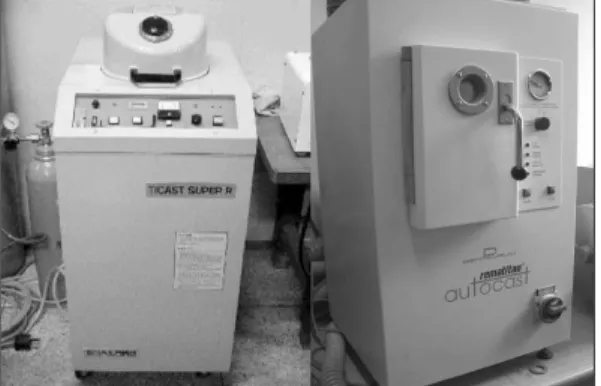
본 실험에서 사용한 두 주조기는 열원으로 아르곤 분위기 (Argon atmosphere)의 아크 발열방식을 사 용하였으며 주조압을 가하는 방식에 따라 원심주조 방식 (Ti Cast Super R�)과 가압흡인 주조방식 (Rematitan autocast�)의 주조기를 사용하였다 (Fig. 1 and Table II).
각각의 주조기를 생산한 제조회사에서 추천한 매 몰재인 Selevest CB�(Selec, Japan)와 Rematitan plus�(Dentaurum, Germany)를 사용하였다(Table III).
나. 모형 제작과 주입선 형성
주조성을 평가하기 위해서 격자 사이 공간 1.9mm, 두께 0.76mm인 사각 망의 왁스패턴 (Grids RN II, Dentarum, Germany)을 165개의 격자가 포 함되도록 가로 40mm, 세로 30mm의 직사각형 모양 으로 절단한 후 직경 2.6mm, 길이 5mm의 주입선 (Kerr,10 gauge, 2.6 Φ)을 붙여서 28개의 왁스모형 을 제작하였다(Fig. 2).
Fig. 2에서 보여진 것 같이, 녹은 금속은 좁은 통로 를 통해 전체 왁스패턴을 채우며 이들 통로는 서로 다른 흐름성을 보이는 mold filling capacity를 감별 할 수 있도록 일부로 좁게 설계하였다.
다. 매몰과 주조
왁스모형을 주입선에 부착한 상태로 매몰재인 MgO계의 Selevest CB�와 Rematitan plus�를 진 공상태에서 혼합하고 매몰하였고 상부를 슬라이드 글라스로 덮은 후 표면이 직각이 되도록 경화시켰 다. 액체/분말 비율, 혼합 간격, 그리고 매몰재의 소 환 계획은 제조자의 지시에 따랐다. 각각 실온에서 1 시간 40분간 경화 시킨 후 소환로에 넣었다. 매몰된 시편을 Table IV의 소환 조건에 따라 소환하였고
Fig. 1. Casting machines used in this study. Fig. 2. Schematic representation of wax pattern tested.
Table IV. The Heating Cycles of the investments tested in this study
Selevest CB�
Mixing time Burn-out schedule (heating speed : 6℃/min)
45 sec waiting time 2hour 20min 7hour
↓ ↓
room temperature 850℃ 100℃
↑ ↑
holding time 60min 60min casting
Rematitan PLUS�
Mixing time Burn-out schedule(heating speed : 5℃/min)
1 min waiting time 16min 20min 150min slowly
↓ ↓ ↓ ↓
70 ℃ 150℃ 250℃ 1000℃ 430℃
↑ ↑ ↑ ↑
holding time 4min 90min 90min 90min casting Table II. Experimental casting machines used in this study
Brand Pouring Method Heat Source Manufacture
Ti Cast Super R� Centrifugal Arc Selec.Co., Japan
Rematitan autocast� Pressable Arc Dentarum., Germany
Table III. Experimental investments used in this study
Brand L/P Setting Thermal Final Menufacturer
exp (%) exp (%) Composition
Selevest CB� 0.21 0.1 0.3 MgO, ZrO2, Al2O3 Selec.Co., Japan Rematitan Plus� 0.16 1.2 0.6 MgO, SiO2, Al2O3 Dentaurum., Germ
10분 동안 냉각시켰다. 티타늄 ingot은 99.5% 순수 티타늄인 Tritan (ASTM Grade 2: Dentaurum, Germany) 40g을 진공 원심주조기인 TiCast Super R� 와 2실 가압흡인형 주조기인 Rematitan autocast�를 사용하여 주조하였다.
라. 주조성과 주조결함 측정
왁스 패턴의 재현여부와 외형을 관찰하고 주조 후 완전하게 형성된 격자 변수를 측정하여 주조성의 차 이를 평가하였다. 주조 적합성을 측정한 시편을 티 타늄 전용 주조 결함 측정기인 Easyti X-ray Ti (Manfredi, Italy)를 사용하여 주조성을 비교하였 는데, 방사선 사진을 촬영하고 다시 슬라이드 필름 으로 전환하여 기포를 비교하였다.
마. 미세경도의 측정
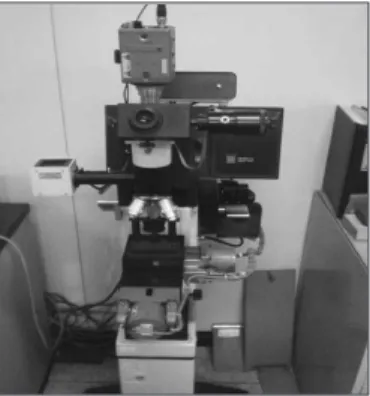
주조된 티타늄 시편을 절단하여 에폭시레진에 포 매한 후 SiC 연마지로 연마하고 미세경도기 Micro- Vickers hardness tester(Future-Tech Corp, Tokyo, Japan)로 측정하여 주조체의 한쪽 표면에서 내면으로 50㎛씩 이동하여 경도변화를 측정하여 각 군당 8개를 측정하여 평균값을 구하였다.
바. 반응층의 검사
주조된 티타늄 시편을 절단하여 에폭시 레진에 포 매한 후 SiC 연마지로 연마한 후 0.5㎛로 정밀 연마 후 3초간 부식시키고 이후 증류수로 세척하고 SEM
(scanning electron microscope)를 사용하여 표면을 관찰하고 반응층의 두께를 측정한다.
사. 통계처리
본 실험의 통계처리는 SPSS ver. 10.0 for WIN (SPSS. Inc. USA)를 사용하였다. 주조기와 매몰재에 따른 주조성과 미세경도를 일원변량 분산분석(One- way ANOVA)을 시행하여 각 군 간의 차이를 검정하 고 유의수준 5%에서 Scheffe’s multiple comparison test로 사후 분산분석을 시행하여 각 군 간의 평균값 의 차이를 검정하였다.
Ⅲ. 연구결과 1. 주조성의 측정
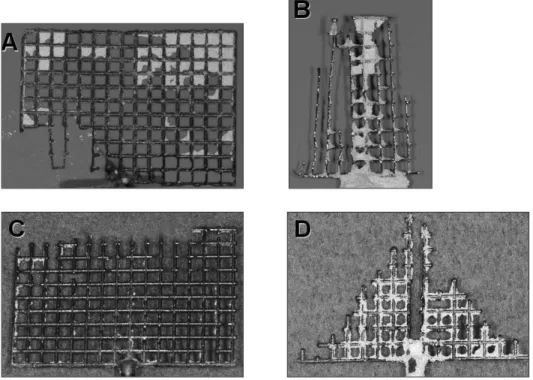
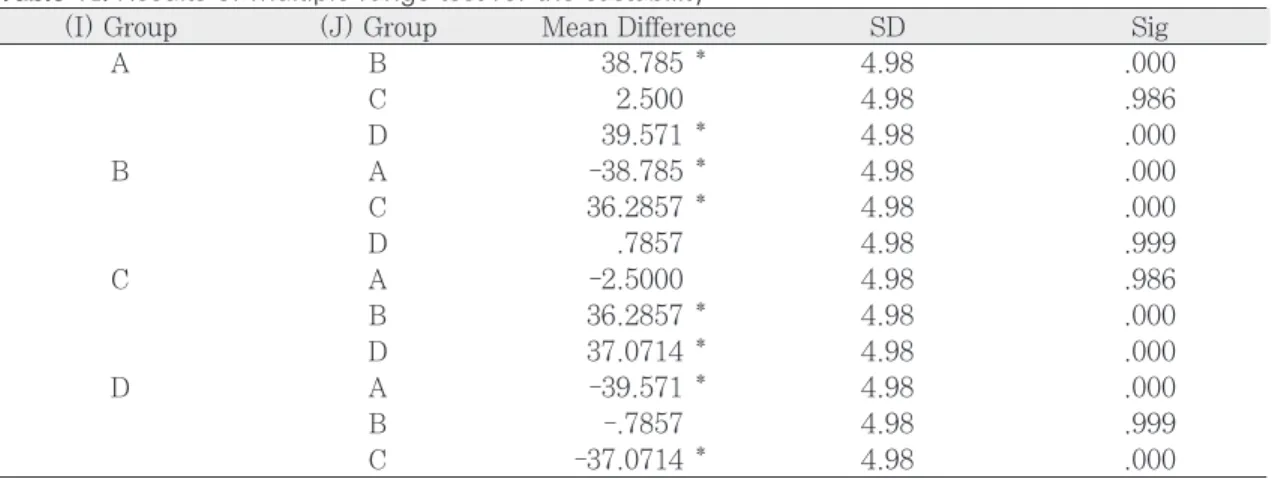
티타늄의 주조체는 크게 두 가지 관점으로 평가하 였다. 하나는 재현성을 평가하는 것이고 또 하나는 내부기포 형성 및 결합유무를 평가하는 것이다. 각 주조체의 모양과 왁스패턴의 재현 여부는 각각 다르 게 나타났다. 주조성의 측정은 육안과 주조결함 분 석기로 측정한 슬라이드 필름을 관찰하여 완전하게 주조가 된 격자의 변수의 총합을 4로 나누어 평가하 였다. 주조성의 측정결과 A군에서 가장 우수하게 나 타났으며, C군, B군, D군 순으로 주조성이 감소하였 다. one-way ANOVA test 결과 네 군 사이는 유의한 차이를 보였다.
Fig. 3. Easyti X-ray Ti (Manfredi, Italy). Fig. 4. MicroVickers hardness tester(Future- Tech Corp, Tokyo, Japan).
Fig. 4. Casting body images of mesh pattern.
Fig. 5. X-ray radiograghs of mesh pattern.
Table V. Castability measurement
Group N Mean SD Max Min
A 7 63.037 13.02 75.50 42.00
B 7 24.25 2.01 36.00 20.75
C 7 60.53 11.99 71.00 42.25
D 7 23.46 2.45 26.50 20.50
Fig. 6. Castability measurement. Fig. 7. Microhardness (VHN).
Table VI. Results of multiple range test for the castability
(I) Group (J) Group Mean Difference SD Sig
A B 38.785 * 4.98 .000
C 2.500 4.98 .986
D 39.571 * 4.98 .000
B A -38.785 * 4.98 .000
C 36.2857 * 4.98 .000
D .7857 4.98 .999
C A -2.5000 4.98 .986
B 36.2857 * 4.98 .000
D 37.0714 * 4.98 .000
D A -39.571 * 4.98 .000
B -.7857 4.98 .999
C -37.0714 * 4.98 .000
* . The mean difference is significant at the 0.05 level
Table VII. Microhardness (VHN)
Group N Mean SD Max Min
A 8 206.71 10.89 191.00 219.80
B 8 204.00 10.21 193.00 223.50
C 8 168.00 6.91 163.00 168.20
D 8 164.16 3.98 157.90 223.50
Castability 80
70 60 50 40 30 20 10 0
250 200 150 100 50 0 (VHN)
2. 미세경도 (Microhardness)
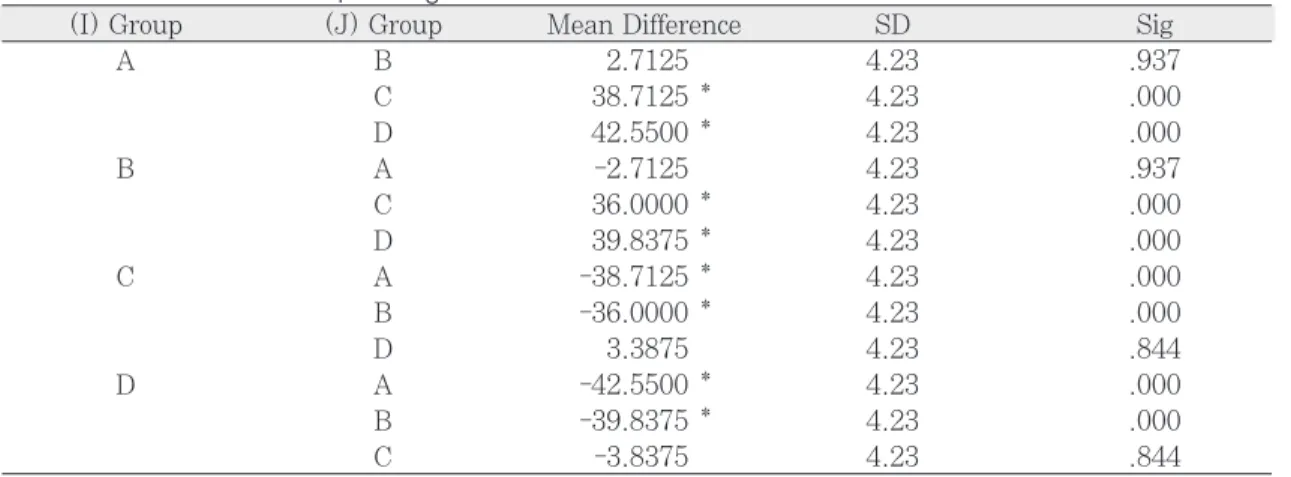
티타늄 주조체의 견고성과 관련하여, 각 표면으로 부터 50㎛ 지점의 평균 미세경도 값은 A군이 206.71
Vickers Hardness Number(VHN)으로 가장 높았으 며, B군, C군, D군 순이었다. Table VII은 각 군에 따 른 미세강도의 표준과 표준편차를 보여주고 있다.
Table VIII. Results of multiple range test for the microhardness
(I) Group (J) Group Mean Difference SD Sig
A B 2.7125 4.23 .937
C 38.7125 * 4.23 .000
D 42.5500 * 4.23 .000
B A -2.7125 4.23 .937
C 36.0000 * 4.23 .000
D 39.8375 * 4.23 .000
C A -38.7125 * 4.23 .000
B -36.0000 * 4.23 .000
D 3.3875 4.23 .844
D A -42.5500 * 4.23 .000
B -39.8375 * 4.23 .000
C -3.8375 4.23 .844
* . The mean difference is significant at the 0.05 level.
Fig. 8. SEM image of titanium-investment interfaces.
3. 표면반응층의 분석
각 조건에 따른 주조체의 표면 반응층은 최외각층 으로 티타늄 주조체 기질 상상에 검은 띠 모양으로 보인다. A군과 C군에서는 산화 반응층이 거의 나타 나지 않은 경향을 볼 수 있으나, B군과 D군에서는 A 군, C군보다 5㎛의 반응층이 관찰되었다.
Ⅳ. 결 론
본 연구에서는 치과계에서 사용 요구가 증대되는 티타늄을 주조기와 매몰재를 각각 다른 조건에서 주 조하여 주조성과 미세경도, 표면의 반응층을 직접, 간접 계측하고 상호 비교하기 위해서 격자모양의 기 성 납형을 원심주조기와 가압흡인 주조기를 이용하 여 주조하였다. 실험에서 사용한 매몰재는 각각의 주조기를 생산한 회사에서 추천한 매몰재를 각각의 주조기에 교차하여 사용하였다. 납형에 주조선을 같 은 위치에 부착시켰으며 주조시 조건은 각각의 주조 기와 매몰재를 생산한 제조회사의 지시대로 매몰과 주조를 수행하였다. 주조기와 매몰재가 다른 4개의 군은 각 군당 7개씩 총 28개의 시편을 사용하였다. 실 험성적을 통계 처리하여 다음과 같은 결과를 얻었다.
1. 측정된 티타늄의 주조성은 selevest CB�을 이용 한 원심 주조, 가압흡인 주조, rematitan plus� 을 이용한 원심주조, 가압흡인 주조 순서로 우 수하였다.
2. 티타늄의 주조성은 주조기 형태에 따라서는 유 의할만한 차이를 보이지 않았으나, 매몰재 조건 에서는 rematitan plus�보다 selevest CB�가 우 수한 주조성을 보였으며 이는 통계적으로 유의 한 차이가 있었다.
3. 티타늄 주조체의 미세강도는 매몰재 종류 에 따 라서는 통계적으로 유의한 차이를 보이지 않았 으나 주조기 형태에 대해서는 가압흡인 주조방 식보다 원심주조방식이 우수하였으며 이는 통 계적으로 유의한 차이가 있었다.
4. 주조체의 반응층은 매몰재에 따라 다르게 나타 났으며 ZrO2을 포함하는 매몰재에서 반응층이 감소한 것을 볼 수 있다.
이상의 결과로 티타늄의 주조성은 원심주조방식과
가압흡인방식을 사용한 주조기에서 큰 차이가 없었 으며 지르코늄을 함유한 마그네슘계 매몰재를 사용 한 주조체가 주조성이 좋은 것을 알 수 있었다. 그러 나 티타늄을 임상에 사용하기 위해서는 주조시 제조 사의 지시대로 매몰과 주조를 해야 하며 임상에 적 용하기에 앞서 주조장비와 매몰재에 대한 주의 깊은 관찰과 평가가 필요할 것이다. 더 나아가 사용이 급 증하는 티타늄을 multiple-unit보철물, 가철성 국소 의치의 금속구조물을 제작시에 변연까지 주조가 완 전하게 이루어지기 위해서는 주조성에 미치는 요소 들에 대한 더 많은 연구가 필요하리라 생각된다.
참고문헌
1. Wang RR, Boyle AM. A simple method for inspection of porosity in titanium castings.
J prosthet Dent 1993;70:275-6.
2. Parr GR, Gardner LK, Toth RW. Titanium
; the mystery metal of implant dentistry Dental materials aspects. J Prosthet Dent 1985;54:410-14.
3. Eugene PL, Peter M. Titanium and tita- nium alloys as dental materials. Int Dent J 1993;43:245-53.
4. Reclaru L, Meyer JM. Study of corrosion between a titanium implant and dental al- loy. J Dent 1994;22:159-68.
5. Miyazaki T. Recent progress in titanium dental casting technologies and current problems for a clinical application.
Quintessence 1992;11:171-182.
6. Miyazaki T. Casting of titanium and its alloys: Metal surface and ceramics Proceeding of international Symposiumon titanium in dentistry 1995;3:120-133.
7. Christer Bessing, Maud Bergman. The castability of unalloyed titanium in three different casting machines. Swed Dent J 1992;16:109-113.
8. Watanabe, Okawa, Miyakawa, Nakano.
Determination of titanium flow by the
tracer element molten methodin the dental precisopn casting. 1. The principle of flow vi- sualization and application to sample cast- ings. J J Dent Mater 1990;9:623-632.
9. Watanabe, Okawa, Miyakawa, Nakano.
Determination of titanium flow by the tracer element molten methodin the den- tal precisopn casting. 2. Relationship be- tween the titanium flow in plate molds and the casting defects. J J Dent Mater 1991;
10:77-96.
10. Watanabe K, Okawa S, Miyakawa O, Nakano S, Honma H, Shiokawa N, Kobayashi M. Relationship between tita- nium flow and casting contamination caused by mold materials. J Dent Mater 1992;11:662-671.
11. Mori T, Togaya T, Yabugami M, Jean-Louis M. Titanium for removable dentures. J Oral Rehabilit 1997;24:338-341.
12. Watari F. High temperature reactivity between titanium and refractory oxides in dental casting procedure. Fundamental study on refractoriness of investments and ceramo metal bonding by analytical SEM and oxide single crystals. J Dent Mater 1989;8:83-96.
13. MiyazakiT(1995). Casting of titanium :mold materials Procedings: Transaction of second international congress on dental materilas. 107-11237. Mori T. Titanium:
A review of investments for high temper- ature casting. Aust prosthodont J 1993:7:31- 49. Miyazaki T. Recent advances in in- vestment materials for titanium castings.
Transactions of second internationl congress on dental metarials. 1993;107-112.
14. Watanabe I, Watkins JH, Nakagima H, Atsuta M, Okabe T. Effect of pressure dif- ference on the quality of titanium casting.
J Dent Res 1997;3:773-9.
15. Her H, Syverud M, Waarli M. Mold filling and porosity in casting of titanium. J Dent Res 1993;9:15-8.
16. Syverud M, Her H. Mold filling of Ti castings using investments with different gas permeability. Dent Mater 1995;11:14-8.
17. Sunnerkrantz PA, Syverud M, Her H.
Effect of casting atmosphere on the qual- ity of Ti-crowns. Scand J Dent Res 1990;98:268-72.
18. Her H, Syverud M, Waari M, Jorgensen RB. Casting of dental titanium crowns: sur- face reations and dimensional fit. In:
Proceedings of the 1990 International Conference on titanium. Products and Applications. Vol.Ⅱ. Dayton. Ohio: Titani- um Development Association: 1990. p.612- 21.
19. Mori T, Jean-Louis M, Yabugami M, Togaya T. The effect of investment type on the fit of cast titanium crowns. Aust Dent J 1994;39:384-52.
20. Chai TI, Stein RS. Porosity and accuracy of multiple-unit titanium castings. J Prosthet Dent 1995;73:534-41.
21. Chan D, Guillory V, Blackman R, Chung KH. The effects of sprue designs on the roughness and porosity of porosity of ti- tanium castings. J Prosthet Dent 1997;
78:400-4.
22. Al-Mesmar HS, Morgano SM, Mark LE.
Investigation of the effect of three sprue designs on the porosity and the completeness of titanium cast removable partial denture frameworks. J Prosthet Dent 1999;82:15-21.
23. D.C.N. Chan R. Blackman, D.A. Kaiser, K. Chung. The effect of sprue design on the marginal accuracy of titanium castings. J Oral Rehabili 1998;25:424-9.
24. Kim KN. Dental casting alloy, fisrt edi- tion. Kunja, 45-60.
25. Blackman R, Barghi N, Tran. Dimensional changes in casting titanium removable partial denture frameworks. J Prosthet Dent 1991;65:309-315.
26. Bridgeman JT, Marker VA, Hummel SK.
Comparison of titanium and cobalt-chromi- um removable partial dentures. J Am Dent Assoc 1997;78:187-193.
32. Russell RW, Gerhard EW, Mario CC.
Interfacial reactions of cast titanium with mold materials. Int J Prosthet 1998;11:
33-43.
27. Waterstratt, RM. Comments on castings of Ti-13Cu-4. 5Ni alloy. Publication No.(NIH) 77-127, DHEW:224-33.
28. Watanabe K,Okawa S, Miyakawa O, Nakano S, Shiokawa N, Kobayashi M.
Molten Titanium flow in a mesh cavity by the flow visualization technique. Dent Mater J 1991;10:128-37.
29. Eugene PL, Peter M. Titanium and tita- nium alloys as dental materials. Int Dent J 1993;43:245-53.
30. Matsui A(1989). Casting pure titanium and high fusing dental alloys by experimental castings machine. 6. Castability of pure ti- tanium castings with room temperature molds. Nihon Shika Hozongaku Zasshi 32, 1989;1021-1028.
31. Hashimoto H, Kuroiwa A,Wada K, Hibino Y, Akaiwa Y. Reaction product on the surface titanium casting. Nihon Shika Hozongaku Zasshi11 1992;603-614.
32. Oda Y et al. Surface reaction between titanium casting and investments. Bull Tokyo Dent Coll 1996;37:129-136.
33. Watari F, Nishimura F, Fukumoto R, Nomito S. Zirconia investment Nihon Shika Hozongaku Zasshi6, 1987;212- 217.
34. Ha¨gg G. General and inorganic chem- istry. Stockholm: Almquist & Wicksell.
1965:685.
35. Miyazaki T. Recent advances in investment materials for titanium castings. International Congress on Dental Material 1993;107-116.
36. Mori T, Jean Louis M, Toyaga T. The ef- fect of investment type on the fit of cast titanium crowns. Aust Dent J 1994;
39:348-352.
37. Watanabe I, Watkins JH, Nakajima H, Atsuta M, Okabe T. Effect of pressure difference on the quality of titanium cast- ing. J Dent Res 1997;76:773-779.
38. Greener EH, Moser JB, Opp J, Szurgot K, Marker BC. Properties of dental castability of Ti-6Al-4V. J Dent Res 1986;65:301.
39. Watanabe, Okawa, Miyakawa, Nakano.
Molten titanium flow in a mesh cavity by the flow visualization technique. Dent Mater 1991;10(2):128-137.
40. Baez RJ, Nonaka T. Titanium castability and surface characteristics with three phosphate bonded investments. J Dent Res 1991;70:1757.
Reprint request to:
Hong-So Yang, D.D.S., Ph.D.
Department of Prosthodontics, College of Dentistry, Chonnam National University 8, Hak-Dong, Dong-Gu, Gwangju, Korea
Statement of problem: There has been a great interest in the use of titanium for fixed and removable prostheses in recent because of its excellent biocompatibility. However, the melting tem- perature and chemical reactivity of titanium necessities casting system different from those used in conventional casting.
The current titanium casting systems are based on an electric-arc design for melting the met- al in an argon atmosphere and its exclusive investment.
Despite the new development in Ti casting system, inadequate mold filling and internal poros- ity are frequently observed casting defects.
Purpose: The purposes of this study were to compare the castibility and reaction layer of the casting titanium under the two casting machines and their investment condition.
Material and method: coping and machine-milled titanium coping according to the casting methods and the marginal configurations. The total 28 specimens were used, and these are divid- ed into 4 groups according to 2 casting machines and 2 investments. The castings were analyzed using x-ray microanalysis and microhardness testing. The reaction layer between margin of tita- nium casting and the investments was observed and analyzed with scanning electron microscope.
Result:
1. Castabiliy of casting titanium specimen was best in the group of centrifugal casting machine and Selevest CB�and good that of Selevest CB and pressure differential casting machine, Rematitan plus and centrifugal casting machine, Rematitan plus and pressure differential casting machine in order.
2. There was no significanct correlation in titanium castability in respect of casting machine.
However ANOVA indicated that Selevest CB�groups had significantly better castability than Rematitan plus�groups.(p<0.05)
3. There was a significant microhardness difference between cetrifugal casting machine groups and pressure differential groups.(p<0.05)
Titanium castings in centifugal groups had significantly harder than those in pressure dif- ferential groups.
4. The addition of zirconia decreased interfacial reactivity.
Conclusion: above result revealed that of the castability of titanium casting specimens had little correlation in casting machines and was better in magnesia-based investment contained ZrO2 groups. However in order to practice casting titanium in clininic, its castability should be improved, also there should be more research on factor of castability so that long-span prothesis and remov- able partial denture metla frame may be casted completly.
THE EFFECT OF CASTING MACHINE AND INVESTMENT ON THE CASTABILITY OF TITANIUM ALLOY
Da-Woon Chung, D.D.S., Hong-So Yang, D.D.S., Ph.D.
Department of Dentistry Graduate School, Chonnam National University ABSTRACT
Key words : Castabiliy, Titanium, Microhardness