< 목 차 >
Ⅰ. 서 론
Ⅱ. 연구재료 및 방법
Ⅲ. 연구성적
Ⅳ. 총괄 및 고안
Ⅴ. 결 론 참고문헌 사진부도 영문초록
I. 서 론
가철성 보철물이 금속과 레진간의 결합은 기계적인 결합방식으로 언더컷, struts, open lattice, 그리고 meshwork등을 이용하여 왔으며 결합을 보강하기 위 해 보조 포스트, loops와 beads를 첨가하기도 하였 다.1) 이들 방법에 의한 금속과 레진간의 결합은 저작압 에 의한 응력의 분산, 음식물에 의한 구강내 온도차이 에 의해 두 재료간의 접촉경계면에서 레진의 탈락이 일어날 수도 있으며, 금속면에 유지형태를 부여하기 어려운 상악의 금속상의치를 개상할 경우에는 더욱 가 속된다. 또 이들 기계적 유지장치의 부피로 인해 보철
물의 순면 두께가 불필요하게 증가되거나, 의치상에서 레진치가 탈락하는 단점이 있다. 이런 단점을 해결하 기 위한 다른 기계적인 접착법으로 금속표면의 화학적 식각법, 전기화학적 식각법, sandblas-ting법등이 있 으나 전기화학적 식각법은 기술적으로 조작이 어렵고 특수장비가 필요하며 귀금속합금에는 사용이 어려운 단점이 있고, 화학적 식각법은 식각처리시 화학약품의 오염이 결합강도에 영향을 미칠 수 있다.
최근에 소개된 금속과 레진간의 접착방식은 크게 기 계적인 접착방식외에 화학적인 접착방식으로 4- META(4-methacryloxyethl trimel-litate anhydride)함유의 애크릴계 또는 인산에 스테르계 복 합레진 시멘트를 이용하는 방법과 silicoating을 이용 하는 방법등이 있으며 합금의 종류와 이용방식에 따라 선택하여 사용할 수 있다.
Tanaka등(39)은 4-META를, Omura등(85)은 인산에 스테르계 콤포지트 시멘트를 결합촉진제로 이용하여 주조합금과 레진간의 결합강도를 증가시켰다고 보고 한바 있다. Yasuda등(76)은 4-META가 비귀금속에 결 합력이 있는 것을 이용하여 의치상 레진에 4-META 를 첨가하여 코발트 크롬계 합금 가철성의치를 제작하 여 코발트 크롬계 합금 가철성의치를 제작하면 레진의 균열이나 파절이 줄어든다고 하였다. 한편 이들 방법 은 귀금속 합금에는 큰 효과가 없는것으로 보고되었으 나, Tanaka등(81)은 귀금속합금표면에 1회 또는 2회 가
- 대한 치과 보철학회지 Vol. 36 No. 2, 1998 -
가철성 보철물의 금속면 처리방법이 열중합 레진과 금속간의 결합강도에 미치는 영향
서울대학교 치과대학 보철학교실
엄태완∙장익태
열로 산화막을 형성시킴으로서 4-META레진과의 결 합강도가 향상되었음을 보고하였다. 그러나 이 방법은 레진이 이미 존재하는 보철물에는 열을 가해야 하므로 사용할 수 없다.
Ohno등(60)은 중량비 75%의 갈륨과 25%의 주석액 으로 처리한 금속표면에 4-META/MMA-TBB(4- methacryloxyethyl trimellitate anhydride / methyl methacrylate-tri-n-butyl-borane) 레진 을 사용하여 귀금속과의 접착력이 향상되었음을 보고 하였으며, Watanabe등(37)은 금합금을 주석 전석처리 하여 레진시멘트와의 결합강도가 증가하였다고 하였 다. Yamashita등(69)은 부착성 레진과의 결합강화를 위한 산화막 형성을 위하여 금속표면에 50㎛의 산화알 루미늄을 sandblasting하면 니켈, 크롬, 코발트, 주석 의 산화막을 얻을 수 있다고 하였고, 제 IV형 금합금을 주석전석 처리하면 전기화학적 식각을 시행한 것과 유 사한 결합력을 얻을 수 있다고 하였다. 그러나 이 주석 전석법은 예민하고 불안정한 전해질을 써야 하며 니 켈-크롬-베릴리움 합금과 고농도 팔라듐합금에는 주 석이 달라붙지 않아 사용이 어렵다. Tanaka등(87)은 금 속표면에 이온 sputtering을 시행한 후 레진과 합금간 의 결합강도가 증가하였다고 보고하였다. 이 방법도 레진과 합금간의 결합력은 증가시키지만 장비가 필요 하고 술식이 까다로운 단점이 있다. 또 Tanaka등(39)은 코발트 크롬계 합금의 표면을 단지 sandblasting만을 시행하고 초음파 세척기로 세척한 경우 물에 녹아있던 산소에 의해 산화막이 생성되어 레진과의 결합력이 증 가했다고 보고하였다. 그러나 니켈 크롬합금의 경우는 sandblasting을 한후에 화학적 산화를 시켜야 유사한 결과를 얻었다고 하였다.
한편 Kojima(59)는 N-(4-mercaptophenyl) methacrylamide(MPMA)를 포함하는 금속전 처리제 는 금, 팔라듐, 구리에 강하게 결합한다고 하였고, Atsuta등2)은 vinyl-thiol primer가 금, 은합금과 4- META/MMA-TBB 레진간의 접착을 증진시켰다고 하 였다. Matsumura등(63)은 MMA-TBB레진과 코발트 크롬계합금의 결합에 thiophosphate유도체를 이용하 여 높은 결합강도를 얻었다. Watanabe등6)은 제IV형 금합금에 vinyl-thiol primer와 thiophosphate pri-
mer를 이용하여 접착레진과의 결합력을 향상시켰다 고 하였다. May.등3),4)은 티타늄 국속의치 골격재료와 레진간의 접착에 silicoating, Roca-tec(ESPE, GmbH & Co., Seefeld/Oberbay, Germany)을 이용 하였으며 이들 처리가 식각등 기타처리보다 우수한 결 합력을 보인다고 하였다. Musil 과 Tiller(79)는 이 Silicoater를 이용한 방법을 소개하였으며 발표된 여 러 논문에 의하면 silicoating이 금속부식보다 우수한 결합력을 나타낸다고 하였고(12),(14), Kolodney등(13)은 Silicoater를 이용한 실험에서 기존의 방법과 결합력 의 차이등을 보고한바 있으며, Bienick와 Kupper(21) 는 코발트 크롬계 상악 가철성의치의 첨상을 위해 Silicoater를 이용한 가철성의치를 제작한바 있다. Re
등(14),(26)은 화학적 식각이나 전기화학적 식각보다
silicoating법이 더 우수한 레진과의 결합강도를 나타 내었다고 하였다. Creugers등(34)은 금속과 레진의 결 합강도는 합금의 종류, 합금표면의 처리방법, 사용하 는 레진의 종류에 의해 결정지어진다고 하였다.
이들 금속과 레진간의 결합력을 향상시키기 위한 방 법들은 결합력을 증가시킬뿐 아니라, 금속과 레진계면 의 간극생성(gap formation)의 발생을 줄인다.
가철성 의치에서 금속과 레진간의 결합력을 증진시 키기 위한 금속면 처리는 기계적인 유지력을 부여하기 어려운 상황이나 임플랜트 상부구조의 레진과의 결합 에 있어 더욱 중요하다.
본 연구의 목적은 금속과 레진간의 결합강도에 영향 을 미치는 요소들을 연구함으로서 금속표면 처리법의 임상적 응용에 도움을 주는데 있다. 이 실험을 통하여 코발트 크롬계 합금 및 제IV형 금합금에서 금속표면 처리방법 및 thermocycling이 금속과 레진간 결합력 에 미치는 영향을 비교 연구하였고 그 결과를 보고하 고자 한다.
Ⅱ. 연구재료 및 방법
가) 연구재료
본 실험에서 금속시편을 위한 합금으로는 코발트 크 롬계(Vitallium)합금과 제IV형 금합금을 이용하였고
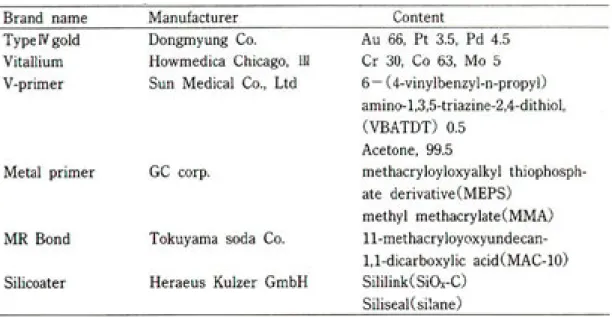
레진은 열중합레진(Vertex RS)을 사용하였으며 금속 표면 처리제들은 아래의 표와 같다(Table 1).
나) 연구방법
1) 시편제작
금속시편은 각 실험군당 40개씩 총200개를 제작하 였다. 플라스틱 막대를 이용하여 직경 5mm, 길이 10mm의 납형을 만들었고 수지 접착면을 평평하게 유 지하기 위해 silicon car-bide,연마지에서 바닥과 평 행하게 연마하였다. 통법에 따라 제IV형 금합금을 위 한 납형은 규산염 매몰재로 매몰하고, 코발트 크롬계 합금을 위한 납형은 인산염 매몰재로 진공매몰하여 주 조하였다. 주조된 금속 시편은 carborundum disc로 주입선을 절단하고 silicon carbide wheel로 연마한 후 초음파 세척기에서 10분간 세척하였다.
레진과 접합할 표면은 silicon-carbide paper (No.
80, 120, 320)로 균일하게 연마한 후, 주조된 금속시 편의 표면을 1군에서는 50㎛이 산화알루미늄으로 4기 압의 압력으로 금합금은 15초, 코발트 크롬계 합금은 30초간 sandblas-ter(Penblaster, Woosung Co., Korea)를 이용하여 금속시편에 분사연마한후 초음파 세척기에서 10분간 세척 하였으며, 2군에서는 1군과
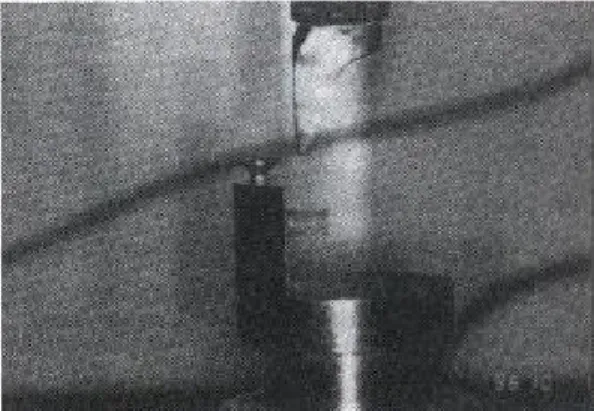
같은 과정처리후 V-primer를 1회 금속표면에 얇게 도 포하였고(Fig. 1.), 3군에서는 Metal primer를, 4군에 서는 MR Bond를 도포하였으며, 5군에서는 250㎛산 화알루미늄으로 sand-blasting후 에틸아세테이트 용 액(siliclean)으로 세척하고 실리카 용액(Sililink)을 얇 게 도포한 다음 silicoating machine (Silicoater MD)내에서 300℃까지 열처리 하고 시편을 공기중에 서 식힌후 silane(Siliseal)을 도포하였다(Table 2). 그 후 각군 모두 열중합레진으로 중합접착을 하였다. 온 성과정 완료후 함에서 제거하고 경화된 여분의 수지는 고속회전비를 이용, 제거하여 완성된 실험시편을 얻었 다.
Fig. 1. V-primer coating.
Table 1. Normal compositions of materials used in experiment (%)
2) Thermocycling
전단강도시험전에 시편의 절반은 결합강도의 지속 성을 평가하기 위하여 thermocycling ma-chine의 수조속에 위치시켜, 5℃와 55℃의 수조에 각각 30초간 머물게하여 총1000회의 ther-mocycling을 시켰다.
3) 레진과 금속표면간의 결합강도 측정
레진과 금속표면간의 결합강도는 전단강도시험으로 측정하였다. 만능시험기(Instron Model 1000, Instron Corp., Canton, Mass U.S.A)에 금속시편은 하부에 고정시키고, 상부에 고정시키고, 상부에 고정 시킨 전단기구(shearing blade)는 금속시편과 수직이 되게 하여 crosshead speed 0.05in/min의 속도로 전 단압력이 금속과 레진시편 접합부에 집중되도록 하여 레진시편이 분리되는 시점의 결합강도를 측정하였다 (Fig. 2.).
4) 금속표면의 주사전자현미경적 관찰
전단강도시험후 실험군간의 파절양상을 비교하기 위하여 금속면을 주사전자현미경(JEOL, JSM-840A, Japan)으로 비교 관찰하여 탈락이 레진에서 일어났는 지(cohesive), 레진-금속계면에서 일어났는지 (adhesive)를 관찰하였다.
Ⅲ. 연구성적
가) 전단결합강도
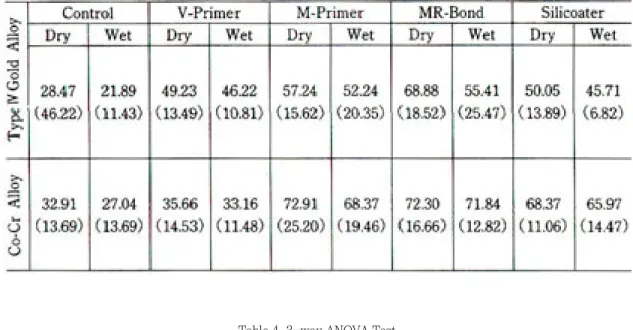
전단결합강도 시험후 각 실험군의 평균결합강도 및 표준편차는 Table 3, 3원 변량분석에 의한 분산분석결 과는 Table 4와 같다. 분산분석 결과 금속간의 차이, 표면처리간의 차이, ther-mocycling에 의한 차이, 금 속과 표면처리 사이에 교호작용이 있었으며 이에 따라 서 0.05의 유의수준으로 Scheffe’s test를 이용하여 각군을 비교 분석하였다. 제IV형 금합금에서 금속시편 과 레진의 결합전단강도는 1군은 28.47㎏/㎠, 2군은 49.23㎏/㎠, 3군은 57.24㎏/㎠, 4군은 68.88㎏/㎠, 5 군은 50.05㎏/㎠의 평균치를 나타내서 대조군인 1군이 가장 낮았으며, V-primer, Silicoater, Metal primer, MR Bond순으로 결합강도가 접차 높았고 대 조군과 나머지 군간에는 통계학적으로 유의성이 있는 차이를 보였다(P < 0.05)(Fig. 3).
코발트 크롬계 합금에서는 금속시편과 레진간의 전 단결합강도가 1군에서는 32.91㎏/㎠, 2군에서는 35.66㎏/㎠, 3군에서는 72.91㎏/㎠, 4군에서는 72.30
㎏/㎠, 5군에서는 68.37㎏/㎠의 평균치를 보였고 Metal primer, MR bond, Slilcoater간에는 통계학적 으로 유의성있는 차이를 보이지 않았으며 V-primer, 대조군과의 유의성있는 차이를 보였다 (P < 0.05) (Fig. 4).
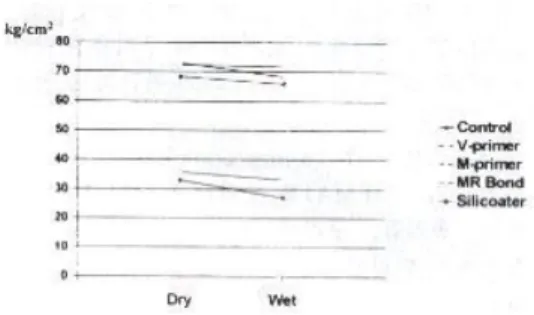
각각의 금속면 처리방법과 금속종류의 상관관계를 통계처리한 결과 V-primer에서는 제IV형 금합금이 코발트 크롬계 합금보다, Silicoa-ter 에서는 코발트 크롬계 합금이 제 IV형 금합금보다 상대적으로 결합강 도가 높게 나타났다(P < 0.05) (Fig. 5, Fig. 6).
Fig. 2. Loading shearing force with Instron machine.
Table 2. Experimental groups
시편을 themocycling한 후의 전단결합강도는 모든 시편에서 공히 줄었으나 thermo cyc-ling전의 전단
결합강도와 사이에 유의성있는 차이는 없었다(P >
0.05) (Fig. 7, Fig. 8).
Table 3. Bond Strength of Test Specimens(㎏/㎠)
Table 4. 3-way ANOVA Test
Fig. 3. Bond strength of gold alloy at various conditions.
Fig. 4. Bond strength of Co-Cr alloy at va-rious conditions.
나) 주사전자 현미경적 소견
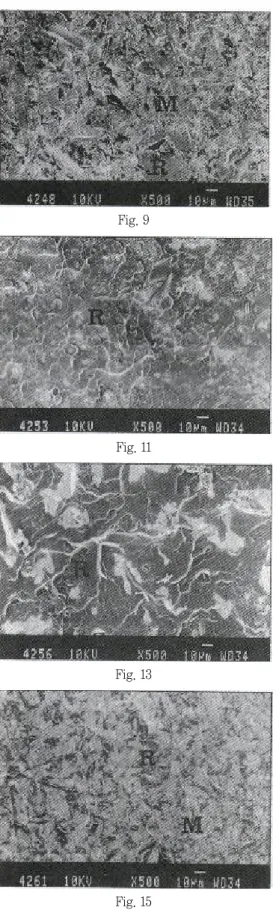
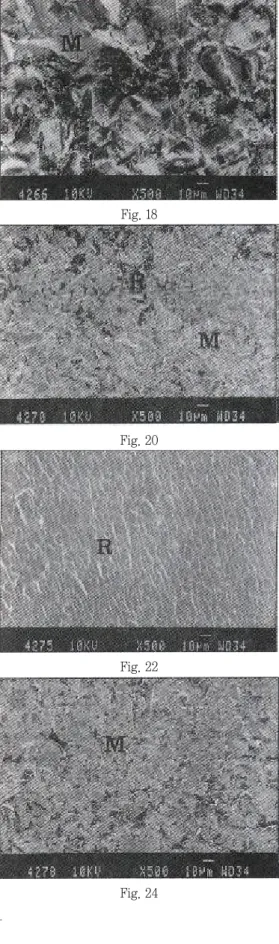
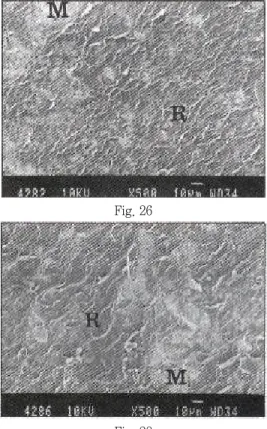
파절양상은 대조군의 경우 금속시편의 종류나 thermocycling 여부에 관계없이 공히 금속계면에서 파절이 일어났으며(Fig. 9, 14, 19, 24), V-primer를 도포한 2군의 경구, 제IV형 금합금에서는 부착성 (adhesive)파절과 점착성(cohe-sive) 파절이 모두 관 찰되는 반면, 코발트 크롬계 합금에서는 부착성 파절 이 관찰되었다(Fig. 10, 15, 20, 25). Metal primer를 도포한 3군에서는 제IV형 금합금과 코발트 크롬계합 금에서 부착성 파절과 점착성 파절이 모두 관찰되었으 나 점착성 파절이 주를 이루었다(Fig. 11, 16, 21, 26).
MR Bond로 금속표면을 처리한 4군의 경우 레진에서 파절이 일어나는 점착성파절이 주로 나타났고(Fig.
12, 17, 22, 27), Silicoating 한 5군에서는 금속표면이 매우 거친 양상을 보였으며 레진이 날카로운 금속 골 사이에 파묻혀있는 형태로서 부착성 파절과 점착성 파 절이 모두 관찰되었으나 주로 부착성파절이 관찰되었
다 (Fig. 13, 18, 23, 28).
Thermocycling을 시행한 시편들의 파절양상은 시 행전의 시편파절양상과 유사한 소견을 보였다.
Ⅳ. 총괄 및 고안
현재까지 금속과 레진간의 결합력을 향상시키기 위 한 여러 방법들이 개발되어 왔으며 본 연구에서는 몇 가지 금속표면 처리법들이 금속과 레진간의 결합강도 에 미치는 영향을 연구하였다. 구강내 가철성 보철물 에는 전단력이 자주 가해지므로 이 전단결합강도 시험 은 적절한 평가방법의 하나라고 할수 있다.
V-primer는 원래 금/은.팔라듐을 포함하는 귀금속 합금에 사용하도록 고안된 것으로 주성분은 0.5% 6- (4-vinylbenzyl-n-propyl) amino-1,3,5- triazine-2, 4-dithiol(VBATDT)과 99.5%의 아세톤 Fig. 5. Bond strength of specimens at dry co-
nditions.
Fig. 6. Bond strength of specimens at Wet conditions.
Fig. 7. Comparison Between dry and wet con-ditions of gold alloy.
Fig. 8. Comparison Between dry and wet con-ditions of Co-Cr alloy.
으로 구성된 부착성 단량체이다. 이는 주로 금관이나 교정용장치, 파절된 도재전장금관 수리에 사용되며, 본 실험에 사용한 열중합 레진과도 유의할만한 결합강 도 향상을 보였다. 그러나, 코발트 크롬계 합금의 경우 는 결합강도에 있어 대조군과의 차이를 보이지 않았 다 . 더 욱 본 실 험 을 위 한 예 비 실 험 에 서 THERMOCYC-LING후 금속시편과 레진간의 결합이 소실되어 분리된 시편을 관찰할 수 있었다.
Mercapto기를 가지는 어떤 유기화합물은 귀금속에 결합력을 나타내는데, 예를 들어 poly-sulfide 고무인 상재는 구리밴드나 구리를 포함한 애크릴릭 레진트레 이(58), 그리고 귀금속 보철물에 결합한다.
Kojima등5)은 N-(4-mercaptophenly) metha- crylamide (MPMA)를 포함하는 단량체는 금, 백금, 팔라듐, 구리에 강하게 결합한다고 하였으며 이 단량 체는 diethyl ether와 n-hexane이 재결정화한 것으 로서 free mercapto group이 레진과 금속의 계면에 존재하면 이것이 귀금속과 반응하여 화학적 결합을 한 다고 보고하였다.
Watanabe등6)은 이 V-primer가 비귀금속에 사용 할 때는 이같은 이점이 크게 나타나지 않으며 금합금 의 경우 열처리나 주석도금같은 처리후에 나타나는 결 합강도의 향상과 유사한 효과를 볼수있다고 하였다.
Atsuta등(57)은 은-팔라듐-구리-금합금에 4-META / MMA-TBB레진을 사용하여 콤포지트 레진과의 결합 을 증강시키는 방법으로 금합금에 구리이온을 도금한 경우도 우수하였으나 VBATDT를 포함하는 primer를 도포한 경우 더욱 강한 결합력을 얻을수 있었다고 하 였다. 이들 여러 논문에서도 증명되었지만 V-primer 금속처리제는 가철성 보철물에 사용하는 합금이 귀금 속일 경우에는 효과가 있으나 비귀금속 합금에는 큰 이점이 없음을 알 수 있다.
Metal primer는 주성분이 methacryloyloxya- lkyl thiophosphate 유도체로서 유황이 금속과 결합 하고 methacrylic기가 레진과 결합하여 금속과 레진 간의 결합을 향상시켜 계면에서 미세누출, 세균기생, 금속과 레진간의 분리를 막아준다10).
Metal primer제조자는 이 제품에 있는 thio- phosphate 유도체가 귀금속뿐만 아니라 비귀금속에
도 잘 결합한다고 하였다. 이 primer는 금관에 레진을 접합할때나 가철성보철물의 금속구조와 의치상 레진 과의 접합, 직접유지장치나, 자성 정밀부착장치와 레 진과의 결합에도 사용을 하며 의치상의 수리, 교정용 장치에도 쓰인다.
Watanabe등6)에 의하면 Metal primer는 V- primer와 더불어 제IV형 금합금에 4-META/MMA- TBB 레진이 결합하는 것을 향상시킨다고 보고하였다.
Matsumura등(89)은 MMA-TBB레진과 코발트 크롬계 합금의 결합에 Metal pri-mer를 포함한 여러 금속표 면 처리제를 이용하여 전단결합강도가 향상되었다고 하였으며, Yoshida등(82)은 Metal primer를 이용하여 은-팔라듐-구리-금합금에 레진시멘트를 접합시켰을 때 코발트 크롬계합금에 사용한 경우보다 결합강도가 우수했다고 보고하였다. 본 실험결과에서는 이 제품이 귀금속합금뿐 아니라 코발트 크롬계 합금에서도 우수 한 레진-금속간의 결합강도를 보였다. 통계학적으로 는 유의한 차이가 없었지만 MR Bond와 더불어 실험 군들중 가장 결합강도가 높았으며 Yoshida등(82)의 실 험 결과와 달리 비귀금속에서 더 높은 결합력을 보인 이유는 sandblasting과정에서 제IV형 금합금의 표면 요철이 효과적으로 이루어지지 못한 반면, 코발트 크 롬계 합금에서는 단단한 금속표면 특성 때문에 날카로 운 요철이 효과적으로 생겼기 때문으로 사료된다.
MR Bond는 의치상 수리만을 목적으로 개발된것으 로서 가철성국소의치나, 총의치의 금속구조물과 레진 간의 접합을 도모하며 계면에 생기는 미세누출을 막아 준다(56). 친수성의 마론산이 금속과 결합하고 소수성의 알킬기가 레진과 결합한다. 그리고 귀금속과 레진의결 합도 도모하지만 특히 코발트 크롬계, 니켈 크롬계, 티 타 늄 계 합 금 에 우 수 한 결 합 력 을 나 타 낸 다 . Matsumura등(89)은 이 금속표면 처리제가 접착 레진 과 코발트 크롬계 합금의 결합력을 향상시켰다고 하였 다.
본 실험에서는 Metal primer와 같이 이 제품도 두 가지 합금에서 모두 높은 결합강도를 보였으며 코발트 크롬계 합금에서 조금 더 높은 결합력을 나타내었다.
전자현미경적 관찰에서도 보였지만 이 금속표면 처리 제는 다른 금속전처리제와는 달리 점도가 높아 약간
두껍게 도포되는 것을 관찰할수 있었다.
Silicoater는 1984년 Musil과 Tiller(79)에 의해 소개 되어 불꽃에 의한 방법, 가열로에서 소결하는 방법이 개발되었으며 기계적 결합방법보다 금속과 레진간의 결합력을 향상시킨다고 하였다. Silicoater의 기전은 silane에 레진이 결합하고 금속에 SiOx-C층을 만들 어 여기서 공급하는 -OH 기가 silane과 결합을 한다
7).
Verzijden(22)는 silicoating법을 이용하였을때 레진 시멘트의 중합수축률이 줄었다고 보고한바 있고 Gate(23)는 주석 전석처리효과와 같은 결합강도를 얻었 다고 하였으며, Re(26) 등은 화학적 식각이나 전기화학 적 식각보다 silicoating법이 더 우수한 레진과의 결합 강도를 나타내었다고 하였다. Twesme등(24)과 Imbery등(27)도 silicoa-ting 후 결합강도의 증가를 보 고하였다.
Veen등(28)은 silicoating이 천공된 금속구조물이나 sandblasting법보다 더 높은 결합강도를 보이며, 주 석도금법과 유사한 결합강도를 보인다고 하였다.
Hansson과 Moberg(18),(19)는 코발트 크롬계 합금이 귀 금속보다 결합강도가 우수하였다고 보고하고 있으나, 이를 반박하는 논문도 있다. Hero등(16)은 처음에 silicone oxide입자가 합금의 기공(porosity)에 박히 는 것으로 알았으나 전자현미경적 관찰에서 silicoating을 하지않은 표면과 차이가 없는 것을 알 고, 여기에는 모종의 화학적 접합이 있는 것을 알았다.
May등3),4)은 임플랜트에 사용되는 티타늄 구조물에
silane을 도포하면 polymethyl metacry-late와 티 타늄간의 결합력을 향상시킨다고 보고하였으며 아무 처리도 하지않은 경우보다 60%이상의 결합강도가 있 다고 하였다. Kolod-ney등(13)은 니켈-크롬-베릴리움 계 합금에 silane을 바르고 3가지의 레진을 이용하여 전단결합 강도 실험을 하여 이들간의 유의한 차이를 발견하지 못하였으며, 현미경적 관찰에서 파절양상이 모두 점착성이었다고 하였다. Beech와 Jalaly11)는 교 정용 접착레진의 탄성강도가 낮을수록 전단결합강도 가 낮으며 탄성강도가 높으면 응력을 결합부위에 골고 루 분산시키다고 하였다. Silicoating을 하면 sandblasting에 의해 고에너지 표면이 제거되며 깊은
미세 홈에 silica가 적절히 도포되지 않기 때문에 silicoating만을 시행한 경우보다 결합력이 떨어진다 고 하였다. 이는 sandblasting의 중요성을 의미하며 금합금에서는 비귀금속합금에서보다 sandblasting의 시간이나 산화알루미늄의 입자크기를 조절할 필요성 을 의미한단(15),(20). Hansson(31)은 sandbla-sting과정 이나 silicoater machine내의 고온에 의해 금속표면 에 산화막이 형성되며 이들 산화막의 종류나 두께, 산 화막의 기계적 강도, sandblasting후에 남아있는 금 속표면의 alu-mina등이 결합강도에 영향을 미칠 수 있다고 하였다. 최와 방(93)의 연구에서는 니켈-크롬합 금과 50㎛, 250㎛ 산화알루미늄을 사용한 결과 두 입 자 크기간에 유의한 차이를 발견할수 없었다고 하였 다 . Laufer등(15)은 Silicoater를 이 용 할 때 sandblasting뿐 아니라 SiOx-C분자에 화학적 결합 을 할수 있는 금속산화막의 종류와 양도 결합강도에 영향을 미칠 수 있다고 하였다. 합금종류에 따른 결합 력의 차이에 대하여, Twesme등(24)은 은-팔라듐 합금 이나 금합금에 비해 니켈-크롬 합금이 레진시멘트와 더 강하게 결합한다고 보고하였고, Peutzfeldt와 Asmus-sen(63)도 은-팔라듐 합금과 금합금보다 코발 트 크롬합금의 결합강도가 더 높다고 보고하였다. 또 Hansson(31)도 금합금에 비해 코발트-크롬합금과 티 타늄 합금의 결합강도가 더 높다고 하였고, Ishijima 등11)도 코발트 크롬 합금이 금합금을 포함한 여러 다른 합금에 비해 높은 결합강도를 보인다고 하였다. 신등
(93)도 50㎛ 산화알루미늄을 사용한 실험에서 금합금에 비해 니켈-크롬 합금의 결합강도가 더 높다고 보고하 였다. 그러나 Hummel등(88)은 silicoating법중 불꽃에 의한 방법에서는 비귀금속합금이, 소결하는 방법 (Silicoater MD)에서는 귀금속합금이 더 높은 결합강 도를 나타낸다고 하였다. Laufer(15)도 레진 시멘트와 silicoating한 합금간의 결합강도 실험결과, 금합금에 서 니켈 크롬합금이나 팔라듐계 합금보다 높은 수치를 관찰할수 있었다고 보고하였다. Luthy등(32)은 silicoa-ting법을 이용하였을 때 금속표면을 전기화학 적으로 식각한 경우보다 sandblasting한 경우가 더 우수한 인장경합강도를 보였다고 하였으며 레진을 unfilled, microfilled, macrofilled 3가지의 충전재를
사용한 결과 인장결합강도에는 영향이 없었다고 하였 으며 이것은 산부식 에나멜층에 사용할때와는 달리 충 전재의 크기가 중요하지 않았다고 하였다. Creugers 든(34)은 주석 도금법이나 화학적 식각법보다 sandblas-ting을 시행한 silicoating법이 더 높은 결 합력을 보였는데 이는 주석 도금시 금속표면에 기계적 유지력이 감소하기 때문이라고 보았으며 금속과 레진 간의 결합에 매우 중요한 역할을 한다고 하였다.
Ekstrand등(41)은 silane처리한 티타늄합금에 열중합 레진을 결합시켜 30일간 수중에 보관한 결과 결합력이 떨어지는 것을 관찰하였으며 이는 레진 중합체에 흡수 된 수분이 plasti-cizing효과를 나타내기 때문이라고 하였다. 본 실험에서의 결과는 Hansson(18),(19)의 실험 에서와 유사하게 비귀금속에서 금합금보다 높은 결합 강도를 보였는데 이는 금속표면의 연마처리가 요인이 되지 않았나 사료되며, 결합강도의 높은 표준편차는 silicoating법이 술자에 따라 변화 할수 있는 요인이 매우 많은 것을 의미한다.또한 sliane을 도포할 때도 두껍게 발라서는 않되며 이는 결합강도의 약화를 초래 한다7). 결국 sili-coater법은 다른 방법에 비해 고가의 장비와 시간을 필요로 하며 예민한 기술을 필요로 한 다고 볼 수 있다. 또한 앞서 실험한 금속표면 처리제와 달리 구강내에서 수리를 할 수 없으며 의치상을 개상 할 경우에도 어려움이 있다. 이에 비해 2, 3, 4군에 사 용한 금속표면 처리제들은 사용법이 매우 간편하고 장 비가 필요치 않으며 금속에 적용하였을 때에도 레진과 의 우수한 결합력을 나타내었다.
이상의 결과로 보아 제IV형 금합금에서는 금속계면 에 아무런 처리를 하지않은 대조군에 비해 2, 3, 4, 5 군에서 모두 결합력의 증가를 나타냈고, 코발트 크롬 계 합금에서는 1,2군에 비해 3, 4, 5군에서 결합력의 증가를 보였으며, thermocycling이 결합력에 크게 영 향을 미치지 않는것으로 나타났다. 본 실험에서 시행 한 화학적 금속표면 처리방법을 임상에 응용하기 위해 서는 각 도포제의 특성과 sandblasting의 정도를 고 려하여 적절한 금속면 처리방법의 선택이 필요하다고 하겠다.
Ⅴ. 결 론
본 연구는 코발트 크롬계 합금과 제IV형 금합금의 표면을 V-primer, Metal primer, MR Bond, silicoater를 이용하여 표면처리후, 열중합레진과 접합 하여 금속과 레진과의 결합강도를 알아보기 위하여 50
㎛의 알루미나로 sa-ndblasting만 하고 레진과 접합 시킨 것을 1군, sandblasting후 V-primer를 도포한 것을 2군, Metal primer를 도포한 것을 3군, MR Bond를 도포한 것을 4군, 250㎛의 알루미나로 sandblasting한후 silicoating한것을 5군으로 분류하 고 모든 시편의 절반을 thermocycling하였으며 각 시 편을 만능시험기를 이용하여 결합강도를 측정하고 파 절 양상을 관찰하여 다음과 같은 결과를 얻었다.
1. 제IV형 금합금에서는 2군, 3군, 4군, 5군에서 sandblasting만을 시행한 1군보다 높은 결함강 도를 보였으며, 코발트 크롬계 합금에서는 3군, 4군, 5군에서 1,2군에 비해 높은 결합강도를 나 타내었다.
2. V-primer를 도포한 2군의 경우, 코발트 크롬계 합금보다 제IV형 금합금에서 높은 결합강도를 보였다.
3. silicoating한 5군의 경우, 제IV형 금합금보다 코발트 크롬계 합금에서 높은 결합강도를 보였 다.
4. Thermocycling 후 결합력의 감소를 보였으나 유의할만한 차이를 보이지 않았다.
5. 1군 전부와 2군중 코발트 크롬계합금에서 부착 성 파절양상이 관찰되었으며, 나머지군들에서는 부착성 파절 양상과 점착성 파절 양상이 동시에 관찰되었다.
Reference
1. McCracken WL. Partial denture construc-tion.
2ed ed. St Louis : CV Mosby, 1964 : 218-37.
2. Atsuta M, Matsumura H, Tanaka T. : Bo-nding fixed prosthodontic composite resin and precious metal alloys with the use of a vinyl-thilo primer and an adhesive opaque resin. J Prosthet Dent 1992 ; 67 ; 296-300
3. May KB, Russel MM, Razzoog ME, Land BR. : The shear strength of polymethyl methacrylate bonded to titanium partial denture framework material. J Prosthet Dent 1993 ; 70 : 410-3 4. May KB, Fox J, Razzoog ME, Land BR. : Silane to
enhance the bond between po-lymethyl methacrylate and titanium. J Prosthet Dent 1995
; 73 : 428-43
5. Kojima K, Kadoma Y, Imai Y. : Adhesion to precious metals utilizing triadine di-thione derivative monomer. : J Jpn Dent Mater 1987 ; 6 : 702-7
6. Watanabe I, Matsumura H, ㎌㎚㎒㎃Atsuta H. : Ef-fect of two metal primers on adhesive bo- nding with type4 gold alloys. J Prostet Dent 1995
; 73 : 299-303
7. Silicoater. Technique and operating inst- ructions. Bad Hamburg, Germany : Kul-zer &
Co. Dental Division.
8. Guggenberger R. Rocatec system-adhe-sion by tribochemical coating. Deutsch Za-hnarztl Z 1989
; 44 : 874-6
9. May KB, Razzoog ME, Land BR : Silane to enhance the bonding between polyme-thyl methacrlyate and titanium : J Pros-thet Dent 1995 ; 73 : 428-431
10. Metal Primer, Tcehnique and operation instuctions. Tokyo, Japan : GC Corp.
11. Ishijima T, Caputo AA, Mito R : Adhesion of resin to casitng allows J Prostet Dent 1992 ; 67 : 445-
449
12. Caeg C, Leinfelder KF, Lacefeid WR, Bell W. : Effectiveness of a method used in bo-nding resins to metal. J Prosthet Dent 1990 ; 64 : 37-41 13. Kolodney H, Puckett AD, Brown K. : Shear strength of laboratory processed composite resins bonded to a silane-coa-ted nickel-chromium- beryllium alloy. J Prosthet Dent 1992 ; 67 : 419- 422
14. Re G, Kaiser D, Malone W. Godoy F, Jones T. : Three different retentive methods for the resin- bonded retainer 『Abstract』J Dent Res 1987 ; 66 : 206
15. Laufer BZ, Nicholls JI, Towsend JD. : SiOx-C coating : a composite to metal bo-nding mechanism. J Prosthet Dent 1988 ; 60 : 320-7 16. Hero H, Ruyter IE, Waarli ML, Hultquist G. :
Adhesion of resins to Ag-Pd alloys by means of the silicoating technique. J Dent Res 1987 ; 66 : 1380-5
17. Beech DR, Jalaly T. : Clinical and labora-tory evaluation of some orthodontic direct bonding system. J Dent Res 1981 ; 60 : 970-8
18. Hansson O, Moberg LE. : Clinical evalua-tion of resin bonded prosthese. Int J Pros-thodont 1992
; 5 533-41
19. Hansson O, Moberg L-E. : Evaluation of three silicoating methods for resin bonded prosthese.
Scand J Dent Res 1993 ; 101 : 243-51
20. Peutzfeldt A, Asmussen E. : Silicoating : Evaluation of a new method of bonding composite resin to metal. Scand J Dent Res 1988
; 96 : 171-6
21. Bienick KW, Kupper H. : New construc-tion principles for silicoater-cast maxillary prosthesis. ZWR. 98(12) ; 1031-3,1 1989 Dec 22. Verzijden CWGJM, Feilzer AJ, Creuger NHJ,
Davidson CL : The influence of poli-merization shrinkage of resin cements on bonding to metal.
J Dent Res 1992 ; 71 : 410-413
23. Gates WD, Diaz-arnold AM, Aquilino SA, Ryther JS : Comparison of the adhesive strength of a BIS-GMA cement to tin-pla-ted and non-tin- plated alloys. J Prosthet Dent 1993 ; 69 : 12-16 24. Twesme DA, Lacefield WR, O’Neal SJ : Effects of
thermocycling, silicoating and etching on composite bonding to Cu, Au and Ni base alloys.
J Dent Res 1989 ; 66 : 206 『Abstract』#799 25. Kolodney H, Ducket AD, Breazeale MS, Patterson
KL, Leutz DL : Shear bond st-rengths of prosthodontic adhesive systems to a nickel- chromium-beryllium alloy. Quintessence Int 1992
; 23 : 65-69
26. Re GJ, Kaiser DA, Malone WFP. Godoy F : Shear bond strengths and scaning ele-ctron microscope evaluation of three dif-ferent retentive methods for resin-bonded retainers. J Prosthet Dent 1988
; 59 : 568-573
27. mbery TA, Burgess JO, Naylor WP. : Te-nsile strength of three resin cements fol-lowing two alloy surface treatments. Int J Prosthodont 1992
; 5 : 59-67
28. Veen JH, Brinsdijk AE, Slagter AP, Poel ACM, Arends J : Tensile bond strength of comspan resin to six differently treated metal surface.
Dent Mater 1988 ; 4 : 272
29. Jochen DG, Caputo AA, Matyas J : Effect of metal surface treatment on ceramic bond strength. J Prosthet Dent 1986 ; 55 ; 186-188 30. Soderholm KJM, Roberts MJ : Influence of water
exposure on the tensile strength of composites. J Dent Res 1990 ; 69 : 1812-1816
31. Hansson O : Strength of bond with coms-pan opaque to three silicoated alloys and titanium.
Scand J Dent Res 1990 ; 98 : 248-56
32. Luthy H, Marinello CP, Scharer P. : Fac-tors influencing metal-resin bond strength to filled composites. Dent Mater 1990 ; 6 : 73-77
33. Laufer B-Z, Nicholls JI, Townsend JD. : SiOx-C Coating : A composite-to-metal bonding mechanism. 1988 ; 60 : 320-327
34. Creuger NHJ, Welle PR, Vrijhoef MMA. : Four bonding systems for resin retained cast metal prosthese. Dent Mater 1988 ; 4 : 85-88
35. Naegeli D, Duke ES, Schwartz R. : Adhe-sive bonding of composites to a casting alloy. J Prosthet Dent 1988 ; 60 : 279-283
36. Jemt T, Linden B. : Fixed implant-suppo-rted prostheses with welded titanium fra-meworks.
Int J Perio & Res 1992 ; 12 : 177-183
37. Watanabe F, Power JM, Lorey RE. : In vi-tro bonding of prosthodontic adhesives to dental alloys. J Dent Res 1988 : 67 : 479-483
38. Livzditis GJ, Thompson VP. : Etched cas-tings : An improved retentive mechanism for resin- bonded retainers. J Prothet Dent 1982 ; 47 : 52- 58
39. Tanaka T, Fujiyama E, Shimizu H, takaki A, Atsuta M. : Surface treatment of nonp-recious alloys for adhesion-fixed partial dentures. J Prosthet Dent 1986 ; 55 : 456-462
40. Tanaka T, Atsuta M, Nakabayashi N, Ma-suhara E. : Surface treatment of gold al-loys for adhesion. J Prosthet Dent 1988 ; 60 : 271-278 41. Ekstrand K, Ruyter IE, Oysad H. : Adhe-sion to
titanium of methacrylate-based po-lymer materials. Dent Mater 1988 ; 4 : 111-115
42. Barzialy I, Mayers ML, Cooper LB, Graser GN : Mechanical and chemical retention of laboratory cured composite to metal su-rfaces. J Prosthet Dent 1988 ; 59 ; 131
43. Brady T, Doukoudakis A, Rasmussen ST : Experimental comparison between per-forated and etched metal resin bonded retainers. J Prosthet Dent 1985 ; 5 : 361
44. EI-sherif MH, EL-Messery A, Halhoul MN : The effects of alloy surface treatme-nts and resins
on the retention of resin-bonded retainers. J Prosthet Dent 1991 ; 65 : 782
45. Hudgins JL, Moon PC, Knap FJ : Particle- roughened resin0bonded retainers. J Pros-thet Dent 1985 ; 53 : 471
46. Jones RM, Morre BK, Goodacre CJ, Mu-noz- Viveros CA : Micrloeakage and shear bond strength of reisn and porcelain ve-neers bonded to cast alloys. J Prosthet Dent 1991 ; 65 : 221 47. LaBarre EE, WardHE : An alternative re-sin
bonded restoration. J Prosthet Dent 1984 ; 52 : 247
48. Modelli J, Bastos MT, Ishikiriama A, Na-varro MF : Tensile strength of five types of retention for resin-bonded prosthese. J Prosthet Dent 1991
; 66 : 759
49. Rochette AL : Attachment of a splint to enamel of lower anterior teeth. J Prosthet Dent 1973 ; 30 : 418
50. Shue SL, Nicholls JI, Townsend JD : The effect of metal retentive designs on resin veneer prosthese. J Prosthet Dent 1987 ; 58 : 297 51. Stoke AN, Tidmarsh BG : Porous metal coatings
for resin-bonded systems. J Pros-thet Dent 1986
; 56 : 170
52. Taleghani M, Leinfeldt KF, Taleghani AM : An alternative to cast etched retai-ners. J Prosthet Dent 1987 ; 58 : 424
53. Tanaka T, Atsuta M, Uchiyama Y, Kawa-shima I : Pitting corrosion for retaining acrylic resin facings. J Prosthet Dent 1979 ; 42 : 282
54. Tanaka T, Atsuta M, Uchiyama Y, Nakaba-yashi N, Masuhara E : Spherical powder for retaining thermosetting acrylic resin veneers. J Prosthet Dent 1978 ; 39 : 295
55. Tuner CH, Sinclair L : Sprayed opaque porcelain as a retentive surface for resin bonded restorations. Int J Prosthet 1990 ; 3 : 384 56. Sekine H, Kishi M, Matsuo E : Develop-ment of
the no-irritation relining material. The Bulletin of Tokyo Dental College 1990 ; 31 : 59
57. Atsuta M, Matsumura H, Tanaka T : Bon-ding fixed prosthodontic composite resin and precious metal alloys with the use of a vinyl-thiol primer and an adhesive opaque resin. J Prosthet Dent 1992 ; 67 : 296-300
58. Shigeto N, Kawazoe Y, Hamada T. Yamada S : Adhesion between copper plated acry-lic tray resin and a polysulfide rubber im-pression material. J Prosthet Dent 1979 ; 42 : 228-30 59. Kojima K. Studies on adhesion of functio-nal
monomers with SM group to tooth su-bstrates and dental alloys. J Jpn Dent. Ma-ter 1986 ; 5 : 92-105
60. Ohno h, Araki Y, Endo K. : A new method for promoting adhesion between precious metal alloys and dental adhesives. J Dent Res 1992 : 71 : 1326-31
61. Craing RG. Restorative dental materials 8th ed.
St Louis : CV Mosby 1989 ; 509-59
62. Gates WD, Diaz-arnold AM, Aquilino SA : Comparison of the adhesive strength of a BIS- GMA cement to tin-plated and non-tin-plated alloys. J Prosthet Dent 1993 ; 69 : 12
63. Matsumura H, Kawahara M, Tanaka T, Atsuta M : Surface preparations for metal frameworks of composite resin veneered prostheses made with an adhesive opaque resin. J Prosthet Dent 1991 ; 66 : 10
64. Cassidy AJ, Storie DQ : Saliva contamina-tion and resin bonding of etched metal restoration. J Prosthet Dent 1987 ; 57 : 29
65. Dilorenzo SC, Duke ES, Noring BK : Inf-luence of laboratory variables on chrome-cobalt alloy. J Prosthet Dent 1986 ; 55 : 27
66. Eshleman JR, Moon PC, Barnes RF : Cli-nical evaluation of cast metal resin-bonded anterior fixed partial dentures. J Prosthet Dent 1984 ; 51 :
751
67. Hill GL, Zidan O, Gomez-Marin O : Bond strengths of etched base metals : Effects of errors in surface area estimation. J Pro-sthet Dent 1986 ; 56 : 41
68. Livaditis GJ : A chemical etching system for creating micromechanical retention in resin bonded retainers. J Prosthet Dent 1986 ; 56 : 181 69. Yamashita A, Yamami T : Procedures for
applying adhesive resin to crown and bri-dge restorations. Part I, The influence of dental non0precious alloys and the treat-ment of inner surface of metal to adhesion. J Jpn Prosthet Dent 1982 ; 26 : 584-591
70. Chang JC, Powers JM, Hurt D : Bond st-rength of composite to alloys treated with bonding systems. J Prosthet Dent 1993 ; 2 : 110
71. Diaz-Arnold AM, Mertz JM, Aquilino SA, Ryther JS, Keller JC : A comparison of the tensile strength of four prosthodontic adhesives. J Prosthet Dent 1983 ; 2 : 215
72. Lawson JR : Alternative alloys for resin bonded retainers. J Prosthet Dent 1991 ; 65 : 97
73. Love LD, Breitman JB : Resin retention by immersion-etched alloy. J Prosthet Dent 1985 ; 53 : 623
74. Meiers JC, Jensen ME, Mayclin T : Effect of surface treatments on the bond stre-ngth of etched-metal resin bonded retai-ners. J Prosthet Dent 1985 ; 53 : 185
75. Reilly B, Davis El, Joynt RB, Queveddo J : Shear strength of resin developed by four bonding agent used with cast metal restoration. J Prosthet Dent 1992 ; 68 : 53
76. Yasuda N, Sasaki M, Mogi T, Ai M, Naka- bayashi N : Interface between metal and resin on the finishing line of Co-Cr den-ture J Jp Prosthet Dent 1978 ; 22 : 525
77. Bahannan SA, Connelly ME, Mueninghoff LA :
Application of silica coating techni-que for removable prosthodontics. A clini-cal report. J Prosthet Dent 1991 ; 65 : 1.
78. Creugers NHJ, Welle PR, Vrijhoef MMA : Four bonding systems for resin retained cast metal prostheses. Dent Mater 1988 ; 4 : 85
79. Musil R, Tiller H-J : The adhesion of den-tal resins to metal surfaces. The Kulzer silicoater technique. Kulzer & Co GmbH, FRG, 1984 80. Watanabe F, Power JM, Lorey RE : In vi-tro
bonding of prosthodontic adhesives to dental alloys J Dent Resd 1988 ; 67 : 479
81. Tanaka T, Atsuta M, Nakabayash E : Sur-tace treatment of gold alloys for adhesion. J Prosthet Dent 1988 ; 60 : 271
82. Yoshida K, Kamada K, Tanagawa M, At-suta M : Shear bond strengths of three resin cements used with three adhesive primers for metal. J Prosthet Dent 1996 ; 75 : 254-261
83. Tanaka T, Atsuta M, Uchiyama Y, Nakaba-yashi N, Masuhara E : Spherical power for retaining thermosetting acrylic resin veneers. J Prosthet Dent 1978 ; 39 : 295-303
84. Berfolotti RL, Napolitano LJ : Bonding of Isosit to electrolytically etched nickel-ch-romium.
Substrate (Abstract). J Dent Res 1983 ; 62 : 220 85. Yamauchi J, Omura I, Harada I : Adhesive and
mechnical properties of a new dental adhesives. J Dent Res 1984 ; 63 : 314
86. Yoshida K, Taira Y, Matsumura H, Atsuta M : Effect of adhesive metal primer on bonding a prosthetic composite resin to metals. J Prosthet Dent 1993 ; 69 : 357
87. Tanaka T, Hirano Y, Kawahara M, Matsu-mura H, Atsuta M : A new ion-coating su-rface.
treatment of alloys for dental adhe-sive resins. J Dent Res 1988 ; 67 : 1376
88. Hummel S, Pace L, Marker VA : A com-parison of two silicoating techniques. J Dent Res 1993 ;
72 : 124
89. Matsumura H, Tanaka T, Taira Y, Atsuta M : Bonding of a cobalt-chromium alloy with acidic primers and tri-n-butylborane-initiated luting agents J Prosthet Dent 1996 ; 76 : 194-199 90. 이근우 : 수지접합 수복물용 합금의 피착면 처리에 따른
결합력에 관한 실험적 연구. 대한치과보철학회지 1991 ; 29 : 13
91. 박상원, 양홍서 : 식각된 비귀금속 합금과 법랑질간의
접착인장강도에 관한 연구, 대한치과보철학회지 1987 ; 25 : 303.
92. 신현수, 한동후, 이근우 : Silicoating이 수지접합 수복 물의 결합력에 미치는 영향에 관한 실험적 연구. 대한치 과보철학회지 1989 ; 27 : 101
93. 최낙준, 방몽숙 : 레진전장관의 금속면 처리방법-레진 과 금속간 접착강도에 미치는 영향 대한치과보철학회지 1994 ; 32 : 471
논문사진부도
Fig. 9. SEM of debonded suface of type IV gold control group. (X500)
Fig.10. SEM of debonded suface of V-primer treated type IV gold alloy. (X500) Fig.11. SEM of debonded suface of Metal primer treated type IV gold alloy. (X500) Fig.12. SEM of debonded suface of MR Bond treated type IV gold alloy. (X500) Fig.13. SEM of debonded suface of Silane treated type IV gold alloy. (X500) Fig.14. SEM of debonded suface of Co-Cr alloy control group. (X500)
Fig.15. SEM of debonded suface of V-primer treated Co-Cr alloy alloy. (X500) Fig.16. SEM of debonded suface of Metal primer treated Co-Cr alloy alloy. (X500) Fig.17. SEM of debonded suface of MR Bond treated Co-Cr alloy alloy. (X500) Fig.18. SEM of debonded suface of Silane treated Co-Cr alloy alloy. (X500)
Fig.19. SEM of debonded suface of type IV gold control group after thermocycling. (X500)
Fig.20. SEM of debonded suface of V-primer treated type IV gold alloy after thermo-cycling. (X500) Fig.21. SEM of debonded suface of Metal primer treated type IV gold alloy after thermo-cycling.
(X500)
Fig.22. SEM of debonded suface of MR Bond treated type IV gold alloy after thermo-cycling. (X500) Fig.23. SEM of debonded suface of Silane treated type IV gold alloy after thermo-cycling. (X500) Fig.24. SEM of debonded suface of Co-Cr alloy control group after thermocycling. (X500)
Fig.25. SEM of debonded suface of V-primer treated Co-Cr alloy alloy after thermocycling. (X500) Fig.26. SEM of debonded suface of Metal primer treated Co-Cr alloy alloy after thermo-cycling.
(X500)
Fig.27. SEM of debonded suface of MR Bond treated Co-Cr alloy alloy after thermo-cycling. (X500) Fig.28. SEM of debonded suface of Silane treated Co-Cr alloy alloy after thermocycling. (X500)
Fig. 9
Fig. 11
Fig. 13
Fig. 15
Fig. 10
Fig. 12
Fig. 14
Fig. 16
사진부도 1
Fig. 17
Fig. 19
Fig. 23
Fig. 18
Fig. 20
Fig. 21 Fig. 22
Fig. 24
사진부도 2
Fig. 25 Fig. 26
Fig. 28 Fig. 27
사진부도 3
=Abstract=
THE EFFECTS OF METAL SURFACE TREATMENTS ON THE BONE STRENGTH OF POLYMETHYL METHACRYLATE BONDED REMOVABLE PROSTHESE
Tas-Wan Eom, Ik-Tae Chang
Dept. of Prosthodontics, School of Dentistry, Seoul National University