Korean J Perinatol Vol.26, No.2, June, 2015 http://dx.doi.org/10.14734/kjp.2015.26.2.134
� Case Report �
‘whirlpool sign.’2 We report a case of fetal bowel dila
tion and intestinal volvulus presented by the whirl
pool sign with meconium peritonitis at 30 weeks of gestation. The patient survived after delivery by cesarean section and appropriate surgical interven
tion.
Case report
A 29yearold primigravida in the 29+1 week of gestation was admitted to department of obstetrics and gynecology of Seoul National University Hospital because the fetal ultrasound showed a mildly dilated and echogenic bowel with maximal diameter of 32.4 mm without any ascites. Ultrasound showed normal fetal development, and there was no evidence of con
genital infection.
Ultrasound at 29+4 weeks revealed a markedly dilated bowel loop with a maximum diameter of 36.3 mm and an amniotic fluid index of 260 mm. In addi
Fetal volvulus is an abnormal twisting of the gas
trointestinal tract that predisposes to midgut volvulus and can lead to ischemic bowel infarction, perforation and peritonitis. This condition is extremely rare and has high rates of morbidity and mortality.1 Early de
tec tion and immediate postnatal management is imperative for a better outcome.
Most cases of volvulus are diagnosed in the post
natal period. However, an increasing number of re
ports of prenatal ultrasound diagnosis have been reported recently with highresolution ultrasound technology imaging, especially with detection of the
Received: 1 May 2015 Revised: 19 June 2015 Accepted: 19 June 2015
Correspondence to: Seung Han Shin M.D., Ph.D.
Department of Pediatrics, Seoul National University College of Medicine, 101 Daehak-ro Jongno-gu, Seoul 110-799, Korea Tel: +82-2-2072-3555, Fax: +82-2-2072-0590
E-mail: [email protected]
Copyrightⓒ 2015 by The Korean Society of Perinatology
This is an Open Access article distributed under the terms of the Creative Commons Attribution Non-Commercial License (http://creativecommons.org/license/
by-nc/3.0/), which permits unrestricted non-commercial use, distribution, and reproduction in any medium, provided that the original work is properly cited.
The Korean Journal of Perinatology · pISSN 1229-2605 eISSN 2289-0432 · e-kjp.org
A Case of a Preterm Infant with Prenatally Diagnosed Intrauterine Midgut Volvulus
Hae Kyung Woo, M.D.
1, Hae Yun Lee, M.D.
1, Sae Yun Kim, M.D.
1, Young Hwa Jung, M.D.
1, Seung Han Shin, M.D.
1, Hyun-Young Kim, M.D., Ph.D.
2, Ee-Kyung Kim, M.D., Ph.D.
1, Han-Suk Kim, M.D., Ph.D.
1, Jong Kwan Jun, M.D., Ph.D.
3, and Jung-Hwan Choi, M.D., Ph.D.
1Departments of 1Pediatrics, 2Pediatric Surgery, 3Obstetrics and Gynecology, Seoul National University College of Medicine, Seoul, Korea
Intrauterine midgut volvulus is a rare and potentially life-threatening congenital disease that can lead to intestinal ischemia, sepsis and peritonitis caused by bowel perforation and meconium obstruction. Early detection and immediate treatment is crucial to improve the outcome. Herein, we report a preterm infant of 30 weeks of gestation with intrauterine midgut volvulus associated with meconium peritonitis who survived after cesarean delivery and immediate postnatal surgical intervention. The outcome of in-utero intestinal volvulus depends on optimal delivery timing and adequate postnatal treatment. Therefore, prompt multidisciplinary consultation and planning with obstetricians, neonatologists and pediatric surgeons is necessary to reduce the morbidity and mortality associated with fetal midgut volvulus, especially in the preterm period.
Key Words: Intrauterine midgut volvulus, Meconium peritonitis, Antenatal diagnosis, Preterm infant
suspicion of intestinal perforation. This prompted the decision for emergency caesarean delivery.
A male newborn weighing 1,860 g was delivered with Apgar scores of 4, 6 and 7 at 1, 5 and 10 minutes.
The baby initially did not cry, and his heart rate was below 100 beats per minute. Positive pressure ven
tilation (PPV) was applied, but respiratory distress remained with a distended and tense abdomen.
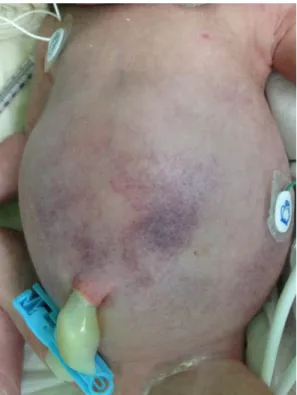
Ecchymosis was observed on the abdominal skin with visible peristalsis (Fig. 2). An investigational workup, including blood culture, chest xray, and arterial gas, was performed, and widespectrum intravenous antibiotics were started. Immediate ultrasonography of the abdomen confirmed the diagnosis of intestinal obstruction with perforation.
An emergent laparotomy was carried out three hours after birth. Intraoperative findings showed a volvulus of the small bowel with meconiumstained turbid fluid occupying the abdomen and the twisted bowel segment 10 cm distal to the ligament of Treitz (Fig. 3).
There was no intestinal malrotation, mesenteric defect or atresia. A 6 cm necrosis of the ileum was resected, and an ileostomy was performed. Macro
scopic histopathology revealed a gangrenous seg
ment of the small bowel measuring 6 cm in length and tion, volvulus with a typical whirlpool sign was ob
served in twisted bowel loops containing meconium (Fig. 1). Thereafter, induction of labor for delivery was attempted for two days, with failure to deliver.
Ultrasound at 30 weeks of gestation showed bowel dilation with echogenic spots and ascites, raising the
Fig. 1. Fetal ultrasonography at 29+4 of gestation showed the ‘whirlpool sign’ (arrow).
Fig. 2. At birth, the abdomen was distended, and the skin
was discolored with visible peristalsis. Fig. 3. Intra-operative finding showed a midgut volvulus with necrosis and perforation (arrow).
a central segment dilated to a maximum diameter of 3 cm. Microscopic histopathology included a few immature ganglion cells in the submucosa with an absence of mature ganglion cells.
The postoperative course was uneventful. Six weeks later, ileostomy closure was performed. Two weeks later, the patient was discharged with full enteral feeding and adequate weight gain.
Discussion
Fetal intestinal volvulus is rare, and only a few cases of prenatal diagnosis have been reported. So far, less than thirty cases of fetal midgut volvulus have been reported with only three cases in Korea.
311 In two cases of them, the twisted bowel was observed on sonography, but no diagnostic doppler features were reported. This is the second case of prenatally diagnosed intrauterine volvulus with whirlpool in preterm infant sign in Korea.
Most cases of intestinal volvulus are associated with anomalies of intestinal rotation or congenital developmental defects, such as intestinal atresia, gastroschisis and omphalocele.12 At approximately 8 weeks of gestation, the midgut rotates an additional 180 degrees counterclockwise, fixing to the posterior wall. Arrest of development at any stage and impaired fixation leaves the bowel at a high risk for volvulus.13 However, the etiology of intestinal volvulus without malrotation is not well understood; rare predisposing causes have been suggested, such as Meckel's di
verticulum, duplication cyst and meconium plugs.14 Sonographic findings of intestinal volvulus were first reported in 1983.15 The diagnosis of intrauterine midgut volvulus has become easier with high
resolution image technology. Ultrasound findings re
vealed the hallmark whirlpool sign in which the bowel
and accompanying mesentery and vessel wrap around the main superior mesenteric artery.16 More
over, polyhydramnios, intestinal dilation and ascites were also helpful in distinguishing bowel obstruction.
A recent prospective study of neonates showed that the sensitivity and specificity of the whirlpool sign are as high as 89% and 92%.17 In our case, the patho
gnomonic whirlpool sign was detected prenatally, and the diagnosis of midgut volvulus was made before birth.
If the prenatal ultrasound findings show the typical image of the whirlpool sign, delivery should be considered. However, there has been no consensus regarding the timing of delivery in fetuses with a high suspicion of intestinal obstruction, especially in preterm infants. In present case, even though the sonographic abnormalities associated with volvulus are found at 29+4 weeks of gestation, the baby was delivered by caesarean section at 30 weeks of gesta
tion after few days of induction of delivery. For the case was preterm at diagnosis, time for admini
stration of prenatal dexamethasone was required, and there were no abnormal findings on biophysical monitoring and signs of intestinal perforation at the time of prenatal diagnosis. Emergency caesarean section and emergent pediatric surgery are available in our hospital. Careful biophysical monitoring of the fetus and screening of the amount of amniotic fluid and presence of ascites could be helpful.5 Prenatal emergencies can occur with decreased fetal move
ment and nonreactive readings on cardiotocography or signs of intestinal perforation. Survival of the affected neonates is influenced by the length of is
chemic necrosis bowel, gestational age at birth and the ability to tolerate neonatal surgery.18
In summary, the key for successful treatment of the volvulus depends on a high index of suspicion and
clinical skills. A team effort that includes an experi
enced obstetrician, a pediatric surgeon, a neona
tologist and nutritional support is valuable. Herein, we report a case of an infant with intrauterine vol
vulus with typical findings, who was delivered with prenatal careful monitoring and treated immediately and appropriately after birth.
References
1) Torres AM, Ziegler MM. Malrotation of the intestine. World J Surg 1993;17:326-31.
2) Taori K, Sanyal R, Attarde V, Bhagat M, Sheorain VS, Jawale R, et al. Unusual presentations of midgut volvulus with the whirlpool sign. J Ultrasound Med 2006;25:99-103.
3) Chung JH, Lim GY, We JS. Fetal primary small bowel volvulus in a child without intestinal malrotation. J Pediatr Surg 2013;48:e1-5.
4) Varetti C, Meucci D, Severi F, Di Maggio G, Bocchi C, Petraglia F, et al. Intrauterine volvulus with malrotation:
prenatal diagnosis. Minerva Pediatr 2013;65:219-23.
5) Molvarec A, Babinszki A, Kovacs K, Toth F, Szalay J.
Intrauterine intestinal obstruction due to fetal midgut volvulus: a report of two cases. Fetal Diagn Ther 2007;22:38- 40.
6) Morikawa N, Namba S, Fujii Y, Sato Y, Fukuba K. Intrau- terine volvulus without malrotation associated with seg- mental absence of small intestinal musculature. J Pediatr Surg 1999;34:1549-51.
7) Cho EH, Sung SI, Yoo HS, Ahn SY, Yoo SY, Chang YS, et al. Intrauterine midgut volvulus with malrotation in a preterm infant: a case report. Neonatal Med 2013;20:476-9.
8) Nakagawa T, Tachibana D, Kitada K, Kurihara Y, Terada H, Koyama M, et al. A case of fetal intestinal volvulus without malrotation causing severe anemia. Jpn Clin Med 2015;6:1-3.
9) Park GO, Kim JH, Lee JH, Lee JJ, Yun SW, Chae SA, et al. A case of premature born with bowel perforation and gangrene due to intrauterine midgut volvulus caused by meconium ileus. Korean J Perinatol 2008;19:312-7.
10) Yim GW, Yang HI, Cho HJ, Park YW, Kim YH. A case of fetal intestinal volvulus diagnosed by prenatal ultra- sonography in the 3rd trimester. Korean J Ultrasound Obstet Gynecol 2007;9:227-31.
11) Park WH, Park SM, Choi SO. Ileal atresia secondary to intrauterine segmental volvulus. J Korean Assoc Pediatr Surg 1995;1:177-80.
12) Crisera CA, Ginsburg HB, Gittes GK. Fetal midgut volvulus presenting at term. J Pediatr Surg 1999;34:1280-1.
13) Rees JR, Redo SF. Anomalies of intestinal rotation and fixation. Am J Surg 1968;116:834-41.
14) Kornacki J, Czarnecka M, Blaszczynski M, Skrzypczak J, Gadzinowski J, Jankowski A, et al. Congenital midgut volvulus associated with fetal anemia. Fetal Diagn Ther 2010;28:119-22.
15) Steffensen TS, Gilbert-Barness E, DeStefano KA, Konto- poulos EV. Midgut volvulus causing fetal demise in utero.
Fetal Pediatr Pathol 2008;27:223-31.
16) Ohuoba E, Fruhman G, Olutoye O, Zacharias N. Peri- natal survival of a fetus with intestinal volvulus and intus- susception: a case report and review of the literature. AJP Rep 2013;3:107-12.
17) Chao HC, Kong MS, Chen JY, Lin SJ, Lin JN. Sonographic features related to volvulus in neonatal intestinal malro- tation. J Ultrasound Med 2000;19:371-6.
18) Yoo SJ, Park KW, Cho SY, Sim JS, Han KS. Definitive diagnosis of intestinal volvulus in utero. Ultrasound Obstet Gynecol 1999;13:200-3.
= 국 문 초 록 =
산전 자궁 내 중장 염전 진단 받은 미숙아 1례
서울대학교 의과대학 소아과학교실1, 외과학교실2, 산부인과학교실3
우혜경
1^이해연
1^김세연
1^정영화
1^신승한
1^김현영
2^김이경
1^김한석
1^전종관
3^최중환
1자궁 내 태아의 중장 염전은 매우 드물게 발생하며 장의 허혈, 패혈증, 복막염 등을 유발하여 태아 생존에 위협이 되기도 하므로, 조기 진단과 즉각적인 치료가 중요한 질환이다. 본 증례에서는 재태주수 30주의 태아에서 태변성 복막염이 동 반된 자궁 내 중장 염전이 발생하여 제왕절개 분만 후에 즉각적으로 수술을 시행한 후 좋은 예후를 보였던 미숙아를 보 고하였다. 자궁 내 장 염전이 발생할 경우 적절한 분만 시점의 결정과 분만 후 치료가 예후를 결정하는 중요한 요소로 알 려져 있다. 그러므로 미숙아 분만이 예상될 경우 산과의, 신생아 진료의, 소아외과의의 즉각적인 다학제적인 접근을 통 해 태아의 중장 염전으로 인한 이환과 사망률을 줄이려는 노력이 필요하다.
중심 단어: 자궁 내 중장 염전, 태변성 복막염, 산전 진단. 미숙아