https://doi.org/10.14734/PN.2020.31.2.94 pISSN 2508-4887•eISSN 2508-4895
Hwa Suk Lee, MD, PhD1, Jun Ho Lee, MD2,3, Young Ju Jeong, MD, PhD1,3 Departments of 1Obstetrics and Gynecology, 2Anesthesiology and Pain Medicine, 3Research Institute of Clinical Medicine, Jeonbuk National University Medical School, Jeonju, Korea
Acute fatty liver of pregnancy (AFLP) can cause liver failure in the third trimester and lead to fatal complications of mother and fetus. Prompt delivery has been known as the best treatment but the importance of the maternal care is also considered an option for accomplishing maternal recovery. We report a case of 28 year-old nullipara with 36+1 weeks who was clinically diagnosed AFLP. Although the patient had an uneventful delivery, she was suffered from acute hepatic failure, coagulo pathy, hepatic encephalopathy, postpartum hemorrhage, and renal failure. We decided to assist the patient’s liver function by using artificial liver support therapy such as molecular adsorbent recirculating system (MARS). After the intensive care with MARS and continuous renal replacement therapy, she was discharged with good condition in general. In conclusion, MARS can be a treatment option for AFLP as well as for prompt delivery. However, more studies need to be done to better understand the role of MARS in assisting liver function for AFLP.
Key Words: Acute fatty liver of pregnancy, Disseminated intravascular coagulation, Molecular adsorbents recirculating system, Postpartum hemorrhage, Renal insufficiency
Introduction
Acute fatty liver of pregnancy (AFLP) is a complication of pregnancy that was first described in 1934 in a seminal research by Stander and Cadden.1 AFLP is uniquely characterized microvesicular fatty infiltration of hepatocyte in pregnancy. It is a very rare disease, the inci
dence is estimated to be one case per 20,000 births.2 This lifethreatening disease usually occurs in the third trimester of pregnancy. In most cases, the patients complained nausea, vomiting, malaise, epigastric pain, jaundice, etc. without a specific underlying liver disease such as hepatitis or fatty liver. The complications of acute hepatic dysfunction due to AFLP result in coagulopathy, renal failure, hepatic encephalopathy, and postpartum hemorrhage.
The maternal mortality of AFLP was 70% before 1985.3 However, it has dramatically de
creased to 10.5% in the 2000s4 due to early diagnosis, better understanding of the pathophy
siology, early decision making on delivery time, and the implementation of the artificial liver support therapy such as plasma exchange or molecular adsorbent recirculating system (MARS).
Early diagnosis and treatment prior to delivery is required by distinguishing AFLP from preeclampsia and hemolysis, elevated liver enzymes, and low platelet count syndrome, both of which share common characteristics of liver failure with AFLP. For treatment, massive transfusion is generally performed to correct coagulopathy caused by liver failure. It has been known that the duration of recovery after delivery for the return of normal liver function is dependent on overall disease severity. Recently, MARS has been applied in order to correct Received: 8 December 2019
Revised: 10 January 2020 Accepted: 31 January 2020 Correspondence to Young Ju Jeong, MD, PhD Department of Obstetrics and Gynecology, Research Institute of Clinical Medicine, Jeonbuk National University Medical School, 20 Geonji- ro, Deokjin-gu, Jeonju 54907, Korea Tel: +82-63-250-1372
Fax: +82-63-254-4833 E-mail: [email protected]
Copyright© 2020 by The Korean Society of Perinatology
This is an Open Access article distributed under the terms of the Creative Com- mons Attribution Non-Commercial License (http://creativecommons.org/
license/by-nc/4.0/), which permits unrestricted non-commercial use, distribution, and reproduction in any
Use of the Molecular Adsorbent Recircula
ting System in Acute Fatty Liver of Preg
nancy: a Case Report
endotoxins cannot be removed effectively due to the reduced detoxification capacity, MARS can be applied for this purpose.
Here, we report a case of severe complications of acute fatty liver in the third trimester of pregnancy and its postpartum treatment using MARS.
Case
A 28yearold nullipara, at 36+1 weeks day gestation, visited a private obstetric clinic with a complaint of jaundice. Measured aspartate aminotransferase (AST)/alanine aminotransferase (ALT) was 60/110 IU/L and totalbilirubin was 12 mg/dL. She was transferred to our Department of Obstetrics and Gynecology.
Her medical and obstetric history was unremarkable, as was family history. She had no history of hypertension or diabetes.
She did not use alcohol or drugs.
As soon as the patient arrived at the hospital, she was moved to the labor and delivery room. At arrival blood pressure was 130/70
mmHg, heart rate was 120 beats/min, and body temperature was 37.3℃. Her consciousness was slightly drowsy, but oral communication was possible. Specific symptoms such as nausea, vomiting and epigastric pain were not presented except jaundice.
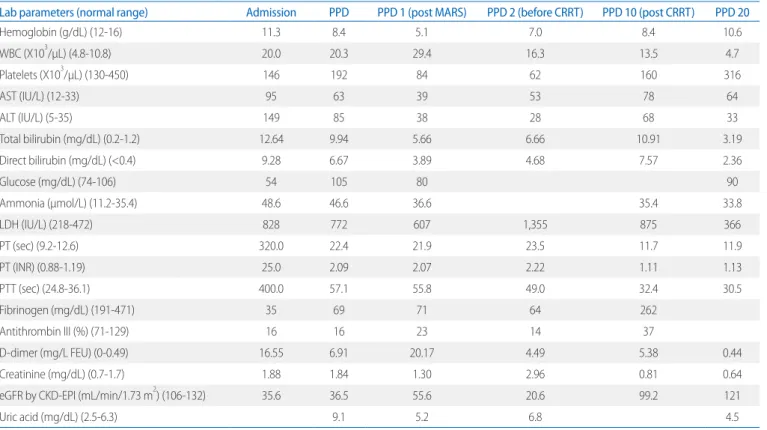
Laboratory findings and the Swansea criteria7 for diagnosing AFLP were in accord with diagnostic AFLP (Table 1). Hepatitis serologic markers were all negative: hepatitis B surface antigens (), hepatitis B surface antibodys (+), antihepatitis B core IgM (), antihepatitis A virus IgM (), antihepatitis A virus IgG (+) and antihepatitis C virus (). Abdominal ultrasonography showed the diffusely increased liver echogenicity and the collapsed gallbladder with pericholecystic edema. On vaginal examination, cervix was 2 cm dilated and 50% effaced.
Oxytocin augmentation for vaginal delivery was decided. Five units of fresh frozen plasma and 16 units of cryoprecipitate were transfused before delivery. Central catheter and longterm he
modialysis catheter were secured to prepare hemodialysis after delivery.
Fetal sonography revealed that a single live fetus was in a
Table 1. The Laboratory Data in Chronological Order
Lab parameters (normal range) Admission PPD PPD 1 (post MARS) PPD 2 (before CRRT) PPD 10 (post CRRT) PPD 20
Hemoglobin (g/dL) (12-16) 11.3 8.4 5.1 7.0 8.4 10.6
WBC (X103/μL) (4.8-10.8) 20.0 20.3 29.4 16.3 13.5 4.7
Platelets (X103/μL) (130-450) 146 192 84 62 160 316
AST (IU/L) (12-33) 95 63 39 53 78 64
ALT (IU/L) (5-35) 149 85 38 28 68 33
Total bilirubin (mg/dL) (0.2-1.2) 12.64 9.94 5.66 6.66 10.91 3.19
Direct bilirubin (mg/dL) (<0.4) 9.28 6.67 3.89 4.68 7.57 2.36
Glucose (mg/dL) (74-106) 54 105 80 90
Ammonia (μmol/L) (11.2-35.4) 48.6 46.6 36.6 35.4 33.8
LDH (IU/L) (218-472) 828 772 607 1,355 875 366
PT (sec) (9.2-12.6) 320.0 22.4 21.9 23.5 11.7 11.9
PT (INR) (0.88-1.19) 25.0 2.09 2.07 2.22 1.11 1.13
PTT (sec) (24.8-36.1) 400.0 57.1 55.8 49.0 32.4 30.5
Fibrinogen (mg/dL) (191-471) 35 69 71 64 262
Antithrombin III (%) (71-129) 16 16 23 14 37
D-dimer (mg/L FEU) (0-0.49) 16.55 6.91 20.17 4.49 5.38 0.44
Creatinine (mg/dL) (0.7-1.7) 1.88 1.84 1.30 2.96 0.81 0.64
eGFR by CKD-EPI (mL/min/1.73 m2) (106-132) 35.6 36.5 55.6 20.6 99.2 121
Uric acid (mg/dL) (2.5-6.3) 9.1 5.2 6.8 4.5
Abbreviations: PPD, postpartum day; MARS, molecular adsorbents recirculating system; CRRT, continuous renal replacement therapy; WBC, white blood cell; AST, aspartate aminotransferase; ALT, alanine aminotransferase; LDH, lactate dehydrogenase; PT, prothrombin time; INR, international normalized ratio; PTT, activated partial prothrombin time; FEU, fibrinogen equivalent units; eGFR, estimating glomerular filtration rate; CKD-EPI, chronic kidney disease epidemiology collaboration equation.
function was gradually improved. She was discharged with good condition in general on postpartum day 22.
Discussion
AFLP is a very rare disease that occurs in the third trimester of pregnancy and threatens the mother and the fetus as well.
Distinctive feature of pathologic finding is micro vesicular fatty infiltration of hepatocyte, but liver biopsy is not necessary for diagnosis.8 The Swansea criteria7 were proposed as a diagnostic tool for AFLP. According to the criteria, AFLP can be diagnosed if at least 6 of 15 positive signs or symptoms were satisfied. Our case fulfilled the 10 items in the 15 of Swansea criteria.
The diagnosis of AFLP and the planning for the patient care after delivery should be performed at the same time. The life threatening condition that associated with AFLP is acute hepatic failure accompanied by disseminated intravascular coagulation, acute renal failure, encephalopathy and gastrointestinal bleed
ing. After delivery, further intensive care should be considered for hemodialysis, or artificial liver support therapy such as MARS or plasma exchange. Most of liver injuries due to AFLP are reversible, and the recovery generally begins 1 week after delivery. However, several studies on liver transplantation were reported because liver function was not recovered even after delivery.911
A study of serologic markers that may affect patient reco
very was performed in China, and it was turned out that hyper
bilirubinemia and increased prothrombin time were relevant factors in increasing the duration of recovery.12 Serum biliru
bin, creatinine, and international normalized ratio (INR) that constituted the model for endstage liver disease score deter
mining the mortality risk of patients with end stage liver disease were studied for the relevance with AFLP. Among them, INR and bilirubin were found as potential predictive markers.12 In our case, the patient showed rapid hypoglycemia, marked elevated INR, severe DIC and encephalopathy due to AFLP. Thus, we decided to proceed appropriate delivery process and immediate ICU care. In order to reduce bilirubin and albumin binding toxin, MARS was applied after vaginal delivery.
MARS is a method that can be applied to patients with acute liver failure without liver cirrhosis or acute exacerbation with a cephalic presentation with a normally estimated fetal weight and
a moderate amniotic fluid volume. Placenta was located along the anterior uterine walls and did not show any abnormal find
ings.
Electronic fetal heart tracing showed a reactive pattern and uterine contraction was estimated as 34 minutes interval. Eight units of platelet concentrate were transfused during the second stage and vaginal delivery was accomplished without episiotomy.
The patient delivered a 3,050 g male infant whose Apgar scores were 6 and 8 at 1 minute and 5 minutes, respectively.
For hemodynamic monitoring and further intensive care, she was transferred to the intensive care unit (ICU). We decided to support the liver function using MARS after the delivery. MARS (MARS Monitor®; Type 1115/1 PrisMARS, Gambro Instruments, Lund, Sweden) was adjusted to the rate of 130 mL/min for the blood reflux, 130 mL/min for the albumin reflux, and 130 mL/
min for the dialysis reflux. To minimize the risk for hemorrhagic complications, anticoagulation was not administered. A single MARS treatment of 8 hours was performed on postpartum day 1. After MARS therapy, the patient's serum ALT was decreased from 85 IU/L to 38 IU/L, and serum total bilirubin was estimated from 9.94 mg/dL to 5.66 mg/dL. The serum creatinine level and estimating glomerular filtration rate (eGFR) by chronic kidney disease epidemiology collaboration equation (mL/min/1.73 m2) were significantly ameliorated from 1.84 mg/dL to 1.30 mg/dL, from 36.5 to 55.6, respectively.
For all that, the massive postpartum vaginal bleeding occurred immediately after MARS treatment due to the poor uterine contraction. Her hemoglobin and platelet levels had fallen 5.1 mg/dL and 84,000 mm3, respectively. She underwent the uterine artery embolization to stop the massive vaginal bleeding. After the uterine artery embolization, further vaginal bleeding had not occurred. However, the urine output and eGFR were decreased, not responding to the diuretics. We decided to apply continuous renal replacement therapy (CRRT), and urine output was im
proved after 4 days of CRRT.
On postpartum day 8, she was transferred from the ICU to the Department of Gastroenterology. On postpartum day 10, marked improvement of renal function was made with eGFR 99.2 mL/min/1.73 m2. However, her serum bilirubin (10.9 mg/dL), AST (78 IU/L), and ALT (68 IU/L) levels rose again. After medical supportive care for several days, the liver
chronic liver disease. It aims to maintain adequate liver function in patients with hepatic failure until the liver is fully regenerated and the hepatic function is restored to be normal, or until the donor liver is ready for transplantation. MARS is composed of three different circuits: blood, albumin, and lowflux dialysis. It allows for the removal of albuminbound toxins that accumulate by liver failure. These toxins are thought to be responsible for brain failure resulting from hepatic encephalopathy, renal fail
ure, cardiovascular failure, and an immunodepression state. It can also remove watersoluble substances, such as smaller proteins (e.g., cytokines, tumor necrosis factor alpha), ammonia, and creatinine.13
Regarding MARS, albumin dialysis has been reported as the most commonly used artificial liver assist device since its first use in the human body in 1996.14 However, in the previous stud
ies no agreements have been made with regard to the criteria and optimal timing for the initiation, frequency and duration of the treatments.5,6,13,15,16 The proposed criteria for the initiation of MARS were as follows: acute liver failure caused by drugs or toxins, including INR above 2.0; acute on chronic liver failure not responding to standard medical therapy, hyperbilirubinemia (>4.52 mg/dL), hepatorenal syndrome type 1, and hepatic encephalopathy (grade ≥2). Won et al.6 reported a case that was taken two secessions of MARS in AFLP. In that case, the pati ent showed improvement in mental state after each session of MARS, and there were decreases in the levels of serum bilirubin, ammonia, urea nitrogen and transaminase. The com
mon adverse effect associated with MARS therapy is thrombo
cytopenia, induced by heparin.6,13,16 Our criteria for initiation of MARS therapy were hepatic encephalopathy (grade ≥2), hyperbilirubinemia (9.94 mg/dL), INR above 2.0 (2.09), and renal failure. Like the findings by Won et al.,6 we observed that her serum bilirubin was decreased, liver function and renal function values were significantly improved after applying one session of MARS. On postpartum day 10, her serum bilirubin and ALT levels rose again to 10.9 mg/dL, and 68 IU/L, respectively. How
ever, MARS was not restarted in this case because the hepatic encephalopathy was improved, and her serum creatinine, and INR levels were returned to the normal range. To our best knowledge, this is the first case of application of the method of MARS for the treatment of AFLP in the Republic of Korea.
In conclusion, MARS can be a treatment option for AFLP as
well as for prompt delivery. However, considering that a majority of patients improve solely with supportive care, it is difficult to determine the contribution of MARS to speeding recovery or preventing maternal death. Therefore, more studies need to be done to better understand the role of MARS in assisting liver function for AFLP.
Conflict of interest
No potential conflict of interest relevant to this article was reported.
References
1) Stander H, Cadden B. Acute yellow atrophy of the liver in pregnancy.
Am J Obstet Gynecol 1934;28:61-9.
2) Knight M, Nelson-Piercy C, Kurinczuk JJ, Spark P, Brocklehurst P; UK Obstetric Surveillance System. A prospective national study of acute fatty liver of pregnancy in the UK. Gut 2008;57:951-6.
3) Rolfes DB, Ishak KG. Acute fatty liver of pregnancy: a clinicopathologic study of 35 cases. Hepatology 1985;5:1149-58.
4) Mellouli MM, Amara FB, Maghrebi H, Bouchnack M, Khaled N, Reziga H.
Acute fatty liver of pregnancy over a 10-year period at a Tunisian tertiary care center. Int J Gynaecol Obstet 2012;117:88-9.
5) de Naeyer S, Ysebaert D, van Utterbeeck M, Francque S, Palit G, Jacquemyn Y. Acute fatty liver of pregnancy and molecular absorbent recirculating system (MARS)-therapy: a case report. J Matern Fetal Neonatal Med 2008;21:587-9.
6) Won TJ, Lin YH, Huang LW. Successful clinical application of the mole- cular adsorbent recirculating system in a patient with acute fatty liver of pregnancy. Taiwan J Obstet Gynecol 2008;47:113-5.
7) Ch'ng CL, Morgan M, Hainsworth I, Kingham JG. Prospective study of liver dysfunction in pregnancy in Southwest Wales. Gut 2002;51:876-80.
8) Minakami H, Takahashi T, Tamada T. Should routine liver biopsy be done for the definite diagnosis of acute fatty liver of pregnancy? Am J Obstet Gynecol 1991;164(6 Pt 1):1690-1.
9) Remiszewski P, Pawlak J, Skwarek A, Grzelak I, Patkowski W, Grodzicki M, et al. Orthotopic liver transplantation for acute liver failure resulting from "acute fatty liver of pregnancy". Ann Transplant 2003;8:8-11.
10) Ringers J, Bloemenkamp K, Francisco N, Blok JJ, Arbous MS, van Hoek B.
Auxiliary or orthotopic liver transplantation for acute fatty liver of pregnancy: case series and review of the literature. BJOG 2016;123:1394- 8.
11) Kushner T, Tholey D, Dodge J, Saberi B, Schiano T, Terrault N. Outcomes of liver transplantation for acute fatty liver disease of pregnancy. Am J Transplant 2019;19:2101-7.
12) Meng J, Wang S, Gu Y, Lv H, Jiang J, Wang X. Prenatal predictors in postpartum recovery for acute fatty liver of pregnancy: experiences at a tertiary referral center. Arch Gynecol Obstet 2016;293:1185-91.
13) García Martínez JJ, Bendjelid K. Artificial liver support systems: what is new over the last decade? Ann Intensive Care 2018;8:109.
14) Stange J, Mitzner S. A carrier-mediated transport of toxins in a hybrid membrane. Safety barrier between a patients blood and a bioartificial
liver. Int J Artif Organs 1996;19:677-91.
15) Kantola T, Koivusalo AM, Parmanen S, Höckerstedt K, Isoniemi H. Sur- vival predictors in patients treated with a molecular adsorbent recir- culating system. World J Gastroenterol 2009;15:3015-24.
16) Wauters J, Wilmer A. Albumin dialysis: current practice and future options. Liver Int 2011;31 Suppl 3:9-12.