에탄올이 Streptococcus mutans의 atpB 유전자 발현 및 양성자 투과성에 미치는 영향
조철민
1, 박용진
1, 이새아
1, 김진범
2,3, 강정숙
1부산대학교 치의학전문대학원 1구강생화학교실, 2예방과사회치의학교실, 3BK21 플러스 사업단
Ethanol changes atpB gene expression and proton permeability in Streptococcus mutans
Chul Min Cho1, Yong Jin Park1, Sae A Lee1, Jin Bom Kim2,3, Jung Sook Kang1
1Departments of Oral Biochemistry & Molecular Biology, 2Preventive & Community Dentistry, 3BK21 PLUS Project, School of Dentistry, Pusan National University, Yangsan, Korea
Copyright © 2018 by Journal of Korean Academy of Oral Health
This is an open-access article distributed under the terms of the Creative Commons Attribution Non-Commercial License (http://creativecommons.org/licenses/by-nc/4.0/), which permits unrestricted non-commercial use, distribution, and reproduction in any medium, provided the original work is properly cited.
Objectives: As a first step to study the anticaries effect of ethanol alone, we investigated the effects of ethanol on the expression levels of the atpB gene and proton permeability of Streptococcus mutans in suspension cultures.
Methods: S. mutans UA159 was grown in brain heart infusion medium at either pH 4.8 or 6.8. The total extracted RNA was reverse-transcribed into cDNA using a SuperscriptTM First-Strand Synthesis System.
The resulting cDNA and negative controls were amplified by ABI PRISM 7700 real-time PCR system with SYBR Green PCR Master Mix. For proton flux assay, bacterial suspensions were titrated to pH 4.6 with 0.5 M HCl, and then additional 0.5 M HCl was added to decrease the pH values by approximately 0.4 units. The subsequent increase in pH was monitored using a glass electrode. Ten percent (v/v) bu- tanol was added to the suspensions at 80 min to disrupt the cell membrane.
Results: In a concentration-dependent manner, ethanol alone not only decreased the growth rate of S.
mutans and the expression of the atpB gene but also increased the proton permeability at both pH 4.8 and 6.8.
Conclusions: These findings suggest that ethanol has the potential for an anticaries ingredient. We be- lieve that ethanol may be used together with fluoride and/or other cariostatic agents in order to develop better anticaries toothpastes and/or mouthrinses.
Key Words: Ethanol, atpB gene expression, Proton permeability, Streptococcus mutans Received: November 30, 2018
Revised: December 19, 2018 Accepted: December 20, 2018
Corresponding Author: Jung Sook Kang Department of Oral Biochemistry
& Molecular Biology, School of Dentistry, Pusan National University, 49 Busandaehak-ro, Yangsan 50612, Korea Tel: +82-51-510-8226
Fax: +82-51-510-8228 E-mail: [email protected]
*This work was supported by a 2-Year Research Grant of Pusan National University.
JKAOH is available at http://www.jkaoh.org pISSN 1225-388X / eISSN 2093-7784
서 론
Dental caries is still a major oral health problem even in developed countries. Although 200-300 bacterial species have been found associated with dental biofilm, especially the presence of Streptococcus mutans (S. mutans) has been
consistently linked with the formation of human dental car- ies1). Recent studies have shown that a large proportion of the S. mutans genome is required for acid tolerance2-4), however, the membrane-bound, proton-pumping F-ATPase is generally regarded as one of the key components of the acid tolerance response5-9).
Proton permeability is an important factor permitting cells to maintain the proton-motive force (PMF) for vital energy transducing processes. PMF is essential for S. mutans activ- ity. In addition to its high-affinity phosphotransferase sugar transport system, S. mutans has the second, low-affinity sugar uptake system, which is activated by PMF10). This is why S.
mutans can survive under acidic conditions which are unfa- vorable to other bacteria.
Ethanol has long been used as a solvent for a number of cariostatic natural products. It is well known that ethanol at- tacks nucleic acids, lipid bilayers, and proteins of the cell and impairs its multiple functions in bacteria11). Even though it is highly probable that ethanol itself may affect the viability of S.
mutans, no experiments have yet been performed to elucidate the anticaries effect of ethanol alone.
As a first step to study the anticaries effects of ethanol it- self, we investigated the effects of ethanol on the expression levels of atpB gene of S. mutans in suspension cultures. Also, we checked the effects of ethanol on the proton permeability of planktonic S. mutans cells.
Materials and Methods
1. Materials
S. mutans UA159 (#700610) was purchased from ATCC (Manassas, VA, USA) and Brain Heart Infusion (BHI) medium from Becton, Dickinson & Company (Franklin, NJ, USA). All other chemicals were of the reagent grade.
2. Bacterial culture
Planktonic cells of S. mutans were grown in 50 ml BHI medium for 16 h at 37°C. The culture was used to inoculate 1 L flasks of prewarmed BHI medium and incubated at 37°C until an absorbance reading of 0.7 at 600 nm was reached.
The cultivation was done at either pH 4.8 or 6.8. During cul- tivation, the bacteria exhibited a tendency to acidify the culti- vation medium. So, the pH value was continuously monitored and adjusted by a stepwise addition of 500 mM KOH, if nec- essary. The growth curves were measured every 15 minutes.
The growth rates (c) were calculated as c=Δlog2(OD420)/Δt where OD420 is the optical density at 420 nm and t is time12).
3. RNA extraction and cDNA synthesis
Cells were harvested via centrifugation, resuspended and incubated in RNAProtect Bacteria Reagent at room tempera- ture, and then centrifuged at 4,000×g for 10 min. The pellets were resuspended in 200 ml lysis buffer containing 20 mM
Tris-HCl (pH 8.0), 20 mg/ml lysozyme, 1000 U/ml mutano- lysin, and 60 mAU/ml proteinase k. They were incubated at 37°C for 45 min, followed by two cycles of sonication for 15 sec twice.
RNA extractions were carried out with the RNeasy mini kit according to the manufacturer’s instructions. RNA was quan- tified spectrophotometrically at A260 for concentration and at A260/A280 for purity.
Total intact RNA obtained from S. mutans UA159 was re- verse-transcribed into cDNA using a SuperscriptTM First-Strand Synthesis System for RT-PCR according to the manufacturer’s instructions.
4. Real-time PCR
The resulting cDNA and negative controls were ampli- fied by ABI PRISM 7700 real-time PCR system with SYBR Green PCR Master Mix (Applied Biosystems, Foster City, CA, USA). The primers were: 5'-AGGCCGACTTTACCACCTTT- 3'(forward) and 5'-TCCGGTTGGAAAAGAAACAC-3'(reverse) and 5'-AAGCAACGCGAAGAACCTTA-3' (forward) and 5'-GTCTCGCTAGAGTGCCCAAC-3'(reverse) for 16S rRNA.
Each of the primers was designed using the Primer3 program (version 0.4.0; http://frodo.wi.mit.edu/primer3/).
Each reaction tube contained 20 ml of reaction mixture, including 1X SYBR Green PCR Master Mix, cDNA, template, and 2 ml of 10 pM forward and reverse primers. The cycle profile was as follows: 1 cycle at 50°C for 5 min and initial denaturation at 95°C for 10 min, followed by 40 cycle ampli- fication consisting of denaturation at 95°C for 15 s, annealing at 54°C for 30 s, and extension at 72°C for 30 s.
The relative expression was calculated by normalizing the mRNA of the atpB gene with that of the 16S rRNA gene, which served as the reference gene.
5. Proton flux assay
The proton permeability was assessed using the procedure described previously13,14). Cells were harvested by centrifuga- tion and washed in 5 mM MgCl2. They were suspended at a cell density of 5 mg/ml in 20 mM potassium phosphate buffer (either pH 4.8 or 6.8) for 1 h to deplete the endogenous ca- tabolites. The cells were centrifuged again and suspended at a cell density of 25 mg/ml in 50 mM KCl+1 mM MgCl2. The sus- pensions were then titrated to pH 4.6 with 0.5 M HCl until the pH value stabilized, as indicated by no pH change for at least 2 min. Then 0.5 M HCl was added to decrease the pH values in approximately 0.4 units. The subsequent increase in pH associated with proton movements across the cell membrane
into the cytoplasm was monitored using a glass electrode. 10
% (v/v) butanol was added to the suspensions at 80 min to disrupt the cell membrane.
6. Statistical analysis
The data are presented as the mean± standard error of the mean (SEM). Student’s t-test was performed to determine the significant difference. Univariate analysis of variance (ANCOVA) was conducted to test the effect of ethanol. Values were considered statistically significant when P value was
<0.05. The statistical analyses were performed using IBM SPSS Statistics 23 (SPSS Inc., Chicago, IL, USA).
Results
1. Effects of ethanol on the growth of S. mutans UA159
First, we measured the growth rates of bacteria cultured at either pH 4.8 or 6.8. Compared to pH 6.8, much slower growth rates were obtained at pH 4.8, especially in the pres- ence of ethanol (Fig. 1 and Table 1). At pH 4.8, the growth rate
of 0.006 min―1 was reduced to 0.002 min―1 and the doubling time (T) of 169 min increased to 417 min in the presence of 500 mM ethanol.
2. Effects of ethanol on the expression levels of the atpB gene in S. mutans UA159
The F-ATPase operon promoter15,16) and atp genes2,17) of S. mutans were transcriptionally upregulated at acidic pH. At pH 4.8, the expression level of the atpB gene was about 20%
higher than at pH 6.8. At both pHs, ethanol inhibited the atpB gene expression in a concentration-dependent manner (Fig.
2). Though significant decreases in the expression levels of the atpB gene were obtained at relatively high concentrations of ethanol, we could observe 26% and 22% decreases at pHs 4.8
Log(ODx1,000)2420
0 10
9
8
7
6
195 Time (min)
30 60 90 120 150 180 0 30 60 90 120 150 180 0
10 100 250 500
pH 4.8 pH 6.8
Ethanol (mM)
Fig. 1. Growth curves of S. mutans UA159. The growth rates (c) were calculated as c=Δlog2(OD420)/Δt where OD420 is the optical density at 420 nm, and t is time. Data are reported as the mean±SEM of triplicate analysis of three preparations.
Table 1. The growth rate (c) and doubling time (T)
Ethanol (mM) c (min―1) T (min)
pH 4.8 pH 6.8 pH 4.8 pH 6.8
0 0.006 0.015 169 66
10 0.004 0.014 227 72
100 0.003 0.013 294 78
250 0.003 0.012 385 86
500 0.002 0.012 417 84
Foldexpression
0 1.4
1.2
1.0
0.8
0.6
0.4
0.2
0.0
Ethanol (mM)
pH 4.8 pH 6.8
10 100 250 500 0 10 100 250 500
*
*** ***
*
**
**
Fig. 2. The relative mRNA levels for the atpB gene of S. mutans UA159.
The relative values were obtained by normalizing the atpB mRNA with expression of 16S rRNA gene. The Data are reported as mean±SEM of triplicate analysis of three preparations. *P<0.05, **P<0.01, ***P<0.001.
pH
0 6.0
5.6
5.2 4.8
4.4
4.0
120 Time (min)
30 60 90 0 30 60 90
pH 4.8 pH 6.8
Ethanol (mM ) 0 10 100 250 500
Fig. 3. Effects of ethanol on the proton permeability in S. mutans UA159. Data are reported as the mean±SEM of triplicate analysis of three preparations.
and 6.8, respectively, even at 10 mM.
3. Effects of ethanol on proton permeability
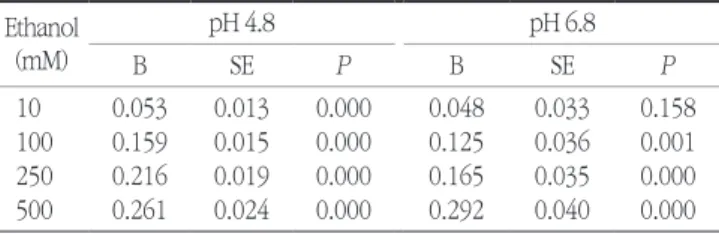
Fig. 3 shows that, following the initial pH pulse, the pH of the cell suspension started to gradually increase as a conse- quence of cellular proton uptake. Ethanol dose-dependently increased proton permeability at both pHs (Fig. 3 and Table 2). We assume that the decreased proton efflux due to the de- creased expression of the atpB gene may be one of the causes of an increase in the proton permeability.
Discussion
In this research, we demonstrated the possibility of etha- nol as an active ingredient that may have the anticaries effect.
In a concentration-dependent manner, ethanol alone not only decreased the growth rate of S. mutans and the expression of the atpB gene but also increased the proton permeability at both pHs 4.8 and 6.8. The increase in proton permeability seems to be due, at least in part, to reduced expression of F- ATPase.
We have previously reported that 10 mM ethanol en- hanced the stimulatory action of fluoride on proton perme- ability as well as the inhibitory action of fluoride on the F- ATPase activity only at pH 4.8 in S. mutans18). In this study, the anti-S. mutans property of ethanol alone started at 100 mM, a 10-fold higher concentration. Ethanol has been added to mouthrinses as an inactive ingredient that acts as a carrier for the flavor. Some mouthrinses on the market have more than 20%(v/v) alcohol, which is equal to 3.45 M, in them. At this high concentration, it is almost certain that some of the anticaries effects of the mouthrinses may have originated from ethanol itself. In addition, it is very likely that the cariostatic effects of a number of naturally occurring compounds may have been exaggerated because ethanol has long been used
as a solvent for dissolving and/or efficient extraction of them.
It is time to consider ethanol as an active ingredient instead of an inactive carrier.
Although fluoride has been unparalleled as an anticaries agent, it is generally accepted that the effectiveness of fluoride could be enhanced when combined with additional cariostatic agents. We believe that better cariostatic preparations may be developed if we use existing agents together with new agents whose mechanisms of action differ from those of fluoride and other anticaries agents. Ethanol is a well-known membrane perturbing agent. Ethanol can induce membrane expansion, accompanied by a decrease in the membrane thickness as well as disordering and enhanced interdigitation of lipid acyl chains19). We suggested that cytoplasmic membrane fluidity is one of the crucial factors that determine proton permeability in S. mutans20). Further experimentation is required to study the membrane effects of ethanol in S. mutans. In addition, we used S. mutans in suspensions. We expect that future experi- ments using S. mutans in biofilms will confirm the results of the present study.
Ethanol is a man’s oldest social beverage-drug. Its ben- eficial and harmful effects have been with mankind for mil- lennia. Ethanol has been appreciated, craved, respected, abhorred, and feared, but it has never been thoroughly un- derstood. Of course ethanol containing products should not be recommended to children for long term use or to individu- als with alcohol problems21). However, for external use only, ethanol has a number of advantages. It is user-friendly, non- allergenic, nontoxic, only minimally irritant, non-aggressive or corrosive22). If ethanol is proved to be an active anticaries ingredient, we may be able to not only reduce the effective concentrations of fluoride and/or other cariostatic agents but also enhance their anticaries activity.
Conclusions
Our findings suggest that ethanol has the potential for an active anticaries ingredient instead of an inactive carrier for the flavor. We expect that ethanol may be used together with fluoride and/or other anticaries agents in order to develop better anticaries toothpastes and/or mouthrinses.
References
1. Loesche WJ. Role of Streptococcus mutans in human dental decay.
Microbiol Rev 1986;50(4):353-380.
2. Baker JL, Abranches J, Faustoferri RC, Hubbard CJ, Lemos JA, Table 2. Effects of ethanol on the proton permeability in S. mutans
UA159a Ethanol
(mM)
pH 4.8 pH 6.8
B SE P B SE P
10 0.053 0.013 0.000 0.048 0.033 0.158
100 0.159 0.015 0.000 0.125 0.036 0.001
250 0.216 0.019 0.000 0.165 0.035 0.000
500 0.261 0.024 0.000 0.292 0.040 0.000
aUnivariate analysis of variance (ANCOVA) adjusted for time was per- formed to calculate the probability using the data in Fig. 3. 0 mM ethanol served as the control.
Courtney MA, et al. Transcriptional profile of glucose-shocked and acid-adapted strains of Streptococcus mutans. Mol Oral Microbiol 2015;30(6):496-517.
3. Baker JL, Faustoferri RC, Quivey RG. Acid-adaptive mechanisms of Streptococcus mutans-the more we know, the more we don’t. Mol Oral Microbiol 2017;33(2):107-117.
4. Quivey RG, Grayhack EJ, Faustoferri RC, Hubbard CJ, Baldeck JD, Wolf AS, et al. Functional profiling in Streptococcus mutans: con- struction and examination of a genomic collection of gene deletion mutants. Mol Oral Microbiol 2015;30(6):474-495.
5. Belli WA, Marquis RE. Adaptation of Streptococcus mutans and Enterococcus hirae to acid stress in conuous culture. Appl Environ Microbiol 1991;57(4):1134-1138.
6. Bender GR, Sutton SV, Marquis RE. Acid tolerance, proton perme- abilities, and membrane ATPases of oral streptococci. Infect Immun 1986;53(2):331-338.
7. Hamilton IR, Buckley ND. Adaptation by Streptococcus mutans to acid tolerance. Oral Microbiol Immun 1991;6(2):65-71.
8. Lemos JA, Abranches J, Burne RA. Responses of cariogenic strepto- cocci to environmental stresses. Curr Issues Mol Biol 2005;7(1):95- 108.
9. Quivey RG Jr, Kuhnert WL, Hahn K. Adaptation of oral streptococci to low pH. Adv Microb Physiol 2000;42:239-274.
10. Hamilton IR, St Martin EJ. Evidence for the involvement of proton motive force in the transport of glucose by a mutant of Streptococ- cus mutans strain DR0001 defective in glucose-phosphoenopyru- vate phosphotransferase activity. Infect Immun 1982;36(2):567- 575.
11. Seydlová G, Halada P, Fišer R, Toman O, Ulrych A, Svobodová J.
DnaK and GroEL chaperones are recruited to the Bacillus sub- tilis membrane after short-term ethanol stress. J Appl Microbiol 2012;112(4):765-774.
12. Ban SH, Kim JE, Pandit S, Jeon JG. Influences of Dryopteris crassirhizoma extract on the viability, growth and virulence prop- erties of Streptococcus mutans. Molecules 2012;17(8):9231-9244.
13. Petrackova D, Vecer J, Svobodova J, Herman P. Long-term ad- aptation of Bacillus subtilis 168 to extreme pH affects chemical and physical properties of the cellular membrane. J Membr Biol 2010;233(1-3):73-83.
14. Phan TN, Buckner T, Sheng J, Baldeck JD, Marquis RE. Physiologic actions of zinc related to inhibition of acid and alkali production by oral streptococci in suspensions and biofilms. Oral Microbiol Im- munol 2004;19(1):31-38.
15. Hwang G, Liu Y, Kim D, Sun V, Aviles-Reyes A, Kajfasz JK, et al.
Simultaneous spatiotemporal mapping of in situ pH and bacterial activity within an intact 3D microcolony structure. Sci Rep 2016 Sep 8 [Epub]. DOI:10.1038/srep32841.
16. Kuhnert WL, Zheng G, Faustoferri RC, Quivey RG. The F-ATPase operon promoter of Streptococcus mutans is transcriptionally regu- lated in response to external pH. J Bacteriol 2004;186(24):8524- 8528.
17. Gong Y, Tian XL, Sutherland T, Sisson G, Mai J, Ling J, et al. Global transcriptional analysis of acid-inducible genes in Streptococcus mutans: multiple two-component systems involved in acid adapta- tion. Microbiology 2009;155:3322-3332.
18. Lee SA, Jung SI, Kim JB, Kang JS. The pH-dependent effects of combining ethanol with fluoride on proton permeability in Strepto- coccus mutans. J Korean Acad Oral Health 2016;40(4):255-260.
19. Gurtovenko AA, Anwar J. Interaction of ethanol with biologi- cal membranes: the formation of non-bilayer structures within the membrane interior and their significance. J Phys Chem B 2009;113(7):1983-92.
20. Cho CM, Jung SI, Kim MS, Lee SA, Kang JS. pH stress alters cyto- plasmic membrane fluidity and atpB gene expression in Strepto- coccus mutans. J Life Sci 2017;27(1):15-22.
21. FDI commission. Mouthrinses and dental caries. Int Dent J 2002;52(5):337-345.
22. Moorer WR. Antiviral activity of alcohol for surface disinfection. Int J Dent Hyg 2003;1(3):138-142.