TCP
Translational and Clinical Pharmacology http://dx.doi.org/10.12793/tcp.2014.22.1.22 2014;22(1):22-29Pharmacokinetic Characteristics of
Ibandronate and Tolerability of DP-R206
(150 mg Ibandronate/24,000 IU Vitamin D 3 ) Compared to the Ibandronate (150 mg)
Monotherapy in Healthy Adults
Hee Youn Choi
1,2, Mi Jo Kim
1,2, Yo Han Kim
1,2, Yook-Hwan Noh
3, Jae-won Lee
4, Tae-won Lee
4, Min-Gul Kim
5and Kyun-Seop Bae
1,2*1Department of Clinical Pharmacology and Therapeutics, Asan Medical Center, Seoul 138-736, Korea 2University of Ulsan College of Medicine, Seoul 138-736, Korea, 3Department of Clinical Pharmacology and Therapeutics, Inje University Pusan Paik Hospital, Busan 614-735, Korea, 4Dreampharma Corp., Seoul 100-755, Korea, 5Clinical Trial Center, Biomedical Research Institute, Chonbuk National University Hospital, Chonju 361-711, Korea
*Correspondence: K.S. Bae; Tel: +82-2-3010-4611, Fax: +82-2-3010-4623, E-mail: [email protected]
Ibandronate (a bisphosphonate) is commonly used as an treatment of osteoporosis in combina- tion with vitamin D. Monthly DP-R206-a novel, fixed-dose combination tablet (150 mg ibandro- nate/24,000 IU vitamin D3)-was recently developed to enhance patient compliance. This open, randomized, two-period crossover study was conducted to compare the pharmacokinetics of iban- dronate when administered as DP-R206 or 150 mg ibandronate to healthy adult volunteers. Each volunteer was randomly allocated to receive single-dose DP-R206 or ibandronate with a 28-day washout period between treatments. Blood samples were assessed using pharmacokinetic analysis.
Plasma ibandronate concentrations were determined using liquid chromatography-tandem mass spectrometry. Safety and tolerability assessments were performed throughout the study. In total, 103 participants received the study drugs and 72 participants completed the study. The geometric mean ratios (DP-R206/ibandronate) of the maximum concentration (Cmax) and the area under the plasma concentration time curve from time zero to the last concentration (AUClast) values were 0.959 (90%
CI: 0.820–1.120) and 0.924 (90% CI: 0.805–1.060), respectively. The frequencies of adverse events (AEs) and drug reactions were similar between treatment groups, and all AEs were recovered with- out sequalae. Ibandronate pharmacokinetics, tolerability, and safety are comparable when adminis- tered to healthy individuals, regardless if administered as DP-R206 or ibandronate.
Received 30 April 2014 Revised 17 May 2014 Accepted 17 May 2014
Keywords
ibandronic acid, Vitamin D, Drug combination, Pharmacokinetics pISSN: 2289-0882
Introduction
Bisphosphonate, which is already widely used to treat osteo- porosis, has a chemically stable pyrophosphate structure. The structural characteristics allow bisphosphonate to bind to hy-
droxyapatite crystals, which have a high affinity for bone miner- als.[1] Most especially, second- and third-generation bisphos- phonates, which share a common P-C-P backbone and contain nitrogen on one side chain, contribute to osteoclast apoptosis by inhibiting farnesyl pyrophosphate synthase and promoting the isoprenylation of the Rab, Rac, and Rho proteins that control osteoclast activity.[1] Although the mechanism has not been di- rectly clinically measured, drug effects can be indirectly assessed by measuring decreases in bone resorption-related biomarkers
Copyright © 2014 Translational and Clinical Pharmacology
It is identical to the Creative Commons Attribution Non-Commercial License (http://creativecommons.org/licenses/by-nc/3.0/).
This paper meets the requirement of KS X ISO 9706, ISO 9706-1994 and ANSI/NISO Z.39.48-1992 (Permanence of Paper).
Original article
TCP
Translational and Clinical Pharmacology
(e.g., the amino- and carboxyl-terminal breakdown of type 1 collagen). Most bisphosphonate demonstrates the maximum in- hibition of bone resorption within 3 months after drug adminis- tration, and this effect is maintained at a relatively constant level during treatment.[2] Compliance is one of the major factors that influence the oral administration of bisphosphonate, main- ly due to inconvenient dosing methods and side effects. Patients need to maintain an empty stomach >2 hours before dosing and cannot lie down, drink, or eat any food for >30 minutes after receiving oral bisphosphonate. Also, commonly reported gas- trointestinal adverse events directly influence compliance.[3,4]
Ibandronate sodium, a third-generation bisphosphonate, can be administered once per month because it demonstrates a higher affinity for bone tissue than other bisphosphonates; therefore, it could markedly improve compliance.[6,7]
Meanwhile, the clinician’s guide on treatment of osteoporosis by the National Osteoporosis Foundation highly recommends vitamin D intake in order to reduce the risk of bone fracture.[3]
Vitamin D deficiency also reportedly increases the risk of bone fracture.[8,9] Also, because vitamin D is associated with the absorption of calcium, bone metabolism, muscle strength, and position balance, it might decrease the risk of falls.[10-12] Gen- erally, the daily recommended dose of vitamin D is 400–800 IU, and patients >71 years should ingest 800 IU because of the high frequency of deficiency.[3,13,14] Also, additional vitamin D administration is recommended in order to maintain concen- trations >30 ng/mL 25(OH)D in patients with osteoporosis.[3]
Recent studies indicate that maintaining an adequate vitamin D concentration is an important factor that increases the efficacy of treatment of osteoporosis.[15,16]
Accordingly, a fixed drug combination-DP-R206 (150 mg ibandronate/24,000 IU vitamin D3)-was developed to increase the treatment effects of ibandronate and adherence. Therefore, the objective of this study was to investigate the pharmacoki- netic (PK) characteristics of ibandronate when administered as DP-R206 or 150 mg ibandronate to healthy volunteers, as well as assess tolerability and safety.
Methods
Subjects
We enrolled healthy Korean volunteers between 20–55 years of age. Medical histories, vital signs, physical examinations, labora- tory tests, and electrocardiography (ECG) results were assessed in all volunteers, included volunteers who were negative for human immunodeficiency virus antibody, hepatitis B surface antigen, hepatitis C virus, and syphilis high quality reagin test.
Exclusion criteria included clinically significant medical history, drug hypersensitivity, receiving any drugs that could induce or inhibit drug metabolism 30 days prior to dosing (e.g., barbitu- rates) and/or other prescription drugs 14 days prior to dosing, abnormal liver function (aspartate aminotransferase [AST], alanine aminotransferase [ALT], gamma-glutamyl transpepti-
dase [rGT], alkaline phosphatase [ALP], total bilirubin >1.5x upper normal limit), abnormal parathyroid hormone, calcium, or phosphorus, <9 ng/mL 25(OH)D, and Cockroft-Gault creati- nine clearance <80 mL/minute.
All subjects provided written informed consent prior to the study participation. This study was conducted in accordance with the Declaration of Helsinki and the International Confer- ence on Harmonization (ICH) guidelines for Good Clinical Practice (GCP). The institutional review boards (IRB) at Asan Medical Center and Chonbuk National University Hospital ap- proved our protocol prior to starting this trial.
Study design
This study uses a randomized, open-label, single-dose, 2x2 crossover design. Each subject received the following 2 treat- ments in a randomly allocated sequence (RT or TR) with a 28- day washout between periods: single-dose 150 mg ibandronate (reference; R) or single-dose DP-R206 (test; T). The randomiza- tion code was generated using R (version 2.10.1; R Foundation for Statistical Computing, Vienna, Austria). All subjects were admitted to the hospital on day 1 and discharged on day 2 after all blood samples were collected at 24 hours after dosing. On day 1, all subjects administered the study drug with 240 mL plain water on an empty stomach. Water was restricted for 2 hours after administration. Lunch and dinner were served 4 and 9 hours after administration, respectively. Participants had to remain in an upright sitting position for 1 hour after swallowing the study drug. After discharge, subjects participants visited the outpatient clinic for blood sample collection until 120 hours af- ter dosing. Throughout the entire study period, alcohol, smok- ing, heavy exercise, and other drugs were not allowed, except concomitant drug(s) approved by the investigator.
Blood sample collection and bioanalysis of ibandronate For the pharmacokinetic (PK) analysis, blood samples (7 mL) were collected prior to study drug administration and 0.25, 0.5, 0.75, 1, 2, 3, 4, 6, 8, 10, 24, 32, 48, 72, and 120 hours after dosing.
Each sample was collected in heparinized tubes. Plasma was obtained by centrifugation at 1800 g for 8 minutes at 4°C, im- mediately transferred to two Eppendorf tubes (0.8 mL), frozen at -70°C, and shipped to the Seoul Pharma Laboratory (Seoul, Korea) for analysis using an ibandronate concentration assay.
Plasma ibandronate concentrations were determined using validated high-performance liquid chromatography-tandem mass spectrometry (HPLC-MS/MS). Briefly, 300 μL plasma was added to 10 μL of the internal standard sample (ibandronate- d3 [8 μg/mL in water]), 200 μL sterile water, and 500 μL sodium bicarbonate buffer (10 mM; native pH). The mixture was then vortexed, and diazomethane in hexane and 2 mL methanol was added and allowed to evaporate. Then, added 50% acetonitrile and was injected into the HPLC-MS/MS system (HPLC system:
Waters Alliance 2795 HT [Waters, US]; MS/MS system: Waters micromass Quattro Premier XE [Waters, US]). The column was
®
Hee Youn Choi, et al.
TCP
Translational and Clinical Pharmacology
DP-R206 and Ibandronate Pharmacokinetics
a Luna 3 μ HILIC 200 Å (2.0x100 mm; 3 μm), and the mobile phase consisted of ammonium formate buffer (5 mM; native pH): acetonitrile (8:92 [v/v]). Th e fl ow rate was maintained at 0.2 mL/minute. Th e calibration curves of each batch were linear over the range 0.5–500 ng/mL (r2 >0.99) with intraday accu- racy: 91.53–106.96%; precision: 0.19–2.03%; interday accuracy:
99.76–104.31%; precision: 1.33–10.85%.
Pharmacokinetic analysis
Th e PK characteristics of ibandronate were assessed by non- compartmental analysis of the actual sampling times (using Winnonlin version 6.1; Pharsight, CA, US). Maximum con- centration (Cmax) and the time to reach Cmax (Tmax) values were directly obtained from the plasma concentration-time curves.
Th e area under the plasma concentration time curve from time zero to the last concentration (AUClast) was calculated using the linear trapezoidal method by increasing the period, and log/lin- ear trapezoidal summation in the decreasing period. From the terminal slope, linear regression was used to estimate the elimi- nation rate constants and obtain the AUC from time zero to infi nity (AUCinf) and the terminal half-life (t1/2β).To compare the PK profi les of DP-R206 and ibandronate, the log-transformed individual Cmax and AUClast values were analyzed using mixed- effects analysis of variance (ANOVA, using SAS version 9.2;
SAS Institute INC., NC, US). Th e treatment eff ects are shown as the geometric mean ratio (test/reference; DP-R206/ibandro- nate) and 90% confi dence intervals (90% CI).
Safety and tolerability analyses
Safety and tolerability assessments included the regular moni- toring of adverse events (AEs) and concomitant medications, as well as physical examination, vital signs, laboratory tests, and ECGs. Th e fi rst admitted subject developed infl uenza-like symptoms at 1 day aft er drug dosing. Th ese symptoms are suf- fi ciently predictable based on previous studies on ibandronate, and the study protocol was revised to allow the preemptive administration of acetaminophen. At 14, 24, and 32 hours aft er study drug administration, a maximum of 2 acetaminophen ER (extended release) tablets could be administered according to the subjects’ clinical symptoms. All AEs were intensively moni- tored because acetaminophen might increase the gastrointesti- nal irritation caused by the study drugs. All AEs were observed by unmasked investigators, and the participant’s spontaneous reports were noted. The symptoms, signs, severity, time of onset, duration, course, outcomes, and relationship with the study drug were assessed (SAS version 9.2 and R version 3.0.2 (R Foundation for Statistical Computing, Vienna, Austria, URL http://www.R-project.org) was used if any statistical analysis needed).
Results
Th is study was conducted at two centers: Asan Medical Center (AMC) (August–October 2011) and Chonbuk National Univer-
sity Hospital (January–March 2012).
Demographics
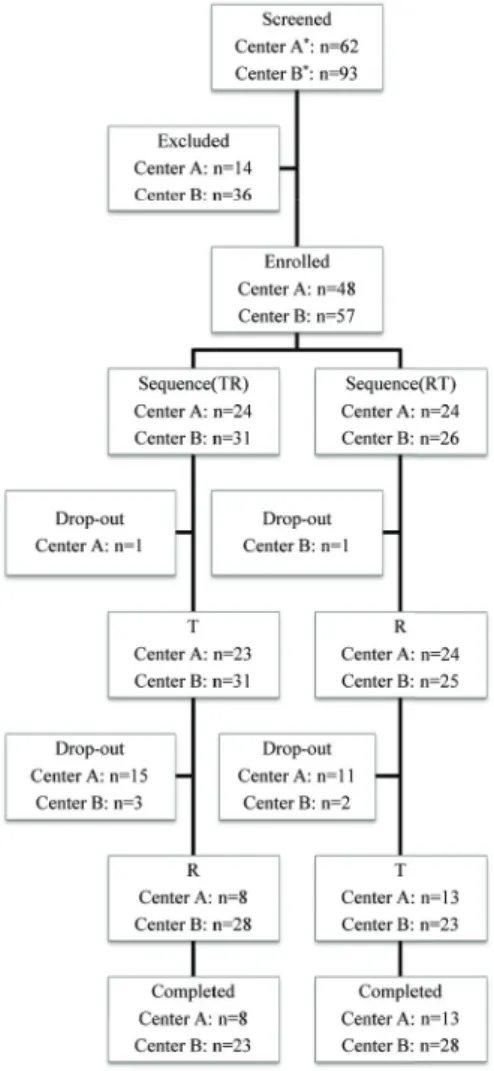
In total, 155 male volunteers were screened and 105 partici- pants were enrolled (62 volunteers were screened and 48 sub- jects were enrolled at AMC; 93 volunteers were screened and 57 subjects were enrolled at Chonbuk National University Hospi- tal). At AMC, 24 subjects were assigned two admission dates.
At each admission date, participants were randomly assigned to two sequences (RT or TR) at a 1:1 ratio. At Chonbuk National University Hospital, 50 subjects were admitted and randomly assigned to two sequences (RT:TR=24:26), and 7 subjects were admitted at a 2:5 RT:TR randomization ratio. In total, 103 sub- jects were administered the study drug at least once, and 2 sub- jects withdrew consent before drug administration. Th irty-three subjects dropped out of the study, and 72 subjects completed the study (Fig. 1). Subjects either withdrew consent (10 subjects) or developed AEs (23 subjects). All AEs with dropout developed
Figure 1. Allocation of the subjects to study groups
®
TCP
Translational and Clinical Pharmacology
during period 1.
Mean subject age, height, and weight were 24.7 years, 174.9 cm, and 71.0 kg, respectively. Age, height, weight, and alcohol, nicotine, and caf- feine consumption were not statistically different between groups (Table 1).
Pharmacokinetic analysis
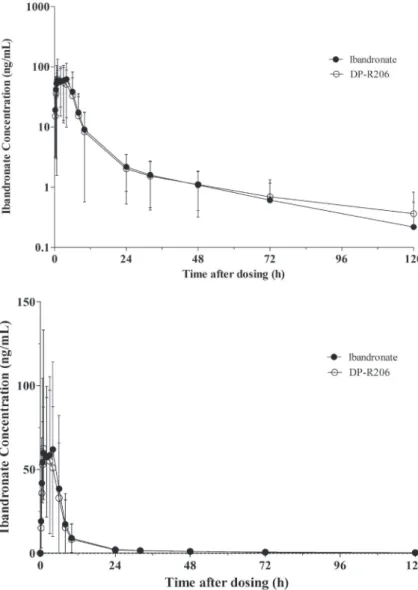
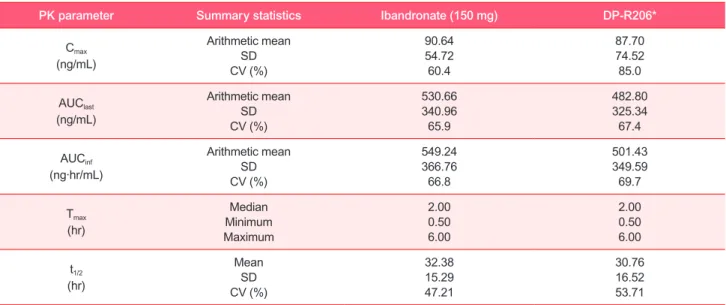
PK parameters were determined using the ibandronate concentration data obtained from the 72 subjects who complete the study. The plasma concentration-time profiles for ibandro- nate are shown in Figure 2. The mean (standard deviation [SD]) Cmax value was 90.64 (54.72) ng/
mL after the single-dose administration of iban- dronate (reference drug), while 87.70 (74.52) ng/mL was determined for DP-R206 (test drug).
Both drugs demonstrated median Tmax values of 2 hours (range 0.5–6.0 hours). The mean (SD) AUClast value was 530.66 (349.96) ng∙hour/mL for ibandronate and 482.80 (325.34) ng∙hour/
mL for DP-R206. The mean (SD) AUCinf val- ues were 549.24 (366.76) and 501.43 (349.59) ng∙hour/mL for ibandronate and DP-R206, re- spectively (Table 2).
The mixed-effects model considered sequence, period, treatment, trial center, interactions between period and trial center (period x trial center), and interactions between treatment and
Table 1. Demographic characteristics of the enrolled subjects
RT (n=49) TR (n=54) Total (n=103) p
Age (yr) 24.71±2.75 24.70±3.49 24.71±3.15 0.694*¶
Weight (kg) 70.24±8.73 71.71±8.03 71.01±8.37 0.579†¶
Height (cm) 174.62±4.92 175.15±4.59 174.90±4.73 0.376†¶
Drinking‡ Yes 63.3% (31) 61.1% (33) 62.1% (64)
0.822§
No 36.7% (18) 38.9% (21) 37.9% (39)
Smoking‡ Yes 38.8% (19) 33.3% (18) 35.9% (37)
0.565§
No 61.2% (30) 66.7% (36) 64.1% (66)
Caffeine‡ Yes 61.2% (30) 55.6% (30) 58.3% (60)
0.560§
No 38.8% (19) 44.4% (24) 41.7% (43)
Subjects who administered the study drug at least once were included in this analysis. *Mann-Whitney U test, †T-test, ‡% (numbers of participants),
§Chi-square test, ¶Shapiro-Wilk test for normality check were conducted. The p-value was <0.05 for age, while p-value>0.05 for weight and height parameters each.
Figure 2. Mean plasma ibandronate concentration- time curves (semilog (upper) and linear (lower) scale) Hee Youn Choi, et al.
TCP
Translational and Clinical Pharmacology
DP-R206 and Ibandronate Pharmacokinetics
trial center (treatment x trial center) as fixed effects; admission date to the trial center and subjects nested in the admission date of the trial center were considered random effects. The log- transformed Cmax, AUClast, and AUCinf valueswere analyzed us- ing ANOVA. None of the differences in terms of fixed effects or admission dates were statistically significant (p>0.05). The geo- metric mean ratio (test/reference) of the Cmax, AUClast, AUCinf
values were 0.959, 0.924, and 0.923, and the 90% CI values were 0.820–1.120, 0.805–1.060, and 0.801–1.061, respectively. There- fore, all PK parameters were within the range of 0.8–1.25, which is the criterion for bioequivalence (Table 3).
Safety and tolerability analysis
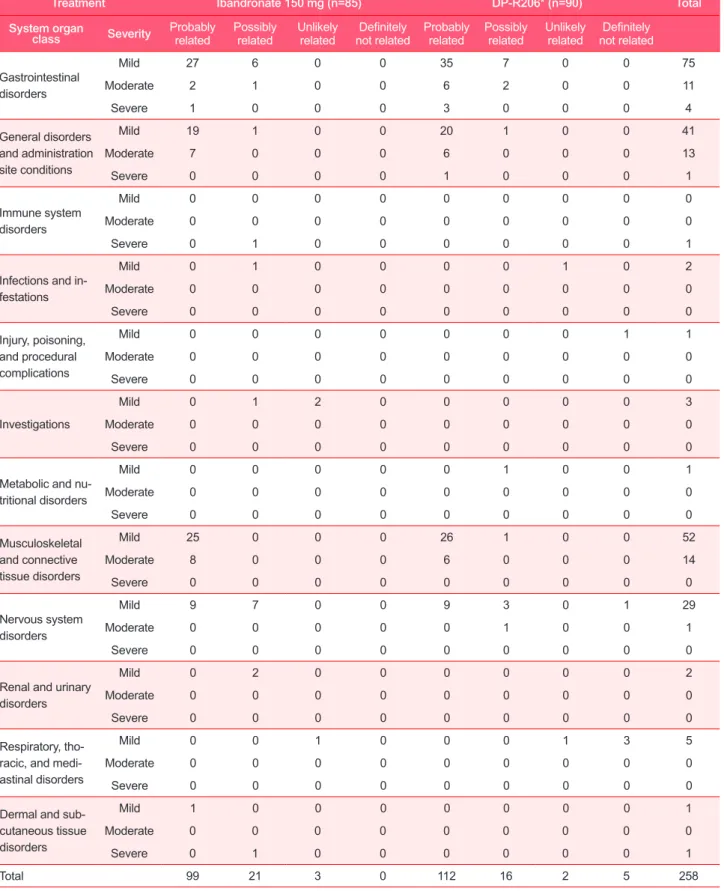
In total, 273 AEs were reported throughout the study, and 258 AEs developed after administering the study drug. In terms of maximum intensity, 212 mild, 39 moderate, and 7 severe AEs developed after administration. Among these, 248 AEs were considered adverse drug reactions (ADRs) (i.e., possibly related
to the drug). The most common AEs were gastrointestinal (GI) (90 cases), followed by musculoskeletal (66 cases) and general disorders (55 cases). Common GI symptoms included diarrhea (43 cases), abdominal pain (32 cases), abdominal discomfort (6 cases), and dyspepsia (5 cases), while myalgia (49 cases), bone pain (8 cases), and arthralgia (5 cases) were common musculo- skeletal symptoms. Influenza-like symptoms (23 cases), pyrexia (16 cases), febrile sensation (6 cases), and chills (7 cases) were commonly reported general disorders. In addition, 23 cases of headache were reported, of which 22 cases were considered probably or possibly drug-related. To treat or prevent the high incidence of AEs (like pyrexia, bone pain, myalgia, influenza- like symptoms, and headache), 92 participants received ≥ 1 administration of acetaminophen.
Two serious AEs were reported. One subject’s admission was extended by 1 day after ibandronate (reference drug) adminis- tration due to influenza-like symptoms with fever. After symp- tomatic treatment, including acetaminophen, symptoms abated and the subject was discharged. This AE was assessed and considered probably drug-related. The other subject developed anaphylactic shock 10 minutes after orally receiving preven- tive acetaminophen at 14 hours after ibandronate (reference drug) dosing. The subject developed generalized urticaria with hypotension and nausea, but no mental changes developed.
Hydration with pheniramine, metoclopramide, and intravenous methylprednisolone was provided, and ECG, laboratory tests (including arterial blood gas analysis), and the continuous mon- itoring of vital signs were conducted. The subject completely recovered and was discharged without extending the admission period. This AE was considered possibly drug-related.
AEs were categorized by treatment group, and 56% and 69%
Table 2. Pharmacokinetic parameters
PK parameter Summary statistics Ibandronate (150 mg) DP-R206*
Cmax
(ng/mL)
Arithmetic mean SD CV (%)
90.64 54.72 60.4
87.70 74.52 85.0 AUClast
(ng/mL)
Arithmetic mean SD CV (%)
530.66 340.96 65.9
482.80 325.34 67.4 AUCinf
(ng·hr/mL)
Arithmetic mean SD CV (%)
549.24 366.76 66.8
501.43 349.59 69.7 Tmax
(hr)
Median Minimum Maximum
2.00 0.50 6.00
2.00 0.50 6.00 t1/2
(hr)
Mean SD CV (%)
32.38 15.29 47.21
30.76 16.52 53.71
*DP-R206: fixed-dose 150 mg ibandronate/24,000 IU vitamin D3
Table 3. Geometric mean ratio and 90% confidence interval limits of the primary ibandronate PK parameters (DP-R206*:150 mg tablet ibandronate)
PK parameter Geometric mean ratio
90% Confidence interval
Cmax 0.959 0.820–1.120
AUClast 0.924 0.805–1.060
AUCinf 0.923 0.801–1.062
*DP-R206: fixed-dose 150 mg ibandronate/24,000 IU vitamin D3
TCP
Translational and Clinical Pharmacology
Treatment Ibandronate 150 mg (n=85) DP-R206* (n=90) Total
System organ
class Severity Probably
related Possibly
related Unlikely
related Definitely
not related Probably
related Possibly
related Unlikely
related Definitely not related
Gastrointestinal disorders
Mild 27 6 0 0 35 7 0 0 75
Moderate 2 1 0 0 6 2 0 0 11
Severe 1 0 0 0 3 0 0 0 4
General disorders and administration site conditions
Mild 19 1 0 0 20 1 0 0 41
Moderate 7 0 0 0 6 0 0 0 13
Severe 0 0 0 0 1 0 0 0 1
Immune system disorders
Mild 0 0 0 0 0 0 0 0 0
Moderate 0 0 0 0 0 0 0 0 0
Severe 0 1 0 0 0 0 0 0 1
Infections and in- festations
Mild 0 1 0 0 0 0 1 0 2
Moderate 0 0 0 0 0 0 0 0 0
Severe 0 0 0 0 0 0 0 0 0
Injury, poisoning, and procedural complications
Mild 0 0 0 0 0 0 0 1 1
Moderate 0 0 0 0 0 0 0 0 0
Severe 0 0 0 0 0 0 0 0 0
Investigations
Mild 0 1 2 0 0 0 0 0 3
Moderate 0 0 0 0 0 0 0 0 0
Severe 0 0 0 0 0 0 0 0 0
Metabolic and nu- tritional disorders
Mild 0 0 0 0 0 1 0 0 1
Moderate 0 0 0 0 0 0 0 0 0
Severe 0 0 0 0 0 0 0 0 0
Musculoskeletal and connective tissue disorders
Mild 25 0 0 0 26 1 0 0 52
Moderate 8 0 0 0 6 0 0 0 14
Severe 0 0 0 0 0 0 0 0 0
Nervous system disorders
Mild 9 7 0 0 9 3 0 1 29
Moderate 0 0 0 0 0 1 0 0 1
Severe 0 0 0 0 0 0 0 0 0
Renal and urinary disorders
Mild 0 2 0 0 0 0 0 0 2
Moderate 0 0 0 0 0 0 0 0 0
Severe 0 0 0 0 0 0 0 0 0
Respiratory, tho- racic, and medi- astinal disorders
Mild 0 0 1 0 0 0 1 3 5
Moderate 0 0 0 0 0 0 0 0 0
Severe 0 0 0 0 0 0 0 0 0
Dermal and sub- cutaneous tissue disorders
Mild 1 0 0 0 0 0 0 0 1
Moderate 0 0 0 0 0 0 0 0 0
Severe 0 1 0 0 0 0 0 0 1
Total 99 21 3 0 112 16 2 5 258
*DP-R206: fixed-dose 150 mg ibandronate/24,000 IU vitamin D3
Table 4. Adverse events
Hee Youn Choi, et al.
TCP
Translational and Clinical Pharmacology
of participants in the ibandronate group (85 subjects) and DP- R206 groups (90 subjects) reported ADRs, respectively. Three severe AEs were reported after administering ibandronate, while 4 severe AEs developed after administering DP-R206.
The percentages of AEs considered above moderate intensity among all AEs were 17% and 19% in the ibandronate and DP- R206 groups, respectively. The number of subjects who reported AE above moderate intensity were not statistically significant different between treatment groups (p=0.230; McNemar test).
Also, the number of subjects who reported AEs and ADRs were not statistically significant different between treatment groups (p=0.112; McNemar test). GI symptoms (the most common AE) developed in 37 and 53 cases after ibandronate and DP- R206 administration; musculoskeletal symptoms developed in 33 cases in each treatment group; and influenza-like symptoms developed in 11 and 12 cases in the reference and test groups, respectively.
Compared with baseline, body temperature tended to increase in both treatment groups: subjects with body temperatures
>37.5°C increased 24 hours after drug administration, but tended to decrease within 48 hours. On the other hand, blood pressure and heart rate did not demonstrate any tendencies be- tween pre- and post-dose. During the study period, parathyroid hormone tended to increase about 2-fold from baseline regard- less of treatment. Except for the reported AEs, no clinically significant findings were observed on physical examinations, laboratory tests, or ECG.
Discussion
Osteoporosis and bone fracture continuously increase in rap- idly aging societies.[17] This is especially true in Korea: accord- ing to a recent 2008 report, about 2.9 million patients are receiv- ing treatment of osteoporosis and >80% of patients are women
>50 years of age. In addition, 33.3% of women >50 years might suffer from osteoporosis.[18] Until recently, bisphosphonate comprised the main treatment of osteoporosis regimen. Many efforts have been approved to increase dosing intervals, notably once-a-month 150 mg ibandronate.[19] Recent trials have also confirmed the non-inferiority of once-a-month ibandronate vs repeated daily doses of 2.5 mg ibandronate.[20,21] Also, con- sidering that ibandronate and vitamin D combination therapy has been recommended for the treatment of osteoporosis, the DP-R206 (150 mg ibandronate/24,000 IU vitamin D3) once per month is expected to increase adherence by decreasing the number of required daily doses, as well as to obtain the treat- ment efficacy.
This study was conducted to compare the PK characteristics of DP-R206 and ibandronate. As a result, the 90% CI values of the geometric mean ratios for the primary PK parameters range between 0.8–1.25. Ibandronate demonstrates very low bioavail- ability (0.63%) when administered as part of an oral dosing regimen, as well as large inter- and intra-individual variability (approximately 70% and 46%, respectively).[22] Therefore, ≥68
participants are needed to obtain statistical power >80% and level of significance <0.05 after considering intra-individual variability (46% assumption). After considering dropouts, our goal was to recruit 84 participants.[23] Although total 72 subjects completed this study, that was satisfied with the mini- mum required number of subjects. In addition, this study was designed to administer drugs during fasting in order to reduce variability. To minimize esophageal irritation, drug dosing was administered in an upright position, and this position was maintained for 1 hour.[19]
According to this study, DP-R206 and ibandronate was bio- equivalent in the aspect of ibandronate pharmacokinetics. Also, the Tmax of ibandronate is about 2 hours after dosing and the half-life is about 30 hours and these results are similar to the previous studies on 2.5 mg ibandronate.[19] Another study reported the bioequivalence of vitamin D when administered as DP-R206 or vitamin D3.[24] Therefore, ibandronate and vita- min D-both ingredients in DP-R206-are bioequivalent, and it is expected that DP-R206 administration would be shown similar pharmacokinetic characteristics compared to the each compo- nent of drug administration. But this study is conducted in only healthy male volunteers with single dose administration, further long-term studies in osteoporosis patients might be helpful to evaluate clinical efficacy of DP-R206.
Throughout this study, similar AEs were reported regardless of DP-R206 or ibandronate administration. Most AEs were previously known events, including GI symptoms, influenza- like symptoms, musculoskeletal symptoms, and headache.[19]
The development of influenza-like symptoms after ibandronate administration is a kind of acute reaction, and mostly occurred after the first dosing (rarely after repeated administration).[19]
This mechanism is associated with inflammation-mediated cytokines (e.g., interlukin-6), and symptoms generally sponta- neously recover or antifebrile agents can control symptoms.[25]
Musculoskeletal pain is commonly associated with influenza- like symptoms. Although the mechanism is unclear, second- ary hyperparathyroidism affects cytokines and synergistically increases drug concentration in bone, which is followed by local pain.[25] Here, all AEs, including influenza-like symptoms and musculoskeletal pain, spontaneously recovered or lessened fol- lowing the administration of intermittent acetaminophen, and no sequelae were reported. The overall characteristics of AEs and ADRs following DP-R206 administration were not signifi- cantly different than following ibandronate administration, and no clinically significant findings were reported.
In conclusion, the PK characteristics of ibandronate are similar when administered as single-dose ibandronate or DP-R206 to healthy volunteers, and both drugs are generally tolerable.
Acknowledgments
The study was funded by Dreampharma Corp., Seoul, Korea, the manufacturer of DP-R206. All authors agree with the con- tent of this manuscript, and the corresponding author made the DP-R206 and Ibandronate Pharmacokinetics
TCP
Translational and Clinical Pharmacology
final decision regarding its submission. Authors contributed this paper to conduct the clinical trial in this paper and we all read and approved of the contents.
Conflict of Interest
We authors have not any conflicts of interest regarding the content of the article.
References
1. Luckman SP, Hughes DE, Coxon FP, Graham R, Russell G, Rogers MJ.
Nitrogen-containing bisphosphonates inhibit the mevalonate pathway and prevent post-translational prenylation of GTP-binding proteins, including Ras. J Bone Miner Res 1998;13:581-589.
2. Cremers SC, Pillai G, Papapoulos SE. Pharmacokinetics/pharmacody- namics of bisphosphonates: use for optimisation of intermittent therapy for osteoporosis. Clin Pharmacokinet 2005;44:551-570.
3. Clinician's guide to prevention and treatment of osteoporosis. http://nof.
org/hcp/clinicians-guide/ Accessed 17 Feb 2014
4. Penning-van Beest FJ, Goettsch WG, Erkens JA, Herings RM. Determi- nants of persistence with bisphosphonates: a study in women with post- menopausal osteoporosis. Clin Ther 2006;28:236-242.
5. Mühlbauer RC, Bauss F, Schenk R, Janner M, Bosies E, Strein K, et al. BM 21.0955, a potent new bisphosphonate to inhibit bone resorption. J Bone Miner Res. 1991;6:1003-1011.
6. Lewiecki EM, Babbitt AM, Piziak VK, Ozturk ZE, Bone HG. Adherence to and gastrointestinal tolerability of monthly oral or quarterly intravenous ibandronate therapy in women with previous intolerance to oral bisphos- phonates: a 12-month, open-label, prospective evaluation. Clin Ther 2008;30:605-621.
7. Reginster JY, Felsenberg D, Cooper C, Stakkestad JA, Miller PD, Kendler DL, et al. A new concept for bisphosphonate therapy: a rationale for the development of monthly oral dosing of ibandronate. Osteoporos Int 2006;17:159-166.
8. Busse B, Bale HA, Zimmermann EA, Panganiban B, Barth HD, Carriero A, et al. Vitamin D deficiency induces early signs of aging in human bone, increasing the risk of fracture. Sci Transl Med 2013;5:193ra88. doi:
10.1126/scitranslmed.3006286.
9. Bischoff-Ferrari HA, Willett WC, Orav EJ, Lips P, Meunier PJ, Lyons RA, et al. A pooled analysis of vitamin D dose requirements for fracture preven- tion. N Engl J Med 2012;367:40-49. doi: 10.1056/NEJMoa1109617.
10. Holick MF, Binkley NC, Bischoff-Ferrari HA, Gordon CM, Hanley DA, He- aney RP, et al. Guidelines for preventing and treating vitamin D deficiency and insufficiency revisited. J Clin Endocrinol Metab 2012;97:1153-1158.
doi: 10.1210/jc.2011-2601.
Hee Youn Choi, et al.
11. Sohl E, van Schoor NM, de Jongh RT, Visser M, Deeg DJ, Lips P. Vitamin D status is associated with functional limitations and functional decline in older individuals. J Clin Endocrinol Metab 2013;98:E1483-E1490. doi:
10.1210/jc.2013-1698.
12. Bischoff-Ferrari HA, Dawson-Hughes B, Staehelin HB, Orav JE, Stuck AE, Theiler R, et al. Fall prevention with supplemental and active forms of vitamin D: a meta-analysis of randomised controlled trials. BMJ 2009;
339:b3692. doi: 10.1136/bmj.b3692.
13. MacLaughlin J, Holick MF. Aging decreases the capacity of human skin to produce vitamin D3. J Clin Invest 1985;76:1536-1538.
14. Holick MF, Matsuoka LY, Wortsman J. Age, vitamin D, and solar ultraviolet.
Lancet 1989;2:1104-1105.
15. Mosali P, Bernard L, Wajed J, Mohamed Z, Ewang M, Moore A, et al. Vi- tamin D status and parathyroid hormone concentrations influence the skeletal response to zoledronate and denosumab. Calcif Tissue Int 2014;94:553-559. doi: 10.1007/s00223-014-9840-0.
16. Deane A, Constancio L, Fogelman I, Hampson G. The impact of vitamin D status on changes in bone mineral density during treatment with bisphos- phonates and after discontinuation following long-term use in post-meno- pausal osteoporosis. BMC Musculoskelet Disord 2007;8:3.
17. Reginster JY, Burlet N. Osteoporosis: a still increasing prevalence. Bone 2006;38(2 Suppl 1):S4-S9.
18. Choi HJ, Shin CS, Ha YC, Jang S, Jang S, Park C, et al. Burden of osteo- porosis in adults in Korea: a national health insurance database study. J Bone Miner Metab 2012;30:54-58. doi: 10.1007/s00774-011-0280-x.
19. Bonviva (ibandronate sodium) tablets http://www.accessdata.fda.gov/
drugsatfda_docs/label/2005/021455s001lbl.pdf Accessed 17 Feb 2014 20. Miller PD, McClung MR, Macovei L, Stakkestad JA, Luckey M, Bonvoisin
B, et al. Monthly oral ibandronate therapy in postmenopausal osteoporo- sis: 1-year results from the MOBILE study. J Bone Miner Res 2005;20:1315-1322.
21. Miller PD, Epstein S, Sedarati F, Reginster JY. Once-monthly oral ibandro- nate compared with weekly oral alendronate in postmenopausal osteopo- rosis: results from the head-to-head MOTION study. Curr Med Res Opin 2008;24:207-213.
22. Barrett J, Worth E, Bauss F, Epstein S. Ibandronate: a clinical pharmaco- logical and pharmacokinetic update. J Clin Pharmacol 2004;44:951-965.
23. Diletti E, Hauschke D, Steinijans VW. Sample size determination for bio- equivalence assessment by means of confidence intervals. Int J Clin Pharmacol Ther Toxicol. 1991;29:1-8.
24. Jeon JY, Lee SY, Im YJ, Kim EY, Kim Y, Park TS, et al. Comparison of the pharmacokinetics, safety, and tolerability of vitamin D3 in DP-R206 (150- mg ibandronate/24,000-IU vitamin D3 tablet) and as monotherapy (24,000 IU) in healthy male Korean adults. Clin Ther 2014;36:48-57. doi: 10.1016/j.
clinthera.2013.12.001.
25. Papapetrou PD. Bisphosphonate-associated adverse events. Hormones (Athens) 2009;8:96-110.