CASE REPORT
가려움증 및 담즙정체로 발현한 전립선암
김영희, 박진명, 강창돈, 서상오, 이경열1, 송기현2
강원대학교 의학전문대학원 강원대학교병원 내과, 병리과1, 비뇨의학과2
Prostate Cancer Presenting with Pruritus and Cholestasis
Young Hee Kim, Jin Myung Park, Chang Don Kang, Sang Oh Seo, Kyougyul Lee1 and Geehyun Song2
Departments of Internal Medicine, Anatomic Pathology1, Urology2, Kangwon National University Hospital, Kangwon National University School of Medicine, Chuncheon, Korea
Jaundice is a rare symptom of the paraneoplastic syndrome associated with prostate cancer. We report a case of metastatic prostate cancer that presented as jaundice. There was an absence of biliary obstruction and hepatic metastasis; therefore, the paraneoplastic syndrome was suggested as the etiology of cholestasis. Jaundice improved with the treatment of prostate cancer. In the literature, interleukin-6 has been suggested to be associated with paraneoplastic syndrome. (Korean J Gastroenterol 2021;78:59-64) Key Words: Prostatic neoplasms; Cholestasis; Paraneoplastic syndromes; Interleukin-6
Received April 7, 2021. Revised April 25, 2021. Accepted April 26, 2021.
CC This is an open access article distributed under the terms of the Creative Commons Attribution Non-Commercial License (http://creativecommons.org/licenses/
by-nc/4.0) which permits unrestricted non-commercial use, distribution, and reproduction in any medium, provided the original work is properly cited.
Copyright © 2021. Korean Society of Gastroenterology.
교신저자: 박진명, 24289, 춘천시 백령로 156, 강원대학교 의학전문대학원 강원대학교병원 내과
Correspondence to: Jin Myung Park, Department of Internal Medicine, Kangwon National University Hospital, Kangwon National University School of Medicine, 156 Baengnyeong-ro, Chuncheon 24289, Korea. Tel: +82-33-258-9235, Fax: +82-33-258-2404, E-mail: [email protected], ORCID: https://orcid.org/
0000-0002-8798-0587
Financial support: None. Conflict of interest: None.
INTRODUCTION
An extrahepatic malignant tumor can be associated with cholestasis. When hepatic metastasis, bile duct obstruction, or other causes are ruled out, cholestasis may be attributed to the remote effect of a tumor. This is called paraneoplastic syndrome.
We report a case of a man who presented with paraneo- plastic jaundice as a manifestation of prostate cancer.
Cholestasis improved with androgen deprivation therapy.
CASE REPORT
An 81-year-old man visited Kangwon National University Hospital with complaints of pruritus and jaundice. He developed
pruritus 2 months ago and visited the dermatology department.
Subsequently, jaundice was confirmed, and he was referred to department of internal medicine for further evaluation.
He had a weight loss of 9 kg over 2 months and com- plained of dark urine for the previous 2 weeks. He had no abdominal pain and fever. He had undergone left total hip replacement arthroplasty surgery 9 years ago. There was no other medical history, including hypertension, diabetes, and chronic liver disease.
He was a current smoker (40 pack-years) and had stopped drinking alcohol 1 year ago. He did not take any toxic sub- stances or herbal medication.
Physical examination revealed icteric sclera, and there was no mass or tenderness observed on abdominal examination.
The results of laboratory tests were as follows: white blood
A B C
Fig. 1. Computed tomography showed (A) no findings of metastasis, hepatic infiltration, and no bile duct dilation or obstruction (B) heterogeneous enhancement of the prostate. (C) The whole body bone scan was suggestive of multiple bone metastases.
A B
Fig. 2. (A) Prostate biopsy revealed adenocarcinoma (hematoxylin and eosin stain, ×100). (B) Liver biopsy showed cholestasis and nodular inflammation (hematoxylin and eosin stain, ×200).
cell count 6,800/µL (reference range 3.8-10.0×10³/µL), hemo- globin 12.1 g/dL (13.3-16.5 g/dL), platelet count 529,000/µL (140-400×103/µL), total bilirubin 23.0 mg/dL (0.3-1.2 mg/dL), direct bilirubin 16.84 mg/dL (0-0.40 mg/dL), GGT 81 U/L (0-73 U/L), AST 50 U/L (0-34 U/L), ALT 32 U/L (10-49 U/L), ALP 678 U/L (45-129 U/L), and CRP 0.524 mg/dL (0-0.500 mg/dL).
BUN, creatinine, sodium, potassium, chloride, glucose level, and prothrombin time were within their normal limits. The sero- logic tests for viral hepatitis were negative. Anti-nuclear and mitochondrial antibodies were negative. The ceruloplasmin lev- el was 42.0 mg/dL (15.0-30.0 mg/dL) and the IgG level was 783 mg/dL (700-1,600 mg/dL).
CT did not reveal a hepatic mass, bile duct dilatation, or obstruction (Fig. 1A). It showed a heterogeneous enhance- ment of the prostate, lymph node enlargement in bilateral iliac chains, and diffuse presence of osteoblastic lesions in the axial skeleton, which were suggestive of prostate cancer
with metastasis (Fig. 1B). The whole body bone scan with technetium-99m was suggestive of multiple bone metastases (Fig. 1C).
The serum prostate-specific antigen (PSA) level was ele- vated (59.68 ng/mL, reference range 0-4 ng/mL), and the carbohydrate antigen 19-9 level was within the reference range. Ultrasonography-guided prostate biopsy revealed adenocarcinoma. The Gleason score was 7 (4+3) (Fig. 2A).
A liver biopsy was also performed, and it showed marked cho- lestasis and nodular inflammation. However, fatty change, in- terface hepatitis, bile duct damage, granuloma, and malig- nant cell infiltration were not present (Fig. 2B).
PET/CT revealed diffuse osteosclerotic change with hyper- metabolism along the axial and appendicular skeletons, which was suggestive of metastasis. However, no abnormal hyper- metabolic lesion was found in the liver and biliary tree.
We made the diagnosis of paraneoplastic jaundice with
Table 1. Interval Change of the Laboratory Findings On
admission 4th day
11th day
14th day
18th day (discharge)
27th day
41th day
55th day
85th day
104th day
108th day 1st
leuprorelin SC
2nd leuprorelin SC Oral bicalutamide administered daily
Total bilirubin
(mg/dL) 23 21.7 17.7 15.4 12 6.4 3 1.8 1 1 0.7
Direct bilirubin
(mg/dL) 16.84 16.76 14.32 12.53 9.82 6.17 2.39 1.31 0.39 0.39
AST (U/L) 50 44 50 57 54 64 83 49 37 31 68
ALT (U/L) 32 29 28 33 32 41 63 44 21 21 40
ALP (U/L) 678 593 453 396 357 320 689 946 602 328 222
GGT (U/L) 81 78 63 64 77 146 350 374 200 134
PSA (ng/dL) 60 3,320 2,260
AST, aspartate aminotransferase; ALT, alanine aminotransferase; ALP, alkaline phosphatase; GGT, gamma-glutamyl transpeptidase; PSA, prostate-specific antigen; SC, subcutaneous injection.
Fig. 3. Clinical course of the patient. From the 14th day of hospitalization, leuprorelin was injected every 3 months, and bicalutamide was administered daily. Total bilirubin level gradually decreased.
prostate cancer. From the 14th day of hospitalization, the pa- tient was started on leuprorelin 22.5 mg subcutaneous in- jections, (to be adimistered every 3 months) and oral bicaluta- mide 50 mg daily. However, hepatotonics were not prescribed.
Total bilirubin and ALT levels gradually decreased. The ALP level decreased initially, but it increased again. After the sec- ond leuprorelin injection, the ALP level finally decreased. The
PSA level rose to 3,319.91 ng/mL after 2 weeks, and then it decreased to 2,260 ng/mL at the time of the second leu- prorelin injection (Table 1, Fig. 3). Contrast-enhanced MRI of the prostate was performed three weeks after the first leu- prorelin injection. It revealed diffuse involvement of prostate cancer in both lobes of the prostate gland. Other follow-up imaging tests were not performed.
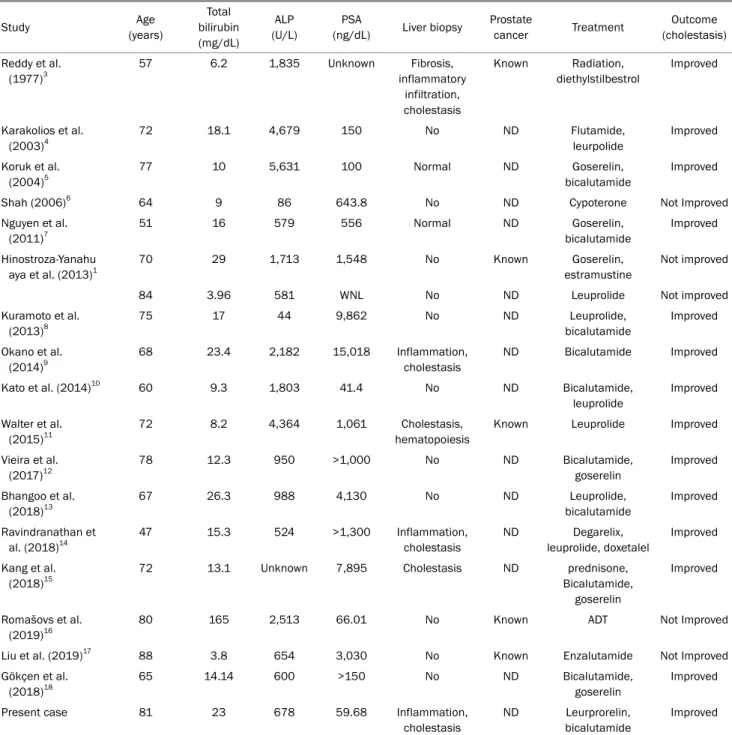
Table 2. Summary of Cases of Paraneoplastic Cholestasis in Prostate Cancer
Study Age
(years)
Total bilirubin (mg/dL)
ALP (U/L)
PSA
(ng/dL) Liver biopsy Prostate
cancer Treatment Outcome
(cholestasis) Reddy et al.
(1977)3
57 6.2 1,835 Unknown Fibrosis,
inflammatory infiltration, cholestasis
Known Radiation, diethylstilbestrol
Improved
Karakolios et al.
(2003)4
72 18.1 4,679 150 No ND Flutamide,
leurpolide
Improved
Koruk et al.
(2004)5
77 10 5,631 100 Normal ND Goserelin,
bicalutamide
Improved
Shah (2006)6 64 9 86 643.8 No ND Cypoterone Not Improved
Nguyen et al.
(2011)7
51 16 579 556 Normal ND Goserelin,
bicalutamide
Improved
Hinostroza-Yanahu aya et al. (2013)1
70 29 1,713 1,548 No Known Goserelin,
estramustine
Not improved
84 3.96 581 WNL No ND Leuprolide Not improved
Kuramoto et al.
(2013)8
75 17 44 9,862 No ND Leuprolide,
bicalutamide
Improved
Okano et al.
(2014)9
68 23.4 2,182 15,018 Inflammation,
cholestasis
ND Bicalutamide Improved
Kato et al. (2014)10 60 9.3 1,803 41.4 No ND Bicalutamide,
leuprolide
Improved
Walter et al.
(2015)11
72 8.2 4,364 1,061 Cholestasis,
hematopoiesis
Known Leuprolide Improved
Vieira et al.
(2017)12
78 12.3 950 >1,000 No ND Bicalutamide,
goserelin
Improved
Bhangoo et al.
(2018)13
67 26.3 988 4,130 No ND Leuprolide,
bicalutamide
Improved
Ravindranathan et al. (2018)14
47 15.3 524 >1,300 Inflammation,
cholestasis
ND Degarelix,
leuprolide, doxetalel
Improved
Kang et al.
(2018)15
72 13.1 Unknown 7,895 Cholestasis ND prednisone,
Bicalutamide, goserelin
Improved
Romašovs et al.
(2019)16
80 165 2,513 66.01 No Known ADT Not Improved
Liu et al. (2019)17 88 3.8 654 3,030 No Known Enzalutamide Not Improved
Gökçen et al.
(2018)18
65 14.14 600 >150 No ND Bicalutamide,
goserelin
Improved
Present case 81 23 678 59.68 Inflammation,
cholestasis
ND Leurprorelin, bicalutamide
Improved ALP, alkaline phosphatase; PSA, prostate-specific antigen; WNL, within normal limits; ND, newly-diagnosed; ADT, androgen deprivation therapy.
Four days after the second leuprorelin injection, the patient was readmitted due to myocardial infarction and was man- aged with percutaneous coronary intervention. He did not have any hepatobiliary problem during hospitalization and was discharged 12 days later. After 2 months, he suffered a car- diac arrest while working in the field and expired.
DISCUSSION
This is a case of a metastatic prostate cancer patient pre- senting with jaundice and pruritus. Jaundice showed a choles- tatic pattern; however, the etiology was unclear. There was an absence of extrahepatic biliary obstruction. Viral, toxic hep- atitis, and other rare causes were also excluded. Based on the imaging based diagnostic tests, we concluded that choles-
tasis was paraneoplastic jaundice associated with metastatic prostate cancer.
Stauffer’s syndrome is a rare paraneoplastic syndrome, which is characterized by cholestasis, in which the patient may present with pruritus, jaundice, elevated liver enzymes, hepatosplenomegaly without liver metastases, bile duct ob- struction, and other hepatocellular disorders. It disappears when the tumor is controlled.1 This disease entity was first reported in renal cell carcinoma (RCC) by an American gastro- enterologist Maurice H. Stauffer. Prostate cancer, soft tissue sarcoma, pancreatic cancer, bladder cancer, malignant lym- phoproliferative diseases, bronchogenic carcinoma, and gas- trointestinal neuroendocrine tumor have also been reported to be associated with this syndrome. Prostate cancer is the second most common malignancy associated with paraneo- plastic jaundice.2
However, Stauffer’s syndrome has been rarely reported in prostate cancer. A thorough search of medical literature re- vealed only 17 case reports published in the english language (Table 2).1,3-18 Of these, 13 cases were of newly diagnosed prostate cancer, and cholestasis which improved after treat- ment, and five cases where improvement was not seen. There was accompanying distant metastasis in all cases. To the best of our knowledge, this case is the second reported case of prostate cancer with Stauffer’s syndrome in South Korea.
The pathophysiology of Stauffer’s syndrome is unknown.
An association between IL-6 and paraneoplastic manifes- tations has been observed in RCC, including cholestasis, al- though the causality is less well established.2 The association between IL-6 and cholestasis may be mediated by systemic inflammation. Pro-inflammatory cytokines, including IL-6, are involved in the up-regulation of inflammation and inhibition of the expression of the hepatobiliary transporter gene possi- bly accounting for biliary outflow.13
In a study, the anti-IL-6 monoclonal antibody was found to reverse most of the biochemical abnormalities in patients with Stauffer’s syndrome with RCC.19 Kuramoto et al.8 re- ported that the serum IL-6 levels decreased after anti-an- drogen therapy. Unfortunately, IL-6 was not measured in this case. The correlation between the IL-6 level and cholestasis needs further investigation.
Stauffer’s syndrome is characterized by paraneoplastic cho- lestasis, which is rarely seen in prostate cancer. It is neces- sary to consider the possibility of paraneoplastic cholestasis
in cases of prostate cancer with cholestasis of unknown etiology.
REFERENCES
1. Hinostroza-Yanahuaya J, Mon-Mon C, Ortega-Marcos O, Herrero- Berron JC, Ortiz-Libreros M, Vigil-Medina A. Stauffer syndrome and prostate carcinoma, two cases in chronic haemodialysis patients. Nefrologia 2013;33:749-750.
2. Sharma N, Darr U, Darr A, Sood G. Stauffer syndrome: a compre- hensive review of the icteric variant of the syndrome. Cureus 2019;11:e6032.
3. Reddy AN, Grosberg SJ, Wapnick S. Intermittent cholestatic jaun- dice and nonmetastatic prostatic carcinoma. Arch Intern Med 1977;137:1616-1618.
4. Karakolios A, Kasapis C, Kallinikidis T, Kalpidis P, Grigoriadis N.
Cholestatic jaundice as a paraneoplastic manifestation of pros- tate adenocarcinoma. Clin Gastroenterol Hepatol 2003;1:
480-483.
5. Koruk M, Büyükberber M, Savaş C, Kadayifçi A. Paraneoplastic cholestasis associated with prostate carcinoma. Turk J Gastroenterol 2004;15:53-55.
6. Shah SH. Paraneoplastic liver dysfunction in prostate cancer. J Pain Symptom Manage 2006;32:511-513.
7. Nguyen V, Gurney H, van der Poorten D. Paraneoplastic hepatic dysfunction in metastatic prostate cancer: the role of cytokine dysregulation. J Clin Oncol 2011;29:e21-e23.
8. Kuramoto T, Senzaki H, Koike H, et al. Cholestatic jaundice as a paraneoplastic manifestation of prostate cancer. Case Rep Urol 2013;2013:303727.
9. Okano A, Ohana M, Kusumi F. Idiopathic cholestatic jaundice may be a paraneoplastic manifestation of underlying malig- nancy: a case of prostate cancer. Clin J Gastroenterol 2014;7:
278-282.
10. Kato D, Okwara C, Moreland C, Parker A. Hepatic dysfunction as a paraneoplastic manifestation of metastatic prostate adenocarcinoma. J Investig Med High Impact Case Rep 2014;2:
2324709614539927.
11. Walter H, Backus N, Aragon G. Intrahepatic cholestasis in the set- ting of recurrent prostate cancer: a paraneoplastic syndrome.
Am J Gastroenterol 2015;110:S394.
12. Vieira AC, Alvarenga MJ, Santos JC, Silva AM. Paraneoplastic jaundice and prostate cancer. BMJ Case Rep 2017;2017:
bcr2016218001.
13. Bhangoo MS, Cheng B, Botta GP, Thorson P, Kosty MP. Reversible intrahepatic cholestasis in metastatic prostate cancer: an un- common paraneoplastic syndrome. Mol Clin Oncol 2018;8:
609-612.
14. Ravindranathan D, Hitron EE, Russler GA, Xue Y, Bilen MA.
Metastatic prostate cancer manifesting as cholestatic jaundice:
a case report and review of the literature. Case Rep Oncol Med 2018;2018:1809432.
15. Kang MK, Park JG, Lee HJ. Cholestatic jaundice as a paraneo- plastic manifestation of prostate cancer aggravated by steroid therapy. Med Princ Pract 2018;27:197-200.
16. Romašovs A, Puķītis A, Mokricka V, Frolova E. Stauffer's syn- drome in patient with metastatic prostate cancer. Case Rep Urol 2019;2019:9745301.
17. Liu J, Agyapong G, Misra D, Taylor CD, Hirsh DA. A rare case of idio- pathic cholestasis: Clinical conundrums complicating enzaluta- mide therapy in metastatic prostate cancer. Clin Case Rep 2019;7:2068-2073.
18. Gökçen P, Gökçen K, Çakmak E, Gökçe G. Paraneoplastic hyper- bilirubinemia in metastatic prostate cancer and review of the cur- rent literature. Turk J Urol 2018;45:70-72.
19. Blay JY, Rossi JF, Wijdenes J, et al. Role of interleukin-6 in the para- neoplastic inflammatory syndrome associated with renal-cell carcinoma. Int J Cancer 1997;72:424-430.