• 검색 결과가 없습니다.

Surgical Treatment of Post-Infarction Left Ventricular Free Wall Rupture: Three Cases Review

N/A
N/A
Protected

Academic year: 2021

Share "Surgical Treatment of Post-Infarction Left Ventricular Free Wall Rupture: Three Cases Review"

Copied!
5
0
0

로드 중.... (전체 텍스트 보기)

전체 글

(1)

http://dx.doi.org/10.5090/kjtcs.2013.46.5.357 ISSN: 2233-601X (Print) ISSN: 2093-6516 (Online)

Department of Thoracic and Cardiovascular Surgery, Samsung Medical Center, Sungkyunkwan University School of Medicine Received: February 12, 2013, Revised: April 13, 2013, Accepted: April 16, 2013

Corresponding author: Young Tak Lee, Department of Thoracic and Cardiovascular Surgery, Samsung Medical Center, Sungkyunkwan University School of Medicine, 81 Irwon-ro, Gangnam-gu, Seoul 135-710, Korea

(Tel) 82-2-3410-3480 (Fax) 82-2-3410-0089 (E-mail) [email protected]

C

The Korean Society for Thoracic and Cardiovascular Surgery. 2013. All right reserved.

CC
This is an open access article distributed under the terms of the Creative Commons Attribution Non-Commercial License (http://creative- commons.org/licenses/by-nc/3.0) which permits unrestricted non-commercial use, distribution, and reproduction in any medium, provided the original work is properly cited.

Surgical Treatment of Post-Infarction Left Ventricular Free Wall Rupture: Three Cases Review

Hee Moon Lee, M.D., Young Tak Lee, M.D., Ph.D., Wook Sung Kim, M.D., Ph.D., Dong Seop Jeong, M.D., Ph.D., Pyo Won Park, M.D., Ph.D., Kiick Sung, M.D., Ph.D.

Left ventricular free wall rupture (LFWR) is rare, but is one of the most serious complications of myocardial in- farction and is associated with high mortality. Several operative techniques have been attempted, but early diag- nosis and prompt surgical management are crucial for a positive patient outcome. We report three cases of LFWR successfully treated with surgical methods.

Key words: 1. Myocardial infarction 2. Heart rupture 3. Heart ventricles 4. Surgical procedures

CASE REPORTS

Left ventricular free wall rupture (LFWR) is rare but one of the most serious complications of myocardial infarction, and is associated with high mortality. Early diagnosis and prompt surgical management are crucial for a positive patient outcome. We report three cases of LFWR successfully treated with surgical methods.

1) Case 1

A 66-year-old her patient was admitted to the emergency department with chest pain and dyspnea. His initial vital signs were a blood pressure of 94/63 mmHg with a pulse rate of 111 beats/min. Electrocardiographic (ECG) findings showed ST elevation in leads II and III and ST depression in lead V2. A chest X-ray showed increased pulmonary vascular markings suggestive of pulmonary edema. His serum tropo-

nin-I levels were elevated. Echocardiography showed regional wall motion abnormalities of the lateral wall, and the left ventricular (LV) ejection fraction was less than 30%.

Emergency cardiac catheterization showed total occlusion of the mid-portion of the left anterior descending artery (LAD) and 75% focal stenosis of the diagonal branch ostium. There was also total occlusion of the distal left circumflex artery (LCX). Up to 50% diffuse luminal irregularity was observed from the proximal to the distal right coronary artery (RCA).

An intra-aortic balloon pump (IABP) was inserted due to the patient developing cardiogenic shock during cardiac cathete- rization. Three days later, the patient went into cardiac arrest after IABP removal. IABP and extracorporeal membrane oxy- genation (ECMO) were instituted. Echocardiography showed cardiac tamponade, indicating that LFWR had occurred. An emergency operation was performed.

The operation was performed with a median sternotomy

(2)

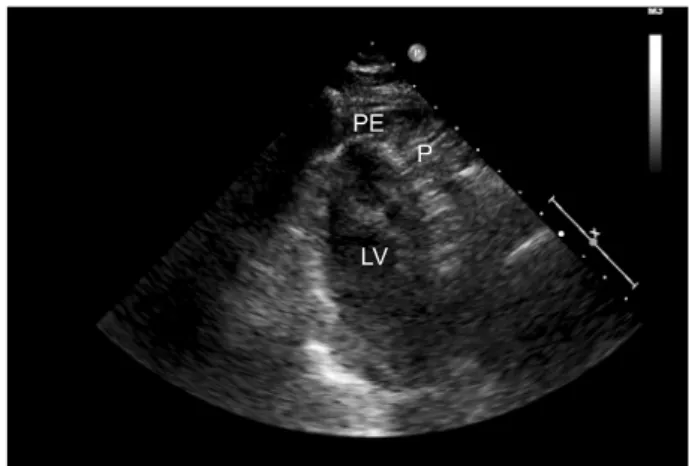
Fig. 1. The echocardiographic finding (apcial 2 chamber view) of the patient 2 showing the psuedoaneurysm (P) of mid antero- lateral wall of left ventricular (LV) wall with moderate amount peri- cardial effusion (PE).

with a cardiopulmonary bypass (CPB) after the heartbeat stopped. The LV rupture site was observed in the LV lateral wall. The rupture site was directly repaired with two pledg- eted 4-0 polypropylene interrupted sutures. Bioglue was ap- plied over the sutured rupture site and bovine pericardium was used to cover the site. Coronary artery bypass grafting was performed with the saphenous vein graft to the LAD, di- agonal branch, obtuse marginal (OM) branch, and proximal RCA. The patient was successfully weaned from the CPB and transferred to the intensive care unit.

On the first postoperative day, bleeding control was performed. On the third postoperative day, ECMO was removed. On the fourth postoperative day, the IABP was removed. However, a brain computed tomography (CT) was performed due to weakness of the left side. The brain CT showed an acute infarction involving the right mid-cerebral artery territory. Anticoagulation was started. Continuous renal replacement therapy was applied from the fifth to seventh postoperative days due to acute renal failure. The patient was extubated on the 10th postoperative day. On the 16th post- operative day, the patient complained of abdominal pain.

Acute cholecystitis was diagnosed. Percutaneous transhepatic gallbladder drainage was performed due to septic shock. The patient was transferred to the department of rehabilitation on the 41st postoperative day and discharged on the 105th post- operative day. The patient has been followed up for 5 years and has not developed any other complications.

2) Case 2

An 88-year-old female patient was admitted to the emer- gency department with loss of consciousness. She had only been treated for hypertension (HTN). Her initial vital signs were stable except that her body temperature had decreased to 32.8°C. Her blood pressure dropped suddenly to 67/23 mmHg. Septic shock was suspected and early goal-directed therapy was started. However, ECG findings showed T-wave inversion in leads V4-6, II, III, and aVF. Her serum tropo- nin-I level was elevated, and echocardiography showed re- gional wall motion abnormalities of the lateral wall and peri- cardial effusion. Emergency cardiac catheterization showed to- tal occlusion of the LCX and OM branches. The echocardiog- raphy was suggestive of a LV pseudoaneurysm and increased

pericardial effusion (Fig. 1). An emergency operation was de- cided upon, with the suspicion of a concealed LV rupture.

The operation was performed with a median sternotomy.

After an inverted Y-shaped pericardiotomy, the hematoma was removed and irrigation was performed. Under CPB, mul- tiple rupture points were observed in the LV lateral wall. The rupture was directly repaired with Prolene 5-0 continuous sutures. Aseptic industrial glue was applied and a Teflon patch was used to cover the rupture site. Furthermore, the bo- vine pericardium was sutured with 5-0 polypropylene running sutures with a 2-cm-long lateral margin. Tisseel (Baxter Healthcare, Deerfield, IL, USA) was injected between the bo- vine pericardial patch and the epicardium to enhance the compressing sutured tear point and to prevent blood leakage.

Tachocomb (Nycomed Pharma, Linz, Austria) was placed over the suture site. The patient was successfully weaned from CPB and transferred to the intensive care unit (ICU).

On the second postoperative day, the patient was extubated.

On the third postoperative day, the patient was reintubated because of desaturation and dyspnea, and extubated again on the fourth postoperative day. On the 10th postoperative day, the patient was transferred to the general ward. The patient was discharged on the 17th postoperative day.

3) Case 3

A 48-year-old male patient was admitted to the emergency

(3)

department with loss of consciousness. Initial vital signs were a blood pressure of 74/52 mmHg with a pulse rate of 124 beats/min. The ECG findings showed lateral wall myocardial infarction. The patient had been treated for diabetes mellitus and HTN without any history of angina pectoris or my- ocardial infarction. His serum troponin-T level was elevated and echocardiography and chest CT showed hemopericardium and LFWR. Emergency cardiac catheterization showed total occlusion of the distal LCX with thrombolysis in myocardial infarction score 0 flow and a thrombus. An IABP was in- serted and an emergency operation was performed.

The operation was performed with a median sternotomy.

The pericardium was dilated, and old blood-colored fluid gushed out when the pericardium was opened. A large amount of hematoma was observed behind the LV side.

Under CPB, after the heartbeat stopped, the hematoma was removed. There was no active bleeding and a definite rupture point. A section of LV free wall about 5×6 cm in size had developed a hematoma, and bloody oozing was observed in the central area of the hematoma. TachoComb was applied to the hematoma, and caution was taken to ensure that any visi- ble margins of the hematoma were covered. Fibrin glue and Surgicel (Ethicon Inc., Sommerville, NJ, USA) were applied for reinforcement. The patient was successfully weaned from CPB and transferred to the ICU.

On the second postoperative day, the IABP was removed without any complications. The patient was transferred to the general ward on the sixth postoperative day. Due to mono- plegia of the right leg, a brain magnetic resonance imaging was performed, which showed multiple embolic infarctions in the bilateral cortical border zone. Warfarin was started.

Follow-up echocardiography showed thinning of the baso- lateral LV to the mid-wall and a focal absence of middle portion of the lateral wall reinforced with Tachocomb, as well as minimal pericardial effusion. The patient was dis- charged on the 18th postoperative day.

DISCUSSION

LFWR is a life-threatening complication of myocardial infarction. The incidence is 2% to 4% after acute myocardial infarction, and mortality has been reported to range from

12% to 20% [1].

Old age, being female, experiencing the first myocardial in- farction or transmural infarction, a high systolic blood pres- sure, an absence of heart failure before rupture, prolonged an- gina, delay of hospitalization, excessive in-hospital physical activity, a lower body mass index, and a longer time to re- perfusion are all reported to be risk factors of LFWR [2].

Early intervention reduces the infarct size and incidences of ventricular rupture [2].

Two types of rupture have been noted based on intra- operative findings. In blow-out type ruptures, a macroscopic tear or defect in the epicardium with free communication be- tween the LV cavity and the pericardial space can be seen; in oozing type ruptures, no macroscopic tears can be detected [3].

Patients can present with any of the following: chest pain, syncope, jugular vein distention, hypotension, arrhythmias, nausea, or pulsus paradoxus. A sudden onset of shock, hemo- dynamic instability due to cardiac tamponade, or cardiac ar- rest can occur. Our patients also each showed a different pre- sentation, specifically, delayed rupture 3 days after acute my- ocardial infarction presenting as cardiac arrest, concealed rup- ture resulting in pseudoaneurysm and misdiagnosis as septic shock, and an oozing type rupture accompanied by embolic stroke and altered mental state.

Echocardiography is the diagnostic method of choice for LFWR. A localized pericardial effusion over the infarcted akinetic area is the most common echocardiographic finding in cases of LFWR. Echogenic ‘specks’ within the effusion and visible wall defects are other signs of LFWR [4].

Contrast echocardiography is helpful in the direct visual- ization of myocardial tears and in demonstrating the extent of a pseudoaneurysm [5].

The definitive treatment for LFWR is emergency surgical repair. Various operative techniques have been applied, in- cluding pericardial patch placement with biological glue or epicardial sutures, infarctectomy with patch placement and ventricular wall reconstruction, pledgeted sutures without in- farctectomy, and pericardial, Dacron, Goretex, or Teflon patches adhered with biologic glue or sutures [6]. Sutureless techniques include gelatin-resorcin-formalin (GRF glue:

Cardial, Saint-Etienne, France) applied to a bovine pericardial

(4)

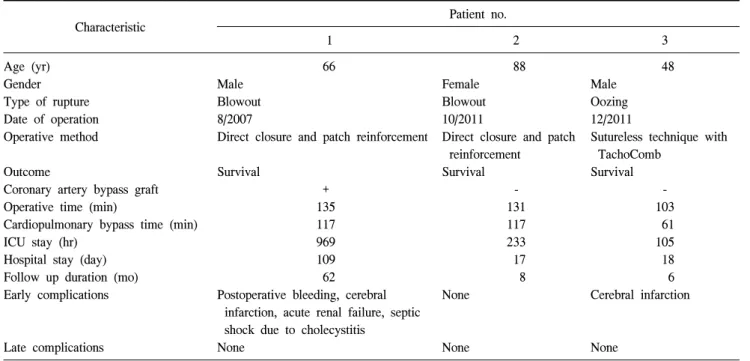
Table 1. Data of the patients who underwent operations for left ventricular free wall rupture

Characteristic Patient no.

1 2 3

Age (yr) Gender Type of rupture Date of operation Operative method

Outcome

Coronary artery bypass graft Operative time (min)

Cardiopulmonary bypass time (min) ICU stay (hr)

Hospital stay (day) Follow up duration (mo) Early complications

Late complications

66 Male

Blowout 8/2007

Direct closure and patch reinforcement

Survival

+ 135 117 969 109 62

Postoperative bleeding, cerebral infarction, acute renal failure, septic shock due to cholecystitis

None

88 Female Blowout 10/2011

Direct closure and patch reinforcement

Survival - 131 117 233 17 8 None

None

48 Male

Oozing 12/2011

Sutureless technique with TachoComb

Survival - 103 61 105 18 6 Cerebral infarction

None

patch (Impra, Tempe, AZ, USA) [7] and collagen fleece with fibrinogen-based impregnation (Tachocomb; Nycomed Pharma, Linz, Austria) [8]. Some authors have suggested that, under CPB, bypassing all major coronary arteries empirically prior to closing the defect is necessary because of the associ- ation of multivessel disease [1].

This paper reviewed two cases of direct closure with bo- vine pericardial patch reinforcement for blowout-type LFWR and one case of a sutureless technique with TachoComb for oozing-type LFWR at Samsung Medical Center (Table 1). All of the methods were successfully performed without any op- erative mortality. The first and third patient had early post- operative complications and the second patient had no early postoperative complications, even though she was of old age and a female patient who had been treated for HTN. The postoperative course of the first patient was the worst because the diagnosis was delayed to the third hospital day and car- diac arrest occurred after IABP removal.

In conclusion, LFWR is rare, but one of the most serious complications of myocardial infarction, and is associated with high mortality. The surgical treatment of LFWR remains challenging. We report three cases of LFWR successfully treated with surgical management without mortality. Early di-

agnosis and prompt surgical intervention can increase patient survival.

CONFLICT OF INTEREST

No potential conflict of interest relevant to this article was reported.

REFERENCES

1. Sutherland FW, Guell FJ, Pathi VL, Naik SK. Postinfarction ventricular free wall rupture: strategies for diagnosis and treatment. Ann Thorac Surg 1996;61:1281-5.

2. Yip HK, Wu CJ, Chang HW, et al. Cardiac rupture compli- cating acute myocardial infarction in the direct percutaneous coronary intervention reperfusion era. Chest 2003;124:565- 71.

3. Sakai K, Sakaki S, Hirata N, et al. Treatment for cardiac rupture following acute myocardial infarction. Kyobu Geka 1993;46:1039-43.

4. Wehrens XH, Doevendans PA. Cardiac rupture complicating myocardial infarction. Int J Cardiol 2004;95:285-92.

5. Waggoner AD, Williams GA, Gaffron D, Schwarze M.

Potential utility of left heart contrast agents in diagnosis of

myocardial rupture by 2-dimensional echocardiography. J

Am Soc Echocardiogr 1999;12:272-4.

(5)

6. Lopez-Sendon J, Gonzalez A, Lopez de Sa E, et al. Diagno- sis of subacute ventricular wall rupture after acute my- ocardial infarction: sensitivity and specificity of clinical, he- modynamic and echocardiographic criteria. J Am Coll Cardiol 1992;19:1145-53.

7. Vohra HA, Chaudhry S, Satur CM, Heber M, Butler R,

Ridley PD. Sutureless off-pump repair of post-infarction left ventricular free wall rupture. J Cardiothorac Surg 2006;1:11.

8. Nishizaki K, Seki T, Fujii A, Nishida Y, Funabiki M,

Morikawa Y. Sutureless patch repair for small blowout rup-

ture of the left ventricle after myocardial infarction. Jpn J

Thorac Cardiovasc Surg 2004;52:268-71.

수치

Fig. 1. The echocardiographic finding (apcial 2 chamber view) of  the patient 2 showing the psuedoaneurysm (P) of mid  antero-lateral wall of left ventricular (LV) wall with moderate amount  peri-cardial effusion (PE).
Table 1. Data of the patients who underwent operations for left ventricular free wall rupture

참조

관련 문서

Relationship between Serial Measurement of Plasma Brain Natriuretic Peptide and Left Ventricular Remodeling or Long-term Prognosis after Acute Myocardial Infarction..

Objectives: This study designed to find the differences of left ventricular (LV) geometry in acute myocardial in- farction (AMI) between ST elevation myocardial infarction (STEMI)

We report a case of acute inferior myocardial infarction complicated with left ventricular free wall rupture that occurred 8 hours after onset of chest pain.. In this case,

Background: Matrix Metalloproteinase (MMP) inhibition has emerged as a potential therapeutic strategy for the left ventricular dilatation that occurs after myocardial infarction.

We report here on a case of successfully managed case of subactue left ventricular free wall rupture after acute myocardial infarction with using the sutureless technique and

Under cardiopulmonary bypass and cardiac arrest with cold blood cardioplegia, coronary artery bypass graft with saphenous vein, pericardial patch cover- ing on the rupture area

Rupture of the left ventricular free wall following mitral valve replacement for mitral stenosis: a cause of complete (fatal) or contained (false aneurysm)

Coronary Flow Reserve in the Remote Myocardium Predicts Left Ventricular Remodeling Following Acute Myocardial Infarction.. Rongchao Cheng, 1 Guoqian Wei, 1 Longhao Yu, 1