• 검색 결과가 없습니다.

Development of health education program model of young children for prevention and management of fine dust based on e-book using QR code

N/A
N/A
Protected

Academic year: 2021

Share "Development of health education program model of young children for prevention and management of fine dust based on e-book using QR code"

Copied!
9
0
0

로드 중.... (전체 텍스트 보기)

전체 글

(1)

Development of health education program model of young children for prevention and management of fine dust based on

e-book using QR code

Rae-Eun Kim

1

, Sang-Mee Koo

2*

1

Professor, Department of Gifted Child Care and Education, U1 University

2

Professor, Department of Nursing, U1 University

미세먼지 예방 및 관리를 위한 QR 코드 활용의 e-book 기반 유아건강교육 프로그램 모형 개발

김래은

1

, 구상미

2*

1

유원대학교 영재보육학과 교수,

2

유원대학교 간호학과 교수

Abstract This study was to develop the health education program model of young children based on e-book using QR code to prevent and manage fine dust. We developed program to prevent and manage fine dust for young children’ health through in-depth discussions with 2 young children's health experts and 3 young children education experts, and developed the e-book using QR code. The program model for fine dust’s prevention education based on e-book using QR code was verified for suitability as a field adaptation and teaching medium for 5-year old. The results of this study are as follows: First, the program model for fine dust’s prevention education based on e-book using QR code was developed through 3 stages of appreciation activity-central activity-finishing activity. Second, the e-book using QR code is a useful teaching medium applicable to fine dust’s prevention education program. In conclusion, the e-book-based fine dust’s prevention education program using QR code will be used as an appropriate education method for fine dust’s prevention and health management activities in the field of education for young children.

Key Words : Fine dust, Early childhood, E-book, QR code, Prevention program

요 약 본 연구는 영유아 건강을 위한 미세먼지를 예방하고 관리할 수 있기 위해 QR 코드를 이용한 E-book 기반 미세먼지 예방 교육 프로그램 모형을 개발하고자 하였다. 이에 아동건강 전문가 2명과 영유아 교육전문가 3명의 심도 깊은 토론을 통해 미세먼지 예방을 위한 유아건강교육 프로그램 모형을 개발했으며, QR 코드를 이용한 E-book을 개 발하였다. QR 코드를 활용한 e-book 기반의 미세먼지 예방교육 프로그램 모형은 만 5세 유아를 대상으로 현장 적합 성 및 교수매체로서의 적절성을 검증하였다. 연구결과, 첫째, QR 코드를 이용한 E-book 기반 미세먼지 예방 교육 프로그램 모형은 감상활동-핵심활동-마무리활동의 3단계를 거쳐 개발되었다. 둘째, QR 코드를 이용한 E-book은 미 세먼지 예방 교육 프로그램에 적용가능한 유용한 교수매체이다. 결론적으로, 개발된 QR 코드를 활용한 e-book 기반 미세먼지 예방교육 프로그램은 영유아의 미세먼지에 대한 민감성을 높이고, 영유아교육 분야의 미세먼지 예방 및 건강 관리 활동을 위한 적절한 교육방법으로 활용될 것이다.

주제어 : 미세먼지, 영유아, e-book, QR 코드, 예방 프로그램

*Corresponding Author : Sang-Mee Koo([email protected]) Received May 30, 2019

Accepted August 20, 2019 Revised August 9, 2019

Published August 28, 2019

(2)

1. Introduction

In recent years, the concentration of fine dust in the Republic of Korea has increased the public anxiety[1]. The Ministry of the Environment has revised the ‘air quality conservation act’, and since February 2014, the National Institute of Environmental Science has implemented a fine dust forecasting system. Particulate matter are defined as PM10 particles smaller than 10 μm and larger than 2.5 μm, depending on particle size, and PM2.5 particles smaller than 2.5 μ m[2,3]. Previous studies have shown that total mortality increases by 14% and cardiovascular and respiratory mortality increases by 19% every 10g/m3 of PM2.5 concentration. According to the World Hearth Organization(WHO), about 7 million peaple die each year from pollution-related cause from 2012[4].

As a result of investigating the disease burden of Koreans according to fine dust, the disease burden was shown in the order of lung cancer, chronic obstructive pulmonary disease, ischemic heart disease, pneumonia, asthma and premature birth. In addition to these effects, fine dusts have also been reported to affect skin and eye diseases such as atopic dermatitis, hair and scalp damage, and conjunctivitis[5]. The burden of these diseases was greater in infants and elderly than in other ages. As the adverse health effects of fine dusts are known, there is anxiety about the health of young children, which is a vulnerable subject, and this has a great influence on kindergartens where long-term care is provided. young children spend a lot of time on the floor, their metabolism is fast and their respiration rate is high. Because they breathe mainly through the mouth, they do not get caught in the nose and are exposed to the same concentration of particulate matter. In addition, internal organs such as lungs, which are directly affected by fine dust, are more susceptible to infection because they are still growing[6,7].

Under such circumstances, manuals for countermeasures against fine dust are published for adults, and the problem is that there is no countermeasure for young children yet.

The Ministry of Education recommends outdoor activities for at least one hour a day for smooth physical development of children aged 3 to 5 years. Ensuring time and space to play outside is a young child's needs and rights and a key factor influencing their development[8]. It is pointed out that outdoor play takes place in kindergarten or daycare center, but it is done with formal and ceremonial activities. Recently, as the early childhood education programs are developed with indoor play, the proportion of outdoors play is very low. Narrow outdoor play space due to urbanization due to digestion and anxiety about risks, opportunities for outdoor play by young children are gradually being deprived. Environmental factors such as yellow sand and particulate matter that may cause health problems also makes outside play difficult[9,10]. The concentration of fine dust before outdoor activity can be confirmed by the voice recognition function such as SIRI of iPhone, Bixby of Galaxy and so on. However, as the number of days that microscopic dust is visually confirmed by the naked eye is increasing, there is a concern among teachers that they worry about whether or not there will be a day for outdoor play at a later date. The previous studies conducted in Korea have been as follows.

The actual conditions of outdoor play and teacher's perception in fine dust environment[11], parents and teachers' perception of early childhood activities and fine dust[12,13], most of the researches on the change of perception and work change of early childhood teachers due to the fine dust situation are.

Despite the fact that particulate matter was

known to negatively affect the health of young

children, research on preventive education and

management methods is insufficient. We thought

(3)

about ways to increase self-efficacy for early childhood. Self-efficacy is the most influential factor in human behavior change by judging the ability of an individual to successfully perform an action or activity needed to obtain desirable results. Also health awareness and acquired health behavior formed in early childhood can affect adolescent and adult health.

It is difficult to systematically approach education and information because healthcare programs for young children in Korea do not have diverse teaching methods[13]. According to these social needs, efforts to try various teaching-learning methods for health education targeting young children are being tried.

Including a study on developing a health education program for young children in the eco education approach[15], there were the study on the application of health education programs of young children on the field using multimedia[16], and the health education program using the learning cycle And research[17]. Although there were studies to develop a teaching-learning method and program model of health education for young children, there is still a lack of research on a program model with an effective teaching method.

At present, most of the contents of health education in the educational institutions of young children are 'forming habit of cleansing oneself' and 'knowing and practicing how to prevent diseases'. The results of this study are summarized as follows. First, it was found that the most frequently used media were the assimilation/

simultaneous data and the multimedia data.

However, young children faced difficulties in obtaining and producing multimedia data for health education[18].

Therefore, it is an urgent matter to develop educational curriculum and media that can give young children interests and can memorize for a long time. Although there are hand-washing programs using video[19], most of them are

parents or teachers who take care of young children.

This study is a methodological study to develop the fine dust prevention education program for young children and to provide basic data of on-site guidance using e-book. This study was to develop the program model for fine dust’s prevention education based on e-book using QR code of young children.

2. Theoretical background

The factors that should be considered in developing the health education program model of young children are the choice of teaching-learning method suitable for development, namely, teaching strategy and teaching medium. It is necessary to develop teaching-learning methods to help young children understand more realistic causal relationships in health and to lead to changes in actual behavior[20,21].

Recently, studies on health education using multimedia(including e-book) have been actively conducted. The reason that the multimedia is used for health education is that young children go beyond their own cognitive level by utilizing images, images, and voices and perform health promotion activities through rational thinking process based on health information[22]. Young children are more interested in the multimedia itself, so they learn better[23]. The multimedia provides visual and audio information in a short period of time, which helps young children to learn factual information quickly and iterative learning is possible[24]. In addition, multimedia-based instruction helps to indirect experience by providing facts and information about health problems that are difficult to experience directly, and the effectiveness of simulation is effective to explain the causal relationship of complex health problems[25].

The effect of health education using multimedia

(4)

is not simply based on the use of multimedia, but on effective teaching and learning methods.

Therefore, in order to maximize the merits of multimedia and to develop a program model that fits the purpose of health education, e-book is considered to be most effective considering the development level of young children. Nevertheless, little was known about the effects of the activities of health activities using picture books on health awareness and health promotion of young children[26].

Recently, the QR code has greatly contributed to the smartization of the educational environmnet in that it can be used not only for efficient work processing[27] but only as a teaching medium that can over some physical and spatial constraints of existing educational materials. Many previous studies have applied QR codes to various educational fields such as science, mathematics, art, and technology. S. M.

Lee(2012)[28] found that the use of QR codes in science subjects had a positive effect on students' interests and grades. S. H. Hyun (2013)[29]

suggested that the use of video showing how to draw parabolic curves using QR codes in the mathematics department affects students' interest in mathematics activities. A. R. Kim(2012)[30]

created a portfolio using QR codes in art subjects, and exhibited and evaluated them to increase students' participation in class and to actively exhibit and appreciate works. In addition, researches on the practical use of QR codes are conducted in various subject areas, including the study of making and using pre-education materials for field experience learning[31], and the use of QR codes in electronic textbooks[32].

For international studies, the QR code adopted in the ODCRE cooking teaching-learning model developed in this study suggests that there is a great value in the field of young children education as a teaching and learning tool[33].

Despite the fact that QR codes are being used in the education field, studies on applying QR codes

to children's health education and literature education are currently inadequate.

3. Research model and hypothesis

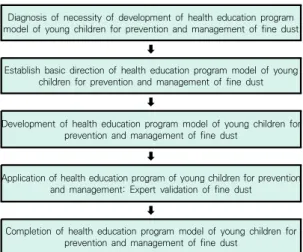
In this study, the process of developing health education program model of young children for fine dust prevention and management is shown in Fig. 1.

Diagnosis of necessity of development of health education program model of young children for prevention and management of fine dust

󰀻

Establish basic direction of health education program model of young children for prevention and management of fine dust

󰀻

Development of health education program model of young children for prevention and management of fine dust

󰀻

Application of health education program of young children for prevention and management: Expert validation of fine dust

󰀻

Completion of health education program model of young children for prevention and management of fine dust

Fig. 1. Procedure for development of program model

The process for developing an early childhood health education program model is as follows.

First, we diagnosed whether it is necessary to develop early childhood health education program model for fine dust prevention and management, set the basic direction of program. Before developing the educational model, two early childhood education specialists and two child nursing professionals gathered and discussed several times.

We developed a early childhood health education

model and proved that 3 early childhood

education specialists and 2 children’s health

specialists are appropriate for young children. In

order to evaluate the appropriateness of program

contents and operation methods, experience of

lectures and research related to health of one

(5)

child, one kindergarten director with more than 10 years field work experience, two professors of early childhood education department The contents validity was verified by two professors of the nursing department with many. Finally, we completed the program model for early childhood education. This study presented a research plan for the purpose, content, scope, method, and contents of research. Afterwards, it was approved by the University of IRB and ethical considerations were made throughout the research process. For the participation of young children, the purpose and the procedure of this study were explained to the presidents of Y kindergarten, kindergarten teachers and health teachers.

The hypotheses we would like to examine in this study are as follows.

Hypothesis 1. What is the health education program model of young children based on e-book using QR code to prevent and manage fine dust?

Hypothesis 2. What is instructional media based on e-book using QR code to prevent and manage fine dust of young children?

4. Results

4.1 Development of program model for prevention education of fine dust based on e-book using QR code

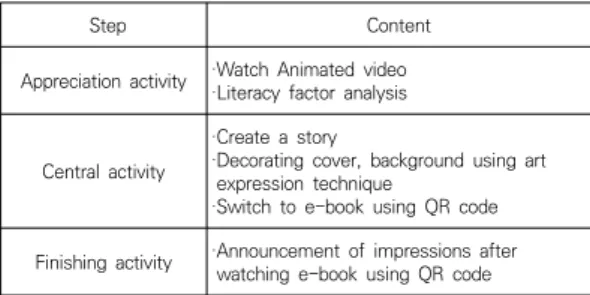
The model of health education program of young children for prevention and management of fine dust applying e-book was conducted with integrated representation activities(language, music) centering on creativity factors. Table 1 shows the health education program model of young children based on e-book using QR code to prevent and manage fine dust. The development process of health education program model for

prevention and management of fine dust based on e-book using QR code is to analyze the literary elements included in the animation after watching the animation related to young children and particulate matter in the introducing impression activities. In this activity, we build story contents with young children and use various art expressive techniques based on the stories to decorate the cover story and background of young children's books. We converted the storybooks into e-books, watched them all together in the finishing activities, and proceeded to present their testimonies.

Step Content

Appreciation activity ·Watch Animated video ·Literacy factor analysis Central activity

·Create a story

·Decorating cover, background using art expression technique

·Switch to e-book using QR code Finishing activity ·Announcement of impressions after

watching e-book using QR code

Table 1. The program model for prevention education of fine dust based on e-book using QR code

4.2 Development and application of program for prevention education of fine dust based on e-book using QR code

As shown in Table2, a variety of early childhood health education program activities for prevention and management of fine dust carried out large group and story sharing activities under the name of 'What actions can beat fine dust?'.

As for the activity contents, we talked about

various particulate matter prevention methods

and behaviors which were not so, and proceeded

to O and X quiz with children to see which

method was the correct prevention method. The

second activity is to engage in art and outdoor

play as a 'fine dust prevention campaign'. The

third activity is the activity to share stories with

fairy tales as 'Make a fine dust prevention fairy

tales'. It is an activity to make children's fairy

(6)

tales and convert them into e-books and enjoy them.

Session Topic Activities

1 What actions can beat fine

dust?

Large group story sharing.

Discuss various fine dust prevention and

dust prevention activities and talk with them.

2 Let's do a fine dust prevention campaign.

Large group Linking art and outdoor after making a sign play

about the use of public transportation

among the fine dust prevention methods.

we take a walk near the kindergarten at the time of outside play and carry out a campaign with a

sign

3 Make a fine

dust prevention fairy tale.

Small group sharing stories.

We try to create a fairy tale with the theme of fine dust prevention, make a fairy tale book, convert it into an

e-book, and enjoy it.

Table 2. The Activities of program for prevention education of fine dust based on e-book using QR code

4.3 Development and application of e-book using QR code

After watching the animated images related to young children and fine dust in the introduction activity using the animation of 'Wizard of Oz:

Dorothy Returned', he performed an analysis of the literary elements included in the animation.

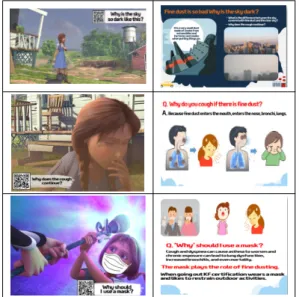
The contents of the story together with the children were used, and various art expressive techniques were used based on the content to decorate the cover and background of the fairy tale book, and to converge literature and art into e-book. The contents of the e-book using the first QR code are as follows. If QR code is recognized in the scene of the question 'Why is the sky so dark?', 'Why should I have a cough?' And 'Why should I use a mask?', You can check the information and contents of the question through e-book can be. An example of applying an e-book using QR code is shown in Fig. 2.

Fig. 2. Applying the e-book using QR code

5. Conclusion

The purpose of this study was to develop the health education program model of young children based on e-book using QR code to prevent and manage fine dust and, instructional media based on e-book using QR code to prevent and manage fine dust of young children.

The greatest contribution of this study is that it can be directly utilized in the field by being helpful to the educating teacher. Providing interest by using e-books for early childhood who are curious and prefer new experiences, and of course, in order to be able to solve their own problems by presenting the situation of virtual problems, It turns out that it is an effective teaching method.

In this study, the literature is reviewed and the

consultation and the verification of the experts

are reflected to fully convey the concepts and

situation - related actions required for

particulate matter prevention and management

in various ways. It was difficult for young

children who were subjects of education to be

too young to investigate their satisfaction or to

(7)

reflect their needs.

The limitations of this study are as follows. In order to measure the effectiveness of the lesson, it is desirable to measure the accuracy of fine dust prevention and management, but there was a limit to the difficulty of observation. In addition, we should measure changes in knowledge of prevention and management in fine dust, but there are limitations in not measuring the effectiveness of less-aged classes.

Based on the results of this study, the following suggestions are made. Future research will need to investigate the needs of kindergarten teachers and parents of young children. In addition, it is necessary to develop the educational intervention program for child care teachers and parents by grasping the knowledge and awareness about particulate matter. Recently, there have been educational effects of prevention of fine dust in young children through board games[34]. Future research should also be conducted to verify the educational effects of learners applying e-book based health education program of young children for particulate matter prevention and management. In the era of the fourth industrial revolution, the development of a complex program model that goes beyond integrated education in the field of early childhood education is attracting attention. In the future, it is required to develop a variety of teaching media using various ict media considering age and to develop a convergent program applying it.

In addition, quantitative research on knowledge of fine dust prevention and self-efficacy is proposed to verify the sustainable effect of education.

In terms of academic use of the results of this study, this study will contribute to the development of curriculum and program for early childhood health education that should take into consideration the early childhood health education such as the influence of fine dust as well as the interdisciplinary convergence

of early childhood education. In addition, the E-book-based early childhood health education program model using the QR code developed in this study is used not only for the class that understands fine dust for young children in the early childhood education field, but also for fine teachers and infants. It will be used as a useful teaching material for preventive education and health promotion activities.

REFERENCES

[1] I. B. Oh. (2018). Association between particulate matter concentration and symptoms of atopic dermatitis in children living in an industrial urban area of South Korea. Environmental Research, 2018(2) , 462-468.

DOI : 10.1016/j.envres.2017.10.030

[2] Ministry of Environment of Korea. (2014). Knowing particular matter right: protect your health from particulate matter by checking forecast and following basic safety tips.

http://webbook.me.go.kr/DLi-File/091/019/003/55675 14.pdf

[3] Ministry of Environment of Korea. (2017). Comprehensive measures to reduce particulate matter.

http://www.me.go.kr/issue/finedust4.

[4] H. Y. Pak & Y. S. Pak, (2019). The effects of pm10 on the hospital admission of patients with respiratory disease in Seoul, Korea. Journal of Convergence for Information Technology, 9(6) , 194-210.

[5] J. H. Im. (2016). Health and particulate matter. Urban Affairs 51, 32-35.

[6] J. Choi & Y. Lee. (2015). A study on the impact of PM 2.5 emissions respiratory disease. Environmental policy and administration, 23(4), 155-172.

[7] Q. Deng, C. Lu, Y. Li, K. Sundell & D. Norback.

(2016). Exposure to outdoor air pollution during trimesters of pregnancy and childhood asthma, allergic rhinitis, and eczema. Environmetal Research 150 ,119-127. DOI:10.1016/j.envres.2016.05.050 [8] V. S. Chithra & S. N. Madanayak. (2018). source

identification of indoor particulate matter and health risk assessment in school children. Journal of Hazardous, Toxic, and Radioactive Waste, 22(2), 162-176.

DOI:10.1061/(ASCE)HZ.2153-5515.0000390

[9] R. L. Mackett & J. Paskins. (2008). Children’s physical activity: The contribution of playing and walking.

Children and Society, 22(5), 345-357.

(8)

DOI:10.1111/j.1099-0860.2007.00113.x|

[10] N. B. Cohen & E. Elliot. (2011). Young children and educator engagement and learning outdoors: A basis of rights-based programming. Early Education and Development, 22(5) , 757-777.

DOI:10.1080/10409289.2011.596460

[11] H. Y. Kwak & Y. Y. Jeon. (2018). An analysis of teachers’ perception of the obstacle factors, teacher’s roles, and the level of activities by area in outdoor play. The Korea Society for Children’s Media, 17(1) , 321-349. DOI:10.21183/kjcm.2018.03.17.1.321 [12] E. S. Kim. (2018). The actual operation status and

teachers' perception of outdoor play for infant class in fine dust environment. Master’s thesis. Paichai University, Daejeon.

[13] J. Y. Han. (2017). Parents and teacher's perception of childhood forest experience activities and fine Dust.

Master’s thesis. Kyonggi University, Suwon.

[14] H. O. Lee. (2007). Original articles: Health nutrition education program curriculum and the effects for preschool children. Korea Food and Drug Administration, 20(2), 202-208.

[15] M. R. Kweon. (2007). Seeking the meaning of the health care program for young children -on the view of eco early chidhood education. The Journal of Eco-Early Childhood Education, 6(1) , 65-84.

[16] E. Y. Yoo. (2011). A study of the development and effects of a multimedia based health education program for young children. Doctor's thesis.

Chung-Ang University, Seoul.

[17] J. M. Kim & J. Y. Ahn. (2016). Effect of health education program using learning cycle on children’s health perception, knowledge, and practice. The Journal of Korea Open Association for Early Childhood Education, 20(6) , 379-403.

[18] E. S. Kim. (2015). Analysis of picture book contents and teacher's actual condition on the utilization of picture books for young children health education.

Master’s thesis. Hanyang University, Seoul.

[19] H. S. Lim & I. S. Kwon. (2019). Development and Effects of a hand-washing Program using role-playing for preschool children. Child Health Nurs, 25(2), 123-132.

DOI: 10.4094/chnr.2019.25.2.123

[20] A. K. Park. (2007). Food safety education development based on standard educare curriculum. Korean Journal of Child Education and Care, 7(4), 83-101.

[21] S. Tousman et al. (2007). Evaluation of a hand-washing program for 2nd-graders. Journal of School Nursing, 23(6), 342-348.

[22] T. Y. Chuang & W. F. Chen. (2009). Effect of computer-based video games on children: An experimental study. Educational Technology &

Society, 12(2), 1-10.

[23] T. Baranowski, R. Buday, D. Thompson & J.

Baranowski. (2008). Playing for real video games and stories for health-related behavior change. American Journal of Preventive Medicine, 34(1), 74-82.

[24] E. G. Scheffield & J. A. Hudson. (2006). You must remember this: Effects of video and photograph reminders on 18-month-olds' event memory. Journal of Cognition and Development, 7(1), 73-93.

[25] P. Bauer & J. Mandler. (1990). Remembering what happened next: very young children's recall of event sequences. In R. Fivush & J. A. Hudson(Eds.), Knowing and remembering in young children. (pp. 9-29). New York, NY: Cambridge University Press.

[26] S. Y. Park, S. O. Hong & G. H. Kim. (2016). Effects of picture-book based health life activities on cognition of children's health and health promotion. Journal of Children's Literature and Education, 17(1), 24-43.

[27] S. D. Kim & J. K. Lee. (2012). Efficient customer reception policy with QR code, Journal of Convergence for Information Technology, 2(1), 1-9.

[28] S. M. Lee. (2012). Application and revitalization of science class using UBL. Master’s thesis. Sookmyung Women’s University, Seoul.

[29] S. H. Hyun. (2013). A study of mathematics teaching-learning using smart learning. Master’s thesis. Sungshin Women's University, Seoul.

[30] A. R. Kim. (2012). A Study on application of smart learning methods in art education. Master’s thesis.

Sookmyung Women’s University, Seoul.

[31] J. S, Yu & S. J. Kim. (2012). Educational possibilities the use of QR codes in prior educational materials for field trips with theme. Journal of Digital Convergence, 10(10) , 439-445.

[32] J. H. Park & D. W. Park.(2011). Suggestion of new educational model with smart phone & QR code:

integration of mobile device, QR code and the book-type textbooks. Journal of the Korea Society of Computer and Information, 16(10) , 155-164.

[33] H. J. Kim, M. H. Kim & M. S. Song. (2018). Development of the ODCRE cooking teaching-learning model using code to promote creativity of 5-year-old young children. International Journal of Engineering &

Technology, 7(23) . 1264-1268.

[34] S. K. Heo, D. L. Lee & B. P. Kyung.(2016). A study on the educational effectiveness of fine dust particle preventive board game developed for children.

Journal of Korea Game Society, 16(6) , 101-110.

(9)

김 래 은(Rae-Eun Kim) [정회원]

․ 2011년 8월 : 경성대학교 생활문화학 과 아동보육전공(이학박사)

․ 2013년 8월 : 경성대학교 유아교육학 과(교육학박사)

․ 2016년 4월 ∼ 현재 : 유원대학교 영 재보육학과 조교수

․ 관심분야 : 유아교육, 창의성교육, 교수 매체

․ E-Mail : [email protected]

구 상 미(Sang-Mee Koo) [정회원]

․ 2015년 8월 : 대전대학교 간호학과(간 호학 박사)

․ 2015년 3월 ~ 현재 : 유원대학교 간호 학과 조교수

․ 관심분야 : 영유아 건강, 여성건강

․ E-Mail : [email protected]

수치

Fig.  1.  Procedure  for  development  of  program  model
Table  1.  The  program  model  for  prevention  education  of fine dust based on e-book using QR code
Table 2. The Activities of program for prevention education of  fine  dust  based  on  e-book  using  QR  code

참조

관련 문서

The purpose of this study was to investigate the effects of a disability awareness program on improving the attitudes of regular elementary school

The objective of this study is to understand the effects of walking activity using fairy tales on the peer competence and emotional intelligence of

The purpose of this study is to investigate the effect of the employment education program implemented by the Gwangju Education Office Employment Support

Therefore, the purpose of this study is to study on the special education teachers’ state of first aid education completion, knowledge level and abilities

The purpose of this study is to develop and apply a program that can develop and expand SW-based AI education by proving the effectiveness of

Moreover, it describes how this education should be oriented with referring to studies and literature based on the understanding of reading book

Objectives: The purpose of this study was to investigate the relationship between mental health and experience of falling in some local elderly people using the 2013

The purpose of this study was to examine the effects of a swimming program for 12 weeks on health-related physical fitness and growth hormone in