• 검색 결과가 없습니다.

CdSe-sensitized Photoelectrochemical Solar Cell Prepared by Spray Pyrolysis Deposition Method

N/A
N/A
Protected

Academic year: 2021

Share "CdSe-sensitized Photoelectrochemical Solar Cell Prepared by Spray Pyrolysis Deposition Method"

Copied!
6
0
0

로드 중.... (전체 텍스트 보기)

전체 글

(1)

DOI:10.5229/JKES.2011.14.2.104

− 104

CdSe-sensitized Photoelectrochemical Solar Cell Prepared by Spray Pyrolysis Deposition Method

Sang Hyuk Im

†,

*, Yong Hui Lee

, and Sang IL Seok*

KRICT-EPFL Global Research Laboratory, Advanced Materials Division, Korea Research Institute of Chemical Technology, 100 Jang-Dong, Yuseong-Gu, Daejeon 305-600, Korea

These authors have equally contributed to this work

(Received May 18, 2011 : Accepted May 30, 2011)

Abstract : We fabricated CdSe-sensitized photoelectrochemical solar cell by depositing CdSe nanoparticles on nanoporous TiO

2

(np-TiO

2

) via spray pyrolysis deposition method. By adjusting the amount of CdSe-sensitizer deposited on np-TiO

2

, we can fabricate an efficient CdSe-sensitized solar cell ( η = 3.0% under 1 sun irradiation) in polysulfide liquid electrolyte.

Keywords : CdSe, Spray pyrolysis deposition, Solar cell, Polysulfide, TiO

2

1. Introduction

Recently inorganic semiconductor-sensitized photoelectrochemical solar cells have been con- sidered as one promising alternative of conventional dye-sensitized solar cells (D-SSCs) since Grätzel et al.

1)

have reported a highly efficient solar cell with ~11%

of power conversion efficiency under simulated light of 100mW/cm

2

AM 1.5G. Particularly, metal chalcogenide- based inorganic semiconductors such as CdS, CdSe, PbS and PbSe have been intensively studied to use them new sensitizers replacing conventional Ru-dyes or organic dyes because the metal chalcogenide particles have stronger absorption than dyes, rapid charge separa- tion by larger intrinsic dipole moment, convenient bandgap control by quantum confinement effect, multiple exciton generation and good stability.

2)

Among the metal chalcogenide semiconductors, the CdSe has been recog- nized as an ideal sensitizing material for solar cells because it can fully exploit visible light owing to its bulk energy bandgap of 1.74 eV.

3)

The inorganic semiconductor-sensitized photoelectro- chemical solar cells have been initiated by mimicking the device architecture of conventional D-SSCs just replacing the conventional organic sensitizers with inor- ganic semiconductors. Until now, the device efficiency

of inorganic semiconductor-sensitized solar cells have been revealed lower than the efficiency of conventional D-SSCs and the exact operation mechanism has been still under investigation. The relatively poor device performance might be originated from i) the difficulty of full coverage of whole nanoporous TiO

2

(np-TiO

2

) surface with inorganic semiconductors, ii) the severe recombination between semiconductor sensitizers and electrolytes, and iii) the lack of controlling surface traps at interfaces.

To assemble inorganic semiconductors on np-TiO

2

surface, various assembling methods such as linker molecule assisted deposition,

4)

chemical bath deposition (CBD),

5)

successive ionic layer adsorption and reaction (SILAR),

6)

and spray pyrolysis deposition (SPD)

7,8)

have been developed. Among the assembly methods, the SPD method seems hold some advantage for the cost-effective mass production because the SPD method does not conta- minate a reaction bath and is readily commercializable process. Therefore, here, we chose the SPD method to deposit CdSe inorganic semiconducting sensitizer on np- TiO

2

film and fabricated CdSe-sensitized photoelec- trochemical solar cells.

2. Experimental

2.1 Preparation of TiO

2

nanoparticles

TiO

2

nanoparticles for SPD process were synthesized

*E-mail: [email protected](S.H. Im)

[email protected](S.I. Seok)

(2)

by a precipitation method. The 0.5 M TiCl

4

(Titanium (IV) chloride, 99.9%, Aldrich) aqueous solution and NH

4

OH (Ammonium hydroxide solution, Samchun Pure Chemicals, 28.0%~30.0%) was simultaneously dropped into 100 mL deionized-water while keeping the pH to 3~4. After finishing dropping the solutions, we adjusted the pH of precipitated solution to 9.0 by adding additional NH

4

OH with vigorous stirring. The solution was then heated at 90

o

C for 3h with stirring and filtered.

To remove the chloride impurity, the precipitate was washed several times with fresh deionized water and dried for 12 h in a dryer. To make a crystalline TiO

2

, the dried TiO

2

powder was calcined at 500

o

C for 3 h in a furnace. The particle size and the BET area were 30~40 nm and 44~45 m

2

/g, respectively. The crystalline phase of the calcined TiO

2

powder was confirmed to anatase from XRD. TiO

2

paste was prepared as described elsewhere.

9)

2.2 Deposition of CdSe on np-TiO

2

by SPD method

A 50-nm-thick TiO

2

blocking layer (bl-TiO

2

) was deposited on fluorine-doped tin oxide (FTO) glass (TEC15, USA) by SPD using 0.02M solution of titanium diisopropoxide bis(acetylacetonate) to prevent direct contact of FTO electrode and electrolyte. The ca.

6 µ m-thick np-TiO

2

film was then screen printed on the bl-TiO

2

/FTO substrate and was sintered at 500

o

C for 1 h. A 0.2 M sodium selenosulfite was prepared by mixing 7.9 g of selenium powder and 0.5 M sodium sulfite aqueous solution (500 mL) and subsequent heating at 70

o

C for 10 h with a magnetic stirring.

The reactant was then filtered to remove tiny amount of unreacted selenium powder. A 0.2 M cadmium chloride solution (500 mL) was then mixed to 0.2 M of sodium selenosulfate solution (500 mL) and finally the pH of this solution was adjusted to 12.6 by ammonium hydroxide solution to get stable clear solution. This pH-controlled CdSe precursor solution was then sprayed on the np-TiO

2

film that was preheated to 450

o

C. 1.0 mL of a precursor solution was sprayed for 2s and left for 5s to form crystalline CdSe particles in one cycle. Through one cycle spray, ca. 12 mg of CdSe was deposited on the film. To increase the amount of deposited CdSe sensitizer, we repeated the process cycles 5, 10, and 15 denoted by SPD5, SPD10, and SPD15, respectively. To remove the sodium sulfate

formed by SPD, we rinsed it with deionized water at 60

o

C for 1 h.

2.3 Fabrication of CdS-sensitized photoelectro- chemical solar cells

A Pt-coated counter electrode was prepared by dropping 5 mM H

2

PtCl

6

in i -propanol onto FTO glass and heating it up to 400

o

C for 20 min. The cells were assembled by sandwiching CdSe deposited on the bl-TiO

2

/FTO substrate and Pt-coated counter electrode using a thermal adhesive film (Surlyn, 60 µ m, DuPont).

Methanol/water (7 : 3 v/v) solution containing 0.5 M Na

2

S, 2 M S, and 0.2 M KCl was used as the redox electrolyte.

10)

The electrolyte was injected by vacuum backfilling process and the hole was sealed by a Surlyn film and cover glass. The active area of the photo- electrode was fixed to 0.18 cm

2

.

2.4 Measurements

Photocurrent-voltage (I-V) characteristics were measured under 1 sun irradiation (100 mW/cm

2

AM 1.5 G) from a solar simulator (Newport, Class A, 91195A) by using a Keithley 2420 sourcemeter and calibrated Si reference cell (certified by NREL). For the I-V measurement, we masked all devices. The external quantum efficiency (EQE) was measured using a fully computerized homemade system comprising a light source (300-W Xe lamp, Newport, 66902), monochromator (Newport Cornerstone 260), and multimeter (Keithley 2002).

3. Results and Discussion

3.1 Device structure and morphology

Fig. 1 shows a schematic illustration of SPD method for the deposition of CdSe inorganic sensitizer on np- TiO

2

film. For the spray of CdSe precursor solution, we prepared 0.1 M of cadmium chloride and 0.1 M sodium selenosulfate aqueous solution with controlled pH of 12.6 by ammonium hydroxide solution. The possible chemical reactions involved in SPD process are listed as following:

11,12)

NH

3

+ H

2

O ↔ NH

4+

+ OH

Na

2

SeSO

3

+ OH

↔ Na

2

SO

4

+ HSe

HSe

+ OH

↔ H

2

O + Se

2−

CdCl

2

+ 4NH

3

↔ [Cd(NH

3

)

4

]

2+

+ 2Cl

NH

4+

+ Cl

↔ NH

4

Cl

(3)

[Cd(NH

3

)

4

]

2+

+ Se

2−

↔ CdSe + 4NH

3

(aq)

Here, we sprayed the CdSe precursor solution on the pre-heated np-TiO

2

film at 450

o

C. At such high proce- ssing temperature, the CdSe will be formed by the simultaneous reaction of Cd

2+

(derived by thermal decom- position of complex cadmium tetra-amine ions) and Se

2−

(derived by thermal-hydrolysis of sodium seleno- sulfate).

11,12)

From the above reaction, we could expect that the CdSe, Na

2

SO

4

and NH

4

Cl will be remained as a final solid product. However, the NH

4

Cl should be sublimed at the processing temperature (450

o

C) due to its low sublime temperature of 340

o

C.

13)

In addition, the excess sulfite ions from sodium sulfite are likely to react with oxygen and then are converted into sulfate ions.

11,12)

Therefore, the CdSe and Na

2

SO

4

are left as final product on np-TiO

2

film. The solid Na

2

SO

4

hinders the growth of CdSe into bigger particles and con- sequently reduces the size of produced CdSe but it may deteriorate the performance of photoelectrochemical solar cell due to hinder the regeneration of holes in CdSe by electrolyte. Finally, the Na

2

SO

4

should be removed from the CdSe-sensitized photoelectrochemical cell to obtain better power conversion efficiency. Accordingly, we rinsed the as-deposited CdSe/np-TiO

2

film with de- ionized water at 60

o

C for 1 h for the further uses.

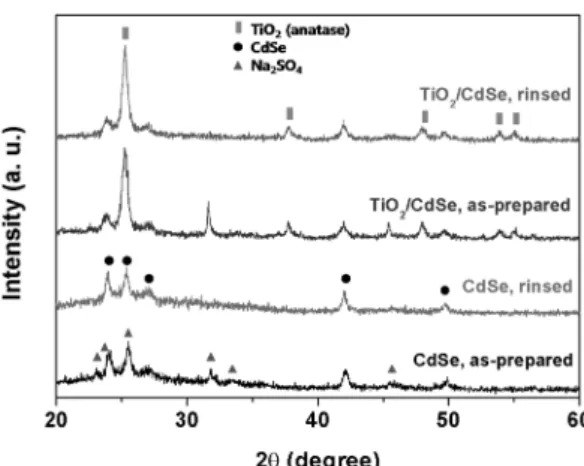
Fig. 2 shows the typical XRD patterns confirming the CdSe, Na

2

SO

4

, and TiO

2

peaks. The XRD patterns clearly indicate that the Na

2

SO

4

can be removed from the as-deposited CdSe/np-TiO

2

film just by simple rinsing with de-ionized water. The XRD pattern of TiO

2

shows the np-TiO

2

is pure anatase phase and the produced CdSe by SPD method does not have any detectable oxide form such as CdO.

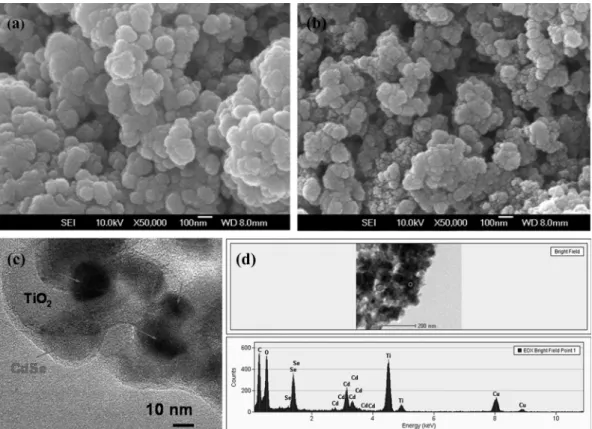
To check the macroscopic morphologies of CdSe/np- TiO

2

film, we observed SEM images of bare np-TiO

2

film and CdSe/np-TiO

2

film as shown in Fig. 3(a) and (b). Fig. 3(b) shows that small CdSe nanoparticles are deposited on np-TiO

2

surface by SPD method because additional small particles appear on the TiO

2

surface.

The formation of small CdSe nanoparticles might be attributed to the presence of solid Na

2

SO

4

in the deposited CdSe during SPD process. To observe morphology of CdSe/np-TiO

2

in detail, we analyzed TEM image as shown in Fig. 3(c). This image displays that the size of deposited CdSe nanoparticles on np-TiO

2

surface is polydispersed which might exploit more broadband spectrum of light compared to monodispersed CdSe quantum dots. The EDX spectrum in Fig. 3(d) confirms the formation of CdSe nanoparticles on np-TiO

2

film.

Fig. 2. XRD patterns of as-prepared CdSe, rinsed CdSe with water, as-prepared CdSe/TiO

2

, and rinsed CdSe/

TiO

2

with water.

Fig. 1. Schematic illustration of SPD process.

(4)

Fig. 4 shows the device performance of CdSe- sensitized photoelectrochemical solar cell prepared by SPD method. All device performances are summarized in Table 1. The current density-voltage (J-V) curves under 1 sun irradiation according to the spraying number of CdSe precursor indicate that the device performance

Fig. 3. SEM images of (a) np-TiO

2

, (b) CdSe/np-TiO

2

, (c) TEM image of CdSe/np-TiO

2

, and (d) EDX spectrum of CdSe/TiO

2

.

Fig. 4. (a) J-V curves and (b) EQE spectra of CdSe-sensitized photoelectrochemical solar cells.

Table 1. The summary of device performance

J

sc

(mA/cm

2

) V

oc

(V) F.F (%) η (%)

SPD5 11.5 0.54 41.2 2.5

SPD10 16.0 0.57 33.0 3.0

SPD15 14.3 0.59 23.7 1.9

(5)

increases with the spraying number of CdSe precursor (SPD5 → SPD10) owing to the increased light harvesting efficiency and further spray of CdSe precursor (SPD15) deteriorates the overall device performance. The EQEs in Fig. 4(b) are consistent with the short circuit current density (J

sc

) of each device. Practically, the generated electrons in CdSe-sensitizer by simulated light are injected to the conduction band of TiO

2

and the generated holes in CdSe are simultaneously reduced by the redox couple.

The oxidized redox couple is then diffused to Pt counter electrode and regenerated by the electrons supplied from external circuit. Therefore, the J

sc

is dependent on the combination of light harvesting efficiency, charge injection efficiency, and charge collection efficiency. As the spray number of CdSe precursor increases from SPD5 to SPD10, the amount of deposited CdSe on np-TiO

2

also increases while absorbing more light. Therefore, the number of generated charge carriers in CdSe (SPD10) by the external light are increased and consequently the transferred number of charge carriers into both np-TiO

2

and redox couple are also increased if the charge transfer efficiency and charge collection efficiency are maintained.

The performance improvement of SPD10 ( η = 3.0%) compared to SPD5 ( η = 2.5%) was mainly ascribed to the improved J

sc

(11.5 → 16.0 mA/cm

2

) although fill factor is deteriorated (41.2 → 33.0%). The slightly increased open circuit voltage (Voc: 0.54 0.57V) might be attributed to the increased number of charge carriers which shift the qusi-Fermi level of np-TiO

2

upward. The deterioration of fill factor might be derived from the aggregated CdSe nanoparticles which hinder the efficient transport of generated charge carriers either np- TiO

2

or redox couple. The further spray of CdSe precursor (SPD15) may increase the light harvesting efficiency but the charge transfer and collection efficiency seem to be deteriorated because both J

sc

(14.3 mA/cm

2

) and fill factor (23.7%) are decreased due to the over aggregated CdSe nanoparticles. Therefore overall power conversion efficiency are also decreased ( η = 1.9%).

4. Conclusion

We successfully prepared the CdSe-sensitized photoelectrochemical solar cell by depositing CdSe nano- particles on np-TiO

2

film via cost-effective SPD method.

The deposition of CdSe on np-TiO

2

film by SPD of CdSe precursor left a solid Na

2

SO

4

as by-product which

helps the formation of small CdSe nanoparticles on np-TiO

2

surface. Therefore, further rinsing process is required to remove the Na

2

SO

4

. By adjusting the repeated number of SPD, we could fabricate CdSe-sensitized photoelectrochemical solar cell having 3.0% of overall power conversion efficiency under 1 sun illumination.

Acknowledgement

This study was by the Global Research Laboratory (GRL) Program supported through the National Research Foundation of Korea funded by the Ministry of Education, Science and Technology and KRICT 2020 program.

References

1. B. O’Regan and M. Grätzel, ‘A low-cost, high-efficiency solar cell based on dye-sensitized colloidal TiO

2

films’

Nature , 353 , 737 (1991).

2. A.J. Nozik, ‘Multiple exciton generation in semiconductor quantum dots’ Chem. Phys. Lett. , 457 , 3 (2008).

3. S.H. Im, Y.H. Lee, S.I. Seok, S.W. Kim and S.-W. Kim,

‘Quantum-dot-sensitized cells fabricated by the combined process of direct attachment of colloidal CdSe quantum dots having ZnS glue layer and spryay pyrolysis deposition’

Langmuir , 26 , 18576 (2010).

4. K. Tvrdy and PV. Kamat, ‘Subsrate driven photochemistry of CdSe quantum dot films : Charge injection and irreversible transformations on oxide surfaces’ J. Phys.

Chem. A , 113 , 3765 (2009).

5. Y. Itzhaik. O. Niitsoo. M. Page and G. Hodes, 2009,

‘Sb2S3-sensitized nanoporous TiO2 solar cells’ J. Phys.

Chem. C , 113 , 4254 (2009).

6. H.J. Lee, J. Bang, J. Park, S. Kim and S.-M. Park,

‘Multilayerd semiconductor (CdS/CdSe/ZnS)-sensitized TiO

2

mesoporous solar cells : All prepared by successive ionic layer adsorption and reaction process’ Chem. Mater. ,

22 , 5636 (2010).

7. Y. H. Lee, S. H. Im, J. H. Rhee, J.-H. Lee and S. I. Seok,

‘Performance enhancement through post-treatments of CdS-sensitized solar cells fabricated by spray pyrolysis deposition’ ACS Appl. Mater. Interfaces , 2 , 1648 (2010).

8. J.-Y. Hwang, S.-A. Lee, Y.H. Lee and S.I. Seok, ‘Improved photovoltaic response of nanocrystalline CdS-sensitized solar cells through interface control’ ACS Appl. Mater.

Interfaces , 2 , 1343 (2010).

9. S. Ito, T.N. Murakami, P. Comte, P. Liska, C. Grätzel, M.K. Nazeeruddin and M. Grätzel, ‘Fabrication of thin film dye sensitized solar cells with solar to electric power conversion efficiency over 10%’ Thin Solid Films , 516 , 4613 (2008).

10. Y.-L. Lee and C.-H. Chang, ‘Efficient polysulfide electrolyte

(6)

for CdS quantum dot-sensitized solar cells’ J. Power Sources , 185 , 584 (2008).

11. I. Ezema and R.U. Osuji, ‘Band gap shift and optical characterization of chemical bath deposition CdSSe thin films on annealing’ Chalcogenide Lett. , 4 , 69 (2007).

12. Y.J. Yang and B.J. Xiang, ‘Wet synthesis of nearly

monodisperse CdSe nanoparticles at room temperature’

J. Cryst. Growth , 284 , 453 (2005).

13. S.H. Im, Y.H. Lee and S.I. Seok, ‘Photoelectrochemical solar cells fabricated from porous CdSe and CdS layers’

Electrochim. Acta , 55 , 5665 (2010).

수치

Fig. 2. XRD patterns of as-prepared CdSe, rinsed CdSe with water, as-prepared CdSe/TiO 2 , and rinsed CdSe/
Fig. 4 shows the device performance of CdSe- CdSe-sensitized photoelectrochemical solar cell prepared by SPD method

참조

관련 문서

Regional Innovation Center for the Hydrogen Fuel-Cell and Solar

In this study, 3D PCL scaffolds were fabricated by using notch type nozzle via fused deposition modeling (FDM) to improve the cell adhesion and

These results revealed that TiO 2 NM surface had positive affect on activity of alkaline phosphatase after 15 days cell culturing time... 티타늄은

Green (University of New South Wales), and Reuben Collins (Colorado School of Mines) MRS Bulletin (2008)... World

종류에는 Si 또는 화합물 반도체를 이용하는 무기태양전지와 나노결정산화물 입자 표면에 염료가 흡착된 염료감응형 태양전지(DSSC,Dye Sensitized Solar

Bacterial and yeast plaque on dentures is thought to be an important etiologic factor in the pathogenesis of denture stomatitis. Since these fungi have

Table 8.. tors for particle formation in gas phase and scale-up of the reactor system. They have developed models for droplet and particle dynam- ics and applied to the

In this study, we investigated the surface characteristics of hydroxyapatite film on the micro-pore structured Ti-35Ta-xNb alloys by